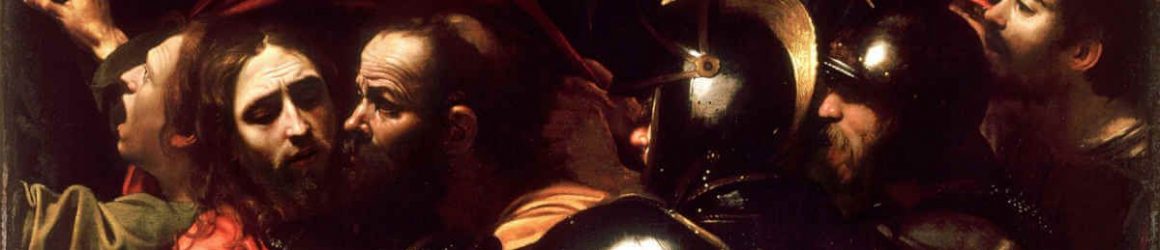

While Catholics acknowledge the importance of invoking St. Michael in their daily struggle against the Evil One, the Archangel Michael also appears in occult mythology, where He is venerated as a ‘planetary angel’ of the sun. But are practitioners of the occult referring to the same being found in Scripture?
The answer is no, not at all. Like all anti-Christians, the masters of the Dark Arts – just like their unwitting students, the Modernists – like to use the language of the Church while inserting their own meaning into the words. This is how they communicate with each other while fulfilling their twofold aim: instilling confusion into the minds of the faithful while mocking God.
There are various interpretations and role given to St. Michael in the occult world. The most superficial version is found in some New Age circles, where there is an imprecise notion of St. Michael – and angels in general. This school tends to view angels, as well as God Himself, simply as archetypes. In this case, St. Michael is a fairly vague character – he might represent a concept, such as ‘goodness.’ 1 This is possibly the meaning given to Michael in the sculpture mentioned at the end of the article.
However, some systems have a more specific idea of their fake ‘St. Michael’. Most seem to agree, as do Christians, that Michael was created prior to man and was present at the fall of the angels from heaven. There the similarity ends, for the occultists hail Lucifer as the supreme good while presenting the Trinitarian God as evil. (In the occult world, Lucifer and God are equally powerful; this is echoed in Eastern philosophies which search for balance: between good and evil, dark and light, male and female and so on.)
The search for balance between two opposing forces is a feature of Freemasonry. Freemasons have a specific concept of St. Michael, as Albert Pike explained in his book, Morals and Dogma of the Ancient and Accepted Scottish Rite of Freemasonry:
“The pavement (of the Lodge), alternatively black and white, symbolizes the Good and Evil principles of the Egyptian and Persian creeds. It is the warfare between Michael and Satan, Light and Darkness, Freedom and Despotism, Religious Liberty and the Arbitrary Dogmas of a Church that thinks for its votaries and whose Pontiff claims to be infallible.”
Albert Pike 2
Further, Masons regard St. Michael as the “planetary angel of the Sun,” a solar being,
ruler of the “Cosmic Fire,” who assists mankind in expanding their consciousness and becoming liberated.3
The idea of ‘solar being’ is found in several secret orders; these are entities who dwell on the sun. They are luminous, perhaps the size of a dinner plate, with the greatest of these being the Archangel Michael.4
The Occult Encyclopedia5 gives some principles related to the false St. Michael:
- His Hebrew letter is hod
- He governs the direction of south
- His element is fire
- Astrologically, Michael is related to Mars and the Sun and to the signs of Aries, Sagittarius and Leo
- The day of the week he rules is Sunday.
- He is Prince of the angelic choir of Virtues (In Catholic theology, opinions vary as to the status of St. Michael, although none place him as head of the Virtues6.)
According to the same source, the consensus among most occultists is that Michael is an Ascended Master7. The infamous Theosophist, Helena Blavatsky, for example, believed that all the archangels were spiritual messengers.
One of Blavatstky’s disciples, who went onto to create his own occult movement was Rudolf Steiner. Steiner built a fairly sophisticated philosophy around angels, including St. Michael. Steiner taught that Michael was a spirit with whom man could engage; that the ‘Age of Michael’ began at the end of the nineteenth century; and that a principle ‘sin’ against the spirit of Michael was nationalism. Here we see an example of the message of globalism being given incessantly to occultists.8
Another mention of the fake St. Michael is found the esoteric legend of the Holy Grail. In the great battle fought between the good angels and the fallen ones, Michael dislodged a precious gem from Lucifer’s crown. This gem, a sapphire known as the Lapis Exilis, was later used to fashion that legendary treasure: the Holy Grail – Christ’s chalice at the Last Supper.9
St. Michael again appears in the world of the occultist Eliphas Levi, who had recourse to the archangel when creating magical swords. Along with the names of other angels (Gabriel and Samuel), Levi instructed that Michael’s name and his famous cry, Quis est Deus, ‘Who is like God?’, should be inscribed on the sword.10
The Kabbalah has yet another idea about St. Michael. According to Jewish mysticism, God used His angels to communicate Kabbalistic ‘secret knowledge’ to the Patriarchs. Adam was said to have been visited by Raziel; Isaac by Raphael and Moses by Metatron. It was to King David that St. Michael is said to have divulged the mysteries of the Kabbalah.11
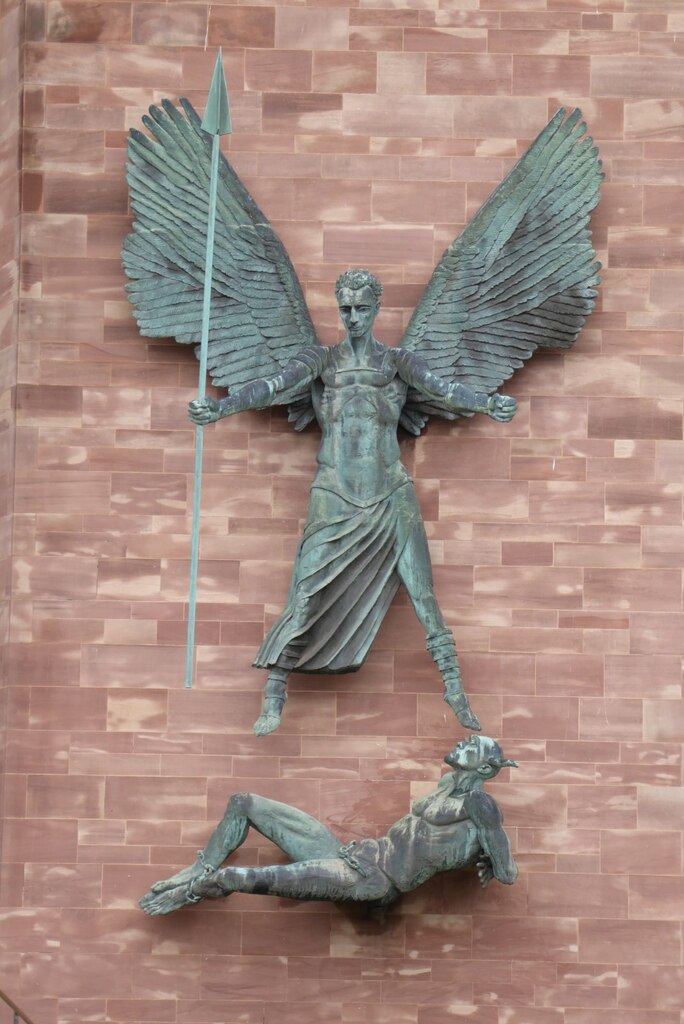
The sculpture of St. Michael shown in the header image of this article was chosen because it is a possible example of the false angel so beloved of occultists. The sculptor was Jewish and the work adorns the Anglican Cathedral of Coventry.
According to the Cathedral website, the sculpture is shows the “triumph of good,” but this is apparently not the angel, acting as an agent of God, defeating the fallen Lucifer. Rather, a benevolent St. Michael shows mercy to his pathetic captive. It reads, “St Michael holds his spear upright, not pointing at his captive with aggression, or intention of revenge.”12.
SOURCES
- Cannibalism, Blood Drinking and High Adept Satanism by Kerth Barker (purchase here) ↩︎
- Pike, Morals and Dogma of the Ancient and Accepted Scottish Rite of Freemasonry, p. 14 (purchase here). ↩︎
- David Ovason, The Secret Architecture of our Nation’s Capital: The Masons and the building
of Washington, DC (purchase here) ↩︎ - Secret Teachings of All Ages – Manly P. Hall (purchase here) ↩︎
- Occult Encyclopedia online ↩︎
- New Advent online ↩︎
- Occult Encyclopedia online ↩︎
- The Rudolf Steiner Archive online ↩︎
- Secret Teachings of All Ages – Manly P. Hall ↩︎
- Secret Teachings of All Ages – Manly P. Hall ↩︎
- Secret Teachings of All Ages – Manly P. Hall ↩︎
- Coventry Cathedral website ↩︎
 Ecclesiastical Freemasonry