The Eleusinian School was the most popular of the many so-called ‘mystery religions’ of ancient times. Like all mystery religions, Eleusinianism was based on rites of initiation which led to ‘transformation’, through a mystical ‘birth’ and ‘rebirth’.
This principle of transformation is commonly found among today’s secret societies and cults such as Illuminism.
The Mystery Religions
As Manly P. Hall points out, the ancient mystery religions “were branches from one philosophic tree [which,] with its roots in heaven and its branches on the earth…” 1
This idea could be seen through the Christian lens of truth and grace having their source in God, yet is an interesting turn of phrase, as it also exemplifies the occult principle of ‘as above, so below‘. This principle falsely posits that what is conceived in the spiritual realm is manifested on earth.
As Christians, we believe that the eternal Wisdom of the Holy Trinity guides all activities on the earth: world events are only the result of God’s Permissive Will or of His Direct Will, but they are always the Will of God alone. [If a satanist or witch ‘manifests’ an outcome via a ritual or spell, then God has merely allowed a demon to fulfil the request in order to honour that person’s free will. We hope that at some point in the unfortunate person’s life, he or she will recognise the demonic power to which they are enslaved and repent.]

The Eleusinian School
The Eleusinian School was widespread, moving from Greece to Rome and eventually to Britain. Over time, it absorbed some of the smaller mystery cults.

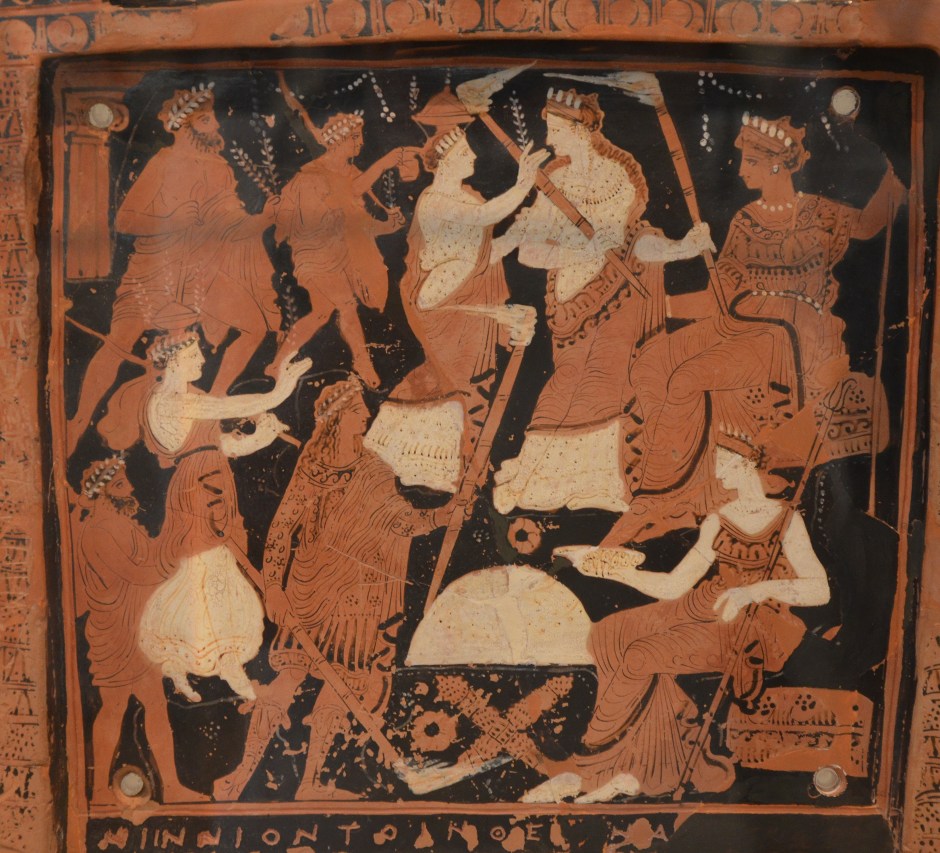
Every year, (some rituals were performed only every five years) its rituals were performed in the city of Eleusis, near Athens, in honour of the goddess, Ceres, and her daughter Persephone.
Ceres and Persephone are the subjects of a famous Greek myth in which Persephone is kidnapped by Hades, god of the Underworld. With assistance from the sun-god, Helion, Ceres succeeds in rescuing Persephone for half the year. This myth came about as an explanation of the seasons; during winter, vegetation ‘dies’ while Persephone visits the Underworld.
IMAGE: Fragments of the Great Eleusinian Relief with Demeter (left), Persephone (right) and Triptolemos (centre). C 450 BC.
Initiates were sworn to secrecy regarding the precise nature of the rituals, however, we do know that the ceremony would begin in Athens with ritual washing, followed by animal sacrifice. On the fourth day of the ten-day festival, participants processed from Athens to Eleusis – a 22km journey. Finally initiates spend several days together inside a temple, undergoing some kind of traumatic ritual which was designed to produce the ‘transformation.’
The intense ritual, wherein candidates were symbolically led on a journey through Hades,2 was led by priests and priestesses while former initiates watched on. It involved activities designed to alter the consciousness of initiates, probably involving emotive music and dancing, and possibly involving hallucinogens.3
Eleusinian Philosophy
At the heart of Eleusinianism is the belief that man’s state after death changes little unless he manages to access ‘secret wisdom’ during his time on earth. “If he does not rise above ignorance during his sojourn here, man goes at death into eternity to wander about forever, making the same mistakes which he made here.”4
Interestingly, the Church Father, Hippolytus, mentioned the Eleusinians in his classic work, the Refutation of all Heresies. Hippolytus draws attention to one part of the secret rituals, the moment when ‘an ear of corn is reaped in silence’. 5 Likewise, Clement of Alexandria warned of the cult in the 3rd century.6
Plato, in his Republic, is thought to contain a reference to the ‘rebirth’ contained in Eleusinian doctrine, and Carl Jung is said to have used the Eleusinian mysteries as a basis for some of his work, particularly his notion of initiation and rebirth as a metaphor for psychoanalysis.7

Eleusinian Symbolism
The following text is taken from Manly P. Hall’s The Secret Teachings of All Ages. It is instructive because it sheds light on the importance placed on the various materials and surfaces with which occultists who are inspired by the Eleusinians surround themselves.
“God being a luminous principle, residing in the midst of the most subtile fire, he remains for ever invisible to the eyes of those who do not elevate themselves above material life: on this account, the sight of transparent bodies, such as crystal, Parian marble, and even ivory, recalls the idea of divine light; as the sight of gold excites an idea of its purity, for gold cannot he sullied. Some have thought by a black stone was signified the invisibility of the divine essence. To express supreme reason, the Divinity was represented under the human form–and beautiful, for God is the source of beauty; of different ages, and in various attitudes, sitting or upright; of one or the other sex, as a virgin or a young man, a husband or a bride, that all the shades and gradations might be marked. Every thing luminous was subsequently attributed to the gods; the sphere, and all that is spherical, to the universe, to the sun and the moon–sometimes to Fortune and to Hope. The circle, and all circular figures, to eternity–to the celestial movements; to the circles and zones of the heavens. The section of circles, to the phases of the moon; and pyramids and obelisks, to the igneous principle, and through that to the gods of Heaven. A cone expresses the sun, a cylinder the earth; the phallus and triangle (a symbol of the matrix) designate generation.”
Expressed in table form, we have
MATERIAL
crystal, marble, ivory
gold
black stone
a beautiful human form (representing God)
anything luminous
anything spherical
anything circular
sections of circles
pyramids and obelisks
cone
cylinder
triangle, phallus
MEANING
divine light
purity
invisibility of the divine essence
supreme reason
the gods
the universe, sun, moon, Fortune, Hope
eternity or the celestial movements
phases of the moon
the Igneous principle/the gods of Heaven
sun
earth
regeneration
We can see that the meaning attributed to some of these symbols differs from that given by other schools, however this list could help when interpreting the communications and loyalties of occultists.
Conclusion
Having briefly examined the ancient cult of the Eleusinians, we can see its influence on modern-day Gnostic cults.
In fact, some occultists posit that when Christianity took hold and paganism fell into disrepute, the Eleusinians went underground and became the basis for many esoteric religions such as Hermeticism, Kabbalah, Freemasonry, Gnosticism, Neo-Platonism and Alchemy,8 all of which are centred on the theme of spiritual transformation via the attainment of ‘secret’ knowledge.
Additionally, Ceres is the equivalent of Demeter (Rome) and Isis (Egypt), so with goddess worship becoming increasing popular in our post-Christian world, the beliefs and symbolism of the Eleusinians hold extra relevance for us.

SOURCES: [note: may contain Amazon affiliate links]
- The Secret Teachings of All Ages, Kindle Edition, p 107. ↩︎
- The Secret Teachings of All Ages, Kindle Edition, p 109 ↩︎
- Mystical Initiation in Ancient Greece video ↩︎
- The Secret Teachings of All Ages, Kindle Edition, p 109 ↩︎
- Wikipedia – Eleusinian Mysteries ↩︎
- Mystical Initiation in Ancient Greece video ↩︎
- Wikipedia – Eleusinian Mysteries ↩︎
- Theosophical.org ↩︎
 Ecclesiastical Freemasonry