Update – readers from Austria have assured me that Villach is a small town south-west of vienna, rather than a suburb, as I previously thought. Apologies for the error!
A new art exhibition displayed in an Austrian Catholic church is not only sacrilegious, but also shows indications of an occult influence.
The exhibition was launched during Mass on March 9 with the enthusiastic blessing of the parish priest. Entitled CROSS: WAY: STATION (“Kreutz: Weg: Station” in the native tongue) the installation will be displayed in St. Jakob Church in Villach, Austria until April 4.
Artist Michael Kos has taken classic images of Christ and subjected them to abuse in the name of his spiritualised ‘art’. Kos claims that his three pieces, a crucifix, a tabernacle and a bizarre architectural structure in front of the altar are meant to represent the Son of God being subjected to a ‘real ordeal’ – something he undoubtedly managed to achieve by his disrespectful display.
According to Gloria TV, the diocese is run by the heterodox bishop who gave the world an “Episcopal Vicaress.”
Body Cube
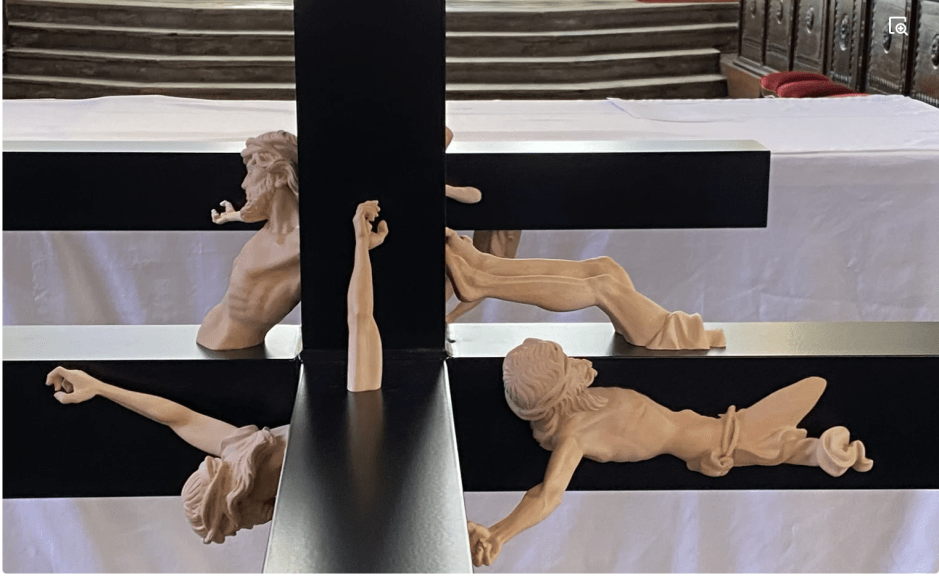
The so-called ‘Body Cube’ is set in front of the altar and is large enough to stand in. It is quite disturbing, containing 49 dismembered body parts of Jesus Christ.
Kos explains the structure as a three-dimensional cross and says “the open axis structure of the cube creates a variable play of cross shapes. From every other point of view, different forms arise, from the simple cross to the half cross, the cross of the room to the swastika.”

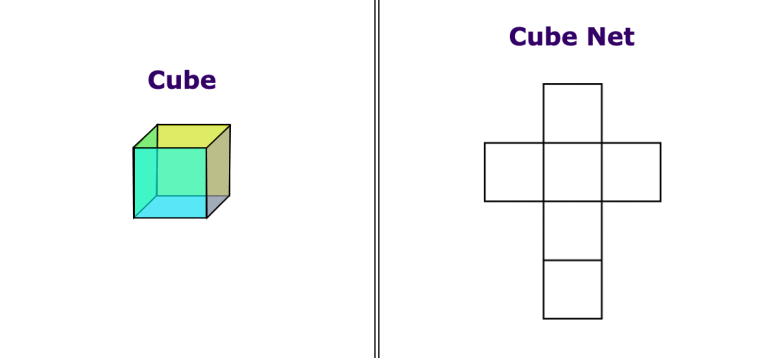
Kos’ reference to the swastika, is another red flag since the swastika is a well-known New Age symbol. The composition of the structure, black-painted aluminium is a further clue since in the occult, the use of a base-metal for construction of a cross symbolises humiliation.


Balance Act
A second piece of artwork in the installation is a wooden figure of Christ, covered with white chalk and appearing to balance on a tightrope. The artist believes that this represents “a kind of resurrection happening through a rapture” and that it also refers to the concept of ‘balance.’
As mentioned many times in these pages, the principle of balance is very significant in the occult world. In choosing this theme, the artist underscored the balancing of chaos with order, sin with grace.
Although black-and-white tiled floors are not unusual in Catholic churches, it is perhaps no coincidence that one is found in this particular church. The contrast between black and white is yet another reference to finding ‘balance’ between opposites.
Here is what article Michael Kos says about “Balance Act”:
“Art is very often a balancing act because it can support values but also overthrow them.”
The installation balance.AKT is an unusual, sacred representation that not only shows the change in religion and culture, but also the wafer-thin dividing line between play and existential fall.
No god can be safe in the long run. Every individual and a son of heaven can experience the loss of balance. Man has become one who knows about the light-footed play and the bottomless abyss. [Emphasis added.]
Kos makes no attempt to hide his disdain for the Son of God.
Christpower
The final and most blasphemous of all the artworks is entitled, “Christpower.”
Believe it or not, this is a tabernacle (or at least represents a tabernacle – it isn’t clear whether or not the Blessed Sacrament is actually housed in this monstrosity.)
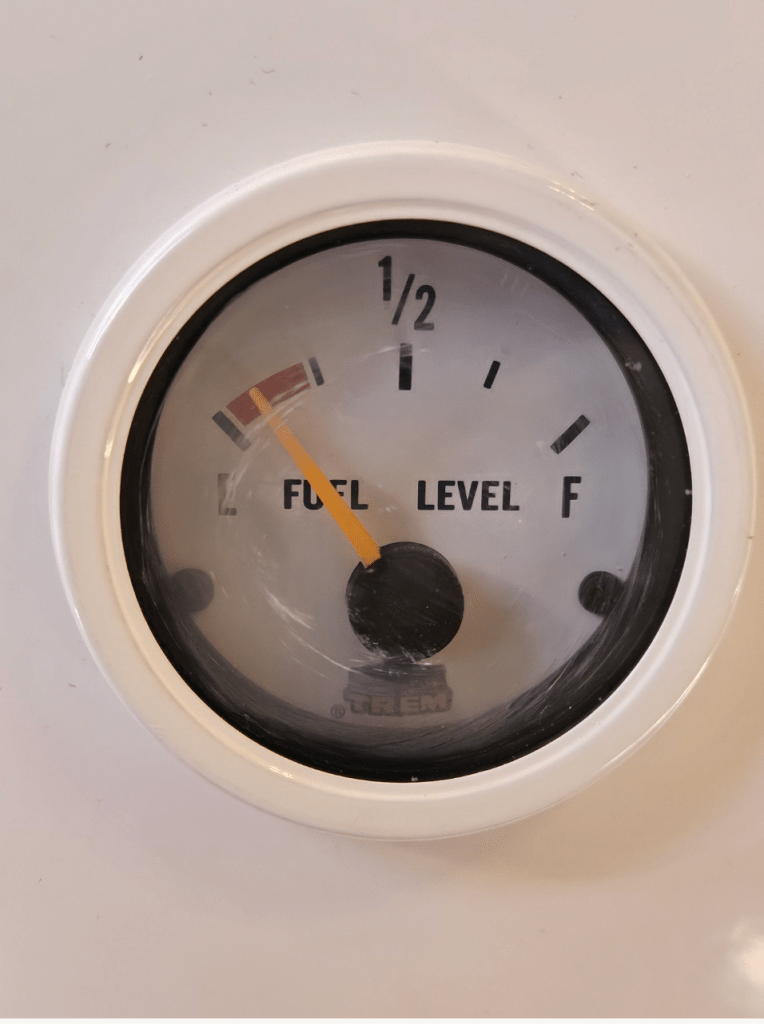
“Christ Power” is a white lacquered steel tank with a fill indicator which the artist says was inspired by the idea of “a critical tabernacle – or rather a tabernacle in crisis.”
Again, references to the occult are peppered in the artist’s explanation: he says that “shrine”, “transformation” and “secrecy” are all aspects of the tabernacle. ‘Transformation’ is of course, the ultimate ‘balancing’ act.

In his explanation of the work, Kos again shows his disregard for the Catholic faith, calling its veneration for the Blessed Sacrament ‘exaggerated.’ He goes on to suggest that divinity is found within the individual. This is the immanentism of esoteric philosophy and may be contrasted with the Christian idea of transcendence – that God is found beyond the individual.
“The question arises as to the relevance of a unique object today, which was characterized for centuries by cult dramaturgy and symbolic exaggeration.
This work of art oscillates between affirmation and negation of the religious level. The fill indicator is just before the vacancy rate and refers to a vacuum where there could also be spiritual abundance. But what is this abundance? Who fills up at all?
… Isn’t CHRISTPOWER also a psychoanalytic transmission that the believer unconsciously performs himself? So less an external force than an active internal force. A intrinsic force that fades away.
 Ecclesiastical Freemasonry