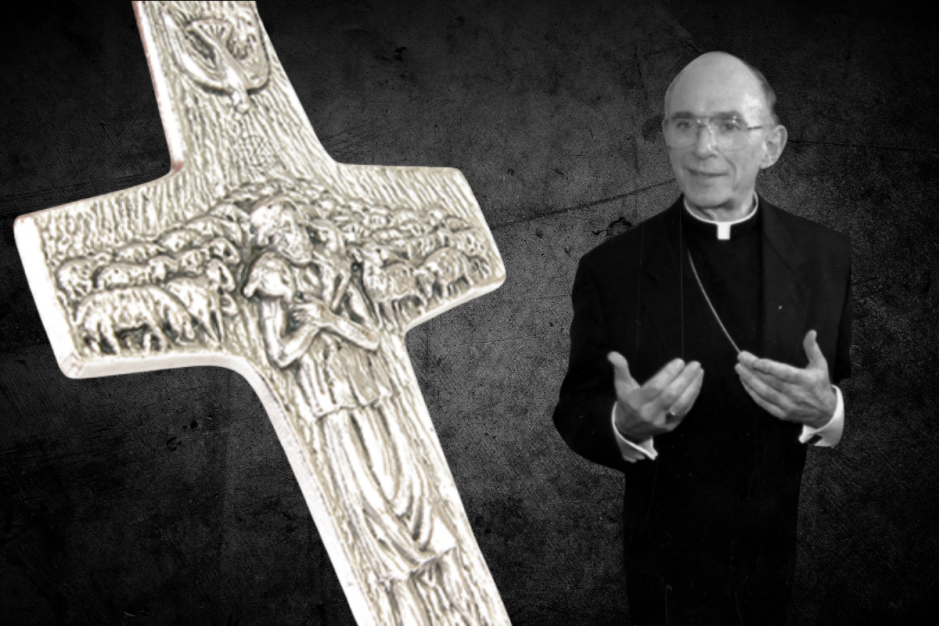
Joseph Bernadin is remembered among traditionalists as one of the most notorious members of the American hierarchy, whose evil legacy is still being felt in the Catholic Church. This brief overview aims to explain why knowing the truth about Bernadin is particularly relevant to our times.
Background
Born in 1928, Joseph Bernadin was, according to the Chicago Tribune, the “son of an immigrant stonecutter.” He grew up in Charleston, South Carolina, which perhaps not coincidentally, was home of the Palladian Rite created by renowned Freemason, Albert Pike.
Ordained in the early 1950’s, Bernadin quickly rose through the ranks and was made a Monsignor by Pope John XXIII in 1959, at the age of only 31. He was Archbishop of Cinncinati from 1972 to 1982, then Archbishop of Chicago until his death in 1996. In 1983, Bernadin was raised to the Cardinalate by John Paul II.
As President of the USCCB, he exerted an enormous influence on the Church in the United States: during the 1970’s Bernadin promoted Communion in the hand, altar girls and toleration for homosexuals in the Church. He was a hero to the young Barack Obama and was viewed by the Church in the US as the progressive leader of a faction opposed to the relatively conservative “John Paul II Bishops.”
Charleston
Bernadin served as a priest in Charleston for fourteen years. The Charleston Diocese at this time was a hotbed of scandal due to the prevalence of homosexual clergy. Many of those were later charged with sexual abuse, including a former roommate of Bernardin, Monsignor Frederick Hopwood. In 1993, after Hopwood was accused of sexually abusing over 100 boys, then-Cardinal Bernadin acted to have the records of the case sealed and arranged for an out-of-court settlement for the victims.
Writer Richard Sipe documented evidence of Bernadin’s own penchant for young seminarians while the latter was Assistant Chancellor for the Diocese of Charleston.This included testimonies from priests who “partied” with Bernadin and the seminarians as well as at least one seminarian who said he had been “forced into a sexual relationship with Bernadin and other American prelates.”
Bernadin himself was officially charged with several counts of abuse. Although he denied the claims, one victim, who later died of AIDS, was compensated by the Chicago Archdiocese by around USD $3 million.
The “Boys Club”
Things were even more scandalous when Bernadin became Archbishop of Chicago. During his tenure there, Bernadin was implicated in a homosexual network known as the “Boys Club”. This group became known, not only for their homosexual activity but also for their involvement in occult rituals and sexual abuse of impoverished young boys.
A whistleblower who wanted to leave the group was murdered in 1984. Although the victim was apparently unknown to Cardinal Bernadin, the latter arrived unnannounced on the scene soon after the brutal murder to question police; the crime remains unsolved.
In 2014, it was revealed that Bernadin and another Cardinal, John Cody, had covered up thousands of abuse cases in the Archdiocese of Chicago during the 1990’s. They routinely moved abuser-priests from parish to parish, allowing them to maintain access to children.
Pectoral Cross
Bernadin is known to have worn the occult-inspired pectoral cross for which Bergoglio was infamous. Cardinal Fernandez has also been pictured wearing this cross.
[Note: Photographs of Cardinals Martini and Prevost (now Pope Leo XIV) wearing the same cross have circulated on social media but at the time of publication I wasn’t able to find these. I’ll update the article if I come across them again.]
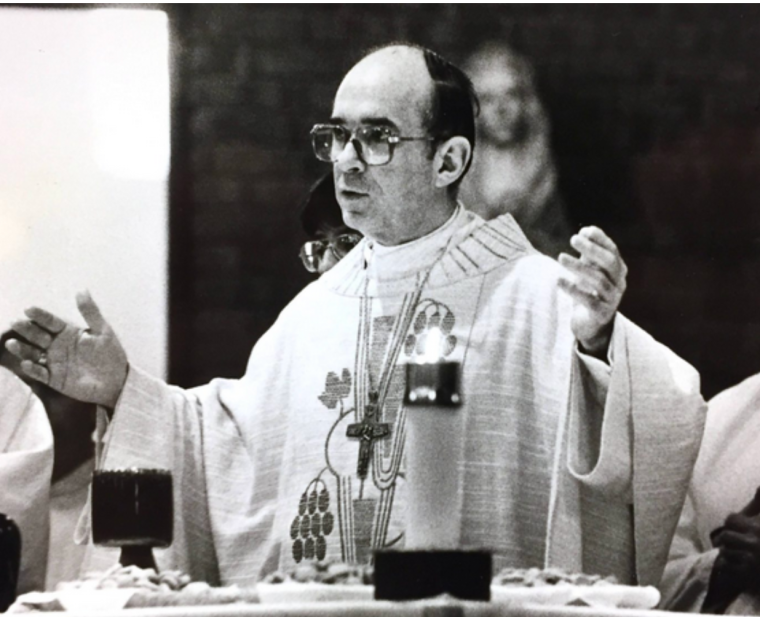


The cross is thought to be representative of a Masonic gesture: the folding of arms across the chest.
Although the Masonic Encyclopedia claims that Christian icons of the Good Shepherd often have crossed arms, this seems not to be the case.
Rather, it is a gesture beloved of Rosicrucians: “The Good Shepherd Sign in Rosicrucian Knight´s masonic chapters consists of crossing arms over the chest, stretching hands with joined fingers and palms on the nipples, and opening eyes to heaven while bowing. This represents reason and immortality. This position can be reflected through the skull and crossed bones.“
Seamless Garment & Common Ground
Cardinal Bernadin coined the phrase ‘seamless garment’ in the 1970’s and this ideology has been adopted by the Church at the highest levels since that time. The ‘seamless garment’ philosophy is that Catholics must hold a ‘consistent life ethic’ meaning that they must oppose war, poverty, inequality, environmental decline and a host of other problems as passionately as they oppose abortion.
Pope Francis famously promoted this ideology when, along with his condemnations of abortion, he also condemned the death penalty.
Not long before his death, Bernadin founded the Catholic Common Ground Initiative, a project dedicated to ‘Reconciliation and Peacemaking’, interreligious dialogue and the ‘consistent life ethic’. Bernadin’s Common Ground project, with its focus on dialogue and ecumenism, can be seen as a forerunner of Pope Francis’ destructive ideology of ‘synodality.’
Ritual Sexual Abuse
Like many of the worst of our 20th and 21st century abusers. Bernadin was also said to have been involved in sexual abuse rituals. The most famous case is that of the woman known by the pseudonym, ‘Agnes’.
In the 1990’s, ‘Agnes’ came forward with allegations that she had been raped by Cardinal Berndadin when she was 11 years old. Agnes repeated the claims to investigators and Church officials, as well as in a sworn deposition and affidavits.
According to Agnes, the rape was part of a satanic ritual which was attended by both Bernadin and Bishop Russell of Charleston. Agnes’ father was in attendance and he presented her to be abused along with her pet dog. This incident famously formed the basis for the depraved Black Mass scene in the Malachi Martin’s novel, Windswept House.

Death of Bernadin
Perhaps the most significant proof of Bernadin’s loyalties came at his funeral: the Windy City Gay Men’s Chorus sang at his wake in the Cathedral at his request. According to reports, “The chorus’s director said that they regarded the invitation as a sign of approval by the Church, and accepted enthusiastically.”
Not only that, Freemasons wearing their full regalia acted as guard s of honour, standing by Bernadin’s coffin. Bernardin was posthumously awarded the Fraternal Order of Masons’ Masonic Order of Galilei Award, which he had agreed to accept prior to his death.
A Disturbing Tribute
A concerning connection took place more recently, as Bernadin and his approach to ethics were lauded by then-Cardinal Prevost in 2023. Prervost gave an address given at the Catholic University of Santo Toribio de Mogrovejo, saying, “..a catholic cannot claim to be pro-life just to take a stance against abortion while at the same time saying they are in favour of the death penalty.”
This is merely further proof that Bernadin’s influence has not diminished over time and that his views remain highly regarded by Progressives both inside and outside the Church.
SOURCES: Bishop Accountability / The Guardian / False Rape Timeline / Masonic Encyclopedia – Cambridge Centre for the Study of Western Esotericism / Catholic Culture / National Catholic Register / Chicago Tribune
 Ecclesiastical Freemasonry
One thought on “Who was Cardinal Bernadin?”