Articles

Weekly News

Welcome to this week’s newsletter, dear friends.

In this installment, you will find a fascinating account by a man who, like Pope Francis, was once a friend to the notorious abortionist, Emma Bonino. Unlike the Pope, this man repented and is now a faithful Catholic.

The second article is rather grim: I stumbled across this Adoration chapel in Melbourne and was horrified by what greeted me there. Lord, have mercy.

Hope you have a good week,

AC.

The Pope, the Abortionist and the Convert

Emma Bonino is an Italian, a former politician and abortionist, who is on good terms with Pope Francis and who was apparently friendly with JPII as well..

A fascinating report comes from Gloria TV (or here on his own blog, in Italian) where the author, Danilo Quinto, was once a personal friend of the notorious Ms. Emma Bonino. After experiencing a conversion, he now writes to expose the rot inside and outside the Church. God bless him.

The author is a former and repented high-placed activist of the immoral and inhuman Italian Partito Radicale which works for the de-Christianisation of Italy. On 5 November Bergoglio paid a visit to Emma Bonino, a former leader of that party. Bergoglio called Bonino a ‘great Italian’ (sic) and example of ‘liberty and resilience’ (sic).

I too frequented that terrace in Trastevere, in the centre of Rome.

Those were the years when strategies were being imagined and constructed to consolidate the results of the divorce and abortion laws, which destroyed the family institution.

A ‘demographic bomb’ was denounced, which never existed, but served to decertify an entire country and prevent, with the spread of the pill and other contraceptive systems, its growth, which is only determined by the birth of new creatures into the world.

The foundations for the campaign on euthanasia were laid, which over the years, despite the lack of a law, has become a widespread and customary practice, along with assisted suicide.

We discussed how to permanently overthrow the temporal power of the Church; the theory of the third and fourth sex, same-sex marriage, assisted fertilisation, and surrogate motherhood were being spread.

Consciences were manipulated to the acceptance and integration of people who sooner or later – after replacing us – will kill us all.

Well, on that terrace of that house that has seen literally every colour of the rainbow, the Head of the Catholic Church, the indestructible Jorge Maria Bergoglio, came up the other day.

He had a bouquet of white roses and a box of chocolates in his hand, to pay homage to the maximum exponent of that ideology – after the death of Pannella – that has contributed decisively to de-Christianising Italy and making churches useful for making large soup kitchens for the poor, for welcoming migrants or for making money by handing them over to private individuals, who manage them to make museums or other worldly stuff.

‘Example of freedom and resilience,’ Bergoglio said of Emma Bonino. He hit the nail on the head.

After all, from a man like him, who masterfully interprets the desires of this degenerate world, one could not expect the intention to convert Emma Bonino – he has declared several times that he does not want to convert anyone – but only a snapshot of reality.

Certainly, Emma Bonino is an example of ‘freedom and resilience’. Yes, from God! As is the one who uttered these words.

Both have done, and they will still do everything until their death – unless they convert, in their case publicly, given the gravity of their sins – to ensure that human beings are free from their Creator and will be resilient to His laws.

As have been those many Italian Catholics who have divorced, had abortions, used contraceptive methods, letting an ideology win that has nothing human about it.

As has been that modernist Church, a direct product of the secular work of Freemasonry and the Second Vatican Council, which has in Bergoglio its latest interpreter, after a succession of popes subsequent to Pius XII who paved the way for him and the Mafia of St. Gallen.

At the conclusion of the encyclical Etsi Multa of 21 November 1873, Pius IX uses an expression that appears twice in the Bible – Synagogue of Satan – in ch. 2 verse 9 and ch. 3 verse 9 of the Apocalypse of St John the Evangelist.

He writes: ‘It will perhaps surprise some of you, Venerable Brethren, that the war that is being waged against the Catholic Church today is expanding so much. But whoever knows the character, the aims and the purpose of the sects, whether they are called Masonic or by any other name, and compares them to the character, the manner, and the extent of this war, by which the Church is assailed on almost every side, will certainly not be able to doubt that this calamity is not to be attributed to the frauds and machinations of those sects. For from them is formed the synagogue of Satan, who orders his army against the Church of Christ, raises his banner and comes to battle’.

Prophetic words. Exemplary of the situation we live in, where men of the Church prostrate themselves to the World and the builders of Evil.

To counterbalance the attempts of those men of the Church and those builders of Evil – united by the design of the strong powers, who want to annihilate man, created in the image and likeness of God – the Church founded by Our Lord Jesus Christ, which is of divine origin, will not be brought down, despite the night of Gethsemane that it has been living through for too long, to the delight of its enemies.

As the beautiful antiphon at the introit of the Feast of Christ the King of the Apostolic Mass says:

‘The Lamb who was slain is worthy to receive power, riches, wisdom, strength, honour, glory and praise; on Him be Lordship forever’.

Here is Bonino again, dressed as a priest. This time in with US Secretary of State, John Kerry, when she was the Italian Foreign Minister in 2013.

Blackcat, CC BY-SA 3.0 https://creativecommons.org/licenses/by-sa/3.0, via Wikimedia Commons

John Paul II, Emma Bonino, Marco Pannella (Vatican City, 1986).jpg

U.S. Department of State from United States, Public domain, via Wikimedia Commons
A Wiccan Adoration Chapel in Melbourne

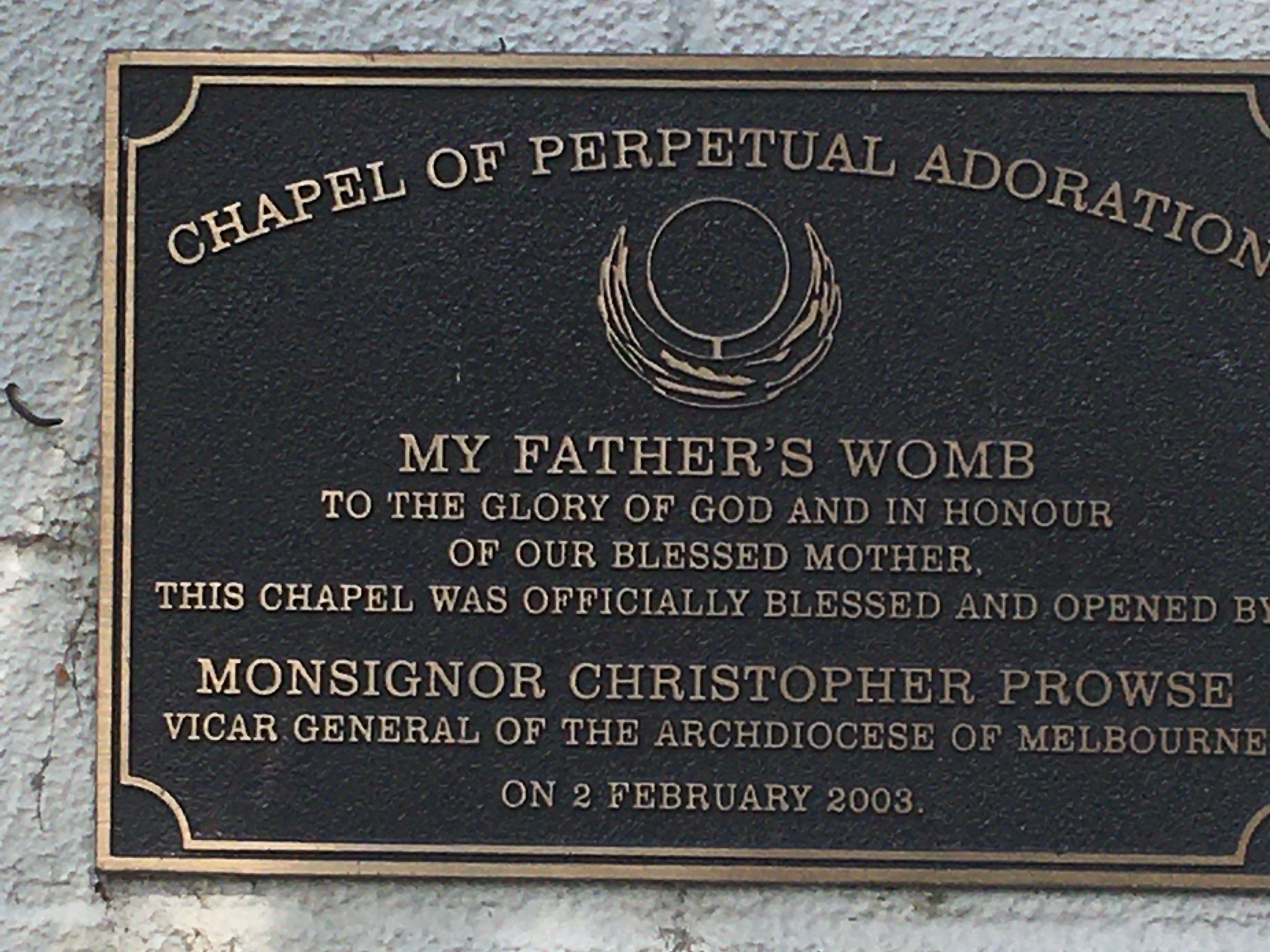
An Adoration chapel at St. Kevin’s Novus Ordo parish in suburban Melbourne raises questions as to just who has been designing our modern churches. Named, “Our Father’s Womb”, the chapel exhibits several hallmarks of Wiccan influence: exultation of the Feminine; mockery of the sacred; a giant labyrinth and a spell-casting tool.

Wicca is differentiated somewhat from witchcraft, although the two are related. Wicca is a religion whose disciples, known as practitioners, worship both a God and a Goddess. Wiccans celebrate rituals according to the seasons which, they believe, put them in touch with the Divine. The beliefs of each Wiccan vary according to the individual although the overarching rule is ‘Harm none and do as you will’. Most, but not all, Wiccans practise witchcraft, but not all witches are Wiccans.

The name of this chapel is absolutely bizarre, and suggests the glorification of the Feminine: “Our Father’s Womb: to the glory of God and in honour of our Blessed Mother.”

‘God’ in this case, does not necessarily refer to the Christian God; just as ‘the Blessed Mother’ does not necessarily refer to Our Lady.

Obviously, men do not have wombs and even more obviously, God is pure spirit and most certainly has no human organ such as a womb. Even if we accept the metaphor of a chapel being a womb-like place of security and comfort, the name is illogical from a Catholic point of view. Peace may be a fruit, but is not the purpose of an Adoration chapel. At best, this is the Modernist ideology of man-centredness at play.

At worst though, we are looking at a deliberately pagan mockery of the Blessed Sacrament.

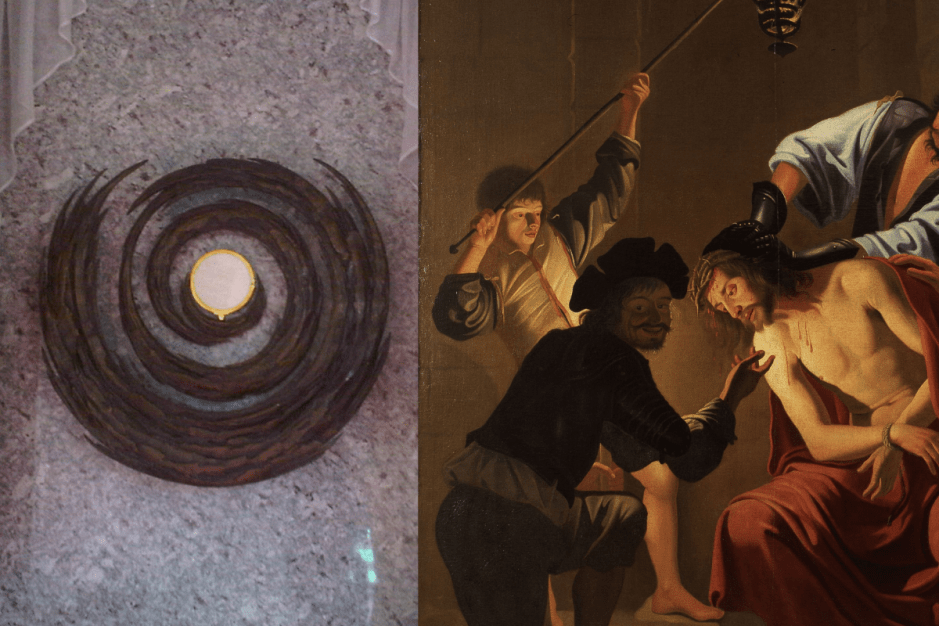
A closeup of the image shows a now-familiar symbol, which has the appearance of a nest holding the Host.

This is very similar to an element found in the logo for the Synod on Synodality.

(I have also previously wondered if this was meant to represent a child in a womb – the Antichrist, perhaps?)

In witchcraft, bird-nests are used for both curses and blessings, so are tools used in spell-casting rituals. There is coincidentally a legend relating to the Celtic saint, St. Kevin, in which a bird made a nest on the palm of his hand. Kevin apparently remained motionless for 40 days while the bird came and went, building the nest.

A different explanation for the nest is that it is actually a crescent moon, which is another symbol for the Feminine.

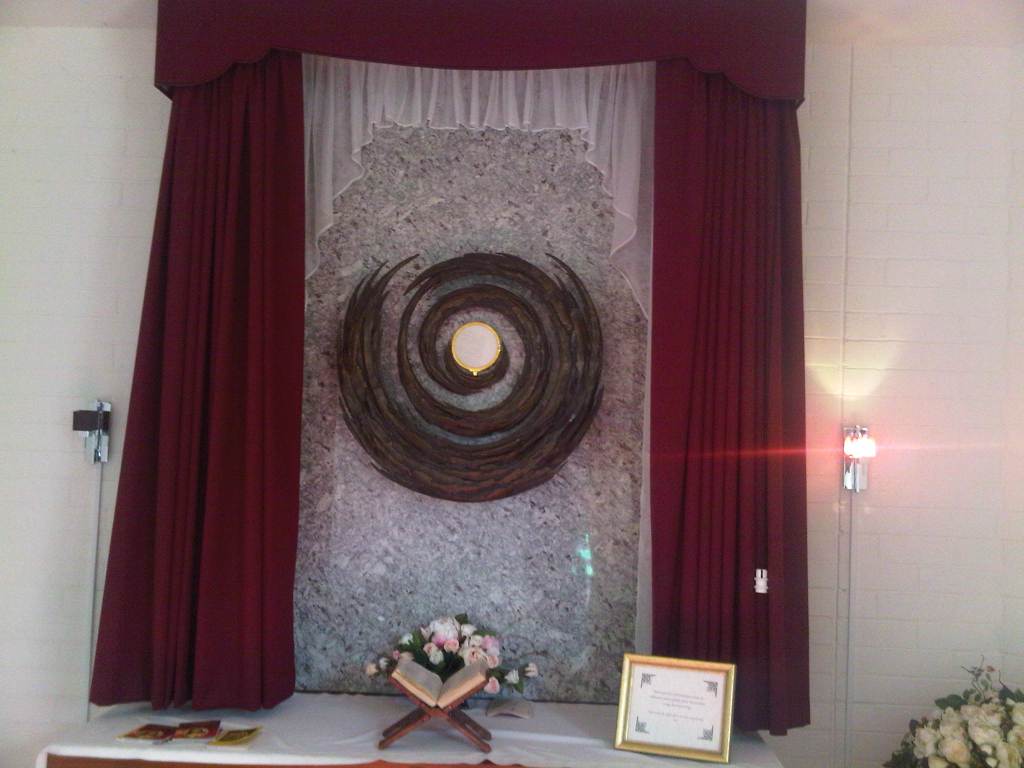
So far, the signs of a Wiccan influence are somewhat veiled. Once we step inside, however, the occult references are even more pronounced.

To the untrained eye, this is merely a very ugly setting for the exposed consecrated Host. But my learned friend believes that the red curtains are meant to represent female genitalia. He is familiar with this kind of imagery from the shrine to Lucifer in the Brisbane Cathedral.

The spiral surrounding the host is made of metal plates, something akin to the scales of a snake. Snakes have an obvious relevance when it comes to Christianity and witchcraft: they represent Lucifer and his rebellion against God.

According to the book, The Women’s Encyclopedia of Myths and Secrets, a spiral represents “death and rebirth as movement into the disappearing-point of formlessness, and out of it again, to a new world of form.”

One variation of the spiral is the labyrinth, and one of these is found in the grounds of the church in question. To pagans,  the labyrinth is a “metaphor for the spiritual journey and a powerful tool for transformation. This walking meditation is an archetype, a mystical ritual found in all religious traditions.” Thus walking the labyrinth is a form of meditation – the dangerous mind-emptying kind, not the wholesome Catholic tradition of mental prayer.

Labyrinths are specifically related to Goddess worship, with the circle being an important symbol of the Divine Feminine. So in this setting, the Sacred host is surrounded by two symbols of the Feminine, with the spiral appearing as though it is ready to strangle or consume the Host and the scale of the curtains suggesting the apparent superiority of the goddess over the Triune God.

This raises the question: is the Host in this chapel Consecrated? It is truly the Body, Blood, Soul and Divinity of Christ? My answer to that is yes, probably. For the insult is only complete when such an ignoble setting surrounds the True Presence of the Lord, precisely as He endured during His Passion.

What the wicked people responsible for this abomination fail to acknowledge is that He alone created them and died for their sins. Unless they repent, the veil of their souls’ temples will one day be torn in two and they will be cast into everlasting fire for their rebellion and their failure to adore the One, True God.

As I was putting together a header image for this post, I wanted to use sacred artwork to counter the foul images of witchcraft that have been flooding my screen. On seeing a beautiful representation of Christ’s Passion, it occurred to me that the Host surrounded by a diabolical wreath of scales is not unlike Christ’s Sacred Head crowned with thorns. Perhaps this is yet another layer of mockery those responsible had in mind.

Weekly News

Welcome to this week’s newsletter, dear friends. For your reading pleasure, here is an article investigating some of the Masonic design elements which have made their way into Catholic churches. Included are a few examples from Australia and one from Europe.

I’ve also added an article by Plinio Correa de Oliviera: Professor Plinio is a favourite thinker of mine. His article explains his idea of ‘Synarchic Morality’ which is a little different from the kind of Synarchy about which I have been writing of late. However, it contains some insights of a practical, social nature which you may find enlightening.

And of course, I haven’t failed to add my own take on the new Vatican mascot, ‘Luce‘. It is all so tiresome, but this does serve to confirm what we know about Bergoglio’s cabal – that they are occultists and sexual deviants who love to mock faithful Catholics.

Let There Be Luce

The controversial anime-inspired ‘Luce’ is the official mascot for the 2025 Jubilee and was launched at a press conference on October 28 by Archbishop Rino Fisichella. Luce’s name is of course derived from the Latin lux, lucis, meaning ‘light’. From this comes such English words as ‘illuminate’, ‘luminous’, and ‘Lucifer’, as well as the Italian, illuminati. (This article from LifeSite gives a very thorough analysis of the name ‘Luce’ and its link with Enlightenment philosophy.)

The artist who created Luce was immediately exposed as being a promoter of LGBTI rights and a purveyor of fine sex-toys, leading to a collective sigh from controversy-fatigued traditional Catholics.

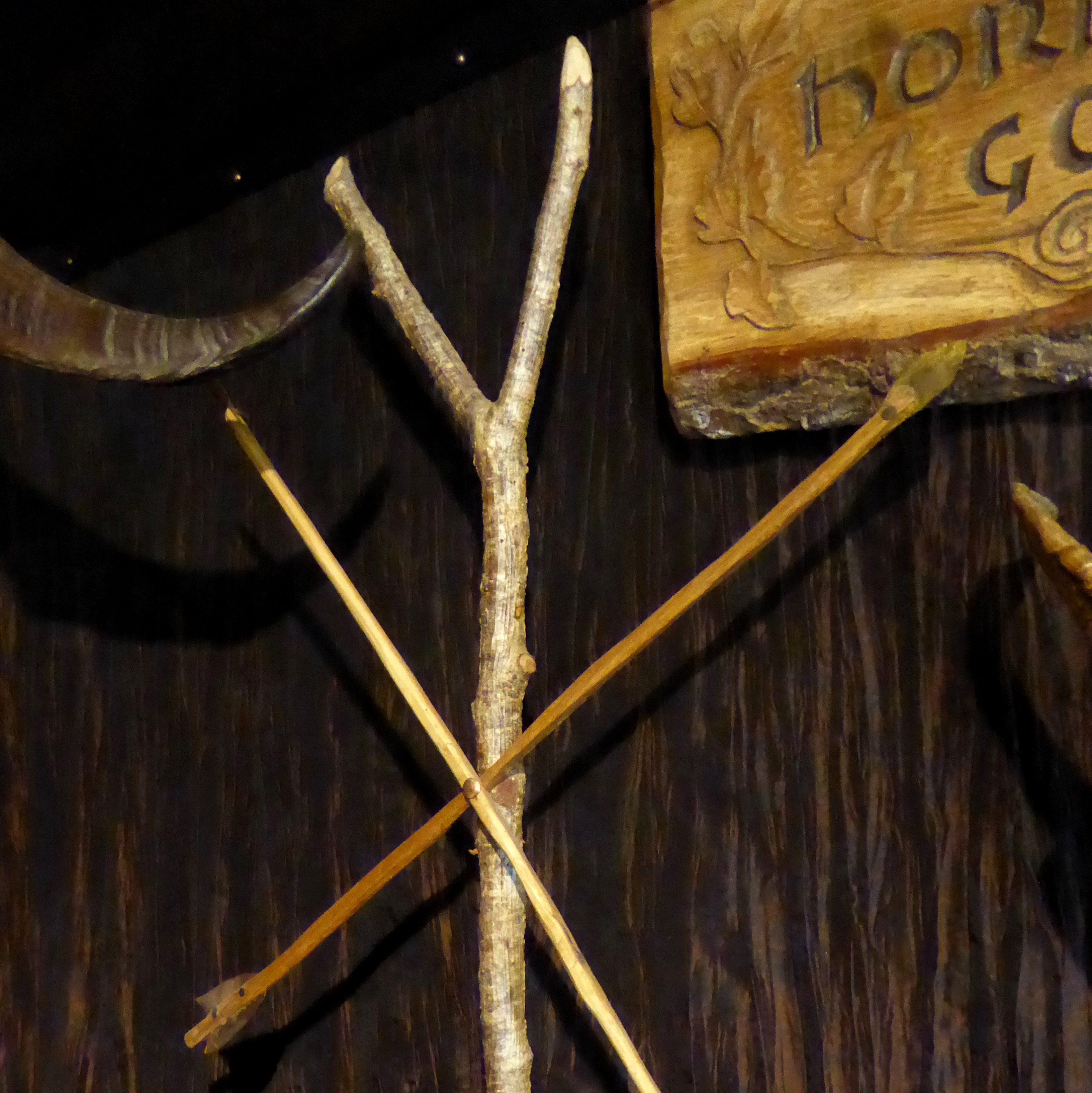
The first thing one notices when first looking at Luce – when one recovers from the visceral response to the sheer insult being given to God and to the Church’s tradition of exceptionally fine art – is the staff in the figure’s left hand. Although being promoted as a pilgrim’s staff, this is very reminiscent of a witch’s stang. The stang is a two-pronged tool made of wood, used by witches for spells and (apparently), for flight.

A stang was famously presented to Pope Francis during the 2018 Synod by a young woman wearing a red string around her wrist. The Pope later carried this stang instead of the usual crozier during Mass.

From the Museum of Witchcraft and Magic, Boscastle, Cornwall

The Stang, pictured at left with crossed arrows, is the relatively modern name given to a witch’s staff. The word was first used by a male witch in the 1960’s but the tool itself is far older and can be found in ancient artwork as well as in various cultures.

Luce also features a Rosary without a corpus (so as not to offend the Protestants?) worn around its neck and shells in its eyes. Eyes are highly symbolic for occultists, and represent the gateway to inner knowledge. In the esoteric world, shells are said to represent new birth or transformation. At first glance, the eyes of Luce seem to be extremely sad and filled with tears – not a great look in these days of industrial-scale child abuse.

But Luce is only part of a collection of mysterious esoteric-themed artwork being promoted by the Vatican. Vatican News also announced that a bizarre painting will be displayed during the Jublilee. From artist Marc Chagall, the painting will be on loan from the Art Institute of Chicago. The artwork is called, “white Crucifixion’ and shows Jesus on the cross, wearing a Jewish prayer shawl called a tallit.

Chagall, a Jew, was apparently obsessed by Christ’s crucifixion and painted many works around this theme. Some of those showed Chagall’s own face in the figure on the cross. This is said to represent the persecution of Jews, especially during the Holocaust.

But there may be a more sinister interpretation of this: high-level satanists pursue something known as apotheosis, which is the state of ‘becoming a god’. I’ve previously mentioned a book by Kerth Barker, in which he mentions some satanists he knew who displayed statues and artwork which featured their own faces. This was because they wanted to be worshipped as gods. Chagall was perhaps attempting to do the same thing by replacing Christ’s face with his own. Chagall’s work was also featured in an occult art exhibition in Spain in 2023. So while none of this is conclusive evidence of Chagall’s ties to the occult, it is nevertheless interesting in light of the Vatican’s continued use of artwork from Rupnik and its ties to the very strange artist, Jago.

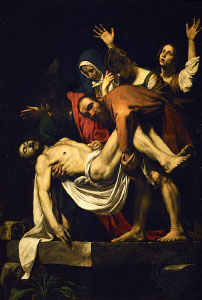
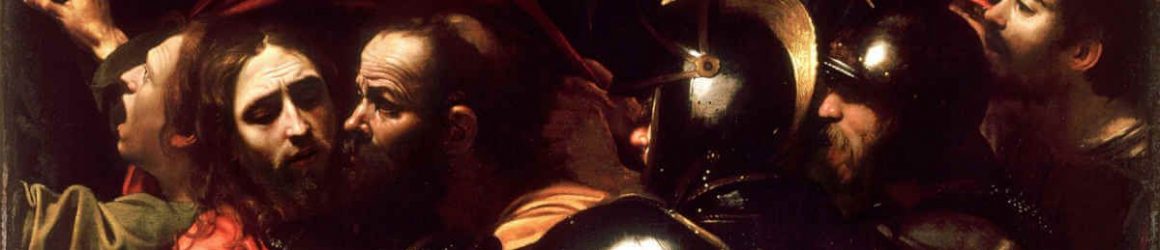
Vatican officials are also planning to use ‘Luce’ as a mascot at the 2025 World Expo to be held in Japan. Along with Luce, the Holy See’s pavilion will exhibit Caravaggio’s Deposition of Christ, shown at left. This may be another clue to the existence of Luce: Caravaggio is known as the ‘Master of Light‘ because of his use of the technique known as tenebrism – the dramatic contrast between dark and light areas – in his works. Caravaggio must be a favourite in the Curia, as he was most likely a bisexual who died at an early age, possibly from either syphilis or murder.

So with Luce, Chagall and Caravaggio, it’s just a case of ‘another day, another immoral role model’ as the Ape of the Church continues its slow grind towards total apostasy.

Masonic Symbolism in Liturgical Design

“Masonry, like all the Religions, all the Mysteries, Hermeticism, and Alchemy, conceals its secrets from all except the Adepts and Sages, or the Elect, and uses false explanations and misinterpretations of its symbols to mislead those who deserve only to be misled, to conceal the Truth, which it calls Light, from them, and to draw them away from it.”

Albert Pike, former Sovereign Grand Commander

The Masonic infiltration which has penetrated very deeply into the heart of the Church is often reflected in the layout of modern churches. The designs which reveal Masonic influence track closely with the liturgical changes that took place after the Council, and which were first exposed by Cardinals Ottaviani and Bacci in their historic Intervention. Their letter to Pope Paul VI, and its attached document compiled by a group of theologians, became known as the Ottaviani Intervention.That document lists the main problems detected in Pope Paul’s New Order of the Mass:

  • definition of the Mass (supper, memorial, assembly instead of Sacrifice)
  • purpose of the Mass (community/fraternal charity instead of Sacrifice and worship)
  • essence of the Mass (thanksgiving – actually a fruit instead of the Mystery of Calvary continued)

With regard to liturgical design, these changes were achieved by

  • reducing the main altar to a table
  • eliminating the sanctuary and placing the altar in the midst of the people
  • omitting specifically Catholic elements
  • inverting the roles of priest and laity
  • eliminating hierarchical structure
  • implicitly denying the Real Presence
  • having the priest face the people to support the idea of narrative rather than sacrifice
  • providing limitless options to undermine unity
  • using ambiguous designs and art
  • focussing on ‘paschalism’ to the exclusion of other communications of grace
  • promoting “archaeologism”, condemned by Pope Pius XII, to suggest that the Church has somehow lost Her way in more recent times.

It is easy to see how these novel elements in design are closely aligned with Masonic principles of liberty, equality and fraternity.

Traditionally, the design of a church symbolises the exclusive and hierarchical nature of Catholicism. The Sacrifice of the Mass takes place in a dedicated area, the Sanctuary, which is only entered by males. Only an ordained priest may offer the Mass, and steps surrounding the altar denote his ascent on behalf of the people towards the Triune God.

By contrast, the egalitarianism of Masonry sees the altar moved to the midst of the people, with the priest mingling among them. Steps no longer appear, and on some churches, the altar is even placed at a lower level than the congregation.

Specifically Catholic elements such as statuary, side altars, traditional motifs in stained glass windows, artwork and textiles point to a Church which believes Herself to be the One True Faith. These must be jettisoned in favour of the more universal “spiritualism” found in Masonry.

In line with the Masonic need for secrecy and misdirection, ambiguous patterns and symbols create confusion, replacing clear catechesis with mystical suggestions. In accordance with the Masonic principle of liberty, these creative details invite the designer or congregation to express their individuality, rather than being subservient to traditional themes and motifs.

The principle of fraternity is expressed when a church’s design emphasises a merely human charity – an assembly of people gathered to pray for the poor or to build up the their community. Any reference to the Mass as a Sacrifice, or focus on the Real Presence of the Lord in the tabernacle is eliminated. Similarly, artwork reminding parishioners of their eternal destination is replaced by representations of the corporal works of mercy.

Some specific examples of these principles are found in the churches shown below.

Saints Peter and Paul, in Bulimba, Brisbane. [Queensland, Australia.]

Saints Peter and Paul, in Bulimba, Queensland, Australia

As explained in notes about the church’s interior found on the parish website, this layout represents the theology wherein the assembly, that is the congregation, is the celebrant of the liturgy. Thus the priest loses his preeminent place and merges with the people. This was one of the concerns raised in The Ottaviani Intervention and represents the Masonic principle of egalitarianism.

Focus on the priest , as a man, actually increases in this layout and the people are forced to stare at each other.

According to the notes, both the altar and the ambo are cubes, each carved from a single block of marble and decorated with arches. Notably, the Le Guide du Paris Maçonnique, explains that the perfect cube, the cut stone and the arches are all “inherently Masonic.” [As related in Unholy Craft: Freemasonry and the Roots of Christophobia.]

As an aside, the priest in question held, as a fundraiser for the Church’s renovations, a Black and White Ball. It is a small point but interesting in the context of this discussion.

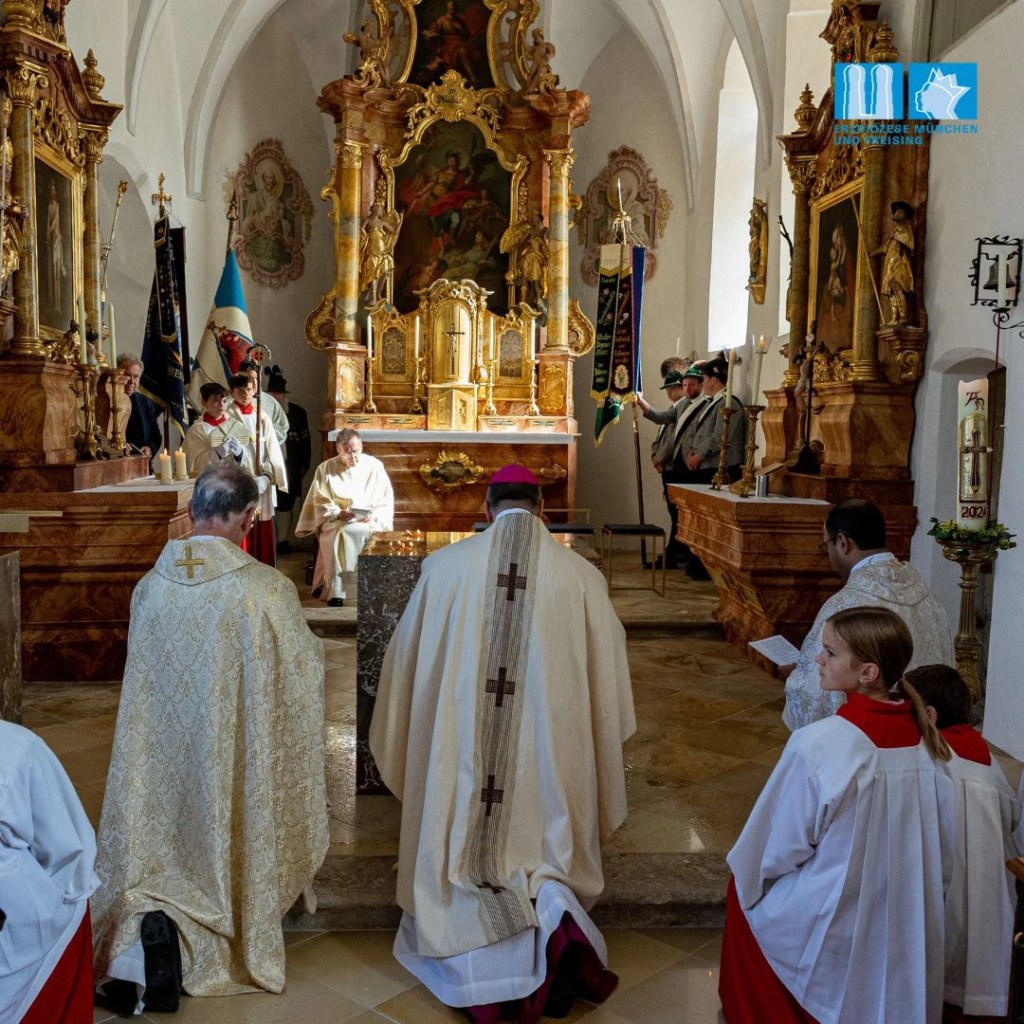
Another example of a cube-shaped altar can be found in this German church. Made of red marble, the altar was consecrated by Auxiliary Bishop of Munich, Rupert Graf zu Stolberg, at the St. Michael Church in Niederaudorf.

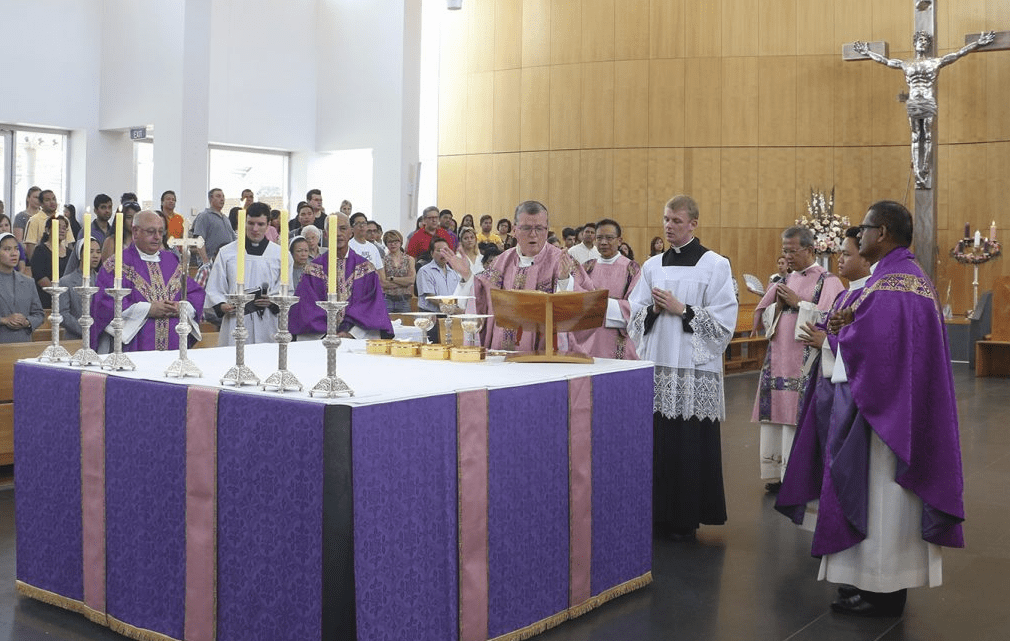
St. Patrick’s at Parramatta, Sydney. [New South Wales, Australia.]

St. Patrick’s Cathedral, Parramatta, Australia

This rather sparsely-decorated cathedral has been described by visitors as a ‘barn’ or a ‘basketball court’. The shift from Catholic, theocentric liturgical design to a Masonic, anthropocentric one is very clear here: there is no tabernacle in the main body of the church, and the lectern faces over the altar to the crucifix on the back wall. What looks like a floating storm cloud, is said by the designer to embody “a sublime narrative of spiritual life.”

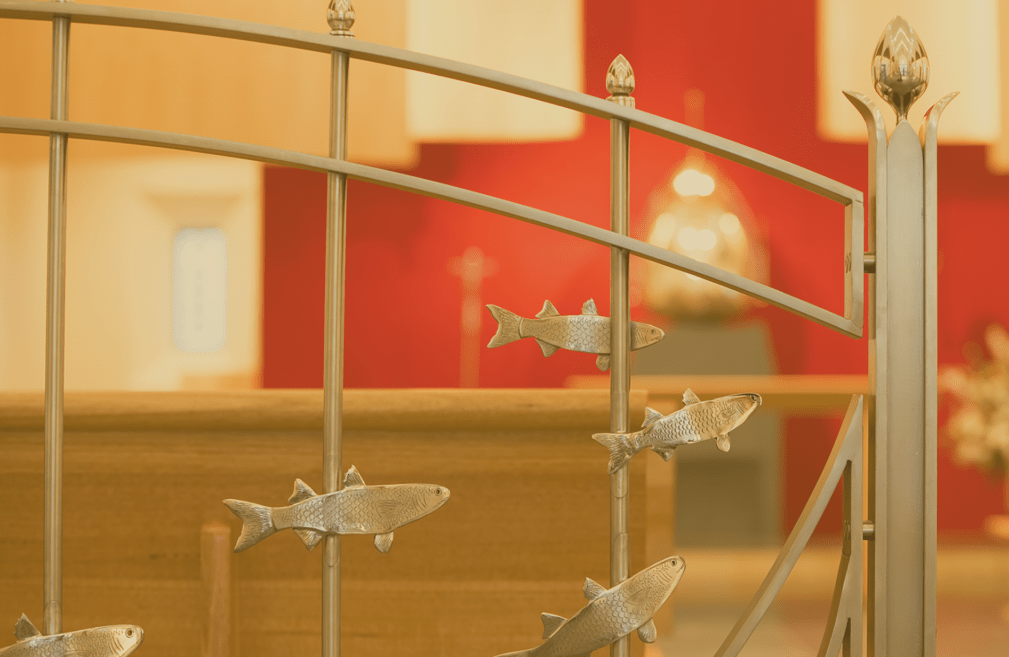
The altar is a very egalitarian square. While not ugly, the fish and decoration shown at the entrance to the Adoration chapel, are ambiguous: they in no way point to the reality of the Real Presence only a few feet away.

The ‘presider’s chair’ is brutalist and situated near a rather grotesque crucifix. Notably, the arms of the cross are incomplete.

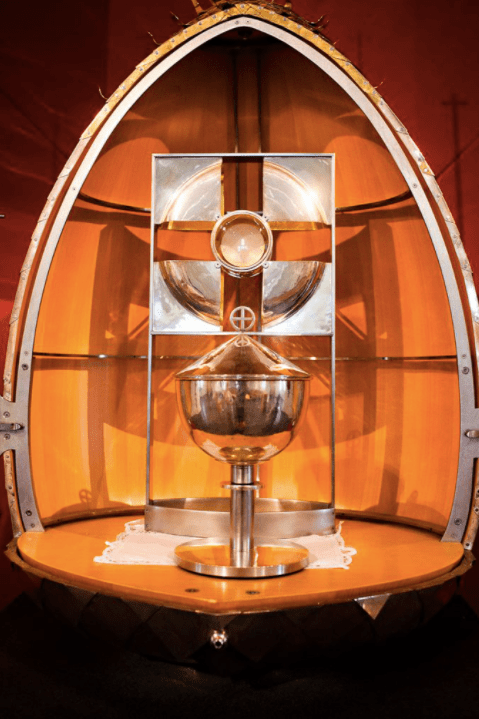
The tabernacle, like its decorations, is quite ambiguous: it is difficult to discern what we are looking at. The arms on the cross surrounding the Sacred Host are of the same length – a common occult representation of a cross which is commonly found in Rosicrucianism.

Banyo Seminary Chapel, Brisbane. [Queensland, Australia.]

Banyo Seminary, Queensland, Australia

Another example is this chapel in a dioscesan seminary in Australia. Again we see the altar and ambo have been brought into the midst of the congregants. No sanctuary, as such, exists. Congregants are left with little choice but to look at each other, instead of being able to gaze unimpeded at the Holy Sacrifice unfolding before them.

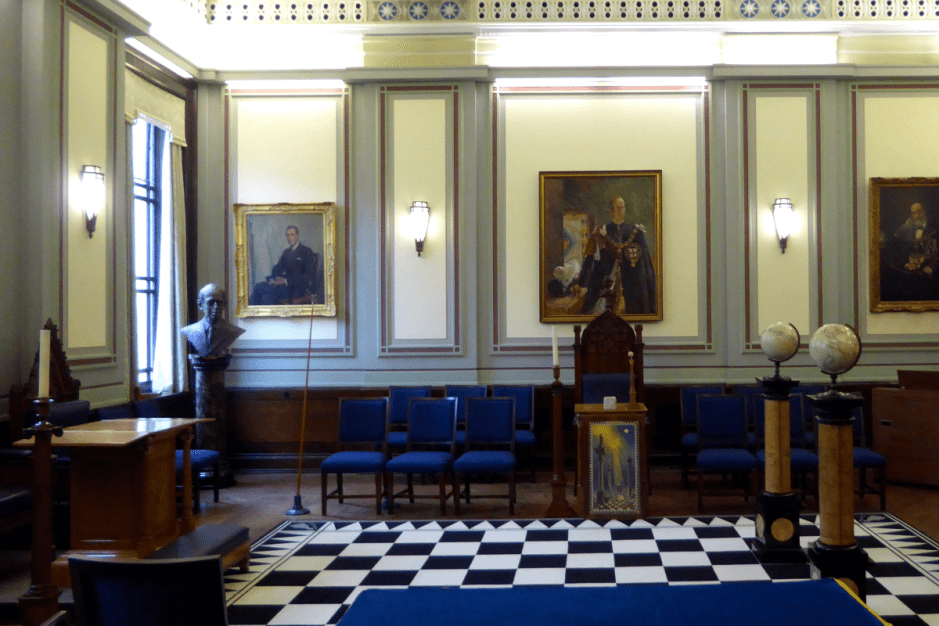
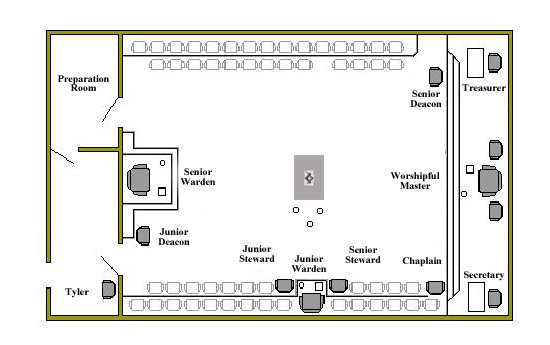
A typical Masonic lodge layout

If we compare the three new churches above to the typical layout of a Masonic temple, we are at once struck by some obvious similarities. In the lodge, chairs are arranged in rows with the people facing each other. A table, known as the Table of the Book, is situated between the rows of chairs. In this layout, the focus is on man, which is a fundamental problem in new church designs as well.

Where once the focus of the Mass was clearly on God – as the faithful, along with the priest, faced the high altar with tabernacle and a prominent crucifix – these modern designs place the emphasis firmly on man. This novelty takes on a more sinister aspect with the introduction of occult-inspired details, such as the cube-shaped altar. In that case, what could be put down to mere ideological influence is clearly exposed as an attempt to replace the object of worship: Christ for Antichrist.