Articles

Saint-Yves Alveydre

Around the turn of the nineteenth century, there was a resurgence of interest in Rosicrucianism, Kabbalism and Spiritualism among Freemasons. You may recall that demons have revealed to exorcists that that this time period was marked by a great increase in demonic activity. Various groups, including the Kabbalist Order of the Rose-Cross, the Martinists and the Symbolists, splintered off from Masonry. These groups were particularly active in France.

One member who had connections with several of these groups was Joseph Alexandre Saint-Yves Alveydre (1842-1909). Saint-Yves was a member of the occult, moving in circles with Victor Hugo and Lord Bulwer-Lytton.

who is credited with being the founder of Synarchy because he was the first to write down its doctrines. Saint-Yves believed that he was in contact with a superior race of beings who communicated with him telepathically. He claimed that the principles of Synarchy were given to him by these beings as a way of countering the spread of anarchy which was prevalent at that time.

Whereas anarchy holds that there should be no governing authority, Synarchy imposes control over every facet of life. More specifically, Saint Yves believed that the superior beings who gave him this secret knowledge would help a ruling elite to govern society.

Saint-Yves believed that the world had once been ruled by such an elite and that their civilization was destroyed by natural disaster. His hypothesis is reflected in the legend of Atlantis and he believed that the Atlantians constructed the Sphinx.. Throughout history, the cosmic powers continued to send prophets such as Jesus, Moses, and of course, Saint-Yves, using secret societies to pass on the philosophy of synarchy. One example of this is the Knights Templar, whom he regarded as the perfect model of Synarchists because of their level of control over the three levers of power: socio-political, religious and economic.

Saint-Yves believed these three areas should be controlled by an elite who took their orders from the “wise ones”. This would be done without the general population realising that they were being governed by elite puppets. Once the elites gained control of the three levers of power, it would not matter whether a government was on the “left” or on the “right” – the outcome would be the same.

Saint-Yves also called for a united state of Europe – something that will become important later in our inquiry. Apart from his interest in geo-politics, His Synarchy adopted elements from popular occult movements of his time, melding them with his principle of taking orders directly from the “enlightened beings.”

Saint-Yves wrote many books in which he described plans for a Universal Synarchist Church, which is nothing other than Masonic syncretism. A blend of Christianity, Judaism, Hinduism, Islam, Buddhism, the church of the Synarchists would be cultural as well as spiritual.

Saint-Alveydre’s Universal Synarchic Church did not attempt to eliminate the Catholic Church, but to subsume Her into its ranks. For this two occur, Catholicism would firstly need to agree that all religions are equal and then to come to terms with Freemasonry. One can see how closely the post-Conciliar Popes have followed this programme through their promotion of ecumenism.

And while they may have officially upheld the Church’s teaching on Freemasonry, in their words and actions, they have been quite tolerant of Masonry within the hierarchy. Saint-Alveydre promoted the idea that Masonry was based in Christianity, writing that:

“If Masonry admits men without distinction of race, worship, creed, to fraternal assistance from the Prince of Wales to the pariahs of India, then it is more Christian, more Orthodox in the eyes of Jesus than you who anathematize it.” (Mission des Souverains, p 446, as quoted in Mystère d’iniquité)

Saint-Alveydre’s comment is reminiscent of Stefano Bisi, Grand Master of the Grand Orient of Italy. At a recent event to promote rapprochement between Masonry and Catholicism, he said:

“The starry sky is the same for the Buddhist, for the Catholic, for the Waldensian, for the Muslim, for all those who believe in a supreme being,” he continued, adding: “We set our brothers free to adhere to any religion and to practice. Absolute truths and walls of the mind do not belong to us, and for us they must be torn down.” 

His 1877 book, Keys to the East, introduced Synarchy to a popular audience. In1886,   Saint-Yves created the Syndicate of the Professional and Economic Press which introduced business and political leaders to synarchy. Enthusiasts included French minister François Césaire Demahy and Paul Deschanel who later became President of France.

There seems little doubt that Saint-Yves was in direct communication with demons and that the principles of Synarchy were directly inspired by hell. Certainly the consequences of a totalitarian state ruled by an unworthy elite seem consistent with their origin. Anything that lacked evidence, such as his ideas about race or the origins of the world were for Saint-Yves a product of the secret knowledge from the “wise ones.”

Raoul Husson

Roaul Husson was a Synarchist and member of a secret society for mathematicians known as the Nicolas Bourbaki group. It is possible that this group was also a member of Synarchy, as one of the founders, Henri Cartan, was the president of the European Federalist Movement (1974-1985) and promoted the idea of the United States of Europe.

In 1946,  Raoul Husson released Synarchy, Panorama of 25 years of Occult Activity under the pseudonym Geoffroy de Charnay. In the appendix to this work, he reproduced the entire “Revolutionary Synarchic Pact for the French Empire ”. In his book, he concluded that technocrats had deliberately orchestrated the collapse of France during WWII and suggested that the Synarchists were planning to repeat their performance. 

Husson spelled out the hidden plan contained within the Pact: that the unification of Europe was only the first step to a unified world.

He explained that parliamentarianism was a political enemy, and that the future citizen of Synarchy would become identified solely with his profession: he should have no part in running his country through involvement in politics.

In his book, Husson spelled out the priority for France to be infiltrated if a united Europe was to be established. It was necessary for Synarchs to be firmly positioned there because despite its anti-clerical drift, France’s egalitarian spirit meant that independent leaders could spontaneously come forth from the grassroots and threaten the Synarch’s long-term goal. He claimed this had already been achieved by 1939.

Details of the Pact include: permeable national borders, pacifism, world peace after the establishment of five political supercontinents.

“Unable to agree to dissociate ourselves from any being, we want the current world revolution to bring the peoples into an irresistible movement, beyond orthodox materialist Marxism like false capitalist liberalism, towards a high spiritual civilization marked by seal of universal humanism.”

Abbé Roca (1830-1893)

Canon Roca was a French priest who was ordained in 1858. He promoted the occult and was eventually excommunicated. Once defrocked, Roca priest preached his message of ‘Divine Synarchy’ in Europe and the United States. As a renegade priest, he bestowed prestige on the occult circles in which he moved – among Rosicrucians, Kabbalists, Martinists and other High Secret Societies.

Roca was a friend of the infamous Satanist, Stanislaus de Guaita, and like many occultists, was one continual search for the ‘ultimate’ initiation ritual, one that would transform him into a Christ-like being. Roca specifically tried to enlist clerics into his esoteric spirituality, believing that this would lead to an ‘evolution’ of Catholicism to its, as yet unfound, ultimate status. Along with this religious evolution, there would need to be a transformation of society.

Roca thought socialism was a helpful tool which high secret societies could use to introduce Catholics to the occult. This is because its end is an earthly Utopia, which coincides with the goal of the occultists. He realised that clerics, especially within the Vatican, would need to be indoctrinated with the false ideas of Gnosticism, Masonic Universalism and superstition so they would come to believe that the Church had lost Her way.

Roca predicted that one day a Pope would embrace the ideals of Synarchy: he referred to this man as the Magus of Synarchy. According to Athanasius (book), he proclaimed the coming of a “divine synarchy” under a Pope converted to scientific Christianity.’ (Athanasius and the Church of our Time p 34) in a world of anonymous bureaucratic institutions. He predicted that the Church would undergo “Not a reform but a revolution”. “The new church, which might not be able to retain anything of Scholastic doctrine and the original form of the former Church, will nevertheless receive consecration and canon jurisdiction from Rome.” (Athanasius and the Church of our Time p 35) He also predicted an ecumenical council at which a new liturgy would be forged.

For Roca and his conferes, ‘Christ’ is a symbol of the potential perfection which can be reached by humans through the initiations of the secret societies. It is His Humanity which they worship, believing that this Christ and His power exist within everyone of us, waiting to be realised. This is the heresy of immanentism: that we need look no further than the ‘god-within’.

Roca once stated, “My Christ is not the Christ of the Vatican!” This is something to keep in mind when trying to discern what is behind comments from prominent clerics, especially those mouthpieces of the Synod on Synodality. Though their comments may sound Catholic in places, their ‘Christ’ may not be the Jesus Christ of the Gospels.

Australian Bishops are in the Synodal Way

Even though they missed out on the red hat, three of Australia’s bishops remain happy to carry water for the Synod.

One of them is Shane Mackinlay, bishop of Sandhurst, who is representing the Bishops Conference at the Synod in Rome. According to McKinley, Fiducia Supplicans was a direct result of the Synod. He told a press conference that although the Pope didn’t act synodally by issuing the heretical document, that’s fine by him:

“As with many things Pope Francis has done in the last year, he did not wait for the final document. He has already responded to things that were raised in the discussions and in the final report last year.”

This is despite the Pope stating that he would absolutely not be making a decision on same-sex unions before the second Synod sessions.

According to Mackinlay, “Fiducia supplicans is a significant step forward … and then I think those of us from the West are not so surprised that in some other parts of the world it is received differently and has a different kind of priority.”

Yes, it is received differently because ‘in some parts of the world’ the Bishops are actually Catholic! Mackinlay is so popular in Rome that he was elected for the second time as the Oceania representative for the Commission for the Final Document of the Synod – quite the appointment.

Another Synod apparatchik is Archbishop Timothy Costelloe, no stranger to these pages. As Archbishop of Perth and president of the Australian Catholic Bishops’ Conference, Costelloe is completely onboard with the Synod’s agenda of re-imagining Catholicism. He couldn’t hide his enthusiasm for heterodox novelty when he told Vatican News that it was great to have priests, women, and lay people usurping to role of the Bishops by being given full voting rights instead of having a ‘back row seat’.

“It shows us the equality and unity of all. Unity is communion of mind and heart, of spirit and action, and of faith at the service of the Church’s evangelising mission.”

This ‘unity’ is nowhere to be found either at the Synod or outside of it, of course. The persecution of traditional Catholics and the clamouring voices of dissenters from the Faith are evidence of that.

Archbishop Costelloe also explained that the so-called ‘conversation in the spirit’ “serves to free oneself from prejudices. The Synod must convert us from a competitive approach to a spirit of listening because in this way it will be of real and effective help to the Pope.”

He posed a few more rhetorical questions: “Should the Synod office be restructured in favour of the local Churches? If so, how? And could the reports become documents to be published?”

Now, don’t worry too much if you don’t have the answer to these questions. Something tells me that the Synod Fathers (and Mothers) already have the answers – pencilled in from Day 1.

The third Australian Synod mouthpiece is Anthony Randazzo, Bishop of Broken Bay diocese, who seems to have mastered the art of verbally giving with one hand while taking with the other.

One the one hand, Randazzo criticises those who are ‘obsessed’ by the issue of women’s ordination. But look at the reasons he gives as objections to it:

“Those issues become all-consuming and focusing for people, to the point that they then become an imposition on people who sometimes struggle simply to feed their families, to survive the rising sea levels, or the dangerous journeys across wild oceans to resettle in new lands.”

The Catholic Diocese of Broken Bay website reports that while Randazzo has ‘no problem with the topic of women’s ordination being discussed and studied at the Synod’, he thinks it should be poor women and not wealthy, well-educated ones who call for it. What? So now the disobedient notion of ordaining women is only wrong when it is attached to white privilege?

Maybe someone needs to tell His Grace that the Amazonian women are way ahead of the curve. They are already receiving a para-liturgical blessing from their Cardinal before beginning their ‘ministry’ of distributing the Sacraments.

How anyone can think this matter was not laid to rest in the past with an infallible statement is beyond me.

Two new articles for you

Well, my new-fangled newsletter was very short lived – Mailchimp let me down today by locking me out of my account!

Never fear, we will go old-school and send the news articles through the website. I hope you enjoy the articles!

Trad Inc’s Pyrrhic Victory

Be silent no more! Cry out with one hundred thousand tongues. I see that, because of this silence, the world is in ruins, the Spouse of Christ has grown pale; the color is taken from her face because her blood has been sucked out, that is the blood of Christ, which is given as a…

Keep reading

Trad. Inc. & the Art of War

It seems ironic that the same voices that condemn collegiality among the bishops are insisting traditionalist Catholics unite under a milquetoast banner of love, in an effort to secure their Latin Masses. This tactic is flawed and will lead, in some cases, to the most tragic of consequences that can befall a Christian: the loss…

Keep reading

And if you need a dose of outrage to start your week, take at a look at this story from the Vigilant Fox: https://vigilantcitizen.com/latestnews/this-degenerate-opera-about-lusting-over-jesus-has-performers-actually-bleed-and-cook-human-flesh/

Ecumenism: the Utopian Dream

Like the side events staged by NGO’s at the UN, the Pope’s ecumenical side-event at the Synod might be where the real work of demolishing the Catholic Church is taking place.

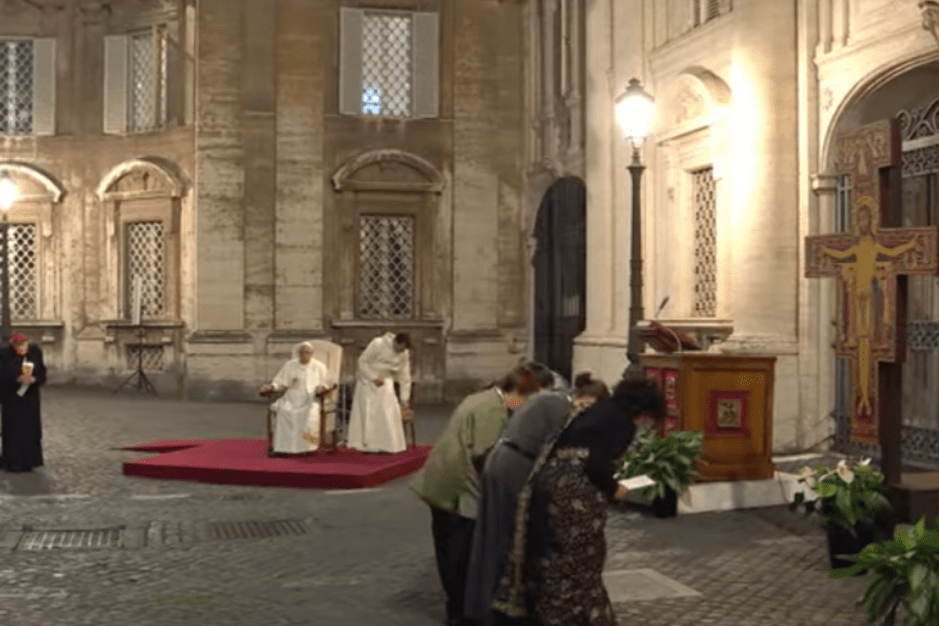
On October 11, the Pope led an ecumenical prayer meeting at a very special non-church venue: the Protomartyrs Square, an area right near St. Peter’s Basilica where the first pope is thought to have died. Francis excelled himself, managing to pack an unprecedented variety of blasphemies into one evening: continuing to promote the Masonic doctrines of religious indifferentism and naturalism, topped off by an egregious insult to every Catholic who shed his blood for the Faith.

The event marked the anniversary of the opening of the Second Vatican Council which the organisers of Francis’ vigil hailed as the beginning of a ‘new ecumenical era.’

For the theme of his reflection, Pope Bergoglio chose the phrase from John’s Gospel: “The glory that you have given me I have given them” (Jn 17:22). This expresses his belief that the martyrdom of early Christians like St. Peter, the shedding of their blood in that very place, had some mystical ecumenical significance.

The Pope continued by saying that the martyrs are ‘accompanying the Church on its ecumenical journey’ – another error with no basis in reality or in Catholic tradition. Unsurprisingly, Pope Francis quoted the arch-ecumenist, John XXIII, linking the pursuit of ecumenism to the unbelievably boring topic of synodality, saying “The journey of synodality… is and must be ecumenical”.

That bit does make sense. Since faithful Catholics are not fooled by either synodality or ecumenism, Francis has to go outside the Church to gain any traction. But that poses no problem when one has no belief in the primacy of Catholicism. When one can give away the bones of St. Peter or sign heretical documents with anti-Christians, then nothing is off the table.

It seems lost on the Pope that the martyrs died rather than compromise their faith to even one degree, let alone completely handing it to non-believers on a platter as he has chosen to do.

The Pope continued to spout his own ‘magisterium of Francis’: “Unity is a grace. We do not know beforehand what the outcome of the Synod will be, just as we cannot predict how the unity we are called to will fully manifest.”

Artist’s impression of how Bergoglio’s ‘unity’ will manifest

In another direct contradiction of Church teaching, Pope Francis claims that a so-called ‘ecumenism of blood’ is a witness of Christian unity to the world. ‘Ecumenism of blood’ is another of Francis’ imaginary theological principles. There really is no such thing. Christians do not achieve unity through martyrdom and this certainly was not the meaning behind Jesus’ discourse at the Last Supper. At least, if it was, then Gnostic Francis is the first Catholic in history to find this hidden interpretation.

Scripture and tradition clearly state that there is no salvation outside the Church. There is no unity when some Christians are outside the Church and others are inside the Church. Further, despite Francis’ many claims to the contrary, heretics can not be considered martyrs. [See note below this article for further explanation.]

St. Peter made this abundantly clear in 1 Corinthians 13:3, when he wrote,  “… if I should deliver my body to be burned, and have not charity, it profiteth me nothing.” Charity, of course, means to love God with all one’s mind and heart – including believing everything which has been taught by His Church. Anyone Christian outside of the Catholic Church is by definition, lacking in charity.

The attempted martyrdom by non-Catholics was the precise context of that famous doctrine, extra ecclesiam nulla salus, as first recorded by St. Cyprian of Carthage:

But if not even the baptism of a public confession and blood can profit a heretic to salvation, because there is no salvation out of the Church, how much less shall it be of advantage to him, if in a hiding-place and a cave of robbers, stained with the contagion of adulterous water, he has not only not put off his old sins, but rather heaped up still newer and greater ones! 

Pius XII reiterated the importance of membership in the Catholic Church in his Encyclical,  Mystici Corporis Christi,

“Actually only those are to be included as members of the Church who have been baptized and profess the true faith, and who have not been so unfortunate as to separate themselves from the unity of the Body, or been excluded by legitimate authority for grave faults committed.”

And these are only a few examples of the constant teaching of the Church prior to Vatican II. Francis’ ecumenical side-event reminds us of his true priority: the deconstruction of Catholicism.

While chancery bureaucrats enjoy their Roman holiday at the Synod, deluding themselves that anything they do will make a scrap of difference to the Pope, Francis puts on his Masonic-coloured lens: promoting religious indifferentism instead of preaching baptism to all nations and promoting the heresy of naturalism by pursuing his Utopian dream of ecumenism.

[NOTE ON NON-CATHOLIC MARTYRS: For a nuanced approach to this topic, consider this: They may have been true martyrs, but only before God (coram Deo), not before the Church (coram Ecclesia). They would be martyrs coram Deo, provided they were habitually willing to believe whatever the Church proposed if they had the means to know it, and it is not their fault. They would not be martyrs coram Ecclesia because only God knows the internal dispositions of a person’s soul at the hour of death. Now the Church can only make a pronouncement about external actions that can be known by one’s senses. Thus, she cannot publicly consider martyrdom something that only God can know, namely, that a person in the state of invincible ignorance decided in his heart, even if only as a desire, to belong to the Catholic Church and who died united to her.]