Articles

This French Mystic predicted the Adrenochrome trade

Blessed Marie-Julie Jahenny is well-known for her prophecies about the rise of a false Church and the Three Days’ Darkness, but a newly-released book on Marian prophecies includes rare predictions from the mystic which include references to cannibalism and the adrenochrome trade.

Adrenochrome, for those who aren’t aware, is the highly-prized nectar of the ‘elites’; a chemical harvested from the pineal gland of innocent children who have been deliberately terrified in order to increase its potency. It became mainstream after being mentioned by Johnny Depp’s character in the film, Fear and Loathing in Las Vegas. As this article mentions, though, it was referenced by Aldous Huxley, William Blake and others long before the advent of Hollywood.

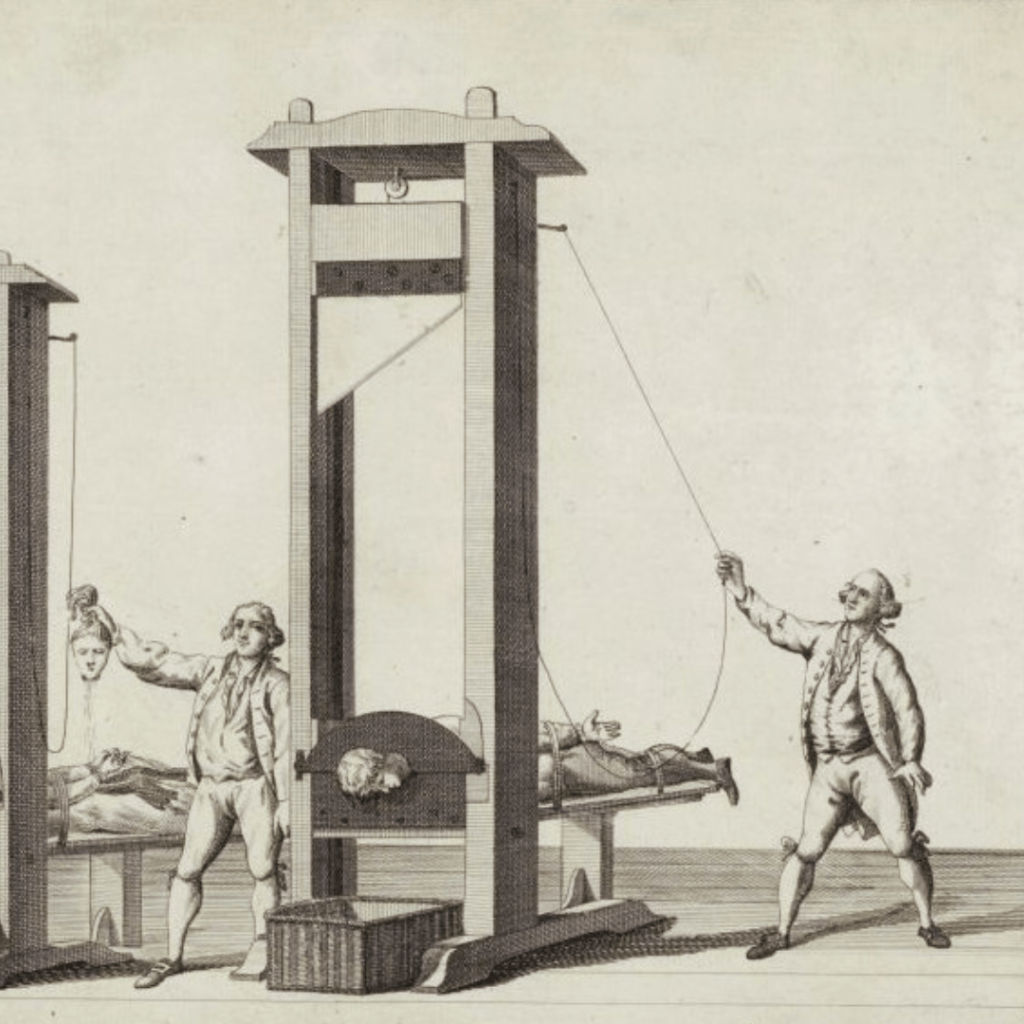
Marie-Julie also had some inspirations about other aspects of our civilisation’s decline, as if to confirm the abysmal state of this evil generation. She foresaw a totalitarian society complete with surveillance and detention, as well as a return to the use of the guillotine – that highly-favoured implement of French revolutionaries:

The strong political party will be the one of evil’s victory … the small number will fall under the thunder of these voices who call for the blood and the flesh of bodies to “stretch their instruments” as they say. The Christian judges will be replaced in every part of France. The people will have to submit to surveillers or being sent to prison and finish one’s life under cutting weapons.

(Julie-Marie Jahenny, Jan 1882)

The guillotine was developed during the French Revolution, & its results featured chillingly in the Olympics Opening Ceremony.
SOURCE Museum of the French Revolution, CC BY-SA 4.0 https://creativecommons.org/licenses/by-sa/4.0, via Wikimedia Commons

I have no idea about what “stretching their instruments” refers to, but when searching, I came across a technique used in genetic experimentation known as “stretching”. Whether or not this is related to the prophecy, there is no doubt that many of the chastisements seen by Marie-Julie Jahenny stem from the world’s obsession with Scientism and that realm’s fascination with cells stolen from aborted babies. Another quote:

…today it [the world] makes a hellish trade, the likes of which the world has never seen before … All is delivered up, everything is sold and new plots are being hatched every day. The hunger to devour human flesh, the thirst for human blood makes all their bodies seethe with unrest, and consumed with a desire to reach their goal as soon as possible.

(Julie-Marie Jahenny, Nov 1924)

So what is this “hellish trade” to which Julie-Marie was referring? Sex-trafficking? Abortion? Organ harvesting on an industrial scale such as goes on in China? She seems to be alluding to something more evil even than these.

Julie-Marie spoke of the “devouring” of human flesh and of the drinking of human blood. This is obviously cannibalism, vampirism and addiction to adrenochrome.

Nothing is more ‘hellish’ than knowing there are powerful adults who misuse innocent children for their own pleasure and profit.

These activities point to a civilisation on the brink of extinction; Hilaire Belloc, for one, believed cannibalism was the sign of a civilisation about to be annihilated. That certainly sounds like our Western culture and when the New York Times starts running articles about cannibalism, it is obvious that perversion has gone mainstream.

But we knew that, didn’t we? The Opening Ceremony of the Paris Olympics summed up the world’s obsession with perversion very succinctly. It has even been said, very insightfully, that it was the ‘Closing Ceremony of Western civilization.’

And here is something really bizarre: the article above tells of an episode of the TV drama, Lewis in which devotees of the false god, Dionysus were taking adrenochrome. Dionysus, of course, was represented by the ‘blue man’ of the Paris Olympics Opening Ceremony.

Whether you believe that adrenochrome is a real substance harvested by elites from terrified children, or whether you think it is Q-Anon bunkum, one thing is for sure: God can’t be too happy with the current state of things on earth. The transexualism, perversion, abortion, organ harvesting and violence predicted by Blessed Marie-Julie Jahenny a hundred years ago have all come to pass.

And if that isn’t worthy of divine intervention, then nothing is.

NOTE: this article was updated August 7th, 2024.

IMAGE CREDITS: Eduardo Hidalgo Downing, CC BY-SA 4.0 https://creativecommons.org/licenses/by-sa/4.0, via Wikimedia Commons; https://upload.wikimedia.org/wikipedia/commons/d/d6/Maria_Julia_Jahenny.gif

New Age/Occult Symbols

unless otherwise noted, this information is Taken from ‘The Hidden dangers of the rainbow’ by Constance Cumbey.

The New Age Movement has several important symbols for identification and mystical (hypnotic) use. They are not all used simultaneously, but all are in current use within the Movement.


The Rainbow

(also called the Antahkarana or Rainbow Bridge)/ This is used an a hypnotic device. They also call it an ‘International Sign of Peace.’ They claim they are building a rainbow bridge between the personality (you) and the over-soul or Great Universal Mind (literally Sanat Kumara, i.e., Lucifer!) See Isaiah 24:5 which states that one reason the Lord is destroying the earth in the latter days is for breaking the everlasting covenant. The rainbow is the sign of the everlasting covenant according to Genesis, chapter 9.


The Triangle

The information in this section comes from Tradition in Action.

The triangle is an ancient symbol venerated since pagan times, as representing the harmonious balance of Earth, Sky and Sea. Although they were misguided in their interpretation, their reverence for the triangle reveals some truth that God placed in the human understanding, which reached its plenitude in the Holy Catholic Church.

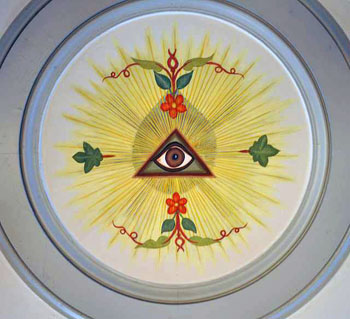
An eye was sometimes added to the center of the triangle to symbolize God’s omniscience as the all-seeing Father watching over His creatures through His Divine Providence, as expressed in the Holy Scriptures: “Behold the eyes of the Lord are on them that fear Him: and on them that hope in His mercy.” (Ps. 32:18)

At right. Eye of Providence on the gallery of St. Gallus Church in Kappel, Germany.The eye of God is also a reminder that, “the eyes of the Lord in every place behold the good and the evil.” (Prov. 15:3) And so, trying to destroy God’s Holy Church the Devil has attempted to mock His omniscience by setting up his own secret societies that fight against the Church.

Kappel eye

New Age/Occult Symbols

Freemasonry stole the symbolism of the eye in the triangle from the Church and adopted it to symbolize the “Supreme Architect of the Universe” and “bestower of light.”

The “light,” which their “Architect” proposes to bestow on his initiates is the light of Gnosis, that pretense secret knowledge that masonry reserves for select members who pass into the higher Orders. The real “god” of the Masons is Lucifer, their Architect who enables the enlightened Masons to become architects of a new world based on equality, fraternity and liberty.

But despite all of their efforts, they themselves are ever under the power and eyes of the Holy Trinity. Their true wretchedness will be made manifest at the Day of Doom: “Behold the eyes of the Lord God are upon the sinful kingdom, and I will destroy it from the face of the earth.” (Amos 9:8)

New Age/Occult Symbols


Rays of light

They represent the seven rays believed to exist in nature and in the rainbow.


The Cross

One version has diagonals placed against it.


The Circle

  • with a point in the centre
  • Centre-ing Symbol: a series of progressively smaller circles within a larger circle leading to a dark and distant (or light and distant) centre
  • divided into two
  • divided into four


The Swastika


The Number 666

Some believe this number has sacred qualities and that by its frequent use, the coming of the Antichrist will be hastened.


Pegasus/Unicorn.


SOURCE: ‘The Hidden Dangers of the Rainbow’ by Constance Cumbey Click here to buy the book. (Please note that I derive a small commission from sales made through this link.)

Pope Francis Has Rupnik’s Art in His Apartment

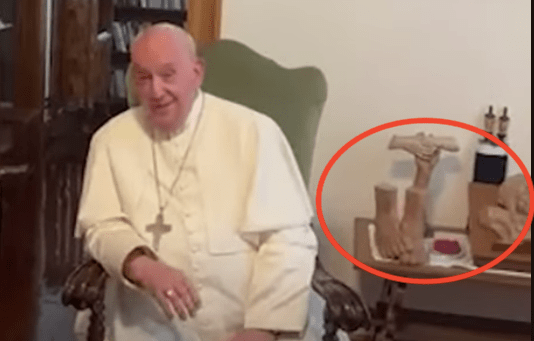
As Catholic media has reported the Pope is hanging artwork from the notorious sex-offender Marko Rupnik in his private apartment at the Santa Marta.

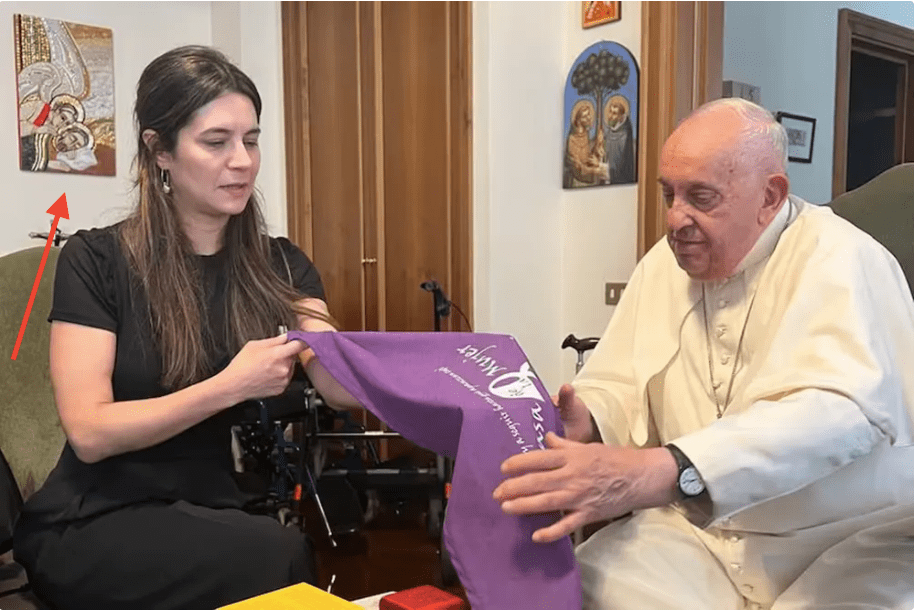
The image in question can be seen in a Youtube video made by Canal de la Cuidad (City Channel), posted on August 8, 2024. The video is entitled Pope Francis met with victims of Alfredo Astiz – although they aren’t exactly victims of Astiz. More about that shortly.

Image source: El Observador

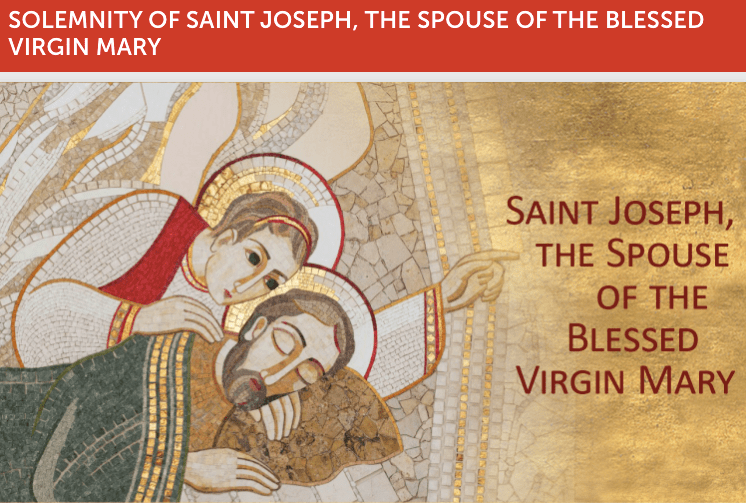
The image indicated above is unmistakably by Rupnik, with its telltale dark, soulless eyes. It is identical to the one shown below: an angel rousing St. Joseph from his sleep. Controversially, Vatican News has so far refused to stop using Rupnik’s images and this one appeared on its website for the feast of St. Joseph, Spouse of the Virgin Mary on March 19 of this year.

Now to the connection Alfredo Astiz connection. Astiz was a prominent military commender during the Argentine Dirty War (1976-1983.) He was later charged with crimes against humanity and sentenced to 19 life sentences for human rights abuses.

The video from Canal de la Cuidad was related to Astiz’ victims. It shows Pope Francis speaking with a young woman by the name of Anita Fernandez, the grand-daughter of Esther Ballestrino de Careaga , who was a left-wing activist executed under orders from Alfredo Astiz.

Ballestrino had been a great friend of Jorge Bergoglio: she was his supervisor when he worked at the Hickethier-Bachmann Laboratory in Buenos Aires. Ballestrino was an avowed Marxist and had a great impact on the young Bergoglio. George Neumayr’s Political Pope recounts Fr. Bergoglio’s thoughts on Ballestrino:

“I owe a huge amount to that woman; she taught me so much about politics. She often read Communist Party texts to me and gave them to me to read…..I realised a few things, an aspect of the social, which I then found in the social doctrine of the Church.”

After his ordination, Ballestrino called Fr. Bergoglio asking for the Last Rites to be given to a family member, even though she was personally an atheist. When Fr. Bergoglio arrived, he was told that Ballestrino in reality wanted him to dispose of the Communist literature which would incriminate her in the event of a raid. Bergoglio acquiesced (one source claims he took these books to a ‘Jesuit library’) but despite this, Ballestrino was eventually detained and ‘disappeared’.

By the time her body was found, washed up on the beach after being thrown from a plane, Bergoglio was Archbishop of Buenos Aires. Even knowing that she was a Marxist, he had her buried in the garden of the church of Santa Cruz. So, while Alfredo Astiz was not a good person, and while throwing Marxists from planes is quite inhumane, Ballestrino wielded an evil influence over the young Bergoglio, helping to form, so to speak, the anti-capitalist and humanist tendencies which are apparent in him today.

{NOTE: One more detail about the Papal apartment: this rather bizarre set of decorations are found to the Pope’s left in the video. They are quite strange and bring to mind Jago – that other sex-fiend artist who has been mentioned in these pages.}

Was John XXIII Really Initiated into the Rosicrucians?

stories of pope John’s occult involvement abound, but it is only recently that i have begun to take them seriously. some of you may think i am foolish for even considering the prospect.

As time has gone on and I have undertaken more research, this accusation seems somewhat more credible than it first appeared to be. Certainly, to my knowledge, Rome has never put out a statement denying the story of John’s occult initiation.

The following is taken from Pier Carpi’s ‘Les Propheties du Pape Jean XXIII’, which was written in the late ’70’s. Along with the alleged prophecies is an account of the Rosicrucian initiation ritual apparently undertaken by Angelo Roncalli when he was stationed in Bulgaria.

I present it here for you in the interests of pursuing the truth about Pope John, the Council and the influence of the occult on the Church during the twentieth century.

We pick up the story at a conversation between Carpi and an occultist. (The text has been run through an online translation tool so may be a bit rough in places.)

The old man took up the document and put it back in the azure blue napkin. “I must not add anything to that. You will have understood the fundamental importance of this table. It constitutes a real restoration of the esoteric tradition that allows the initiates to be free initiators. To choose their disciples, to to form the chain — down through their descendants.”

I knew the tradition but I knew nothing about this document and the reality of the meeting between the three masters in Paris. The old man put down his napkin, got up and went to the window, set aside the white curtains that hid the night, as if he was looking for someone or something in the darkness. He turned around, stood and looked at me. “The evening I met you in Saint-Léon, I told you about the books of ‘T’ and ‘M’.”

“You told me that, like my other friend, you had read them in a dream”.

“If it can be called a dream. Alas! We must use secular terms that betray the content of our thought. However, I feel that we understand each other. If I am here, it is because I have something else to show you, something that needs to be disclosed, that must be made public. But, before I demonstrate it to you, I must tell you the facts.”

He returned to his seat, took up his napkin, which he pressed still more tightly against him and stared at me intensely: “I have to tell you about a man that everyone knows. Angelo Roncalli.”

“John XXIII?”

Here we pause to consider the motivation Carpi may have had for writing a book about John XXIII. By this time, John had been dead for almost fifteen years so it could not undermine his papacy. Carpi does not attempt to taint John’s legacy: from the point of view of an occultist, the book actually benefits John’s image. This leads us to wonder if Carpi had no other motivation than to tell the truth.

He hesitated for a moment, his eyes half-closed: “Jean,” he murmured. “1935 ….. Life was not easy for Angelo Roncalli, Archbishop of Mesembria, delegate in Turkey. Like all other religious, he was made to wear civilian dress, because of persecutions. Under constant surveillance, it was difficult for him to move: the spies were everywhere. Yet all those who approached him at that moment found in him a great serenity, which was not only that joy which he knew so well how to transmit, especially in difficult times.

“It was precisely at this time that his first contact with the unknown world took place.

“That evening Angelo Roncalli hastily retired to his apartments, as if he had an appointment. He lay down on his bed after undressing without the help of anyone – he had always done so and was to continue to do so, even when he became pope.

“Before turning off the light, he looked at the pictures on the walls, images of the extended family. He closed his eyes and, while continuing his prayer, all the faces encountered that day flashed through his mind, especially those of the most humble people. Could he have expected it? More faces, smiles, sad eyes. Then sleep invaded him. But he would never know if it was really sleep. He had an appointment with the old man of sleep.

“Six nights in a row he had seen him. It was the seventh. The most important and perhaps the last.

“He appeared; old, very white hair, thin face, dark skin, eyes sweet and piercing.

” “Will you be able to recognize me?” he asked.

” “Always, master.”

“Then, suddenly, the sacred books of ‘T’ and ‘M’ appeared in his hands. He leafed through. Inscribed on paper, knowledge, the words of knowledge, in a a language that Angelo had never known, never read before. But from his first rendezvous with the old man, in a dream which was perhaps not a dream, Angelo had known how to decipher it.

“He read and everything became simple. God, how simple everything was, how clear everything was! If the other men might have known, the world could have been very different. But Angelo realised it was not given to everyone to know, because these things could be dangerous. Only a few could give them a correct meaning, use them to the good of all. In malevolent hands, they could become terrible weapons against man.

“The two books closed. An intense light illuminated their covers on which were inscribed the two silver letters in relief – a light like the one Angelo felt within him. Impalpable, intransmissible by the poor instruments at man’s disposal; for millennia, has man not renounced forces, powers, and knowledge to replace them by a way as difficult as it is useless?

” “Now you are ready,” said the old man. “And you’re on your way. I came because you called me. Now you know. But you still have a lot to learn, to see, to live. That’s why we’ll see each other again.”

” “I’m waiting for you, master.”

“The old man smiled. “Will you be able to recognize me?”

“He repeated the same question three times. Three times Angelo gave the same answer. Then he woke up. He was alone in his room. He got up from the bed, went to the table, took some sheets of paper of paper and a pencil. He tried to write down what he had read in the books of knowledge. But his hand remained inert, his mind empty.

“It was not possible. Words did not exist. Yet he had something in him – something that no one, could ever erase. That light had made him another man. He knew that the dream would never happen again. That the old man would return, but in reality. What else awaited him? He was not afraid because he knew he was on the the right way, that of the Good. He put down the pencil and thought.

“He thought of the saints, the mystics, the men of faith, of the Church, men of truth and of peace. He took pleasure in remembering St. John the Evangelist, St. Anthony, St. Albert the Grand, St. Teresa, St. Francis. He rose, stopped in front of the crucifix, knelt down and prayed to the Virgin Mary for a long time.

“She too had an apparition. Was it not in a dream that her destiny was fulfilled, when someone appeared to the sleeping Joseph to explain to him, in very simple words, the greatest of mysteries of faith, of all humanity?

“He felt happy. And for the first time that night, he knew that someone was praying for him, in a big secret way.”

The old man had finished his story. I looked at him: “They met?” I asked.

He confirmed it. Seven days later, to be exact. Angelo Roncalli celebrated the sacraments in his humble house, before an even more humble community. While the others were going to work before lunch, Angelo went downstairs. In the hallway, sitting on a chair, stood the old man of his dream. No one had heard him knock or ring. But Angelo didn’t even wonder how he could have gotten in. He approached him and kissed him, as one embraces a brother who returns after a long absence. He invited him to his table but the other shook his head, smiling: “We must sit at a completely different table,” he said. Angelo looked at him. As the old man of his dream had asked him, he had immediately recognized him, and he listened.

“Are you ready?”

“I don’t know”.

“Then you are.” Leave everything and follow me. He followed him, without telling anyone. For a long time they marched through the deserted city. The old man stopped in a small narrow square, with its low houses. He who, until then, had guided Angelo, turned and said:

“Since you are ready, since you will soon be my equal, since the path we have to follow will be the same, you know it too. It is now up to you to lead me.”

Angelo hesitated, looking around him. The man encouraged him:

“Let’s go”.

He advanced and chose without hesitation an alley, and entered it. Behind him, he could hear the footsteps of the old one. He stopped in front of a door of rough wood.

“Is it there?” he asked. The other smiled.

“Push the door, it’s only half closed. Climb up the stairs and don’t wait for me”.

Angelo let himself be led by the voice he felt within him. He climbed two small staircases in almost total darkness, found himself in front of a new door, even smaller and lower than the other, and pushed it. It was ajar and he knew it. He entered.

The room was large and pentagonal. The walls were bare. There were two large windows, closed. In the middle of the room, there was a large cedar table, also pentagonal. There were three chairs, leaning against three of the walls. On the chairs, a linen tunic, coloured belts and envelopes sealed with red. On the table, a Bible opened at the beginning of the Gospel of Saint John. There was a flaming sword with silver hilt; a censer; coloured ribbons; two bronze candelabra with three branches, each bearing three red candles. Then the magical and esoteric symbol of the Order to which Angelo would shortly be initiated. Under the symbol, there were three crossed roses, made of fabric. One white, one red, one black.

The only dim lighting came from the three candles lit on one of the two lampposts. The others were extinguished. Angelo stood in front of the table. He looked at these objects, which, since he had read the sacred books in his dream, meant many things to him. He hardly dared to touch them. He began to read the first chapters of the Gospel of St. John, which had always fascinated him; he had, moreover, penetrated its most secret keys.

He detached himself from it when he heard light footsteps behind him. It was the master, who smiled. He had recently entered the room, behind him the door was closed. He wore a long linen tunic – the protective fabric of any initiation ceremony – down to his feet. Around his neck, there was the magic symbol of the Order, in silver, hung at the end of a chain fromTemplar knots. With his hands gloved in white, his head bare, he approached, and without ceasing to smiled, placed a hand on Angelo’s right shoulder:

“Kneel, on your right knee only”.

Angelo obeyed, and the ceremony began.

The master gave the meaning of each object, explained their symbolism. He took sealed envelopes, opened them and read their contents. On a sheet of blue paper were the ancient regulations of the Order. He opened another envelope, handed the sheet of paper to Angelo, who read what it said: seven questions.

“Do you feel able to answer them?” the master asked him.

Angelo replied in the affirmative and gave him back the paper. Then with the help of a candle, master lit the candles of the second candelabra.

“These lights are for the masters of the past who are among us”.

He put incense in the censer, purified the room by its four corners: then he turned three times and at each turn waved it three times. He returned to the table, and placed his hands on the profane man’s head and began to speak. He told him the mysteries of the Order. He asked questions. He received answers. At last the old master bent over him.

“As you know, we call each other by the name we have chosen. Each one thus signs his freedom, his work program, the new link in the chain. What will your name be?”

The layman did not hesitate: “John.”

Here, we pause to consider the name that Angelo Roncalli chose for himself on being elected as Pope. It was John XXIII. That name had in fact been used once before: by an antipope in the fifteenth century. That John XXIII was eventually tried for  “piracy, rape, sodomy, murder and incest” with “the more scandalous” charges being “suppressed”!!

We continue our narrative, making note that the ‘peculiar and complex ritual’ is the great Secret of the Rosicrucians, something so depraved and unnatural that it cannot be mentioned outside of the brotherhood.

“John”, repeated the master. And he then undertook the peculiar and complex ritual of the initiation ceremony.

Finally, he put his sword on the neophyte’s head. At that moment, some new, elusive thing happened in John, something exploded in him. He was quite stunned and confused while reaching the height of serenity and happiness.

“What you are experiencing at this moment, Brother John, many others have experienced before You: Myself, the masters of the past, the other brothers around the world. That thing, call it Light, but it has no name”.

The master helped the disciple to his feet, kissed him seven times, and exchanged fraternal greetings with him. Then he taught him the secret words, the signs of recognition, the touching, the ritual of group work. Verbally, according to tradition.

He then taught him the daily rites to be performed at three very specific moments of the day — which correspond to the three points of the operation of the sun — and in the most great secret, a Greek sentence and gestures to repeat.

“At these three moments precisely,” explained the master, “our brothers and sisters all over the world make the same gestures, say the same sentence. Their strength is great, it comes from afar and is goes very far. Day after day, it acts on humanity.

Finally, the master took the last envelope, opened it, and read its contents to John. On a sheet of paper was inscribed the formula of the oath: an oath not to reveal the secrets of the Order, to follow tradition, to always act for good, to be always strong, to help the brethren and the unfortunate, to respect above all the law of God and his ministers.

Without hesitation, John signed at the end of the formula. He was animated by great strength. Near his signature, he wrote the number and the acronym that the master indicated to him. These two elements codified his initiation and rank. The master took the sheet back, folded it seven times, and asked the disciple to put it with the tip of his hand onto the flaming sword. This was done.

The master brought the sword close to the candelabra where it was burning the candles for the masters of the past; the fire licked the paper. In a few seconds, the Oath was taken, reduced to ashes which the master scattered. “You have sworn, John, but know that the freedom of the brothers is far superior to all oaths. Today, you really know what freedom is. He kissed him again. John began to cry.

The last consideration I will present here is that even if the described events did not not involve Angelo Roncalli, they do offer us an insight into the diabolical world of the mystery religions. We catch a glimpse of the mindset of those involved: their disdain for true religion, their arrogance in believing that the occult offers a solution to life’s problems that is superior to that of Our Lord Jesus Christ, Who is the Way, Truth and the Life.

IMAGE CREDIT: Abzeronow, CC BY 4.0 https://creativecommons.org/licenses/by/4.0, via Wikimedia Commons
The Anti-Marian Current at Vatican II

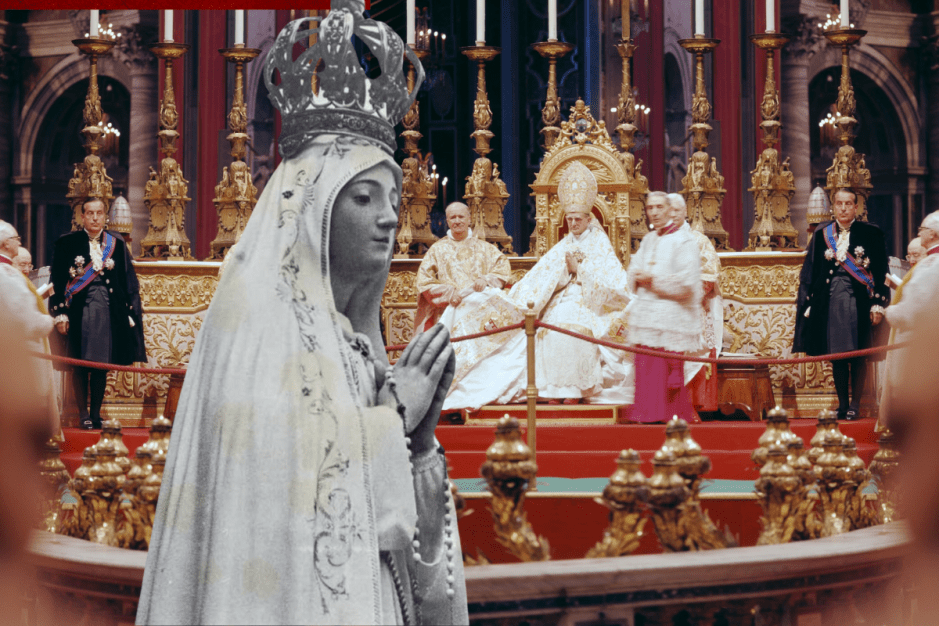
It is widely acknowledged among traditionalists that the Second Vatican Council contained many elements which were designed to appease non-Catholics. This is most obvious in the changes which were later made to the Mass and the failure to condemn Communism at the time of the Council itself. However this non-Catholic appeasement also worked in an extraordinary way against devotion to the Mother of God, who was in many ways directly insulted by the progressive Council Fathers.

While the main reason for this was the all-pervading Masonic ecumenism of the Council, two lesser motives were also at work. One of these is a Modernist trend toward denigrating miracles. Modernists do not mind acknowledging Our Lady as an historical fact; after all, there is little doubt that She was a real person who existed in time and gave birth to Jesus Christ. Other religions and cults also venerate the mother of their prophets. But Modernists are less tolerant of miracles associated with Our Lady: Her apparitions, Her messages and especially Her appearance at Fatima.

A second factor at play is the significance placed on the female type by occultists. The ‘Sacred Feminine’ is important to the Rosicrucians, for example, where Our Lady is blasphemously referred to as one of the ‘Great Women Initiates.’ The Pachamama incident at the Amazon Synod was another reference to this female type. Pachamama is a version of Gaia, the earth goddess, who is venerated by Wiccans and climate worshippers as well as by tribalist pagan cults.

These motives led the progressive element among the Council Fathers to downplay or ‘cancel’ the Mother of God in three main ways. The first was in regard to the proclamation of Our Lady as Mediatrix. There had been a movement among orthodox prelates to have the Mother of God honoured by the proclamation of the Fifth Marian dogma: that She is Mediatrix of all Graces. Many bishops and countless faithful were optimistic that this would be proclaimed by John XXIII at the Council, but the good bishops’ campaign was thwarted at every opportunity. Petitions in favour of the proclamation were not delivered to the correct authorities and speeches bordering on blasphemy against Our Lady were delivered during Council sessions.

The second insult was in regard to Fatima. Readers will recall that the Virgin Mary, through her messenger, Sr. Lucia of Fatima, asked that the Third Secret be revealed by the year 1960, that is, at the latest, under the pontificate of Pope John XXIII. It is known that John read the Secret in August 1959 by which time, preparations for the Council were well underway. After reading the message from Our Lady, John stated, “This does not concern the years of my pontificate.”

These are remarkable words, considering that several sources claim the Secret refers to an evil Council! It is worth remembering that the convening of an ‘evil Council’ was also among the predictions made by the occultist and Synarchist, the false priest Roca.

Even if the Secret contained no reference to a Council, John deliberately disobeyed the Mother of God by failing to make its details public. He further added to the disobedience by failing to consecrate Russia to the Immaculate Heart and formally promulgate First Saturday devotions.

To further disrespect Our Lady, Pope John insulted Her in his Opening Speech to the Council in October 1962. The speech, which had heavy input from Cardinal Montini, the future Paul VI, contrasted John’s highly optimistic aggiornamento with the attitude of the so-called ‘prophets of doom’. This was a clear reference to the children of Fatima who carried Our Lady’s message, as well as to those conservative bishops and Cardinals who were concerned about threats to the Church and to the world at large. John XXIII criticised those who dwelled on ‘ruin and calamity’, echoing the words of the Fatima seers who saw in a vision that ‘the Holy Father crossed a large city half in ruins.’

The insults to Our Lady did not end there, however. The final part of the campaign to denigrate the Mother of God was the denial of the dangers of Communism. It is well-documented that John XXIII made a secret pact with the Communist-run Russian Orthodox Church prior to the Council. John, always anxious to boost his ecumenical credentials, wanted Russian Orthodox ‘observers’ at Vatican II. The Orthodox agreed – but only on condition that there was no condemnation of Communism from the Council. Encouraged by Montini, John went even further, ensuring there was no mention of Communism at all, despite many petitions from the prelates present.

As the Abbe de Nantes wrote, “The greatest Council of all time (supposedly) would therefore remain deaf and blind to the greatest phenomenon of inhumanity of all time: the global expansion of Bolshevism. Thus did it secretly lend its aid.”

Once Montini was elected Pope after the death of John XXIII, this anti-Mary agenda became even more clear. Throughout 1964 particularly, there were many attempts by the more conservative prelates to have Russia consecrated to the Immaculate Heart in the presence of all the world’s bishops. There could have been no better time for such an event as the Bishops were already gathered in Rome for the Council’s next session.

But instead of taking the opportunity to consecrate Russia while all the world’s bishops were present, Paul VI ignored the pleas of the hundreds of Bishops who heeded Our Lady’s warnings. By the end of 1964, however, as Pope Paul could see the damage already being wrought by his reckless Council, he made one small concession: Paul ‘recalled’ the Consecration made by Pius XII in 1942, while declaring Our Lady “Mother of the Church”.

Of course, this feeble response could in no way be said to fulfil the requests made by Our Lady at Fatima.

So it was that Popes John and Paul presided over a Council during which there was a concerted effort to insult, disrespect and denigrate the Mother of God. By refusing to condemn atheistic Communism, the Progressive Popes took the insult even further by refusing to acknowledge the greatest danger posed to the world, one which had precipitated a Divine visitation to earth in the form of the apparitions of Our Lady at Fatima.

REFERENCES:

“vatican council II and the fatima revelations” by the Contre Reforme Catholique

Timely Reflections on the Third Secret | The Fatima Center

The Whole Truth about Fatima – Vol III (click here to purchase)

IMAGES: Lothar Wolleh, CC BY-SA 3.0 https://creativecommons.org/licenses/by-sa/3.0, via Wikimedia Commons; https://upload.wikimedia.org/wikipedia/commons/9/95/Our_Lady_of_Fatima_1968.jpg

When a Shrine to Lucifer appeared in a Brisbane Cathedral

Although some us have only recently come to see the influence of the occult underlying the Church’s most serious problems, there are others who saw the dangers years ago and tried to alert fellow Catholics to the danger. One of those faithful pioneers was Tim Pemble-Smith. Through his publication, News From the Pews, he and his colleagues set out to expose Freemasonry and other occult forces with the Archdiocese of Brisbane, in Queensland, Australia.

The following is from Issue 24 of News from the Pews, dated 28 April, 2000. It explains the occult meanings behind an art installation which was once placed inside a chapel at St. Stephen’s Cathedral in Brisbane. At the time, the chapel was dedicated to “The Human Search for God”, but has since been redesigned and dedicated to St. Mary McKillop.

After much public outcry, and largely due to pressure from Mr. Pemble-Smith and his colleagues, the installation was removed. Strangely, no records of this artwork exist online, neither from the indigenous artist, Fiona Foley nor the Cathedral. For copyright reasons, this article contains no photographs from the shrine.

Article begins:

‘Devil’ Shrine in St. Stephen’s

Over the past two years, this newsletter has exposed many hidden demonic messages contained in The Human Search for God shrine in St. Stephen’s Cathedral. Yet, the shrine has not been closed down and requests for an enquiry have been ignored….The Church admits that the shrine contains “systems of meaning”, but neither the artist nor the Church has explained those meanings. In this issue, we re-examine the artwork and see how it corresponds with the writings of the ‘devil-worshipper’ Aleister Crowley.

Influence of Crowley

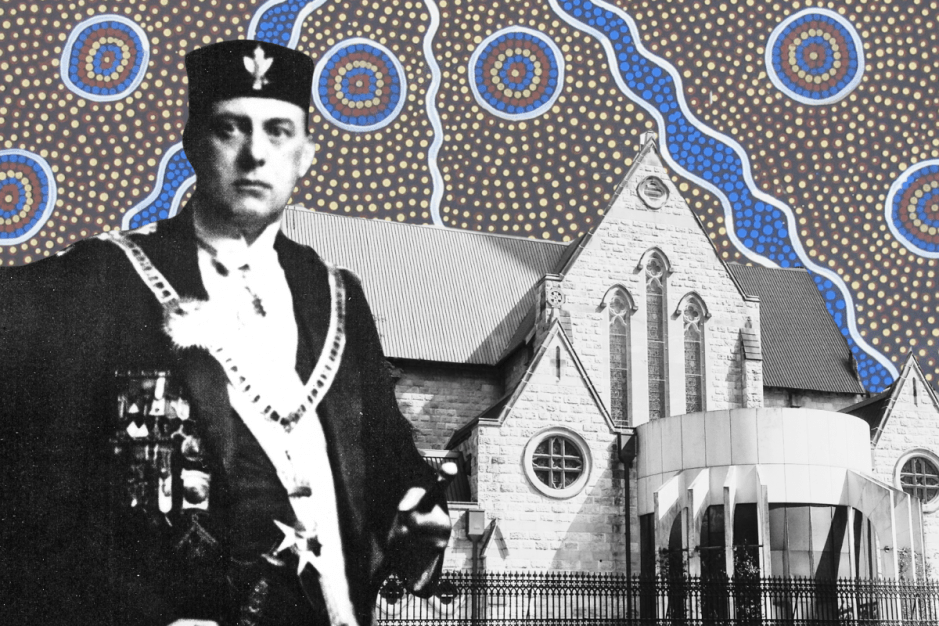
Although he died in 1947, Aleister Crowley was the most influential occultist of the twentieth century. He was a self-proclaimed devil worshipper and sex and drug fiend. His book, 777 and Other Qabalist Writings of Aleister Crowley, sets out a system of elaborate codes to disguise the meanings of references to the occult. For example, the use of numbers is prevalent in much the same way as a codebook shows the disguised meaning of a message. Crowley created his own cult to worship the devil and wrote books setting out the way to practice his religion. Today there are many believers who follow his methods.

Artwork in Shrine

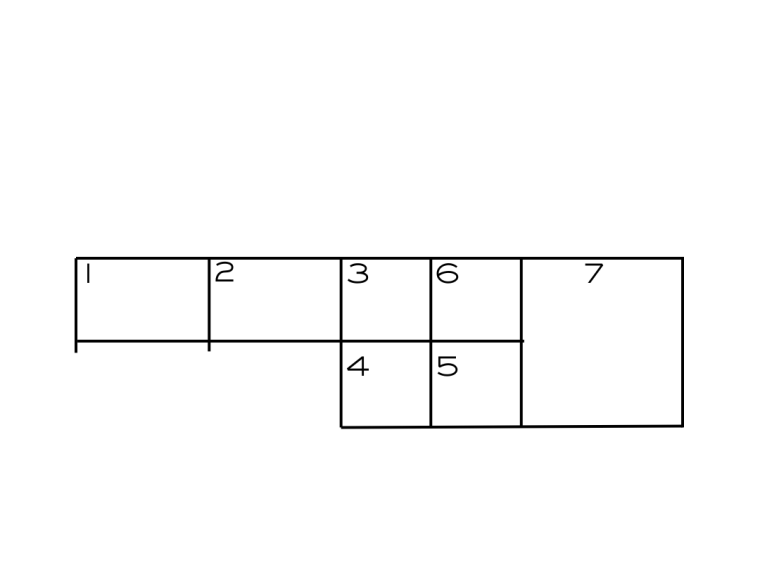
To a person unfamiliar with Crowley’s methods, the artwork presents a series of abstract images. There are seven panels of artwork in all, with four, square, central panels. The panels are all dark. You see a blood moon, a dog, a black luminous disc, and dark blue moon, leaves, pipi shells, fish etc. Certain images are repeated. Perhaps the first thing you notice is panel 1.

The dog in panel 1 stands out. Crowley used the dog as a reference to the Christian God. In Crowley’s system, “dog” is simply “God” spelled backwards. Crowley revelled in the use of wordplay, ie, a play on words. It should be noted that in the Courier-Mail (newspaper) article, Ms Foley is reported to have admitted to using reverse spelling in her art.

A Crowley follower who is familiar with Ms Foley’s other art, will recognise the dog in Panel 1 as the one in Ms Foley’s other work, “The Three-legged dog day.” They would also notice the 7 stars in the left corner in the pattern of a crescent. Cycles of the moon are commonly references to witchcraft. It is a classic Crowleyan reference. As Crowley said, “The best blood is of the moon monthly: then the fresh blood of a child…”

Multiple uses of Images and Shapes

A follower of Crowley will also be looking in the shrine for any repeated images or shapes. Multiple uses of images or shapes could point to Crowley’s codes. The Crowley follower would quickly note the central group of 4 square panels arranged into a larger square – panels 3, 4, 5, & 6.

Functions of Four: Alchemy

The Crowley fan knows that any ‘functions of 4’ are likely to point to alchemy, the ‘black art’ of attaining spiritual union with the devil. In the shrine there are many: the 4, square, central panels arranged to form a larger square, the 4 fish swimming, a group of 4 shells, a 4-part skeletal fish image.

The Crowley follower will know that if these panels relate to alchemy, the four central panels should represent the four elements of alchemy – earth, air, fire and water.

It is clear that panel 4 represents the red earth and that panel 5 represents water. The circular, black disk in panel 3 has a distinctive luminescent quality. It does not reflect light as the moon does, it’s black light comes from within. The Crowley fan will recognise this as Crowley’s vision of a ‘black sun’ – a reference to the abyss (hell) and to the dark angel of the abyss, Lucifer – the light bringer. Panel 3 is the fire panel.

Panel 6 presents the blue moon in the night air. This is the air panel. Air and earth panels are thus, as required, located diagonally opposite each other, as are fire and water. So the four square panels represent the four elements of alchemy, in a way, which – via the black sun – can be referenced to Crowley, the ‘abyss’ and to Lucifer.

Further, panels 3 and 6 present the sun and the moon opposite each other, “in balance”: symbolic of alchemy, as Crowley says.

Fish: Alchemy

Ms Foley presents four fish swimming in panel 5. The number 4 here is symbolic of alchemy. In 777 Crowley also links fish to alchemy. The fish are presented swimming in iridescent water. In 777, Crowley connects iridescence of water and alchemy.

Shells & Leaves

In Crowley’s system, the number ‘777’ itself represents his “world of the shells”, “demon-world” or “abode of the evil spirits” which are called the “shells”. Note that there are 17 shells in panel 4 and 4 more (4: alchemy again) in panel 5 – in total, 21 shells. 21 shells is a way of presenting 7, 7, 7 shells – a reference to Crowley’s codebook 777.

Ms Foley also presents five ‘V’ or heart-shaped, yellow brown leaf images, 3 in panel 4 and 2 more immediately above in panel 3. Reading downwards, this is ‘VVVVV’, Crowley’s signature contraction of the Latin used in reference to himself as ‘Master of the Temple.’ In Crowley’s system, the number 5 corresponds with the heart. Five is also Crowley’s number for sulphur, the yellow brown substance said to be used in alchemy. Crowley linked yellow brown with the ‘earth nature’ of his imaginary ‘camel’, which he says is the ‘means of travelling through the wilderness of the abyss’. As to the heart, Crowley states in 777 in reference to the invocation of his ‘Holy Guardian Angel’ (the devil) that “the human heart is the foundation of the work”.

Foley’s combination of 3 leaves and 17 shells in panel 4 (Remember there were exactly 17 shells in panel 4, for yet another reason; it was not simply coincidence) and 2 leaves in panel 3 immediately above is also significant. In 777, Crowley uses the numbers 2, 3 and 17 to derive a reference to the ‘Angel of Venus’, who is Lucifer.

Is it a shrine to the devil?

This otherwise unexplained shrine speaks for itself. The images and codes it contains correspond all too perfectly with Aleister Crowley’s writings. The parallels are too many and detailed to be mere coincidence. So, is it likely that the reluctant-to-comment Foley “Had never even heard of Crowley”?

HutheMeow, CC BY-SA 4.0 https://creativecommons.org/licenses/by-sa/4.0, via Wikimedia Commons

Wikicommons, author unknown: Aleister Crowley in the garments of the Ordo Templi orientis (OTO)