Articles

Rampolla: Worse than a Freemason

The figure of Cardinal Mariano Rampolla is well known among those who take an interest in the inner workings of the Roman Curia, especially in events surrounding papal conclaves. He was famously very close to being elected Pope after the death of Pope Leo XIII in 1903, when he was vetoed on behalf of the Austro-Hungarian Empire.

At that time, only three nations retained that ancient power of veto: Austria, Germany and Italy. Even so, Emperor Franz Joseph had been reluctant to intervene in such a solemn matter. He had no choice, however, once presented with evidence that Rampolla was at least associated with Masonry, if not a fully-fledged Freemason himself.

The evidence came from Monsignor Jouin, founder of the International Review of Secret Societies; a priest who dedicated his life to exposing Masonry and its associated ideology. It is said he went first to the Cardinals, but was ignored and so he took his evidence instead to the Emperor.This led to the saintly Pius X being elected instead of Rampolla.

There have been attempts to play down the role of Cardinal Mariano Rampolla in this matter: written histories vary as to the reason behind the veto, with some historians, even Catholic ones, concluding that the intervention was merely political. Some go so far as to accuse the Emperor of vengeance: after son had tragically died, apparently by his own hand, it is said that Rampolla denied the boy a Christian burial.

However, after Rampolla’s death in 1913, hard evidence implicating him in Masonry was discovered by the Curia. Papers confirming his membership were shown the Pope Pius X, who ordered them burned, ostensibly to protect the reputation of this ghastly man. Surely no favours were done to the Church or to the faith of Her members by covering up Rampolla’s true allegiances. Ecclesiastical Freemasonry in the Curia has only flourished from that point forward.

In 1929, Rampolla’s betrayal was corroborated by a Bishop Marty in an interview with Felix Lacointa of the newspaper, The Anti-Revolutionary Bloc. Bishop Marty stated that he had been told by Cardinal Merry dal Val, Secretary of Sate to Pius X that the Pope had indeed viewed and then destroyed the incriminating papers. [Cited in L’Église Éclipsée by Georges Vinson.]

What makes Rampolla’s case even more serious is that the specific cult in which he was involved was the Ordo Templi Orientis or OTO. This cult is a blend of Masonry and Rosicrucianism, with a strong focus on magic and Rampolla is said to have achieved a very high status. While a man may join Masonry without fully realising what he is doing, the same cannot be said about the OTO. It is possible to potentially complete multiple rituals and levels in Masonry without understanding that one in fact giving one’s allegiance to Satan, believing that one is simply doing one’s best to be a good person by acknowledging God, albeit in the vaguest sense possible.

However, the OTO is something different. It is only approached by those who have a keen desire to access hidden knowledge and the powers that go with that.

There are several different routes into OTO initiation. Some first complete all the levels available at their local Masonic Lodge, finding that they still ‘want more’. Others complete several levels of Freemasonry then pivot to follow the seductive promises of magic, alchemy and power that are promised by the OTO and similar groups. Still others, knowingly rejecting the True God from the beginning, pursue from the beginning the rituals that promise them wealth, sex and power in this world, even while damning them in the next. Notably, the OTO has always been seen by Freemasons as something “irregular” and it has received many condemnations from within Masonry, particularly of the OTO’s homosexual rituals.

So what is the OTO and why is it so dangerous, yet so alluring to fallen human beings? Looking at one well-known member, Aleister Crowley, will shed some light on those questions. Crowley was among the OTO’s adherents at the end on the 19th century, eventually becoming a Grand Master. He publicly flaunted his immoral antics and invented some of his own rituals centred around sex magick.

It is perhaps this aspect for which he is most infamous. It was possibly Crowley, moreso than any other individual, who helped to make spell-casting, sexual deviancy and even satanism mainstream, to the point where, in our days, occult rituals at rock concerts and Olympic opening ceremonies are commonplace.

The sexual deviancy promoted by Crowley needs little explanation. It has saturated our culture to the point where its practitioners are a protected class. Even the diabolical Alfred Kinsey, the man responsible for deceiving millions of Westerners into accepting deviancy with his disgusting sexual experimentation on children, and even babies was a protege of Crowley’s.

Since sex-magick is integral to the OTO rituals, this means that Rampolla almost certainly engaged in such rituals. We can only wonder at how great a role he may have played in introducing rampant clerical homosexuality and pedophilia into the Church. ‘Uncle Ted’ McCarrick participated in sex-magick; Cardinals Bernadin and Murphy O’Connor were credibly accused of ritual sex abuse. The writings of Cardinal Tucho Fernandez are replete with sexual occultism and Rupnik is obviously into spiritualised sexual abuse.

When it comes to Rampolla, Crowley and McCarrick, though, there another link tying them to technocracy and the Synarchists: they all spent time in Switzerland. Crowley admitted to first dabbling with alchemy during a trip to Switzerland – a hotspot for the occult and the New World Order ‘elite.’ McCarrick is known to have spent many vacations at St. Gallen, which was also the birthplace of the notorious ‘St. Gallen Mafia’, those unworthy Cardinals who conspired to have Bergoglio elected to the papacy. Rampolla also vacationed in Switzerland, where, according to Felix Lacointa of The Anti-Revolutionary Bloc, that he regularly attended lodges in both Einsiedeln and Zurich.

Felix Lacointa provides the testimony of an unnamed French priest who, when on pilgrimage at Einsiedeln Abbey, was so impressed by Rampolla that he decided to write a favourable report on the conversations he had with the pilgrims. An Einsiedeln bookseller quickly brought him back to earth: “He is not worth it! Every fortnight he goes to the lodge in Zurich!”

Einsiedeln and St. Gallen are only a short distance from each other by car, and each is almost equidistant from Davos, the regular gathering spot for the world’s technocrats, many of whom are part of their own diabolical and esoteric group, Synarchy. Like members of the OTO (and it must be remembered, many of these occult groups overlap in both philosophy and membership), Synarchists access ‘secret knowledge’ from demons which they use to steer the world toward total enslavement to science and rationalism. All three sites are close to Zurich, as well as Lucerne, known as a centre of the OTO in the early twentieth century.

Our knowledge of Rampolla’s alleged attendance at lodges in Switzerland, and his founding of a lodge for ecclesiastics within the walls of the Vatican is confirmed by the occultist (and apostate priest) Roca. Roca moved in circles with Saint-Alveydre, Eliphas Levi and other like-minded magicians. Roca and others stated that Rampolla set up an ecclesiastical lodge within the Vatican, something the Marquis de la Franquerie claimed was recognised by St. Pius X. Roca also included the names of other Cardinals: Ferrata, Gasparri, Ceretti, Béa, and Liénart.

Tellingly, the name of this lodge is dedicated to St. John [either St. John the Baptist or St. John of Jerusalem] which was, of course, the name taken by Angelo Roncalli when he ascended to the papacy in 1958. St. John is apparently a “patron saint” of occultists, along with St. Michael the Archangel.

Rampolla’s name can still be found in registers compiled by members of the OTO. One website, to which I won’t link, lists his name among other famous members: Eliphas Levi, Nietzsche, Papus and Richard Wagner. The page seems to be reproduced from an OTO publication called The Equinox. That journal was once said to be highly confidential but that can hardly be the case now that it is freely available on the ‘net.

While there have been concerted efforts in the last few years to expose Rampolla’s involvement with an esoteric cult, the fact that he is known as a Freemason rather than as an occultist is intriguing. Freemasonry is often treated as a threat of the past and tolerated as no longer being seen as subversive. The result is that the word, “Freemasonry” has largely lost its meaning. Like “abortion” and “gay” the word no longer evokes an image of its true nature, indicating that the trend of describing Rampolla merely as a Mason might be part of the whitewash.

Cardinal Alfons Stickler once told a reputable monk that Annibale Bugnini was something “far worse than a Freemason.” One can only wonder what that was and whether Bugnini was merely following in the magical, alchemical footsteps of Mariano Rampolla.

One-Time
Monthly

PLease donate to help me create more content like this!
Make a one-time donation

Make a monthly donation

Choose an amount

A$5.00
A$15.00
A$100.00
A$5.00
A$15.00
A$100.00

Or enter a custom amount

A$

Your contribution is greatly appreciated!

Your contribution is appreciated.

DonateDonate monthly
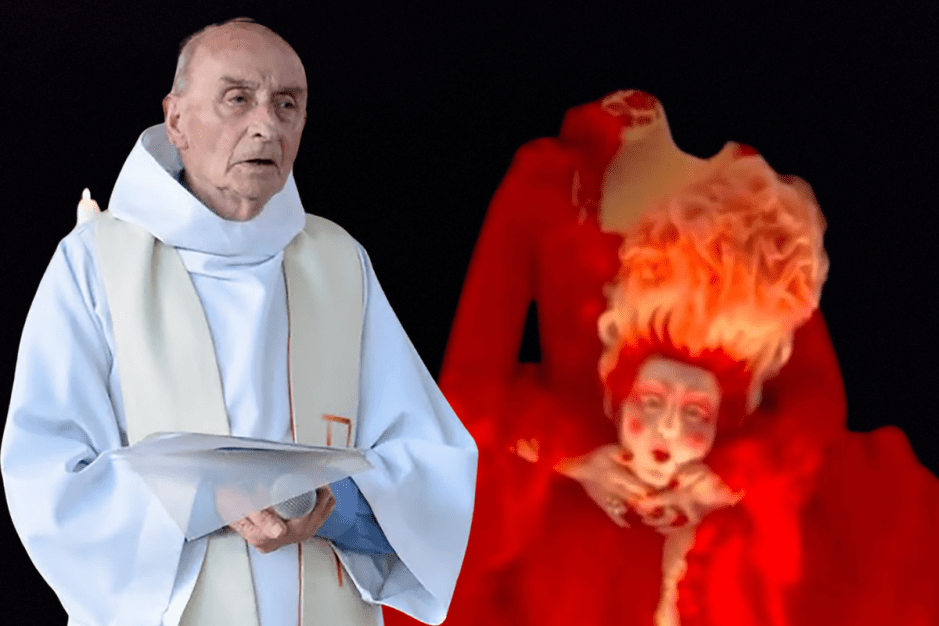
Olympic Blasphemy on Martyr Priest’s Anniversary

By now, almost the entire world knows of France’s most recent national shame: the Olympic Opening ceremony. It lauded vice and intentionally insulted Catholics under the guise of being the “creme de la creme” of modern culture. Although somewhat sour to our tastes, transvestites, gluttonous lesbians, pagans and hedonists mocked Scripture and even the person of Jesus Christ.

The event also derided Marie Antoinette, the Catholic Queen of France who was beheaded at the height of the French Revolution. The inclusion of Marie Antoinette is an interesting one, as the Opening Ceremony was held on July 26th, which is the anniversary of the violent murder of a French Catholic priest. In 2016, the elderly Fr. Jacques Hamel was killed while offering Mass in his small parish in northern France. The perpetrators were two 19 year-old members of the Islamic State to whom Fr. Hamel cried, “Begone, Satan!” before having his throat slit.

A blasphemous parody of the Last Supper, featuring sexual deviants in place of the holy Apostles.

As if that wasn’t enough, the Ceremony, televised across the world to families with little children, included a segment featuring a threesome, reminding viewers that it was France who legitimised these groupings under the term ménage à trois. [Don’t forget it was also the French who immortalised prophylactic contraception under the title French Letters. The Olympic Committee distributed 200,000 of these to competitors as the Games began.]

Screenshot from the pre-recorded ‘threesome’ segment

Much of the pageantry was centred around death and destruction, with bloody displays, a decaying Statue of Liberty and a figure representing an Apocalyptic horseman. Included was strange a segment showing singers “dying suddenly” on a blood-red dance-floor. This apparent reference to the destructive Gene Serum brings to mind the 2012 London Olympics which predicted the pandemic using images of sick children and the Grim Reaper holding something resembling a syringe.

From the 2012 London Olympics ceremony.

Now blasphemy is a matter that needs serious reparation. According to Thomas Aquinas, it is worse than murder, even worse than killing a poor old priest during Mass (although if that was intended as an insult to God then it is blasphemy AND murder.)

In France, the SSPX announced that its parishes would pray the penitential Psalm, De Profundis and chant the sorrowful Parce Domine at the conclusion of every Mass on Sunday July 28th. God bless them for that and may many more parishes follow suit.

And the Pope? What did the leader of 2.6 billion Catholics have to say about this disgrace? Well, during his Sunday Angelus address, the Pope did mention the Ceremony – only to condemn the “scandal” of war. [Wars are bad and some athletes are from countries at war, so that’s the connection. Obviously. Talk about drawing a long bow and then failing to hit the bullseye.]

Yet, all is not lost for France, eldest daughter of the Church. While humans were struggling with a sabotaged subway system and torrential rain, God Himself chose to intervene in this highly chaotic situation. During a blackout across the 18th arrondissement, one building remained illuminated. That building? Sacré Coeur basilica.

Yes, lights continued to shine from the Basilica dedicated to the Sacred Heart of Jesus, while a significant section of Paris went dark. Readers should note that the Church traditionally dedicates a whole month to the Sacred Heart. In recent times, that same month, June, has been dedicated by secular authorities to a sin which cries to heaven for vengeance and has become known as PRIDE month.

The gracious Lord, instead of smiting Paris with fire and brimstone, drew attention to Himself in a manner more like the gentle breeze He used to catch the attention of Elijah. A good lesson for we impatient mortal beings.

As Above, So Below

This article will look at the principle quod est superius est sicut quod inferius, et quod inferius est sicut quod est superius, meaning “that which is above is like to that which is below, and that which is below is like to that which is above”, often shortened to “as above, so below”. It will also examine a gesture used by occultists which embodies the principle.

In his work, The Mystery of Iniquity, Pierre Virion states that the “as above, so below” principle is a false analogy which is at heart anti-Christic: “Illuminism and the theogony (stories of the gods) of the sects thus lead to an inversion of the data of revelation and consequently of Catholic theology.”

Thus transformation or regeneration is evil when it relies on occult means rather than on the graces flowing from Christ’s Redemption. For the proud occultist, however, transformation and enlightenment without Jesus Christ are desired, and he believes they are achieved by the recognising and balancing of opposing forces.

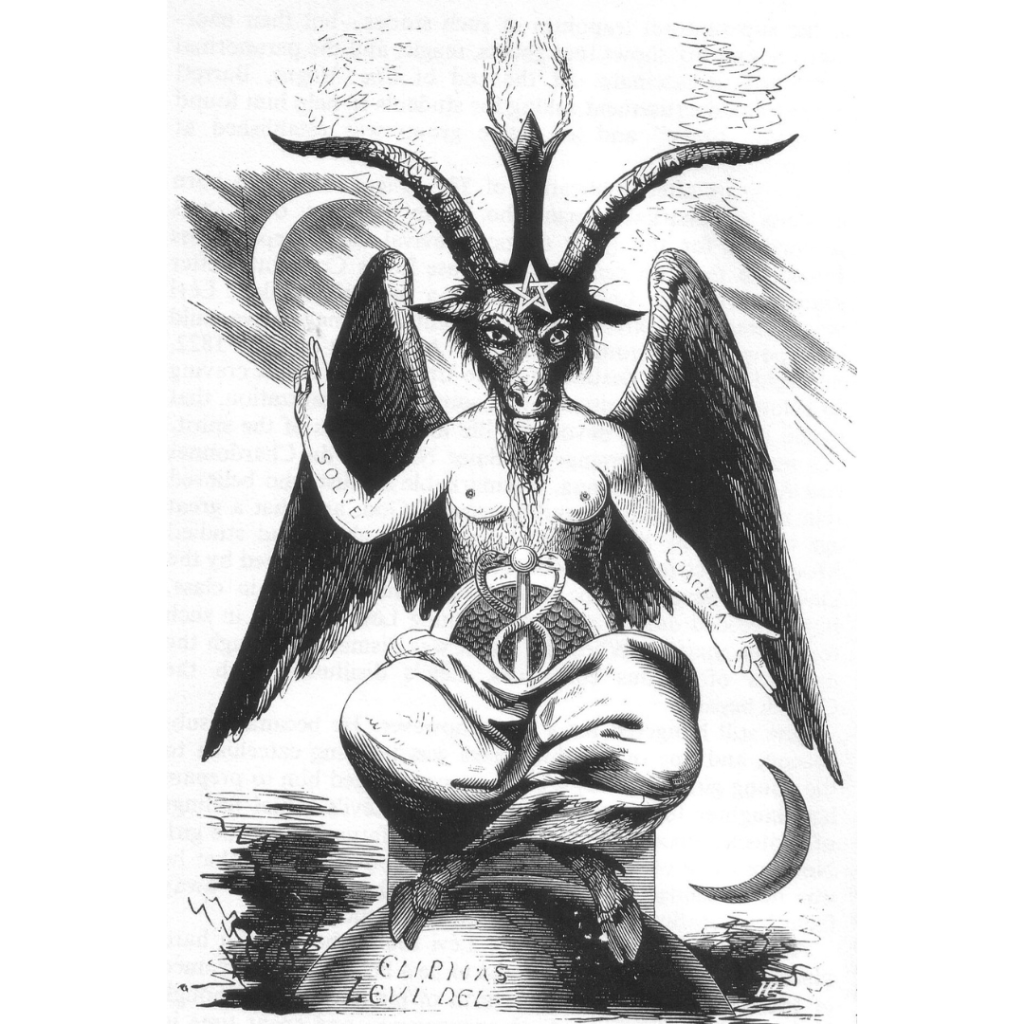
This well-known image of the demon Baphomet comes from the 1856 book, Dogme et Rituel de la Haute Magie, Volume 2 by Éliphas Levi.

Levi, a French occultist of the 19th century, greatly influenced Saint-Yves d’Alveydre, the founder of Synarchy.

Levi’s depiction embodies the principle of duality, reconciling opposites such as light and dark, male and female, spiritual and material. Baphoment, known to traditional Catholics as the demon of fornication, is androgynous and holds its hands in opposing directions in the familiar “as above, so below” formation. One explanation of the gesture is that it “signifies the flow of spiritual knowledge and the grounding of that knowledge in the material world.” The occultist believes that by using this gesture he can balance the opposing forces surrounding him.

A detail from the Redemptoris Mater chapel, created by the disgraced artist, Fr. Marco Rupnik. Christ is depicted with hands in the “as above, so below” configuration. Pope John Paul II can be seen in the background.

The principle of duality is found in a number of occult traditions such as Hermeticism and Kabbalism. In Hermeticism, the “as above, so below” represents the macrocosm (the universe) reflecting the microcosm (the individual). The Kabbalah applies a similar meaning, using the dualistic principle of the Macroprosopus and the Microprosopus (the great world and the small world). In Alchemy, this duality represents transformation, both of base metal into a precious metal and of man through spiritual enlightenment.

The characteristics of the god Baphomet with his up-down” gesture are said to be shared by the god, Baal. Baal is known as the demon responsible for promoting abortions.

This link is an interesting one given the video compilation shown in the Tweet below. In it, one finds the ultra-pro-abort Kamala Harris repeating variations of a specific phrase, accompanied by the “as above, so below” hand gesture. Harris’ gestures and repetition of the phrase, “what can be, unburdened by what has been”, are reminiscent of a witch performing an incantation.

The principle of “as above, so below” is also found in Freemasonry where it has particular significance. It refers to the presence of the Divine in both the spiritual and physical worlds and emphasises their interconnectedness. Masonry also includes the explicitly Hermetic idea that the spiritual realm is reflected in the physical realm and vice versa. Another application of the principle is found in the Masonic obligation of each human being to maintain balance and harmony, especially as expressed through Masonry’s tolerance of various creeds.

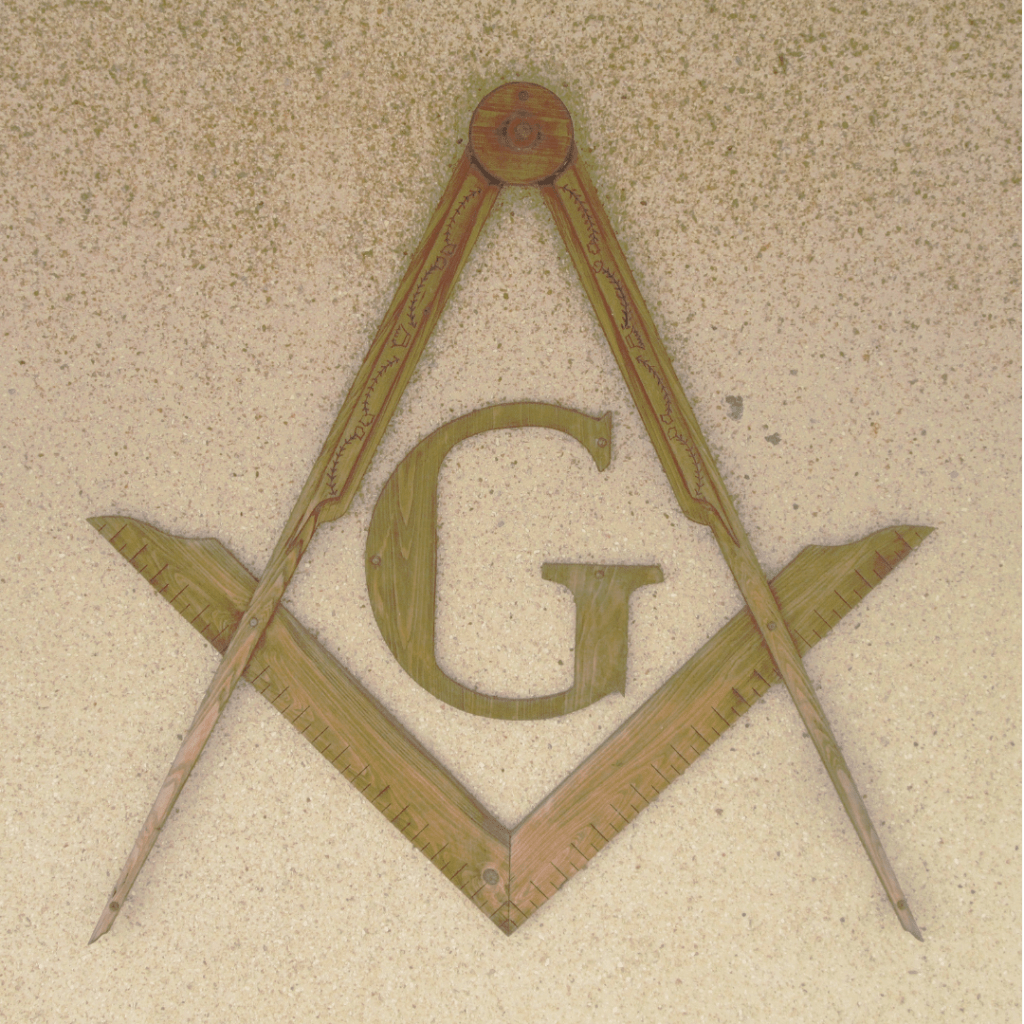
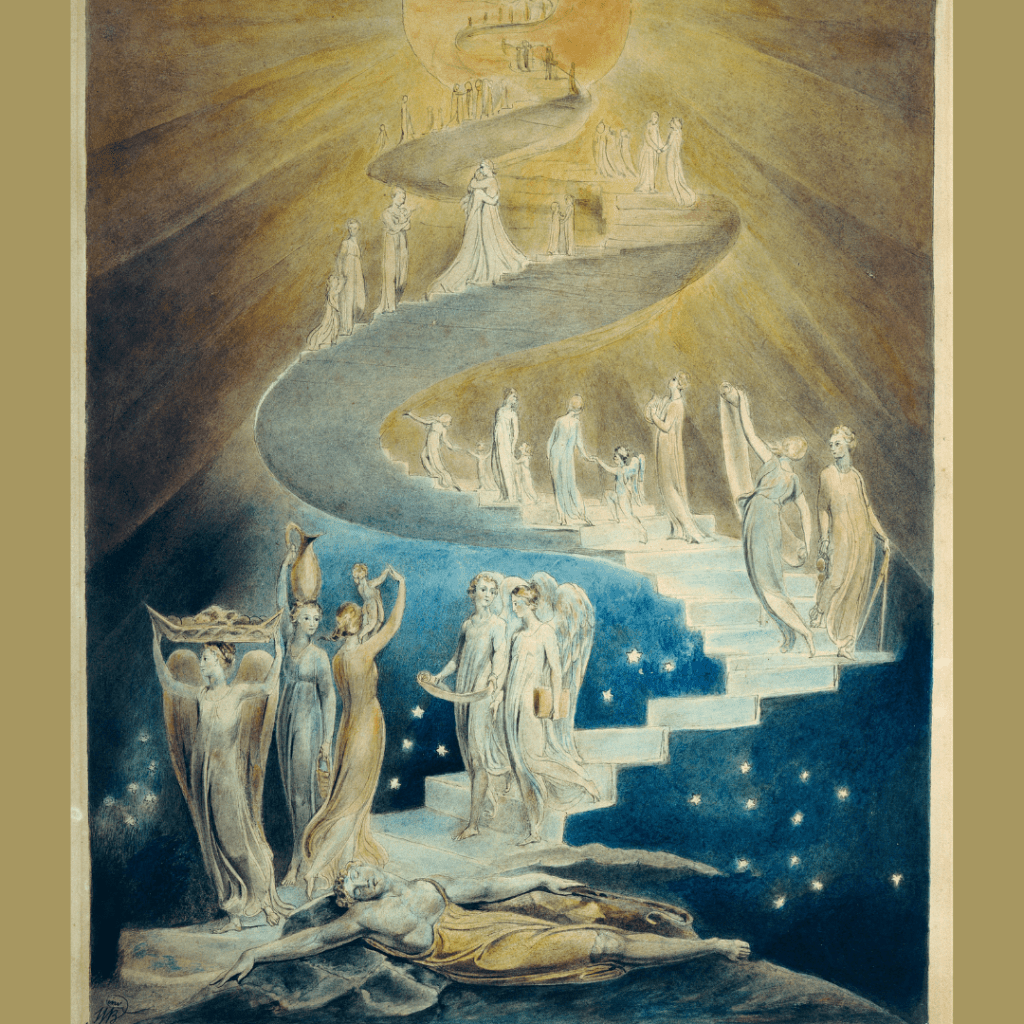
The “as above, so below” theme is found in three of Masonry’s integral symbols: the square and compass; the hexagram, also known as the Seal of Solomon; and Jacob’s Ladder.

This quote from a Freemason, explaining how Masonry’s rituals reference the “as above, so below” principle, point to a diabolical inversion of the Catholic Mass:

INFORMATION SOURCES:https://whowhatwhere.substack.com/p/hand-signals-of-baphomet-and-baal

https://en.wikipedia.org/wiki/Hermeticism

Pierre Virion, La Mystere_iniquite

Esoteric Freemasons website

On the Square website

IMAGE SOURCES: Eliphas Levi, Public domain, via Wikimedia Commons

Beyond My Ken, CC BY-SA 4.0 https://creativecommons.org/licenses/by-sa/4.0, via Wikimedia Commons

Pblpitt, CC BY-SA 4.0 https://creativecommons.org/licenses/by-sa/4.0, via Wikimedia Commons

https://www.vatican.va/content/dam/vatican/virtualtour/redemptorismater/resources/tour-en.html

MASONIC HANDSHAKES

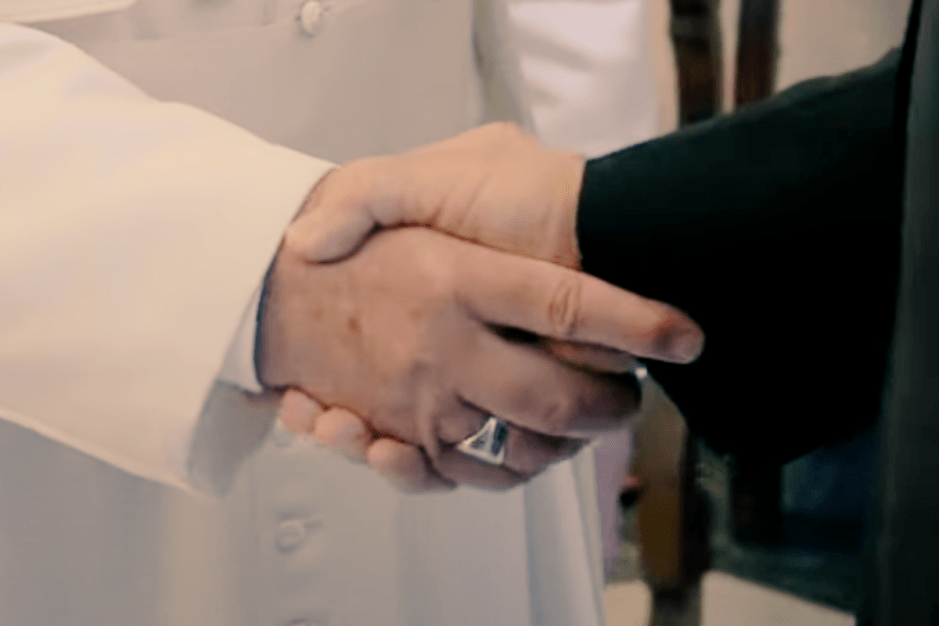
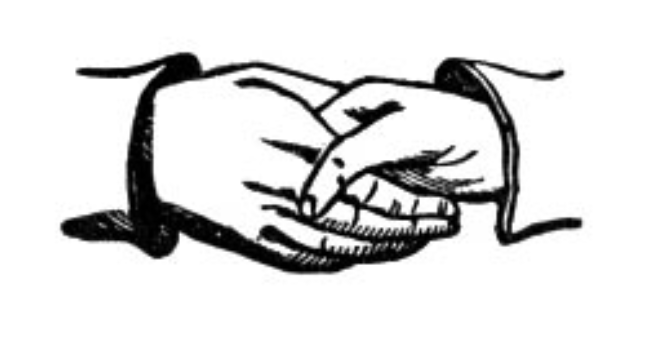
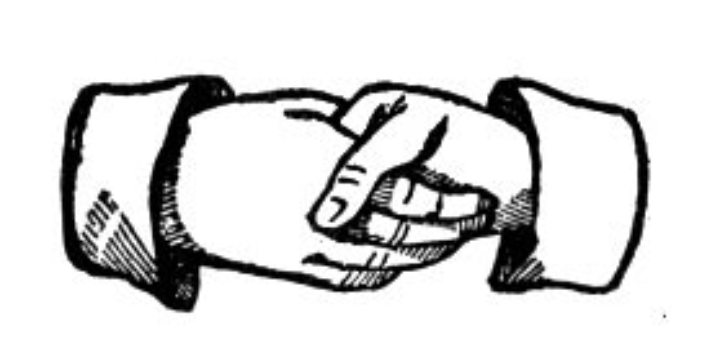
Hand gestures are common among secret societies such as the Freemasons and the Illuminati, for the purpose of identifying the person making the gesture and they may also alert the viewer to a hidden agenda at play.

For Masons, a handshake is an “outward sign, or token, of the union of our minds and hearts.” Their handshakes are also known as “grips’ or “tokens”.

The left-hand image indicates the Grip of an Entered Apprentice and shows the Mason’s thumb pressing against the first knuckle-joint of the first finger of the recipient. If the recipient is also a Mason, he will usually press back. It also goes by the name of “Boaz”.

The image on the right indicates the Pass-Grip of Fellow Craft, where the Mason presses with his thumb between the first and second knuckles of the recipient’s hand. Also known as “Shibboleth”.

The image below left shows the Real Grip of a Fellow Craft where the Mason presses hard on the recipient’s second knuckle. This may be returned if the recipient is also a Mason. The formal name is “Jachin.”

The image below right shows the Pass-Grip of a Master Mason; the Mason presses on the space between the second and third knuckles. This is also known as “TubalCain.”

In the Masters Grip, the Mason pushes his fingertip into the recipient’s wrist. Pressure may be returned by a fellow Mason.

This one is the Real Grip of a Master Mason and shows the index and middle fingers extended over the recipient’s hand. It is also known as the “Lion Paw”.

SOURCE for information on handshakes.

Become a Member to get access to the Directory of Ecclesiastical Freemasonry. It’s full of exclusive documents & articles. Click here for more information.

Shades of Tucho in Cardinal Pierre’s Sad Commentary on the Real Presence

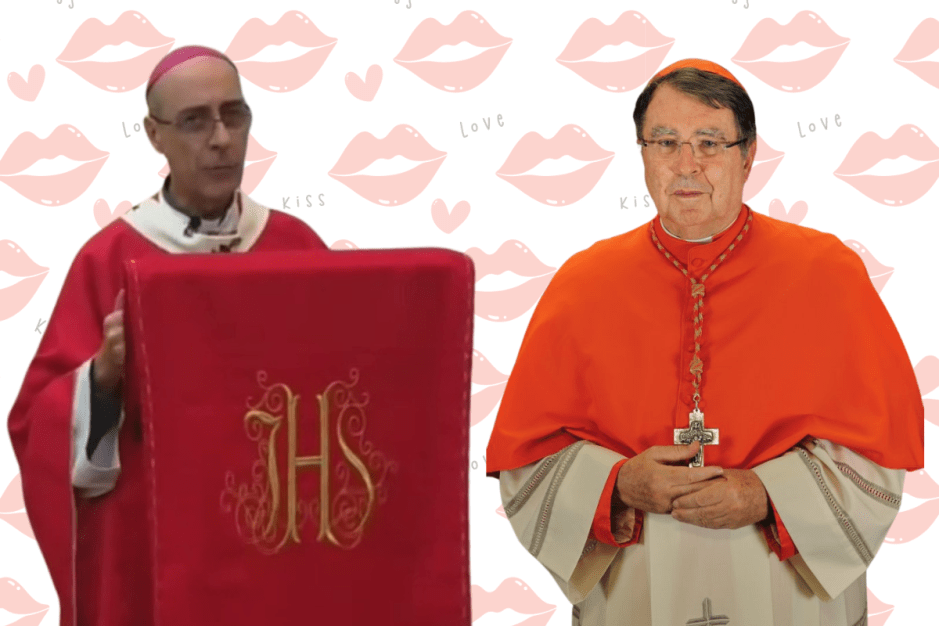
It is a sign of the times when a senior Catholic churchman wastes an ideal opportunity for increasing devotion to the Blessed Sacrament in favour of pushing the idea that the Body, Blood, Soul and Divinity of Christ are just as present in the average sinful human being. It is also a sign sign, albeit a very disturbing one, to hear language reminiscent of Cardinal “Heal me with your Mouth” Fernandez in a discourse on the most sacred reality of the Catholic faith.

In his address to the Eucharistic Congress in Indiana, the Papal Nuncio to the United States, Christophe Cardinal Pierre, began by reminding attendees that to be Catholic is to be united with the Papacy. So far, so good – although one always wonders with these Modernists if they really mean “being united with every word that falls from the mouth of Frances” rather than with the office of the Pope, and all that entails. By beginning his address by quoting the Council and JPII, Pierre suggests the latter.

After that dubious introduction, Pierre next asks the questions, “What is Eucharistic revival?”  and “How will we know that we are experiencing Eucharistic revival?” He then goes to to list the initiatives that have been presented by the US bishops to the faithful in recent times:

” … increased opportunities for adoration and benediction.  There has been catechesis on the Eucharist and, of course, processions. By displaying the Blessed Sacrament for worship and increasing our acts of devotion, we have drawn attention once more to this great Sacrament in order to “stir up” a renewed faith, both in our fellow Catholics and in ourselves.  We have even attracted the curiosity of people of other faiths.”

Again, so far, so good. Then comes the “BUT”. (With the Modernist, there is always a “but.”) Time to draw our attention, not to God, but to “the other.”

“Not only is He present in our family, friends, and communities; but He is also present in our encounters with people from whom we would otherwise consider ourselves “divided”.  This might include people from a different economic class or race, people who challenge our way of thinking, and people whose perspective is informed by experiences that differ greatly from our own.  ….. If we are experiencing true “Eucharistic revival”, then one of the signs will be a greater movement on our part to build bridges of unity.”

The term, “building bridges” always calls to mind the arch-heresiarch, James Martin. But there’s more:

And so, to believe in the real presence of Christ is not only to say: In these forms of bread and wine are His body, blood, soul, and divinity

Wait! Did he mean that during Consecration the bread and wine are changed into the Body, Blood, Soul and Divinity of Christ, or did he say something else? It sounds more like Luther’s Consubstantiation (the idea that the Real Presence presence exists alongside the bread and wine) than Catholic Transubstantiation. It’s a bit ambiguous. Finally comes the humanist clincher: the Real Presence is just not that big of a deal. Christ’s Presence is all over the place – most especially when we are dealing with “the other.”

“But Christ is also present in the assembly of His believing people.  Not only that, but he is present to people who struggle to connect with Him because of wounds, fear, and sin.  We need to be there with Him, accompanying such people, and helping them to experience the real presence of Christ’s love.”

Now to the act of Eucharistic Adoration itself. Of course it is good, ….. “but”……

Adoration, is essential to our relationship with Christ — but it is important that we treat it as that: a relationship.  If, in the act of Eucharistic adoration, we were to look at the Sacrament merely as an “object” to be admired, then we would be remaining, as it were, “on the outside….” 

Does any Catholic actually do that? Simply admire the Blessed Sacrament? In any case, here comes the really strange part. The “heal me with your mouth” part. But even stranger is the fact that this reference to “mouth to mouth contact” came not from Tucho Fernandez but from Pope Benedict!

“…. Pope Benedict explained: “The Latin word for adoration is ad-oratio — mouth to mouth contact, a kiss, an embrace, and hence, ultimately love….”

The reference does check out: Pope Benedict did in fact use these words at World Youth Day in Cologne in 2005. To young people. But here is the really strange bit: the Latin word adoratio does NOT have anything to do with kissing, embracing or “mouth to mouth contact” – at least not in any of my three Latin dictionaries or that I could find anywhere online. The noun, adoratio (from the verb adorare, to speak or entreaty or worship), only means an act or worship or prayer. That’s it.

So where does the kissing come in? Benedict was meant to be a great Latinist! The mind boggles.

Getting back to Cardinal Pierre and his address, it finishes by emphasising that the purpose of Adoration is not to give perfect worship to God but merely to solve the problems of this world. This is pure naturalism; it lines up perfectly with the Masonic ideology of a horizontal, humanist church.

There’s a bit more about the being open to the surprises of the Spirit and Synodality, and that listening “to one another and to the Spirit in the person we listen to” will be the “fruit of the Eucharistic revival.”

So there we have it: the main fruit of this Eucharistic Revival will be a Synodal, listening Church. And they wonder why the majority of mainstream Catholics do not believe in the Real Presence!

IMAGES SOURCE: Romanuspontifex, CC BY-SA 3.0 <https://creativecommons.org/licenses/by-sa/3.0&gt;, via Wikimedia Commons; http://nuntiususa.org/nuncio

The Pact of the Catacombs

Four files are shown below: a document outlining the Pacts of the Catacombs, the text of both the 1965 and the 2019 Pacts, and a biography of the instigator of the original Pact, Dom Helder Camara.