Kathy Clubb is a mother and writer whose articles have appeared at The Remnant, LifeSiteNews, Family Life International, Pax Orbis and Endeavour Forum. She is the author of "Latina Rosarii, the Latin Primer for the Reluctant". Her book, "An Unjust Law" is due for release in 2026.
Unpublished Testimony of Fr. Malachi Martin, Taken from L’Eglise Eclipsee. TRanslated from the French by online translation tool.
Malachi Brendan Martin S.J. : July 23, 1921 ~ †July 27, 1999 Born in County Kerry, Ireland, he studied at the Catholic University of Louvain, Belgium. There he received doctorates in Semitic language, archeology and Oriental history. He then studied at Oxford and at the Hebrew University in Jerusalem.
Ordained as a priest on August 15, 1954, he was a Jesuit priest in Rome from 1958 to 1964, and carried out certain delicate missions for Cardinal Augustine Bea, for whom he was private secretary, and Popes John XXIII and Paul VI. Relieved in 1964 by Paul VI of his vows of poverty and obedience at his own request, he moved to New York and became an international author of bestsellers, fiction and non-fiction. One of his favourite subjects is the Third Secret of Fatima, about which he spoke at length in his works. He recalls that what is most frightening is that it is apocalyptic and corresponds to the eschatological texts of the Holy Scriptures.
We approach this study through the testimony of Father Malachi Martin, who was extremely kind enough to sign his declarations. As he was secretary to Cardinal Bea, and the latter played a major role in the founding of the new “conciliar church”1, as well as in the execution of the plan by enemies of the Church, his testimony is both of great interest and extreme seriousness. This is why we will avoid mentioning the names of the people directly concerned by this investigation; except, of course, Father Malachi Martin himself. Some told us they didn’t really agree with some of the Father’s statements. We point out that it is necessary to distinguish, in this testimony, the events he relates from his personal opinions, which we are not obliged to follow. What seemed important to us in the context of this work are the objective facts that it reports.
It all started with an article entitled “Is the Pope Cardinal Siri?” » signed L.H. Rémy, of which here is the reproduction:
“In one of his writings, Prince Scortesco, first cousin of Prince Borghese, President of the Conclave having elected Montini to the Supreme Pontificate, gives the following information concerning the conclave of June 21, 1963: “During the Conclave, a cardinal left the Sistine Chapel, met the representatives of B’naï B’rith2, announced to them the election of Cardinal Siri. They responded by telling him that the persecutions against the Church would resume immediately. Returning to the conclave, he had Montini elected.”
Visiting Monsieur de la Franquerie in November 1984, with my friend Francis Dallais, we spoke again about this serious problem. Monsieur de la Franquerie, in 1963, was in close contact with numerous Roman prelates, and he confirmed to us that he had heard confidences from reliable and well-informed people who had knowledge of these facts.
To find out for sure, e decided to go see Cardinal Siri in Genoa. Monsieur de la Franquerie, having had the opportunity in the past to meet him and have friendly conversations with him, wrote to him to ask for an audience which the cardinal granted us on the Friday following Ascension 1985.
This is how on May 17, 1985, we found ourselves at my home in Lyon: Monsieur de la Franquerie and Francis Dallais. The evening was wonderful. I admit that I am sensitive to the very old French charm of our dear Marquis and that we spent, until very late in the night, unforgettable moments listening to him tell us his memories of a fruitful life and well filled. Whether it is his memories of Monsignor Jouin, Marshal Pétain or Pius XII, Monsieur de la Franquerie is inexhaustible and fascinating.
The next morning we left early for Genoa where the Cardinal was waiting for us around 10 a.m. and granted us a two-hour audience. We were received with great attention in the magnificent Episcopal Palace of Genoa. The Cardinal, who speaks French very well, was warm, attentive and had a courtesy typical of these people, great in office, but even more so in heart.
A dialogue then began between these two respectable people in a diplomatic language that I did not know and which is of a charm, of a delicacy, the fruit of the education of hundreds of years, and unfortunately disappeared from our days.
Giuseppe Cardinal Siri
They talked about several current or past problems, useless to recount today. As far as we are concerned, we had agreed the evening before to first talk about the exit, during the Conclave, of Cardinal Tisserand. Recalling this story, Cardinal Siri’s reaction was clear, precise, firm and indisputable: “No, no one left the Conclave.” He can only testify to what he saw and not to what might have happened in his sleep or behind his back. But what caught our attention was this firmness, this categorical ‘no’ from the Cardinal.
Moments later, when asked if he had been elected pope, his reaction was completely different. He began by remaining silent for a long time, he raised his eyes to the sky with a grin of pain and sorrow, clasped his hands and said, weighing each word with gravity: “I am bound by secrecy.” Then, after a long silence, heavy for all of us, he continued: “I am bound by secrecy. This secret is horrible. I could write books on the different conclaves; very serious things have happened. But I can’t say anything.”
Let’s think. If he had not been elected pope, he would have said it with as much promptness and firmness as the previous question. Having been elected, he could not say it, bound by secrecy, and, not being able to lie, he took refuge behind this secret.
In fact, it turns out that someone close to me who knew him closely assured me that the Cardinal told them that he had been elected pope twice: in place of Paul VI, and Wojtyla. The first time he refused, the second he was forced to refuse under threat of schism!
We three witnesses were left very shaken and practically convinced of his election.
And then serious questions arise. Did he resign? Was he forced to resign? What about these elections? What heavy secrets weigh on him? During the last Synod, he stayed a few hours and left. Despite his advanced age and the fact that he was over 75, he did not resign and it was not demanded. So?
As he was the last cardinal appointed by Pius XII, we leave it to historians and theologians to study this problem in depth and respond to it. We simply leave this grave testimony3. In the week following the publication of this article, Monsieur de la Franquerie received two telephone calls from Rome, proving that even a small, very confidential magazine was read in the Vatican. The correspondents wanted to know if the article was serious, which Monsieur de la Franquerie confirmed to them.
The article was then translated into English, German, Spanish, Italian and distributed everywhere, so much so that one day a priest asked for a meeting with the director of the magazine. This priest was sent by Father Malachi Martin, a Jesuit, living in New York.
He met him to let him know from Father Malachi Martin, present as an interpreter at the last conclaves (speaking several languages), that what he had written was true. He supplemented this information with an important element: namely that Malachi Martin had to translate a message intended for Cardinal Siri, which contained exactly this sentence: “If you accept the pontificate, we will retaliate against your family.”
During May 1996, one of our friends, who was in the United States for a few months, took the opportunity to go see Father Malachi Martin. He took the initiative to ask him a few questions in writing. Here is the report of the visits, the questions and the answers as they reached us.
First interview on June 3, 1996 in New York
“Malachi Martin lives in the United States. He always says his Mass, confesses and sees people. He is seventy-five years old and in his right mind.
I introduced myself as a friend of friends of the Marquis de la Franquerie. This was enough for him to put things in perspective. (…) Almost by himself, he told me about the Conclaves he experienced. I asked him two or three questions. He told me that Cardinal Siri was indeed elected pope in place of Paul VI and John Paul II and that he refused twice because of threats made against him and his family. He came from a great family from Genoa. During the two Conclaves, none of the cardinals went out. These threats were made to him by another cardinal.
I didn’t dwell too much on the subject and we talked about the crisis in general. Then, on his own, while he was talking about John Paul II, about the fact that he did not govern and that he did not believe in his infallibility, that the Church was governed by the bishops. He told that ultimately all this posed serious problems: that all the ordinations of priests by John Paul II were invalid and that the faithful were lost.
I asked him the question again: “So you say that all of this is invalid?” He answered me with great simplicity and assurance: “But yes, since the sacrament was changed at the Council”4.
So I told him that we should write all this down and he told me that he is writing a new book on this subject. At the same time he dedicated his latest book to me in English, which will be translated into French: “Windswept House”.
“Then we talked about this and that. He told me that the Abbot of Nantes had come to see him and asked him to insert a page about his community and himself in one of his books, but that he had to refuse. He knew Mgr Guérard des Lauriers, Mgr Ngo Dhin Thuc and many people.
I asked him what he thought of the consecrations carried out by Mgr Ngo Dhin Thuc. He thiinks they are completely valid. He believes that there are currently some 57 bishops who have been consecrated in this way. He asked me if Bishop Williamson is a “sedevacantist” at heart or not. I told him that in any case, he is, as are others, but that he doesn’t say it and that Bishop Fellay claims to have relations with “undeclared sedevacantists”. He invited me to come back and see him – which will happen very soon.”
Second interview of September 12, 1996 in New York
“In my last story I forgot to mention that Cardinal Ottaviani had probably been blackmailed in his last days so that he would accept the Novus Ordo, otherwise he would not be given the last sacraments.
This Thursday evening, Malachi Martin had prepared the written answers to the questions that I had asked him in writing by mail some time before. This with the aim of possible publication. He warned me that our interview will not be long because he was to receive a prelate from Rome in an hour.
John Paul II signed an official document authorizing a Conclave to depose the pope on grounds of physical incapacity or health. So much so that we only talk about the Conclave in Rome… but the next one will be worse and so will the situation!
In addition to the written responses, we took up some of them orally. In particular the question of the Conclave. He described to me again how Cardinal Siri’s refusal happened: “After having been elected Pope and having read a paper which had just reached him, in an envelope, from the rank of cardinals, one of the three cardinals presiding the Conclave approached to ask him according to the consecrated words if he agreed to be pope. At that moment, Siri stood up stiff as a stick and pronounced the Latin phrases of refusal in an impersonal and cold tone as if he were forced. The reason he gave for his refusal was propter metum, that is to say ‘because of fear’.” At this moment, Malachi Martin told me that, canonically, this way of responding could have been a reason to invalidate the Conclave5.
I asked him: “Who did this paper come from?”
He answered me: “It came from the cardinals, probably from Cardinals Villot and …..6..In any case it was the expression of the refusal of the Special Lodge. This Lodge is reserved in Rome for cardinals in close contact with the Grand East. John XXIII and Paul VI were part of the Special Lodge.”
I asked him to confirm: “Was John XXIII a Freemason?” He replied: “On the membership of John XXIII in Freemasonry, all the proofs are in the Vatican archives, jealously guarded by Cardinal Sodano. He himself saw photos taken by his driver revealing John XXIII frequenting Parisian dressing rooms.” The rest of our conversation was a bit of a repetition of the answers he had written. Due to lack of time we stop there. We must meet again the following Tuesday.”
Third interview of September 17, 1996 in New York
“This will be our last meeting before my return to France. Malachi Martin told me again that we are only talking about the Conclave in Rome, that everyone is looking for votes and that the Freemasons are agitating very actively within the special Lodge reserved for cardinals, but in liaison with the rest of Freemasonry via the Grand East and the Grand Master of Italy whose name he does not remember.
He told me that he spoke several times to John Paul II about these pressures (from Freemasonry) and the errors of Vatican II, but that he told him that it was nothing and that he made fun of it.
I asked him: “Does John Paul II consider himself pope?”. He answered me: “He even doubts whether he is pope and he behaves more like a bishop than like a pope.”
We then talked about Mgr Thuc, Mgr Mac Kenna then he read and signed the translation of his responses into French in order to be able to ask that they be published. I asked him for some details on the reason for Cardinal Siri’s first refusal and how it happened. He replied that it was the same process each time (for Paul VI and John Paul II).
Then I asked him what he meant by “advancing issues on Ecumenism and Judaism”. In fact, he was simply an intermediary between John XXIII and Cardinal Bea. Finally, after he gave me his blessing, we parted with the intention of remaining in correspondence.”
Questions asked of Malachi Martin (September 1996)
Subject: Traditionalism
Q. Do you know the so-called Cassiciacum thesis written by Mgr Guérard des Lauriers? What do you think? Do you consider that today the “pope”7 is a usurper, no longer has authority and should either convert or be deposed?
Q. The Society of Saint Pius X9 signed a recognition of the legitimacy of John Paul II before the diaconate. It gives the practical instructions to pray publicly for him and to say “Una cum famulo tuo papa nostro Joanne Paulo” at Mass. What do you think of that?
A. The Society is confused about the papacy.
Q. Do you think that the consecrations performed by Mgr Ngo Dinh Thuc are valid?
A. The consecrations of Mgr Ngo Dinh Thuc are valid.
Q. What do you think of the fight between Mgr Lefebvre and Mgr de Castro Mayer?
A. I think that Mgr Lefebvre and Mgr de Castro Mayer were fallible heroes but heroes.
Q. Do you know the book by Arnaldo Xavier da Silvera “The new Mass, what to think of it?” Is it true that he was murdered?
A. I don’t know anything about Arnaldo Xavier da Silvera.
Subject: Conclaves
Q. Was Cardinal Siri elected pope twice? When ? One might think that his refusal comes from him alone. Why did he refuse and give way to Paul VI then to John Paul II? Some have asked Cardinal Siri; he did not respond and remained silent. You say there was pressure. Which ones and how do you know? From which cardinal do these pressures come? We saw black smoke at the Conclave electing John Paul II. Was it because Cardinal Siri had been elected and refused?
A. That Siri, twice in his old age, was elected pope is an undeniable fact to those who know what happened. All that Siri himself conceded was that fear of retaliation was the determining factor in his behaviour. The pressure on him not to accept the pontificate did not come from a single cardinal. Simply Siri was not acceptable to the progressive faction and its bosses. Yes, there was confusion after a vote at the October 1978 Conclave.
Q. You did not attend the Conclave electing John XXIII but you say that he kindly carried out his personal propaganda. Is this true? Why would he want to be pope?
A. Angelo Roncalli was always a missionary with his intention of becoming pope. He had an entirely Modernist agenda for the Church10.
Subject: The Popes
Q. Was John XXIII an initiate? Some documents refer to him as “brother”. What do you think?
Q. Does the encyclical Pacem in Terris contain heresies? Does it fall under the infallible Magisterium?
A. This should belong to the universal Ordinary Magisterium, but it is a Modernist document.
Q. Should we consider John XXIII as a legitimate pope? Should we follow his liturgical reform?
A. He was validly elected. No, we should not follow his liturgical reform.
Q. Did Paul VI have Jewish origins? What do you think of the thesis of the survival of Paul VI saying that he was replaced by a double?
A. No one really knows all of Montini’s ancestors. No, Paul VI was never replaced by a double.
Q. Did John Paul II have Jewish origins? Was he a heretic before his election? Some Masonic documents acclaimed him because he recognized “the right to make mistakes.” Do you think he is perfectly aware of what he is doing?
A. John Paul II, no, as far as I know, has no Jewish ancestors, but who really knows12? He is perfectly aware of what he did. He is not aware of the mistakes he has made.
Q. Was John Paul I assassinated? For what ?
A. We cannot explain the events surrounding the death of John Paul I by ordinary means. Powerful people didn’t like him as pope.
Q. What do you think of the reform of the psalms by Cardinal Bea under Pius XII? What do we think of the institution of the Easter liturgy at midnight by Pius XII?
A. I think all their changes were harmful.
Q. Which pope is guilty of obscuring the message of Fatima?
A. Pope John XXIII.
Q. Who are the current “papabile” cardinals? Can we hope for a return to order after John Paul II? What future do you envision for the papacy and therefore for the Church?
A. The future of the papacy: the hierarchy of the Church is extremely gloomy.13
Subject: Vatican II
Q. Does the Second Vatican Council include formal heresies? Which ones?
A. Certain parts of certain documents contradict past statements of the Roman Magisterium. For example, about religious freedom, papal primacy and infallibility; about the purpose of marriage, about the role of Jews, about the Church in the world.
Q. Does the Second Vatican Council fall under the Ordinary Universal Magisterium? Is it infallible?
A. Explicitly, Paul VI and the bishops of the Council denied the infallibility of the Second Vatican Council. If it had reflected the Tradition of the Roman Magisterium, it would have been part of the Ordinary Universal Magisterium, but it did not do so.
Q. Should the Second Vatican Council be declared a robbery, in the same way as the Council of Ephesus? Can we interpret the Council in the light of Tradition?
A. What the Roman Magisterium will ultimately do regarding Vatican II is what everyone hopes. Ultimately the pope will have to correct Vatican II and its documents in light of the fixed teaching of the Roman Magisterium – which won’t happen very soon. If you want to interpret Vatican II in the light of Tradition, you will have to reform its main documents completely14.
Subject: Relations at the Vatican
Q. You were Cardinal Bea’s secretary and therefore probably followed his interviews. What do you think of him? Cardinal Bea is said to have been at the origin of Ch.4 of the Schema on Ecumenism concerning the Jews15, which rejects the guilt of the Jewish people in the crucifixion. What do you think? Did you participate in the writing of this text?
A. Cardinal Bea was busy introducing as many progressive doctrines and policies as possible. He was the leading hand in the Schema on Ecumenism. I refused to follow what John XXIII and Bea proposed about the role of the Jewish population.
Augustin Cardinal Bea
Q. It is said that you have spent your entire career in the Vatican. Is this true? In what position?
A. No, I was appointed professor at the Pontifical Biblical Institute in Rome in 1958. From there I became an assistant and advisor to Cardinal Bea.
Q. What was your role during the Council? Did the “observers” participate in the writing of the “New Mass”?
A. During the Council, my role was to be “behind the scenes”, pushing forward plans on Ecumenism and Judaism. Six Protestant clergymen (out of a total of eight consultants) wrote the Novus Ordo under the direction of Mgr. Annibale Bugnini. Unless very special care is exercised, the Novus Ordo is invalid.
Q. All your books are released in novel form with imaginary names. Why is that ? Have you had death threats?
A. Not all of my books are in the form of a novel; only three of them. I have published sixteen books.
Q. Did you know Carlo Falconi? What do you think of him? In his book Seen and heard at the Council, he said: “An otherwise trustworthy thirty-third degree assured me that Montini was a Freemason. For my part, I don’t believe it.” What do you think?
A. I did not know Carlo Falconi personally. Yes, for a certain period, Montini was a member of the Lodge, as was John XXIII.
What matters in this testimony – disregarding the fact that these maneuvers may have rendered these conclaves invalid – is that the election of these conciliar pontiffs is due to enormous manipulation by the servants of the Masonic sect.
Let us thank Father Malachi Martin for his courage. His accusations raise serious questions that only theologians and canonists can resolve. How did we get to this?
The reader will have understood: what Father Malachi Martin reveals is the culmination of a long conspiracy. Indeed, what does he say?
“Siri was not acceptable to the progressive faction and its bosses.” “We cannot explain the events surrounding the death of John Paul I by ordinary means.” “Powerful people didn’t like him as pope.”
Who are the “bosses” of this progressive faction plaguing the Vatican? Who are these “powerful people”? How did they come to dominate in the Vatican, to the point of being able to manipulate Conclaves?
FOOTNOTES
This is the name that Cardinal Benelli used to designate the church resulting from the Council. Cardinal Wojtyla, in his book “Sign of Contradiction”, gives it the name “post-conciliar church”. ↩︎
“B’naï B’rith, which means ‘Sons of the Covenant’ in Hebrew, is the first world Jewish organization. It is at the same time the oldest, the most numerous and undoubtedly the most influential. Founded in 1843 in the United States, this para-Masonic secret society exclusively reserved for Jews includes more than 550,000 Brothers and Sisters in around fifty countries” (The Warriors of Israel, Facta, 1995, p. 415). Also read the remarkable work by Mr. E. Ratier: Mysteries and secrets of B’naï B’rith. ↩︎
The question of the possible invalidity of the post-conciliar rite of the sacrament of orders is dealt with in the magazine “Forts dans la Foi”. Rama P. Coomaraswamy, MD: “The Anglican drama of the post-conciliar Catholic clergy”, n° 9/10, 2nd quarter 1990. ↩︎
L’Osservatore Romano of 03/21/1989 reports a comment by Father Betti about the new formulas of the profession of faith (a chapter should be written to comment on them). He says among other things: “The second category concerns the truths and doctrines that the Magisterium proposes in a definitive manner although they are not divinely revealed. To these truths must correspond to a total assent, even if it is not an assent of faith, because they are precisely not proposed as divinely revealed. For example, the legitimacy of a Roman Pontiff: his election is a historical fact. It could even be theoretically tainted by an electoral defect. It is not the fact in itself which is divinely revealed, but it is so linked to Revelation that the Magisterium can pronounce in a definitive manner on the legitimacy of this or that Pope. Otherwise, the Church would have remained for this or that period without a legitimate leader, without a successor to Peter. This extract would almost seem a response to the testimony published three years before, in 1986 in “Under the Banner”. ↩︎
The second name is difficult to grasp. In order to avoid an error we prefer not to transcribe it. ↩︎
We do not know why Father Malachi Martin did not answer the second question. ↩︎
The Society of Saint Pius X was founded by Mgr Lefebvre in 1970. ↩︎
By evoking this expression of “missionary” Father Malachi Martin means that Cardinal Angelo Roncalli was acting to become Pope. By the word “agenda” he means that he had a modernist program. We will come back to this later. ↩︎
This is an initiation into Freemasonry. Let us note this extract from Father Mouraux’s magazine: “Nuncio in Paris, Mgr Roncalli received at an open table Edouard Herriot and Vincent Auriol, notorious freemasons and politicians who carried out persecutory action against the Church. In the warmth of a banquet, he said to them one day: “What separates us is of little importance”. All his happiness seemed to be that of the table where he wanted above all to please” (Bonum Certamen 122, p. 7). ↩︎
Emilia Kaczorowska, the mother of John Paul II, was Jewish. ↩︎
Note from AC – Fr. Martin had read the Third Secret of Fatima, which is widely believed by traditionalists to have predicted the Crisis. He knew in the 1990’s where the Church was heading. ↩︎
We can note that “totally reforming the main documents” of Vatican II necessarily amounts to rejecting the Council, the good parts of which served to push through the bad ones. ↩︎
During the Council a brochure was distributed to the Council Fathers entitled Judeo-Masonic action in the Council. After having given several proofs that chapter 4 presented to the Council was of Jewish origin, we find this on page 10: “If we want definitive proof that chapter 4 of the Schema on Ecumenism presented to the Council by Cardinal Bea — who personally defended this thesis – is from a Judeo-Masonic source, we find it in the pages of the important French newspaper Le Monde, of November 19, 1963: “The international Jewish organization B’naï B’rith has expressed its desire to establish closer relations with the Catholic Church. The said Order has just submitted to the Council a declaration in which the responsibility of all humanity in the death of Jesus Christ is affirmed. If this declaration is accepted by the Council, declared Mr. Label A. Katz, President of the International Council of B’naï B’rith, the Jewish communities will study the means of cooperation with the authorities of the (Catholic) Church.” In presenting his draft decree in favor of the Jews – completely contrary to the Gospel – His Eminence Cardinal Bea took care not to properly inform the Fathers of the Council of the origin of his theses and to specify to them they were suggested by the Masonic Order of B’naï B’rith. Let us also add this letter from Cardinal Villot to Cardinal Marty of December 22, 1977: “…The Holy Father is indeed well aware of the sincere and fruitful relations that his venerated predecessor Pope John XXIII maintained with Jules Isaac. He also appreciates the happy consequences that these reports have had for subsequent orientation of the relations of the Catholic Church with Judaism, relations which found ecclesial expression in number 4 of the declaration Nostra Aetate of the Second Vatican Council, as well as in other manifestations which preceded it deated or followed” (The Churches before Judaism, Ed. du Cerf, Paris, 1980, pp. 181 and 182). ↩︎
We therefore know, as it is confirmed by this testimony, that the “New Mass” is the work of Protestants and Freemasons. Should we be surprised to find, for example, cabbalistic formulas in the Offertory? To know the thoughts of Protestants on the subject of the mass, let us read what Luther, founder of this sect, wrote: “We declare in the first place that our intention has never been to absolutely abolish all worship of God, but only to purge that which is in use, of all the additions with which it has been soiled: I am speaking of this abominable Canon, which is a collection of muddy lacunae; we made the Mass a sacrifice; we added offerories. The Mass is not a sacrifice or the action of the priest. Let us look at it as a sacrament or as a testament. Let us call it blessing, eucharist, or table of the Lord, or Lord’s Supper, or Memory of the Lord. Let us give it any other title we wish, provided that we do not sully it with the name of sacrifice or action” (Werke, t. xi, p. 774). “When the mass is overthrown, I think we will have overthrown the papacy” (Contra Henricum Angliae Regem, Werke, t. x; sec. ii). ↩︎
Hi all, thanks for sticking around for another week.
There’s lots of great content for you in this newsletter: an article on what some Australian bishops are saying about the Synod and the first part of a series on Synarchy, along with some short bios of early Synarchists. This background material on Synarchy is necessary for those wanting to review my book chapter.
CLICK ‘READ ON BLOG’ TO GO THE WEBSITE & READ THE ARTICLES!
Here’s something you might find amusing: the image below came up in my search results recently. In my haste, I at first thought it said, “5 Practical Ways to Outlive Laudato ‘Si.”
Which is something most of us here are intending to do anyway.
When someone uses the term, ‘Synarchy’ he or she is generally referring to one of two things. It may be that they mean the general concept of a technology-based rule by a minority, which is also synonymous with technocracy. Or they may mean something more specific: a group of high-level occultists who seek to manipulate the world using Luciferian powers, and who infiltrate governments, institutions and religious organisations in order to create their own totalitarian, globalist World Order. It is this second meaning, a specific secret society with their specific goal of world governance, to which this article refers.
Although these days, there are very few who acknowledge that the shadowy figures behind the New World Order are Synarchists, there were, in the past, a number of writer and investigators who exposed Synarchy in all its brutal reality. One of these was the Catholic author, Pierre Virion, who wrote extensively on Synarchy and the New World Order during the 1970’s.
In his book, Mysterium Iniquitas, Virion wrote that Synarchy is defined as:
a set of occult powers of all orders and of all schools united to contribute to the formation of an invisible world government. Politically, it is the desired integration of all the social and especially financial powers, forming this government in a generalized, technicalized socialist regime, extending to the world divided into geo-political zones.”
Virion continues,
Catholicism would be like all religions reputed to be equal, absorbed in a universal syncretism.
Looking at Virion’s definition, it becomes immediately obvious that the goals of Synarchy coincide precisely with the goals of Freemasonry: a universalist world religion in which the Catholic Church is no longer seen as the One, True Faith. This is the end goal of the false ecumenism which is so prevalent in the Church today, and indeed, the ecumenical movement grew out the false ideas of the Synarchists.
The religion of Synarchy itself sprang from the Lodges and, as we will eventually see, influenced the Masons to work with the Catholic Church, rather than trying to annihilate Her, as had previously been their plan.
Another early writer on Synarchy was Fr Gruber, who described it as: “a centralized world state with a centralized government planned as an anti-church.” (Athanasius and the Church of our Time p 31)
Thus, is can be seen that Synarchy is a form of Freemasonic totalitarian government, the religion of the Technocrats. Rather than being a purely spiritual movement, Synarchy seeks to employ financiers, industrialists, technocrats as well as spiritual leaders to force compliance on the populace. This is the dark and sinister end-game of globalist entities such as the World Economic Forum, the Bilderbergers, the Council on Foreign Relations and the United Nations for which the hysterical COVID ‘pandemic’ was a trial run.
[Note: In Europe, the media sometimes uses the term “synarchy” to describe any kind of conspiracy or cartel.]
The Goal of Synarchy
It is important to realise that within the dark and shadowy world of the the secret societies, there are not always bright lines delineating particular philosophies and denominations. There is a great deal of overlap, with shifting loyalties, degrees of understanding by adherents, a constant splintering and restructuring within groups with everything veiled in the utmost secrecy.
Individual initiates join the various groups for a variety of reasons – none of which may be related to world domination or even to the occult. This is particularly true of the lower levels of Freemasonry, when members may be interested purely in fostering business relationships. Even though they necessarily become involved in occult rituals, these men and women may not even realise the fact.
There are certain groups, however, whose membership is limited to those specifically pursuing esoteric knowledge. These include the Rosicrucians, the Martinists, members of the Order of the Golden Dawn and the OTO, Theosophists and so on and they are under no illusions about the true source of any power they may acquire. The Synarchists are part of this latter group, and its leaders are part of the highest level of occultists: those in direct communication with satan.
The common thread in all these brotherhoods is the source of the anti-Christic inspiration behind them. Although each adherent may perform a different series of rituals and be influenced by a completely different set of philosophies and personalities, the end goal of the demonic intelligence behind all of them is the same: the total enslavement of the human race to satan using technology and every other lever of power in society.
This is the diabolical inversion of the reign of Christ the King: the reign of satan as lord of the world. Every secret society is in some way contributing to that goal, whether or not the individuals within those groups understand it.
The History of Synarchy
Given the secretive nature of Synarchy, there will always remain some aspects and personalities that are unknown to us – especially those at the ‘top’ for whom their involvement would compromise their ability to work behind the scenes.
There are many men from the past, however, whose involvement is documented; they are the founders of Synarchy and their disciples. These include the defrocked Abbé Roca, Joseph Alexandre Saint-Yves Alveydre, and Raoul Husson. (Each of these has a separate page which can be accessed by clicking on their name.)
Joseph Alexandre Saint-Yves d’Alveydre was an occultist who was active at the turn of the 19th Century. He is credited as being the founder of Synarchy because he was the first to record its doctrines. According to Saint-Yves, the principle tenet of Synarchy was to pursue a world government with a world religion which was a mixture of the major spiritualities, including Christianity, Buddhism, Hinduism, Judaism and Islam. This world religion would be based on superstition and esotericism, rather than on any true supernatural belief.
Out of Saint-Alveydre’s teachings came the Martinist Order, founded by another occultist named Gerard Encausse, also known as Papus. One of the chief aims of this order was to form a “United States of Europe.” Saint-Yves had this idea as did his friend, Victor Hugo. Some say the Martinists also wanted to unite all occultists into a reformed Rosicrucianism, making Russia a link between East and West. Martinists initiated only master Masons into their brotherhood.
Synarchy then became linked with the rise of Fascism, especially in Italy and with the Pan-European movement. An International Synarchist Movement was founded in 1919 to counter the rise of Communism after the Russian Revolution. There also seems to have been some influence by Synarchists on the ideology of Nazism.
The death of Encausse in 1916 led to a rupture among the Martinists due to the aversion of some to be involved in politics. The political Martinists went on to form the Martinist and Synarchic Order in 1921, headed by Victor Blanchard, who was another friend of Saint-Yves.
Blanchard was the secretary to the French government’s Council of Ministers and was also a member of the Polaire Brotherhood, a mysterious group which apparently received its orders via the Ouija Board.
Blanchard went on to form the Synarchic Central Committee in 1922, followed by the Synarchic Revolutionary Convention, in order to enlist fresh young blood from the business and bureaucratic worlds.
United Europe – the Synarchist Pact
From the 1930’s, the explicit idea of a United Europe became a theme among the Synarchists. A document known as the Synarchist Pact was written (possibly) by the occultist, Vivien Postel du Mas, in 1930 and this became a platform for the various Synarchist groups. The Pact was kept so secret that its existence remained unknown until 1941.
The Pact described the Synarchists’ plan to infiltrate governments and first take over France then form a “European Union.” Postel du Mas held soirees in his apartment where information from the “secret master” was delivered through a medium. It is said that the meetings were attended by “men of science, company directors and bankers.”
The Synarchist Empire Movement was formed in 1932 by Postel du Mas and another occultist, Jeanne Canudo. Their own secret society had the stated aim of influencing politics and the economy using spiritism. This group was responsible for much of France’s right-wing terrorism initiated by groups such as CSAR, the Secret Committee for Revolutionary Action, during the 1930’s
The movement to unite Europe continued unabated and from 1932 was spearheaded by Count Richard Coudenhove-Kalergi of Austria under the banner of the Pan-European movement. Coudenhove-Kalergi became extremely influential: Otto von Hapsburg referred to him as “guide and prophet” of a United Europe while even Winston Churchill was influenced by him and in 1953, wrote the foreword to the Count’s book.
Churchill also began to promote the idea of a united Europe. One of Coudenhove-Kalergi’s ideas, that of dividing the world into “five Imperial federations” was found in the Synarchic Pact document.
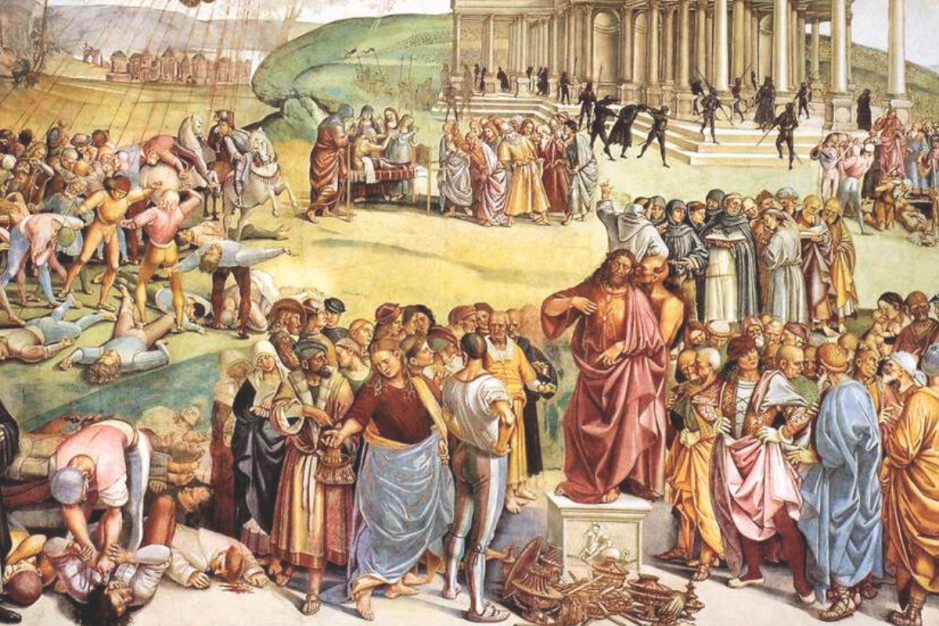
IMAGE CREDIT: Luca Signorelli: Sermon and Deeds of the Antichrist – Wikimedia
Around the turn of the nineteenth century, there was a resurgence of interest in Rosicrucianism, Kabbalism and Spiritualism among Freemasons. You may recall that demons have revealed to exorcists that that this time period was marked by a great increase in demonic activity. Various groups, including the Kabbalist Order of the Rose-Cross, the Martinists and the Symbolists, splintered off from Masonry. These groups were particularly active in France.
One member who had connections with several of these groups was Joseph Alexandre Saint-Yves Alveydre (1842-1909). Saint-Yves was a member of the occult, moving in circles with Victor Hugo and Lord Bulwer-Lytton.
who is credited with being the founder of Synarchy because he was the first to write down its doctrines. Saint-Yves believed that he was in contact with a superior race of beings who communicated with him telepathically. He claimed that the principles of Synarchy were given to him by these beings as a way of countering the spread of anarchy which was prevalent at that time.
Whereas anarchy holds that there should be no governing authority, Synarchy imposes control over every facet of life. More specifically, Saint Yves believed that the superior beings who gave him this secret knowledge would help a ruling elite to govern society.
Saint-Yves believed that the world had once been ruled by such an elite and that their civilization was destroyed by natural disaster. His hypothesis is reflected in the legend of Atlantis and he believed that the Atlantians constructed the Sphinx.. Throughout history, the cosmic powers continued to send prophets such as Jesus, Moses, and of course, Saint-Yves, using secret societies to pass on the philosophy of synarchy. One example of this is the Knights Templar, whom he regarded as the perfect model of Synarchists because of their level of control over the three levers of power: socio-political, religious and economic.
Saint-Yves believed these three areas should be controlled by an elite who took their orders from the “wise ones”. This would be done without the general population realising that they were being governed by elite puppets. Once the elites gained control of the three levers of power, it would not matter whether a government was on the “left” or on the “right” – the outcome would be the same.
Saint-Yves also called for a united state of Europe – something that will become important later in our inquiry. Apart from his interest in geo-politics, His Synarchy adopted elements from popular occult movements of his time, melding them with his principle of taking orders directly from the “enlightened beings.”
Saint-Yves wrote many books in which he described plans for a Universal Synarchist Church, which is nothing other than Masonic syncretism. A blend of Christianity, Judaism, Hinduism, Islam, Buddhism, the church of the Synarchists would be cultural as well as spiritual.
Saint-Alveydre’s Universal Synarchic Church did not attempt to eliminate the Catholic Church, but to subsume Her into its ranks. For this two occur, Catholicism would firstly need to agree that all religions are equal and then to come to terms with Freemasonry. One can see how closely the post-Conciliar Popes have followed this programme through their promotion of ecumenism.
And while they may have officially upheld the Church’s teaching on Freemasonry, in their words and actions, they have been quite tolerant of Masonry within the hierarchy. Saint-Alveydre promoted the idea that Masonry was based in Christianity, writing that:
“If Masonry admits men without distinction of race, worship, creed, to fraternal assistance from the Prince of Wales to the pariahs of India, then it is more Christian, more Orthodox in the eyes of Jesus than you who anathematize it.” (Mission des Souverains, p 446, as quoted in Mystère d’iniquité)
Saint-Alveydre’s comment is reminiscent of Stefano Bisi, Grand Master of the Grand Orient of Italy. At a recent event to promote rapprochement between Masonry and Catholicism, he said:
“The starry sky is the same for the Buddhist, for the Catholic, for the Waldensian, for the Muslim, for all those who believe in a supreme being,” he continued, adding: “We set our brothers free to adhere to any religion and to practice. Absolute truths and walls of the mind do not belong to us, and for us they must be torn down.”
His 1877 book, Keys to the East, introduced Synarchy to a popular audience. In1886, Saint-Yves created the Syndicate of the Professional and Economic Press which introduced business and political leaders to synarchy. Enthusiasts included French minister François Césaire Demahy and Paul Deschanel who later became President of France.
There seems little doubt that Saint-Yves was in direct communication with demons and that the principles of Synarchy were directly inspired by hell. Certainly the consequences of a totalitarian state ruled by an unworthy elite seem consistent with their origin. Anything that lacked evidence, such as his ideas about race or the origins of the world were for Saint-Yves a product of the secret knowledge from the “wise ones.”
Roaul Husson was a Synarchist and member of a secret society for mathematicians known as the Nicolas Bourbaki group. It is possible that this group was also a member of Synarchy, as one of the founders, Henri Cartan, was the president of the European Federalist Movement (1974-1985) and promoted the idea of the United States of Europe.
In 1946, Raoul Husson released Synarchy, Panorama of 25 years of Occult Activity under the pseudonym Geoffroy de Charnay. In the appendix to this work, he reproduced the entire “Revolutionary Synarchic Pact for the French Empire ”. In his book, he concluded that technocrats had deliberately orchestrated the collapse of France during WWII and suggested that the Synarchists were planning to repeat their performance.
Husson spelled out the hidden plan contained within the Pact: that the unification of Europe was only the first step to a unified world.
He explained that parliamentarianism was a political enemy, and that the future citizen of Synarchy would become identified solely with his profession: he should have no part in running his country through involvement in politics.
In his book, Husson spelled out the priority for France to be infiltrated if a united Europe was to be established. It was necessary for Synarchs to be firmly positioned there because despite its anti-clerical drift, France’s egalitarian spirit meant that independent leaders could spontaneously come forth from the grassroots and threaten the Synarch’s long-term goal. He claimed this had already been achieved by 1939.
Details of the Pact include: permeable national borders, pacifism, world peace after the establishment of five political supercontinents.
“Unable to agree to dissociate ourselves from any being, we want the current world revolution to bring the peoples into an irresistible movement, – beyond orthodox materialist Marxism like false capitalist liberalism, – towards a high spiritual civilization marked by seal of universal humanism.”
Canon Roca was a French priest who was ordained in 1858. He promoted the occult and was eventually excommunicated. Once defrocked, Roca priest preached his message of ‘Divine Synarchy’ in Europe and the United States. As a renegade priest, he bestowed prestige on the occult circles in which he moved – among Rosicrucians, Kabbalists, Martinists and other High Secret Societies.
Roca was a friend of the infamous Satanist, Stanislaus de Guaita, and like many occultists, was one continual search for the ‘ultimate’ initiation ritual, one that would transform him into a Christ-like being. Roca specifically tried to enlist clerics into his esoteric spirituality, believing that this would lead to an ‘evolution’ of Catholicism to its, as yet unfound, ultimate status. Along with this religious evolution, there would need to be a transformation of society.
Roca thought socialism was a helpful tool which high secret societies could use to introduce Catholics to the occult. This is because its end is an earthly Utopia, which coincides with the goal of the occultists. He realised that clerics, especially within the Vatican, would need to be indoctrinated with the false ideas of Gnosticism, Masonic Universalism and superstition so they would come to believe that the Church had lost Her way.
Roca predicted that one day a Pope would embrace the ideals of Synarchy: he referred to this man as the Magus of Synarchy. According to Athanasius (book), he proclaimed the coming of a “divine synarchy” under a Pope converted to scientific Christianity.’ (Athanasius and the Church of our Time p 34) in a world of anonymous bureaucratic institutions. He predicted that the Church would undergo “Not a reform but a revolution”. “The new church, which might not be able to retain anything of Scholastic doctrine and the original form of the former Church, will nevertheless receive consecration and canon jurisdiction from Rome.” (Athanasius and the Church of our Time p 35) He also predicted an ecumenical council at which a new liturgy would be forged.
For Roca and his conferes, ‘Christ’ is a symbol of the potential perfection which can be reached by humans through the initiations of the secret societies. It is His Humanity which they worship, believing that this Christ and His power exist within everyone of us, waiting to be realised. This is the heresy of immanentism: that we need look no further than the ‘god-within’.
Roca once stated, “My Christ is not the Christ of the Vatican!” This is something to keep in mind when trying to discern what is behind comments from prominent clerics, especially those mouthpieces of the Synod on Synodality. Though their comments may sound Catholic in places, their ‘Christ’ may not be the Jesus Christ of the Gospels.





 Ecclesiastical Freemasonry