Australian Bishops are in the Synodal Way

Even though they missed out on the red hat, three of Australia’s bishops remain happy to carry water for the Synod.

One of them is Shane Mackinlay, bishop of Sandhurst, who is representing the Bishops Conference at the Synod in Rome. According to McKinley, Fiducia Supplicans was a direct result of the Synod. He told a press conference that although the Pope didn’t act synodally by issuing the heretical document, that’s fine by him:

“As with many things Pope Francis has done in the last year, he did not wait for the final document. He has already responded to things that were raised in the discussions and in the final report last year.”

This is despite the Pope stating that he would absolutely not be making a decision on same-sex unions before the second Synod sessions.

According to Mackinlay, “Fiducia supplicans is a significant step forward … and then I think those of us from the West are not so surprised that in some other parts of the world it is received differently and has a different kind of priority.”

Yes, it is received differently because ‘in some parts of the world’ the Bishops are actually Catholic! Mackinlay is so popular in Rome that he was elected for the second time as the Oceania representative for the Commission for the Final Document of the Synod – quite the appointment.

Another Synod apparatchik is Archbishop Timothy Costelloe, no stranger to these pages. As Archbishop of Perth and president of the Australian Catholic Bishops’ Conference, Costelloe is completely onboard with the Synod’s agenda of re-imagining Catholicism. He couldn’t hide his enthusiasm for heterodox novelty when he told Vatican News that it was great to have priests, women, and lay people usurping to role of the Bishops by being given full voting rights instead of having a ‘back row seat’.

“It shows us the equality and unity of all. Unity is communion of mind and heart, of spirit and action, and of faith at the service of the Church’s evangelising mission.”

This ‘unity’ is nowhere to be found either at the Synod or outside of it, of course. The persecution of traditional Catholics and the clamouring voices of dissenters from the Faith are evidence of that.

Archbishop Costelloe also explained that the so-called ‘conversation in the spirit’ “serves to free oneself from prejudices. The Synod must convert us from a competitive approach to a spirit of listening because in this way it will be of real and effective help to the Pope.”

He posed a few more rhetorical questions: “Should the Synod office be restructured in favour of the local Churches? If so, how? And could the reports become documents to be published?”

Now, don’t worry too much if you don’t have the answer to these questions. Something tells me that the Synod Fathers (and Mothers) already have the answers – pencilled in from Day 1.

The third Australian Synod mouthpiece is Anthony Randazzo, Bishop of Broken Bay diocese, who seems to have mastered the art of verbally giving with one hand while taking with the other.

One the one hand, Randazzo criticises those who are ‘obsessed’ by the issue of women’s ordination. But look at the reasons he gives as objections to it:

“Those issues become all-consuming and focusing for people, to the point that they then become an imposition on people who sometimes struggle simply to feed their families, to survive the rising sea levels, or the dangerous journeys across wild oceans to resettle in new lands.”

The Catholic Diocese of Broken Bay website reports that while Randazzo has ‘no problem with the topic of women’s ordination being discussed and studied at the Synod’, he thinks it should be poor women and not wealthy, well-educated ones who call for it. What? So now the disobedient notion of ordaining women is only wrong when it is attached to white privilege?

Maybe someone needs to tell His Grace that the Amazonian women are way ahead of the curve. They are already receiving a para-liturgical blessing from their Cardinal before beginning their ‘ministry’ of distributing the Sacraments.

How anyone can think this matter was not laid to rest in the past with an infallible statement is beyond me.

Two new articles for you

Well, my new-fangled newsletter was very short lived – Mailchimp let me down today by locking me out of my account!

Never fear, we will go old-school and send the news articles through the website. I hope you enjoy the articles!

Trad Inc’s Pyrrhic Victory

Be silent no more! Cry out with one hundred thousand tongues. I see that, because of this silence, the world is in ruins, the Spouse of Christ has grown pale; the color is taken from her face because her blood has been sucked out, that is the blood of Christ, which is given as a…

Keep reading

Trad. Inc. & the Art of War

It seems ironic that the same voices that condemn collegiality among the bishops are insisting traditionalist Catholics unite under a milquetoast banner of love, in an effort to secure their Latin Masses. This tactic is flawed and will lead, in some cases, to the most tragic of consequences that can befall a Christian: the loss…

Keep reading

And if you need a dose of outrage to start your week, take at a look at this story from the Vigilant Fox: https://vigilantcitizen.com/latestnews/this-degenerate-opera-about-lusting-over-jesus-has-performers-actually-bleed-and-cook-human-flesh/

Ecumenism: the Utopian Dream

Like the side events staged by NGO’s at the UN, the Pope’s ecumenical side-event at the Synod might be where the real work of demolishing the Catholic Church is taking place.

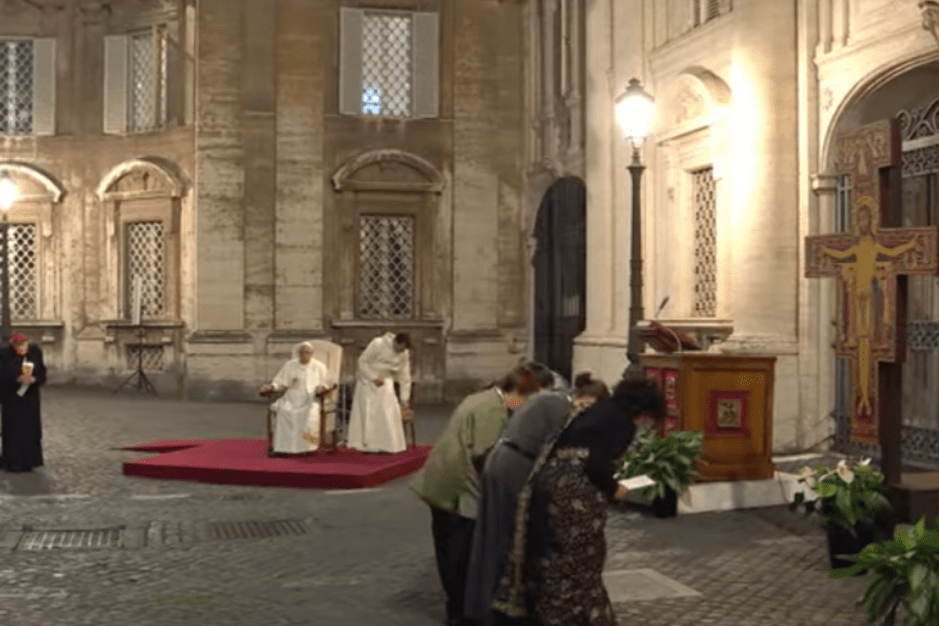
On October 11, the Pope led an ecumenical prayer meeting at a very special non-church venue: the Protomartyrs Square, an area right near St. Peter’s Basilica where the first pope is thought to have died. Francis excelled himself, managing to pack an unprecedented variety of blasphemies into one evening: continuing to promote the Masonic doctrines of religious indifferentism and naturalism, topped off by an egregious insult to every Catholic who shed his blood for the Faith.

The event marked the anniversary of the opening of the Second Vatican Council which the organisers of Francis’ vigil hailed as the beginning of a ‘new ecumenical era.’

For the theme of his reflection, Pope Bergoglio chose the phrase from John’s Gospel: “The glory that you have given me I have given them” (Jn 17:22). This expresses his belief that the martyrdom of early Christians like St. Peter, the shedding of their blood in that very place, had some mystical ecumenical significance.

The Pope continued by saying that the martyrs are ‘accompanying the Church on its ecumenical journey’ – another error with no basis in reality or in Catholic tradition. Unsurprisingly, Pope Francis quoted the arch-ecumenist, John XXIII, linking the pursuit of ecumenism to the unbelievably boring topic of synodality, saying “The journey of synodality… is and must be ecumenical”.

That bit does make sense. Since faithful Catholics are not fooled by either synodality or ecumenism, Francis has to go outside the Church to gain any traction. But that poses no problem when one has no belief in the primacy of Catholicism. When one can give away the bones of St. Peter or sign heretical documents with anti-Christians, then nothing is off the table.

It seems lost on the Pope that the martyrs died rather than compromise their faith to even one degree, let alone completely handing it to non-believers on a platter as he has chosen to do.

The Pope continued to spout his own ‘magisterium of Francis’: “Unity is a grace. We do not know beforehand what the outcome of the Synod will be, just as we cannot predict how the unity we are called to will fully manifest.”

Artist’s impression of how Bergoglio’s ‘unity’ will manifest

In another direct contradiction of Church teaching, Pope Francis claims that a so-called ‘ecumenism of blood’ is a witness of Christian unity to the world. ‘Ecumenism of blood’ is another of Francis’ imaginary theological principles. There really is no such thing. Christians do not achieve unity through martyrdom and this certainly was not the meaning behind Jesus’ discourse at the Last Supper. At least, if it was, then Gnostic Francis is the first Catholic in history to find this hidden interpretation.

Scripture and tradition clearly state that there is no salvation outside the Church. There is no unity when some Christians are outside the Church and others are inside the Church. Further, despite Francis’ many claims to the contrary, heretics can not be considered martyrs. [See note below this article for further explanation.]

St. Peter made this abundantly clear in 1 Corinthians 13:3, when he wrote,  “… if I should deliver my body to be burned, and have not charity, it profiteth me nothing.” Charity, of course, means to love God with all one’s mind and heart – including believing everything which has been taught by His Church. Anyone Christian outside of the Catholic Church is by definition, lacking in charity.

The attempted martyrdom by non-Catholics was the precise context of that famous doctrine, extra ecclesiam nulla salus, as first recorded by St. Cyprian of Carthage:

But if not even the baptism of a public confession and blood can profit a heretic to salvation, because there is no salvation out of the Church, how much less shall it be of advantage to him, if in a hiding-place and a cave of robbers, stained with the contagion of adulterous water, he has not only not put off his old sins, but rather heaped up still newer and greater ones! 

Pius XII reiterated the importance of membership in the Catholic Church in his Encyclical,  Mystici Corporis Christi,

“Actually only those are to be included as members of the Church who have been baptized and profess the true faith, and who have not been so unfortunate as to separate themselves from the unity of the Body, or been excluded by legitimate authority for grave faults committed.”

And these are only a few examples of the constant teaching of the Church prior to Vatican II. Francis’ ecumenical side-event reminds us of his true priority: the deconstruction of Catholicism.

While chancery bureaucrats enjoy their Roman holiday at the Synod, deluding themselves that anything they do will make a scrap of difference to the Pope, Francis puts on his Masonic-coloured lens: promoting religious indifferentism instead of preaching baptism to all nations and promoting the heresy of naturalism by pursuing his Utopian dream of ecumenism.

[NOTE ON NON-CATHOLIC MARTYRS: For a nuanced approach to this topic, consider this: They may have been true martyrs, but only before God (coram Deo), not before the Church (coram Ecclesia). They would be martyrs coram Deo, provided they were habitually willing to believe whatever the Church proposed if they had the means to know it, and it is not their fault. They would not be martyrs coram Ecclesia because only God knows the internal dispositions of a person’s soul at the hour of death. Now the Church can only make a pronouncement about external actions that can be known by one’s senses. Thus, she cannot publicly consider martyrdom something that only God can know, namely, that a person in the state of invincible ignorance decided in his heart, even if only as a desire, to belong to the Catholic Church and who died united to her.]

The St. Michael Prayer was an Antidote to Freemasonry

Most of the information in this article comes from a fascinating book, ‘Pope Leo XIII and the Prayer to St. Michael’. The book looks at various accounts of the origin of the prayer as well as its significance.

Pope Leo XIII famously composed the prayer to St. Michael after seeing a vision in which God gave the devil permission to have free reign over the earth from the mid-twentieth century. The date of that apparition is traditionally given as October 13, 1884 – coincidentally, that is exactly 140 years ago today. This date is significant for several reasons, none of which should be a surprise to my readers. October 13, as well as being the anniversary of Leo’s apparition, it is the date of the miracle of the sun at Fatima (1917) and of the final apparition of Our Lady at Akita (1973).

Some sources believe that Leo’s decision to write the prayer coincided with his increasing concern over the influence of Freemasonry on the Catholic Church. His predecessor, Pius IX, had ordered a set of prayers to be prayed by priest and faithful after Low Mass for the protection of the Church. Leo inserted the prayer to St. Michael into that set of prayers – a practise which continues today in traditional parishes – requesting this from his priests in his classic encyclical against Freemasonry, Humanem Genus.

Leo issued continued warnings to his priests to be increasingly vigilant with regard to dangers both within and without the Church. As well as the St. Michael prayer, Leo composed an exorcism prayer just for priests which is based on the St. Michael prayer as well as a longer version of the St. Michael prayer to be used by the laity.

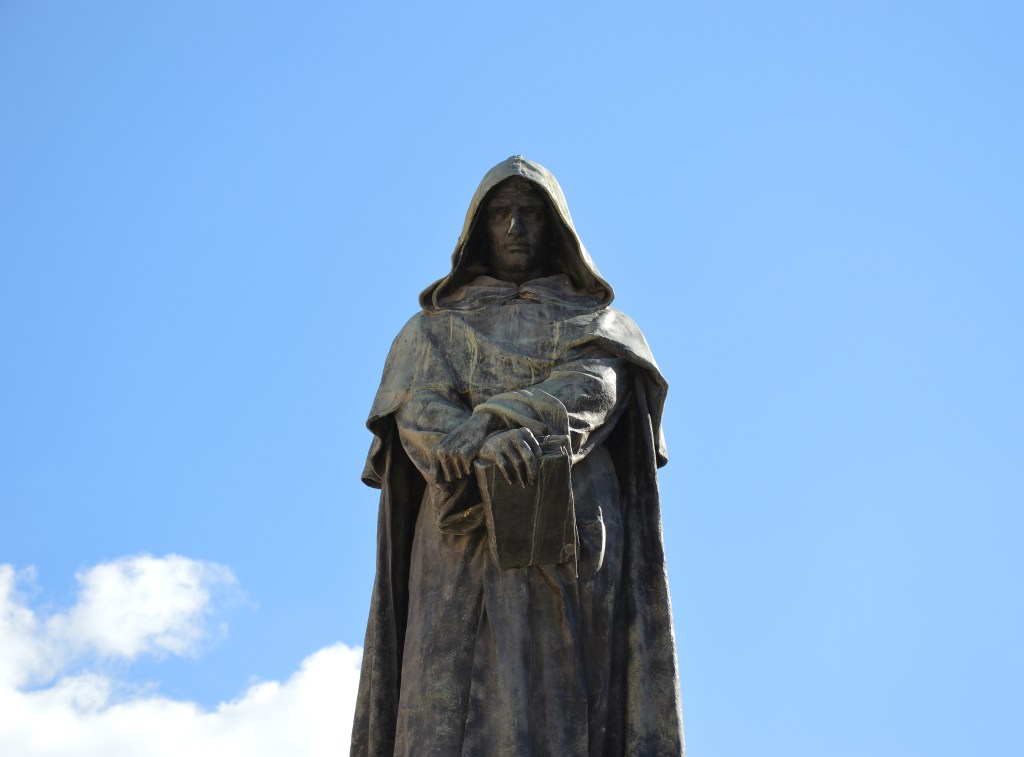
Statue of Giordano Bruno at the Campo de ‘Fiori in Rome.
SOURCE: Livioandronico2013 via Wikimedia Commons

Leo’s strong condemnations of Masonry drew the ire of the secret societies against him. In particularly egregious incident, the Masons erected a statue of an infamous heretic in Rome. The heretic, Giordano Bruno had been condemned and executed under the Inquisition in 1600.

Bruno was a hero to the Freemasons and other subversive groups and the statue’s sculptor went on to become the Grand Master of the Grand Orient lodge of Italy. By erecting Bruno’s statue, the Masons were in effect thumbing their noses at Pope Leo. Leo’s response was to release another encyclical, Dall’alto dell’Apostolico Seggio, condemning the Freemason’s act. The date of issue was October 15, 1890, just two days after the mysterious and highly significant date of October 13th.

[As an aside, Giordano Bruno was posthumously rehabilitated by the highly suspect Cardinal Angelo Sodano in the year 2000! As another aside, and this is very strange: St. Michael is a saint who is perversely venerated by the Masons, who think of him as the ‘planetary angel of the sun.’]

One reason why Pius and Leo sought to engage extra help from the archangels can be found in the records of exorcists. During exorcisms performed after their pontificates, demons admitted that there had been ‘unusually numerous and strong invasions by diabolical spirits on the earth’ during Pius’ pontificate. One exorcist wrote:

In their battle against the Church, the demons use the wicked people as their allies. They have succeeded in enlisting a large number of people under their banner.

“We have the will of the people on our side,” they say.

The demon ‘Caesar’ leads their forces to stir up governments against the Church. “The people are our trusty storm troops”, he stated.

The Masons are among the main supporters of the demons. Lucifer admits that they are his ‘dearly beloved children’ and calls them his ‘representatives on earth.’

The exorcist continued:

Once they are defeated, the time will come when the members of the secret societies will be humiliated. The Virgin will destroy the secret societies. She has already set herself against them.

So we can see that before Modernism infiltrated the Church, Freemasonry was identified as being Her fundamental enemy, leading Pius to institute extra prayers after Mass for the protection of the Church and leading Leo to compose some very powerful new prayers invoking the great St. Michael.

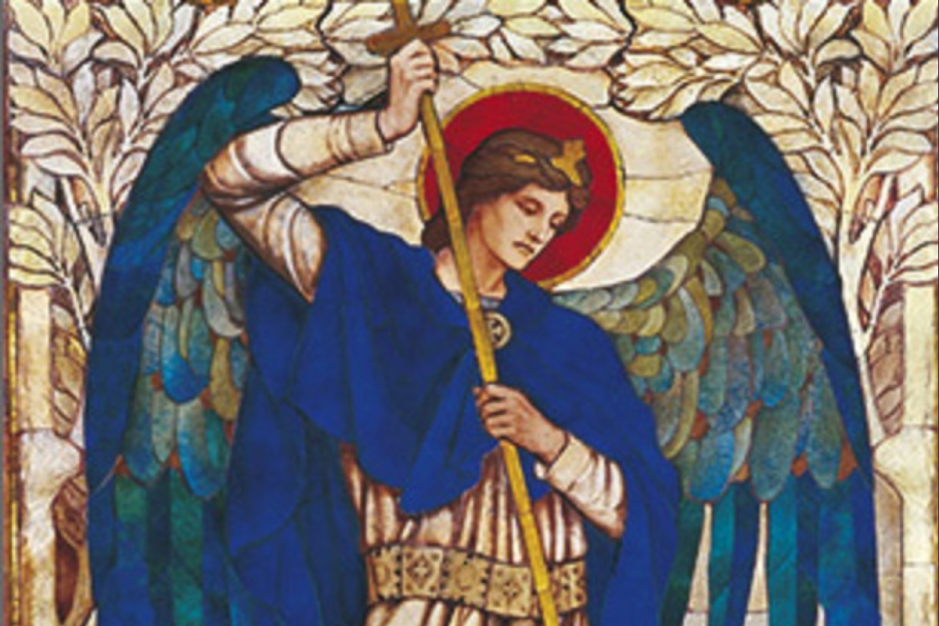
IMAGE SOURCE: detail from James Powell and Sons of the Whitefriars Foundry, Public domain, via Wikimedia Commons

Subscriber update

Dear friends,

Tomorrow you will receive the first Ecclesiastical Freemasonry newsletter from a third-party email service.

As these sometimes end up in ‘spam’ or ‘junk’ folders, please check those if you don’t get your regular Monday email! I have some updates to share with you plus loads of great content.

Thanks for your loyal readership,

Anonymous.

The Church of the ‘Divine Synarchy’

This is the English translation of a section of Pierre Virion’s “Mystery of Iniquity.” Taken from the Third Edition, and released during the 1970’s, M. Virion masterfully traces the crisis in the Catholic Church back to the plans of the Synarchists.

“The development of the revolution within the Church – for it is indeed a revolution – is linked to the march of international political events. Here we are in the presence of a politico-religious complex combining in its entirety the decadence of doctrinal and institutional Catholicism with the projects of a world government which, in the end, as we have said elsewhere, would be itself, at least visibly, only a universal super-church integrating national churches. In each of these two fields, parallel processes are oriented towards the same goal, so that if one is are in a hurry to follow a political trajectory ordered to their globalism, the others, under the guise of ecumenism, but in reality with a view to a versatile and Masonic dogmatic opening, are busy perfecting this revolution. 

Progress is such that they speak openly about this world government. Le Monde of February 16, 1967, citing as an example: “the rapprochement in ecumenism of the Christian churches said something about it” in advance, like Perrette in the fable, the unhoped-for advantages: no more starving people, no more epidemics, friendly exchanges and a limitation of births. 

Georges Hourdin, in Croissance des Jeunes Nations (n° 61) quoted by the Courrier Communautaire Autaire of 15 January 1967, had a geopolitical program that was more informed about the great synarchical groups: “We must accept to group the states into large regional confederations, then into a world government. It is then necessary, and very quickly, to plan births and savings”.

The pill, which, as we can see, holds a large place in globalist diplomacy, also has the good fortune to be the link between and the ecumenism of the clerics of the new Church. But this is only a small side of the homogeneity of the system, which means that the building of the New Church, as widely open to all the faithful of multiple denominations as the world government is to all the peoples of the earth, so desired, so long awaited, whose Church of Holland is today enthusiastically presented to us like the prototype, or a politico-religious enterprise.

Holland

This will be seen by reading, in Le Figaro, the articles of Abbé Laurentin on “The Dutch Catholicism of Mutation”. For him, “Holland has been a country open to the freedoms of intelligence since the first hurricanes of the sixteenth century”. He forgets to tell his readers that this was so because Holland was then a hotbed of Rosicrucians and sects. In our day, The Masonic centres are Harlem and The Hague, where, we are told, some good Fathers are forgotten, but its activity has not been weakened. That could explain this. 

But what interests the Abbé so keenly is the sudden outburst of “Christian energies”. Let us read it, in fact (emphasis added): “The first symptoms were noticeable as early as 1950. They were linked to the economic and intellectual development that changed the condition of the Dutch Catholics. The phenomenon took on considerable proportions shortly before the opening of the Vatican Council. It catalysed research and provoked immense hope, but became a disappointment from the second session of the Council”. (Le Figaro 19/2/1967)

Doesn’t Father Laurentin know that one should never talk about ropes in the house of a hanged man? So what happened “from 1950 onwards”? We remember the ‘Schumann Bomb’ which initiated the constitution of the European Coal Community in public opinion. Thus began the reputation that the ‘Father of Europe, a title’ Robert Schumann shared with Jean Monnet, whose international synarchic power and financial relations were in direct proportion to the discretion with which it surrounded them. 

Germany

Immediately, the Études of the Jesuit Fathers, in their June issue, sounded the trumpet in favour of the ‘Christian-European epic.’ Mr Robert d’Harcourt extolled in a couplet on ‘German Realism’ the profound views and talents of Mr. Adenauer. It was reported that the Chancellor, proud of the role of the Federal Republic of Germany in this affair, affirmed that, by his decisive influence, it had accompanied Robert Schumann at the London Conference and that it thus became “a factor with which international policy must count”. This “must count” was not a figure of rhetoric. 

Let us not reproach Mr Adenauer for having wanted to create Europe and, to do so, for having used forces and the audience party, the Christian Democratic Party. But from the beginning, the company had partners who were neither on its side nor in its own designs and party whose successes he attributed in 1946 to the assistance of the financier, Pferdmenges, communicated to his European peers a a dynamism led by other powers, those of the ‘Europe of the Bankers’, less zealous than he was for the cause of the Roman Church. Pferdmenges was a pious Protestant who belonged to the Salomon Oppenheim Bank of Cologne, former president of the Chamber of Commerce and of the Bankers’ Association of this city. Having helped Mr. Adenauer to form a powerful party, he was raised by him to the rank of Grand Cross.

Bankers & Bilderbergers

Pferdmenges was chairman of the Rheinische-Westfälische Credit Bank in Cologne and vice-chairman of seven associations attached to the Dresdner Bank. His death did not put an end to other support, including that of a friend Adenauer and his financial advisor: Mr. Abs, a Catholic, it seems. With Mr. Abs, we entered a circle very similar to that of the Dresdner Bank, but more powerful than he, that of the Deutsche Bank, which owns the Rheinische-Westfälische Bank in Düsseldorf. 

With Mr. Abs, again, we had full access to the ‘World Understanding’ through the channel of the famous Bilderbergers in whose meetings he took part assiduously and recently again in Cannes with a line-up of German financiers. Mr. Abs presiding over the destinies of the Western and especially of the Rhine-Westphalia Group enjoys both the confidence of the Anglo-Saxons and holds the threads that connect powerful cosmopolitan consortiums from the Hambros Bank of London, the Lazare Bank and the International Bank of London. Luxembourg, well known to Mr. Van Zeeland, Bilderberger, too, up to the Dutch giant A. K. U. and its trusts, several of which are chaired by Mr Abs and which, as everyone knows, more or less discreetly finance the so-called right-wing parties with a tendency to Catholic or Protestant. Among the Catholic organs are Volkskrant (175,000 copies), the Tydg and its chain of four daily newspapers (114,000 copies), of which there is much talk in these times of the ‘National Council’. In these perspectives, it is conceivable, in fact, as Abbé Laurentin says, that the “economic condition” of the Dutch Catholics have changed.

Luxembourg

The Schumann-Adenauer-Monnet-Gaspéri movement was born in Luxembourg. It also settled in Strasbourg. Let’s say everything immediately: the main and always discreet craftsman was Jean Monnet. The ‘Schumann bomb’ was full of hard-hitting arguments, so powerful that in Christian Democratic circles one could perceive the repercussions as far as Strasbourg where “from 1950 various personalities either in their capacity or representing different Catholic movements belonging to eleven countries “established a Catholic Secretariat for European Problems (SCPE) previously founded in Luxembourg and which defined itself as follows:

 “A technical body made available to organisations and Catholic personalities interested in European problems. Its essential purpose is therefore to establish networks between them information and documentation. The SCPE will inform and inform interested persons of the projects which may be carried out in the Discussion in the bodies called upon to work for European unity. In addition, it will prepare the files and themes of study that will facilitate the examination of European problems involving the Christian conscience and requiring the study and presence of Catholics”. 

The presidency was devolved to the president of Italian Catholic Action, Mr. Vitorino Veronese, who in 1957 became president of UNESCO celebrated the tercentenary of Comenius, the famous Rosicrucian of the sixteenth century. The direction remained with M. Baumgartner, former finance minister with whom we remained in the orbit of the Bilderbergers. Dr. Roesen, President of the Commission to the Katolikentag was delegated by the German Catholics.

The Fingerprint of Synarchy Emerges

In 1951, the Documentation Catholique listing the various European movements presented with advantage the impetus given by the Count of Coudenhove-Kalergi and the action of M. Van Zeeland. This evocation of an authentic synarchic lineage should not make us forget that, in addition, Mr. Van Zeeland “passed through more than one place to dispose of a manoeuvring mass in impressive dollars “added to the presidency of the “Economic League for European Cooperation” of which Mr Giscard d’Estaing was vice-president. The same year, the “Comité de la rue de Penthièvre” led by Mr. Boutémy, secretary general of the French Employers’ Association. He too, it was said, had “considerable funds, not all of which were of French origin, and acted energetically in connection with the international organisation led by the former Belgian minister, Mr Van Zeeland, to promote a federal status for Europe” (J. Hammer). 

In the same year again, in the year of elections, the Communists, hardly suspected of recognizing miracles, were to observe with astonishment that, with tripartism buried, their former Christian Democrat allies had suddenly become Europeans and Globalists. It was a fine piece of work in which a technical body, as the Catholic Secretariat of Strasbourg was called, was not unknown. He had undoubtedly made available to “organisations”, “personalities”, his networks, his documentation, his files and its themes of study, but the rest? His own budget must have been very heavy and such successes are expensive. The rest could not have been neglected.

On 6 March 1953, in Strasbourg, at the Congress of the ‘Europe of the Six’, what political and financial authority other than that of M. von Brentano, Minister for West Germany, could in terms almost identical to those of the Synarchic Pact, better specify the action taken? 

“The mission received from the six Foreign Ministers and the acceptance of a task that we are now leading to its conclusion, constitute a kind of silent revolution; public opinion has taken note of this work, without, however, grasping its significance”. And the result was there, vast as the ‘Europe of the Six’, as deep as the mass of the MRP of which Robert Schumann was a member and leader of the “Movement of Christian Workers for Europe” sitting in the CFTC. 

Sub-Plot to the Vatican II Council

It is therefore understandable that in such a wide environment, in such a favourable atmosphere, in a system as well as to the immense design of politicians, in a pool of people who are as well chosen in terms of its dimensions, its resources and security, the intellectuals of the Catholic Secretariat for Europe have been able, happy as fish in water, to deepen their ‘study themes’ and push their projects. In the European and globalist perspectives, the new theology perceived, now certain of achieving this, distant to the continental measure of Christian confessions and the depths of an ecumenism defying formulations of strict Catholicity. As the occultist Abbé Mélinge predicted, liberal Protestants and broad-minded Catholics could apply “at common expense” for the construction of a new church. At common expense this was, it seems, quite the case.

But if the revolution of the politicians was silent, that of the theologians was not silent enough to be able to carry the masses along in the wake of the New World and discreet enough that one did not realise the work in which one was busy in order to to try to pass on to the future Council, supported by well-known Eminences and Excellencies, the plans prepared during the “that long maturation which has led French, German, Belgian and other theologians to prepare Vatican II from afar.” (Courier January 1967). “The phenomenon took on considerable proportions shortly before the opening of the Council” (Laurentin, Le Figaro, 19-2-1967), but The effort did not relax during the sessions. It is not to the peri-conciliar literature rising like an outbreak of revolution in the press, nor to the declamations with a great deal of costly publicity of the theologians of the future that we only think. There were also in Rome, a whole organisation which constituted an instrument of propaganda and formidable pressure, offering them round tables and crossroads, which could print on the spot and distribute to the Fathers their talks and their “themes of study.”