Kathy Clubb is a mother and writer whose articles have appeared at The Remnant, LifeSiteNews, Family Life International, Pax Orbis and Endeavour Forum. She is the author of "Latina Rosarii, the Latin Primer for the Reluctant". Her book, "An Unjust Law" is due for release in 2026.
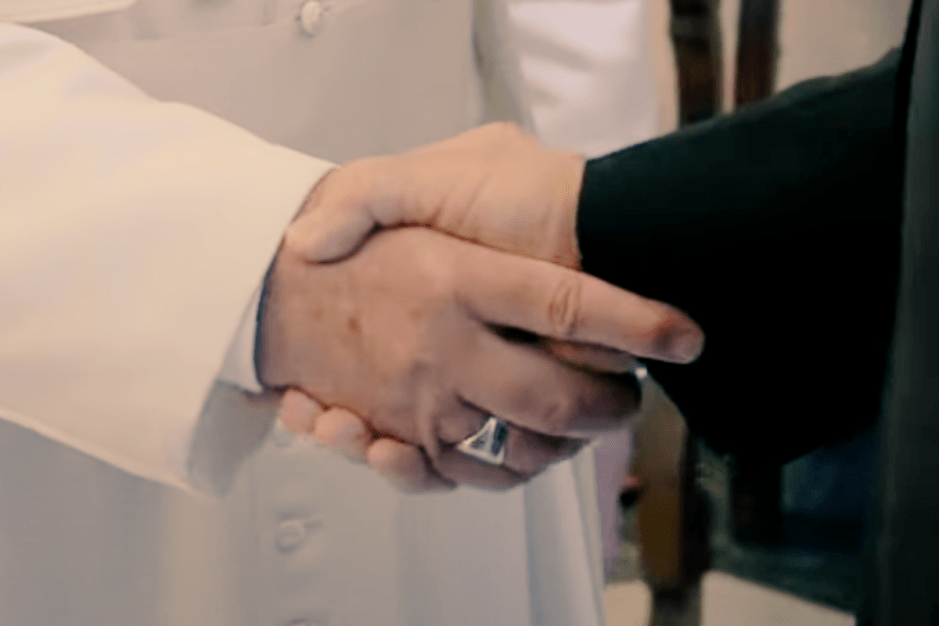
Hand gestures are common among secret societies such as the Freemasons and the Illuminati, for the purpose of identifying the person making the gesture and they may also alert the viewer to a hidden agenda at play.
For Masons, a handshake is an “outward sign, or token, of the union of our minds and hearts.” Their handshakes are also known as “grips’ or “tokens”.
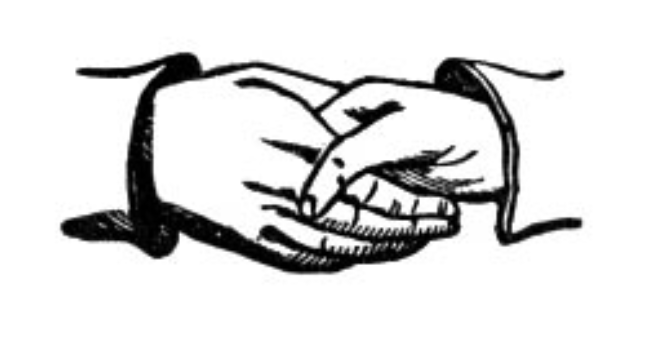
The left-hand image indicates the Grip of an Entered Apprentice and shows the Mason’s thumb pressing against the first knuckle-joint of the first finger of the recipient. If the recipient is also a Mason, he will usually press back. It also goes by the name of “Boaz”.
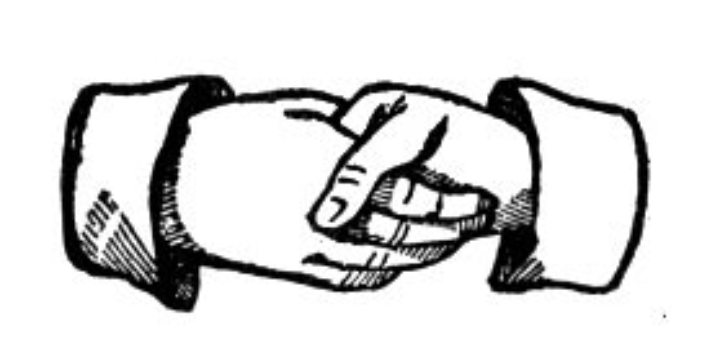
The image on the right indicates the Pass-Grip of Fellow Craft, where the Mason presses with his thumb between the first and second knuckles of the recipient’s hand. Also known as “Shibboleth”.
The image below left shows the Real Grip of a Fellow Craft where the Mason presses hard on the recipient’s second knuckle. This may be returned if the recipient is also a Mason. The formal name is “Jachin.”
The image below right shows the Pass-Grip of a Master Mason; the Mason presses on the space between the second and third knuckles. This is also known as “TubalCain.”
In the Masters Grip, the Mason pushes his fingertip into the recipient’s wrist. Pressure may be returned by a fellow Mason.
This one is the Real Grip of a Master Mason and shows the index and middle fingers extended over the recipient’s hand. It is also known as the “Lion Paw”.
Become a Member to get access to the Directory of Ecclesiastical Freemasonry. It’s full of exclusive documents & articles. Click here for more information.
It is a sign of the times when a senior Catholic churchman wastes an ideal opportunity for increasing devotion to the Blessed Sacrament in favour of pushing the idea that the Body, Blood, Soul and Divinity of Christ are just as present in the average sinful human being. It is also a sign sign, albeit a very disturbing one, to hear language reminiscent of Cardinal “Heal me with your Mouth” Fernandez in a discourse on the most sacred reality of the Catholic faith.
In his address to the Eucharistic Congress in Indiana, the Papal Nuncio to the United States, Christophe Cardinal Pierre, began by reminding attendees that to be Catholic is to be united with the Papacy. So far, so good – although one always wonders with these Modernists if they really mean “being united with every word that falls from the mouth of Frances” rather than with the office of the Pope, and all that entails. By beginning his address by quoting the Council and JPII, Pierre suggests the latter.
After that dubious introduction, Pierre next asks the questions, “What is Eucharistic revival?” and “How will we know that we are experiencing Eucharistic revival?” He then goes to to list the initiatives that have been presented by the US bishops to the faithful in recent times:
” … increased opportunities for adoration and benediction. There has been catechesis on the Eucharist and, of course, processions. By displaying the Blessed Sacrament for worship and increasing our acts of devotion, we have drawn attention once more to this great Sacrament in order to “stir up” a renewed faith, both in our fellow Catholics and in ourselves. We have even attracted the curiosity of people of other faiths.”
Again, so far, so good. Then comes the “BUT”. (With the Modernist, there is always a “but.”) Time to draw our attention, not to God, but to “the other.”
“Not only is He present in our family, friends, and communities; but He is also present in our encounters with people from whom we would otherwise consider ourselves “divided”. This might include people from a different economic class or race, people who challenge our way of thinking, and people whose perspective is informed by experiences that differ greatly from our own. ….. If we are experiencing true “Eucharistic revival”, then one of the signs will be a greater movement on our part to build bridges of unity.”
The term, “building bridges” always calls to mind the arch-heresiarch, James Martin. But there’s more:
And so, to believe in the real presence of Christ is not only to say: In these forms of bread and wine are His body, blood, soul, and divinity.
Wait! Did he mean that during Consecration the bread and wine are changed into the Body, Blood, Soul and Divinity of Christ, or did he say something else? It sounds more like Luther’s Consubstantiation (the idea that the Real Presence presence exists alongside the bread and wine) than Catholic Transubstantiation. It’s a bit ambiguous. Finally comes the humanist clincher: the Real Presence is just not that big of a deal. Christ’s Presence is all over the place – most especially when we are dealing with “the other.”
“But Christ is also present in the assembly of His believing people. Not only that, but he is present to people who struggle to connect with Him because of wounds, fear, and sin. We need to be there with Him, accompanying such people, and helping them to experience the real presence of Christ’s love.”
Now to the act of Eucharistic Adoration itself. Of course it is good, ….. “but”……
Adoration, is essential to our relationship with Christ — but it is important that we treat it as that: a relationship. If, in the act of Eucharistic adoration, we were to look at the Sacrament merely as an “object” to be admired, then we would be remaining, as it were, “on the outside….”
Does any Catholic actually do that? Simply admire the Blessed Sacrament? In any case, here comes the really strange part. The “heal me with your mouth” part. But even stranger is the fact that this reference to “mouth to mouth contact” came not from Tucho Fernandez but from Pope Benedict!
“…. Pope Benedict explained: “The Latin word for adoration is ad-oratio — mouth to mouth contact, a kiss, an embrace, and hence, ultimately love….”
The reference does check out: Pope Benedict did in fact use these words at World Youth Day in Cologne in 2005. To young people. But here is the really strange bit: the Latin word adoratio does NOT have anything to do with kissing, embracing or “mouth to mouth contact” – at least not in any of my three Latin dictionaries or that I could find anywhere online. The noun, adoratio (from the verb adorare, to speak or entreaty or worship), only means an act or worship or prayer. That’s it.
So where does the kissing come in? Benedict was meant to be a great Latinist! The mind boggles.
Getting back to Cardinal Pierre and his address, it finishes by emphasising that the purpose of Adoration is not to give perfect worship to God but merely to solve the problems of this world. This is pure naturalism; it lines up perfectly with the Masonic ideology of a horizontal, humanist church.
There’s a bit more about the being open to the surprises of the Spirit and Synodality, and that listening “to one another and to the Spirit in the person we listen to” will be the “fruit of the Eucharistic revival.”
So there we have it: the main fruit of this Eucharistic Revival will be a Synodal, listening Church. And they wonder why the majority of mainstream Catholics do not believe in the Real Presence!
Four files are shown below: a document outlining the Pacts of the Catacombs, the text of both the 1965 and the 2019 Pacts, and a biography of the instigator of the original Pact, Dom Helder Camara.
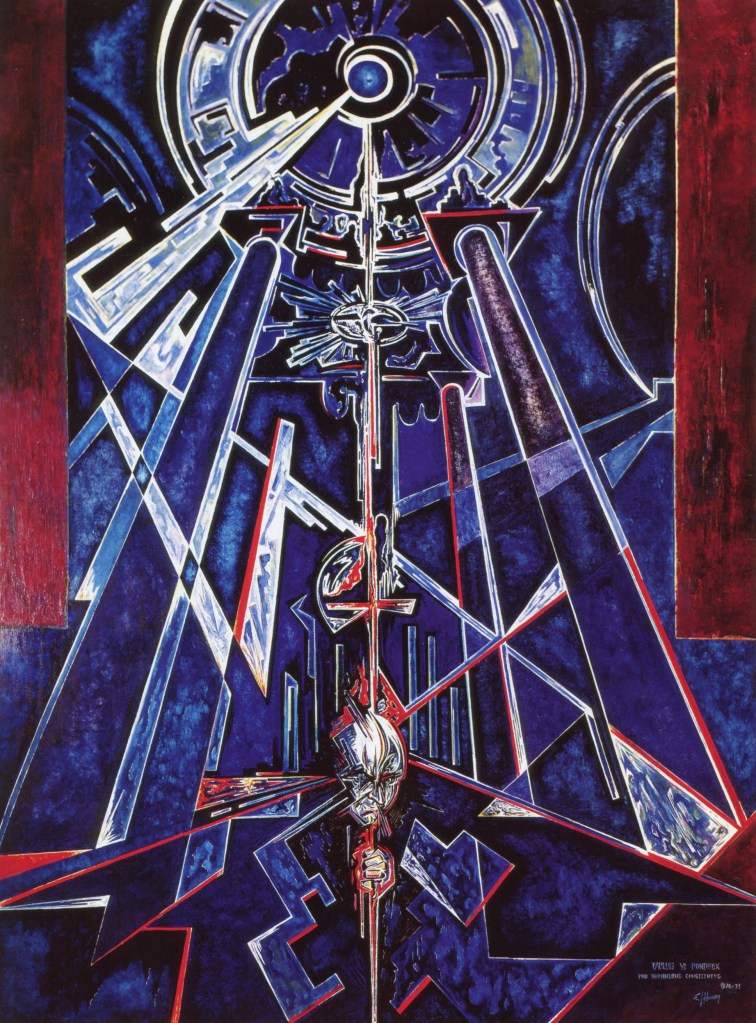
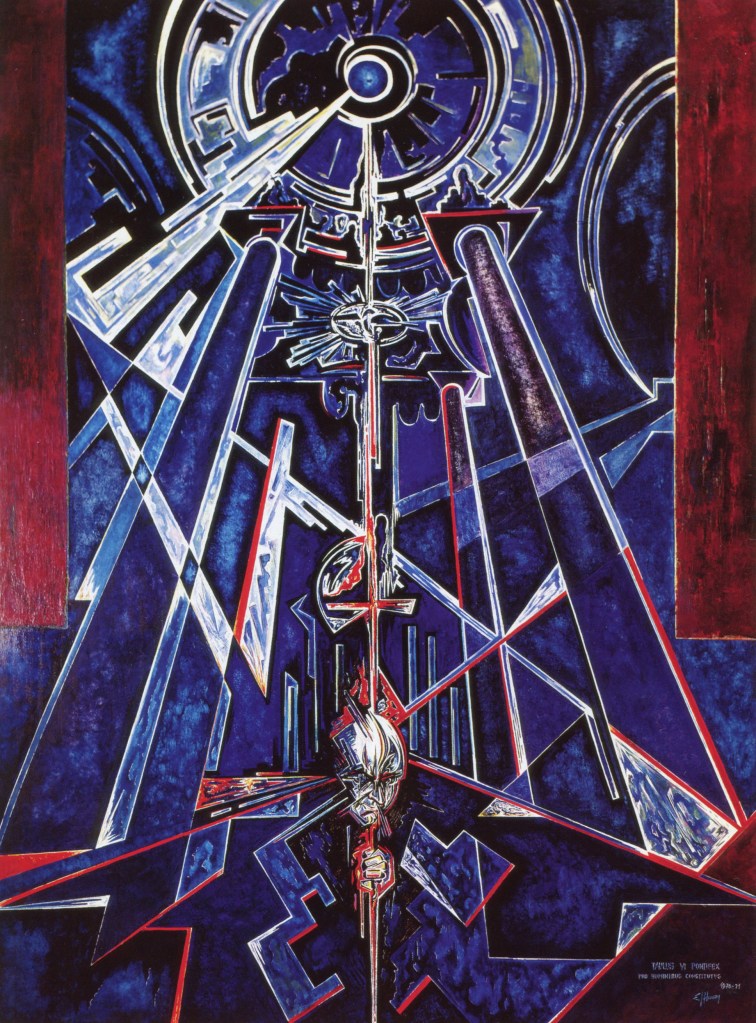
In 1971, Paul VI was presented with a painting, said to be his portrait, and which, to be honest, is one of the more disturbing images this author has come across. The picture emits a demonic violence that almost leaps out of the frame, leaving the viewer feeling oppressed and unsettled.
Most startling of all, the Supreme Pontiff of the Catholic Church is surrounded by cold, dark Masonic symbols, hiding in plain sight.
Hansing described the portrait as showing “the tension-fraught situation of the church, caught in a multiplicity of issues, as reflected in the countenance of the Pope.”
I don’t profess to be the first to discover this particular connection between Pope Paul VI and Masonry – the articles cited in this one are testimony to that. But since I have only just come across this rather disconcerting episode in Paul’s life, I thought I’d write on it anew and add some further research.
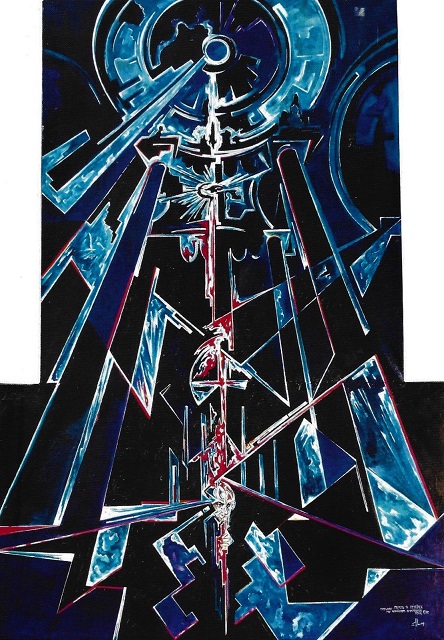
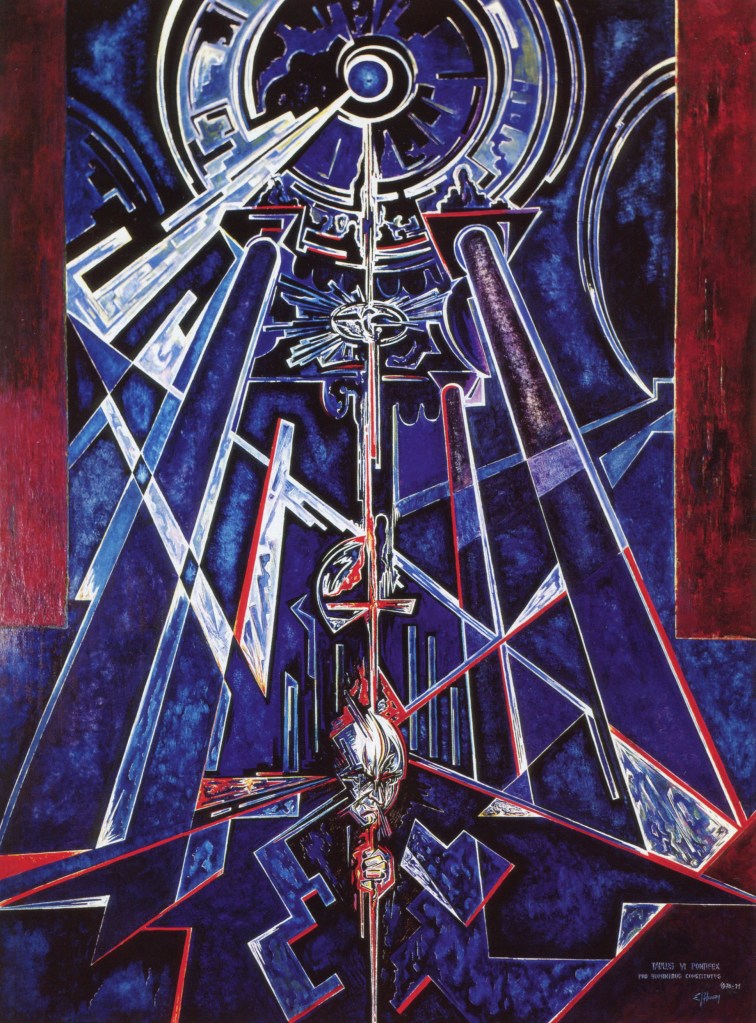
Firstly, there are not one but nine versions of this scene. Each tells, I believe, a part of a story that begins at the Second Vatican Council and culminates in the very public accusations that Paul was a homosexual. Shown below are three versions, created in 1970, 1970/1 and 1975 respectively. The third is part of a series of screen prints, which are based on the second painted version of the portrait.
The artist, Ernst Guenter Hansing, was initially associated with Cardinal Josef Frings, for whom he painted two portraits. Hansing had trained under the abstract artist, Fernand Leger, and had mixed with many avant-garde artists of Europe. This of course, would have appealed to Montini, who was known for his love of the cultural elite. Fring invited Hansing, a Lutheran, to observe the final session of Vatican Two in 1965, in order to “internalise the atmosphere.”
Hansing claims to have been struck by the Pope’s meekness, describing Paul as “humility personified” and as a “pleading” or “begging” person. Hansing at once expressed a desire to paint the Pope, so the story goes, wanting to encapsulate the scene presented by the massive Bernini columns dwarfing the humble Pope, he who alone carried the burden of determining the Church’s future. Hansing also wanted to capture the rays of light which issued from the great dome surmounting the canopy. So the story goes.
Paul apparently did not commission a portrait, but was approached by Hansing who was eventually given a room to work from inside the Vatican from 1969. The artist was then allowed to sit in on 13 papal audiences over the next two and a half years to make his sketches. The Pope’s secretary, then-Fr Pasquale Macchi, acted as go-between for the artist and pontiff.
Strangely, the image of the Pope at the centre of the painting was not based on the sketches Hansing made during those many papal audiences. Rather, it is based on a photograph taken during the Pope’s trip to Jerusalem in 1967. A drawing made from that photograph was then transposed onto the “Papacy” work. The many sessions that saw Hansing scrutinising Paul’s speeches were justified by the artist’s need to ‘internalise” the character of Paul.
Upon seeing a working sketch of himself, Paul is said to have uttered the cryptic comment: “One almost needs a new philosophy to grasp the meaning of this in its context.” [Emphasis added.]
The first version of the painting is made from two separate pieces of canvas: one above and one below. The bottom canvas is horizontal and the top one is vertical – which is like an inverted cross when you come to think of it.
Two vertical white blocks – red in the second painting – on either side of the piece are in fact said to represent an inverted cross – the Petrus cross – according to the artist, ostensibly calling to mind the martyrdom of the first Pontiff.
According to Hansing, his trademark blue colour represented “mystical depth” and was more prominent in the second painting. He referred to the use of red as denoting “blood circulation,” and indeed, much of the red in Hansing’s works resembles blood either dripping or in pools.
In the top of the internal space of the real dome, which was designed by Michelangelo, we can find the image of God the Father. In Hansing’s version, God has been replaced by a mere swirl, which could also be interpreted as an All-Seeing Eye, from which emanates a beam of light.
Hansing replaced God the Father with this ambiguous symbol
A ray of light proceeding from beneath this All-Seeing Eye, seems to pierce the Holy Spirit in the form of a dove, then continue vertically downwards right through the person of the Pope. Blood appears to drip down this central axis, through Paul and merging with his own grotesque hands that grasp a threatening dagger-like implement.
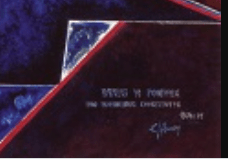
A second painting was begun after Fr Macchi and Hansing’s poet friend, Stefan Andrew, suggested to him that the first work was too small. The second work contains a few changes: more “Hansing Blue” is incorporated and the pillars are emphasised. The Pope’s face is “more humble” and the phrase, Pro hominibus constitutus, meaning ‘appointed for service to the people’ – is written in the lower right hand corner. Surprisingly, this motto is also found on Cardinal Frings’ Coat of Arms.
The finished work was a massive 21.6 m x 3.6m (71ft by 12 ft) and was presented to the Pope in 1972.
Cardinal Fring’s Coat of Arms.
Detail from the painting. No, I can’t read it either.
In his speech at the time the second painting was presented to the Pope, Bishop Wilhem Cleven referred to John’s Gospel, stating “The time comes when someone else girds you and leads you where you do not want to go.” (John. 21:17).
When he saw the finished second portrait, he remarked that the it was “very useful” to make an “act of reflection’ in studying the painting. The artist then went on to make seven screen prints of the portrait, apparently at the behest of Paul, in order that they may be sources of “acts of reflection.”
Interpretation
The definitive explanation of the Masonic symbols found in the work was written by researcher and author, Craig Heimbichner, who detected, among other symbols, the three pillars of Masonry, inverted crosses, pentagrams, and at least one square and compass. Heimbichner also explains that the initiation rite of the 30th degree Mason, the Kadosh Degree, involves thrusting a dagger into the papal tiara. He believes the pope is represented as holding that dagger.
It is certainly true that Paul VI surrendered the Papal Tiara at the start of his pontificate. Could his devastating reforms and the emptying of papal authority on his watch also be considered as “killing” the papacy?
I am not normally given to making wild speculations on subjects that are outside my competency. However, this case is an exception. While we will never know the true meaning of this mysterious episode, or of the paintings themselves, I proffer the following hypothesis. You may like to think of it as fan-fiction:
Paul is represented as both victim and perpetrator in Hansing’s portrait: this is an image of his character and of his pontificate…..
Prior to the conclave, the blackmailable Montini promised his Progressive/Masonic coalition supporters that he would allow sweeping reforms once he was elected Pope. As Pope Paul VI, he went along with changes to the Mass, leaving details to the Freemason Bugnini, and approved the other innovations introduced during and after the Council.
Although the Council reaffirmed the Church’s teaching on birth control, Cardinal Frings later challenged Paul to review the that stance, leading Paul to establish a commission to look into the matter. The commission returned to Paul with their conclusion: birth control should be allowed.
This was a bridge too far for Paul. Already cracks were appearing as the Council’s love-fest aura began to wear off. The unity and renewal Paul had, far too optimistically, hoped for had not eventuated, and his latitude in doctrinal matters was being exploited by those closest to him.
Paul decided to risk the ire of the Masonic brotherhood, stand his ground and defend the Church’s teaching in Humanae Vitae, which was released it in 1968.
Frings and the Masonic forces he represented were furious. Paul needed to be reigned in but they knew him to be pliable and timid. (“Begging” and “pleading”, as Hansing said.) They decided to send him a warning – of the most severe kind. Hansing was conscripted to deliver the message on behalf of the Lodge.
Hansing is moved onsite although he didn’t really need to sketch Paul: he already had chosen the photograph taken in Jerusalem as a model – an indication, perhaps, that the Ecclesiastical Lodge that commissioned him had powerful Jewish connections. He sat in on thirteen of Paul’s Audiences merely to intimidate him.
The pressure mounted and Paul began to waver. He was shown a working sketch of himself and mused aloud: “One almost needs a new philosophy to grasp the meaning of this in its context.” Perhaps that “new philosophy” was something antithetical to Catholic teaching to which Paul had ambivalently subscribed.
Once the first painting was finished, the seriousness of the threat became even more apparent. The looming threat of violence overwhelmed him and Paul sensed that his life may be in danger. The angles of the painting resembled an axe cleaving his skull in two but also represented to him his double-mindedness.
He knew he was under pressure to fulfil the ancient decrees of Masonry and demolish Catholicism, as represented by the weapon in his bloody hands, and as symbolised in the stabbing of the Papal Tiara.
Paul finally relented and resigned himself to following the Masonic programme for the rest of his pontificate. He then informed the Lodge.
A second painting was commissioned and the Pope was now represented with a “more humble” countenance. The pillars of Masonry were emphasised, representing Paul’s triumph of “reason” over “superstition”. Bishop Cleven was on hand to remind Paul that someone else “girded him and led him where he does not want to go.” (As if he needed the reminder)
A humbled Paul then acknowledged that his “acts of reflection” led him to make the right decision. To prevent a relapse, the Frings-led Lodge commissioned seven prints of the portrait – one for each day of the week.
Paul later had a crisis of conscience (as did Frings). He was forced to confront the implications of his progressive reforms as the Church continued to implode and he grieved that no one anywhere on the Catholic spectrum respected him.
When he tried to impose his papal authority, the Lodge reacted swiftly: a staged attempt was made on his life when he visited the Philippines in 1975. Macchi and Marcinkus “saved his life,” and Paul was again beholden to the Masonic forces that elected him.
Paul wavered again, trying to warn Catholics of the Pandora’s Box that had been unleashed by the Council. His furious minders began to lose their patience. It was time for a showdown.
When Paul again publicly held his ground on the Church’s approach to sexuality morality, it was the last straw for the Ecclesiastical Masons. In 1976, a campaign was orchestrated to suggest that the Pope had a very dark secret: that he was a homosexual. Paul was crushed and defeated; he never issued another encyclical and openly expressed his regret for the direction taken by the Council, never admitting his part, overwhelmed as he was by the pressure that had been brought to bear on him.
No wonder Paul whispered to his biographers, “You will crucify me.”
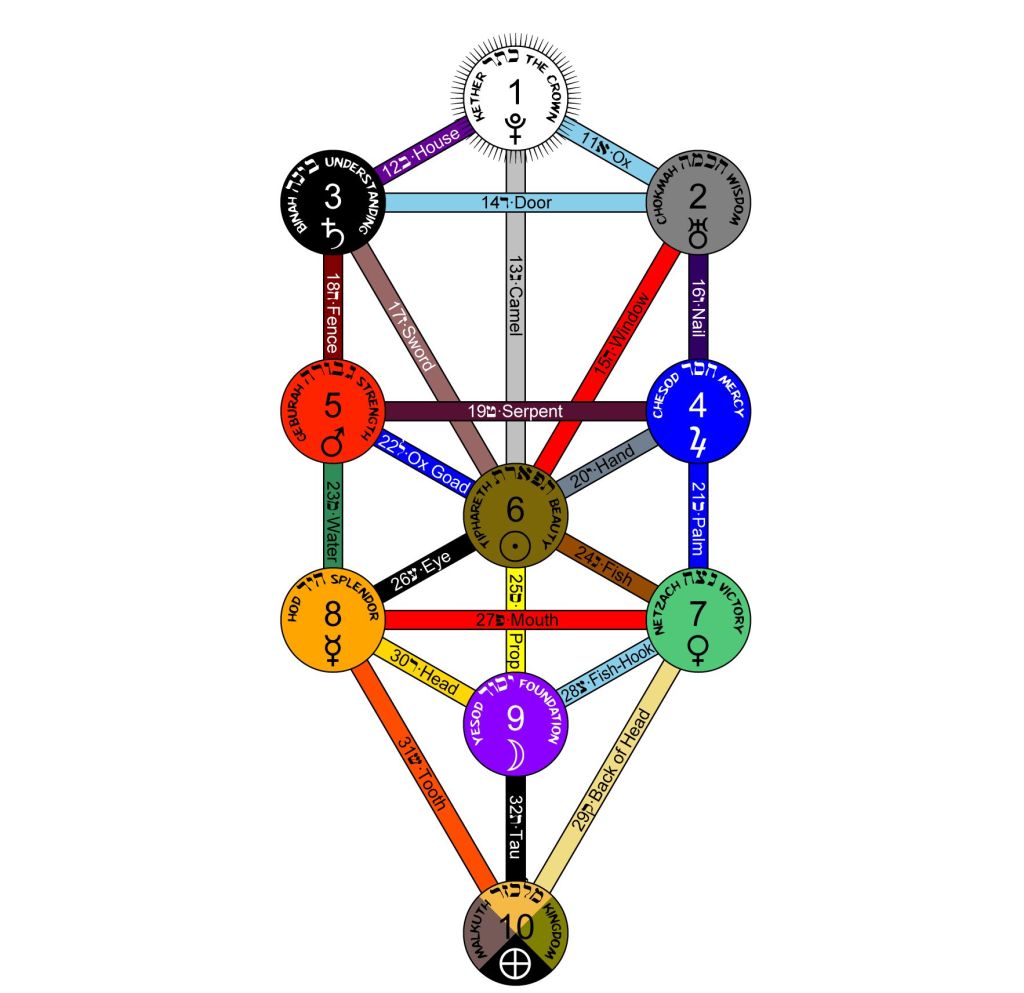
Just to complete the flight of fantasy, on the left is a diagram commonly used in Gnostic Judaism, or Kabbalah.
It is interesting to note how many points line up with Paul’s “portraits.”
Online, there have been more than a few comments by Never-Trumpers and conservative “but he’s not really pro-life” Christians voicing their new-found admiration for Trump, who after he was shot rose up like a phoenix, blood streaming across his face, triumphantly shouting “Fight! Fight!” with his clenched fist raised in the air.
Trump’s triumphant Hero Shot
The assassination attempt yielded the Hero Shot par excellence and it appears that this is the moment his Q Anon devotees have been waiting for: tangible evidence that these long years of waiting and cryptic messages have not been a hoax. Now they “know” for sure that they have not been misled or manipulated, that it must all be true: the White Hats, the ‘Dumbs”, the SRA. All of it.
However factual the heinous activities of the Deep State might be, though – and there is certainly plenty of evidence – the whole concept of an anonymous commentator ‘dropping’ mysterious clues for Trumpian insiders is very troubling. For the idea of an ‘insider’ revealing ‘secret knowledge’ to adoring devotees is the very essence of Gnosticism. And if Trump has a cult-like following, then the name of that cult really is Gnosticism.
His Q-Anon cult thrives on the promise of secret knowledge: the messages, and Trump’s tweets and speeches are treated as codes and are said to full of gematria. Gematria is a cipher which assigns a numerical value to a word or letter of the alphabet. One very famous reference to this can be found in the Bible, where St. John tells us that the number of the Beast of the Apocalypse is six hundred and sixty-six. The importance of dates and numbers, which often are highly significant anyway, becomes elevated in a gematria system.
Gematria is thought to have been first developed by the ancient Greeks and has popped up throughout history in occult circles, with many variations. Magicians throughout the ages have referred to it and gematria is part of the system of Kabbalah. Gematria was once taught to members of the Hermetic Order of the Golden Dawn and Aleister Crowley apparently used it to code his 1904 The Book of the Law.
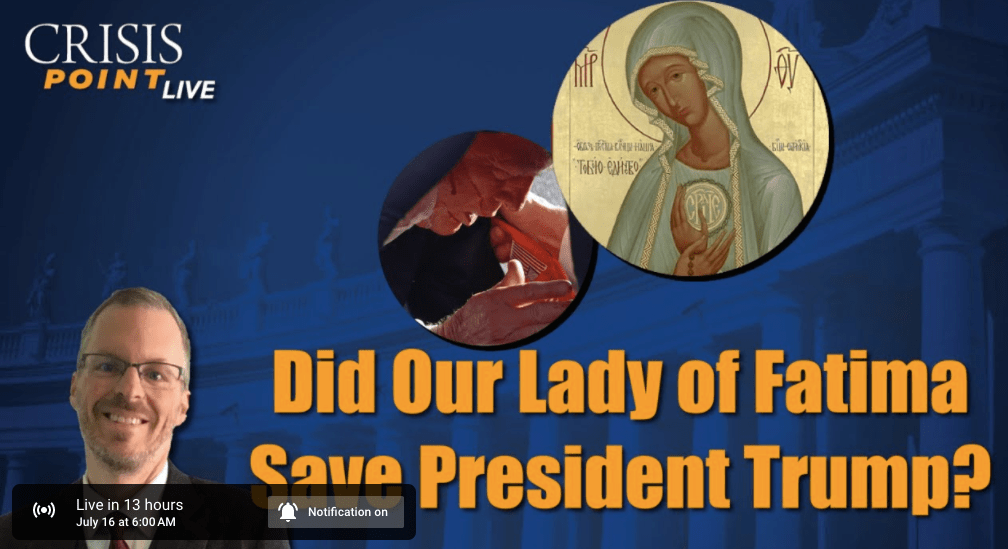
Ciphers aside, Catholics are not immune from Trump Gnosticism. Already, some are claiming that Trump’s life was saved by the Virgin Mary, a theory suggested by the date of his assassination attempt: July 13. This is one of the “Fatima Days”: the 13th day of each of six consecutive months from May to October which mark the most famous apparitions made by the Mother of God to the children at Fatima.
Eric Sammons of Crisis Magazine, king of the Glad Trads.
Now, don’t misunderstand, I wholeheartedly believe that the apparitions and messages from Fatima are true. What I baulk at is attributing Trump’s “miraculous” escape to the intervention of Our Lady. For if one actor in the Deep State can play at the Psy-op game, then so can two.
Trump’s Q-Anon followers have been “trusting the plan” for years. They have an enormous amount of blind faith in Q’s claims that even as we speak, Trump’s secret militia is liberating children from the bowels of the earth. If a prediction fails spectacularly, as happened with the very first one in 2017 when it was foretold by Q that Hillary Clinton would be arrested, the faith of these hillbilly Gnostics is not shaken. A perceived failure simply becomes subject to a new level of revealed truth: Clinton was actually arrested but was subsequently replaced by a body-double.
And so was Biden … and Pope Francis … and on it goes. Throw in the theory that viruses are a product of the imagination and there you have Q Anon-sense.
Meme from Trump’s account on Truth Social
From the very advent of Q, Trump himself played the game, telling reporters that this was the calm before the storm and with sage-like restraint explaining that all would soon be revealed. Perhaps it was more than coincidence that his recent legal battle was over his relationship with a woman known as “Stormy”.
In 2022, he began referencing Q-Anon in his tweets and on his social media platform, Truth Social. He likes to pepper his rally speeches with insider references, the kind of jokes his only his Q-Anon followers would appreciate.
Screengrab from the Republican National Conference: note the background, Novus Ordo Seclorum or “New World of the Ages” AKA “New World Order.”
In the wake of his assassination attempt, it has been fascinating to watch people falling onto one of two camps: the freedom-loving Trump supporters (roughly aligned with the Republican party) and the evil left-leaners (the Democrats.) Those undecideds in the middle grey area, who once constituted the majority, seem to have all but disappeared.
And maybe that was just the point of the whole exercise.
Many rumours and half-truths have been flying about in regard to what happened to the body of Cardinal Pell after his death. Actually, there are also a number of rumours about the cause of his death itself, but that is not the theme of this article.
Rather, I’d like to propose a scenario centred around his corpse, one which includes a modest amount of anecdotal evidence.
After it had been reported that Pell’s body was “grossly disrespected” by having its nose broken and being left dirty, without shoes and with clothes just thrown on top of it, a new version of the story has emerged. George Pell’s brother now claims he was perfectly happy with the treatment of the body.
David Pell toldThe Australian that his brother’s nose “was askew” but that it “could have been broken by the lid of his tight-fitting coffin.” David Pell also thought it reasonable that the Cardinal was without shoes because they just wouldn’t fit into the coffin and clarified that he was clothed but that the vestments were in the wrong order.
I personally find these statements rather troubling. Surely the workers at a reputable funeral parlour would be capable of selecting the correct-sized coffin – one that would account for a large body’s nose and shoes? Is that not simply part of their job? How often do funeral parlours break people’s noses!? Cardinal Pell was a large man, but he wasn’t morbidly obese. There was nothing remarkable about his stature from a coffin-maker’s point of view.
Regarding his vestments: presumably the funeral directors who prepared the body were very familiar with the vestments of Catholic prelates. This was Rome, after all. It seems significant that the Cardinal’s vestments, which played such an integral part in disproving the allegations against him, are again relevant to the mystery surrounding his body’s post-autopsy experiences. [If the reader doesn’t understand what I’m talking about, let him consider the restrictions placed on one’s body by a garment that reaches almost to the floor and which has no front opening. In other words, a Bishop’s vestments would be most inconvenient for someone perpetrating opportunistic s** abuse.]
One online commentator, a Benepapist famous for her histrionic denunciations of all and sundry, has accused the Pell family of being “paid off”. I believe that to be a most uncharitable take on the situation.
It seems far more likely that the family were told that Pell’s nose was broken by the coffin lid and told that his shoes were too big for the coffin. They must have taken it at face value and that would have been the end of it as far as they were concerned.
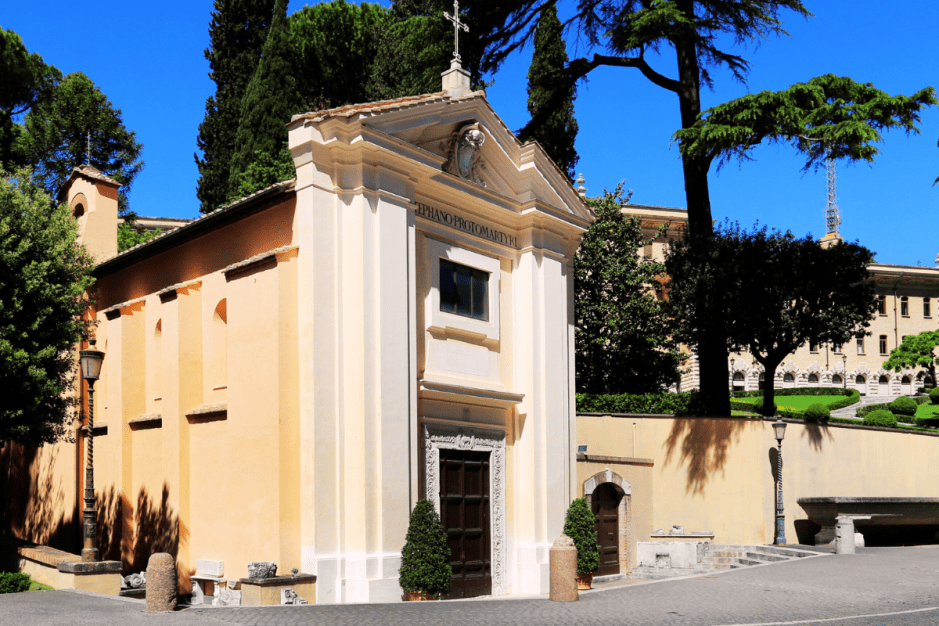
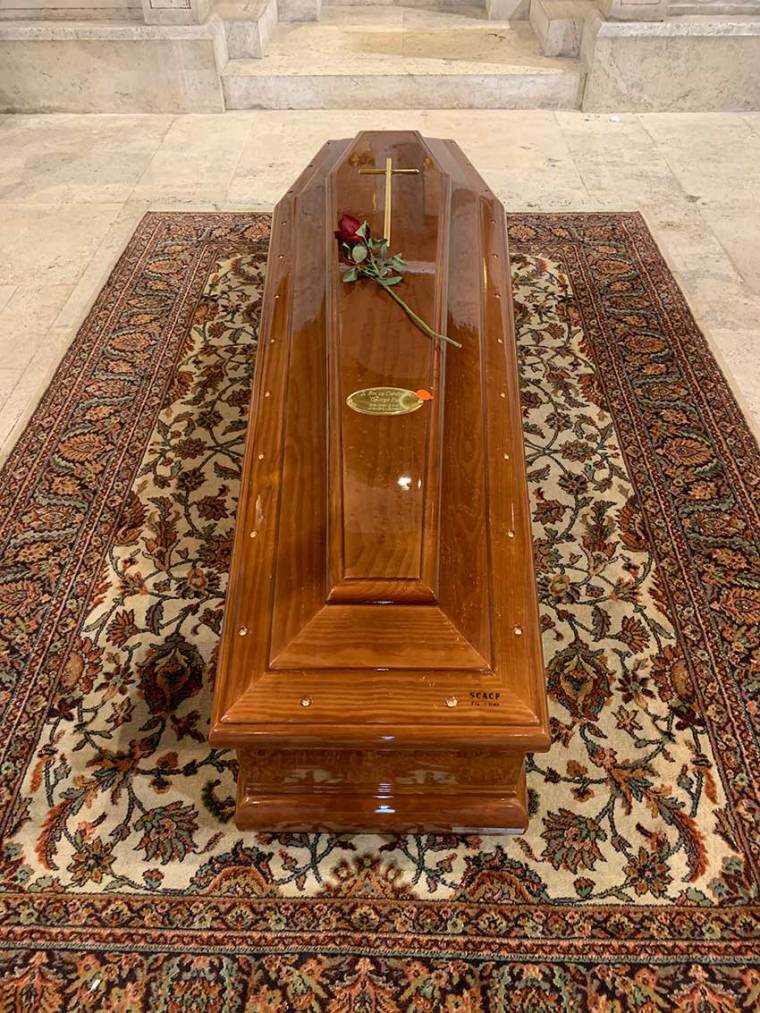
Again, I present the photograph of the coffin as it lay in state inSanto Stefano degli Abissiniprior to the Cardinal’s Requiem Mass.
As was pointed out in my previous article, the screw-holes in the coffin’s lid have been filled with a very light- coloured filler, giving it a most unprofessional finish. This is consistent with the coffin being re-opened some time after it left the funeral home.
So I am not suggesting that David Pell was lying. Rather, I am suggesting that he and the family might be just a little naïve – and they were probably in shock, after all. They trusted whomever told them a yarn about the Cardinal’s body – and that someone may well have actually had a hand in the desecration itself, or at least in hiding the fact.
There is precedent for my opinion. Naïveté can run in the family, even among very good and upright people, perhaps especially among good people.
George Pell was known for sometimes making the most disastrous appointments. There is one Australian Bishop, no stranger to the pages of this website, who was a product of the late Cardinal Pell. Pell mentored him, and brought him up through the ranks of the Church to his present high status.
That man is a complete buffoon, without class or culture, an ecumaniac and sycophant to all things LGBT. It is possible that he should never have been a priest, much less a bishop and I actually once heard a priest say that if it hadn’t been for George Pell, that man would “still be sitting on his couch, watching the footy.” Or words to that effect.
In short, George Pell made a huge mistake when he decided that man was bishop material.
Now Pell was definitely not stupid, and was not corrupt, but on occasion was a very poor judge of character. Perhaps his family shares this honest flaw, making them easy prey for the devious Vatican spin doctors.
A Hypothetical Timeline of Events.
Death of Pell in Rome on Tuesday, Jan. 10, 2023.
Family is notified and the usual protocols for dealing with the corpse of a prelate are triggered.
A priority autopsy is performed according to the standards in Rome.
Corpse is sent to funeral home in Rome for priority treatment: cleaning and embalming are performed, coffin is sealed.
Prepared corpse is sent to Santo Stefano degli Abissini for veneration, perhaps as early as Wed. 11 (according to one report.)
Coffin is reopened at the Santo Stefano degli Abissini church (possibly during the night) and the body is desecrated/abused/ritually humiliated. Abuse includes breaking of Pell’s nose and sullying the body which results in the embalming being “buggered up” (in the words of David Pell.)
The abusers re-seal the coffin lid using a new, lighter coloured filler in the screw holes.
Pell’s body is venerated for several days with coffin (unusually for a bishop) closed.
Pell’s body transferred to St. Peter’s Basilica for a Requiem Mass on Saturday Jan. 14th.
Pell’s body is flown to Australia ahead of the burial on Feb 2, 2023.
Desecration is discovered when the coffin is re-opened in Sydney.












 Ecclesiastical Freemasonry