Deism, Esotericism and Gnosis in the Masonic Constitutions of 1723

FROM: CORRISPONDENZA ROMANA by Fr Paolo Siano

Published May, 2020. (Automatic online translation from Italian)

1723 is the year of the first Constitutions of the new Grand Lodge of London (later of England ) founded in 1717. The author is the Presbyterian pastor and Master Mason James Anderson (1679-1739). By now modern Freemasonry, that of the “Modern” Freemasons, no longer builds churches, but wants to rebuild Man, Society, social and religious relations.

In The Constitutions of the Free-Masons (London 1723), instead of the Old Charges , or Ancient Duties (for which cf. article here ), we find new Duties (“Charges”: Pp. 49-56), still valid in Freemasonry, for example in the Grand Orient of Italy from which I draw the Italian translation (GOI, Antichi Duty – Constitution – Regulation , Rome 2018) of some passages from the 1723 text.

New duties establish in Title I ( The Constitutions , p.50) that Freemasons are henceforth bound ” to that Religion in which all men agree, leaving them their particular opinions; that is, to be good and sincere men, or men of honor and honesty“.

In Title VI, 2 it is written that Freemasons belong to the aforementioned Universal Religion (“as Masons, of the Catholick Religion above mention’d “: p.54; catholic means universal). This religion, with which Freemasonry unites men of all religions or religious confessions (in an alchemical coincidentia oppositorum ), is not at all the Catholic Christian religion ( as, instead, some Catholic Freemasons of the pro-English area affirm ), but it is a natural, anthropocentric and rationalist religiosity that relegates the dogmas to mere opinions. It is Deism, as also admitted by English Freemasons [ AQC 78 (1965), pp.50-51.55].

Historian David Stevenson notes that Anderson, as pastor, hates Catholics and Deists in his sermons, but writing as a Freemason the Constitutions also includes Deism in the Masonic Universal Religion (cf. Heredom, vol. 10/2002, Scottish Rite Research Society , Washington DC , USA, pp. 97,115-116,119-121,127; p.136 note70).

There’s more: I discovered that even in the Constitutions of 1723 there are traces of Esotericism and Gnosis. Here they are in summary. On the cover or frontispiece there is the image of Phoebus-Apollo, the shining sun-god who, young and naked, travels the sky with his chariot. Phoebus, god of divination, gives life and death (alchemical death-rebirth?), Loves both Daphne and Giacinto (divine, initiatory bisexuality?). The image of the god Phoebus, together with that of the Cainite Tubalcain, is already in an alchemical booklet printed in Florence in the 14th century (cf. A Libretto di Alchemy engraved on lead sheets in the 14th century… , Città di Castello 1910, pp. 27.30). Again on the title page of the Constitutions, under the title there is a bird that seems to resemble the ibis, the symbol of Hermes Trismegistus.

I discovered that, in the seventeenth century, in London, in the Devil’s Tavern, in a room called the Oracle of Apollo, the Apollo Club met: a literary club that also recited odes to the Devil. In the Devil’s Tavern there was also a libertine and blasphemous circle, the Hell-Fire-Club to which belonged the Duke of Wharton, Freemason, depicted in the Constitutions of 1723 as newly elected Grand Master!

From 1722 in the Devil’s Tavern a lodge met that took that name, “Devil”. In the “Apollo” of the Devil’s Tavern, from 1725 to 1767, the Grand Lodge of London held at least 75 meetings (cf.The New England Freemason, N° 12, pp.543-544; AQC 11 (1898), p.30; cf. G. Oliver, in W. Hutchinson, Spirit of Masonry, 1843, p.12).

In the historical-legendary part of the Constitutions of 1723 the 4 sons of Lamech, Cainites, do not have a prominent position as in the previous Old Charges of the XV-XVIII centuries. Now it is God who directly transmits the Art / Science of Geometry / Masonry to Adam and these then to his sons Cain and Seth. Abel is not mentioned (pp. 1-2). Anderson does not say that, even according to the Jewish Kabbalah, God passed on the Secrets of the Kabbalah to Adam.

In fact, modern Freemasonry presents itself as an initiatory society and as a spiritual art that binds the Initiates to each other and to the Divine. In a hymn attached to the Constitutions , Freemasonry is defined as divine art revealed by Heaven ( “Craft divine!… From Heav’n reveal’d“: P. 83). Even in Anderson’s Constitutions, Cain figures as the first Mason who builds a city.

Anderson writes that Cain is the Prince of one half of humanity and his posterity has imitated his royal example in improving Science and Masonry (p. 2). Then, in a note, the descendants of Cain (Tubalcain, Jabal…) are credited with the invention of metalworking, architecture and other arts (p. 2). Among the keepers of the Masonry, Nimrod, king of Babylon, is also praised; in footnote Anderson specifies that Nimrod means Rebel and that he was revered as Baal and Bacchus (p. 4).

Anderson mentions the wise men of the Chaldeans, the “Magi,” – hence the term: magic, and the priests of ancient Egypt as custodians and transmitters of Masonry; he specifies that about the Chaldeans, the Magi, Hiram Abiff and Moses, it is necessary to speak only in a constituted Lodge! Another keeper of the Muratoria is Cam (“Ham”), one of Noah’s sons. Pythagoras and Euclid are also among the keepers of the Masonry (cf. pp. 4-5, 8, 16, 20-21). It is good to know that in magical literature, at least since the sixteenth century, Cam is associated with black magic (cf. BE Jones, Freemasons’ Guide and Compendium , London 1950, p. 314).

In the Constitutions, Anderson praises the architect, Vitruvius, (p.25) and affirms that in times of ignorance geometry was considered to be the evocation of spirits (p. 36, note *). The scholar, Frances Yates, (1899-1981) sees a similarity between these statements by Anderson and what the magician, John Dee, (1527-1608) wrote in his preface to Euclid’s Mathematics: Dee praised Vitruvius and called out those who accused him of evoking spirits (The Rosicrucian Enlightenment, London – New York 2002, pp. 271-272). Scholar Susann Mitchell Summers found that Anderson possessed the writings of John Dee and other wizards and occultists (cf. The Square , December 2018, Addlestone, UK, p. 18).

In the Constitutions 1723 there is mention of the ” shining and free Genius ” of the Freemasons, then in one of the songs in the appendix to the Constitutions the powerful Genius of the Upper Lodge is praised (” The Mighty Genius of the lofty Lodge “: p.80). Later in the title page of the Constitutions of 1784 will appear ” the Genius of Masonry “, a winged angel bearing light (a lucifer), defined as she (“She”). Initiatory androgyny? In Title II of Masonic Duties , Anderson writes that even if a Mason commits a crime against the State, he cannot be expelled from the Lodge and maintains an irrevocable bond (“indefeasible “), or indelible, with the Lodge (p. 50)

Also interesting is Anderson’s 1738 New Book of Constitutions approved by the Grand Lodge of London at the Devil’s Tavern . After Anderson’s preface, there is the image of a seated woman, surrounded by various objects including the Caduceus of Mercury (p. X), that is the winged staff with two entwined snakes, symbol of Hermes Trismegistus. In the appendix to The New Book of Constitutions there is a pamphlet from 1730, A Defense of Masonry , in which the rites and principles of Freemasonry are linked to those of ancient pagan, Egyptian, Pythagorean, Druid, Qabalist Mysteries (pp. 216- 226).

In 1739 a posthumous, non-Masonic work by Anderson, ” News from Elysium: or Dialogues of the Dead ” was published in two volumes in London . On the title page of both volumes stands the figure of Hermes Trismegistus flying in the sky and carrying his Caduceus (cf. AQC 18 (1905) pp. 34-37). In the second image Hermes / Mercury appears to have female breasts. Androgyny? 
Rapprochement from 2017

FROM KATHOLISCHES – NOVEMBER 2017

In 2017 the Masonic lodges will celebrate their 300th anniversary. Since 1717 the relationship between Lodge and Church has been rife with tension and conflict. In Syracuse there is a new attempt at an understanding with a spectacular aspect: For the first time a Catholic bishop takes part in a public box event and will discuss with the master of the chair. Some insights into the background of a controversial experiment.

Truth and the search for truth

For the Catholic Church the prescribed relativism and the factually practiced syncretism of the Lodge Brothers are incompatible with the truth of reality revealed by God. The lodges reject this revelation as a truth of faith. The orientation of the lodges is not only deistic, agnostic or atheistic, depending on obedience, but was from the beginning significantly shaped by the esoteric “search” for a “different” truth than the Christian one. In the Catholic states the lodges saw and organized themselves as direct opponents of the church. Following their relativistic credo, they want to eliminate the public influence of the church, which is why Freemasonry has always been attached to a striving for power. This battle has been raging for three centuries.

The history of the lodges, however, also knows the phenomenon of church representatives who allowed themselves to be initiated and thus became apostates according to the church’s understanding. Your covert work in the church as “agents of the lodges” is still awaiting investigation. A particularly striking example is the magnificent Benedictine Abbey of Melk on the Danube. At the end of the 18th century there was not only a monk’s convent in the monastery, but also a lodge. A part of the monks belonged to her and thus formed a convention of the “initiates” in the convent.

The status as a secret society, to which the lodges cling to this day, allows the abbreviated brothers undetected to infiltrate other organizations, parties and churches and to create an invisible network.

“Relaxation Exercises” after the Council

One consequence of the Second Vatican Council it was that lodge-friendly church districts ventured with newfound confidence from obscurity. The 1970s were marked by efforts, also in the German-speaking area, to bring about a “reconciliation” between lodge and church. Faithful bishops in the countries and the election of Pope John Paul II put an end to these attempts in the early 1980s.

Lists of alleged or actual church representatives, including cardinals, who are said to be lodge members, circulate repeatedly. The sociologist of religion, Massimo Introvigne, warned against false suspicions and in May 2013 formulated a sure way to clarify the suspicion of lodge membership:

“The crucial core of Masonic ideology is relativism, with all the related political implications, which often lead Masonic obedience to promote laws to legalize abortion, euthanasia, and gay associations. So if you hear about a Catholic church representative or politician saying that he is a Freemason, the question should be: does he represent relativistic ideas? Is he an abortion advocate? Is he in favor of euthanasia or the legal recognition of gay partnerships?

If the answer is ‘yes’, then he is – according to the definition used by the current Grand Master of the Grand Orient of Italy – a ‘Freemason without an apron’, a companion of Freemasonry, and the question of whether he has an official membership card or not is then only secondary.

If the answer is ‘no’ and the church official or Catholic politician openly opposes relativism and its consequences, then there is good reason to conclude that the allegations are defamatory. “

New signals of rapprochement

Although Freemasonry failed 35 years ago in its attempt to be recognized by the Church, the Lodge Brothers have neither given up their fight for repression against the Church, nor have they tried to make them spiritually submissive to their thinking. Since Pope Francis was elected, the curtailed or unvarnished “brothers” believe they see a new opportunity outside and inside the Church .

Among the signals that point in this direction include not only praise of the pope from Latin America, but also the sensational letter from Cardinal Gianfranco Ravasi to the ” Brethren“.

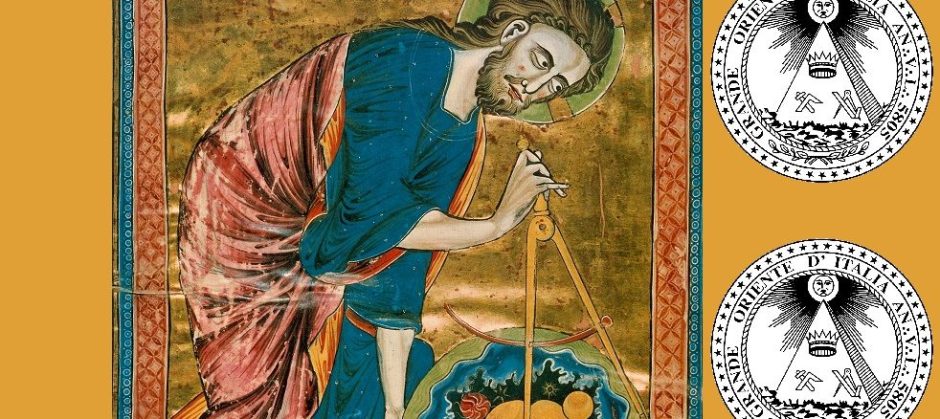
The latest example is a discussion meeting of the Masonic Grand Orient of Italy , to be held at Syracuse next November 12 in the cathedral square. The invitations show Jesus Christ with a compass in hand, a typical Masonic instrument. The circle is one of the “three great lights” of Masonic symbolism, which lies on the altar in the lodge temples.

The theme of the event is: “ Church and Freemasonry – so close, so far? “The portrayal of Jesus is part of the title picture showing the creation of the world. The representation has nothing to do with the Lodge Brothers and their world of ideas. It was created around 1220, 500 years before Freemasonry was founded. The panel discussion is part of the 300-year-anniversary celebrations of the Grand Orient.

The purpose of the event is to present an understanding between lodge and church as possible. It gives the impression of a compatibility that the Church has rejected for 300 years.

Despite the provocative image and an even more provocative title, a Catholic bishop will take part in the discussion. Msgr. Antonio Staglianò, Bishop of Noto and Msgr. Maurizio Aliotta from the Archdiocese of Syracuse will discuss with two Honorary Grand Masters of the Greater Orient, Santi Fedele and Sergio Rosso. The host is the Master of the Chair of Syracuse, Alessandro Spicuglia.

“Communitarianism” as common ground?

Nuova Bussola Quotidiana (NBQ) reports that there are violent protests from devout Catholics against the event. People ask the Archdiocese of Syracuse what this “hug” is about with an organization condemned by the Church.

“It’s about an organization that in southern Italy has always had to do with (often occult) power and always had an esoteric streak between rites and brotherhood that was never really revealed.”

The Catholic Internet newspaper asked Bishop Staglianò what his participation was about. The bishop referred to the spectacular and equally controversial letter from Cardinal Gianfranco Ravasi to the “Brothers Freemasons”. The chairman of the Pontifical Council for Culture had “clearly shown” that there could be similarities between the Church and Loge, namely the “communitarianism”. Bishop Staglianò said:

“I assume that he meant the opposition to unbridled individualism, anti-materialism, a certain idea of spirituality and finally also the philanthropy, that is, the solidary aspect.”

However, the Church gave a negative answer to all these alleged “similarities”, which not least had to do with the “danger of a relativistic and deistic methodology”, according to NBQ, which the lodges are trying to do.

“Hug process in progress”

“The reality is that there is a hugging process going on today,” NBQ said. The most recent example: On the discussion in Syracuse, there appeared in the daily newspaper of the Italian Bishops Conference an article by the priest Ennio Stamile, who argued for the “dialogue” with the Freemasons. Bishop Staglianò was one of his theology professors, the priest defends the bishop’s participation. Stamile also refers to Pope Francis, who called for a dialogue “with everyone, no one excluded”.

The priest accuses the critics of rapprochement as “ignorant” and “superficial” because they “have no idea” about Freemasonry. The claim that the lodges are a “power lobby” is a fairy tale that must finally “disappear”.

Fr Ennio Stamile is one of the most famous priests in southern Italy. He is chairman of the Libera Calabria (Free Calabria) association, an umbrella organization “against the Mafia”. The association proves to be a firmly integrated part of the political left through language, symbols, actionism and contacts, and in any case it is fully recognized by this side. Stamile comes from the circle of Don Ciotti, the founder of the association, whom Pope Francis kissed on the hand in March 2014.

The union has received several hundred hectares of agricultural land by the state, confiscated from the members of the ‘Ndrangheta. The ‘Ndrangheta is the group of organized crime in Calabria and the Mafia in Sicily is comparable. The association runs farms on these areas with those who have been released from prison, former drug addicts, immigrants and those who have dropped out of the Mafia.

Lodge and Mafia?

Don Stamile’s request to speak is important not only because of his anti-Mafia reputation. His partisanship for the dialogue with the lodge is interesting. More information could explain this and open the door to a remarkable circular if the entanglement with organized crime – mafia and lodge are “occult” powers, as it has already been said – may even be a regional problem.

Since the 1960s there have been indications that mafia bosses have entered the lodges. Within the Calabrian mafia, the ‘Ndrangheta, there were violent conflicts about it. The initiative for this cooperation seems to go back to Gioa Tauro’s boss, Girolamo Piromalli (1918–1979).

Since then, investigative files by the public prosecutor have repeatedly referred to a “mass mafia”, a merger of Freemasonry and mafia into a Masonic mafia. 2014 protocol extracts were the interrogation of the former Grand Master of the Grand Orient of Italy, Giuliano Di Bernardo (1990-1993), known. Di Bernardo left the Grand Orient in the wake of the scandal surrounding the mysterious Propaganda Due Lodge (P2). Today he is Grand Master of the Grand Lodge of Italy . According to the data Di Bernardo early 90s were 28 of 32 Calabrian boxes from , ‘Ndrangheta has been inspected.

In 2007 mafia boss Sebastiano Altomonte said in a conversation with his wife that had been recorded by the police through acoustic room surveillance:

“There is one you know about and one you don’t know about. There is the visible and the invisible that nobody knows about, except the invisible. “

The statement has been associated with the “Santa” – the group created by Girolamo Piromalli at the highest management level; the ‘Ndrangheta , whose members are all members of Freemasonry. However, this thesis has not yet been confirmed in a court-relevant manner.

In a conversation between mafia boss Pantaleone Mancuso, overheard by the police in 2013, said during a walk:

“The ‘Ndrangheta no longer exists… It once existed. Today ‘Ndrangheta is part of Freemasonry … Let’s put it this way: It is under Freemasonry but has the same rules! … The ‘Ndrangheta no longer exists, all that remains are Freemasonry and the four idiots who still believe in the’ Ndrangheta. “

Against this background, the words of Don Ennio Stamile may have a slightly different meaning, who mentions a connection between Mafia and Freemasonry in his statement, but dismisses it as an invention and attempt at disinformation by people who want to become something without “merits and competencies” and by to whom the Church is not free either.

But it is also a fact that the former President of the Higher Regional Court of Catanzaro (Calabria) and Honorary President of the Supreme Court of Italy, Giuseppe Tuccio, has to answer in court for membership of the Mafia. It was only in 2016 that Tuccio, who was not unknown to Libera Calabria , published a book about the fight against the Mafia. “The Piromalli had judge Tuccio, a Freemason, in their hands,” a key witness had testified in a court case. Even in the wheels of justice of senior judges came in the wake of anti-mafia Operation Gotha .

Bishop Staglianò: Hans Küng and “why I talk to the Freemasons”

But back to the discussion event in Syracuse. Bishop Staglianò justifies his participation with a statement from Pope John XXIII: “Let us look more for what unites us than what divides us.” Despite all condemnations by the Church, especially Leo XIII. With the encyclical Humanum genus and the letter Inimica vis , or the declaration of the Congregation for the Doctrine of the Faith of 1983, the bishop sees no problem in “having a dialogue with the lodge brothers, for example when these Freemasons should organize themselves to fight against injustice “. It should be examined where one can act together for the “common good”.

The question remains, according to NBQ, what “common good” means from a Catholic point of view and what it means, however, from the point of view of Freemasonry. Bishop Staglianò admitted that he was not “competent” to answer this question. Literally he let it be known:

“Look, I don’t know anything about Freemasonry. I am in the process of reading up, starting with the Congregation for the Doctrine of the Faith declaration [from 1983]. I think that one can have no other opinion on the condemnation of the Masonic theses. I will say more: it is the first time that I have found myself in the situation of speaking to Freemasons. I think that I will begin my remarks with the text by Hans Küng on the ‘Magic Flute’ by Mozart, who was both a Freemason and a Christian. But we cannot ignore the church at the time of the genius from Salzburg as a bureaucratic institution. Not true?”

Criticism of the “integralist” dialogue

NBQ asks whether it is “credible” when a recognized theologian and bishop like Staglianò describes himself as “not competent”. The bishop’s statement could also be seen as a provocation, since he seems to be saying one thing in a few sentences but seem to mean the opposite.

When asked about the Freemason’s invitation with the representation of Jesus Christ, the bishop said that this “does not scandalize” him:

“Didn’t Arius also attribute the cosmogonic traits of a demiurge to Jesus? If Arius made a mistake, it was – if he did – that he did not ascribe God’s features to the demiurge. “

And further:

“I will go like Jesus to the tax collectors and prostitutes and proclaim Christ. The Freemasons will then determine how close or how far they are to this proclamation. “

Bishop Staglianò condescendingly described criticism of the dialogue with the Freemasons as “stupid, superficial and integralistic”. He used one of those “magical” terms with which progressive church circles bludgeon devout Catholics. Ultimately, the bishop insulted the popes of the past 300 years, who condemned Freemasonry, as “stupid, superficial and integralist”. Leo XIII. wrote in Humanum genus :

“The sect is, according to its whole being and its innermost nature, corruption and vice; therefore it is not allowed to join her and to be of any help. “

Finally, Bishop Staglianò also refers to Pope Francis, who urged to go to the “existential fringes”, “and Freemasonry seems to be one”.

Is the Church still equipped for “dialogue” with Freemasonry?

The question that remains, according to NBQ, goes beyond Bishop Staglianò. In the past few years the church has tried to hardly speak about the Freemasons anymore. The intellectual and scientific preoccupation with the lodges at the relevant academies, institutes and faculties had almost completely come to a standstill. There are hardly any more coherent and thorough studies on the subject. The declaration by Paolo Maria Siano, of the Franciscan Friars of the Immaculate, form a remarkable exception.

It is almost as if one does not want to be labeled with the stigma of a “conspiracy theorist”. However, the boxes are a reality, as the celebrations show. Other church districts have elevated dialogue to the “highest dogma” in which they believe, which is why any form of exclusion is frowned upon – at least any form contrary to the spirit of the times. The attempt at a more or less open distancing from the past with its condemnations of Freemasonry is obvious. This raises the question of “how the Church wants to meet Freemasonry, since its younger representatives have hardly any knowledge of the Lodge and reflexively tend to dismiss criticism of it as a“ yesterday’s conspiracy theory ”of an“ integralism ”that has been overcome.

The signals for a new “dialogue” are increasing, although the church staff seem less and less prepared for it. Or is the willingness to dialogue growing parallel to the loss of knowledge?

Dazu NBQ:

“Dialogue is not a gospel term. Does the church want to use the excuse of dialogue – after the radicals, the Protestants, the anti-clerical atheists and the plutocratic elites – to break the last taboo that lodges, which were once enemies, are now only ‘different’? “

Text: Giuseppe Nardi
Image: Wikicommons / Grande Oriente d’Italia (Screenshots)

(Note – the original article was published in German. An online translation rendered some phrases unintelligible.)

The Bugnini Effect: part 1

FROM: Liturgical Time Bombs in Vatican II: The Destruction of Catholic Faith Through Changes in Catholic Worship

by Michael Davies

The Rise and Fall and Rise and Fall of Annibale Bugnini

Before discussing the time bombs in the Council texts, more specifically those in its Constitution on the Sacred Liturgy, which would lead to the destruction of the Roman Rite, it is necessary to examine the role of Annibale Bugnini, the individual most responsible for placing them there and detonating them after the Constitution had won the approval of the Council Fathers.Annibale Bugnini was born in Civitella de Lego [Italy] in 1912. He began his theological studies in the Congregation of the Mission (the Vincentians) in 1928 and was ordained in this Order in 1936. For ten years he did parish work in a Roman suburb, and then, from 1947 to 1957, was involved in writing and editing the missionary publications of his Order. In 1947, he also began his active involvement in the field of specialized liturgical studies when he began a twenty-year period as the director of Ephemerides liturgicae, one of Italy’s best-known liturgical publications. He contributed to numerous scholarly publications, wrote articles on the liturgy for various encyclopaedias and dictionaries, and had a number of books published on both the scholarly and popular level.

Father Bugnini was appointed Secretary to Pope Pius XII’s Commission for Liturgical Reform in 1948. In 1949 he was made a Professor of Liturgy in the Pontifical Propaganda Fide (Propagation of the Faith) University; in 1955 he received a similar appointment in the Pontifical Institute of Sacred Music; he was appointed a Consultor to the Sacred Congregation of Rites in 1956; and in 1957 he was appointed Professor of Sacred Liturgy in the Lateran University. In 1960, Father Bugnini was placed in a position which enabled him to exert an important, if not decisive, influence upon the history of the Church: he was appointed Secretary to the Preparatory Commission on the Liturgy for the Second Vatican Council. [Biographical details are provided in Notitiae, No. 70, February 1972, pp. 33-34.] 

He was the moving spirit behind the drafting of the preparatory schema (plural schemata), the draft document which was to be placed before the Council Fathers for discussion. Carlo Falconi, an “ex-priest” who has left the Church but keeps in close contact with his friends in the Vatican, refers to the preparatory schema as “the Bugnini draft.” [Carlo Falconi, Pope John and His Council (London: Weidenfeld & Nicholson, 1964), p. 244.] It is of the greatest possible importance to bear in mind the fact that, as was stressed in 1972 in Father Bugnini’s own journal, Notitiae (official journal of the Sacred Congregation for Divine Worship), the Liturgy Constitution that the Council Fathers eventually passed was substantially identical to the draft schema which he had steered through the Preparatory Commission. [Notitiae, No. 70, February 1972, pp. 33-34.] According to Father P. M. Gy, O.P., a French liturgist who was a consultor to the pre-conciliar Commission on the Liturgy, Father Bugnini “was a happy choice as secretary”:

He had been secretary of the commission for reform set up by Pius XII. He was a gifted organizer and possessed an open-minded, pastoral spirit. Many people noted how, with Cardinal Cicognani, he was able to imbue the discussion with the liberty of spirit recommended by Pope John XXIII. [A. Flannery, Vatican II: The Liturgy Constitution (Dublin: Sceptre Books, 1964), p. 20.]

The Bugnini schema was accepted by a plenary session of the Liturgical Preparatory Commission in a vote taken on January 13, 1962. But the President of the Commission, the eighty-year old Cardinal Gaetano Cicognani, had the foresight to realize the dangers implicit in certain passages. Father Gy writes: “The program of reform was so vast that it caused the president, Cardinal Gaetano Cicognani, to hesitate.” [Flannery, p. 23.] Unless the Cardinal could be persuaded to sign the schema, it would be blocked. It could not go through without his signature, even though it had been approved by a majority of the Commission. Father Bugnini needed to act. He arranged for immediate approaches to be made to Pope John, who agreed to intervene. He called for Cardinal Amleto Cicognani, his Secretary of State and the younger brother of the President of the Preparatory Commission, and told him to visit his brother  and not return until the schema had been signed. The Cardinal complied.Later a peritus of the Liturgical Preparatory Commission stated that the old Cardinal was almost in tears as he waved the document in the air and said: “They want me to sign this but I don’t know if I want to.” Then he laid the document on his desk, picked up a pen, and signed it. Four days later he died. [Fr. Ralph M. Wiltgen, S.V.D., The Rhine Flows into the Tiber: A History of Vatican II (1967, rpt. Rockford, IL. TAN, 1985), p. 141.]

A Future Pope’s Masonic/Mafia Connections

From: THE RITE OF SODOMY V by Randy Engels

Montini and the Mafia:

Archbishop Montini Meets “the Shark”

Michele Sindona, aka, “the Shark” was an underworld financial fixture in Milan long before Montini became Archbishop.[80]

Born in Messina at the eastern end of Sicily in 1917, the Jesuit educated Sindona was studying law when the British and American troops invaded Italy during World War II. The enterprising Sindona decided to take advantage of the lucrative black market and went into the lemon and wheat business. Since the Sicilian Mafia controlled the produce trade, Sindona cut a deal with Mafioso head, Vito Genovese, whereby he would turn over a certain percentage of his earnings for protection from the mob for his business and his person.

In 1948, Sindona left the poorer war-ravaged southern boot of Italy and migrated north to the richer industrialized city of Milan where he became a “financial advisor” to a number of influential and wealthy Milanese. His Mafia credentials traveled north with him.

In 1954, when Sindona learned that Pius XII had appointed Msgr. Montini to the See of Milan, he secured a letter of introduction to the new Archbishop from the Archbishop of Messina, his home diocese. Sindona soon had a new client in Montini and the Milanese Church.

Archbishop Montini was so grateful to Sindona, that he took the Sicilian to Rome and introduced him to Pope Pius XII and Prince Massimo Spada, a senior official at the Istituto per le Opere de Religioni (the Institute for Religious Works). The IOR, which is popularly known as the Vatican Bank functions as a depository for the Church’s patrimony earmarked for charitable works.[81] Sindona became “a man of confidence” and was given virtually full control over the IOR’s foreign investment program.

The gross assets of the IOR at the time were over $1 billion, but money was secondary to the IOR’s tax-free status and its potential as a laundry for washing dirty money, specifically, Mafiosi earnings from heroin trade, prostitution and illegal political contributions from underground sources including Freemasons.[82]

In 1960, Sindona, operating under the old adage “the best way to steal from a bank is to own one,” purchased his own bank, the Banca Privata, and within a very short time was receiving deposits from the IOR. He used these funds to pyramid his own financial investments and started to launder illegal funds through the Vatican Bank.

After the election of Pope Paul VI, Sindona followed Montini to Rome and became a major player at the IOR. His operations and financial portfolio grew exponentially. In 1964, Sindona formed an international currency brokerage firm called Moneyrex with 850 client banks and annual financial dealings of $200 billion. Many members of the Palazzo, the rich and famous of Rome, used the firm to shield their fortunes from taxation through illegal offshore accounts. Sindona kept a secret ledger of his clients’ transactions with Moneyrex as insurance for a rainy day. The Vatican and Pope Paul VI, along with the name and numbers of the secret accounts of high ranking members of the Christian Democratic Party as well the Socialist and Social-Democratic Parties were all in Sindona’s little black book.

By the late 1960s, the “Gruppo Sindona” included six (later nine) banks in Italy and abroad and more than 500 giant corporations and conglomerates. One of the banks, the Franklin National Bank of New York, the 18th largest bank in the United States with assets of more than $5 billion, was purchased in part with money Sindona had skimmed off from his Italian banks.[83] He also skimmed off funds from his secret masters, that is, the Sicilian Mafia and, after 1971, from the Propaganda Duo (P2), a Mafia-inspired Masonic Lodge catering to Italy’s elite headed by Grandmaster Licio Gelli. In addition, Sindona was handling financial transactions for the U.S. Central Intelligence Agency (CIA) which during the post-war period was pouring large sums of money into Italy, some of which made its way to the Vatican Bank.[84]

Meanwhile Sindona’s friend, Pope Paul VI was the recipient of bad tidings from the State. The Italian government was threatening to remove the fiscal tax exemption on the Church and Church properties and investments that the Holy See had enjoyed since the days of Mussolini’s Fascist regime. Under the revised tax-code, the Vatican State would be taxed like any other corporate entity. Sindona proposed a scheme to hide Vatican money in offshore investments and the pope agreed.

One of Sindona’s prominent protégés was a native Milanese by the name of Roberto Calvi.

Calvi was the central manager of the Banco Ambrosio, Italy’s most prominent Catholic bank as distinguished from the lay or secular banking institutions operated by the Jews and Freemasons. Calvi was a man after Sindona’s own heart, which spelled disaster ahead not only for the Banco Ambrosiano, but also for its major depositor, the Holy See. Calvi had his own connections to the IOR through Monsignor Macchi, Montini’s personal secretary. He was also on excellent terms with an American priest at the Secretariat of State, Msgr. Paul Marcinkus.

FOOTNOTES

Footnotes.

  1. This section on Vatican finance is based in information taken from a large number of publications and web sites including Conrad Goeringer, “History of the IOR – Murder, Bank, Strategy – the Vatican.” See also David A. Yallop “In God’s Name – An Investigation into The Murder of Pope Paul I.” (Free downloadable e-book available at this site.)

Other footnotes available on request.

A Conciliar Pope with the Odour of Masonry

While there is little indication that Paul VI was a formal Mason, there is no doubt that his programme of reform was completely in line with the agenda of Freemasons to create an ape of the Church.

Anonymous Catholic

FROM: Society of Saint Pius X

Archbishop Lefebvre’s assessment

On December 20, 2012, Benedict XVI authorized the Congregation for the Causes of Saints to promulgate a decree recognizing the “heroic virtues” of Paul VI, pope from 1963 to 1978. Now only a miracle obtained through the intercession of Paul VI is necessary to proceed to his beatification. Apparently the postulator for his cause, Fr. Antonio Marrazzo, has already chosen a case to present to the medical commission, the cure of an unborn child diagnosed with severe malformation. According to Andrea Tornielli of La Stampa’s Vatican Insider, the beatification could take place in 2013.

Paul VI is the pope who closed the Second Vatican Council, opened by his predecessor John XXIII. It was during Paul VI’s pontificate that the Novus Ordo Missae was developed. He wrote unhesitatingly to Archbishop Marcel Lefebvre in 1976, “The Second Vatican Council is no less authoritative than the Council of Nicea, and is even more important in some respects.”

Archbishop Lefebvre, who was suspended a divinis during Paul VI’s pontificate, gave his opinion of Paul VI to the seminarians of Econe in the lecture series he gave on the Magisterium that provided the material for his book They Have Uncrowned Him (Angelus Press, 1994).

Chapter 31, “Paul VI, a Liberal Pope,” provides a strong indication of what the Society of St. Pius X’s founder would have said about the pending beatification. DICI has introduced headings in the form of questions into Archbishop Lefebvre’s text, the better to follow his analysis.

How will Paul VI be judged by the Church of the future?

Obviously, the Church will one day judge this council and these popes. How will Paul VI, in particular, fare? Some call him heretic, schismatic, and apostate; others believe themselves to have proved that he could not have acted for the good of the Church, and that therefore he was not in fact pope—the theory held by sedevacantists. I do not deny that these opinions have some arguments in their favor. Perhaps, you will say, in 30 years secrets will have been revealed, or elements that should have been obvious to contemporary observers will stand out, statements made by this pope in complete contradiction to the traditions of the Church, etc. Perhaps. But I do not believe that such hypotheses are necessary; in fact, I think it would be a mistake to espouse them.

Others think, simplistically, that there were two popes: one, the true pope, imprisoned in the cellars of the Vatican, and the other, an imposter, his double, seated on the throne of Peter, working for the destruction of the Church. Books have been published about the two popes, based on the ‘revelations’ of a possessed person and on supposedly scientific arguments that state, for instance, that the double’s voice is not the same as that of the real Paul VI…!

What is your own explanation of Paul VI’s pontificate?

The real solution seems entirely different to me, much more complex, more difficult, and more painful. It is given us by a friend of Paul VI, Cardinal Danielou. In his Memoirs, published by a member of his family, the cardinal clearly states, “It is clear that Paul VI is a liberal pope.”

Such is the solution that seems the most historically likely, because this pope was himself a fruit of liberalism. His whole life was permeated with the influence of the men he chose to surround him or to rule him, and they were liberals.

Paul VI did not hide his liberal leanings; at the Council, the men he chose as moderators to replace the presidents appointed by John XXIII, were Cardinal Agagianian, a cardinal of colorless personality from the Curia, and Cardinals Lercaro, Suenens and Dopfner, all three liberals and the pope’s friends. The presidents were sidelined at the head table, and these three liberals directed the conciliar debates. In the same way, Paul VI supported the liberal faction that opposed the tradition of the Church throughout the entire Council. This is a recognized fact. Paul VI repeated—I quoted it to you—the exact words of Lammenais at the end of the Council: “L’Eglise ne demande que la liberte” – the Church only seeks freedom—a doctrine condemned by Gregory XVI and Pius IX.

Paul VI was undeniably very strongly influenced by liberalism. This explains the historic evolution experienced by the Church over the last few decades, and it describes Paul VI’s personal behavior very well. The liberal, as I have told you, is a man who lives in constant contradiction. He states the principles, and does the opposite; he is perpetually incoherent.

Could you provide some examples in support of your analysis?

Here are a few examples of the thesis-antithesis conundrums that Paul VI loved to present as so many insoluble problems, mirroring his anxious and conflicted mind. The encyclical Ecclesiam suam, (August 6, 1964), provides an illustration:

If, as We said, the Church realizes what is God’s will in its regard, it will gain for itself a great store of energy, and in addition will conceive the need for pouring out this energy in the service of all men. It will have a clear awareness of a mission received from God, of a message to be spread far and wide. Here lies the source of our evangelical duty, our mandate to teach all nations, and our apostolic endeavor to strive for the eternal salvation of all men. (…) The very nature of the gifts which Christ has given the Church demands that they be extended to others and shared with others. This must be obvious from the words: ‘Going, therefore, teach ye all nations,’ Christ’s final command to His apostles. The word apostle implies a mission from which there is no escaping.” 

That is the thesis, and the antithesis follows immediately:

To this internal drive of charity which seeks expression in the external gift of charity, We will apply the word ‘dialogue.’ The Church must enter into dialogue with the world in which it lives. It has something to say, a message to give, a communication to make.” 

And finally he attempts a synthesis, which only reinforces the antithesis:

Before we can convert the world—as the very condition of converting the world—we must approach it and speak to it.”[1] 

Have you another example?

Of greater gravity are the words with which Paul VI suppressed Latin in the liturgy after the Council, and they are even more characteristic of his liberal psychology. After restating all the advantages of Latin: a sacred language, an unchanging language, a universal language, he calls, in the name of adaptation, for the “sacrifice” of Latin, admitting at the same time that it will be a great loss for the Church. Here are his very words, reported by Louis Salleron in his book La nouvelle messe [The New Mass] (Nouvelles Editions Latines, 2nd ed., 1976, p. 83)

On March 7, 1965, he said to the faithful gathered in St. Peter’s square: 

‘It is a sacrifice that the Church makes in renouncing Latin, a sacred language, beautiful, expressive, and elegant. The Church sacrifices centuries of tradition and unity of language in the name of an ever-growing desire for universality’.” 

The ‘sacrifice’ of which he spoke became a reality with the Instruction Tres abhinc annos (May 4, 1967) which established the use of the vernacular for reciting the Canon of the Mass aloud.

This ‘sacrifice,’ in Paul VI’s mind, seems to have been final. He explained it once again on November 26, 1969, when he presented the new rite of the Mass:

The principal language of the Mass will no longer be Latin, but the vernacular. For anyone familiar with the beauty and power of Latin, its aptness for expression of the sacred, it will certainly be a great sacrifice to see it replaced by the vernacular. We are losing the language of centuries of Christianity, we become as intruders, reduced to the profane in the literary domain of expressing the sacred. We lose, too, the greater part of the admirable, incomparable wealth of art and spirituality contained in Gregorian chant. It is with good reason, then, that we experience regret and even distress.” 

Everything therefore should have dissuaded Paul VI from imposing this ‘sacrifice’ and persuaded him to maintain the use of Latin. On the contrary, deriving a singularly masochistic pleasure from his ‘distress,’ he chose to act against the principles he had just set forth, and decreed the ‘sacrifice’ in the name of promoting understanding of prayer, a specious argument that was only a modernist pretext.

Never has liturgical Latin been an obstacle to the conversion of infidels or to their education as Christians. Quite the opposite: the simple peoples of Africa and Asia loved Gregorian chant and the one sacred language, the sign of their affiliation to Catholicism. And experience shows that where Latin was not imposed by missionaries of the Latin Church, there the seeds of future schism were planted.

Paul VI followed these remarks with this contradictory pronouncement:

The solution seems banal and prosaic, but it is good, because it is human and apostolic. The understanding of prayer is more precious than the dilapidated silks in which it has been royally clad.  More precious is the participation of the people, the people of today who want us to speak clearly, intelligibly, in words that can be translated into their secular tongue. If the noble Latin language cuts us off from children, from youth, from the world of work and business, if it is an opaque screen instead of a transparent crystal, would we fishers of men do well to maintain its exclusive use in the language of prayer and religion?” 

Alas, what mental confusion. Who prevents me from praying in my own tongue? But liturgical prayer is not private prayer; it is the prayer of the whole Church.  Moreover, another lamentable lack of distinction is present: the liturgy is not a teaching addressed to the faithful, but the worship the Christian people address to God. Catechism is one thing, and the liturgy is another. The point is not that we “speak clearly” to the people assembled in the church, but rather that these people may praise God in the most beautiful, most sacred, and most solemn manner possible. “Praying to God with beauty” was St. Pius X’s liturgical maxim. How right he was!

How would you describe a liberal?

You see, the liberal mind is conflicted and confused, anguished and contradictory. Such a mind was Paul VI’s. Louis Salleron explained it very well when he described Paul VI’s physical countenance, saying “he was two-faced.” Not duplicitous—this word expresses a malicious intent to deceive which was not present in Paul VI. No, he had a double personality, and the contrast between the sides of face expressed this: traditionalist in words, then modernist in action; Catholic in his premises and principles, and then progressive in his conclusions; not condemning what he should have, and then condemning what he ought to have preserved.

This psychological weakness afforded an ideal opportunity for the enemies of the Church. While maintaining a Catholic face (or half-face, if you like) he contradicted tradition without hesitation, he encouraged change, baptized mutation and progress, and followed the lead of the enemies of the Church, who egged him on.

Did not the Izvestia, official newspaper of the Communist Soviet party, demand from Paul VI my condemnation and that of Econe in the name of Vatican II? And the Italian Communist paper L’Unita followed suit after the sermon I gave in Lille on August 29, 1976; furious because of my attack on Communism, they devoted an entire page to their demand. “Be aware,” they wrote, addressing Paul VI, “be aware of the danger Lefebvre represents, and continue the magnificent approach initiated through the ecumenism of Vatican II.” With friends like these, who needs enemies? This is a sad illustration of a rule we have already established: liberalism leads from compromise to treason.

How should priests and faithful who are attached to tradition act under a liberal pope?

The psychology of a liberal pope is easy enough to imagine, but difficult to bear! Indeed, such a leader—be it Paul VI or John Paul II—puts us in a very delicate position.

In practice, our attitude must base itself on a preliminary distinction, made necessary by the extraordinary circumstances of a pope won over by liberalism.  This is the distinction we must make: when the pope says something in keeping with tradition, we follow him; when he opposes the Faith, or encourages opposition of the Faith, or allows something to be done that attacks the Faith, then we cannot follow him. The fundamental reason for this is that the Church, the pope, and the hierarchy must serve the Faith. They do not make the Faith, they must serve it. The Faith cannot be made; it is immutable, and must be transmitted.

This is why papal teachings intended to validate actions opposed to tradition cannot be followed. In following, we would participate in the self-destruction of the Church, in the destruction of our Faith.

It is clear that what is unceasingly demanded of us—complete submission to the pope, complete submission to the Council, acceptance of the entire liturgical reform—is in opposition to tradition, in the sense that the pope, the Council and the reforms lead us far from tradition, as the facts show more overwhelmingly every year. Therefore, to demand these things is to require us to participate in the downfall of the Faith. Impossible! The martyrs died to defend the Faith; we have the example of Christians imprisoned, tortured, sent to concentration camps for the Faith. One grain of incense offered to an idol, and their lives would have been safe. I was advised once, “Sign, sign saying you accept everything, and then you can continue as before!” No! One does not play games with the Faith.


Footnote

1 English translation taken from the Vatican’s website, consulted Jan. 29, 2013.


Translated from Archbishop Marcel Lefebvre, Ils l’ont decouronne, Clovis, 3rd ed., 2008; pp. 253-260. Available in English translation at Angelus Press as They Have Uncrowned Him (1994).

(Source: DICI no. 269, 2-1-2013)

A French Mason Converts to Catholicism

From the NATIONAL CATHOLIC REGISTER February 14, 2020

Serge Abad Gallardo, a former senior official of the French government and venerable master of the Freemasons, reveals Freemasonry’s anti-Christian spiritual and ideological roots and its impact on democratic political life.

In his youth, Serge Abad Gallardo joined Freemasonry with the conviction he could contribute to make the world a better place. He turned 24 years later to Christ, convinced he had been serving the wrong cause and, above all, the wrong Master.

An architect and a former senior French territorial government official, Gallardo has been a venerable master and a member of the high ranks of the global Masonic order Le Droit Humain, which he left in 2012 after experiencing a sudden conversion at the Shrine of Our Lady of Lourdes.

Since then, Gallardo has been dedicating his time to sharing his long experience within Freemasonry, informing people about the mechanisms and potential dangers of such an institution through regular conferences across France.

To help spread his message about Freemasonry, which the Code of Canon Law (1374) prohibits, he has also written a number of books, among which include Je servais Lucifer sans le savoir (“I Was Serving Lucifer Without Knowing It,” Pierre Téqui, 2016) and La Franc-maçonnerie démasquée (“Exposing Freemasonry,” Good News, 2017).

His last work, Secret maçonnique ou verité catholique (“Masonic Secret or Catholic Truth,” Artege, 2019), sheds light on the problematic dimension of secrecy in Freemasonry, especially its consequences on societies and democracy.

While discussing his personal journey with the Register, Gallardo explains why Masonic activities are deeply incompatible with the Christian faith.

You decided to leave Freemasonry after a staggering conversion at the Marian shrine in Lourdes. Can you tell us more about it?

The first step of my conversion happened before a statue of St. Thérèse of Lisieux at Narbonne Cathedral. My son was in trouble, and I was going through a difficult time. One day, I decided to go to the cathedral that was next to my office to pray.

Soon after, I told my wife it could be nice to go to Lourdes to pray a little for me and my son. I didn’t have the faith I have now at that time, but a small ray was already arising in me when I decided to go to Lourdes. There, I went to the grotto and prayed a whole Rosary for the first time. At the end of the prayer, as I got up, my legs gave out under me and felt paralyzed. I saw a strong light coming out of the statue of the Virgin Mary. Some people around tried to help me to my feet, but my legs stayed paralyzed for many minutes.

I’d been through an incredible experience. I initially didn’t tell my wife because I wanted to do a few medical analyses first. It turned out that nothing was wrong with me. I saw a psychiatrist to make sure I wasn’t having a kind of mystic delirium, and he found I was sane.

I didn’t completely understand what happened to me right away, but I felt that God had entered my life and that everything in me was about to change forever. I made a retreat soon after, and everything made sense. This is how my real life of faith began.

I heard a priest say that, sometimes, God lets Satan act so that Satanic temptations and actions can contribute to the man’s salvation — with the human being’s will, of course. I believe it is an answer to the question of evil.

Did you leave Freemasonry right away?

Not immediately. When I got back to my lodge after all this, I started feeling that this activity was not in line with my faith. I progressively stopped attending Masonic meetings, and I spoke with some priests that confirmed the incompatibility between my faith and Masonic activity. I officially quit about a year after my return to the faith.

Have you suffered reprisals since you began reporting on your experience publicly?

When I meet my former Freemason companions on the street, most of them just turn their backs on me and won’t even say hello. Just a few of them understood my approach and respect it, but they can be counted on the fingers of one hand.

When you are a Freemason, administrative hassles can be very easily resolved, as Freemasons are present in all public administrations. You always have a way out, but once you leave Freemasonry, you lose everything, and they can even make everything harder for you.

Did your testimony help other people open their eyes to the reality of Freemasonry or encourage them to leave it?

Yes, it helped several people. One day, I met a shopkeeper who I didn’t know was a Freemason because he belonged to another obedience [branch]. He recognized me and blamed me for writing books against Freemasonry. He eventually confessed that he was both a Catholic and a Freemason, and he thought it was totally compatible. He told me that his lodge had recruited a senior officer that suddenly resigned after reading one of my books, as he is a Catholic and he realized he was committing a serious sin. A number of former Freemasons have been writing to me to share their testimony over the past few years. I cannot change the world, but I can open some consciences.

What do you do now? Didn’t this decision to leave Freemasonry affect your professional life?

I quit Freemasonry in 2013, and I was fired from public administration in 2017. A file had been built against me in the meantime. I am one of the very few senior officials to have been fired for “unsatisfactory performance.” And it happened after 35 years of rave evaluations from my supervisors. I kept all the documents as potential proof. I went from being a highly competent public official to an underachiever. So I am unemployed today, and I hope I can retire soon.

But I accept this situation quite well. I write and give conferences for the glory of the Lord, to help people, especially the Christians, avoid the trap of Freemasonry.

How did you join Freemasonry in the first place?

I was looking for answers about spirituality, about the meaning of life, and I thought I could find them in a Masonic lodge. I was in my early 30s, and I had a high social status, which made me the perfect candidate.

Why do you think Catholicism is incompatible with Freemasonry?

If someone is very involved in Freemasonry’s initiatory step, like I really used to be, and if at the same time, he has a real living and carnal faith, an interior conflict will necessary arise. We cannot think on the one hand that God was made flesh, that Christ is the Son of God and died on the cross to save us, and on the other hand consider, like Freemasons believe, that God is something abstract, an undefined force called the Great Architect of the Universe, which is similar to a cosmic force, to a kind of naturalism. Those two things are doctrinally far too different to be compatible. Some Freemasons believe in the Christian God and think it is compatible with their Masonic activity, but it is a deep theological mistake.

The second fundamental incompatibility is that one cannot seek the truth through esoterism, resorting to rituals and “magical” processes, to some cosmic elements that are not necessarily divine, and at the same time resorting to the power of God to walk toward the Truth. These are two very incompatible and opposed paths. Such a conflict is true for worldwide Masonry, including that found in America or Europe.

Have you ever seen any clergyman in your lodge?

Not personally, but I’ve heard of some cases. I cannot testify personally, but it is very likely that representatives from the Church belong to Freemasonry. Spanish historian Alberto Bárcena dedicated a book to this topic in 2016.

While quoting extracts from Masonic initiation rites, you often mention sentences that are strangely similar to some Bible verses. What is the purpose of such a distortion? 

There definitely is a misappropriation. The Scottish Rite of Freemasonry, the most ancient and widely practiced rite in the world, also found in the U.S., originally referred to the Bible in high-grade rituals in order to put a mask on their activities and reassure the royal and ecclesiastic authorities.

And the presence of biblical passages is also one of the reasons why many Christians are hooked, because they are told that in Freemasonry, people swear on the Bible and they study the Gospel of St. John. But anyone can do that, make a free interpretation of the Bible and found a congregation, a sect, a group and say it is compatible with the Catholic faith as their truth is being sought in the Bible. There is a real deception behind the Masonic narrative.

What made you think that you were serving Lucifer, as the title of one of your recent books suggests?

One day, when I was an officer in the lodge of Le Droit Humain, I heard a first-grade ritual that I never heard before and that pays tribute to Lucifer. It is also part of the Ancient and Accepted Scottish Rite. I heard the venerable master say: “We must thank Lucifer for bringing light to men,” etc. I was quite taken aback.

This ritual, and Freemasonry in general, consider that religions, and Catholicism in particular, obscure the truth to believers and keep it to themselves, while Freemasonry provides keys to human beings so that they can fully free themselves.

Furthermore, in my two last books, I quoted extracts of a document that is accessible only to high-grade members, so the so-called “blue lodges” [which gather the new members] don’t have access to it. It is taken from Paroles Plurielles — a publication issued by my Masonic order — in which are compiled the best written texts regarding societal issues or Masonic rituals and that are on display in lodges. In this three- or four-page document, there is a text that praises transgression, and the one that allowed it — Lucifer. It is worth noting that Freemasons usually mention Lucifer rather than Satan.

Can members really get out of Freemasonry? Aren’t Masons forever bound by a Masonic vow?

Officially, from an administrative point of view, we can leave quite easily. Although not frequent, it is not so rare that Freemasons quit. And there is even an ad hoc commission to understand why people quit. You just need to send a letter to the venerable master, although it doesn’t have to be accepted.

But contrary to what Freemasonry says, we don’t belong to it forever after our Masonic vow. In the 1884 encyclical Humanum Genus, Pope Leo XIII recalls that a Freemason who comes back to the Church as a repentant Catholic is released from any Masonic vow. It is very clear.

You make a clear distinction between the institution and its members, of whom many are unaware of its true nature and the real implications of their commitment.

Absolutely. It is important for me to recall that I have nothing against Freemasons as persons. Many of them aren’t aware of the Luciferian aspect, of the kind of indoctrination and unique thought surrounding the Masonic doctrine. Some of them are really good people, convinced they are working for the good of humanity and seek to improve themselves with great intellectual honesty. However, I am strongly opposed to the aura of secrecy and mystery that surrounds Freemasonry. I think people should be able to know exactly what they are getting into. Then, if they persist in their will to get involved in Freemasonry, it becomes their personal responsibility.

Does Freemasonry really have the ability to do harm to society and political life? Are Freemasons really at the origin of societal laws such as those on abortion or same-sex “marriage,” as is often suspected, or do you think that such a claim is part of conspiracy theories as esoteric as the Freemasons’ own ideas?

It is absolutely no conspiracy theory to say that Freemasonry holds strong political power over society. There are solid proofs. In France, for instance, the law allowing the contraceptive pill (1967) was initiated by Lucien Neuwirth, who was a Freemason. In addition, the French law on abortion (1975) was promoted by Simone Veil. I don’t know if she was a Freemason herself, but she was at least openly very close to Masonic ideals [she received vibrant tributes from the greatest French Masonic lodges at her death in 2017]. Moreover, the first politician to have tried to introduce the legalization of euthanasia in France was Freemason and French senator Henri Caillavet, in 1978. In the same way, the law on same-sex “marriage” (2013) was promoted by French politician Christiane Taubira, who I met in Guyana — where I worked for a few years — and who is a Freemason.

In my book, I give figures about the two French assemblies — the Senate and the National Assembly. The Freemasons represent around 0.03% of the French population and yet 35% of France’s deputies and senators are Freemasons. It is 120 times more likely to become a deputy or a senator for a Freemason than for someone who is not.

Then there is the so-called “Fraternelle parlementaire,” an informal organization which gathers elected officials at the highest political levels. They are from all Masonic obediences, including some that are not necessarily allies. The Fraternelle is successively presided over by people from the left and the right. It is no accident that French citizens no longer know who to vote for.

The former president of the association, Bernard Saugey [senator of The Republicans, a center-right political party, and openly a Freemason], once said: “If I play my role well, parliamentarians from the left and the right will vote together on societal issues.” And now we have a new proof of that, with the law on medically assisted reproduction [recently approved by the Senate, although predominantly conservative].

One solution to this serious threat for democracy would be to abolish secrecy and oblige politicians to publicly say they are Freemasons. At least the citizens would clearly know who they vote for.