Cardinal Rampolla – the archetypal Freemason cleric

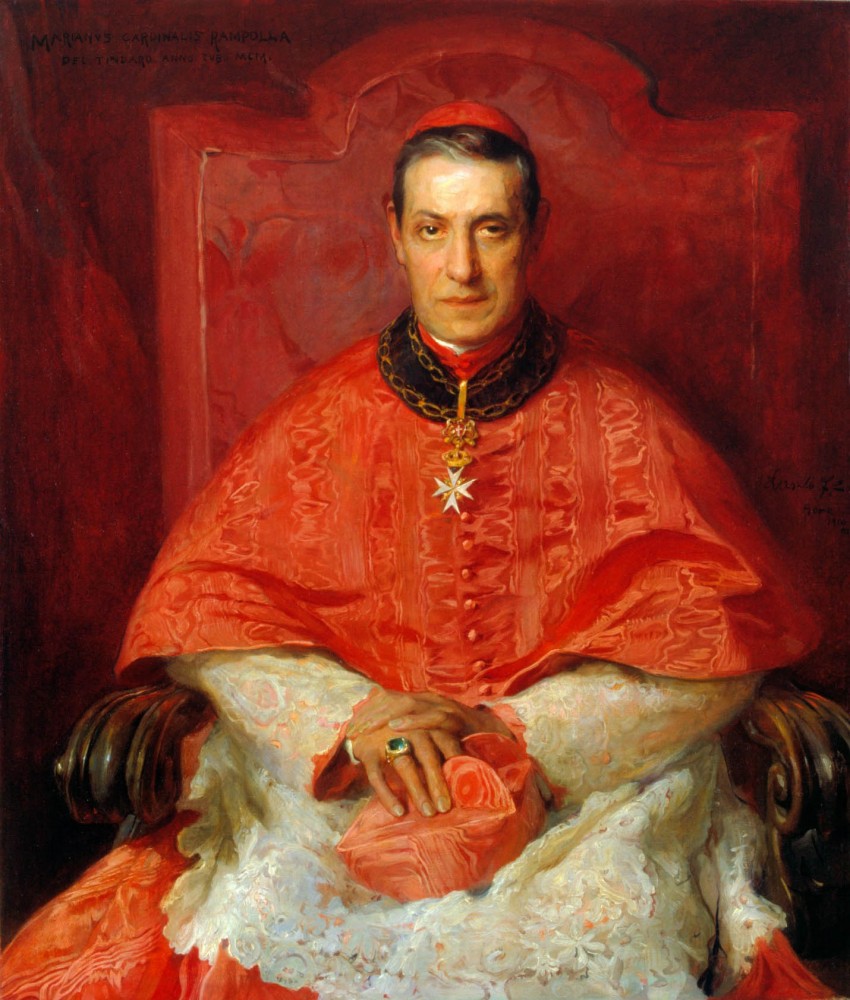
The first significant inroad made by Freemasonry into the heart of the Church was the appointment of the influential Cardinal Rampolla as Secretary of State. Ordained in 1866, Mariano Rampolla was made a bishop by Pope Leo XIII and appointed Apostolic Nuncio of Spain in 1882 for five years. 

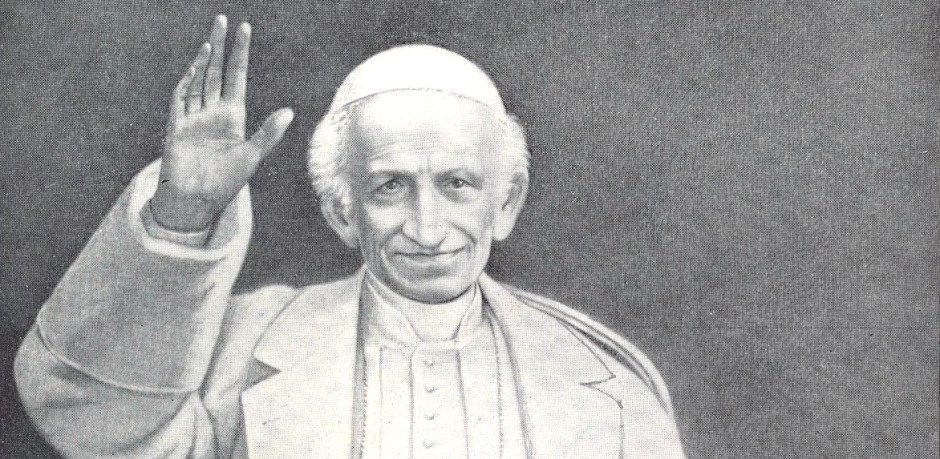
It was during this time that Pope Leo released his landmark encyclical condemning Freemasonry, Humanum Genus. Released in April of 1884, this was to be his final official condemnation of the Craft. Only six months later, Pope Leo received his famous vision of the devil ‘conversing’ with God and subsequently wrote the prayer to St Michael. The date of that vision is particularly significant: it was October 13th – precisely 33 years before the Miracle of the Sun at Fatima. Some time after this, the Pope decreed that the St Michael prayer and the Salve Regina be recited after every Low Mass.

In 1887, the Pope promoted Rampolla to Cardinal and in the same year, appointed him as his Secretary of State. (16 years)

 It seems strange to think that a Pope who was so opposed to Masonry allowed a character like Rampolla to achieve such prominence. Perhaps Pope Leo’s confidence in Rampolla reflected something of the latter’s character: he has all the hallmarks of a wolf in sheep’s clothing.

Leo XIII died in 1903 and Rampolla became known as the best potential new pope, or  ‘papabile.” This was despite Rampolla’s liberal tendencies already being widely known. 

In an unusual political intervention, the French Foreign Minister urged the French Bishops to vote for Rampolla, in order to maintain the support given to the French by Leo XIII.

Some of Rampolla’s other supporters at this time were Bishop Pietro Gasparri, Rampolla’s Under-Secretary of State, Msgr della Chiesa, and his private secretary, Eugenio Pacelli. Another supporter, Bishop Rafael Merry del Val, became Pro-Secretary of the conclave. This followed the sudden death of the original Pro-Secretary, Msgr Volpini. The Pro-Secretary plays an important ceremonial role after the election of a new pontiff and is also automatically elevated to the role of Cardinal at the same time as a former Cardinal is elevated to the papacy.

Cardinal Rampolla received the highest tally in the first vote and things appeared to be going his way. Suddenly there was an unheard-of intervention by the Metropolitan of Krakow, Cardinal Puzyna, on behalf of His Imperial Majesty Franz Josef of Austria-Hungary. Franz Josef was invoking a power of veto that had not been used in 400 years to eliminate Rampolla as a candidate. Del Val had tried without success to stop this intervention from taking place.

When Rampolla realised that the request was valid, he asked that his supporters transfer their votes to the Patriarch of Venice, Cardinal Giuseppe Sarto. The final ballot in fact elected Cardinal Santo and he took the name Pius X.

Pius X abolished the Imperial Privilege soon after his election, possibly due to the common opinion that the Emperor was motivated by political intentions. The true reason behind the intervention was not known until a decade later.

Rampolla was replaced as Secretary of State by Bishop Merry del Val; other progressive prelates, supporters of Rampolla, still held their important posts in the Vatican.  Rampolla became Secretary of the Holy Office in 1908.

The truth behind the Emperor’s intervention was not revealed until 1918, after Rampolla’s sudden demise. Amongst the Cardinal’s private papers were documents that indicated he was a member of the Ordo Templi Orientis,  or OTO, an occult arm of Freemasonry. This cult incorporates elements of Gnosticism, Kabala and Eastern mysticism and is the foundation of Aleister Crowley’s ‘sex magick.’


Of special interest in our own days is one aspect of the initiation ritual of the eleventh degree of the OTO: sodomy. Msgr Jouin believed that Cardinal Rampolla was initiated into the OTO in Switzerland and that he was a Grand Master of the OTO.

INFORMATION FROM THE RITE OF SODOMY V by Dr Randy Engels

One-Time
Monthly

PLease donate to help me create more content like this!
Make a one-time donation

Make a monthly donation

Choose an amount

$5.00
$50.00
$100.00
$5.00
$15.00
$100.00

Your contribution is greatly appreciated!

Your contribution is appreciated.

DonateDonate monthly

A Contemporary Vatican Freemason

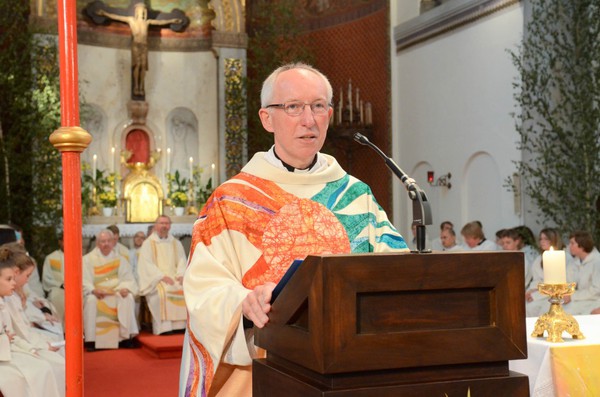
Michael Heinrich Weninger was born in 1951, in Wiener Neustadt . He entered the diplomatic service of the Republic of Austria and in 1993 became head of the Austrian embassy in Belgrade. This appointment lasted until 1997. From 2008-2009, he worked in Sarajevo, again as head of the Austrian embassy. That year, his wife died and he left the diplomatic corps.

It is most likely that Weninger was already a Freemason by this time. He has said that his path crossed with many Masons from the early 2000’s and this continued after he became a priest. He was ordained for the Archdiocese of Vienna in 2011 by the dissident Cardinal Christoph Schonborn. Schonborn is known for his open support for gays and hosts sacrilegious pro-sodomy events in his Cathedral annually.

In 2012, Fr Weninger became a member of the Pontifical Council for Interreligious Dialogue, working under Cardinal Jean-Louis Tauran. Two years later, it became known that Fr Weninger was a Freemason, as his role as chaplain for three Mark Masons Lodges was published on a Masonic website. The same article related that he consecrated the new lodge of the Mark Masons no. 1954 in 2014.

When the rector of the Pontifical Gregorian University learned that Fr. Weninger was planning a book on the compatibility of Freemasonry and Catholicism, he invited the priest to study under him and write a dissertation on that topic. Fr. Weninger’s doctoral dissertation was completed in 2019: he successfully defended it, and was awarded the maximum grade of 10.0 summ cum laude.

The thesis title was Über die Aussöhnung von Katholischer Kirche und regulärer Freimaurerei (On the Reconciliation of the Catholic Church and Regular Freemasonry). It was published as a book in February of 2020 under the title of “Lodge and Altar.”

In order to prove the compatibility of Masonry with the Catholic Faith, Fr. Weninger relies on a false distinction between “regular” and “irregular’ lodges. However, Pope Pius IX, in his encyclical Etsi Multa made it very clear that there is no difference between the various forms of lodges.

One commentator points out that Fr. Weninger is wrong on another score: he writes that although Fr Weninger claims that Freemasonry is not a religion, “the fact that he published his doctoral thesis at the Institute of Spirituality (and not at the Institute of History) suggests that Freemasonry is after all a form of spirituality.”

In his book, Weninger reveals his flawed understanding of the Catholic Faith. He writes that the Church uses magic in Her rituals such as blessings and exorcisms: “The Catholic Church knows legitimate acts of magical-mysterious and thus magically effective acts”, p. 113. He further states that “magic was not and is not condemned by the Catholic Church” (p 113),thereby suggesting that the “hermetic thinking” (p 110) and magic inherent in Masonic rituals are acceptable to the Church.

While perhaps not the most reliable of sources, the occultist Leo Zagami ties the release of this book to a request from Queen Elizabeth and the United Grand Lodge of England to the Vatican to review its prohibition on Freemasonry.

Far from receiving any censure from the Vatican for his allegiance to Freemasonry, Fr Weninger’s career has continued to blossom., for example, he was a speaker at the G20 Interfaith Forum in October last year.

Like the Australian priests Fr. Stephen Hackett and Fr. Costigan, Fr. Weninger promulgates the dangerous and erroneous message that no penalty applies any longer to Catholics who are Masons. The fact that he freely spreads this heresy, and is not only not chastised but is promoted, shows that profound hold that Freemasonry has on the Roman Curia.

There, freemasons were not mentioned anymore: excommunication was no more inflicted upon them. This meant a final reconciliation: it was made crystal-clear that freemasonry was not fighting against Catholicism, but they were cooperating instead. Had they become members of a lodge, Catholics would not have been ousted from the ‘assembly’: no one would have asked them to renounce their faith. Common effort has ever since replaced infighting. Nowadays, many bishops and prelates told me that, as freemasons, they are doing a wonderful job for both their believers and themselves! With irregular freemasonry, of course, it is different…

Fr Weningen, in an interview for MadamaLouise.com, reproduced at Freemason Wiki

A Vatican Freemason Promotes Indifferentism

This G20 Interfaith Forum took place last year, in October 2020. Australian readers may be interested to note that former Prime Minister, Tony Abbott, was a speaker at this conference – Anonymous Catholic

FROM ChurchMilitant.com:

A leading Vatican Freemason from the Pontifical Council for Interreligious Dialogue (PCID) is one of the speakers representing the Holy See at the G20 Saudi Arabia Interfaith Forum Oct. 13–16.

Father Michael Heinrich Weninger, who was outed as a Freemason when celebrating Mass at the 2014 consecration of the new lodge of Mark Master Masons No. 1954, Austria, spoke Tuesday on slavery and human trafficking.

Weninger is accompanied by Islamic expert and PCID president Cdl. Miguel Ángel Ayuso Guixot and Bologna’s Cdl. Matteo Zuppi, the latter of whom is a confidant of Pope Francis and a close ally of Italian Muslims.

Despite the interdicts of 11 popes over 200 years condemning Freemasonry and the Congregation for the Doctrine of Faith (CDF) reiterating that membership in Masonic lodges “remains forbidden,” Fr. Weninger continues to occupy a position in the Roman curia and advocate for freemasonry.

“The faithful who enrol in Masonic associations are in a state of grave sin and may not receive Holy Communion,” the CDF ruled in 1983.

The Interfaith Forum is being viewed as a public relations strategy by Saudi Arabia under Saudi Crown Prince Mohammed bin Salman, “who has tried to put an international sheen on his despotic reign.”

Critics are slamming the Vatican endorsing the regime despite its notable human rights violations and radical departure from the ideals proposed by Pope Francis in his latest encyclical, Fratelli Tutti. Those found with Bibles, crucifixes or other Christian material still risk arrest and, if they’re foreigners, deportation.

Observers have also pointed to the unmistakable coincidence of the Interfaith Forum occurring in light of Saudi Arabia’s bid for a seat on the U.N. Human Rights Council.

On Tuesday, Saudi Arabia failed to secure one of the three-year seats on the U.N. Human Rights Council, obtaining just 90 votes from the 180-member body.

Speaking to Church Militant, renowned Islamic scholar Robert Spencer called the Vatican’s participation in the Interfaith Forum “a travesty.”

“While Saudi Arabia has taken steps toward reform, there still exists no church of any other non-Muslim house of worship on Saudi soil because the Saudi government is bent on implementing Muhammad’s command that only Islam should exist on the Arabian Peninsula,” commented Spencer, author of 21 books on Islam and the Middle East.

“Those found with Bibles, crucifixes or other Christian material still risk arrest and, if they’re foreigners, deportation. Women were recently given the right to drive, but that only underscored how severely Saudi society oppresses women,” Spencer underscored.

Saudi Arabia was the only country up for membership that failed to get elected, leading Bruno Stagno, Deputy Executive Director of Human Rights Watch (HRW), to applaud the “stunning rebuke to Saudi Arabia under Mohammed bin Salman.”

It was the “only country not elected, shunned by a majority of the U.N. The kingdom reaped what it deserves for its serious violations of human rights and war crimes abroad,” Stagno observed.

Ironically, while Saudi Arabia hosts an international Interfaith Forum endorsed by Pope Francis, “with few exceptions, Saudi Arabia does not tolerate public worship by adherents of religions other than Islam,” HRW 2020 World Report states.

The Islamic theocracy “systematically discriminates” even “against Muslim religious minorities” while “government-affiliated religious authorities” continue to “disparage Shia and Sufi interpretations, versions and understandings of Islam in public statements, documents and school textbooks,” HRW reports.

Death Penalty, Immigration

The country is notorious for its use of the death penalty, HRW notes. On April 23, 2019, it carried out a mass execution of 37 men, including 33 from the country’s minority Shia community “who had been convicted following unfair trials.”

Saudi Arabia’s Interior Ministry reported that the country executed 179 persons between January and mid-November 2019, mostly for murder and drug crimes. Executions are by firing squad, beheading and even crucifixion, sometimes in public.

Pope Francis has stridently opposed the death penalty in his latest encyclical, Fratelli Tutti, but has remained silent on the practice in Islamic countries and continues to ally himself with Islamic proponents of the death penalty like Saudi Arabia and Grand Imam of al-Azhar Ahmad al-Tayyeb, Church Militant reported.

In stark opposition to Pope Francis’ call for the welcome and humane treatment of migrants in Fratelli Tutti, Saudi Arabia is known for its systemic oppression of migrant workers.

Further, the theocracy is not a signatory to the 1951 Refugee Convention and does not have an asylum system to protect people fearing persecution.

Call to Unity

At the Forum, Cdl. Ayuso flagged the pontiff’s encyclical calling for “unity, solidarity and fraternity, for bettering our ‘common home,’ as Pope Francis is continuously reminding us all.”

It is necessary to answer Pope Francis’ call to “reaffirm that we are members of the one human family,” he added.

Father Weninger remarked:

The International Conference on 21st Century Slavery stated that human trafficking constitutes a shocking offense against human dignity and a grave violation of fundamental human rights, particularly the sexual exploitation of women and children.

Injustice, exploitation and abuse are often deeply institutionalized due to financial profit. There is a need for faith leaders to challenge these social injustices, particularly as they constitute a fundamental issue of human rights.

Participants at the conference include Ecumenical patriarch Bartholomew, Orthodox metropolitan Emmanuel Adamakis of France, Coptic bishop Anba Marco, Anglican Richard Sudworth representing the archbishop of Canterbury and Sr. Sharon Eubank from the Mormons.

Prominent Hindu, Buddhist and Jewish leaders are also participants.

Masons on the Church – Then and Now

Humanum Genus, Pope Leo XIII’s great encyclical warning against Freemasonry, was promulgated in 1884. In it, the Pope condemned Masonry and other secret societies in the most direct and unambiguous way. The scathing nature of his reprisal can be evaluated by the response from Masons of that time.

From the Bulletin of the Symbolic Scottish Grand Lodge:

Freemasonry cannont help but thank the Supreme Pontiff of the last encyclical. Leo XIII, with unquestionable authority, and wth great luxury of evidence has demonstrated once again that there is an unbridgeable gulf between the Church of which he is the representative, and the Revolution, of which Freemasonry is the right arm. It is good that the skeptics cease to entertain vain hopes. All must get used to the new order which does not recognise any other foundation than that of science and human reason, in the spirit of authority and spirit of liberty.

Enrico Delassus, “Il problema dell’ora presente”, Desclèe e C. Tipografi-Editori 1907, vol. 1, p 39. (Via Fr Villa.)

Contrast this appraisal with laudatory comments from the Masons in our present day. The following is a press release from Italy’s Grand Lodge, made after the election of Jorge Bergoglio in 2013.

The Catholic Church has chosen as Pope the Jesuit Jorge Mario Bergoglio who assumed the name of Francis. A clear-cut choice, away from the logic of the Roman Curia and of the temporal power. From the first moment on, Pope Francis, a man who comes “nearly from the end of the world,” rejecting the ermine robe and gold cross and replacing it with an iron cross, made his first tangible act. In his first words of greeting he fostered a desire for dialogue with the world and with mankind, nurturing the vivid hope for laymen and nonbelievers that change is underway. Maybe this is really what the world expects and what it expected. A new Church that knows how to reconnect love with truth in a confrontation among institutions not entrenched in the defense of their own power. It is that same hope for which the world — and especially Latin America, where the Masons Simon Bolivar, Salvador Allende and the same Giuseppe Garibaldi [especially while in Brazil] among the many who have given liberty to those peoples — has always longed for.

A message that Freemasonry itself perceives a sharp break with the past and one which is turned now to listening to the poor, the marginalized and the weakest. To the new Pontiff we send our best wishes for his good work for years to come.

Luciano Nistri, Grand Master GLVDI

(As found at OnePeterFive)

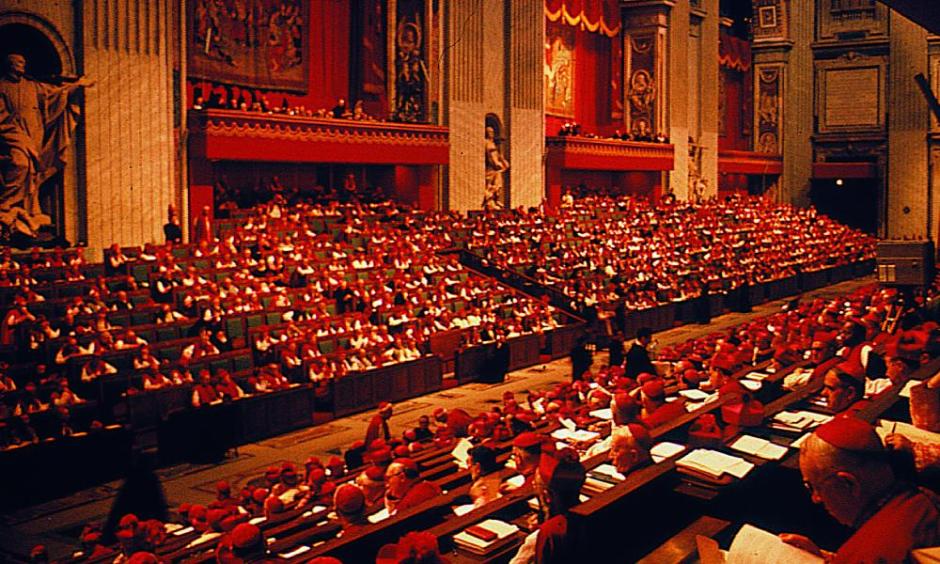
Freemasons on the Second Vatican Council

From The Devil’s Final Battle by Fr Paul Kramer, p 61-62; footnotes in original

“Along with the neo-modernists, the Masons and Communists have rejoiced at the Council’s outcome. Just as the authors of the Permanent Instruction of the Alta Vendita had hoped, just as the Communist infiltrators spoken of by Bella Dodd had hoped, the notions of liberal culture had finally won adherence among the major players in the Catholic hierarchy. Freemasons and Communists have celebrated the astounding turn of events wrought by the Council. They rejoice that Catholics have finally “seen the light,” and that many of their Masonic principles have been sanctioned by the Church.

For example, Yves Marsaudon of the Scottish Rite, in his book Ecumenism Viewed by a Traditional Freemason praised the ecumenism nurtured at Vatican II. He said:

Catholics …. Must not forget that all roads lead to God. And they will have to accept that this courageous idea of free-thinking, which we can really call a revolution, pouring forth from our Masonic lodges, has spread magnificently over the dome of St. Peter’s.”1

Yves Marsaudon was delighted to add that “One can say that ecumenism is the legitimate son of Freemasonry.”2

The post-Vatican II spirit of doubt and revolution obviously warmed the heart of French Freemason Jacques Mitterand, who wrote approvingly:

Something has changed within the Church, and replies given by the Pope to the most urgent questions such as priestly celibacy and birth control, are hotly debated within the Church itself; the word of the Sovereign Pontiff is questioned by bishops, by priests, by the faithful. For a Freemason, a man who questions dogma is already a Freemason without an apron.3

Marcel Prelot, a senator for the doubs region in France, is probably the most accurate in describing what has really taken place. He wrote:

We had struggled for a century and a half to bring our opinions to prevail within the Church and had not succeeded. Finally, there came Vatican II and we triumphed. From then on the propositions and principles of liberal Catholicism have been definitively and officially accepted by the Church.3

  1. Cited from Open Letter to Confused Catholics, pp 88-89
  2. Yves Marsaudon, Oecumènisme vu par un Maçon de Tradition, pp 119-120
  3. Cited from Open Letter to Confused Catholics, pp 88-89
  4. Ibid.

Australian Bishops’ Conference Officially Sanctions Freemasonry

This article appeared on Life Site News back in December of 2019 – there doesn’t seem to have been any action taken by the Australian Bishops to date.
So What does that tell us?

From Life Site News

Back in July, I wrote an article for The Remnant on a Queensland priest who publicly admits to having been a Freemason for more than a decade. While that is shocking enough, the most disturbing part of this story was that the priest claims to have a letter from the Australian Catholic Bishops Conference, giving permission for Catholics to become Masons. This permission was said to be based on the erroneous conclusion that ‘Australian’ Freemasonry is somehow different from any other form of Freemasonry.

As my previous article explained, the communications officer for the ACBC Secretariat  responded to my query with this statement:

“The Australian Catholic Bishops Conference has exchanged private correspondence with officials from the Freemasons in recent years. Fr. Costigan’s writings do not accurately reflect the contents of that private correspondence nor any policy of the Conference.”

As will become clear, that statement might be technically true, but in no way explains the reality of the correspondence’s contents.

Hiding in plain sight

Multiple phone calls and emails to Archdioceses over several months rendered little fruit – only independent Catholic news sites and the Freemasons themselves seemed interested in Fr. Costigan’s conflicting loyalties. However, a careless social media post led to the discovery of the letter online, along with the letter from the Freemasons which originally sparked the ACBC’s response.

That letter was written by the former Grand Master of Northern Territory/South Australia, Stephen Michalak to Fr. Stephen Hackett, the ACBC Secretary, in 2016. In it, Mr. Michalak sought to clarify the Catholic Church’s position on its members becoming Freemasons.

Mr. Michalak is himself a Catholic, as were the Grand Masters of Queensland and Western Australia at that time.  In his letter, Mr. Michalak expounds on the supposed virtues of Masonry, while also admitting that the Church maintains its ban on Catholics being members. He speaks of his ‘long-standing friendship’ with a former Vicar-General of Adelaide, who advised him to contact then Vicar-General, Fr. Philip Marshall.

Fr. Marshall advised him to obtain the agreement of all of the Australian Grand Masters before contacting the Church, and suggested to Michalak that he then write to the ACBC ‘seeking pastoral resolution to the present challenges as well as outlining a pathway for Catholics who are Freemasons to full participation in the sacramental life of the Church.’

Mr Michalak concluded his letter by stating his hope that Roman Catholic Freemasons will eventually be allowed to receive the sacraments without being in a state of sin.

Fr. Hackett’s response

The response from Fr Hackett is dated July 2017, exactly one year after Mr Michalak sent his enquiry. This time was needed, he writes, in order to consult with the Bishops Commission for Canon Law, the Bishops Commission for Doctrine and Morals and the Bishops Conference itself.

Without any explanation other than an acknowledgement of Mr Michalak’s glowing report of Masonry, Fr. Hackett expresses his satisfaction that ‘Australian’ Freemasonry’ is not hostile to Catholicism. However, if this is truly the case, then it is reasonable to ask why this assessment has never been made public or revealed to be the official stance of the ACBC – even though, as Fr. Hackett alleges below, the Bishops Conference came to that conclusion in 1984. Surely, if a thorough investigation involving multiple apparatus of the ACBC and which took a year to complete had actually taken place, then it would behove the Secretary to publicly disclose this fact, and to allow the mysterious 1984 directive to be promulgated.

But there is more.

Fr. Hackett goes on to imagine the Church and the Masons working in a ‘spirit of harmony’ which would be ‘informed by circumstance, need and opportunity.’ He then makes the following alarming and frankly, false, statement:

“Perhaps most importantly for Catholic members of Freemasonry, I can reiterate a directive first made by the Bishops Conference in 1984 and affirmed this year. No penalty attaches to Catholic membership of the Masonic order. The involvement of Catholics in Freemasonry is foremost a moral matter which should normally be dealt with personally and pastorally in the local parish. I suggest that where a local pastoral response is not consistent with this expectation and liturgical-sacramental participation is made difficult or refused, that this might be referred to the local vicar general or to me.

I will raise issue of Catholics and Freemasonry during the annual meeting of Archdiocesan Vicars General, next due to be held in May 2018, to ensure that they are familiar with the preferred approach of the Bishops Conference.”

Fr Hackett’s excuse – that the secrecy is necessary in case there are some Australian lodges which are hostile to the Church – does not hold water, since he provides no criteria by which to judge ‘hostility’ and given that the Church condemns all Masonry in any case.

“No local authority has the competence to derogate from these judgements”

In case there is any doubt as to the Church’s constant teaching on Freemasonry’s incompatibility with the Faith, a summary of the most recent Vatican directive on Masonry is given below. This was the 1983 Directive on Masonic Associations from the Vatican’s Congregation for the Doctrine of the Faith and it was issued after the Code of Canon Law was changed in that same year, omitting the charge that Catholic Freemasons incur ex-communication. That revision had caused confusion amongst Catholics who in some cases assumed that there was no longer any penalty attached to their holding Masonic membership. Then-Cardinal Joseph Ratzinger felt compelled to issue the Directive in order to dispel confusion about Freemasonry. According to the 1983 Directive:

1.    The Church’s negative judgment on Masonry remains unchanged, because the Masonic principles are irreconcilable with the Church’s teaching.

2.    Catholics who join the Masons are in the state of grave sin and may not receive Holy Communion.

3.    No local ecclesiastical authority has the competence to derogate from these judgments of the Sacred Congregation.”

That last point, regarding a prohibition on local authorities to promulgate an alternative teaching on Masonry is very pertinent in this case. For in suggesting that the Australian Bishops Conference can administer a bespoke interpretation of the relationship between Masonry and the Church, Fr. Hackett is in clear violation of the CDF’s directive. Obviously, he has also violated the first point by suggesting that so-called ‘Australian Freemasonry’ can be reconciled with the Church, and the second by failing to advise Catholics who remain Masons that they are not to receive Holy Communion.

Fr. Hackett’s claim that the ACBC directive of 1984 approved Freemasonry after the CDF’s definitive proclamation hints at an arrogance that defies belief.

Freemasonry is an “instrument of Satan”

Fr. Hackett’s assessment of Freemasonry, in addition to violating the 1983 Directive, stands in contrast with that of the many popes, bishops and laymen who have denounced Masonry since its inception four hundred years ago. In fact, there have been more than twenty encyclicals and papal bulls written on this matter by the popes alone.

The most famous of these, Humanum Genus, was written by Pope St. Leo XIII in 1884. In it, Pope Leo wrote,

“We wish it to be your rule first of all to tear away the mask from Freemasonry, and to let it be seen as it really is; and by sermons and pastoral letters to instruct the people as to the artifices used by societies of this kind in seducing men and enticing them into its ranks, and as to the depravity of their opinions and the wickedness of their acts.

As our predecessors have many times repeated, let no man think he may for any reason whatsoever join the Masonic sect, if he values his Catholic name and his eternal salvation as he ought to value them.”

In 1985, American Cardinal Law specifically debunked the idea that Masonry could be acceptable even if ostensibly not hostile to the faith, when he said: “And even though Masonic organizations may not in particular cases plot against the faith, it would still be wrong to join them because their basic principles are irreconcilable with those of the Catholic faith.”

Bishop Athanasius Schneider, in a December 2016 talk, referred to Freemasonry as the ‘Instrument of Satan,’ reminding Catholics that St Maximilian Kolbe founded his Knighthood of the Immaculata in direct response to threats from the Italian Freemasons of his day. As Bishop Schneider pointed out, reiterating the Church’s constant teaching, Freemasonry’’s goal is “to eliminate the entire doctrine of God, especially Catholic doctrine.”

Former 32nd degree Mason, layman John Salza, is just as blunt. He states that “Freemasonry is a religion that is opposed to Jesus Christ and the Catholic Church. That’s the bottom line.”

The Bishops respond

FLI contacted Archbishop Anthony Fisher OP, Vice-President of the ACBC and Archbishop Julian Porteous for a response to our queries:

Archbishop Fisher stated via his private secretary that:

 … he has no recollection of this being discussed at the Bishops Conference. The 1983 Declaration on Masonic Associations from the Congregation for the Doctrine of the Faith makes clear that Catholics who enrol in Masonic activities are in a state of grave sin and may not receive Holy Communion. Furthermore, the Declaration expressly says it is not within the competence of local ecclesiastical authorities to derogate from this.

Further, the Archbishop said that it is his understanding that while penalties have varied, the Church has never been in favour of Catholics joining any secret organisations with quasi-religious doctrines.”

Additionally, Archbishop Fisher’s secretary drew our attention to the 1937 Plenary Council for Australia which passed a decree that prohibited Catholics becoming members of the Freemasons.

Paul Hanrahan spoke to Archbishop Julian Porteous, FLI’s Patron, who would like to withhold any comment until he has had a reply to his letter to Father Stephen Hackett MSC, asking him for clarification, especially where he received the information he has quoted. He does however endorse the comments of Archbishop Anthony Fisher.

“For there is nothing covered, that shall not be revealed”

It’s quite ironic that attempts by Catholic clergy to undermine the Church by embracing Freemasonry were undone by that ‘secret’ society advertising the fact on social media.

One day, as Jesus has promised us, all such secrets will be laid bare. But in the interim before that fearful day, there are sure to be many more betrayals revealed.

In light of the ACBC’s failure to adequately defend the Church’s teaching on a matter as fundamental as Catholicism’s incompatibility with Freemasonry, it should also be asked how any sane Catholic could expect the upcoming Plenary Council to fare any better.

Unless information to the contrary is made known by the bishops, Catholics could well conjecture that there exists in Australia a cabal of the clergy who are involved in Freemasonry, a number that is possibly not insignificant.  Knowing the sad state of the Catholic Education system, the widespread incidence of heterodoxy in Australian parishes, unfettered homo-clericalism and its attendant abuse scandal, as well as the continued failure of anyone in authority to censure Fr Costigan – a spiritual work of mercy that is the obligation of every bishop – those fears would not be unfounded.

The offices of the Bishops Commission for Canon Law, the Bishops Commission for Doctrine and Morals, the Vicars-General and the Bishops Conference itself might be a good place to start looking.