A Freemason Priest in Australia

It isn’t always left to the laity to guess that their clergy are masons – sometimes they just come out and tell us.

Anonymous Catholic

FROM The Remnant

A Catholic priest and Freemason claims that the Bishops Conference gave permission for Catholics to become ‘Australian Freemasons’ in 2016.

Fr. Kerry Costigan, now retired, of the Toowoomba Diocese in Queensland, contributed an article to the liberal publication, The Swag, in which he admitted that he has been a member of the Ashlar Lodge for over ten years. In the article, Freemasonry and the Catholic Church,  Fr. Costigan claimed that the Australian Catholic Bishops Conference approved Catholics to become members of Australian Freemasonry in 2016. Fr. Costigan also wrote that he would like to see this new policy be made public. (The article is available here, behind a paywall.)

Fr Costigan’s Sketchy Synopsis

Fr. Costigan’s article begins by relating how parishioners at a Church where he was about to celebrate Mass left copies of Pope Leo XIII’s Encyclical on Freemasonry in the building’s foyer. He then goes on to explain that, in his opinion, Australian Freemasonry differs from that found in Europe, since it is less sectarian and political.

That article states several times that Freemasonry is not a ‘single, united body’, but that each lodge has its own supreme authority and is the sole authority over its members.

Fr. Costigan points to a change in the character of Freemasonry after the Reformation, and suggests that its current form was established during the 18th century, when it lost its sectarian and political nature. He then cites an oft-repeated tale of a 19th century French journalist whom Masons claim is the source of their bad publicity. The journalist, Leo Taxil, earned notoriety for initially exposing Freemasonry as being satanic, but later recanted and claimed that the whole episode was aimed at mocking the Church. Clearly, this explanation doesn’t account for the fact that the first papal encyclical condemning Masonry was written 150 years before Taxil was on the scene.

At this point, the article becomes a bit sketchy: Fr. Costigan claims that in 1984, the Australian Catholic Bishops Conference began an inquiry into Australian Freemasonry. Fr. Costigan opines that the reason no conclusion was published was due to there being no conflict between Catholicism and Masonry. He admits that this contradicts the Vatican’s policy on Freemasonry in other countries, but fails to mention that the prohibition does, in fact, apply world-wide.

The priest goes on to say that in 2016, Catholic Freemasons contacted the Australian bishops to clarify their status. At that time, Catholic men were said to be the Grand Masters of the Western Australian, Queensland and South Australian/Northern Territory lodges. The Grand Master of SA/NT prepared a submission for the bishops and asked for an authoritative judgement from them. The ACBC’s secretary is said to have then requested a combined submission from the Grand Masters of all Australian lodges, which was to include information on the basic ideals and principles of Australian Freemasonry.

According to Fr. Costigan, the Australian Catholic Bishops, via their secretary, then replied that “any Catholic man may join Freemasonry as it exists in Australia as long as his conscience agrees.” Fr Costigan added that “the reply also asked that membership in the Craft was to be carried out discreetly and without publicity,” and he surmised that this call for discretion was due to Masonry’s prohibition overseas.

Fr. Costigan ends his article by thanking the bishops for their pastoral approach, with the hope that their statement will soon be made public. (One wonders how an article appearing in a national newsletter could not be deemed public!)  He stated that Australian Catholic Masons ‘have been condemned unjustly by the blanket condemnation of all Freemasonry’ and concluded with the somewhat blasphemous “May God prosper in the Craft.”

‘A thousand’ Catholic Freemasons in Queensland alone

Fr. Costigan’s involvement with the Ashlar Lodge has been known for almost a decade. In 2010, Tim Pemble-Smith of The Lepanto League’s QLD branch asked the former Ordinary of the Toowoomba Diocese, Bishop William Morris, to clarify the priest’s relationship with the lodge, and also to clarify his own position on Freemasonry. Bishop Morris declined to answer Mr. Pemble-Smith directly, instead publishing a clarification in a diocesan publication which stated that ‘Fr Kerry has a relationship of friendship and Pastoral Care’ with the lodge.

There was no mention of Bishop Morris’s own stance on Freemasonry. Bishop Morris was subsequently dismissed by Pope Benedict XVI in 2011, for obstinately refusing to recant unrelated heretical positions. Most notably among these was his promulgation of the third Rite of Reconciliation and his unbridled support for women’s ordination. It is worth noting that Bishop Morris clung to his position for four years after first being requested to resign by the Vatican.

The Lepanto also reported in 2011 that a Catholic priest had held a public prayer service for members of the Oddfellows Lodge – a secret organisation affiliated with the Masons – and there were said to be ‘a thousand Catholics’ who were Freemasons in Queensland. A statement from then-Auxiliary Bishop of Brisbane, Michael Putney, was very telling. Bishop Putney said that ecumenism was breaking down many obstacles and “How the church responds to groups like the Masonic lodge is a different pastoral question which varies in different localities”.

Bishop Putney’s claim that the Church’s policy on Freemasonry can vary from place to place was in clear violation of the 1983 directive from the Confraternity for the Doctrine of the Faith, as stated below.

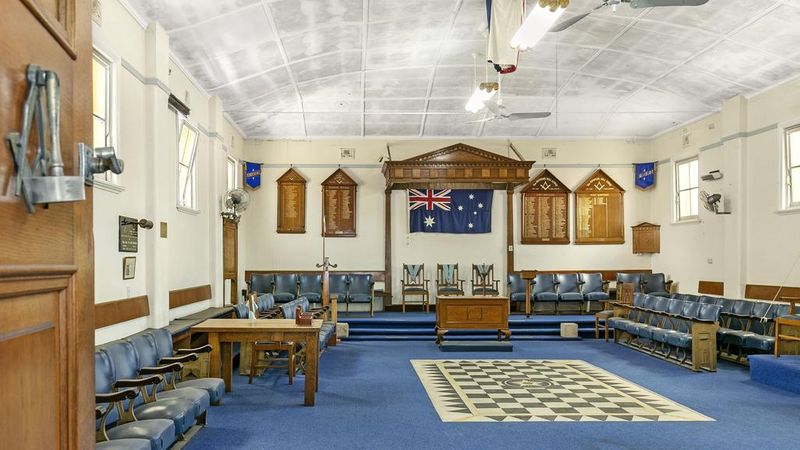
Hunter’s Hill Lodge in AustraliaJuly Hunters Hill Lodge
The CDF has spoken

There is no doubt that some confusion surrounding the status of Freemasonry arose when the Code of Canon Law was revised in 1983.

The new Code failed to reapply the penalty of excommunication for Catholics who held Masonic membership. This led some bishops to wrongly conclude that Freemason’s basic tenets vary from place to place and so its practise in a particular locale may not necessarily pose a danger to a Catholic’s salvation.

However, the German bishops who were in favour of retaining the penalty of excommunication concluded that Freemasonry was ‘an extraordinary danger’ for the Church. Similarly, Cardinal Pietro Palazzini spoke of the need to maintain the penalty of excommunication, since Freemasonry “eliminates truth and revealed religion while welcoming Catholics as ‘useful idiots’.”

Interestingly, Justice Michael Kirby, then deputy commissioner of the Law Reform Commission and former High Court Justice, was, in 1983, full of hope that the Vatican’s review of Catholics and Masonic membership would end the prohibition. In an address to the Lodge University of Sydney, Mr. Kirby predicted that ‘Catholics will soon be able to become Freemasons without fear of excommunication.’

Although the new code of Canon Law is less explicit than its predecessor, Quaesitum es – the CDF’s most recent statement on Masonry – is as clear as it is definitive:

  1. The Church’s negative judgment on Masonry remains unchanged, because the Masonic principles are irreconcilable with the Church’s teaching.
  2. Catholics who join the Masons are in the state of grave sin and may not receive Holy Communion.
  3. No local ecclesiastical authority has competence to derogate from these judgments of the Sacred Congregation.” (Emphasis added.)

Australian Freemasonry: no different from any other form

A spokesman from Freemasons Victoria assured this author that there is little difference between Australian Freemasonry and that which is practised in other jurisdictions. He explained that there are minor differences in dress codes or salutes, for example, but that the basic tenets are the same, and that Australian Freemasonry is most closely aligned with that of Britain. He confirmed the only requirement for membership ‘in their faith’ is belief in ‘a deity’, but that members are free to choose who that deity is. He also confirmed that the name of Jesus Christ is not mentioned in any rituals, at least in the lower levels.

So even if one of Fr. Costigan’s claims is true –  that Australian Freemasonry has no political or sectarian nature – Masonry in this country retains the philosophical marks which render it incompatible with Catholicism.

This unchanging incompatibility has been reiterated time and again by the Church.

Pope St. Leo made it quite clear that ‘the Masonic federation is to be judged not so much by the things which it has done, or brought to completion, as by the sum of its pronounced opinions.’ (Humanum Genus §11.) This teaching was echoed in 1980 by the German bishops, who stated:

“The Freemasons have essentially not changed. Membership places the foundations of Christian existence into question. Detailed investigations of the Masonic rituals and fundamental ideas, and of their current, unchanged self-understanding make clear: Simultaneous membership in the Catholic Church and the Freemasons is incompatible.” (Heresy by Association, p 195.)

Cardinal Law, at the conclusion of an American Bishops’ enquiry into Freemasonry in 1985,  said, “And even though Masonic organizations may not in particular cases plot against the faith, it would still be wrong to join them because their basic principles are irreconcilable with those of the Catholic faith.”

Thus its practical activity is irrelevant; it is the philosophy which endangers a man’s soul.

The verse below comes from a hymn which was in use in Australian Masonic rituals  in 1951. It exemplifies Masonry’s incompatibility with Catholicism; namely that for the Freemason, salvation can be achieved without the Sacraments and without the redemptive action of Jesus Christ.

“Pure as that badge thy life may be, If by its teachings thou abide;

God’s Holy Face thine eyes shall see, If thou wilt make that badge thy guide.”

Freemasonry is always political

Deist philosophy aside, Fr. Costigan is wrong in writing that there is no political danger from Australian Freemasonry. Despite his opinions, Freemasonry’s practical activities have long been a source of contention. As early as 1876, Freemasonry was being blamed for being the driving force behind the secularisation of the education system in Australia. The Archbishop of Sydney at that time, Dr. Roger Vaughan, condemned Freemasonry for secretly driving the push for a government-controlled ‘Universal Secular, Free and Compulsory Education.’

Since then, there have been allegations of Masonic influence being brought to bear in courts of law, and university faculty appointments, at various times and places throughout the country’s history. Although not all the allegations have been proven, there remains little doubt that Freemasons have been able to exert an enormous influence in every facet of Australian society since the nation was founded. Famous Australian figures, such as Joseph Banks, Governor Lachlan Macquarie, the explorers Oxley, Hume and Leichhardt, Sir Charles Kingsford Smith, Sir Donald Bradman, James Boag, and Sir Edward `Weary’ Dunlop were Freemasons. And many members of the Commonwealth Parliament have been Masons, including almost all conservative Prime Ministers up to 1972, from Edmund Barton to William McMahon.

Things are little different in the UK, where there have been historical calls for government enquiries into Masonry and contemporary allegations of corruption involving Freemasons in the medical field and in the police force.

What does the Bishops Conference have to say?

Fr. Costigan’s claims have been refuted by a spokesman for the Australian Bishops. Gavin Abraham, communications officer for the ACBC, issued this response to enquiries about the article:

“The Australian Catholic Bishops Conference has exchanged private correspondence with officials from the Freemasons in recent years. Fr. Costigan’s writings do not accurately reflect the contents of that private correspondence nor any policy of the Conference.”

What this statement does not mention is that it appears from Fr. Costigan’s article that the ‘officials from the Freemasons’, were those Catholic men who were Grand Masters of the states’ Grand Lodges at that time, asking for clarification about their status. Additionally, the statement completely fails to account for the priest’s version of things. Quoting Fr. Costigan’s article:

“… The reply given in writing on the official letterhead of the ACBC was that any Catholic man may join Freemasonry as exists in Australia as long as his conscience agrees. The reply also asked that membership for Catholics in the Craft was to be carried out discreetly and without publicity. No doubt, this was not publicly [sic] to go against the teaching of the Catholic Church about Freemasonry existing in other countries.

“This ruling of the ACBC would certainly be appreciated by Catholics who are members of the Craft. Gratitude is expressed to the Bishops of Australia for their open-handed, sensitive and pastoral approach to this matter.

“It is hoped that before long, this approval will be made public. At the moment, the many Catholic men who belong to the Craft here in Australia have been condemned unjustly by the blanket condemnation of all Freemasonry.”

Fr. Costigan is said to be recovering after surgery and unable to speak to members of the public. So does his article represent the warped reality of a sick, old man?  Or are there bishops in Australia who tolerate and even promote the idea that Freemasonry is somehow acceptable for Catholics?

This whole episode raises more questions than it answers. At a time when there are credible allegations of Freemasons infiltrating the Church at the highest levels, an Australian priest claims that he has been a Mason for a decade, apparently with the approval of his superiors. The bishops say that they haven’t violated the Church’s policy on Masonic membership, but Fr. Costigan claims he has an official statement on the official letterhead, to the contrary.

What of the ‘one thousand’ Catholics who are Freemasons in Queensland? What of the Grand Masters who were allegedly Catholic and thus should be barred from receiving Holy Communion? Where is the bishops’ vocal condemnation of Australian Freemasonry?

It is to be hoped that someone from within the ACBC will be concerned enough to take action on this serious matter.  Souls are at stake, and it is up to the laity to persevere in demanding answers from our bishops on this, and on all deviations from Catholic doctrine.
Cardinal Ravasi flatters the Masons

This 2016 article by Cardinal Ravasi calls for dialogue with Freemasons. The Cardinal disingenuously implies that the penalties cited in Canon Law no longer apply to that ideology which Pope Leo XIII called, “pernicious,” “perverse” and “evil.”

Anonymous Catholic

From Rorate Caeli :

A few days ago, we published a few excerpts of the article published by Cardinal Ravasi, President of the Pontifical Council for Culture, in the Italian paper Il Sole 24 Ore last Sunday, February 14, 2016, calling for dialogue with Freemasons. We now have the full text of the article — followed by a response given by the Cardinal to a reader who asked him for a clarification.
***

DEAR BROTHER MASONS

Over and above our different identities, there is no lack of common values: a sense of community, charitable works and the fight against materialismby Cardinal Gianfranco RavasiI read some time ago in an American magazine that the international bibliography on Freemasonry exceeds more than a 100,000 articles. Certainly contributing to this interest is its aura of secrecy and mystery, more or less with good reason, its different “obediences” and Masonic “rites” shrouded in a sort of murkiness, not to mention its origins, which, according to the English historian Frances Yates, “are one of the most discussed and questionable problems in the entire field of historical research” (curiously the scholar’s study was dedicated to the Rosicrucian Enlightment, translated by Einaudi in 1976).We obviously do not want to go into this archipelago of “lodges” “orients” “arts” “affiliations” and denominations of which history has often weaved – for better or for worse – into the politics of many nations (for example, I’m thinking here of Uruguay where I took part recently in various dialogues with proponents of traditional Masonic culture and society), just as it is not possible to trace the lines of demarcation between the authentic, the false, the degenerate, or para-masonry and the various esoteric or theosophical circles.
It is also arduous to illustrate a map of the ideology which holds such a fragmentary universe, which is why we can speak of a horizon and a method more than a codified doctrinal system. Inside this fluid setting some rather distinct crossroads meet, such as an anthropology based on freedom of conscience, intellect and equal rights, in addition to a deism that acknowledges the existence of God, allowing however, for flexible definitions on His identity. Anthropocentrism and spiritualism, are, therefore, two somewhat excavated paths within a very changeable and flexible map that we are not able to outline in any precise way.


We are content, though, to indicate an interesting little volume which has a clearly distinct aim: that of defining the relationship between Freemasonry and the Catholic Church. Let’s be clear immediately though: it is not a historical analysis of this relationship, neither does it treat of possible contaminations between the two subjects. In fact, it is evident that Masonry has assumed Christian models – even liturgical ones. We must not forget, for instance, that in the 17th century many English lodges recruited members and maestros among the Anglican clergy and it is a fact that one of the first and fundamental Masonic “constitutions” was drawn up by the Presbyterian pastor, James Anderson who died in 1739. In it, among other things, it was affirmed, that an adherent ”will never be a stupid atheist nor an irreligious libertine” even if the creed proposed was, in the end, the vaguest possible, “that of a religion which all men agree on”.


Now, the vacillations of contacts between the Church and Freemasonry have had many varied movements, reaching even manifest hostility, marked by anticlericalism on the one side and excommunication on the other. Indeed, on April 28th 1738, Pope Clement XII, the Florentine Lorenzo Corsini, promulgated the first explicit document on Freemasonry, the Apostolic Letter In eminenti apostulatus specula, in which he declared: “that these same Societies, Companies, Assemblies, Meetings, Congregations, or Conventicles of Liberi Muratori or Francs Massons, or whatever other name they may go by, are to be condemned and prohibited”. Condemnations reiterated by subsequent pontiffs, from Benedict XIV to Pius IX and Leo XIII, affirmed the incompatibility between membership in the Catholic Church and Masonic obedience. Concise was the 1917 code of Canon Law in which canon 2335 reads: “Those who join a Masonic sect or other societies of the same sort, which plot against the Church or against legitimate civil authority, incur ipso facto an excommunication simply reserved to the Holy See.”


The new Code of 1983 tempered the formula, avoiding explicit reference to Freemasonry, conserving the substance of the punishment even if destined in the most generic sense “a person who joins an association which plots against the Church” (canon 1374). However the most articulated Church document on the irreconcilability between adhesion to the Catholic Church and Freemasonry is the Declaratio de associationibus massonicis issued by the Vatican Congregation for the Faith on November 26th 1983, signed by the then Prefect, Cardinal Joseph Ratzinger. It specified precisely the value of the new Code of Canon Law, reaffirming: “the Church’s negative judgment in regard to Masonic association remains unchanged since their principles have always been considered irreconcilable with the doctrine of the Church and therefore membership in them remains forbidden.”


The small volume to which we now return, is interesting since it attaches – along with an Introduction by the present Prefect for the Congregation, Cardinal Gerhard Muller – also two documents from two local Episcopates, the German Episcopal Conference (1980) and the Philippine one (2003). They are significant texts as they address the theoretical and practical reasons for the irreconcilability of masonry and Catholicism as concepts of truth, religion, God, man and the world, spirituality, ethics, rituality and tolerance. It is significant particularly for the method adopted by the Philippine Bishops, who articulate their discourse along three trajectories: the historical, the more explicitly doctrinal and the pastoral. All is examined along the lines of the question-answer type of catechesis. There are 47 question-answers and they go into details, such as the initiation ceremony, symbols, the use of the Bible, the relationship with other religions, the oath of brotherhood, the various levels of the hierarchy and so on. These various declarations on the incompatibility of the two memberships in the Church or in Freemasonry, do not impede, however, dialogue, as is explicitly stated in the German Bishops’ document which had already listed the specific areas for discussion, such as the communitarian dimension, works of charity, the fight against materialism, human dignity and reciprocal knowledge.


Further, we need to overcome that stance from certain Catholic integralist spheres, which – in order to hit out at some exponents even in the Church’s hierarchy who displease them – have recourse to accusing them apodictically of being members of Freemasonry. In conclusion, as the German Bishops wrote, we need to go beyond reciprocal “hostility, insults and prejudices” since “in comparison to past centuries the tone and way of manifesting [our]differences has improved and changed” even if these differences still remain in a clearly distinct way.

[Translation: Contributor Francesca Romana]
***
After being contacted by a Rorate reader, Cardinal Ravasi sent the reader the following message:

Dear [X],
You are probably reacting mainly to the article’s title, which was added by the newspaper’s staff.
My article actually presented the 1983 document from the Congregatio pro Doctrina Fidei, signed by Cardinal Ratzinger, and also the documents on the Masons from the German and Philippine Episcopal Conferences, with clear doctrinal precision as well as practical indications.
Sincere regards,

Gianfranco Card Ravasi

The Masonic Plan to Destroy the Church

This information was written by a priest who compares the stated goals of a Communist infiltrator with the Church’s ‘auto-demolition’ since the Second Vatican Council.

For our purposes, this comparison shows a) with regard to the Catholic Church, the mission of the Communists is identical with that of the Masons and b) that infiltration has actually been achieved, at least on an individual basis.

From Catholic Apologetics:

Memoirs of an Anti-Apostle by Fr.  Morrison

Part I–  Plan for the destruction of the general constitution of the Church.

PART II – Plan for the auto-destruction of the Catholic Church, specifically as they relate to the destruction of the Mass and Sacraments.

PART I

The destruction of the Church, that is, the destruction of the New Order Church, is proceeding according to a plan conceived decades ago. Of course, there are many factors that contribute to the destruction, but it is not possible to deny that a significant part of that destruction has been based on deliberate subversion, developed over the better part of the last century.

I had heard of the book entitled AA-1025: The Memoirs of an Anti-Apostle, but I had not taken the time to read it until now. I have now had that opportunity and am now about halfway through the book, which has already provoked many reflections.

Background. In the 1960s, a French Catholic nurse, Marie Carré attended an auto-crash victim who was brought into her hospital. The man lingered there near death for a few hours and then died. He had no identification on him, but he had a briefcase in which there was a set of quasi-biographical notes. She kept these notes and read them, and because of their extraordinary content, decided to publish them.

The book was originally published in May 1972 in French under the title ES-1025ES standing for Élève Seminariste, or Seminary Student. In 1973 it was published in English as AA-1025AA standing for Anti-Apostle.

It is a succinct (125 pages or so) account of an atheistic Communist mole, who in 1940 was purposely sent by his superiors to infiltrate the Catholic priesthood, along with 1024 others at that time, charged with the mission to subvert and destroy the Church from within by helping effect its auto-destruction, an odd term specifically used by Paul VI years later in his December 7, 1968, Address to the Lombard Seminary at Rome. The Anti-Apostle and his 1024 colleagues were triumphantly successful, as far as the New Order Church goes.

Although the author never identifies the man, the narrative makes it clear that he attended a seminary in United States or Canada. It is certain that at least one of these 1025 men became a bishop. Curiously, although the author could not have known it at the time, the Anti-Apostle hailed from the same country as the man who was six years later to become pope: Poland.

The author prefaces her narrative by observing:

No, the very virtue of obedience is today the extremely powerful weapon that our enemies, who pretend to be our friends, make use of against what we were, to put up in its stead what they have decided to have us become.

AA-1025

The Anti-Apostle makes clear the basis of his plan to effect the auto-destruction of the Church. His seminary career started well before Vatican II, so the elements of his plan now bear chilling fulfillment in our time. Here are some extensive excerpts from the Communist/Liberalist/Modernist plan for the auto-destruction of the Catholic Church, specifically as they relate to the general constitution of the Church, together with our commentary on how they have come true in less than fifty years. A later Part II of this topic will treat of the destruction of the Mass and Sacraments.

THE MODERNIST PLAN OF 1940. “You must drive into the head of men, and particularly the head of Churchmen, to search for, at any price, a universal religion into which all churches would be melded together. So that this idea could take form and life, we must inculcate in pious people, especially Roman Catholics, a feeling of guilt concerning the unique truth in which they pretend to live…. [This Universal Church] could not be otherwise but simple. So that all men could enter it, it could retain a vague idea of a God, more or less Creator, according to the times.


MISSION ACCOMPLISHED BY THE VATICAN II NEW ORDER. Catholics are now told they cannot say that their Church is the one true Church, but that the Church of Christ only “subsists in” the Catholic Church (Vatican II, Lumen Gentium, November 21, 1964, paragraph 8)

THE MODERNIST PLAN OF 1940. “I know that this will not be easy, that we will have to work hard at it, during twenty or even fifty years, but we should succeed in the end.”

MISSION ACCOMPLISHED BY THE VATICAN II NEW ORDER. It has now been about forty years since Vatican II.

THE MODERNIST PLAN OF 1940. “We should succeed in the end … by numerous and subtle means. I look at the Catholic Church as if it were a sphere. To destroy it, you must attack it in numerous small points until it loses all resemblance to what it was before. We will have to be very patient. I have many ideas that might seem at first sight to be petty and childish, but I maintain that the entirety of those petty childishnesses will become an invisible weapon of great efficacy.”

MISSION ACCOMPLISHED BY THE VATICAN II NEW ORDER. The vast number of individual changes making up the whole of the New Order Church is staggering: vulgar tongues instead of sacred Latin used at services, new “eucharistic prayers,” a new form of non-apostolic “consecration,” communion in the hand, altar servettes, elimination of crucifixes, elimination of tabernacles, elimination of statues, “general confession” replacing sacramental confession, elimination of kneelers, introduction of vulgar music at services, “white” funerals, elimination of any concept of sin/Hell/Purgatory, eulogies at Catholic funerals for thrice-divorced men and homosexual panderers, and on and on the list goes.

THE MODERNIST PLAN OF 1940. “To stress that Catholics are responsible for the division among Christians, because, by their refusal to compromise, they caused schisms and heresies. To come to a point that every Catholic will feel so guilty that he will wish to atone at any price. To suggest to him that he must himself endeavor to find all the means capable of bringing Catholics closer to Protestants (and also to others) without harming the Credo. To keep only the Credo. And again … attention: The Credo must undergo a very slight modification. The Catholics say, ‘I believe in the Catholic Church.’ The Protestants say, ‘I believe in the Universal Church.’ It is the same thing. The word Catholic means ‘universal.'”

MISSION ACCOMPLISHED BY THE VATICAN II NEW ORDER. The pope apologies to the heretic Martin Luther, he apologizes to the schismatic Anglican Archbishop of Canterbury. He bows to kiss the pagan Koran. Those in other sects are told not to bother to convert to Catholicism; it’s not necessary. The Jews are told not to worry about becoming Christians, that Christ is not their Messias.

THE MODERNIST PLAN OF 1940. “Always drive minds toward a greater charity, a larger fraternity. Never talk about God, but about the greatness of man. Bit by bit transform the language and the attitude of mind. Man must occupy the first place. Cultivate confidence in man, who will prove his own greatness by founding the Universal Church in which all good wills shall melt together. To bring it out that the good will of man, his sincerity, his dignity, are worth more than an always invisible God.”

MISSION ACCOMPLISHED BY THE VATICAN II NEW ORDER. The Novus Ordo service becomes a communal meal, rather than the Holy Sacrifice of the Mass. The crucifix, the tabernacle, and the statues of God’s Saints are eliminated, while man effusively praises himself. Secular politics become the focus of bishops’ attention, not the worship of God and the keeping of His Commandments. Churches are closed. Traditional worship is replaced by self-serving hootenannies, such as those at World Youth Conference, sponsored by the pope.

THE MODERNIST PLAN OF 1940. “To excite an iconoclastic zeal. Youngsters must destroy all these hodgepodge: statues, pictures, reliquaries, priestly ornaments, organs, candles, and votive lamps, stained glass, and cathedrals, etc., etc.”

MISSION ACCOMPLISHED BY THE VATICAN II NEW ORDER. Statues have been virtually eliminated, priests’ vestments have been simplified to the point of the ridiculous, pipe organs are replaced by electronic pianos, traditional churches are submitted to the wrecking ball.

THE MODERNIST PLAN OF 1940. “In Rome, I had very interesting conversations with a professor who would be mine when I would have received the priesthood. He was a member of our network. He was very optimistic. He had specialized in Holy Scripture and was working at a new translation of the Bible in English. The most astounding thing was that he had chosen a Lutheran pastor as his only collaborator. The said pastor, besides, was no longer in agreement with his own church, which seemed old-fashioned to him. This collaboration, of course, remained secret. The aim of these two men was to rid humanity of all the systems which it had given itself through the Bible, and especially the New Testament. Thus, the virginity of Mary, the Real Presence of Christ in the Eucharist and His Resurrection, according to them, were to be set aside, in order to end up with a complete suppression.”

MISSION ACCOMPLISHED BY THE VATICAN II NEW ORDER. A profusion of “translations” of the Bible into vulgar tongues is published every year, and these purported “translations” become less and less literal, introducing the translators’ own modernistic notions under the guise of “dynamic translation.” One of the Novus Ordo’s leading biblical scholars, “Fr.” Raymond Brown, teaches in a west-coast seminary that Mary’s perpetual virginity, the Real Presence, and the Resurrection are all “myths.”

THE MODERNIST PLAN OF 1940. “There was enough reason to have them [the Saints] erased from the calendar, which was also one of our objectives. But both of us knew that it would take more time to kill all the Saints than it would to kill God.”

MISSION ACCOMPLISHED BY THE VATICAN II NEW ORDER. The New Order has done everything it can to suppress true Saints and replace them with politically-correct modern doppelgangers. St. Christopher, whom seventeen centuries of Catholics venerated was expunged from the New Order. St. Philomena, whom five popes and a Saint publicly venerated and encouraged others to venerate, was expunged. St. Barbara, one of Fourteen Auxiliary Saints from the apostolic Church was expunged.

THE MODERNIST PLAN OF 1940. “The order was also very simple: It was absolutely forbidden for Protestants to convert to Catholicism. And I had this point very much at heart, because conversions had attained an accelerated pace.”

MISSION ACCOMPLISHED BY THE VATICAN II NEW ORDER. Just before Vatican II, conversions to Catholicism from Protestantism and even Judaism were plentiful. Even noted figures publicly converted. After Vatican II, when heretical Indifferentism became the de-facto theology (“we all pray to the same God”; “all religions are equal”), conversions slowed to a trickle. When a schismatic Eastern Orthodox Patriarch approached the Vatican to convert, the Vatican told him to stay as he was. Jews are told that Christ is not their Messias.”

THE MODERNIST PLAN OF 1940. “I suggested that the zeal to give us, in all languages, new Biblical translations in modern style must not be slowed down.”

MISSION ACCOMPLISHED BY THE VATICAN II NEW ORDER. The Catholic Church had always been cautious about translations of the Bible into the vulgar tongues, fearing corruptions of Sacred Scripture and its interpretation. Wisely was the Church cautious. After Vatican II the proliferation of “translations” of the Bible was vast. The translations were no longer even a literal translation of the inerrant Latin Vulgate of St. Jerome, but “dynamic translations,” which allowed any translating committee to change doctrine surreptitiously by merely “retranslating” it. Scripture was now “vernacularized,” so that anyone could interpret it in any way he liked. Martin Luther won again: heretical private interpretation of Scripture had invaded the Novus Ordo Church.

THE MODERNIST PLAN OF 1940. “I also proposed inter-confessional Biblical meetings. This was my real aim, and moreover it could even go further, by adding a benevolent examination of the Koran and of some other oriental books.”

MISSION ACCOMPLISHED BY THE VATICAN II NEW ORDER. Catholics had always been prohibited from attending inter-denominational Bible meetings and studies because of the corruption of the true Faith that they involved. Now one sees, even on “Catholic” television (like Mother Angelica’s EWTN), supposedly “former” Protestants taking the lead in teaching Catholics about the meaning of Scripture. The pope himself scandalized the whole Roman Catholic Church by bowing down to kiss the abominable Koran of the Mohammedans, which contains vicious slurs against Our Lord and the Blessed Virgin.

THE MODERNIST PLAN OF 1940. “It is altogether reasonable to hope that the cure will be at hand for the year 2000 [remember, this was planned in 1940!]. A certain number of words must be banished completely from the human vocabulary, and the best method is to be sure that children never hear these words. That is why it is much better to compose a new catechism than to hope for a simple suppression of all religious teaching.”

MISSION ACCOMPLISHED BY THE VATICAN II NEW ORDER. The new Vatican II Catechism, which went through several editions before the changes in doctrine could be gotten just right, was written by a group of ecclesiastical hacks who were so incompetent that they could not read the original sources in Latin and Greek. Compare this committee with those who authored the Roman Catechism after the Council of Trent: St. Charles Borromeo, St. Robert Bellarmine, and the like. Much Catholic doctrine was “nuanced away,” like the common teaching of the Fathers and Doctors of the Church about the justice of capital punishment, or simply omitted, like the common teaching of the Fathers and Doctors of the Church about limbo. Words like HellPurgatorysin and the like were used as little as possible. I know a teacher who was called into question when he mentioned to his Novus Ordo middle-school class the Church’s dogma about Hell.

THE MODERNIST PLAN OF 1940. “The word charity must absolutely be banished and be replaced by the world love, which allows you to keep your feet on the ground and even to play all kinds of ambiguous games without seeming to do so.”

MISSION ACCOMPLISHED BY THE VATICAN II NEW ORDER. The word love has proliferated like no other word in the post-conciliar Church, and its meaning in English and other modern tongues is certainly ambiguous. The Latin and Greek Bibles had separate words for various types of love: love of family, love of friends, love of God, sexual love. English and other modern languages entirely blur these important distinctions. How does Christ define love? “If you love Me, obey My commandments.” That meaning isn’t even included in New Order “love”! No, we must “love” homosexuality, we must “love” divorce, we must “love” apostasy from the Faith.

THE MODERNIST PLAN OF 1940. “We have found the astuteness — which consists in hiding behind the “Spirit of the Council” — to launch all kinds of thrilling innovations. This expression, “Spirit of the Council,” has become for me a master-trump…. But it will be only at Vatican III that I will be able to present myself with hammer and nails, not to nail God on His Cross, but rather to nail Him in His coffin.”

MISSION ACCOMPLISHED BY THE VATICAN II NEW ORDER. How often have we heard the expression “Spirit of the Council” used to justify every blasphemous, and sacrilegious, and scandalous element of the New Order? Already one hears more and more talk about a Vatican III to seal the destruction of the Church, as the Anti-Apostle and his allies planned already, back in 1940.

If you are a member of the New Order, if you attend a Novus Ordo service, if you defend “obedience” to the Church of the New Order, know that you are simply carrying out the plan hatched as early as 1940 by Modernists and are playing right into their hands.

If you are a traditional Catholic, if you attend exclusively the Traditional Latin Mass, if you will not obey evil, no matter from what color of authority it comes, know that you are standing with Christ against the Modernist forces which would defeat Him, but which in the end will themselves be defeated.

PART II  

Plan for the auto-destruction of the Catholic Church, specifically as they relate to the destruction of the Mass and Sacraments.

 The author prefaces her narrative by observing:

No, the very virtue of obedience is today the extremely powerful weapon that our enemies, who pretend to be our friends, make use of against what we were, to put up in its stead what they have decided to have us become.

The Anti-Apostle makes clear the basis of his plan to effect the auto-destruction of the Church. His seminary career started before well before Vatican II, so the elements of his plan now bear chilling fulfillment in our time. Here are some extensive excerpts from the Communist/Liberalist/Modernist plan for the auto-destruction of the Catholic Church, specifically as they relate to the destruction of the Mass and Sacraments, together with our commentary on how they have come true in less than fifty years:

THE MODERNIST PLAN OF 1940. “The professor also taught me a reasonable way to say Mass, since in six years I would be obliged to say it. While waiting for a profound modification of the whole ceremony [how did he know about this in 1940?], he never pronounced the words of the Consecration. But so as not to be suspected, he pronounced words almost similar, at least according to the ending of the words. He advised me to do the same. All that made this ceremony look like a sacrifice should, little by little, he suppressed. The whole ceremony should represent only a common meal, as among Protestants.”

MISSION ACCOMPLISHED BY THE VATICAN II NEW ORDER. The “profound modification of the whole ceremony,” as predicted, became the Novus Ordo service, which defines itself as a “common meal,” not a Sacrifice.”

THE MODERNIST PLAN OF 1940. “He even assured me that it should never have been otherwise. He also worked at the elaboration of a new Ordinary of the Mass and advised me also to do the same, because it appeared to him to be altogether desirable to present to people a large number of diversified Masses. There must be some, very short, for families and small groups, some longer ones, for Feast Days, although, according to him, the real feast for the working classes is a walk in Nature. He thought that he could easily arrive at a point of considering Sunday as a day consecrated to Nature.”

MISSION ACCOMPLISHED BY THE VATICAN II NEW ORDER. There are many variations of the New Order service. One traditional apostolic Canon became three man-made “eucharistic prayers,” which have now proliferated well beyond that number. There are so many options for the form of the New Order service that most Novus Ordo churches don’t use an official missal, but a pastiche of xeroxed pages contained in a three-ring binder at the altar, so that the service can be changed on a moment’s notice, or be improvised “as the spirit moves.” Moreover, Nature has become the modern-day Earth Goddess, Gaia, the green pagan goddess of the environmental movement, in which it is more morally reprehensible to kill a dog than to murder a child.

THE MODERNIST PLAN OF 1940. “Afterwards come the Seven Sacraments, which are all to be revised.”

MISSION ACCOMPLISHED BY THE VATICAN II NEW ORDER. Not a single one of the seven Sacraments has been left untouched in the Novus Ordo.

THE MODERNIST PLAN OF 1940. “As for the Sacrament called Penance, it would be replaced by a community ceremony, which will only be an examination of conscience directed by a well-trained priest, all of which would be followed by a general absolution, as in some Protestant Churches. God will not be mentioned in this ceremony, which will not be called a Sacrament anymore (because this word must also disappear from the vocabulary).”

MISSION ACCOMPLISHED BY THE VATICAN II NEW ORDER. Already this pseudo-sacrament has replaced the Sacrament of Penance in most churches.

THE MODERNIST PLAN OF 1940. “As for the Sacrament of Extreme Unction, we will have to find another word for it…. We will have to see to it that the notion of eternal life, judgment, Heaven, Purgatory, or Hell be replaced by the sole desire to be cured….. I would willingly choose the expression “Sacrament of the sick.”

MISSION ACCOMPLISHED BY THE VATICAN II NEW ORDER. Just as the Anti-Apostle planned in 1940, the Sacrament of Extreme Unction, so powerful to reconcile to eternity the soul in its last hour, has been obliterated and in its place a mere “blessing of the sick” substituted with the very name that the Anti-Apostle suggested, the “sacrament of the sick.” I have been called in at the last minute to attend a soul when it realizes that Church of the New Order has not the power to absolve it or to prepare it for eternity. Believe me, the vapid Church of the New Order looks quite different to a soul when faced with the seriousness of eternity!

THE MODERNIST PLAN OF 1940. “It is of prime necessity completely to reform the words of the Mass, and it will be well even to suppress the word itself and to replace it by “The Lord’s Supper” or by “Eucharist” (for example). The Renovation of the Mass must minimize the importance of what they call “Consecration” and must give to the Communion a much more trivial appearance.”

MISSION ACCOMPLISHED BY THE VATICAN II NEW ORDERYou might call it a “mass,” but that is not what they call it. Just as the Anti-Apostle planned in 1940, the terms Lord’s Supper or Eucharist have become much more common. The “consecration” of the Novus Ordo service has in fact been minimized: not even the Catholic and Apostolic words, confirmed as dogma by the Council of Trent, have been left untampered.

THE MODERNIST PLAN OF 1940. “We will suggest the possibility of abandoning the high altar and of replacing it by a small table, completely bare, where the priest will stand facing the people.”

MISSION ACCOMPLISHED BY THE VATICAN II NEW ORDER. First the “turned-around” T.V. table was optional; then it was recommended. Now, according to the 2000 third edition of the Novus Ordo missal, it is required.

THE MODERNIST PLAN OF 1940. “Each text forming the Ordinary of the Mass will be carefully compared with the texts used by the Anglicans and Lutherans, in order to promote a single text of varying texts apt to be accepted by these three religions.”

MISSION ACCOMPLISHED BY THE VATICAN II NEW ORDER. It is well known that the Masonic Grand Architect of the Novus Ordo service used six Protestants to help him write the new service, with the full approval of Paul VI, who gladly posed for an historic photograph with the six, which was published by the Vatican Press Office. The six publicly attested to the fact that the Novus Ordo service had been so changed in comparison to the Traditional Latin Mass that they had no problem whatsoever using it as their own Protestant worship service from then on.

THE MODERNIST PLAN OF 1940. “To weaken further the notion of ‘Real Presence’ of Christ, all decorum will have to be set aside. No more costly embroidered vestments, no more sacred music, especially no more Gregorian chant, but a music in jazz style.”

MISSION ACCOMPLISHED BY THE VATICAN II NEW ORDER. In fact, the traditional vestments of the Church have been replaced by an all-purpose slip-over alb. What passes for “music” in the Novus Ordo service is a cacophony of electronic pianos, drums, and rock-based rhythms and tunes. The pipe organ, the Church’s only authentic instruments, has been relegated to oblivion — or sold to nearby Protestant churches. The Church whose music was once the envy of the world and all its cultures now panders the “junk culture” to the world, with the pope personally attending rock concerts and expressing his preference for them over anything religious.

THE MODERNIST PLAN OF 1940. “Moreover, the faithful will have to break themselves of the habit of kneeling, and this will be absolutely forbidden when receiving Communion.”

MISSION ACCOMPLISHED BY THE VATICAN II NEW ORDER. This plank from the 1940 plan has been fulfilled before our very eyes! Just this month the U.S. bishops have banned kneeling for “communion” at Novus Ordo services. Many dioceses already prevent kneeling during the most sacred part of the service, the Canon. And because many Novus Ordinarians still insist on kneeling, many churches have removed the kneelers!

THE MODERNIST PLAN OF 1940. “In order to destroy all sacredness in the worship, the priest will be invited to say the whole Mass in the vernacular.”

MISSION ACCOMPLISHED BY THE VATICAN II NEW ORDER. Although the use of vernacular in the Mass was condemned with the censure of excommunication by the dogmatic Council of Trent, and even though Vatican II confirmed this dogma, the reality of the Church of the Novus Ordo is quite different. A virtual babble (Babel) of vulgar tongues has intruded into what is supposed to be the Sacred Liturgy. It is interesting that the word vernacular comes from the Latin word for slave, vernaculus, and indeed the Church of the New Order has enslaved its congregations to a phony “mass” and a a phony “communion,” which, far from being able to impart any graces, has admitted, in the words of Pope Paul VI, “Satan around the altar.”

So, do we traditional Catholics sink into despair and hopelessness, even into distrust of God, knowing that the New Order has been executed exactly according to the plan of atheistic Modernists as early as 1940? No! I end this commentary by quoting from the truly Catholic woman whom the Anti-Apostle met — sent by God to save him if that were possible, who knows? God gives even atheistic Modernists a chance at grace, if they will but accept it and convert.

Many souls, my Dear, will yield to the temptation of joining a completely human Church, which will mix up all beliefs so as to render them unrecognizable, but the [true] Catholic Church will continue to stand. If you persecute it, it will go into hiding, but its soul will always remain standing. For the mark of this Church is the submission to a Revelation which comes from Heaven….

You might win a certain number of souls to your perverse doctrines, maybe even a part of the Clergy (although I do not believe it), but you will never win all the souls; on the contrary, you will fortify the Saints. Yes, my poor dear friend, by attacking the Church of God you are but a toy in the hands of the All-Powerful. You believe yourself to be strong, but you are only strong insofar as God permits. Fear the day when the Lord will say: “It is enough, I have heard the prayers of those who suffer, and I have decided to comfort them by destroying My enemies.”

And that, my fellow traditional Catholics, is the explanation of what is going on in the Church today. It is a great test of our souls and of our sanctity. The magnitude of the forces against true Catholicism, even if it be within the Church, even if it be to the papacy itself, is but nothing against the All-Powerful.

It is up to us merely to keep the traditional Faith, to keep praying for the restoration of the Church, and one day the enemies of the Church will be destroyed as Marie Carré says — maybe sooner, maybe latter, but the Faith teaches us that the question is not if, but when.


A Canon Lawyer looks at Masonry in the 1983 Code

This is the abstract of a dissertation by Canon Lawyer Ed Condon on the topic of Freemasonry and Catholics. The entire paper can be read here:

Heresy by Association

Despite the remarkable continuity, over the centuries, of the Catholic Church’s condemnation of Freemasonry and the clarity of her rationale for doing so, the current canonical discipline of Catholic-Masonic issues is the subject of considerable confusion. The canonical prohibition of Catholic membership of a Masonic Lodge, or society, was expressly articulated in canon 2335 of the 1917 Code of Canon Law, which attached a penalty of excommunication, latae sententiae. Further canonical effects explicitly linked to Masonry were contained in six additional canons spread throughout the Code. The 1983 Code of Canon Law contains no explicit mention of Freemasonry. Canon 1374 provides for indeterminate penalties for those who join societies which “plot against the Church”, but there is no consensus of what the canonical definition of plotting (machinationem) means, nor which societies, if any, might be intended by the canon.

This dissertation seeks, through historical analysis of the origins of Freemasonry itself, and the Church’s teaching against it, to correctly place Freemasonry, specifically membership of a Masonic society by a Catholic, within the penal law of the 1983 Code.

Chapter I traces the origins of Freemasonry and the Church’s opposition to it, through to the codification of the 1917 Code of Canon Law.

Chapter II is a parenthetical consideration of the particular phenomena of American Freemasonry, which is often held out to be somehow less noxious than the often explicitly anti-clerical European variety, and demonstrates its peculiar, but no less damnable, nature.

Chapter III is an examination of the 1917 Code of Canon Law. It considers the canons on associations generally, and various condemned societies in particular, and extrapolates the significance of the canonical context of the Code’s treatment of Masonry as, variously, a crime against the faith and against authority. The chapter also offers a treatment of some basic principles of penal law, including imputability and the nature of crime and punishment in canon law.

Chapter IV traces the canonical prohibition of Masonic membership by a Catholic through the process of reform and revision which resulted in the 1983 Code of Canon Law. It then examines the various scholarly commentaries on the subject, as well as how Masonry has been canonically treated under the ius vigens.

Chapter V advances the argument that a Catholic joining the Freemasons can, in fact, commit two delicts by the same action: the delict of joining a prohibited society (c. 1374); and the delict of heresy (c. 1364). Masonic texts and rites of initiation are examined as possibly containing heretical material which a Mason explicitly embraces. The chapter finishes by establishing the existence, necessity, and justice of an enduring universal canonical prohibition of Catholic membership of the Freemasons.

Read the entire the dissertation here:

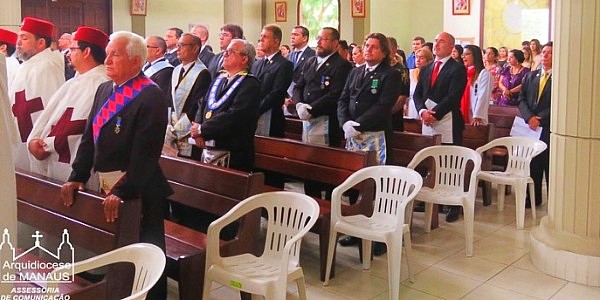
A Freemasonic Mass in Brazil

A Freemason newsletter published this account of a Mass offered for Amazonian Masons in the Archdiocese of Manaus cathedral in 2018. From El Oriente:

Mass for Masonry in Manaus 


 ” What unites us is much greater than what separates us .” That was the message of the Metropolitan Archbishop of Manaus, Monsignor Sergio Castrini, during the celebration in the Sagrada Familia del Tarumã church for the expansion of the improvement orders  dependent on the Grand Orient of Brazil , in friendship with the Grand Lodge of Spain . “ God is love and the way of knowledge is love. Love is always a response, mainly to God who first loved us. The cross that you carry on your insignia is the sign of God’s love for humanity “, explained the archbishop who concluded his homily with a request to the freemasons present, of Christian condition: ” We hope that you will always continue to provide these services to society and mainly by being faithful to Christian principles and communion with the Church, because the Church may be different on the surface .”

More on the Archbishop’s sermon was found here:

Archdiocese of Manaus, May 6, 2018 –What unites us is much greater than what separates us. We are on the eve of Pentecost, whose theme is ‘In the power of the Spirit, we are all brothers and sisters’, which shows that what unites us is the Spirit of God. That was the message that the Metropolitan Archbishop of Manaus, Mgr Sergio Castrini, left during the celebration for the founding of the Templars and Priories of Malta of the Amazon Castelo de Tomar No. 61 and Rondonia Estrela de Porto Velho No. 62. The celebration took place on May 6 ppdo. in the Sagrada Familia del Tarumã church and was concelebrated by the parish priest, Fr. Charles Cunha, assisted by the deacon Messias Alencar.

” This day is a historical landmark that will remain in our hearts and makes it clear that we are Christians, we are Knights of Our Lord Jesus Christ and that we are servants of God “, said Jurimar Collares Ipiranga, Secretary of Education and Culture of the Grand Orient of Brazil (GOB) Amazon.

After the proclamation of the Gospel by Deacon Messias, Bishop Castrini began his homily by emphasizing God’s love for humanity: “ God is love and the way of knowledge is love. Love is always a response, mainly to God who first loved us. The cross that you wear on your insignia is the sign of God’s love for humanity «. Bishop Castrini, who also took the opportunity to speak about the true vocation of the laity, stated: « The Catholic Church is celebrating the Year of the Laity and the vocation of the laity is that: to be Salt of the Earth and Light of the World, in the family, at work and above all being a good citizen «.

The Archbishop concluded the homily by speaking of the journey of the Clergy to the Holy Land at the beginning of the year, where they visited the churches built by the Templars at the time of the Crusades and concluded with a request to the Masons: “ In his first reading, Peter discovers that pagans were also called to follow God. He made this discovery at Cornelio’s house and was very excited. It was a fundamental fact in the history of Christianity and many took time to understand that, when we stopped being a Jewish sect, we became a universal church. We hope that you will always continue to render these services to society and mainly to be faithful to Christian principles and to communion with the Church, because the Church may be different on the surface, but we are all united in Christ«.

According to Armando Corrêa Junior, Grand Master of the GOB Amazonas, the celebration broke a great paradigm and now the idea is to try to make the solemnity an annual tradition in the State of Amazonas. “ Yesterday we founded the Preceptorium and the Castelo de Tomar Priory, and we wanted to celebrate a mass of gratitude to God for that moment reached by the Freemasonry of the Amazon. We are very happy with the presence of Bishop Sergio who came personally to preside over this Mass and I have no words to thank and express emotion for the importance of this moment in which we have overcome a great paradigm. We intend to repeat this act in the coming years, but we depend on the archbishop, since the respect for the authority of Monsignor Sergio is 100% “, commented the Grand Master.

Catholicism vs. Freemasonry—Irreconcilable Forever

This article was reproduced online but was originally produced in pamphlet form by the World Apostolate of Fatima in the 1980’s.

What is the truth regarding the present official attitude of the Catholic Church toward Freemasonry? To begin this inquiry into that which is now in effect, we should go back to what was stated in the Church’s canon law before there was any doubt about where the Church stood on Masonry. The former code (which, incidentally, was promulgated on Pentecost, May 27, 1917, just two weeks after Our Lady’s first apparition at Fatima) contained a canon which definitely capped all the previous papal condemnations of it. Canon 2335 reads as follows:

Persons joining associations of the Masonic sect or any others of the same kind which plot against the Church and legitimate civil authorities contract ipso facto excommunication simply reserved to the Apostolic See.

In the wake of the Second Vatican Council, however, when the revision of the Code of Canon Law was underway, the prevailing spirit of “ecumenical dialogue” prompted questions among various bishops as to whether or not Canon 2335 was still in force. Responding to these questions, a letter from Cardinal Francis Seper, Prefect of the Sacred Congregation for the Doctrine of the Faith, to the presidents of all the episcopal conferences, dated July 18, 1974, stated that: (1) the Holy See has repeatedly sought information from the bishops about contemporary Masonic activities directed against the Church; (2) there will be no new law on this matter, pending the revision of the Code now underway; (3) all penal canons must be interpreted strictly and (4) the express prohibition against Masonic membership by clerics, religious and members of secular institutes is hereby reiterated.1

This rather awkwardly structured letter (which, for whatever reason, was not published in the Acta Apostolicae Sedis, the official journal of record for the Holy See) came to be interpreted in many quarters as allowing membership by laymen in any particular Masonic (or similar) lodge which, in the judgment of the local bishop, was not actively plotting against the Church or legitimate civil authorities.

This state of affairs, in which undoubtedly a fair number of Catholics in good faith became Masons, lasted for some years. Then, on February 17, 1981, Cardinal Seper issued a formal declaration: (1) his original letter did not in any way change the force of the existing Canon 2335; (2) the stated canonical penalties are in no way abrogated and (3) he was but recalling the general principles of interpretation to be applied by the local bishop for resolving cases of individual persons, which is not to say that any episcopal conference now has the competence to publicly pass judgment of a general character on the nature of Masonic associations, in such a way as to derogate from the previously stated norms.2

Because this second statement seemed to be as awkwardly put together as the first, the confusion persisted. Finally, in 1983 came the new Code with its Canon 1374:

A person who joins an association which plots against the Church is to be punished with a just penalty; one who promotes or takes office in such an association is to be punished with an interdict.

CARDINAL RATZINGER’S DECLARATION

Following the promulgation of the new Code, Cardinal Joseph Ratzinger, the new Prefect of the Congregation for the Doctrine of the Faith, issued a new declaration: (1) the new Canon 1374 has the same essential import as the old Canon 2335, and the fact that the “Masonic sect” is no longer explicitly named is irrelevant; (2) the Church’s negative judgment on Masonry remains unchanged, because the Masonic principles are irreconcilable with the Church’s teaching (“earum principia semper iconciliabilia habita sunt cum Ecclesiae doctrina”); (3) Catholics who join the Masons are in the state of grave sin and may not receive Holy Communion and (4) no local ecclesiastical authority has competence to derogate from these judgments of the Sacred Congregation.3

With these official statements of the Universal Church now on record,4 it should be clear that the lamentable confusion of so many Catholics regarding Freemasonry must be seen as only a temporary aberration—to be written off as one most costly consequence of a mindless “spirit of Vatican II.” But we may hope that, as in other issues that have plagued the Church in the last score of years, there is a providence in this, a veritable blessing in disguise. For now, more clearly than ever before, we should see just why the Catholic Church has been—and will always be—so opposed to Masonry.

It may at first seem plausible that the main (if not only) reason for its being condemned by the Catholic Church is that Masonry is conspiratorial. Its plotting against the Church (and, in the old Code, its also plotting against the State) is the one descriptive statement mentioned in both versions of the Code of Canon Law. Moreover, as the first curial document we cited (that of 1974) seems clearly to imply, the one requisite condition for permitting Catholics to join a Masonic lodge is that the lodge in question was not actively plotting against Church and State. Yet, for all its initial plausibility, this opinion seems to be inadequate. The proof of this is evident not only from the two subsequent curial documents (of 1981 and 1983), but more decisively still from the entire previous history of Roman documents, both curial and papal, treating of Masonry.

Beginning in 1738 with Clement XII’s encyclical In Eminenti (just twenty-one years after the establishment of the Grand Lodge of England, the event usually recognized as the commencement of the modern Masonic movement) and running through ten successive pontificates, the Church’s case against Freemasonry finds its culminating statement in 1884 in Leo XIII’s encyclical Humanum Genus. Masonic deceitfulness regarding its real objectives in society—and its consequent policy of secrecy regarding the authorities of Church and State, and including even the rank-and-file of its own membership—has always been noted by the popes, and most tellingly by Leo XIII.5 And in the century since then and in our own country this conspiratorial policy has been amply documented.6

However useful this knowledge of Masonic strategy is for our understanding of the authentic nature of the movement, it is quite secondary. It is wholly subordinate to that which defines the movement itself: the content in function of which conspiracy is but “method,” the end determining and justifying the means. That content—that end—is what we must now examine, if we are to find the fundamental and explicit reason for the Church’s condemnation of Freemasonry .

This fundamental reason can be briefly stated. The following summary passage from Leo XIII’s Humanum Genus suffices.

. . . that which is their ultimate purpose forces itself into view— namely, the utter overthrow of that whole religious and political order of the world which the Christian teaching has produced, and the substitution of a new state of things in accordance with their ideas, of which the foundations and laws shall be drawn from mere “Naturalism.”…

Now, the fundamental doctrine of the Naturalists, which they sufficiently make known by their very name, is that human nature and human reason ought in all things to be mistress and guide. Laying this down, they care little for duties to God, or pervert them by erroneous and vague opinions. For they deny that anything has been taught by God; they allow no dogma of religion or truth which cannot be understood by the human intelligence, nor any teacher who ought to be believed by reason of his authority. And since it is the special and exclusive duty of the Catholic Church fully to set forth in words truths divinely received, to teach, besides other divine helps to salvation, the authority of its office, and to defend the same with perfect purity, it is against the Church that the rage and attack of the enemies are principally directed.7

Catholicism and Freemasonry are therefore essentially opposed. If either were to terminate its opposition to the other, it would by. that very fact become something essentially different from what it previously was; it would in effect cease to exist as itself. For Catholicism is essentially a revealed religion; it is essentially supernatural, both in its destiny and in its resources. Beyond all natural fulfillment, it tends toward an eternity of ineffable union with God in Himself; and beyond all natural resources, it begins that union here and now in the sacramental life of the Church.

Masonry, on the other hand, is essentially a religion of “reason.” With an insistence and a consistency matching Catholicism’s self- definition, Masonry promises perfection in the natural order as its only destiny—as indeed the highest destiny there is. And it provides for this perfectibility with its resources: the accumulated sum of purely human values, subsumed under the logo of “reason.”

Literally a logo, the Masonic compass and square are the symbol of a Rationalism that claims to be identified with all that is “natural.” The consequent syncretism, blending all the strands of human experience—from the cabalistic mysteries of an immemorial Orient to the technological manipulations of a post- modern West—is the basis for Masonry’s claim to be not just a religion but the religion: the “natural” Religion of Man. That is why its claim to date from the beginning of history—its calendar numbers the “Years of Light” (from the first day of Creation) or the “Years of the World”—is no mere jest on its part. And that is why its opposition to the Catholic Church antedates the Catholic Church’s opposition to it. For it cannot abide the Church’s claim to be the One True Church, and the consequent refusal by the Church to be relegated to the status of a “sect” which Masonry would have it be.

Since the Church’s claim to be the One True Church is ultimately founded and validated on the reality of the One True God, the opposing Masonic claim must ultimately derive from a perception of God that diametrically opposes the Church’s faith. And so it does. Although Pope Leo does not explicitly speak of this essential opposition between Catholicism and Masonry in terms of the First Commandment of God—”I am the Lord thy God, thou shalt not have strange gods before me”—surely the most radical and simplest way of situating this opposition is to say just this. The Masonic “God” is an idol. What the Masons really worship is Man—or the Spirit who has deceived man from the beginning: the masked Spirit of Evil. This is the one primal reason why the Catholic Church has condemned, and will always condemn, Freemasonry. It is clearly sufficient to stand by itself as the only reason—and in a most fundamental sense, as Leo XIII seems to imply, that is the only reason in fact.

GRAVELY EVIL MISUSE OF OATHS

We can, however, give a second reason for the Church’s opposition to Masonry. Not strictly independent of the first reason, based as that reason is on the First Commandment, we can yet distinguish a second reason—based on the Second Commandment. Some ten years earlier than Humanum Genus, there appeared (even in English translation) a brief (barely more than pamphlet-sized) but penetrating work, A Study of Freemasonry, by the great bishop of Orleans, Felix Dupanloup.8 All the more impressive because of his “liberal” credentials, Dupanloup duly notes the facts, and the gravity, of the Masonic conspiracy. But what he stresses, besides the same primary point subsequently stressed by Leo XIII, viz., the Masonic violation of the First Commandment, is its violation of the Second Commandment by its gravely evil misuse of oaths. The famous (or, rather, infamous) oaths that run through the entire ritual of Masonic initiation are more than mere promises based on personal honor. They formally invoke the Deity, and have for their object a man’s total commitment to a cause under the direst sanctions. The Catholic Church sees in such oaths an inescapable grave evil. Either the oaths mean what they say or they do not. If they mean what they say, then God is being called to invert by his witness loyalties (viz., to Church and to State) already sanctioned by Him. If the oaths are merely fictitious, then God is being called to witness to a joke.

It is not the secrecy of what goes on “behind the lodge door” that elicits and justifies the Church’s condemnation of Masonry. It is rather the formal violation of the Second Commandment which these proceedings inescapably entail. The vaunted Masonic secrets, moreover, are scarcely that secret any longer. There is in fact a frequent Masonic plea to the effect that there are no secrets in Masonry—that all is open to a truly open mind. On this point we may take the Mason at his word: he is speaking more truly than he knows!

The case for the Catholic Church’s condemnation of Freemasonry is open and clear. By its very nature as formulated in its philosophical statements and as lived in its historical experience, Masonry violates the First and Second Commandments of God. It worships not the One True God of revelation—Father, Son and Holy Spirit—but a false god, symbolically transcendent but really immanent: the “god” called “Reason.” And it invokes without adequate cause the Name of the One True God. After such a case as this, to cite the secrecies of initiation and the further secrecies of machination called “conspiracy” is not only anti-climactic, it is beside the point.

To conclude: we Catholics should now see the Masons more clearly for what they essentially are. They are the heirs (unwitting or otherwise is irrelevant) of a religion which purports to be the one religion of the one “God”—and therefore the enemy, intrinsically and implacably so, of Catholicism. Freemasonry in its modern mode is “modernity” in the deepest (i.e., the philosophical and religious) sense of that term. It is, in a word, “Counterfeit Catholicism.” For its “God” is the “Counterfeit God”: the one who would be as God, the one who is the prince of this world, the one who is the Father of Lies.

ENDNOTES

1. “Complures Episcopi,” Notiziario CEI (1974) 191. (From Enchiridion Vaticanum, No. 563, pp. 350-51.

2. “S. Congregation pro Doctrina Fidei,” Acta Apostolicae Sedis 73 (1981) 240-41. (From EV, No. 1137, pp. 1036-39)

3. “Quaesitum est,” AAS 76 (1984) 300. (From EV, No. 553, pp. 482-87)

4. A summary of this documentation was made available in this country by the American Bishops’ Committee for Pastoral Research and Practice, in a report entitled “Masonry and Naturalistic Religion,” published in Origins, 15 (June 27,1985), pp. 83-84.

5. Acta Sanctae Sedis 16 (1883 sic) 420.

6. For an excellent recent survey, with emphasis on the American scene, see Paul Fisher’s Behind the Lodge Door: Church, State and Freemasonry in America (Bowie, MD: Shield, 1988).

7. Acta Sanctae Sedis 16 (1883 sic) 421. The English version used here is from a Paulist pamphlet first published in 1944 and reprinted by TAN (Rockford, IL: 1987), pp. 6-7.

8. The English edition which I used was published in Philadelphia in 1856.

Printed with ecclesiastical permission

This leaflet, item # 96595, may be obtained for 5 cents per copy from: World Apostolate of Fatima Washington, New Jersey 07882-0976

This item 2652 digitally provided courtesy of CatholicCulture.org