Mar-A-Lago MEGA Mistake

When Calvin Robinson and I crossed paths on X a few days ago, our exchange exemplified the frustration many Trump-questioners are having with the Trump cheerleaders. Try to explain your concern that Trump is bringing about a repackaged Great Reset and you receive the same kind of disbelief or even disrespect formerly reserved for those trying to question the mRNA injection.

Fr. Robinson (or is it Mr. Robinson?) posted about the ‘Catholics for Catholics’ event held at Mar-a-Lago, Trump’s luxury country club, which was ostensibly to gather prominent Catholics to offer prayers for America, including for the President’s conversion. The idea was objectively a good one, but the optics and the execution left much to be desired.

According to Robinson, this is an effective method of ‘evangelising and discipling’ Trump. Bear in mind that tickets for this black tie cost $1200-$1500 USD!

Speaker list, including Michael Flynn and Roger Stone.

Regardless of what anyone thinks about the effectiveness or otherwise of such a strategy, there were a couple of highly unsavoury characters involved. Mike Flynn and Roger Stone, who are also part of the planning committee, gave addresses on the night yet their backgrounds make their involvement extremely problematic.

Mike Flynn

General Mike Flynn was National Security Advisor to Donald Trump during his first term. He is now a Senior Advisor for the group ‘Catholics for Catholics’. However, Flynn’s Catholic credentials are highly questionable, as shown by his behaviour in both the moral and spiritual realms.

Mike Flynn speaks at the Mar-a-Lago event

Firstly, his moral failings are quite evident. Although there is much mis and disinformation surround Trump’s Russian collusion controversy, it is a matter of fact that Flynn twice pleaded guilty in US federal district courts to lying to the FBI. Not a great look for a Catholic no matter how you spin it.

Then, in late 2024, Flynn responded to a question about the possibility of executions of political rivals under the next Trump administration by laughing and saying that “The gates of hell — my hell — will be unleashed.” Whether meant literally or not, those are unsettling words.

But it gets worse.

In 2021, Mike Flynn prayed at a Kenneth Copeland prayer meeting – Copeland is a Protestant televangelist with a huge international following. Flynn’s prayer, although it contained elements of Catholic terminology, was not a Catholic prayer. It had more in common with the prayers of theosophists, particularly Alice Bailey’s Great Invocation, which according to a former occultist, is meant “to call the power of the Hierarchy of Mahatmas, Angels, and other cosmic forces into action to further the evolution of mankind as well as save it from self-destruction.”

One American cult that had it roots in theosophy was the I AM movement. I AM was part of the ‘name it – claim it’ groups that popularised the idea that Christians weren’t meant to suffer and could make good things happen simply by telling God what they wanted. This is not any different from the New Age ‘manifesting’ spells which have become so common these days.

I AM proponents “believed in an Ascended Master called The Great Divine Director”. The head of the cult was a woman known as Elizabeth Clare Prophet, who often recited her own version of the Great Invocation and it is this version that Flynn prayed, almost verbatim at the Copeland event.

Below is a video which compares Flynn’s prayer to that of Prophet.

In the video to the right, you can find a snippet from an interview where Flynn says he carries the occult prayer around in his pocket – yet, he makes it sound as though this is the Catholic prayer to St. Michael the Archangel – in his words, it’s a “rendition of that prayer.” (To learn about the false St. Michael of the occult, click here.)

This is patently untrue yet Flynn received more backlash from Protestants than from mainstream conservative Catholics.

The second video shows how concerned many Christians were about Flynn’s demonic prayer.

Is this really the kind of Catholic who should be invited to a ‘prayers for America’ event?

Roger Stone

Roger Stone is another speaker whose presence should be a source of embarrassment to the attendees of the Catholics for Catholics event. Stone has been an outspoken advocate for LGBTI rights for decades.

This 2017 article, written by a gay republican, explains how Stone was one of the first members of the Advisory Council of GOProud, an advocacy group for gay Republicans. The author, who was the founder of GOProud, also mentioned Trump’s longtime support for the gay community and claims that Stone was behind a push for former Presidential candidate, Gary Johnson, to support same-sex ‘marriage.’

The article also states that Stone told an LGBTI activist that he was “trysexual,” by which he meant that he had “tried everything.”

Back in 2010, Stone attended a Pride parade in New York, when campaigning for a candidate for governor who was a prostitutes’ ‘madam’, Kristin Davis. Davis, also known as “Manhattan Madam” had once supplied prostitutes to disgraced former New York Gov. Eliot Spitzer.

Well, someone must have twigged that Stone’s past would not help the Catholic cause at Mar-a-Lago: pictures of Stone taken at the Pride parade have recently been scrubbed from the Internet. A few weeks ago, they were circulating on social media, shared by outraged former-Trumpers.

One was quite disgusting, with Stone being licked by the “Manhattan Madam” who, from memory, was dressed very scantily. When I tried to find the picture for this article, the image at left is all the best I could do. It has been removed from every news article related to the incident! Even the image I saved on X has disappeared along with the post.

No Presidency Without the Catholic Vote

After the ‘Catholics for Catholics’ event, Stone made a comment which confirmed just how crucial it was to get Catholics on board with Trump’s second presidential run. He explained in an interview with Newsmax why it is that there has been such an effort to endear Trump to Catholics.

He said, “It has actually been the fundamental basis of every Republican victory at the presidential level for the last 50 years. When we lose the Catholic vote, we lose the White House.”

The hubris of Trump receiving a scapular, Trump tweeting special messages on Catholic feast days, Melania photographed near a statue of Our Lady – it all makes sense given how necessary Catholics were to his success. All it took was a little marketing tailored specifically for conservative Catholics to make them forget that Trump removed protections for the unborn and for traditional marriage from the Republican platform and that he is, still proudly, the “Father of the Vaccine.”

And it is worth remembering the silence of most Catholic commentators on Trump’s more recent, very alarming acts: promoting arch-technocrat Larry Ellison and his mRNA cancer vaccines, threatening to annex Canada and Greenland, supporting Netanyahu’s genocide in Gaza, making American taxpayers fund IVF and much more.

One final point of note is that both Roger Stone and Mike Flynn have been suspected of being the identities behind the Q-Anon phenomenon. Both men certainly know a lot about Trump and a lot about marketing. Whether or not it is true, these men are far from conservative Catholics and should absolutely no involvement with anything marketed to Catholics.

Their presence was a disgrace and only adds to the unsavoury air surrounding everything Mar-a-Lago. Don’t forget, it’s only a few weeks since a fundraising auction at Mar-a-Lago included a hideous goat statue which was covered in fake $100 bills featuring Trump’s image and the blasphemous words, “In Trump We Trust”. Some may argue that this fundraiser was nothing to do with Trump himself, but given that he autographed the statue, that position is hard to justify.

So, pray for Trump, by all means. He and his administration certainly need it. His Catholic supporters just need to think twice about how and where that is done and to do some homework about the shady agendas of some of their so-called fellow ‘Catholics’.

Esoteric Sacrilege in a Viennese Church

Update – readers from Austria have assured me that Villach is a small town south-west of vienna, rather than a suburb, as I previously thought. Apologies for the error!

A new art exhibition displayed in an Austrian Catholic church is not only sacrilegious, but also shows indications of an occult influence.

The exhibition was launched during Mass on March 9 with the enthusiastic blessing of the parish priest. Entitled CROSS: WAY: STATION (“Kreutz: Weg: Station” in the native tongue) the installation will be displayed in St. Jakob Church in Villach, Austria until April 4.

Artist Michael Kos has taken classic images of Christ and subjected them to abuse in the name of his spiritualised ‘art’. Kos claims that his three pieces, a crucifix, a tabernacle and a bizarre architectural structure in front of the altar are meant to represent the Son of God being subjected to a ‘real ordeal’ – something he undoubtedly managed to achieve by his disrespectful display.

According to Gloria TV, the diocese is run by the heterodox bishop who gave the world an “Episcopal Vicaress.”

Body Cube

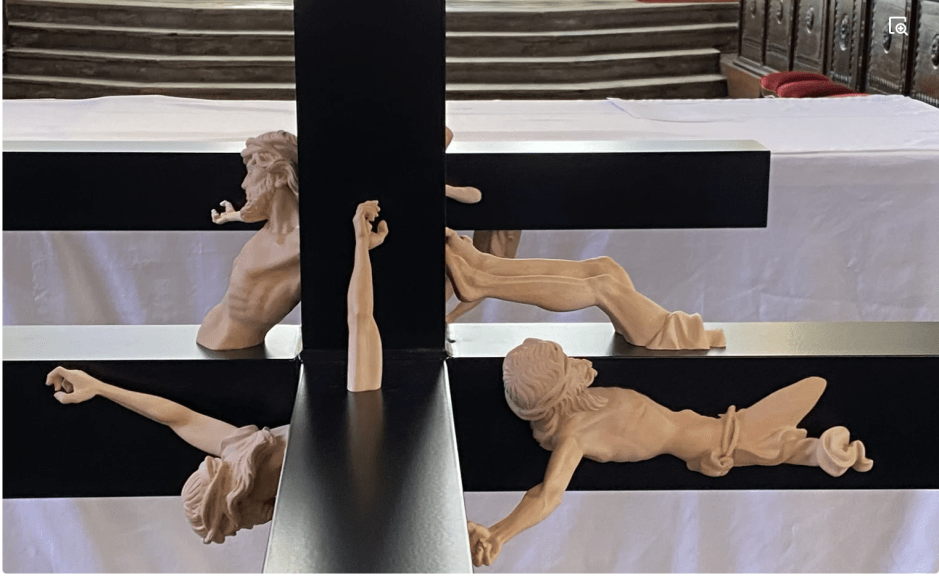
The so-called ‘Body Cube’ is set in front of the altar and is large enough to stand in. It is quite disturbing, containing 49 dismembered body parts of Jesus Christ.

Kos explains the structure as a three-dimensional cross and says “the open axis structure of the cube creates a variable play of cross shapes. From every other point of view, different forms arise, from the simple cross to the half cross, the cross of the room to the swastika.”

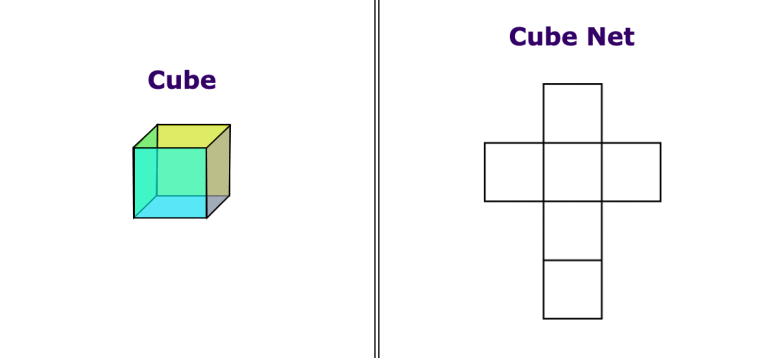
The use of cubes is the first clue to the display’s occult meaning as adepts appreciate the cube’s secret: when unfolded, it becomes a cross. As explained here in an article about liturgical design, cubes are ‘inherently Masonic.

Kos’ reference to the swastika, is another red flag since the swastika is a well-known New Age symbol. The composition of the structure, black-painted aluminium is a further clue since in the occult, the use of a base-metal for construction of a cross symbolises humiliation.

‘Body Cube’ shown in its entirety
The cube bears a resemblance to the ‘triple-tau’ cross, revered by Freemasons.

Balance Act

A second piece of artwork in the installation is a wooden figure of Christ, covered with white chalk and appearing to balance on a tightrope. The artist believes that this represents “a kind of resurrection happening through a rapture” and that it also refers to the concept of ‘balance.’

As mentioned many times in these pages, the principle of balance is very significant in the occult world. In choosing this theme, the artist underscored the balancing of chaos with order, sin with grace.

Although black-and-white tiled floors are not unusual in Catholic churches, it is perhaps no coincidence that one is found in this particular church. The contrast between black and white is yet another reference to finding ‘balance’ between opposites.

Here is what article Michael Kos says about “Balance Act”:

“Art is very often a balancing act because it can support values but also overthrow them.”

The installation balance.AKT is an unusual, sacred representation that not only shows the change in religion and culture, but also the wafer-thin dividing line between play and existential fall.

No god can be safe in the long run. Every individual and a son of heaven can experience the loss of balance. Man has become one who knows about the light-footed play and the bottomless abyss. [Emphasis added.]

Kos makes no attempt to hide his disdain for the Son of God.

Christpower

The final and most blasphemous of all the artworks is entitled, “Christpower.”

Believe it or not, this is a tabernacle (or at least represents a tabernacle – it isn’t clear whether or not the Blessed Sacrament is actually housed in this monstrosity.)

“Christ Power” is a white lacquered steel tank with a fill indicator which the artist says was inspired by the idea of “a critical tabernacle – or rather a tabernacle in crisis.”

Again, references to the occult are peppered in the artist’s explanation: he says that “shrine”, “transformation” and “secrecy” are all aspects of the tabernacle. ‘Transformation’ is of course, the ultimate ‘balancing’ act.

In his explanation of the work, Kos again shows his disregard for the Catholic faith, calling its veneration for the Blessed Sacrament ‘exaggerated.’ He goes on to suggest that divinity is found within the individual. This is the immanentism of esoteric philosophy and may be contrasted with the Christian idea of transcendence – that God is found beyond the individual.

“The question arises as to the relevance of a unique object today, which was characterized for centuries by cult dramaturgy and symbolic exaggeration.

This work of art oscillates between affirmation and negation of the religious level. The fill indicator is just before the vacancy rate and refers to a vacuum where there could also be spiritual abundance. But what is this abundance? Who fills up at all?

… Isn’t CHRISTPOWER also a psychoanalytic transmission that the believer unconsciously performs himself? So less an external force than an active internal force. A intrinsic force that fades away.

SOURCES: Carinthia Diocese website and Gloria TV.

B’nai B’rith

B’nai B’rith is a name that pops up from time to time as one researches events surrounding the Second Vatican Council. Many sources call the group straight-out ‘Jewish Freemasons’.

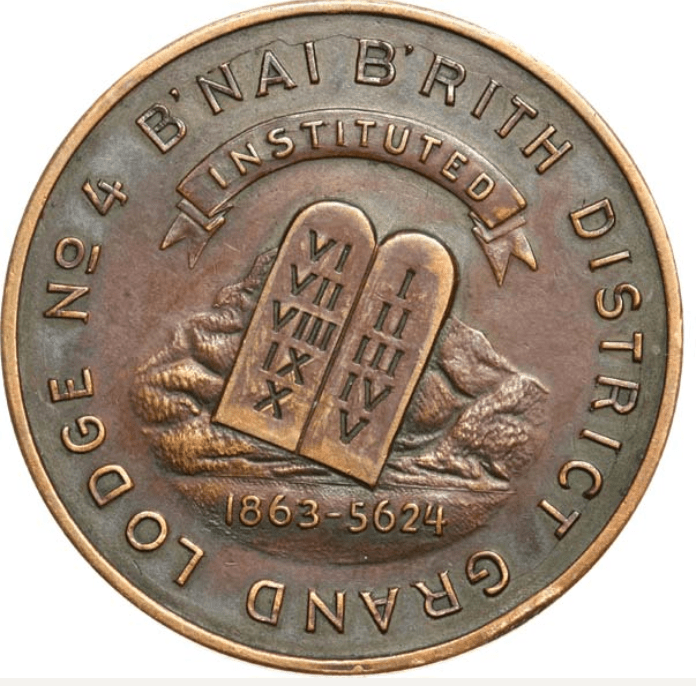
B’nai B’rith coin with the numbers of the Ten Commendmants reading from right to left. Hebrew read from the right, of course, but we also know how occultists love to reverse things.

Origins

According to Masonic sources, B’nai B’rith was founded on October 13, 1843 in the USA. (Note the date – it’s a Fatima day.) The twelve founders were Jewish German immigrants who had met each other through various Masonic and Odd Fellows Lodges and other secret societies. They ostensibly wanted to provide support for immigrant families, especially those in need.

B’nai B’rith means ‘sons of the covenant.’ The group went on to become involved in a number of philanthropic ventures and created the Anti-Defamation League. It is a strong opponent of ‘anti-semitism’ and a vocal supporter of the State of Israel and also attends the UN as a non-government organization, where it lobbies for the rights of Israel.

B’nai B’rith and Ecumenism

Members of the B’nai B’rith International Council also visited John XXIII, as reported at its January 1960 meeting in Amsterdam. President Label A. Katz, reported that “the Pope’s serious intentions to guide the Catholic Church toward brotherly understanding of the Jews were unmistakable” and that Cardinals Bea and König were enthusiastic promoters of reconciliation.

Later, B’Nai B’rith recalled the desire expressed by John XXIII at the opening of the Council “to make up for millenias’ persecution of the Jews and to recall instead the common heritage.” One of the members of B’Nai B’rith suggested that religious textbooks be revised to reflect the Jews’ unhappiness at being painted as the killers of God – something they believed resulted in anti-Semitism.

“We’ll be here ’til there’s no more hate.”

B’nai B’rith and Ecclesiastical Freemasonry

There are a couple of ties between this quasi-Masonic group and some prominent clerics. One is Fr. Malachi Martin, who according to E. Michael Jones “was being paid by both B’nai B’rith and the American Jewish Committee to subvert the Catholic claim that the Jews had killed Christ.”

It is difficult to know how much truth there is to this accusation, but it is certainly true that Fr. Martin was once secretary to ecumaniac Cardinal Bea (before his apparent conversion to orthodoxy and tradition) and also that the Jews did have an agenda to make the Church repeal its historical condemnation of them.

Also linked to B’nai B’rith was Cardinal Albert Decourtray who accepted a humanitarian award from the group in 1991 for his work in promoting inter-religious relations.

I have a feeling there are lots of links that are yet to be discovered when it comes to this influential Masonic/Zionist lobby group.

For more information please see this video on Bitchute.

John XXIII, ‘Pope of the Jews’

Angelo Roncalli has been accused of many things: of conversing with aliens, consorting with Freemasons, being installed by Freemasons, being a Freemason and of course, introducing Synarchy into the heart of the Church. Although those accusations rely on a degree of speculation, he exhibited enough obvious flaws (as evidenced by the disastrous Second Vatican Council) to conclude that his papacy struck a heavy blow to the Church.

Part of that blow came in the form of the ecumenical movement, which was a Modernist counterweight to the longstanding belief of extra ecclesiam nulla salus – there is no salvation outside the Catholic Church. The document, Nostra Aetate, which was a pet project of John’s, formed the basis for the reject of extra ecclesiam. Hidden within its ambiguous text was the suggestion that non-Catholics can be saved without conversion to Catholicism. The document errs mostly by omission in that it fails to advise Catholics to evangelise their non-Catholic neighbours, thus implying that there is, in fact, salvation outside of Catholicism.

One problematic section from Nostra Aetate is given below. For more samples of its errors and a commentary, please read here.)

True, authorities of the Jews and those who followed their lead pressed for the death of Christ (cf. Jn. 19:6); still, what happened in His passion cannot be blamed upon all the Jews then living, without distinction, nor upon the Jews of today. Although the Church is the new people of God, the Jews should not be presented as repudiated or cursed by God, as if such views followed from the holy Scriptures…

While it’s true that prior to being elected Pope, Angelo Roncalli assisted in the protection of thousands of Jewish people as they fled from persecution by the Nazis, he didn’t stop with merely defending their safety. As Pope, John went further and re-wrote the Church’s relationship with the Jews.

In large part, the Church’s relaxation of its policy towards the Jewish religion was the result of lobbying by a French Jewish historian named Jules Isaac.

Jules Isaac

In 1948, Isaac authored a book which, rather brashly, gave suggestions to Christians about how they should teach their children about the Jewish people. Called Jesus and Israel: A Call for Necessary Corrections on Christian Teaching on the Jews, the book included 18 points he believed should be enacted by the Catholic Church. (Read them here.)

Isaac secured a meeting with Pope John XXIII on June 13, 1960, two years prior to the Council, and recorded his thoughts immediately after they met. Isaac’s notes are treasured by Jewish historians.

For the meeting, Isaac was equipped with volumes of material which he believed was evidence that the Church’s teaching was anti-semitic and needed to be changed. Note that Isaac audaciously believed the had a right to change Catholic teaching. He wrote:

The problem of Catholic teaching which I attacked is infinitely more complex than that of the liturgy1. Seen from the special angle concerning Israel, it touches, if not the main ideas of faith and dogma, at least a thousand-year-old tradition, product of the Church fathers, from St. John Chrysostom to St. Augustine. 

Isaac’s particular concern was the so-called “teaching of contempt” of Catholic towards Judaism, which he believed to be anti-Christian and which he believed fuelled anti-Semitism. He put forward his arguments and suggested that the Pope create a sub-committee to study his concerns. The Pope agreed to seek advice on the matter and they parted cordially.

Judaic Influence

A few months later, a group of American Jewish men from a society known as B’nai B’rith met with the Pope. B’nai B’rith (see more here) has close ties to Freeemasonry, and founded the Anti Defamation League.

At that meeting, John told them that: “You are of the Old Testament and I of the New Testament, but I hope and pray that we will come closer to the brotherhood of humanity… It gives me great pain and sorrow to see these recent events (a rash of swastika graffiti) which not only violate a natural right of human beings but destroy the understanding between brothers under God…”

That same year, he also met with a group called United Jewish Appeal, when he said: “We are all sons of the same Heavenly Father. Among us there must ever be the brightness of love and its practice. I am Joseph, your brother.”

Later in 1960, John called for those clerics preparing for the Council to add a declaration on the attitude of the Church towards the Jews. He approved the first draft, entitled Decretum de Judaeis (“Declaration on the Jews”) in November 1961, but didn’t live to see the document in its final form. That was left to Paul VI, who promulgated it as Nostrae Aetate in 1965.

Perfidious Pontiff

Yet, the Jewish question had been in John’s mind before these meetings, as back in March of 1959, during the Good Friday Liturgy, John demanded that the word, ‘perfidious’ should not be read during the prayer for the Jews.

As even such Modernists as Cardinal Bea and Henri de Lubac point out, the adjective ‘perfidious’ was included in Medieval times when its meaning was less offensive than it is today. ‘Perfidious’ originally meant ‘unbelieving’ or ‘unfaithful’ and was thus perfectly appropriate for describing the Jewish people.

[It is worth noting that when Benedict XVI allowed for wider use of the traditional Latin Mass, he only authorised the use of the 1962 Missal from which the word “perfidious” had been removed. Fr. Mawdsley has a lot more to say on this.]

Next, John attacked the Rite of Baptism, removing the necessity to “Abhor Jewish unbelief (in Jesus Christ) and reject the Hebrew error (which is that the Messiah has not yet come).”

John also ‘cancelled’ Pius XI’s prayer from 1925, the Act of Consecration of the Human Race to the Sacred Heart of Jesus. The words, ‘Look with Thine eyes of mercy upon the children of that stock, so long Thy Chosen People; May the blood called upon them of old, now descend on them as the waters of redemption and life,’ were now deemed to be politically incorrect. 

Making Catholics Pay

John went even firther in his efforts to appease the Jews. With the assistance of the heterodox Cardinal Frings, John required that a prayer be said by German Catholics on the Feast of the Sacred Heart. It went:

“Lord, God of our Fathers! God of Abraham, Isaac and Jacob! God of merry and God of solace! We confess before you: Countless men were murdered in our midst, because they belonged to the people from whom the Messiah rose up in the flesh. We pray Thee: Lead all among us who became guilty through deed, omission, or silence, that we may see the wrong and turn from it. In the spirit of heartfelt atonement, we beg for forgiveness for the sins which were committed by our fellow citizens. We beseech that the spirit of peace and reconciliation return to all homes and we pray for the peace of Israel among the nations; on the borders of its state and in our midst…”

While there was most likely a need for some German Catholics to repent of their collaboration with the Nazis, the hypocrisy of John demand is obvious. The Jews detested being held to account as a group for the crime of their forebears – putting Christ to death – yet John expected German Catholics to be held responsible, as a group, for the crime of the Nazis.

And where was the acknowledgement of the non-Jews who were persecuted under Hitler? Including thousands of priests, nuns and lay Catholics? The prayer does not mention those poor people.

Don’t Convert!

John’s commitment to non-evangelisation was well known. Secretary to John XXIII, Loris Capovilla told this story to Time Magazine:

“A young Jewish lad made the acquaintance of Giuseppe Roncalli when he was the Cardinal-Archbishop of Venice. The young man wanted to become a Catholic, but Roncalli kept putting him off. ‘Look,” he said, ‘you’re a Jew. Be a good Jew. Becoming a Catholic will kill your parents.’ The young man persisted and Roncalli finally said he could be baptized — in secret.

“Several years later (in 1961) after his parents had died, he presented himself at the Vatican to see his old mentor, now the Pope. He wanted the Pope to give him the Sacrament of Confirmation. ‘All right, all right,’ said Pope John XXIII, ‘but you have got to continue to be a good Jew, in your own community, go to the synagogue, support the Jewish schul, because, by being a Catholic, you do not become any less a Jew.”

Pope of the Jews

In 2014, Rabbi Dalin, a former professor of Ave Maria University, reminisced about John’s contribution to Catholic-Jewish relations and it was from this man that we learn John was known as the “Pope of the Jews.”

Dalin tells the story of Pope John driving through the streets of Rome on a Saturday, when he suddenly ordered his car to stop in front of Rome’s great synagogue. He got out of the car so he could bless the Jews of Rome as they were leaving: an important symbolic act that earned their gratitude.

“In doing this,” Rabbi Dalin observes, “he began to transform the history of Catholic-Jewish relations in our time, with initiatives inspired by his work on behalf of Jews during the holocaust….

… “Twentieth and 21st-century Jews will forever be indebted to Pope John XIII for his historic role in bringing about Nostra Aetate. It changed forever the relationship between Catholics and Jews.”

It is worth noting that John XXII was canonised (along with another ecumaniac, John Paul II) on the eve of Yom Hashoah, the international day of Holocaust remembrance observed in Israel and by Jews around the world.


  1. see John XXIII’s changes to the liturgy in a later section ↩︎

Problems with ‘Nostra Aetate’

Some of the problematic sections from Nostra Aetate are given below. For a fuller explanation of how this and other Vatican II documents deviate from traditional Catholic teaching, please read here.)

Tolerance for Eastern Religions


The Catholic Church rejects nothing that is true and holy (vera et sancta)in these religions. She looks with sincere respect upon those ways of conduct and of life, those rules and teachings which, though differing in many particulars from what she holds and sets forth, nevertheless often reflect a ray of that Truth which enlightens all men….

… Thus in Hinduism, men contemplate the divine mystery and express it through an unspent fruitfulness of myths and through searching philosophical inquiry. They seek release from the anguish of our human condition through ascetical practices or deep meditation or a loving, trusting flight toward God….

…Buddhism in its multiple forms acknowledges the radical insufficiency of this shifting world. It teaches a path by which men, in a devout and confident spirit, can either reach a state of absolute freedom or attain supreme enlightenment by their own efforts or by higher assistance….

Nostra Aetate §2

Tolerance for Islam

Upon the Moslems, too, the Church looks with esteem. They adore one God, living and enduring, merciful and all-powerful, Maker of heaven and earth and Speaker to men (qui unicum Deum adorant etc…., homines allocutum). They strive to submit wholeheartedly even to His inscrutable decrees (cuius occultis etiam decretis toto animo se submittere student), just as did Abraham, with whom the Islamic faith is pleased to associate itself….

…”Though they do not acknowledge Jesus as God, they revere Him as a prophet. They also honor Mary, His virgin Mother1 ; at times they call on her, too, with devotion.”

… Although in the course of the centuries many quarrels and hostilities have arisen between Christians and Moslems, this most sacred Synod urges all to forget the past and to strive sincerely for mutual understanding. On behalf of all mankind, let them make common cause of safeguarding and fostering social justice, moral values, peace, and freedom.

Nostra Aetate §3

JOHN PAUL II AT ASSISI IN 1986 – A LOGICAL CONSEQUENCE OF NOSTRA AETATE

Misrepresentation of the Jewish Religion

True, authorities of the Jews and those who followed their lead pressed for the death of Christ (cf. Jn. 19:6); still, what happened in His passion cannot be blamed upon all the Jews then living, without distinction, nor upon the Jews of today. Although the Church is the new people of God, the Jews should not be presented as repudiated or cursed by God, as if such views followed from the holy Scriptures.

Nostra Aetate §4

Refuting Nostra Aetate’s Claims about Judaism

“Necessary to note here is the attempt to limit the responsibility for Deicide to a small group of quasi private individuals, whereas the Sanhedrin, the supreme religious authority, represented all of Judaism. Therefore, in the rejection of the Messiah and Son of God, it had collective responsibility for the Jewish religion and the Jewish people, and this irrefutably is stated in Holy Scripture: “And from then on, Pilate was looking for a way to release him. But the Jews cried out, saying, ‘If thou release this man, thou are no friend of Caesar; for everyone who makes himself king sets himself against Caesar'” (Jn. 19:12); and “And all of the people answered and said, ‘His blood be on us and our children'” (Mt. 27:25).

“Also striking is the statement that “the Jews should not be presented as repudiated or cursed by God, as if such views followed from the holy Scriptures.” This lacks the necessary distinction between individuals and the Jewish religion. If the subject is individual Jews, the statement is true, and is exemplified by the great number of converts from Judaism in all eras. But if the subject is Judaism as a religion, the assertion is both erroneous and illogical: erroneous, because it contradicts the evangelical texts and the Church’s constant faith from her origins. (Cf. Mt. 21:43: “Therefore I say to you, that the Kingdom of God will be taken away from you and will be given to a people yielding its fruits.”) And it is illogical, because if God did not reject the Jewish religion or the Jewish people in the religious sense (which in Jesus’ time was one and the same thing), then the Old Testament has to be viewed as being still valid, and contiguous and concurrent with the New Testament. This, then, would sanction the unjustified awaiting of the Messiah, a hope still entertained by today’s Jews! All of this is a totally lying representation of Judaism and its relationship to Christianity.”2

  1. She is honoured by Moslems as mother of a prophet, not mother of the Son of God ↩︎
  2. All taken from the SSPX Asia website ↩︎

 Jules Isaac – Jesus and Israel

Extract from Jesus and Israel: A Call for Necessary Corrections on Christian Teaching on the Jews, published in 1948 (Impact-Site-Verification: 8dad7fd3-e727-499b-bef3-6d8d25dba811)

For purposes of greater clarity, may I be allowed to submit for the examination of Christians of good will—who are agreed in principle on the need for rectification—the following Eighteen Points, meant to serve at least as a basis for discussion.

Christian teaching worthy of the name should

  1. give all Christians at least an elementary knowledge of the Old Testament; stress the fact that the Old Testament, essentially Semitic—in form and substance—was the Holy Scripture of Jews before becoming the Holy Scripture of Christians;
  2. recall that a large part of Christian liturgy is borrowed from it, and that the Old Testament, the work of Jewish genius (enlightened by God), has been to our own day a perennial source of inspiration to Christian thought, literature, and art;
  3. take care not to pass over the singularly important fact that it was to the Jewish people, chosen by Him, that God first revealed Himself in His omnipotence; that is was the Jewish people who safeguarded the fundamental belief in God, then transmitted it to the Christian world;
  4. acknowledge and state openly, taking inspiration from the most reliable historical research, that Christianity was born of a living, not a degenerate Judaism, as is proved by the richness of Jewish literature, Judaism’s indomitable resistance to paganism, the spiritualization of worship in the synagogues, the spread of proselytism, the multiplicity of religious sects and trends, the broadening of beliefs; take care not to draw a simple caricautre of historic Phariseeism;
  5. take into account the fact that history flatly contradicts the theological myth of the Dispersion as providential punishment for the Crucifixion, since the Dispersion of the Jewish people was an accomplished fact in Jesus’ time and since in that era, according to all the evidence, the majority of the Jewish people were no longer living in Palestine; even after the two great Judean wars (first and second centuries), there was no dispersion of the Jews of Palestine;
  6. warn the faithful against certain stylistic tendencies in the Gospels, notably the frequent use in the Fourth Gospel of the collective term “the Jews” in a restricted and pejorative sense—to mean Jesus’ enemies: chief priests, scribes, and Pharisees—a procedure that results not only in distorting historic perspectives but in inspiring horror and contempt of the Jewish people as a whole, whereas in reality this people is in no way involved;
  7. state very explicitly, so that no Christian is ignorant of it, that Jesus was Jewish, of an old Jewish family, that he was circumcised (accordsing to Jewish Law) eight days after his birth; that the name Jesus is a Jewish name, Yeshua, Hellenized, and Christ the Greek equivalent of the Jewish term Messiah; that Jesus spoke a Semitic language, Aramaic, like all the Jews of Palestine; and that unless one reads the Gospels in their earliest text, which is in the Greek language, one knows the Word only through a translation of a translation;
  8. acknowledge—with Scripture—that Jesus, “born under the [Jewish] law” (Gal. 4:4), lived “under the Law”; that he did not stop practicing Judaism’s basic rites to the last day; that he did not stop preaching his Gospel in the synagogues and the Temple to the last day;
  9. not fail to observe that during his human life, Jesus was uniquely “a servant to the circumcised” (Rom. 15:8); it was in Israel alone that he recruited his disclples; all the Apostles were Jews like their master;
  10. show clearly from the Gospel texts that to the last day, except on rare occasions, Jesus did not stop obtaining the enthusiastic sympathies of the Jewish masses, in Jerusalem as well as in Galilee;
  11. take care not to assert that Jesus was personally rejected by the Jewish people, that they refused to recognize him as Messiah and God, for the two reasons that the majority of the Jewish people did not even know him and that Jesus never presented himself as such explicitly and publicly to the segment of the people who did know him; acknowledge that in all likelihood the messianic character of the entry into Jerusalem on the eve of the Passion could have been perceived only by a small number;
  12. take care not to assert that Jesus was at the very least rejected by the qualified leaders and representatives of the Jewish people; those who had him arrested and sentenced, the chief priests, were representatives of a narrow oligarchic caste, subjugated to Rome and detested by the people; as for the doctors and Pharisees, it emerges from the evangelical [Gospel] texts themselves that they were not unanimously against Jesus; nothing proves that the spiritual elite of Judaism was involved in the plot;
  13. take care not to strain the texts to find in them a universal reprobation of Israel or a curse which is nowhere explicitly expressed in the Gospels; take into account the fact that Jesus always showed feelings of compassion and love for the masses;
  14. take care above all not to make the current and traditional assertion that the Jewish people committed the inexpiable crime of deicide; and that they took total responsibility on themselves as a whole; take care to avoid such an assertion not only because it is poisonous, generating hatred and crime, but also because it is radically false;
  15. highlight the fact, emphasized in the four Gospels, that the chief priests and their accomplices acted against Jesus unbeknownst to the people and even in fear of the people;
  16. concerning the Jewish trial of Jesus, acknowledge that the Jewish people were in no way involved in it, played no role in it, probably knew nothing about it; that the insults and brutalities attributed to them were the acts of the police or of some members of the oligarchy; that there is no mention of a Jewish trial, of a meeting of the Sanhedrin in the fourth Gospel;
  17. concerning the Roman trial, acknowledge that the procurator Pontius Pilate had entire command over Jesus’ life and death; that Jesus was condemned for messianic pretensions, which was a crime in the eyes of the Romans, not the Jews; that hanging on the cross was a specifically Roman punishment; take care not to impute to the Jewish people the crowning with thorns, which in the Gospel accoounts was a cruel jest of the Roman soldiery; take care not to identify the mob whipped up by the chief priests with the whole of the Jewish people of Palestine, whose anti-Roman sentiments are beyond doubt; note that the fourth Gospel implicates exclusively the chief priests and their men;
  18. last, not forget that the monstrous cry, “His blood be on us and on our children!” (Mt. 27:25), could not prevail over the Word, “Father, forgive them; for they know not what they do” (Lk. 23:34).