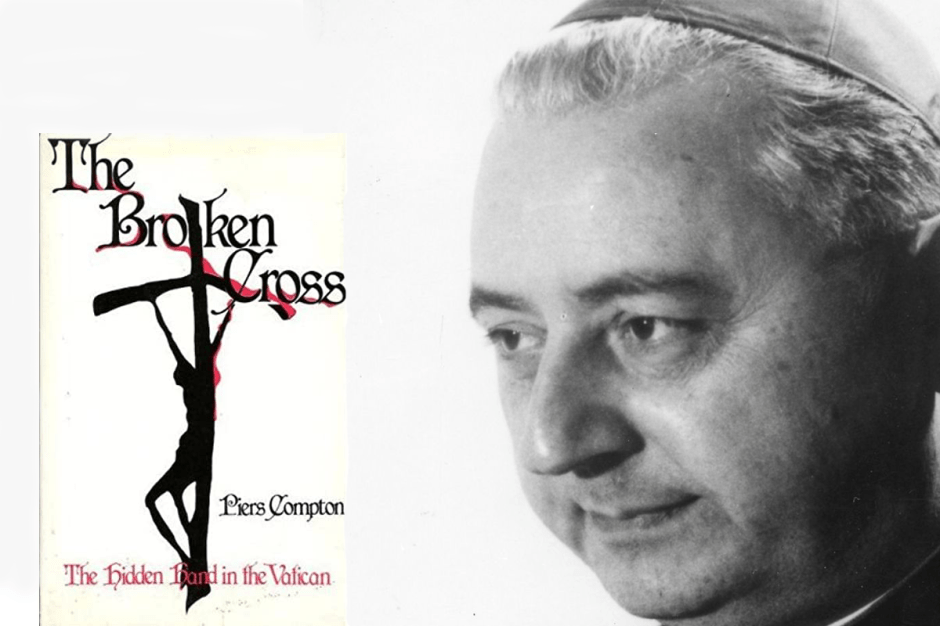
UPDATE: I have tried to discover if the list found in Piers Compton’s book, The Broken Cross, is the famed Pecorelli’s List of Ecclesiastical Freemasons. Until we find otherwise, we shall have to assume that this List was the source of Compton’s names – Jan 25, 2025.
Some time ago, we looked at the notorious “P2” list of Freemasons and speculated that this specimen was fake, perhaps created by a high-ranking Mason for his own nefarious purposes. That list lacked the names of Ecclesiastical Freemasons, of whom there are alleged to have been not a few, operating within the Vatican from at least the time of the Council.
The article below fills in those gaps. It is taken from the website, Today’s Catholic World, and lists those members of the Curia who are alleged to be Masons. One wonders whether some faithful prelate or even a humble paper-pusher, sickened by the thought of Archbishop Gagnon’s report into Ecclesiastical Freemasonry languishing in the Vatican archives, may have taken matters into his own hands and had this list published.
Of course, it may not be authentic, but when we examine how Masonic our Church has become, it would appear that this was the work of more than Bugnini and Baggio – no matter how influential those two were.
Achilles Liénart Documented As Freemason On 1976 Italian Registry List
(Excerpt from Piers Compton’s published TBC Text)
“The veil covering the greatest deceit ever to have mystified the clergy and baffled the faithful, is
doubtless beginning to be torn asunder. ‘Archbishop’ Marcel Lefebvre.” -Piers Compton, TBC (Text)
An observer of the Roman scene, Georges Virebeau1, tells how a feeling of surprise, that was near consternation, spread through the Vatican one morning in 1976. Students in their cassocks, coloured purple, violet, or black, according to their nationality, stood about in groups, discussing the latest number of a journal, the Borghese. Some, the writer says, were actually perspiring with alarm; for although the morning was hot, the atmosphere engendered by what they read affected them more than the weather.
For the paper contained a detailed list of clerics, some holding the most exalted offices, who were said to be members of secret societies.
It was staggering news, for the doubtful head-shaking students were acquainted with Church law; and Canon Law 2335 expressly declared that a Catholic who joined any such society became excommunicate, ipso facto.
We have seen that the secret societies had, long ago, declared war on the Church, which they recognised as the one great obstacle barring their way to world domination; and the Church responded by condemning the societies and making laws for her own protection. Canon 2335 was framed for that purpose, while Canon 2336 was concerned with disciplinary measures to be enforced against any cleric who might be inveigled into joining a society. In the case of a Bishop he would lose all juridical powers, and be barred from exercising priestly functions including ordination and consecrating.
That the Church considered the societies to be a most dangerous threat to its own existence is shown by the number of warnings and condemnations issued by the Vatican. What is usually regarded as the first official instance of this occurred under Pope Clement XII (1730-40), which stressed that belonging to any such society was incompatible with membership of the Church.
Eleven years later Benedict XIV confirmed this in the first Papal Bull directed against the societies. Pius VI and Pius VII followed suit, the last named being specially concerned with the threat posed by the Carbonari. Three subsequent Popes, Leo XII, Pius VIII, and Gregory VI added their weight to the strictures. A further condemnation came from Pius IX […] Leo XIII spoke of the plotters aiming to ‘destroy from top to bottom the whole religious and social discipline born of Christian institutions’, and to replace belief in the supernatural spirit by a sort of second-hand Naturalism.
Just as the writings of Voltaire, Diderot, and Helvetius had opened up the way for the French Revolution, so the secret societies, said Pius X (1903-14), were working to destroy Catholicism in modern France.
So paramount was the danger to Benedict XV that not even the cares imposed by the 1914 war could drive it finally from his mind; while Pius XI reiterated that the secret societies derived much of their strength from the conspiracy of silence that has never ceased to surround them.
Although conducted largely behind the scenes, and therefore away from the public gaze, the struggle between the Church and the secret societies has been more bitter and prolonged than any international conflict; the reason being that it has turned, in great part, on ideas, on a mental and therefore a moral basis; and although not universally recognised, the moral outlook influences the whole nature of man more than any conflict for personal gain, territory, or positive power.
On one side was a religion that, its supporters claimed, rested on facts, the objective value of revealed truth, and a sacramental observance. On the other, a system grounded in humanitarian ideals in which all men, freed from the shackles or dogma and orthodoxy, could share, and on which they could agree. Truth, they said, is relative, hence the claims of objective and revealed truth are seen to be not only valueless, but fundamentally false.
So the struggle developed over the centuries, with those who accepted the atheism, Positivism, or materialism that reached its summit with the French Revolution, on one side; and the strictures uttered by various Popes, from Clement XII in the mid-eighteenth century to Pius XI who died in 1939, on the other.[…]
The news in the Borghese, that so alarmed the students, came as the culmination of a fear that had lingered for some time among the more conservative elements in the Vatican. The exposure of Archbishop Bugnini, at the time of the Second Vatican Council, had been shattering enough. But the revelations in the Borghese were on a more considerable scale, and came perilously near to touching the very nerve of the Church.
It was known that enemy agents had long been nibbling at its fabric. But so long as Church discipline remained strong, it was difficult for the most ardent infiltrator to gain a footing in the priesthood. But the general relaxation and reforms that followed Pope John’s Council opened doors by which agents entered not only seminaries but the Curia, the governing body of the Church.
Because some of those agents rose high in the Church, and became Cardinals and Bishops, many who might otherwise have been suspicious were deceived. The ecclesiastical titles, and the offices that went with them, were thought to be sufficient (though they were really only outward) safeguard. The hands of the manipulators were raised in blessing, and the faithful knelt.
The warnings against them that were issued went largely unheeded or fell stone dead against the historically impressive walls that bounded the Church. ‘A Fifth Column exists within the clergy’, wrote Father Arrupe, Superior-General of the Jesuits, ‘and is steadily working in favour of atheism’.
A similar theme was expressed by a number of theologians who came together in Geneva in 1976, as an International Committee of Defence of Catholic Doctrine. ‘The presence of the enemies of the Church, in the internal structure of the Church, forms a part of the mystery of iniquity and should be unmasked.’
But so far those fears had taken no more tangible shape than to unsettle the minds of students, who felt their future might be disturbed by the revelations that produced little or no effect among their superiors and instructors in the Vatican. The usual inquiry was ordered (by some of the churchmen who had been named as guilty) with the declared object of tracing the source of the rumours. But nothing happened; and neither did one of those who had been implicated ever issue a downright or straightforward denial.
The Borghese article claimed to have a detailed list of conspirators who had penetrated into the Church, together with dates, numbers, and code names. These allegations were answered by a writer in L’Aurora, M. Jacques Ploncard, who asserted that no prelate had been affiliated with a secret society since the time of Charles X, the last of the Bourbons who ascended the throne in 1824, and was driven out by the revolution of 1830.
This was palpably false, as was proved by determined investigators who carried the attack into enemy territory. By one means or another, sometimes posing as members of the Government, they gained access to the Italian Register of Secret Societies, and drew up a much longer and more impressive list than that published in the Borghese.
The particulars that follow are those of Cardinals, Archbishops, and Bishops who, as alleged by those who examined it, figure in the Register. Some have died since the list was drawn up – at one time it was said to have included one hundred and twenty-five prelates. Some of the offices have changed hands.
But the names and ecclesiastical titles, with the dates on which they were initiated into a society, and their secret code names, must call for serious consideration […].
It may be noted that the code name often incorporates the first two letters of the cleric’s name.
2.
Agostino, Cardinal Casaroli. Secretary of State. Prefect of the Sacred Congregation of Public Affairs, and of the Sacred Congregation of Bishops, and of the Pontifical Commission for the Revision of Canon Law. Member of the Commission for Russia and of the Commission for Latin America. The most influential prelate in the Vatican after the Pope, whose place he takes during the absence of the latter. He is known as the ‘Kissinger of Vatican diplomacy’. Initiated into a secret society September 28th, 1957. Secret code name Casa.
Leon Joseph, Cardinal Suenens. Primate of Belgium. Member of the Pontifical Commission for the Revision of Canon Law. Was active in the Sacred Congregation of Propaganda Fide, the Sacred Congregation of Rites and Ceremonies, and the Sacred Congregation of Seminaries and University Studies. He was a delegate and Moderator of the Second Vatican Council, and he has been associated with Protestant Pentecostalism, that reduces people to revivalist hysteria. Initiated June 15th, 1967. Code name Lesu.
Jean, Cardinal Villot. He was Secretary of State to Paul VI, and Camerlengo (the Chamberlain who takes over affairs at the Vatican on the death of a Pope). Prefect of the Sacred Congregation for Religious and Secular Institutes, and administrator of the Patrimony of the Holy See. He came of a family which has produced over the last two hundred years, from father to son, Grand Masters of secret societies including the Rosicrucians.
Being aware that this had become known, he strenuously denied that he was associated in any way with such societies. One of his denials was contained in a letter, dated October 31st, 1976, sent from the Vatican by way of the Papal Nunciature in Paris, to the Director of Lectures Françaises, a monthly publication. It ran: ‘Having noticed that in your review of September 1976, you referred to Cardinal Villot as a member of a secret society, Cardinal Villot declares in the most formal fashion that he has never had, at any moment in his life, the least connection with any secret society. He adheres closely to the condemnations imposed by the Sovereign Pontiffs. Cardinal Villot begs the Director of Lectures Françaises to publish this denial in a future issue, and thanks him in advance.’
One cannot help wondering how Cardinal Villot, who appears to have been afflicted with an unusually short memory, managed to fulfil his office as Secretary of State.
For records show that he was initiated into a secret society on August 6th, 1966, and that in the hope of avoiding identification he was given two code names, Jeani and Zurigo.
Achille, Cardinal Lienart. Bishop of Lille. He was formerly a captain in the French Army, and a life-long ultra-Liberal. He led the progressive forces at the Second Vatican Council, on which account it was said that ‘his ideas were redder than his robes’. Shortly before his death he startled those in the room by suddenly exclaiming: ‘Humanly speaking, the Church is dead.’ Initiated October 15th, 1912. Code name could not be verified.
Ugo, Cardinal Poletti. Vicar-General of the diocese of Rome, and so controller of all the clergy in the city. Member of the Sacred Congregation of Sacraments and of Divine Worship. President of Pontifical Works, and of the Liturgical Academy. Archpriest of the Patriarchal Basilica of the Lateran. Initiated February 17th, 1969. Code name Upo.
Franco, Cardinal Biffi. Head of the St. John Lateran Pontifical University. Initiated August 15th, 1969. Code name Bifra.
Michele, Cardinal Pellegrino. Archbishop of Turin where the Holy Shroud is kept. Initiated May 2nd, 1960. Code name Palmi.
Sebastiano, Cardinal Baggio. Prefect of the Sacred Congregation of Bishops. Initiated August 15th, 1957. Code name Seba.
Pasquale, Cardinal Macchi. Prelate of Honour and secretary to Paul VI. After being excommunicated for heresy, he was reinstated by Cardinal Villot. Initiated April 23rd, 1958. Code name Mapa.
Salvatore, Cardinal Pappalardo. Archbishop of Palermo, Sicily. Initiated May 6th, 1943. Code name Salpo.
Cardinal Garrone. Prefect of the Congregation for Catholic Education. He brazenly let it be known that he was a member of a secret society, but he was neither removed nor publicly reproved. Date of initiation and code name could not be verified.
Archbishop Annibale Bugnini. Consultant in the Sacred Congregation of Propagation of the Faith, and in the Sacred Congregation of Holy Rites. The story of his unmasking during the Second Vatican Council has been told. Died July 3rd, 1982. Initiated April 23rd, 1963. Code name Buan.
Archbishop Giovanni Benelli. Archbishop of Florence. He secured the appointment of Cardinal Villot as Secretary of State in place of the orthodox Cardinal Cicognani. Date of initiation and code name could not be verified.
Archbishop Mario Brini. Consultor of the Pontifical Commission for the Revision of Canon Law. Secretary of the Sacred Congregation for Eastern Churches, and a member of the Pontifical Commission for Russia. Initiated July 13th, 1969. Code name Mabri.
Bishop Michele Buro. Prelate of the Pontifical Commission to Latin America. Initiated March 21st, 1969. Code name Bumi.
Bishop Fiorenzo Angelini. Titular Bishop of Massene, Greece. Delegate of the Cardinal-Vicar of Rome for Hospitals. Initiated October 14th, 1957. Code name could not be verified.
Monsignor Mario Rizzi. Prelate of Honour to the Holy Father. He was responsible for discarding certain Canon Laws which formed part of the foundation of the Church from Apostolic times. Initiated September 16th, 1969. Code name Mari or Monmari.
Monsignor Pio Vito Pinto. Attaché of Secretary of State, and Notary of the Second Section of the Supreme Tribunal and of the Apostolic Segnatura. He is listed as a very important person among the societies. Initiated April 2nd, 1970. Code name Pimpi.
Monsignor Francesco Marchisano. Prelate of Honour to the Holy Father. Secretary of the Congregation for Catholic Education. Initiated February 14th, 1961. Code name Frama.
Aurelio Sabattani. Archbishop of Giustiniana, Milan Province, Italy. First Secretary of the Supreme Apostolic Segnatura. Initiated June 22nd, 1969. Code name Asa.
Abino Mensa. Archbishop of Vercelli, Piedmont, Italy. Initiated July 23rd, 1969. Code name Mena.
Enzio D’Antonio. Archbishop of Trivento. Initiated June 21st, 1969. Code name could not be verified.
Alessandro Gottardi. Archbishop of Trento, Italy. He controls candidates who are likely to be raised to the dignity of Cardinal. He is addressed as ‘Doctor’ at secret society meetings. Initiated June 13th, 1959. Code name Algo.
Antonio Travia. Titular Bishop of Termini Imerese. He is the head of Catholic schools. Initiated September 15th, 1967. Code name Atra.
Giuseppe Mario Sensi. Titular Bishop of Sardi, Asia Minor. Papal Nuncio to Portugal. Initiated November 2nd, 1967. Code name Gimase.
Francesco Salerno. Bishop Prefect. Initiated May 4th, 1962. Code name Safra.
Antonio Mazza. Titular Bishop of Velia. Initiated April 14th, 1971. Code name Manu.
Mario Schierano. Titular Bishop of Acrida, Cosenza Province, Italy. Chief Military Chaplain of the Italian Armed Forces. Initiated July 3rd, 1959. Code name Maschi.
Luigi Maverna. Bishop of Chiavari, Genoa, Italy. Initiated June 3rd, 1968. Code name Luma.
Aldo Del Monte. Bishop of Novara, Piedmont, Italy. Initiated August 25th, 1969. Code name Adelmo.
Marcello Morganta. Bishop of Ascoli, Piceno, in East Italy. Initiated July 22nd, 1955. Code name Morma.
Luigi Bettazzi. Bishop of Lyrea, Italy. Initiated May llth, 1966. Code name Lube.
Gaetano Bonicelli. Bishop of Albano, Italy. Initiated May 12th, 1959. Code name Boga.
Salvatore Baldassarri. Bishop of Ravenna, Italy. Initiated February 17th, 1958. Code name Balsa.
Vito Gemmiti. Member of the Sacred Congregation of Bishops. Initiated March 25th, 1968. Code name Vige.
Pier Luigi Mazzoni. Member of the Sacred Congregation of Bishops. Initiated September 14th, 1959. Code name Pilum.
Ernesto Basadonna. Prelate of Milan. Initiated September 14th, 1963. Code name Base.
Mario Bicarelli. Prelate of Vicenza, Italy. Initiated September 23rd, 1964. Code name Bima.
Salvatore Marsili. Abbot of the Order of St. Benedict of Finalpia, near Modena, Italy. Initiated July 2nd, 1963. Code name Salma.
Annibale Ilari. Abbot of Sua Santita. Initiated March 16th, 1969. Code name Ila.
Franco Gualdrini. Rector of Capri. Initiated May 22nd, 1961. Code name Grefra.
Lino Lozza. Chancellor of the Rome Academy of St. Thomas Aquinas. Initiated July 23rd, 1969. Code name Loli.
Daimazio Mongillo. Professor of Dominican Moral Theology, Holy Angels Institute, Rome. Initiated February 16th, 1969. Code name Monda.
Flaminio Cerruti. Chief of the Office of University of Congregation Studies. Initiated April 2nd, 1960.
Enrico Chiavacci. Professor of Morals at the University of Florence. Initiated July 2nd, 1970. Code name Chie.
Carmelo Nigro. Rector of the Seminary Pontifical of Major Studies. Initiated December 21st, 1970. Code name Carni.
Carlo Graziani. Rector of the Minor Seminary of the Vatican. Initiated July 23rd, 1961. Code name Graca.
Luigi Belloli. Rector of the Lombardy Seminary. Initiated April 6th, 1958. Code name Bella.
Virgilio Noe. Head of the Sacred Congregation of Divine Worship. Initiated April 3rd, 1961. Code name Vino.
Dino Monduzzi. Regent to the Prefect of the Pontifical House. Initiated March 11th, 1967. Code name Mondi.
Vittorio Palistra. Legal Counsel to the Sacred Rota of the Vatican State. Initiated May 6th, 1943. Code name Pavi.
Giuseppe Ferraioli. Member of the Sacred Congregation of Public Affairs of the Church. Initiated November 24th, 1969. Code name Gife.
Alberto Bovone. Substitute-Secretary of the Sacred Office. Initiated April 30th, 1967.
Terzo Nattelino. Vice-Prefect of the Archives of Secretariat of the Vatican. Initiated June 17th, 1957. Code name Nate.
Georgio Vale. Priest official of the Rome diocese. Initiated February 21st, 1971. Code name Vagi.
Dante Balboni. Assistant to the Vatican Pontifical Commission for Biblical Studies. Initiated July 23rd, 1968. Code name Balda.
Vittorio Trocchi. Secretary for Catholic Laity in Consistory of the Vatican State Consultations. Initiated July 12th, 1962. Code name Trovi.
Piero Vergari. Head Protocol Officer of the Vatican State Segnatura. He controls Canon Law changes. Initiated December 14th, 1970. Code name Pive.
Dante Pasquinelli. Member of the Council of the Nuncio to Madrid. Initiated January 12th, 1969. Code name Pada.
Mario Pimpo. Vicar of the Office of General Affairs. Initiated March 15th, 1970. Code name Pima.
Igino Rogger. Officer in the diocese of Rome. Initiated April 16th, 1968. Code name Igno.
Pietro Rossano. Member of the Sacred Congregation of nonChristian Studies. Initiated February 12th, 1968. Code name Piro.
Francesco Santangelo. Substitute-General of Defence Legal Council. Initiated November 12th, 1970. Code name Frasa.
Gaetano Scanagatta. Member of the Commission of Pompeii and Loreto. Initiated September 23rd, 1971. Code name Gasca.
Pio Laghi. Apostolic Delegate to Argentina. Initiated August 24th, 1969. Code name Lapi.
Pietro Santini. Vice-Official of the Tribunal of the Vicariate of the Vatican. Initiated August 23rd, 1964. Code name Sapa.
Domenico Semproni. Member of the Tribunal of the. Vicariate of the Vatican. Initiated April 16th, 1960. Code name Dose.
Angelo Lanzoni. Chief of the Office of Secretariat of State. Initiated September 24th, 1956. Code name Lana.
Giovanni Lajola. Member of the Council of Public Affairs of the Church. Initiated July 27th, 1970. Code name Lagi.
Venerio Mazzi. Member of the Council of Public Affairs of the Church. Initiated October 13th, 1966. Code name Mave.
Antonio Gregagnin. He is the Tribune of First Causes for Beatification for Canonisation. Initiated October 19th, 1967. Code name Grea.
Giovanni Caprile. Director of Catholic Civil Affairs. Initiated September 5th, 1957. Code name Gica.
Roberto Tucci. Director-General of the Vatican Radio. A most important post since this station emits news round the clock in thirty-two languages. Initiated June 27th, 1957. Code name Turo.
Virgilio Levi. Assistant-Director of the Vatican daily newspaper L’Osservatore Romano, and of Vatican Radio Station. Initiated July 4th, 1958. Code name Vile.
There are 526 Masonic Lodges in Italy. In view of that, their admitted membership of only 20,000 is questionable.
The French Register of Secret Societies is more closely guarded than the Italian, so that particulars of recent initiations cannot be quoted. The most sustained list of clerics belonging to French secret societies covers a few decades preceding the French Revolution, and it numbered, even at a time when infiltration of the Church by its enemies was on a smaller scale than it soon attained, some 256 members.




 Ecclesiastical Freemasonry