Another Take on the Secret February 16 Meeting in Milan

By Roberto de Mattei at Rorate Caeli

On Feb. 16, 2024, representatives of the main Italian Masonic lodges and a number of influential Catholic prelates gathered in Milan for a day of study. The seminar, sponsored at the Ambrosianum Foundation by the Gris (Group for Socio-Religious Research and Information), was attended by the three Grand Masters of Italian Freemasonry: Stefano Bisi for the Grand Orient of Italy (GOI), Luciano Romoli for the Grand Lodge of Italy of the ALAMs (GLDI),  and Fabio Venzi (in connection) for the Grand Regular Lodge of Italy (GLRI). On the Catholic side, Archbishop Mario Delpini of Milan, Cardinal Francesco Coccopalmerio, former president of the Pontifical Council for Legislative Texts, Franciscan theologian Father Zbigniew Suchecki, and Bishop Antonio Staglianò, president of the Pontifical Academy of Theology, participated in the meeting. Archbishop Delpini gave the opening address and Cardinal Coccopalmerio the closing one. The meeting was behind closed doors, but the relevance of the participants leaked its contents, which Riccardo Cascioli first brought to light in The New Daily Compass on Feb. 19.

On Feb. 20, the website of the Grand Orient of Italy in turn carried the full report of Grand Master Bisi, who has led Italy’s leading Masonic organization for ten years. “In the course of its more than 300 years of existence, no institution has been opposed, fought, misrepresented, besmirched, and so much feared as Universal Freemasonry,” Bisi said, criticizing for this the Catholic Church, “which has seen Freemasonry as a potential competitor in the spiritualization and elevation of Man,” but forgetting to say that it was precisely Freemasonry that has opposed, fought, misrepresented, and besmirched the Church over the past three centuries.

“Why is the Masonic lodge beautiful and why don’t church authorities like it?” explained Bisi: “Because under the same sky — which represents Creation — each man is a brother to the other, the bond of brotherhood is independent of faith. It is only necessary to believe in the Great Architect of the Universe. The starry sky is the same for the Buddhist, for the Catholic, for the Waldensian, for the Islamic, for all those who believe in a supreme being. (…) Absolute truths and walls of the mind do not belong to us and for us they must be torn down.”  For Bisi, who had the effrontery to ask the Pope to gather around the monument of the heretic and apostate Giordano Bruno, among the truths that must be torn down is, of course, the Catholic faith, which presents itself as absolute and universal. Bisi’s wish that it be “declared that membership in a Masonic lodge is reconcilable with membership in the Catholic faith,” is nothing more than a request to the Church to turn its back on its doctrine and join the Masonic, Gnostic and relativist Pantheon. And the fact that the Grand Master recalled the names of Cardinal Ravasi and Cardinal Martini as patrons confirms this impression.

Bisi recalled that Cardinal Martini “was at home” in Masonic circles and praised Cardinal Ravasi’s well-known article “Dear Brother Masons” published in Il Sole24Ore on Feb. 14, 2016. Their pioneering work seems to want to be carried on by Cardinal Coccopalmerio who, in the Milan seminar, said, among other things, “Fifty years ago there was less knowledge but things have moved on and I hope that these meetings do not stop here. I wonder if we cannot think of a permanent panel, even at the level of authorities, to discuss things better.”

Archbishop Staglianò for his part criticized the Nov. 13, 2023 document of the Dicastery for the Doctrine of the Faith, signed by Cardinal Víctor Manuel Fernández and approved ex audientia, by Pope Francis, according to which it is forbidden for Catholics to join Masonic lodges, “because of the irreconcilability between Catholic doctrine and Freemasonry.” This document confirms the Church’s centuries-old condemnation, which apparently was only recalled during the seminar by Father Zbigniew Suchecki. But we will have to wait for the publication of all the speeches to be able to make an accurate judgment on the proceedings.

What is certain is that, according to the Grand Lodge of Italy of the ALAM (Ancient Free and Accepted Masons), the meeting “culminated in a unanimous consensus on the advisability of establishing a permanent discussion panel.”

It is worth mentioning at this point that relativism constitutes the soul of Freemasonry, although it does not encapsulate its entire essence. Freemasonry, in fact, presumes to be a “universal religion,” the repository of a secret of which the Freemason gradually becomes aware through the rites, symbols, and texts he assimilates, but also through the atmosphere he breathes in the lodges in which he is placed.

It should be added that there is no such thing as a “bad,” atheistic, and anticlerical Freemasonry, and a “good” “religious” and “spiritualist” Freemasonry, as one often hears people repeat, distinguishing between the Latin (left-wing) and the Anglo-American (right-wing) Freemasonry. In reality, in all lodges, the first degrees are overlaid with Masonic High Degree systems called “Rites,” which are characterized by magical and “Kabbalistic” content. Not all affiliates of Freemasonry know its ultimate ends, learned only from the initiated to the highest degrees, who swear, under penalty of death, not to reveal them, but behind the different rites and obediences, there is the same worldview, diametrically opposed to that of the Catholic Church. Jean-Claude Lozac’hmeur’s studies on the occult origins of Freemasonry show that it inherits faith and customs from Gnosticism (Fils de la veuve: essai sur le symbolisme maçonnique, Éditions Sainte Jeanne d’Arc, Chiré 1990), and Father Paolo Siano has devoted in-depth studies to Masonic Luciferism, refuting the thesis of those who believe that it is cultivated only by “fringe,” i.e., marginal, Freemasonry, but is alien to regular Freemasonry (Studi vari sulla Libera Muratoria, Casa Mariana Editrice, Frigento 2012). 

Father Siano himself, who has devoted many essays to Freemasonry, including recent ones, in “Corrispondenza Romana,” in a polite controversy with Gaetano Masciullo, author of La tiara e la loggia. Freemasonry versus the Church (Faith and Culture, Verona 2023), showed that Freemasonry is far from declining, but is still alive and operational.

The danger is to divert attention away from Freemasonry in order to pursue forms of neo-complottery, which denounce the action of “plutocratic elites,” and “cabals” of different kinds, forgetting the presence of what Leo XIII, in his encyclical Custodi di quella fede of December 8, 1892, calls “a sect which after nineteen centuries of Christian civilization strives to bring down the Catholic Church.” If Freemasonry no longer poses a threat, even meetings like the one in Milan find their own reason to take place.
THE CONCILIAR CHURCH MARRIES FREEMASONRY

By Atila Sinke Guimarães at Tradition in Action

On February 16, 2024, Arch. Mario Delpini of Milan hosted a “historic closed-door” seminar at which Catholic Prelates and scholars met with three Grand Masters of the Italian Freemasonry. Catholic Church and Masonry was the title of the event. Card. Francesco Coccopalmerio, president emeritus of the Pontifical Council for Legislative Texts, and Bishop Francesco Stagliano, president of the Pontifical Academy of Theology, also delivered speeches.

I will summarize the message of each of the Prelates, which has become known to the public even though the meeting was not open to the press – because some of the 100 guests who attended afterwards reported on the speeches.

Stagliano: A new ‘theology of wisdom’

Arch. Delpini opened the meeting by expressing his joy to participate in that “encounter between persons” and the need to continue and intensify those encounters.

Bishop Francesco Stagliano

Bishop Stagliano chatting with grand master Bisi at the meeting Catholic Church & MasonryBishop Stagliano’s speech was the feature presentation, which “tore apart” the doctrinal position of the Catholic Church – the expression is from the Italian newspaper La Nuova Bussola Quotidiana – and essentially met the demands of the Masonic leaders.

“Doctrine does not exclude belonging to the Church,” the president of the Pontifical Academy of Theology pronounced. Continuing, Stagliano stressed that “this [belonging to the Church] is above all life, an affirmation that we can agree upon.” He continued: “The Christian event interests me, not the doctrine.”

And how should one define the Christian event? He answered: It is “the manifestation in Jesus Christ of God who is love, only and always love.” Stagliano added: “Therefore, if the world is corrupted by original sin, His mercy precedes original sin and rains on the just and the unjust,” that is, on all men.

Thus, it is clear that an ad hoc theology had been prepared to overcome the irreconcilability of the Church with the Masonry. Stagliano criticized the doctrinal confrontation caused by the 2021 document of the Congregation for the Doctrine of the Faith, which reaffirmed the prohibition for Catholics to belong to a Masonic lodge. From now on, things shift and the picture changes: “We want a theology of wisdom,” the one Pope Francis asked the Pontifical Academy of Theology directed by Stagliano to develop.

What would be this new “theology of wisdom”? He explained: “A theology capable of applying critical thinking to everything, in a way that even applies to the critical instances of universal reason [Freemasonry]. For we live in a world where if we do not dialogue, we risk placing ourselves absolutely outside of the world. Wise means that theology knows how to unite science and the wisdom of life.”

Translating, we see that this obscure parlance is to justify Catholic collaboration with the Masons in works for the common good.

Placed in perspective, Bishop Stagliano’s speech represents a new step in the conciliar apostasy. Indeed, thus far the steps taken of denying the Catholic Faith include:

Archbishop Mario Delpini

Top, Arch. Delpini opening the seminar in Milan, bottom, grand master Romoli delivering his speech at the side of grand master Bisi

  • The hierarchy of truths” – According to this theory, progressivist Catholics should hide points of the Catholic Faith that are not accepted by heretics because they would not be fundamental to the Faith. Progressivism established this suspicious theory to favor ecumenism with Protestants and Schismatics. Accordingly, Catholics should avoid mentioning Transubstantiation and Eucharistic dogmas, Marian dogmas, Papal Infallibility, the Primacy of Peter etc. They should mention only the truths about Christ accepted by those heretics. This means that a good part of our Catholic Faith has been abandoned for the sake of uniting with so-called Christians.
  • Our common God” – Similarly, when dealing with Jews and Muslins, according to the teaching of Vatican II, Catholics should avoid mentioning the name of Christ and instead emphasize the role of God. This means that the very Founder of the Catholic Church, Our Lord Jesus Christ, along with all the articles of the Faith related to Him, should be abandoned for the sake of union with those monotheist false religions.
  • “Our common moral principles” – In order to meet with Buddhists, Hindus, Confucianists, Masons, etc., progressivist Catholics should avoid speaking about God and should emphasize only general moral principles based on Natural Law, such as life should be protected, do good and avoid evil, parents should care for their children, the rich should help the poor etc. This means that the entire Catholic Faith should be abandoned to emphasize only some acceptable consequences of the Faith, such as Morals and general principles of Natural Law.

These three degrees of apostasy have been officially promoted by the Dicastery for Promoting Christian Unity, the Dicastery for Interreligious Dialogue, and the Pontifical Council for Dialogue with Non-Believers. The first organ was created by John XXIII (1960), and the last two by Paul VI (1964 and 1965).

Grand masters of Italian Masonry

The three Masons present at the event, from the left: Stefano Bisi, Luciano Romoli & Fabio VenziIf we lament the apostasy that these successive denials of the Faith represent, we are obliged to recognize that the point of reference in the attack by these organs was Catholic doctrine.

Now then, Bishop Stagliano revealed in his speech at the Catholic Church and Masonry seminar that Francis had recommended him to make a complete ablation of Catholic doctrine and replace it with mercy and love.

This abandonment crosses the boundaries set until now. While the previous plan for dialogue was a denial of the Faith, this new approach represents the disappearance of the Faith: It is transformed into vapor and vanishes in the air.

This, then, was the central point of the star presentation by Stagliano.

Coccopalmerio: A ‘permanent table’ for this dialogue

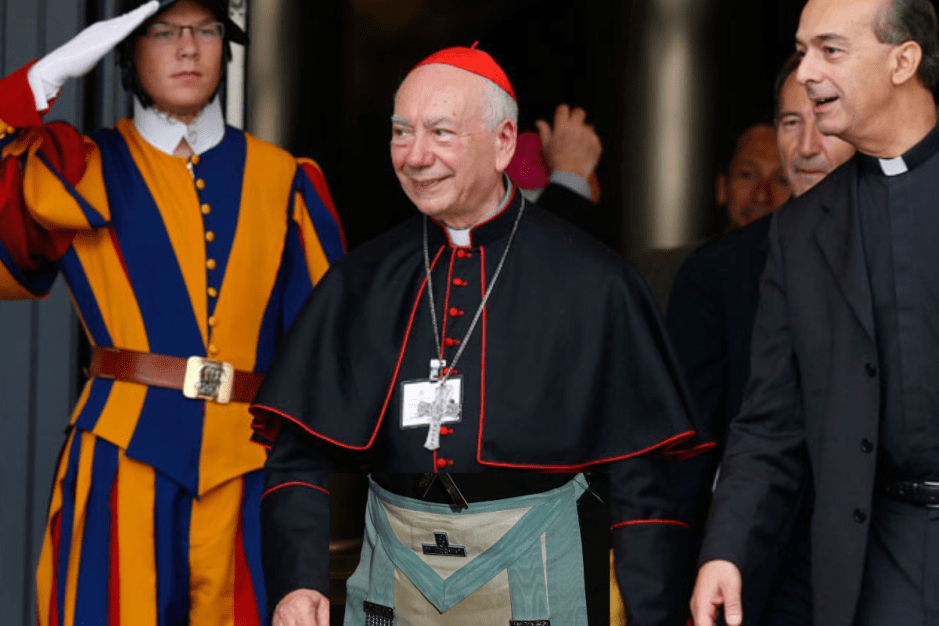
Card. Coccopalmerio expressed his desire that dialogue and collaboration between the Church and Masonry should go forward, and that “these meetings should not stop.” He suggested establishing “a permanent table” for this dialogue.

Delpini, Coccopalmerio and Stagliano

The three Prelates present at the meeting: from left, Delpini, Coccopalmerio & StaglianoAccording to Coccopalmerio, reports La Nuova Bussola Quotidiana, dialogue implies that the Catholic Church must change; she must recognize that she erred in her judgment on Masonry and, therefore, she should do away with the stigma that prevents so many Catholic Masons from receiving Communion.

While Stagliano makes the Faith disappear, Coccopalmerio demands an act of public rejection of the Church’s past condemnations of Masonry and the admission of Masons to Communion.

In their speeches, the three Italian Grand Masters played their role in the game by expressing their desire to be in dialogue with the Church.

In conclusion, by taking one of the last steps of Progressivism, Pope Francis, by way of the facts, abolished the Catholic Faith. Giving to Bishop Stagliano this goal as the mission of the new Pontifical Academy of Theology, he practically declared the Catholic Faith extinct.

Indeed, Bishop Francesco Stagliano was only the herald who announced this new religion of mercy.

We are witnessing the stable marriage of the worst of Progressivism with the worst of the Revolution: The marriage of the conciliar church with Freemasonry. The final step should be the glorification – by the hands of a Pope – of the inspirer of Freemasonry: Satan.

“Doctrinal Development” on Freemasonry

from one peter five by timothy flanders

Cardinal Martini, the architect of the St. Gallen Mafia, had an auxiliary bishop in Milan. That man was Francesco Coccopalmerio, whom Benedict XVI elevated to the cardinalate a year before he resigned. You may shudder to remember Cardinal Coccopalmerio from the Capozzi affair – when his secretary was caught in a revolting cocaine sodomitical orgy – or the Inzoli affair – when Coccopalmerio was alleged to have advocated for child abuser Mauro Inzoli to be reinstated as a priest.

These things are only symptoms of a dialogue with the Devil that seems to have been going on for some time in Milan under Cardinal Martini and his Mafia. The latest scandal about the Vatican and Freemasonry was not the first time this happened publicly.

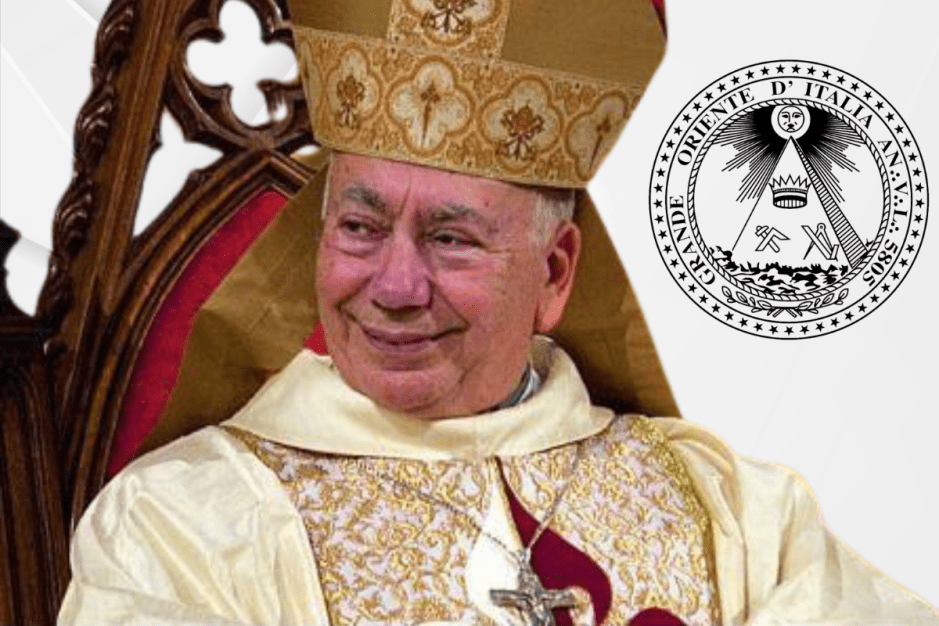
On February 16, 2024, Cardinal Coccopalmerio was a presenter at a Masonic conference organised by three Italian lodges.

It was here that the Benedict-appointed Cardinal became the first prelate to ask for a “permanent dialogue” with the demonic conspiracy known as Freemasonry.

But under the Francis pontificate, this also was not the first time we’ve seen prelates dance publicly with the Devil. In 2016, Cardinal Gianfranco Ravasi wrote what Pentin calls a “conciliatory letter” to the Freemasons, which has helped to spur on this absurd dialogue between Truth and lies.

Now Cardinal Coccopalmerio has presented again publicly to the Freemasons, saying there has been “an evolution in mutual understanding” between the devil’s minions [Freemasonry] and the Catholic Church.

“Evolution?” (When you say the word it’s like magic, and it turns black into white and Coke into Pepsi. Try it!) Remember when Fernández said the magic word “development” in order to contradict the ban on blessing sodomy? More on that in a minute.

As David L. Gray shows, there are few things since the 18th century that the Magisterium (before and after Vatican II) has been more consistent on than its condemnation of Freemasonry:

Thankfully, this is not something that Trads and Communio Catholics need to disagree about. Pentin:

In a 1983 declaration approved by Pope St. John Paul II, Cardinal Joseph Ratzinger reasserted that the Church’s “negative judgment” on Masonry remained “unchanged” since Masonic principles “have always been considered irreconcilable with the doctrine of the Church and therefore membership in them remains forbidden.” 

“The faithful who enroll in Masonic associations are in a state of grave sin and may not receive Holy Communion,” Cardinal Ratzinger added. However, neither that declaration nor the 1983 Code of Canon Law imposed the penalty of excommunication on Catholics belonging to the Masons — something that had been in force since Clement XII’s papal bull.

Even His Eminence, Cardinal Tucho Fernández, affirmed again last fall “the irreconcilability between the Catholic faith and Freemasonry.”

But words are just that, more words. Actions speak louder than words – do we really have to remind people of that? And this pontificate is all about undermining doctrine by means of “pastoral practice.” That’s why Freemasons have praised and thanked His Holiness as he has promoted by word and deed the message of Freemasonry – a worldwide brotherhood without Christ.

The Catholic Church is the true “new world order” of Jesus Christ as King of souls and societies.

Freemasonry is a new world order without Christ.

Therefore, Freemasonry is the new world order of Antichrist.

It’s really as simple as that.

The Devil does not have the power to create, only mar and distort what God creates, making His beauty into something ugly in the name of “fraternity” and “freedom.”

But with the latest news, we now see maybe why the Vatican issued this condemnation of Freemasonry in November.

Condemnation of Freemasonry + Fiducia Supplicans = intercommunion with the Devil with a clear conscience in the name of “mercy.”

From Riccardo Cascioli:

As with gay unions, one could always say that it is not Freemasonry that is blessed but individual Freemasons. And in fact [Cardinal] Staglianò[‘s speech to the Freemasons] does not defend this discrimination, rather he lays the groundwork to overcome it. Including the final invocation of a “healthy sapiential theology” that goes beyond the doctrinal approach that the latest document of the Dicastery for the Doctrine of the Faith published last November is still steeped in.

Who is Staglianò? What did Pope Francis put him in charge of? The Pontifical Academy of Theology of course! So he’s the one to add 2 + 2 to get 5 by means of the magic word “evolution” or “development” or “mercy” or whatever other talisman word they want to use.

As the Francis pontificate is reaching its twilight, the truth about the undercurrent of darkness is brought more and more into the light.

For this, we should be grateful to Almighty God.

For the mystery of iniquity already worketh; only that he who now holdeth, do hold, until he be taken out of the way. And then that wicked one shall be revealed whom the Lord Jesus shall kill with the spirit of his mouth; and shall destroy with the brightness of his coming, him, Whose coming is according to the working of Satan, in all power, and signs, and lying wonders, And in all seduction of iniquity to them that perish; because they receive not the love of the truth, that they might be saved.

Therefore God shall send them the operation of error, to believe lying: That all may be judged who have not believed the truth, but have consented to iniquity. 

But we ought to give thanks to God always for you, brethren, beloved of God, for that God hath chosen you firstfruits unto salvation, in sanctification of the spirit, and faith of the truth: Whereunto also he hath called you by our gospel, unto the purchasing of the glory of our Lord Jesus Christ. Therefore, brethren, stand fast; and hold the traditions which you have learned, whether by word, or by our epistle. Now our Lord Jesus Christ himself, and God and our Father, who hath loved us, and hath given us everlasting consolation, and good hope in grace, Exhort your hearts, and confirm you in every good work and word. (II Thess. ii. 7-16).

Catholics & Freemasons: “an evolution in understanding”

from ed pentin at the national catholic register

MILAN, Italy — A cardinal taking part in a “historic” closed-door meeting on Friday between the heads of Italy’s Freemasonic lodges and senior Catholic Church leaders has called for a “permanent” dialogue to be opened with the secretive organization, despite masonry being long condemned by the Church.

 A 1983 document from the Congregation of the Doctrine of the Faith stated Masonic principles “have always been considered irreconcilable with the doctrine of the Church.” And last November, the Dicastery for the Doctrine of the Faith reaffirmed that stance, quoting the 1983 document that “active membership in Freemasonry by a member of the faithful is prohibited, because of the irreconcilability between Catholic doctrine and Freemasonry.”

Addressing the Milan meeting on the theme The Catholic Church and Freemasonry, Cardinal Francesco Coccopalmiero, 85, reportedly said he believed “an evolution in mutual understanding” had taken place between masonry and the Church over the past 50 years. 

“Things have moved on, and I hope these meetings don’t stop there,” said the retired Italian prelate, according to Il Messaggeroquoting sources present at the meeting that was closed to the press. 

Cardinal Coccopalmiero, who served as an auxiliary bishop in Milan under Cardinal Carlo Maria Martini (1927-2012), said he wondered “if it’s not possible to think about a permanent discussion, even at the official level, so we can better deal with each other.” Cardinal Martini was known to be close to the Freemasons who paid a warm tribute to him as a “man of dialogue” when he died.

According to sources who spoke with La Nuova Bussola Quotidianaall three grand masters of the Italian lodges — Stefano Bisi of the Grand Orient of Italy, Luciano Romoli of the Grand Lodge of Italy, and Fabio Venzi of the Grand Regular Lodge of Italy — addressed the meeting. Two of them made their speeches public. 

“With different nuances, all defended the compatibility of Freemasonry with the Catholic faith,” reported La Nuova Bussola Quotidiana’s editor-in-chief, Riccardo Cascioli, who also spoke with people who attended the meeting at the Ambrosianeum Cultural Foundation.

Along with Cardinal Coccopalmiero, the Catholic Church was represented by Archbishop Mario Delpini of Milan, Franciscan theologian Father Zbigniew Suchecki, and Bishop Antonio Staglianò, president of the Pontifical Academy of Theology.

Bisi, who said he thought the meeting was “very significant,” credited the Church for his education as someone coming from a poor background, and explained how a reconciliation between Freemasonry and the Church was his long-held desire. He also made a point of fondly recalling Cardinal Martini “who was at home here.”

He expressed his appreciation for Cardinal Gianfranco Ravasi’s overture to Freemasons made in a 2016 open letter titled “Dear Brother Masons,” but lamented the pace of dialogue and reconciliation, and asked why Pope Francis had seemingly forgotten Freemasons in his embrace of everyone. He criticized the Vatican’s recent refusal to grant credentials to a masonic ambassador, and highlighted a Vatican ruling last November reasserting the Church’s ban on Catholics joining Freemasonry. 

The Pope, Bisi said, “made the famous statement ‘Who am I to judge?’ at the beginning of his pontificate, addressed to homosexuals” and then “opened the doors to divorcees” but he “forgot that, among Freemasons, are also many Catholics who are prevented from receiving Communion.” Members of Freemasonry have always been denied Holy Communion and until the 1983 Code of Canon Law, were explicitly and automatically excommunicated. 

Ode to Indifferentism

In an ode to indifferentism — the belief that differences of religion are of no importance and a central tenet of masonry — Bisi said “each man is brother to the other” and the “bond of brotherhood is independent of faith. It is only necessary to believe in the Great Architect of the Universe.” 

“The starry sky is the same for the Buddhist, for the Catholic, for the Waldensian, for the Muslim, for all those who believe in a supreme being,” he continued, adding: “We set our brothers free to adhere to any religion and to practice. Absolute truths and walls of the mind do not belong to us, and for us they must be torn down.” 

Bisi ended by expressing a hope that “one day a pope and a grand master may meet and walk a piece of the road together, in the light of the sun.”

Cascioli said the overall Catholic contribution to the meeting was “disconcerting.” 

Archbishop Delpini, who arrived at the meeting 45 minutes late, introduced the conference by stressing that dialogue with the secret society was important because “not everyone may have delved into the subject about such an ancient and prestigious organization, always surrounded by an aura of mystery and suspicion.”

The bishop of Europe’s largest diocese in terms of the number of priests and laity said the conference hosts, the Group for Socio-Religious Research and Information, a private association approved by Italy’s bishops’ conference, had continued “conversations and dialogue” with masonic lodges but added that the aim was not “absolution.” Rather, he said, it was about “fostering conversations between people to get to know each other’s points of view, to record their convergence or distance.” Obviously, he added, “this conference does not conclude with any final document.”

Father Sucheki had prepared a knowledgeable report on the Church’s many pronouncements against Freemasonry, but Cascioli said his contribution was “somewhat snubbed” by Bishop Staglianò’s contribution, which appeared intolerant of the reminders of doctrine.

Although the bishop was scheduled to explain why Freemasonry is irreconcilable with the Church, he gave a “long speech” that “tore apart the doctrinal approach on the Catholic side, and basically went along with the demands of the Freemason exponents.”

Bishop Staglianò said he was “interested in the Christian event, not the doctrine,” and repeating comments he made last month in the newspaper of the Italian bishops’ conference, Avvenire,regarding the Vatican’s declaration on blessings for persons in irregular unions, Fiducia Supplicans(Supplicating Faith), he stressed that the Lord “is love, only and always love.” 

His mercy, he said, precedes original sin and “rains on the just and the unjust” — that is, on everyone. “Who am I to judge that a human condition is such that raining God’s mercy on the just and the unjust does not even touch it with its moisture? Because sometimes the moisture of the water of God’s mercy is enough to regenerate a life.”

Pressure to Lift Excommunication

Bishop Staglianò’s words coincided with Bisi’s complaint that Freemasons should be freely admitted to Holy Communion. 

One element of the way to overcome irreconcilability with Freemasonry is therefore clear, according to Cascioli, and an “ad hoc theology is also being prepared.” In fact, he added, Bishop Staglianò criticized last November’s Vatican ruling reaffirming the ban on Catholics being Freemasons, calling it “reductive” and remaining on the level of doctrinal confrontation.

It is notable that last November, in new statutes for Bishop Staglianò’s Pontifical Academy of Theology, Pope Francis controversially underlined the importance of a “fundamentally contextual theology,” one capable of “reading and interpreting the Gospel in the conditions in which men and women live daily, in different geographical, social, and cultural environments.”

Theology, the apostolic letter said, must “develop in a culture of dialogue and encounter between different traditions and different disciplines, between different Christian denominations and different religions.” It must engage “openly with all, believers and non-believers alike.”

Despite their obvious enthusiasm for some kind of reconciliation, Cascioli said both Bishop Staglianò and Cardinal Coccopalmiero seemed keen to appear inexperienced in matters of Freemasonry at the meeting, even though Bishop Staglianò had attended at least one such meeting with masons in 2017 when he was the bishop of Noto, Sicily. 

Furthermore, Cascioli explained, upon his arrival at Friday’s meeting, Bishop Staglianò “showed great familiarity with several Masonic exponents” and his pectoral cross was hidden — “a strange way of bearing witness.”

Open Letter to Australia’s Catholic Bishops regarding Freemasonry

Is something finally going to be done about this disgraceful state of affairs? Well, we won’t be holding our breath.

From the remnant newspaper

In a document dated 13 November 2023, the Dicastery for the Doctrine of the Faith has reaffirmed the incompatibility between Catholicism and Freemasonry and has reiterated the Church’s centuries-old prohibition on Catholics being members of Freemasonry.

Responding to a request for pastoral direction from the Most Rev. Julito Cortes, Bishop of Dumaguete, (Philippines) who expressed concern about the increasing numbers of his Catholic flock who were enrolled in Freemasonry, Cardinal Víctor Manuel Fernández, Prefect of the Dicastery for the Doctrine of the Faith, issued a “Note for the Audience With the Holy Father Regarding the Best Pastoral Approach to Membership in Freemasonry by the Catholic Faithful”1. The document was countersigned by Pope Francis. In addition to providing practical suggestions and pastoral guidelines, the document states that:

“ … active membership in Freemasonry by a member of the faithful is forbidden because of the irreconcilability between Catholic doctrine and Freemasonry (cf. Congregation for the Doctrine of the Faith, “Declaration on Masonic Associations” [1983], and the guidelines published by the Catholic Bishops Conference of the Philippines in 2003). Therefore, those who are formally and knowingly enrolled in Masonic Lodges and have embraced Masonic principles fall under the provisions in the above-mentioned Declaration. These measures also apply to any clericsenrolled in Freemasonry.”

The 1983 “Declaration on Masonic Associations” states:

“Therefore the Church’s negative judgment in regard to Masonic association remains unchanged since their principles have always been considered irreconcilable with the doctrine of the Church and therefore membership in them remains forbidden. The faithful who enrol in Masonic associations are in a state of grave sin and may not receive Holy Communion.”

Given this recent confirmation by the Apostolic See of the Church’s perennial ban on Catholic membership in Freemasonry, we feel it is an opportune moment to remind Your Excellencies of the ongoing deep concern among many Australian Catholics that was first sparked over six years ago by a letter of 11 July 2017 written by the then General Secretary of the Australian Catholic Bishops’ Conference, the Rev Stephen Hackett [see letter].

Fr. Hackett’s response to the Grand Master, written on behalf of the ACBC, clearly leaves the door open to sacramental reception by Australian Catholic Freemasons in many or most cases, even though that door had been totally and firmly closed – and remains closed – by the Church’s perennial doctrine and discipline.

Fr. Hackett was replying to a letter sent a year earlier to the ACBC by Mr Stephen Michalak, a Catholic who was then Grand Master of Freemasonry for South Australia and the Northern Territory. In this letter, which he said was written with the unanimous support of all Masonic Grand Masters in Australia, Mr. Michalak not only asked the Australian bishops to “outline a pathway for Catholics who are Freemasons to full participation in the sacramental life of the Church,” but appealed to the present Holy Father’s pastoral approach in support of this request. To deny Catholic Masons access to the sacraments, said the Grand Master, “seems totally at variance to my understanding of what Pope Francis is actively trying to promote – a spirit of understanding and reconciliation . . . love and forgiveness”.

Rome’s recent reiteration of the Church’s absolute prohibition of membership in Freemasonry shows how completely Grand Master Michalak misunderstood the Holy Father’s thinking on this matter. But it seems possible that Fr. Hackett, along with the members of the Bishops’ Commissions on Canon Law and Doctrine and Morals whom he says he consulted, and not a few others among Your Excellencies, may have shared that misunderstanding. For Fr. Hackett’s response to the Grand Master, written on behalf of the ACBC, clearly leaves the door open to sacramental reception by Australian Catholic Freemasons in many or most cases, even though that door had been totally and firmly closed – and remains closed – by the Church’s perennial doctrine and discipline. Fr. Hackett’s response is particularly shocking to many of the faithful in this country, given that it claims merely to “reiterate” an Australian episcopal policy dating right back to 1984 that has been “affirmed this year” (i.e., some time between January and July 2017). As if to drive the point home, Fr. Hackett ends his letter to the representative of Australian Freemasonry by stating that this essentially affirmative response to his request is “the preferred approach of the Bishops [sic] Conference”.

So what, precisely, does this “preferred approach” consist in? Fr. Hackett assures Mr. Michalak that “no penalty attaches to Catholic membership in the Masonic order”. This is technically correct, given that in the 1983 Code of Canon Law the previous Code’s canonical penalty of excommunication for Masonic membership was deleted and replaced by a more general penal sanction against those who join any society that “plots against the Church” (cf. c. 1374). But since Fr. Hackett did not insert the word “canonical” before “penalty”, and since most lay Catholic readers would certainly regard their exclusion from the sacraments as a “penalty”, his statement is wide open to creating the false and scandalous impression that the Church no longer excludes Freemasons from the sacraments in any way.

The second point Fr. Hackett ignores in his letter is the CDF’s insistence that local ecclesiastical authorities have no authority to mitigate or derogate from the Church’s total exclusion of Catholic Freemasons from the sacraments in places where (as in Australia, apparently) they may discern a benign, rather than hostile, attitude towards the Church in local Masonic lodges.

It is true that Fr. Hackett nuances this seemingly permissive generalization by acknowledging that “in some other countries, . . . Freemasonry can be antithetical to Catholic faith” (in which case, presumably, membership would fall foul of canon 1374). So because of such regional or local divergences within Freemasonry, says Fr. Hackett, the Australian bishops have “prudently” decided not to issue any general directive on “Catholic involvement in Freemasonry”. Rather, he says, “such involvement is in each instance best addressed personally with the local parish priest”. Nevertheless, Fr. Hackett, claiming to express the official position of the ACBC, makes it abundantly clear that admission to the sacraments is to be the norm for Australian Catholic Freemasons, and exclusion from them the exception. For he tells the Grand Master that “where a local pastoral response is not consistent with this expectation [i.e., the expectation of admission to the sacraments as a general rule following the Church’s elimination of any “penalty” for Masonic membership] and liturgical-sacramental participation is made difficult or refused, that this might be referred to the local vicar-general or to me”.

In all this, however, Fr. Hackett’s letter ignores what seem to us two fundamentally important points. The first is that even when Freemasons do not “plot against the Church”, and so don’t incur the canonical penalty laid down in c. 1374, Masonic membership as such is still affirmed by the Church to be a grave sin that excludes from Holy Communion. Why? Because of “the irreconcilability between Catholic doctrine and Freemasonry”. Masonic communities do indeed allow members to profess and practice the religion of their choice, Christian or non-Christian; but only as one human tradition among others. Freemasonry’s relativistic, deistic and anti-supernatural ideology rejects the Catholic Church’s claim to possess uniquely the fullness of divine revelation. Moreover, Freemasonry has its own syncretistic religious rituals (which it tries to keep a closely guarded secret), and participation in prohibited rites such as these remains penalized in the current Code of Canon Law. In the section “Offences Against Religion and the Unity of the Church”, we read, “One who is guilty of participation in prohibited religious rites is to be punished with a just penalty” (c. 1365).

The second point Fr. Hackett ignores in his letter is the CDF’s insistence that local ecclesiastical authorities have no authority to mitigate or derogate from the Church’s total exclusion of Catholic Freemasons from the sacraments in places where (as in Australia, apparently) they may discern a benign, rather than hostile, attitude towards the Church in local Masonic lodges. Indeed, Fr. Hackett’s message to this country’s Catholic Masons that the ACBC has in general opened the door to their liturgical and sacramental participation, and that exceptional or problematical cases may be referred to “the local parish priest”, the “local vicar general”, or Fr. Hackett himself, stands in open defiance of the 1983 Vatican ruling. For the Declaration ends with the following affirmation:

“It is not within the competence of local ecclesiastical authorities to give a judgment on the nature of Masonic associations which would imply a derogation from what has been decided above, and this in line with the Declaration of this Sacred Congregation issued on 17 February 1981. (cf. AAS 73 1981 pp. 240-241.)”

We present them with a view to mitigating the scandal experienced in this matter by the faithful, as well as by members of Freemasonry, whose immortal souls may have been put in jeopardy by rash assurances that such membership is not sinful and is compatible with the reception of the Eucharist.

In view of the above, we respectfully request a new clarification from Your Excellencies regarding Catholic involvement in Freemasonry that includes a formal repudiation of Fr. Hackett’s erroneous position. More specifically:

1. We ask that the Australian Catholic Bishops Conference formally state its commitment to upholding the 1983 Declaration from the Congregation for the Doctrine of the Faith and the November 2023 Note from the Dicastery for the Doctrine of the Faith. Both of these are in continuity with the Church’s longheld judgment when they affirm, “The principles [of Freemasonry] have always been considered irreconcilable with the doctrine of the Church and therefore membership in them remains forbidden. The faithful who enrol in Masonic associations are in a state of grave sin and may not receive Holy Communion.”

2. We ask that the Bishops’ Commission for Canon Law and the Bishops’ Commission for Faith and Morals, both explicitly mentioned by Fr Hackett as having been consulted prior to the release of his letter, clarify for those unfamiliar with canon law that the statement “no penalty attaches to Catholic membership in the Masonic order” refers only to the absence of an ecclesiastically imposed canonical punishment such as excommunication or interdict, and in no way implies that such membership is morally acceptable.

3. We ask that, in a manner similar to that which has now been recommended to the Filipino Bishops by the DDF, the Australian Bishops “conduct catechesis accessible to the people and in all parishes regarding the reasons for the irreconcilability between the Catholic Faith and Freemasonry”.

4. We ask that the results of any investigation into the preparation and publishing of Fr. Stephen Hackett’s 2017 letter be made public. For that letter, written on behalf of the ACBC, directly contradicts the well-known doctrine and discipline of the Catholic Church towards Freemasonry that had been declared in 1983 by the CDF under Pope St. John Paul II and has now been reaffirmed by the DDF under Pope Francis.

These requests to Your Excellencies are being respectfully made in the spirit of canon 212, sections 2 and 3, which recognize the right of Christ’s faithful to make known to the Pastors of the Church their spiritual needs and their views on matters which concern the good of the Church. We present them with a view to mitigating the scandal experienced in this matter by the faithful, as well as by members of Freemasonry, whose immortal souls may have been put in jeopardy by rash assurances that such membership is not sinful and is compatible with the reception of the Eucharist.

Be assured of our prayers for Your Excellencies as we thank you for your gracious attention to this submission ….

Grand Master Bisi’s speech at the Catholic-Freemason seminar.

From the grand orient of italy website

“Let’s start from the things that unite us. This morning three workers died on a construction site in Florence. May this fact unite us in mourning, in the respectful thoughts of three men who leave behind families. I think that strong thoughts should be addressed to the victims and their families.” This is how Grand Master Stefano Bisi began by speaking at the seminar on Church and Freemasonry, wanted by the Catholic association Gris, represented by the national secretary Giuseppe Ferrari, and organized in Milan at the Ambrosianum Foundation with the endorsement of the archbishop of the city Monsignor Mario Delpini, who spoke at the event which was attended among others by Cardinal Francesco Coccopalmerio, former president of the Pontifical Council for Legislative Texts, the president of the Pontifical Academy of Theology Monsignor Antonio Staglianò and Grand Master Bisi, who has always hopes for a thaw in mutual relations, has been the bearer of numerous initiatives to this end and whose dream is, as he revealed in an interview, to walk together with the Pope under the sky of the Great Architect of the Universe.

Below is the speech that the Grand Master gave during the meeting

I would like to thank the Group for socio-religious research and information for this invitation to a meeting which I consider very significant. It is not the first time since I have been Grand Master of the Grand Orient of Italy of Palazzo Giustiniani that I have discussed the complex topic of relations between the Church and Freemasonry. I did it in Turin, Pescara, Arezzo, Matera, Gubbio and I talked about it several times around Italy and before that. I confess to you that the first table I sculpted in my long 41 and a half years of belonging to the Grand Orient of Italy was precisely on this topic. Maybe it was a joke from my older brothers who wanted to better understand why, this young man, I, saw him enter a church for a few minutes which is located along the main street of Siena, along the struscio. The truth is that I wanted to spend a few moments in meditation, away from the noise, the noise of words and chatter. Maybe they wanted to understand why, I, who went to nursery school thanks to a country priest; that I went to middle school thanks to a priest who wanted to help the children of workers, blacksmiths, truck drivers; that I made the first printed newspaper thanks to the parish priest of the neighborhood; my older brothers perhaps wanted to investigate the reason for my choice to seek admission to Freemasonry.

So I’ve been passionate about the topic for a long time. I would like the prelate, the man of the Church in front of me, not to be afraid of me and I would like not to be afraid of him. And I’m pleased to be here today because it means that progress has been made along the path of knowledge and respect. And I hope that the participants in this seminar do not end up in the media pillory as happened to two bishops, from Arezzo and Terni, who participated in public initiatives of the Grand Orient of Italy. Over the course of its more than 300 years of life, no institution has been opposed, fought, mystified, slandered and feared as much as Universal Freemasonry. From the Catholic Church which saw Freemasonry as a potential competitor in the spiritualisation and elevation of Man, to dictators of all colours, up to certain populist political forms which fear the inexhaustible and libertarian strength of its profound human and social charge.

A long history that starts from 1738 and, with ups and downs, between pseudo tolerances and small glimmers of hope, has in fact continued until today without ever resulting in a desirable and true opportunity to change the course of History by opening the doors of constructive dialogue and putting an end to that excommunication which – although attenuated by the modification of article 1374 of the Canon Code with the disappearance of the precise reference to Freemasonry – still hangs over millions of free masons scattered around the globe, many of whom are wondering how to overcome that presumed and substantial dogma of irreconcilability which would preclude any rapprochement between the two realities.

The Church and Freemasonry both place Man at the center of everything, albeit with different bases. For us we must work internally to sublimate his being and strengthen him “in virtue and against vice” to elevate him in that fraternal love aimed at the Good of Humanity and the Glory of the Great Architect of the Universe. The Freemason, who lives in doubt and polishes his own stone, tends towards Good and divine Love by following the steep Path of Knowledge in the constant search for the Truth. By nature and mindset I do not subscribe to the circle of doctors and lovers of irreconcilability, a word that I don’t like and which has never produced bridges on which to unite but has divided men.

I believe, but I use this term only secularly, instead of never thinking that something is impossible to achieve. And, for this reason, in 2016 I greatly appreciated the writing of Cardinal Gianfranco Ravasi, to whom I sent a letter after the publication of his article entitled “Dear Freemasons” in the newspaper “Il Sole24Ore”. On that occasion I too hoped for the path of dialogue and discussion starting from the things that in some way unite the two institutions. Here is what I wrote: “As the president of the Pontifical Council for Culture wisely recalled, citing the document of the German bishops of 1983, the points of contact between Freemasonry and the Church cannot be ignored, which find common values ​​in the community dimension, in human dignity, in fight against materialism, in charity. In this we can have an open and free discussion, maintaining the differences but reducing the distances that the Philippine bishops instead articulate in their document”. But what matters is perhaps starting from a limited reconcilability and discussing it instead of still professing an absolute, intransigent and dogmatic irreconcilability. Who has the Truth? Man or just God? Cardinal Ravasi himself wrote a few years ago: “The Truth is only one but like the diamond has many faces, we can, from our angle of vision, see only one of these faces”. Those who think they see everything and hold the only Truth are therefore deluding themselves. This is why Freemasons with humility and many doubts perpetually seek it, leaving dogmas to others. But always looking for dialogue and discussion with anyone. At that time there was certainly no shortage of criticism of the cardinal and there was no further development of dialogue. And two bishops present at our initiatives at the invitation did not fail to be the target of heavy attacks. In 2019 the then archbishop of Arezzo-Cortona-Sansepolcro Riccardo Fontana went to one of our conferences for the 150 years of the Benedetto Cairoli lodge organized by the Grand Orient of Italy and in the provincial council room he said: “The historical fences remain but we must look forward, to what unites” and subsequently received the reproach and dismay of circles close to the Episcopal Conference, wrote a newspaper. In October 2022 the bishop of Terni Monsignor Francesco Antonio Soddu took part in the inauguration of the Masonic house showing courage and desire for dialogue. They told him all kinds of things. Yet already in the 1960s, during the pontificate of Paul VI, contacts began between a group of priests, such as Rosario Esposito and Giovanni Caprile and the bishop of Livorno Ablondi and the leaders of the Grand Orient of Italy, to understand each other. Numerous meetings followed but then the death of Paul VI stopped the dialogue.

And let’s go to current times. Both during the pontificate of Pope Benedict XVI and that of Pope Bergoglio there was no significant attempt at openness. The then Cardinal Ratzinger, in the role of prefect of the Congregation for the Doctrine of the Faith, intervened with a “Declaration” on 26 November 1983 – approved by Pope Wojtyla – in which he maintained that “the negative judgment of the Church remains (…) unchanged with regards to Masonic associations, since their principles have always been considered irreconcilable with the doctrine of the Church and therefore membership in them remains prohibited”.

The text did not speak of excommunication but added that the faithful registered in the lodges “are in a state of grave sin and cannot access Holy Communion”. Pope Francis made the famous statement “who am I to judge?” at the beginning of his pontificate aimed at homosexuals, he then opened the doors to divorced people but he forgot that among the Freemasons there are also many Catholics who are prevented from receiving communion and when it came to granting credentials to a Freemason ambassador said “no”.

Finally, the last act took place last November with the document made known by the Dicastery of the Doctrine of the Faith signed by Prefect Victor Hernandez with the approval of the pontiff. Catholics remain prohibited from joining Freemasonry. A solution to the problem of reconcilability between the Catholic faith and membership of Freemasonry appears not to be close, through no fault of ours, but in the meantime let’s talk about it. Just like we do today. Let’s start again from what Father Josè Ferrer Benimeli and Father Giovanni Caprile stated: desiring, encouraging, attempting, conducting dialogue prudently “does not mean betraying the Catholic faith, nor opening the doors to presumed enemies, nor giving in to irrefutable ideas. It involves only the patient search for common points of understanding, the desire to exchange the real goods possessed by each, the tension so that the truth (without any possessive adjective) has the upper hand, the search for union for the good of all”.

Freemasonry is a great tree of Freedom that sways in the wind but does not break and continues to work for the good of Humanity by creating better men, available to listen and which makes Tolerance a principle that everyone should practice with great love. This is why we speak today – in broad daylight and without preconceived plans – in the various meetings organized in every part of Italy with exponents of all religions and we strive to find syntheses that can help people overcome prejudices, conflicts, wars, fanaticism and selfishness which are the evil of a Society. Why is the Masonic lodge beautiful and why does the ecclesiastical authorities not like it? Because under the same sky – which represents Creation – every man is the brother of the other, the bond of brotherhood is independent of faith. We just need to believe in the Great Architect of the Universe. The starry sky is the same for the Buddhist, for the Catholic, for the Waldensian, for the Islamic, for all those who believe in a supreme being. For all those who have the awareness that we are a point within something greater which is the universe, which we can call god. And as Vito Mancuso says, “by saying God I mean a reality perceived as bigger and more important than one’s own self. This something more important can be called in many ways, but the essential point is that, by perceiving it, one lives for a different and higher value than oneself”, that is, “the real difference is not between those who believe and those who do not believe, but between those who surpass themselves and those who don’t. Between those who know a god, and those who only know their own self.” In short, look beyond. Towards the sky or infinity, which are the same thing.

We leave our brothers free to adhere to any religion and practice it. Absolute truths and the walls of the mind do not belong to us and must be torn down for us. As for the feared danger for the Church of exposing itself to a dangerous dialogue with the Freemasons because it is against the Faith, I add that I do not think in the slightest that this thesis can lead to such extremes consequences. Reconciliability, on the contrary, if well rooted and illuminated by reason, can only strengthen it. And give all men the opportunity to meet on bridges of light to travel together while respecting the different paths. Our doors are perpetually open. The world has changed, the breach of Porta Pia dates back to 1870 and, as Paul VI said, it is a date desired by Providence because it leaves the spiritual power to the church and the government of earthly things to the civil authority. In 2010 the then Secretary of State Cardinal Tarcisio Bertone went to the Breccia monument together with the President of the Republic Giorgio Napolitano. An important act. And it would be even more significant if tomorrow, February 17, the anniversary of the fire of Giordano Bruno, a man, dressed in white, walked a few hundred meters to gather in front of the Nolan monument. Maybe? I hope that the dialogue continues, I would like the compatibility between belonging to a Masonic lodge and belonging to the Catholic faith to be declared. I say this because the path in this direction is still long, and many brothers experience access to the sacraments in a clandestine way because they know that they are in a state of grave sin. From the canon code the word excommunication has been removed but the effects are the same.

We move forward with tolerance and trust. I want to quote a thought from Luciano De Crescenzo who says: doubt the men who have certainties, they are usually the most intolerant and anti-democratic, however when you encounter question marks, prefer those who have doubts, they are usually almost always people open to dialogue , tolerant.

Well, I prefer these people. And I would like to remember, among these people, Cardinal Carlo Maria Martini who was at home here. I still remember today a response from him in the Corriere della Sera to a reader who wrote to him: “I am an atheist but I see Beauty around me”. Martini replied: “I, a Catholic, and you, an atheist, are fundamentally united by the same wonder of Creation.” This message, which is also a universal response, still seems very beautiful to me today. My wish – which is also a hope – is that one day a Pope and a Grand Master will be able to meet and travel a part of the way together, in the light of the sun. It comes to me to say in the light of the Great Architect of the universe.