Australian Bishops are in the Synodal Way

Even though they missed out on the red hat, three of Australia’s bishops remain happy to carry water for the Synod.

One of them is Shane Mackinlay, bishop of Sandhurst, who is representing the Bishops Conference at the Synod in Rome. According to McKinley, Fiducia Supplicans was a direct result of the Synod. He told a press conference that although the Pope didn’t act synodally by issuing the heretical document, that’s fine by him:

“As with many things Pope Francis has done in the last year, he did not wait for the final document. He has already responded to things that were raised in the discussions and in the final report last year.”

This is despite the Pope stating that he would absolutely not be making a decision on same-sex unions before the second Synod sessions.

According to Mackinlay, “Fiducia supplicans is a significant step forward … and then I think those of us from the West are not so surprised that in some other parts of the world it is received differently and has a different kind of priority.”

Yes, it is received differently because ‘in some parts of the world’ the Bishops are actually Catholic! Mackinlay is so popular in Rome that he was elected for the second time as the Oceania representative for the Commission for the Final Document of the Synod – quite the appointment.

Another Synod apparatchik is Archbishop Timothy Costelloe, no stranger to these pages. As Archbishop of Perth and president of the Australian Catholic Bishops’ Conference, Costelloe is completely onboard with the Synod’s agenda of re-imagining Catholicism. He couldn’t hide his enthusiasm for heterodox novelty when he told Vatican News that it was great to have priests, women, and lay people usurping to role of the Bishops by being given full voting rights instead of having a ‘back row seat’.

“It shows us the equality and unity of all. Unity is communion of mind and heart, of spirit and action, and of faith at the service of the Church’s evangelising mission.”

This ‘unity’ is nowhere to be found either at the Synod or outside of it, of course. The persecution of traditional Catholics and the clamouring voices of dissenters from the Faith are evidence of that.

Archbishop Costelloe also explained that the so-called ‘conversation in the spirit’ “serves to free oneself from prejudices. The Synod must convert us from a competitive approach to a spirit of listening because in this way it will be of real and effective help to the Pope.”

He posed a few more rhetorical questions: “Should the Synod office be restructured in favour of the local Churches? If so, how? And could the reports become documents to be published?”

Now, don’t worry too much if you don’t have the answer to these questions. Something tells me that the Synod Fathers (and Mothers) already have the answers – pencilled in from Day 1.

The third Australian Synod mouthpiece is Anthony Randazzo, Bishop of Broken Bay diocese, who seems to have mastered the art of verbally giving with one hand while taking with the other.

One the one hand, Randazzo criticises those who are ‘obsessed’ by the issue of women’s ordination. But look at the reasons he gives as objections to it:

“Those issues become all-consuming and focusing for people, to the point that they then become an imposition on people who sometimes struggle simply to feed their families, to survive the rising sea levels, or the dangerous journeys across wild oceans to resettle in new lands.”

The Catholic Diocese of Broken Bay website reports that while Randazzo has ‘no problem with the topic of women’s ordination being discussed and studied at the Synod’, he thinks it should be poor women and not wealthy, well-educated ones who call for it. What? So now the disobedient notion of ordaining women is only wrong when it is attached to white privilege?

Maybe someone needs to tell His Grace that the Amazonian women are way ahead of the curve. They are already receiving a para-liturgical blessing from their Cardinal before beginning their ‘ministry’ of distributing the Sacraments.

How anyone can think this matter was not laid to rest in the past with an infallible statement is beyond me.

A Providential Good News story

this morning, without an article ready to publish, i was overwhelmed with discouragement at having to present yet another post containing an Apostate pope in a funny hat or a freemason prelate expelling a faithful priest or any similarly dismal theme.

Lo and behold, this sweet testimony, full of hope and gratitude, arrived in my inbox. It originated here.

NOTES in square brackets [ ] added by yours truly.

Cara Veronica,

On June 19, 2024, a sad day to remember, the last Latin Mass was celebrated in St. Patrick’s Cathedral (Melbourne). More than 850 faithful were present.

On Wednesdays of every week of the year, an ancient mass was celebrated in that church, attended by hundreds of young people.

The document to suppress it was sent by the Vatican and signed by Archbishop Vittorio Francesco Viola. In it they apologized, saying that since there is an anti-traditional climate in Rome, it is not appropriate for the Cathedral to continue with the usual Mass. Words that really make no sense…

Now, that one has been suppressed, only two parishes remain that celebrate the traditional mass. Among these is mine, which has the authorization for another 2 years. Then we will have to ask for permission again, which we fear will not be granted. Let us pray intensely that the Lord will come to free us soon, Veronica! It was too much pain for us! What a disappointment! What an outrage!

We are all infinitely sorry, also because that Holy Mass was attended by many young people: students, seminarians and young workers. For them it was the only ancient, midweek Mass they could attend. 

Already in 2021, after receiving the first order from Rome, the archbishop had forbidden all parishes to celebrate in Latin. Then we do not know what happened: suddenly he gave permission to the Cathedral to celebrate it and on Wednesdays it was very popular. At least 500 [NOTE: a slight exaggeration – by a factor of 10] faithful attended each time. Its suppression was a real scandal! Let us entrust ourselves to the Virgin Mary, Mother of the Church, Veronica, and pray that Her Immaculate Heart will soon triumph.

In my parish, as I was saying, one of the two still authorized to celebrate the ancient rite of the Saturday mass,*  by Grace, the Sunday mass is reformed, but in Latin** and is solemn.  [NOTE: Most Masses in this parish are Novus Ordo, offered ad Orientem; there is a weekly TLM as permitted by the local Ordinary.] Between incense, blessings and Gregorian chants, many are the young people and large families, with many children, who attend it, even coming from very far away. There are those who travel hundreds of kilometers by car to be there, on holidays.

The solemn Mass lasts about an hour and a half. Many women, like me, wear the veil and 90% of the faithful and more, receive Communion on the tongue. 

Our parish priest is an exemplary priest. Very young, but with a traditionalist background.

Upon his arrival, a new air was breathed. Softer, more sacred. He made a radical counter-revolution, abolishing all modernist customs and practices and restoring a certain material and spiritual discipline.

First he removed the altar girls and placed the Tabernacle back in the center, from a lateral position where it had previously been placed. He removed an ugly table, placed in place of the Altar, installing another, worthy of the name. He put back the kneelers to receive Holy Communion on the tongue and began to use the plate under the chin again, during His distribution. With him the sign of peace immediately became a distant memory and he began to distribute Holy Communion personally, completely excluding extraordinary ministers.

Needless to say, the priest wears a cassock and I noticed that the toes of his shoes are bent upwards, so much time is spent kneeling. God bless him and confirm. He has already bought the balustrades [altar rails] that will be installed soon.

During the lockdown he never abandoned or neglected the faithful. He heard confessions for more than 3 hours on Saturdays, when other churches were closed. He even installed an automatic dispenser for holy water, instead of taking it away. So great is his zeal, that he always found a solution for every problem that arose.

The Church in Australia has changed in recent years, but it has not reached the negative extremes of Italy: for example, no priest has ever thought of refusing Communion to the faithful, because they want to receive it on the tongue and kneeling . [NOTE: this does, in fact, sometimes happen in Australia, unfortunately.] The Our Father has not changed either and normally everyone kneels during the Consecration.

We know well that in particular everything depends on the priest and in general we notice a certain awakening among them.

The young consecrated people are very devoted and lovers of the two-thousand-year-old tradition of the Catholic Church.

Let’s hope so, Veronica.

A big hug to you. Thank you

Silvia, da Melbourne (Australia)

While there are some who say that the reverent Novus Ordo is “part of the problem”, I say, along with St. Pio of Pietrelcina, that in times like these, we must take the good wherever we find it. Thank God for this woman and for her blessed little parish which is evidence that God never abandons His Church.

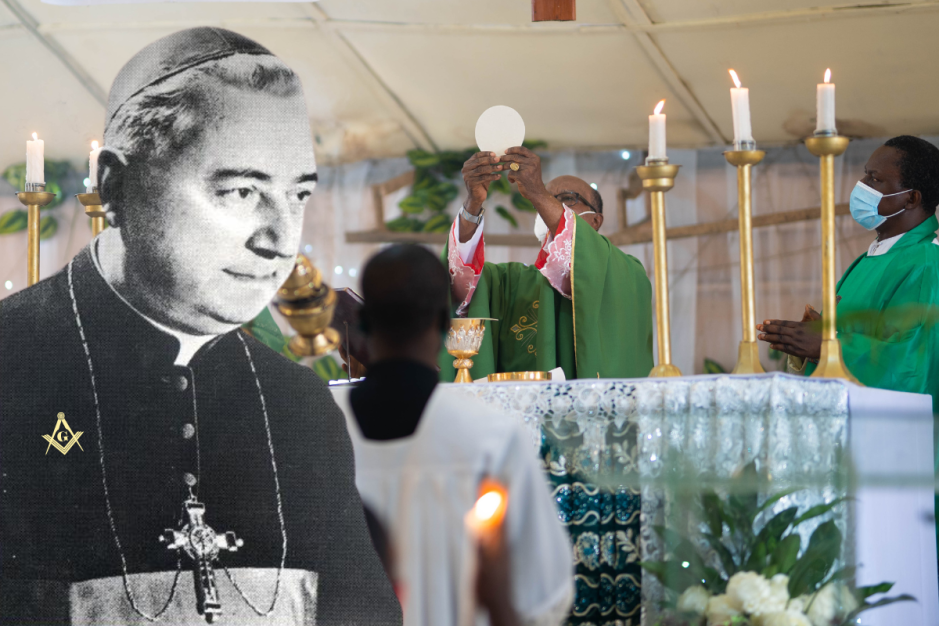
Ghana’s Bishop opposes Freemasonry

After a Ghanian MP publicly stated that he was a Catholic and a Freemason, Bishop Joseph Osei-Bonsu went public to clarify the Church’s stance.

The MP, Alexander Afenyo-Markin, said that he hadn’t been sanctioned by the Church and that the President of Ghana is also a Catholic and a Mason. said “Freemasonry is a fraternal society that believes in God Almighty, and follows certain principles that guide a man’s life, and it does not run counter with my beliefs as a Catholic.”

In response, Bishop Osei-Bonsu told the Catholic Standard that it was unfortunate Afenyo-Markin “does not know the teaching of his Church on this matter.” God bless this man!

INTRODUCTION
Many people regard Freemasonry as a benevolent and charitable organization, somehow similar to the Rotary and Lions Clubs, the Knights of Marshall, the Knights of St. John International or the Knights of Columbus. Undoubtedly, it is for this reason that some Catholics join this fraternity.

In recent times, the Member of Parliament for Effutu in the Central Region, Hon. Alexander Afenyo-Markin, on a live radio interview stated that he is a proud member of the Lodge, and his church, the Catholic Church, does not frown on its members joining the Brotherhood. He added, “I am a mason and I have not been sanctioned by the Catholic Church. Freemasonry is a fraternal society that believes in God Almighty and follows certain principles that guide a man’s life and it does not run counter with my beliefs as a Catholic” (https://newsghana.com.gh/is-afenyo-markin-a-true-catholic/)

It is unfortunate that the Honourable Member of Parliament does not know the teaching of his Church on this matter. Contrary to what Honourable Alexander Afenyo Markin believes, Freemasonry is not approved by the Catholic Church. Indeed, Catholics are forbidden to become Freemasons.

FREEMASONRY AND THE CATHOLIC CHURCH
The Catholic Church has opposed the Lodge nearly since the birth of modern
Freemasonry in 1717. Since the founding of the Grand Lodge of England, eleven
popes have explicitly condemned Freemasonry or Masonic principles. These popes are: Pope Clement XII (28 April 1738); Pope Benedict XIV (18 May, 1751); Pius VII (13 September 1821); Pope Leo XII (13 March 1825); Pope Pius VIII (24 May 1829); Pope Gregory XVI (15 August 1832); Pius IX (between 1846 and 1873); Leo XIII (15 February 1882; 20 April 1884; 1887; 15 October 1890; 18 December 1892; 20 June 1894); Pope Pius IX (1907); Pope Pius X (1907); Pope Pius XI (1924).

A recent condemnation of Freemasonry is contained in the “Declaration on
Masonic Associations” issued by the Congregation for the Doctrine of the Faith on 26 November 1983, declared that Masonic principles are irreconcilable with the doctrine of Church, and that Catholic membership in Freemasonry remains forbidden.

The Church’s position is that Freemasonry is a religion in its own right with its own doctrines, which are not compatible with Christian beliefs. For this reason, one
cannot simultaneously be a Christian and be a Freemason. What it teaches about the following cannot be reconciled with Christian beliefs, i.e., God, Christ, the denial of the role of grace and Christ in salvation, morality, its attitude towards the Bible, eschatology, the masonic oaths and the notion of rebirth and enlightenment. For this reason, one cannot simultaneously be a Catholic and a Freemason, just as one cannot be a Catholic and be Muslim, a Hindu, a Shintoist or a practitioner of African Traditional Religion. One will have to make a choice between Catholicism and Freemasonry.

CONCLUSION
Let me conclude by drawing attention to the DECLARATION OF THE GHANA CATHOLIC BISHOPS’ CONFERENCE ON SANCTIONS FOR CATHOLICS WHO JOIN MASONIC ASSOCIATIONS, issued on 7 May 2009. Among other things, it says:

1) Any Catholic who is a member of any Masonic Association and participates in its programmes, or promotes its views, or holds any office therein, and refuses to renounce such membership despite at least one warning (cf. Canon 1347) is to be punished with an interdict (cf. Canon 1347), that is:

a. He is not allowed to receive Holy Communion and other sacraments (cf. Canon 1332).

b. He is prohibited to act as sponsor in Baptism and Confirmation.

c. He is not to be admitted as a member of parish or diocesan structures.

d. He is to be denied funeral rites, unless he shows some signs of repentance before death (Canon 1184 §1, no. 3).

e. Where funeral rites are allowed by the bishop, no Masonic service shall be allowed in the Church or cemetery immediately before or after the Church rites in order to avoid public scandal (cf. Canon 1184, §1, no. 3, and Canon 1374)

Any Catholic who is a convinced member of a Masonic Association and notoriously adheres to the Masonic vision is already considered to have incurred automatic excommunication (cf. Canon 1364). This means that the censures described in Canon 1331 automatically take full effect on this person. According to Canon 1331 §1, an excommunicated person is forbidden:
I. To have any ministerial participation in the celebration of the Eucharist or in any other ceremonies whatsoever of public worship.

II. To celebrate the sacraments and sacramentals and to receive the sacraments.

III. To discharge any ecclesiastical offices, ministries, or functions whatsoever, or to place acts of governance.

It is possible that some Catholics joined Freemasonry without knowing that it is forbidden to Catholics. Such people are advised to see their priests or their bishops who will assist them to renounce Freemasonry and avoid incurring the sanctions that will be imposed on them if they do not renounce Freemasonry.

EXCERPTS FROM CAN A CATHOLIC BE A FREEMASON BY MOST REV. JOSEPH OSEI-BONSU BISHOP OF KONONGO-MAMPONG

A “hypothetical” papal resignation

Is good old Rome Reports providing some predictive programming?

Protocols surrounding papal resignations have been around since the time of John Paul II, and Pope Bergoglio has made no secret of the possibility that he could resign at some stage. Liberal Catholic media outlets love to throw the cat among the pigeons (usually on slow new weeks) by suggesting that such a resignation is imminent.

The eighty canon lawyers who have gotten together to discuss what a resignation protocol would look like, “theoretically” of course, might be enjoying their all-expense-paid confab, but it does raise the question how it was possible for Pope Benedict to do it all on his own. His resignation was not without controversy, but it was above board and not an eighty-lawyer-job.

Why on earth should anyone want to discuss resignations when it is obvious that an elderly and unwell Pope will not live forever? What DOES Francis have up his sleeve? Is he about to introduce fixed terms for the papacy, as with our political leaders? Is this another step closer to the One World Masonic Humanist religion?

Or is this just another distraction from the main event, like the “restructuring” or the Curia and “cleaning up” of the Vatican finances? Red herrings both, if you ask me.

Stay tuned for more apostasy. When whatever is about to happen happens, there will be no going back.