Another Take on the Secret February 16 Meeting in Milan

By Roberto de Mattei at Rorate Caeli

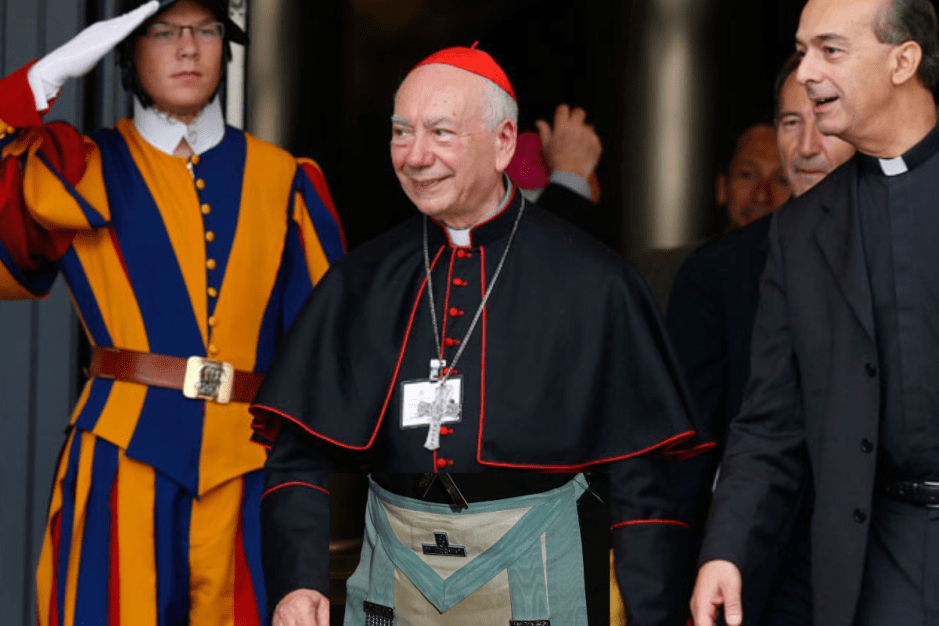
On Feb. 16, 2024, representatives of the main Italian Masonic lodges and a number of influential Catholic prelates gathered in Milan for a day of study. The seminar, sponsored at the Ambrosianum Foundation by the Gris (Group for Socio-Religious Research and Information), was attended by the three Grand Masters of Italian Freemasonry: Stefano Bisi for the Grand Orient of Italy (GOI), Luciano Romoli for the Grand Lodge of Italy of the ALAMs (GLDI),  and Fabio Venzi (in connection) for the Grand Regular Lodge of Italy (GLRI). On the Catholic side, Archbishop Mario Delpini of Milan, Cardinal Francesco Coccopalmerio, former president of the Pontifical Council for Legislative Texts, Franciscan theologian Father Zbigniew Suchecki, and Bishop Antonio Staglianò, president of the Pontifical Academy of Theology, participated in the meeting. Archbishop Delpini gave the opening address and Cardinal Coccopalmerio the closing one. The meeting was behind closed doors, but the relevance of the participants leaked its contents, which Riccardo Cascioli first brought to light in The New Daily Compass on Feb. 19.

On Feb. 20, the website of the Grand Orient of Italy in turn carried the full report of Grand Master Bisi, who has led Italy’s leading Masonic organization for ten years. “In the course of its more than 300 years of existence, no institution has been opposed, fought, misrepresented, besmirched, and so much feared as Universal Freemasonry,” Bisi said, criticizing for this the Catholic Church, “which has seen Freemasonry as a potential competitor in the spiritualization and elevation of Man,” but forgetting to say that it was precisely Freemasonry that has opposed, fought, misrepresented, and besmirched the Church over the past three centuries.

“Why is the Masonic lodge beautiful and why don’t church authorities like it?” explained Bisi: “Because under the same sky — which represents Creation — each man is a brother to the other, the bond of brotherhood is independent of faith. It is only necessary to believe in the Great Architect of the Universe. The starry sky is the same for the Buddhist, for the Catholic, for the Waldensian, for the Islamic, for all those who believe in a supreme being. (…) Absolute truths and walls of the mind do not belong to us and for us they must be torn down.”  For Bisi, who had the effrontery to ask the Pope to gather around the monument of the heretic and apostate Giordano Bruno, among the truths that must be torn down is, of course, the Catholic faith, which presents itself as absolute and universal. Bisi’s wish that it be “declared that membership in a Masonic lodge is reconcilable with membership in the Catholic faith,” is nothing more than a request to the Church to turn its back on its doctrine and join the Masonic, Gnostic and relativist Pantheon. And the fact that the Grand Master recalled the names of Cardinal Ravasi and Cardinal Martini as patrons confirms this impression.

Bisi recalled that Cardinal Martini “was at home” in Masonic circles and praised Cardinal Ravasi’s well-known article “Dear Brother Masons” published in Il Sole24Ore on Feb. 14, 2016. Their pioneering work seems to want to be carried on by Cardinal Coccopalmerio who, in the Milan seminar, said, among other things, “Fifty years ago there was less knowledge but things have moved on and I hope that these meetings do not stop here. I wonder if we cannot think of a permanent panel, even at the level of authorities, to discuss things better.”

Archbishop Staglianò for his part criticized the Nov. 13, 2023 document of the Dicastery for the Doctrine of the Faith, signed by Cardinal Víctor Manuel Fernández and approved ex audientia, by Pope Francis, according to which it is forbidden for Catholics to join Masonic lodges, “because of the irreconcilability between Catholic doctrine and Freemasonry.” This document confirms the Church’s centuries-old condemnation, which apparently was only recalled during the seminar by Father Zbigniew Suchecki. But we will have to wait for the publication of all the speeches to be able to make an accurate judgment on the proceedings.

What is certain is that, according to the Grand Lodge of Italy of the ALAM (Ancient Free and Accepted Masons), the meeting “culminated in a unanimous consensus on the advisability of establishing a permanent discussion panel.”

It is worth mentioning at this point that relativism constitutes the soul of Freemasonry, although it does not encapsulate its entire essence. Freemasonry, in fact, presumes to be a “universal religion,” the repository of a secret of which the Freemason gradually becomes aware through the rites, symbols, and texts he assimilates, but also through the atmosphere he breathes in the lodges in which he is placed.

It should be added that there is no such thing as a “bad,” atheistic, and anticlerical Freemasonry, and a “good” “religious” and “spiritualist” Freemasonry, as one often hears people repeat, distinguishing between the Latin (left-wing) and the Anglo-American (right-wing) Freemasonry. In reality, in all lodges, the first degrees are overlaid with Masonic High Degree systems called “Rites,” which are characterized by magical and “Kabbalistic” content. Not all affiliates of Freemasonry know its ultimate ends, learned only from the initiated to the highest degrees, who swear, under penalty of death, not to reveal them, but behind the different rites and obediences, there is the same worldview, diametrically opposed to that of the Catholic Church. Jean-Claude Lozac’hmeur’s studies on the occult origins of Freemasonry show that it inherits faith and customs from Gnosticism (Fils de la veuve: essai sur le symbolisme maçonnique, Éditions Sainte Jeanne d’Arc, Chiré 1990), and Father Paolo Siano has devoted in-depth studies to Masonic Luciferism, refuting the thesis of those who believe that it is cultivated only by “fringe,” i.e., marginal, Freemasonry, but is alien to regular Freemasonry (Studi vari sulla Libera Muratoria, Casa Mariana Editrice, Frigento 2012). 

Father Siano himself, who has devoted many essays to Freemasonry, including recent ones, in “Corrispondenza Romana,” in a polite controversy with Gaetano Masciullo, author of La tiara e la loggia. Freemasonry versus the Church (Faith and Culture, Verona 2023), showed that Freemasonry is far from declining, but is still alive and operational.

The danger is to divert attention away from Freemasonry in order to pursue forms of neo-complottery, which denounce the action of “plutocratic elites,” and “cabals” of different kinds, forgetting the presence of what Leo XIII, in his encyclical Custodi di quella fede of December 8, 1892, calls “a sect which after nineteen centuries of Christian civilization strives to bring down the Catholic Church.” If Freemasonry no longer poses a threat, even meetings like the one in Milan find their own reason to take place.
THE CONCILIAR CHURCH MARRIES FREEMASONRY

By Atila Sinke Guimarães at Tradition in Action

On February 16, 2024, Arch. Mario Delpini of Milan hosted a “historic closed-door” seminar at which Catholic Prelates and scholars met with three Grand Masters of the Italian Freemasonry. Catholic Church and Masonry was the title of the event. Card. Francesco Coccopalmerio, president emeritus of the Pontifical Council for Legislative Texts, and Bishop Francesco Stagliano, president of the Pontifical Academy of Theology, also delivered speeches.

I will summarize the message of each of the Prelates, which has become known to the public even though the meeting was not open to the press – because some of the 100 guests who attended afterwards reported on the speeches.

Stagliano: A new ‘theology of wisdom’

Arch. Delpini opened the meeting by expressing his joy to participate in that “encounter between persons” and the need to continue and intensify those encounters.

Bishop Francesco Stagliano

Bishop Stagliano chatting with grand master Bisi at the meeting Catholic Church & MasonryBishop Stagliano’s speech was the feature presentation, which “tore apart” the doctrinal position of the Catholic Church – the expression is from the Italian newspaper La Nuova Bussola Quotidiana – and essentially met the demands of the Masonic leaders.

“Doctrine does not exclude belonging to the Church,” the president of the Pontifical Academy of Theology pronounced. Continuing, Stagliano stressed that “this [belonging to the Church] is above all life, an affirmation that we can agree upon.” He continued: “The Christian event interests me, not the doctrine.”

And how should one define the Christian event? He answered: It is “the manifestation in Jesus Christ of God who is love, only and always love.” Stagliano added: “Therefore, if the world is corrupted by original sin, His mercy precedes original sin and rains on the just and the unjust,” that is, on all men.

Thus, it is clear that an ad hoc theology had been prepared to overcome the irreconcilability of the Church with the Masonry. Stagliano criticized the doctrinal confrontation caused by the 2021 document of the Congregation for the Doctrine of the Faith, which reaffirmed the prohibition for Catholics to belong to a Masonic lodge. From now on, things shift and the picture changes: “We want a theology of wisdom,” the one Pope Francis asked the Pontifical Academy of Theology directed by Stagliano to develop.

What would be this new “theology of wisdom”? He explained: “A theology capable of applying critical thinking to everything, in a way that even applies to the critical instances of universal reason [Freemasonry]. For we live in a world where if we do not dialogue, we risk placing ourselves absolutely outside of the world. Wise means that theology knows how to unite science and the wisdom of life.”

Translating, we see that this obscure parlance is to justify Catholic collaboration with the Masons in works for the common good.

Placed in perspective, Bishop Stagliano’s speech represents a new step in the conciliar apostasy. Indeed, thus far the steps taken of denying the Catholic Faith include:

Archbishop Mario Delpini

Top, Arch. Delpini opening the seminar in Milan, bottom, grand master Romoli delivering his speech at the side of grand master Bisi

  • The hierarchy of truths” – According to this theory, progressivist Catholics should hide points of the Catholic Faith that are not accepted by heretics because they would not be fundamental to the Faith. Progressivism established this suspicious theory to favor ecumenism with Protestants and Schismatics. Accordingly, Catholics should avoid mentioning Transubstantiation and Eucharistic dogmas, Marian dogmas, Papal Infallibility, the Primacy of Peter etc. They should mention only the truths about Christ accepted by those heretics. This means that a good part of our Catholic Faith has been abandoned for the sake of uniting with so-called Christians.
  • Our common God” – Similarly, when dealing with Jews and Muslins, according to the teaching of Vatican II, Catholics should avoid mentioning the name of Christ and instead emphasize the role of God. This means that the very Founder of the Catholic Church, Our Lord Jesus Christ, along with all the articles of the Faith related to Him, should be abandoned for the sake of union with those monotheist false religions.
  • “Our common moral principles” – In order to meet with Buddhists, Hindus, Confucianists, Masons, etc., progressivist Catholics should avoid speaking about God and should emphasize only general moral principles based on Natural Law, such as life should be protected, do good and avoid evil, parents should care for their children, the rich should help the poor etc. This means that the entire Catholic Faith should be abandoned to emphasize only some acceptable consequences of the Faith, such as Morals and general principles of Natural Law.

These three degrees of apostasy have been officially promoted by the Dicastery for Promoting Christian Unity, the Dicastery for Interreligious Dialogue, and the Pontifical Council for Dialogue with Non-Believers. The first organ was created by John XXIII (1960), and the last two by Paul VI (1964 and 1965).

Grand masters of Italian Masonry

The three Masons present at the event, from the left: Stefano Bisi, Luciano Romoli & Fabio VenziIf we lament the apostasy that these successive denials of the Faith represent, we are obliged to recognize that the point of reference in the attack by these organs was Catholic doctrine.

Now then, Bishop Stagliano revealed in his speech at the Catholic Church and Masonry seminar that Francis had recommended him to make a complete ablation of Catholic doctrine and replace it with mercy and love.

This abandonment crosses the boundaries set until now. While the previous plan for dialogue was a denial of the Faith, this new approach represents the disappearance of the Faith: It is transformed into vapor and vanishes in the air.

This, then, was the central point of the star presentation by Stagliano.

Coccopalmerio: A ‘permanent table’ for this dialogue

Card. Coccopalmerio expressed his desire that dialogue and collaboration between the Church and Masonry should go forward, and that “these meetings should not stop.” He suggested establishing “a permanent table” for this dialogue.

Delpini, Coccopalmerio and Stagliano

The three Prelates present at the meeting: from left, Delpini, Coccopalmerio & StaglianoAccording to Coccopalmerio, reports La Nuova Bussola Quotidiana, dialogue implies that the Catholic Church must change; she must recognize that she erred in her judgment on Masonry and, therefore, she should do away with the stigma that prevents so many Catholic Masons from receiving Communion.

While Stagliano makes the Faith disappear, Coccopalmerio demands an act of public rejection of the Church’s past condemnations of Masonry and the admission of Masons to Communion.

In their speeches, the three Italian Grand Masters played their role in the game by expressing their desire to be in dialogue with the Church.

In conclusion, by taking one of the last steps of Progressivism, Pope Francis, by way of the facts, abolished the Catholic Faith. Giving to Bishop Stagliano this goal as the mission of the new Pontifical Academy of Theology, he practically declared the Catholic Faith extinct.

Indeed, Bishop Francesco Stagliano was only the herald who announced this new religion of mercy.

We are witnessing the stable marriage of the worst of Progressivism with the worst of the Revolution: The marriage of the conciliar church with Freemasonry. The final step should be the glorification – by the hands of a Pope – of the inspirer of Freemasonry: Satan.