
republished from The Remnant.
It is by now common knowledge that Pope Leo XIV has made another highly inappropriate episcopal appointment in the person of Shane Mackinlay, currently Bishop of Sandhurst. To rub salt into the wounds of faithful Catholics, this new appointment will include Mackinlay’s promotion to the rank of Archbishop, as he takes over the Archdiocese of Brisbane, Queensland.
Bishop Mackinlay has become prominent in recent months over his unrepentant installation of a demonic idol inside Sacred Heart Cathedral. Despite repeated calls for the removal of the infamous idol, and a petition singed by more than a thousand people, Bishop Mackinlay refused to back down. The idol had been part of a local art exhibition, and was openly linked by its creator with the occult, specifically with the condemned practices of Tarot card reading and witchcraft. Its placement in the Cathedral, as part of an esoteric ‘pilgrimage’ made a mockery of true Catholic pilgrimages and of Catholic belief itself.
Eventually, the laity stepped in and the idol was ‘relocated‘ by three anonymous men in broad daylight. No apology was ever provided by Bishop Mackinlay to deeply offended Catholics nor was a statement made by the diocese about the statue’s removal from the Cathedral.
The pagan idol display was only one of a series of incidents that point to Bishop Mackinlay’s failure to enforce the Catholic religion in his diocese, as ongoing scandals have been quite a feature of his tenure there.
The pagan idol display was only one of a series of incidents that point to Bishop Mackinlay’s failure to enforce the Catholic religion in his diocese, as ongoing scandals have been quite a feature of his tenure there. One recent incident highlights the diocese’s commitment to extreme ecumenism with its accompanying liturgical laxity.
On that occasion, an Anglican priestess gave the appearance of concelebrating Mass. The woman, a known lesbian, remained near the altar during a Novus Ordo Mass and was administered Holy Communion. She even helped herself to a chalice containing the Precious Blood until it was retrieved by the hapless Catholic priest who has apparently suffered no consequences for his actions from the Bishop. While some good, orthodox priests do exist in Sandhurst diocese, these are few and far between, and they have been living with a constant fear of being targeted by their Bishop.
It is being argued that, along with other recent episcopal appointments made by Pope Leo, this one was in the pipeline long before he became Pope. That rings hollow, however, when one considers his position prior to becoming Pope, for the former Cardinal Robert Prevost was, in fact, Prefect of the Dicastery for Bishops. Having been in that position since January 2023, Cardinal Prevost was one of the churchmen best placed to evaluate the suitability or otherwise of our bishops.
According to the local Catholic grape-vine, Bishop Mackinlay had been earmarked for the Archdiocese of Brisbane for some time. This means that his name was already pencilled in for the position while Cardinal Prevost was still at the Dicastery for Bishops.
According to the local Catholic grape-vine, Bishop Mackinlay had been earmarked for the Archdiocese of Brisbane for some time. This means that his name was already pencilled in for the position while Cardinal Prevost was still at the Dicastery for Bishops. Thus there is little doubt that, due to his former position, Pope Leo is well aware that Bishop Mackinlay is in favour of ordained women deacons as well as Fiducia Supplicans, which the latter believes to be a “significant step forward.”
Bishop Mackinlay is also known internationally for his adherence to the Bergoglian theme of synodality and, just months ago, he released what can only be called a propaganda video extolling the virtues of this Modernist innovation. Note that in the video, pro-life activists are portrayed as antagonists who fail to ‘dialogue’ while, perhaps unsurprisingly, those of other faiths are portrayed as being respectful and therefore able to ‘enrich’ Catholics.
The inappropriateness of Bishop Mackinlay’s new appointment has not been lost on many in the Church. Bishop Strickland criticised the move on social media, drawing attention to Bishop Mackinlay’s stance on female deacons. Bishop Strickland stated that the appointment “raises serious pastoral and doctrinal questions”, saying that “appointing a bishop who holds such views to shepherd a major archdiocese is a source of scandal and division. The faithful deserve clarity, not ambiguity; fidelity, not experimentation.”
Yet, in one sense, the appointment of Archbishop-elect Shane Mackinlay could be seen as being entirely appropriate, as his future Archdiocese is even more notorious than his current one. The Archdiocese of Brisbane has been led by Mark Coleridge since 2012 and he is a man who is possibly even more dedicated to squashing tradition and promoting heterodoxy than is Bishop Mackinlay.
Drawing together all these threads, one can only wonder what criteria is being used by the Dicastery for Bishops when selecting our prelates. For it would be no surprise to learn that those with more than a passing interest in the occult are deliberately being sent to dioceses with a history of tolerating and even promoting New Age practices.
While Bishop Mackinlay has allowed Latin Masses to continue in the Sandhurst Diocese – albeit with caveats – since the introduction of Traditiones Custodes, Archbishop Coleridge has been far less understanding. In 2023, he banished the well-attended Latin Masses offered by the Brisbane Oratory to the nearby parish hall. The Masses had formerly been held in a stunning heritage church which had been sympathetically renovated.
It was Archbishop Coleridge who, during the COVID hysteria, enforced government mandates to an extreme degree – even threatening his priests with removal of faculties if they did not comply with vaccination mandates. Prior to that, Archbishop Coleridge allowed a sacrilegious and indecent performance in one of his churches and possibly enlisted Cardinal Blase Cupich to cover up for him over sex abuse allegations. It was also on Coleridge’s watch as President of the Australian Catholic Bishops Conference that Freemasons were given permission to remain Catholics in good standing.

The Archdiocese of Brisbane has a history of heterodoxy and scandal, going all the way back to the 1980’s with then-Bishop Cuskelly and Archbishop Rush. Those two clerics, along with a bevy of priests, introduced into the Archdiocese of Brisbane revolutionary ideas such as a democratised Church and the potential for ordination of women. The wider acceptance of sodomy among Catholics can be traced back to this era.
After that came Archbishop Bathersby who infamously allowed a host of New Age practices to flourish within the Brisbane Archdiocese during the 1990’s. That included everything from nuns worshipping Gaia to alchemists lecturing seminarians.
There could only be one goal in such a grim scenario: that of further entrenching anti-Christianity in areas which are catechetical wastelands. Let us hope and pray for God to draw good from these disastrous appointments.
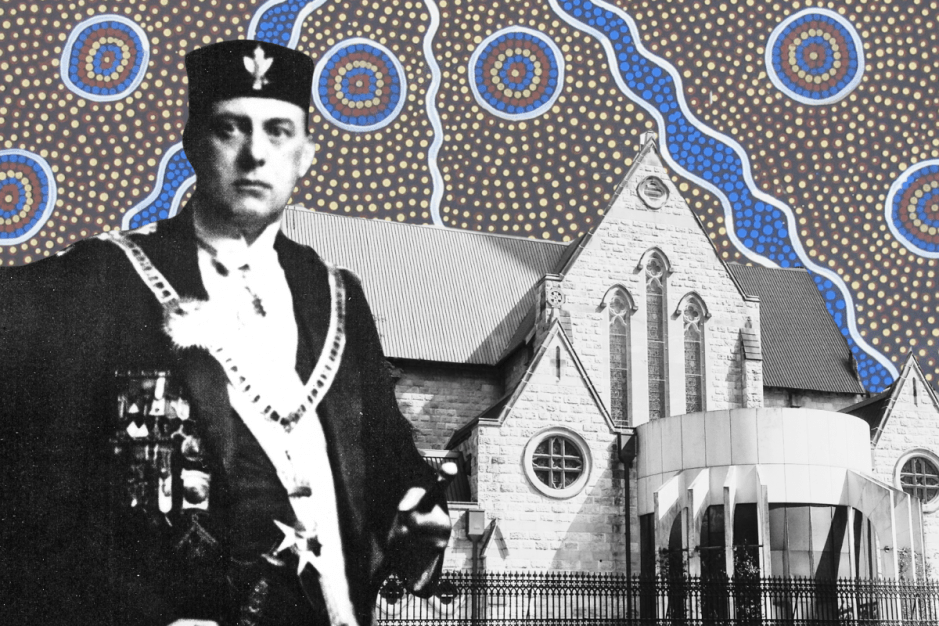
One highlight (or lowlight) during these decades, with particular relevance to Bishop Mackinlay, was a notorious shrine that appeared in Brisbane’s St. Stephen’s Cathedral. The shrine, entitled, The Human Search for God, was an anti-Christic collection of indigenous totems, fertility symbols and motifs related to pagan spirits and tribal ancestor worship. Some Catholics even discerned references to the magick rituals of Aleister Crowley in the designs. Outrageously, the collection was in place for seven years.
Although the exhibition has now been removed, other disturbing artworks remain at St. Stephen’s including a bizarre crucifix over the main altar.

 Ecclesiastical Freemasonry