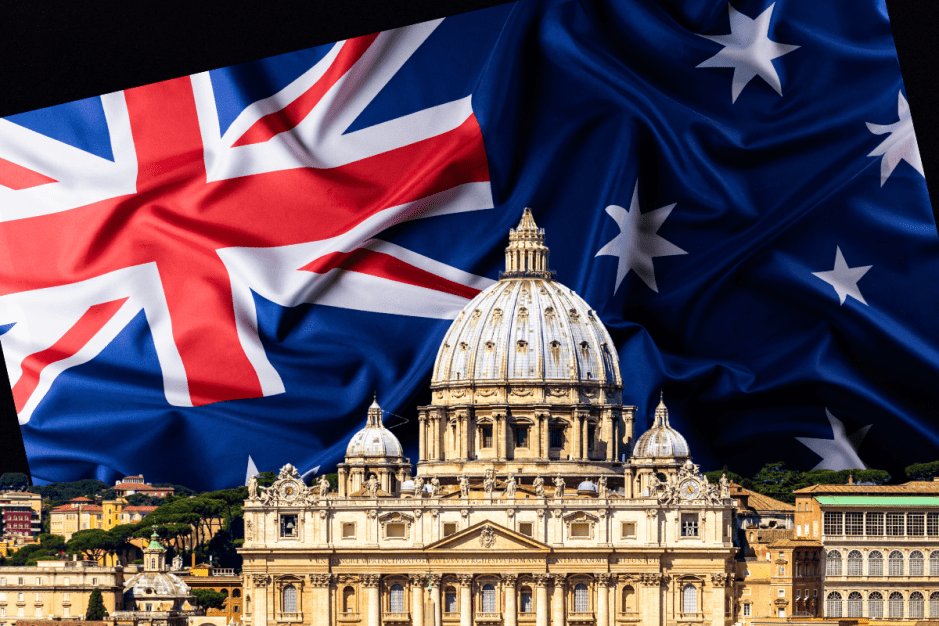
A Church Dedicated to the Four Elements

A church built in 2017 at the largest parish in Australia exemplifies the fusion of humanism and paganism which is unfortunately almost ubiquitous in contemporary Australian parishes. The church is one of five in the Burleigh Heads parish, and is part of the Archdiocese of Brisbane.

Named ‘Mary, Mother of Mercy’, the building includes anti-Christian features, including Masonic symbols and indigenous mythology. Pagan and occult features were built into the church’s design and the opening ceremony exemplified the parish’s focus on paganism with a smoking ceremony and allusions to the four principal elements of alchemy.

Problems begin with the logo used for all churches in the parish. It shows five crosses which no doubt represent the total number of churches, but these replace the traditional three-cross arrangement which represents Christ’s saving Crucifixion.

The usual arrangement representing the crosses of Our Lord and the two thieves.
The Burleigh Heads logo attributes to the crosses the merely human aspect of the number of member-churches.

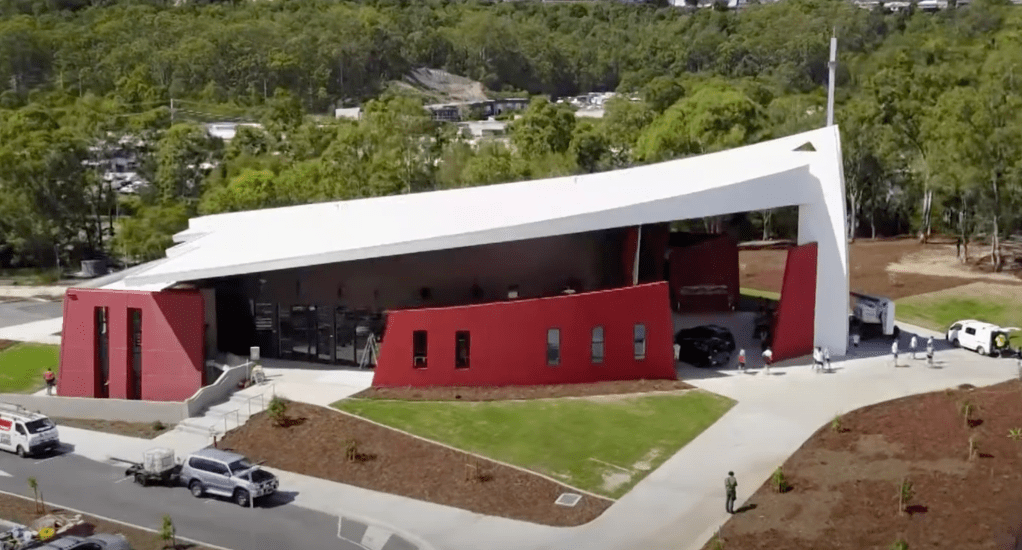
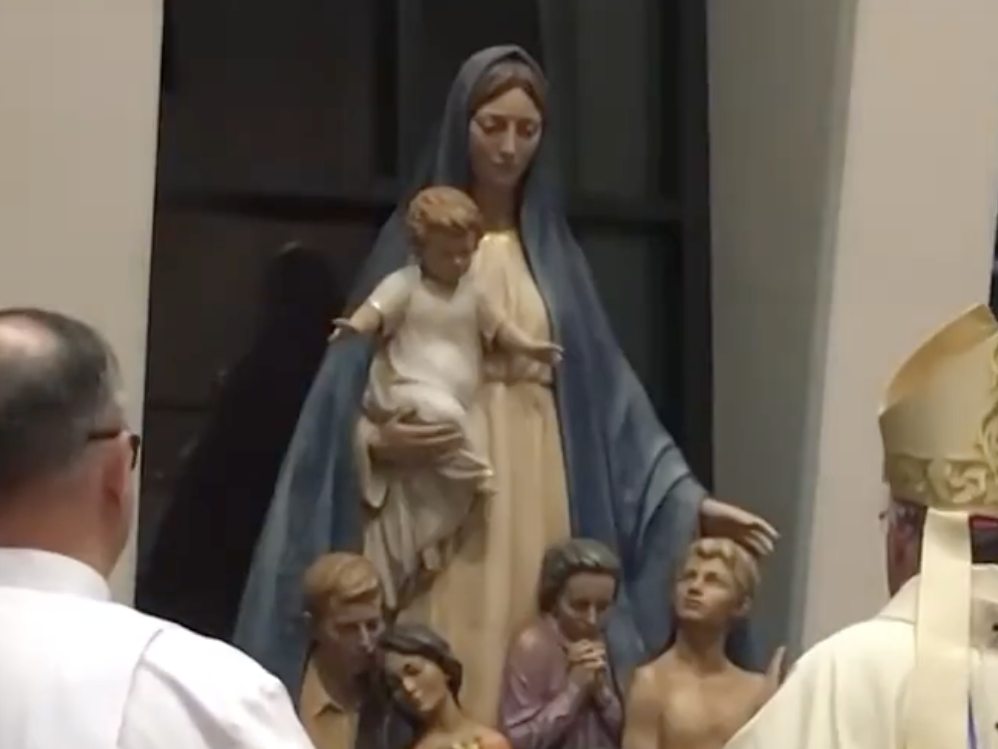
Built in a style typical of modern Australian churches, it features exposed steel beams and is almost devoid of sacred images. One exception is the enormous wooden statue of a very plain-faced Mother of God, surrounded by a group representing the diversity of Australian citizens, including a semi-naked boy with his surfboard.

The exterior of the church
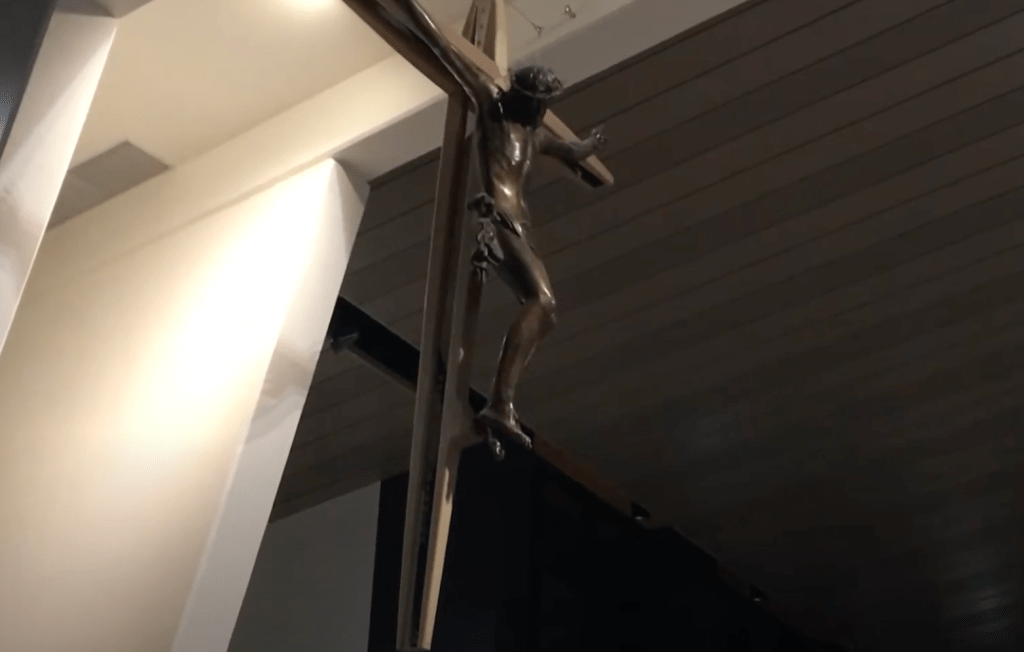
Massive beams and pillars dominate the interior

A plain-faced Mother of God
A topless boy

The sanctuary is typical of many churches here, with the tabernacle hidden from view. The church features a pair of strikingly Masonic design elements: two sets of twin pillars, one at the church’s entrance and one set inside the body of the church. A news report describes the latter set as ‘concrete portals;’ significant because in esotericism, a portal is a gateway to secret knowledge, and is usually achieved via occult rituals.

Interior of a Masonic lodge from Ohio.
The two pillars at the entrance to the church, flanked by structures appearing to represent a modern nod to the traditional flying buttress.
The nave holds the tabernacle; rather than the Blessed Sacrament being the focal point, this area is dominated by the massive pillars which span the entire building. The rows of chairs facing each other is another Masonic motif.

Twin pillars are especially significant in Freemasonry, where are said to represent the truth being found between two opposites, or poles. Duality is a common theme in the occult and was actually part of the design brief given to the designers for the church: they were asked that it embody ‘light and darkness, the masculine and the feminine, the sky and the earth’.

The heretical Archbishop of Brisbane, Mark Coleridge, (who possibly requested the design elements) gave a clue to the occult meaning of the ungodly building in his sermon at the opening Mass. He mentioned wind and fire, two of the four elements associated with alchemy and the occult.

This is the Church that has given birth to us and will continue to give birth to this community of faith in Burleigh Heads. It’s a place of the Spirit. It’s a place therefore of wind and fire, a place that can turn the human womb into a temple of God himself.

Archbishop Mark Coleridge

The third element, earth, is referenced by the twin pillars both inside and outside the church, which the designers explain “visually tie it to the ground.” The fourth element, water, is referenced in the name of the suburb housing the church – Burleigh Waters – as well as in the waters within the womb. Mention of the womb and rebirth also suggests the theme of transformation, so common among occultists.

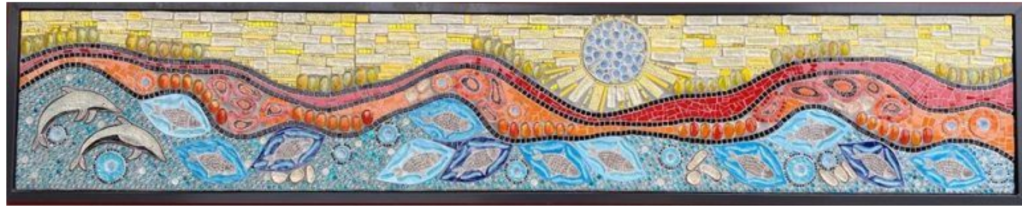
Outside the church is a mosaic, shown below, which was produced by a local indigenous artist. It represents a pagan myth about a hero who was reincarnated as a dolphin.

Indigenous artwork based on a pagan myth

During the church’s opening ceremony, an unknown type of smoking ritual took place. It involved a layman raising a ‘smoking’ bowl over congregants. This appeared similar to indigenous smoking ceremonies in which smoking leaves or herbs are burned in the belief that this cleanses the space of ‘evil spirits’.

A smoking ritual during the opening ceremony

Perhaps unsurprisingly, the parish is home to at least one esoteric prayer group: the ‘Contemplative Women’s Group’ which purports to examine Scripture and which features an activity reminiscent of Wicca: “sinking into the feminine divine.”

Prior to the construction of the building, the former parish priest, Fr Ken Howell, was given a ‘virtual tour’ using cutting edge technology from a company named Oculus. Oculus is, of course, Latin for eye – a very important symbol for occultists.

Fr. Howell, wearing the ‘Oculus’ virtual reality goggles.

A Wiccan Adoration Chapel in Melbourne

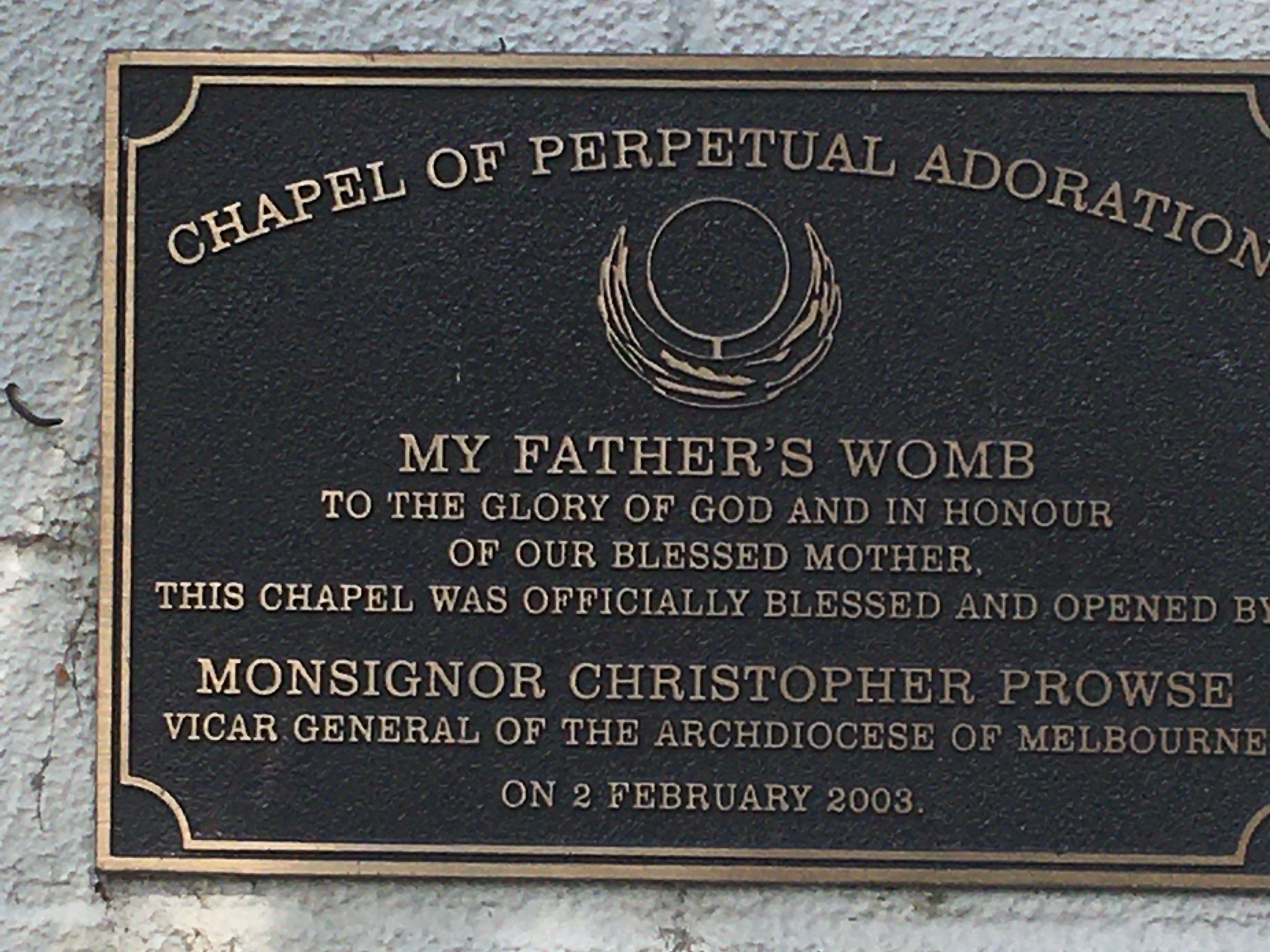
An Adoration chapel at St. Kevin’s Novus Ordo parish in suburban Melbourne raises questions as to just who has been designing our modern churches. Named, “Our Father’s Womb”, the chapel exhibits several hallmarks of Wiccan influence: exultation of the Feminine; mockery of the sacred; a giant labyrinth and a spell-casting tool.

Wicca is differentiated somewhat from witchcraft, although the two are related. Wicca is a religion whose disciples, known as practitioners, worship both a God and a Goddess. Wiccans celebrate rituals according to the seasons which, they believe, put them in touch with the Divine. The beliefs of each Wiccan vary according to the individual although the overarching rule is ‘Harm none and do as you will’. Most, but not all, Wiccans practise witchcraft, but not all witches are Wiccans.

The name of this chapel is absolutely bizarre, and suggests the glorification of the Feminine: “Our Father’s Womb: to the glory of God and in honour of our Blessed Mother.”

‘God’ in this case, does not necessarily refer to the Christian God; just as ‘the Blessed Mother’ does not necessarily refer to Our Lady.

Obviously, men do not have wombs and even more obviously, God is pure spirit and most certainly has no human organ such as a womb. Even if we accept the metaphor of a chapel being a womb-like place of security and comfort, the name is illogical from a Catholic point of view. Peace may be a fruit, but is not the purpose of an Adoration chapel. At best, this is the Modernist ideology of man-centredness at play.

At worst though, we are looking at a deliberately pagan mockery of the Blessed Sacrament.

A closeup of the image shows a now-familiar symbol, which has the appearance of a nest holding the Host.

This is very similar to an element found in the logo for the Synod on Synodality.

(I have also previously wondered if this was meant to represent a child in a womb – the Antichrist, perhaps?)

In witchcraft, bird-nests are used for both curses and blessings, so are tools used in spell-casting rituals. There is coincidentally a legend relating to the Celtic saint, St. Kevin, in which a bird made a nest on the palm of his hand. Kevin apparently remained motionless for 40 days while the bird came and went, building the nest.

A different explanation for the nest is that it is actually a crescent moon, which is another symbol for the Feminine.

So far, the signs of a Wiccan influence are somewhat veiled. Once we step inside, however, the occult references are even more pronounced.

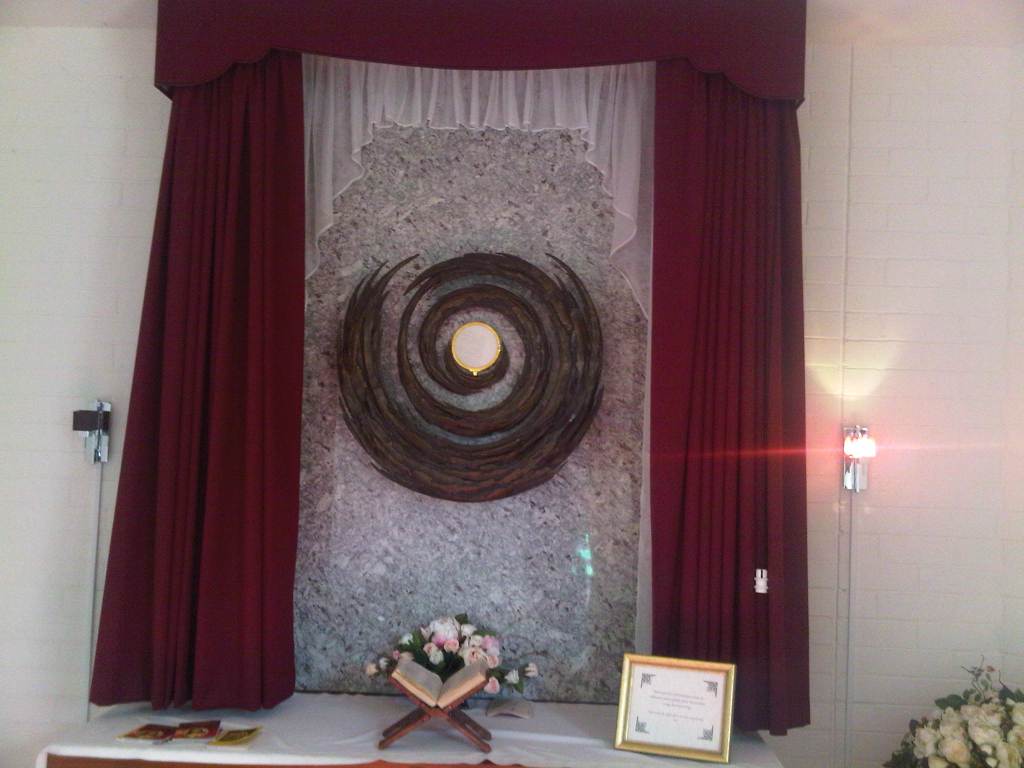
To the untrained eye, this is merely a very ugly setting for the exposed consecrated Host. But my learned friend believes that the red curtains are meant to represent female genitalia. He is familiar with this kind of imagery from the shrine to Lucifer in the Brisbane Cathedral.

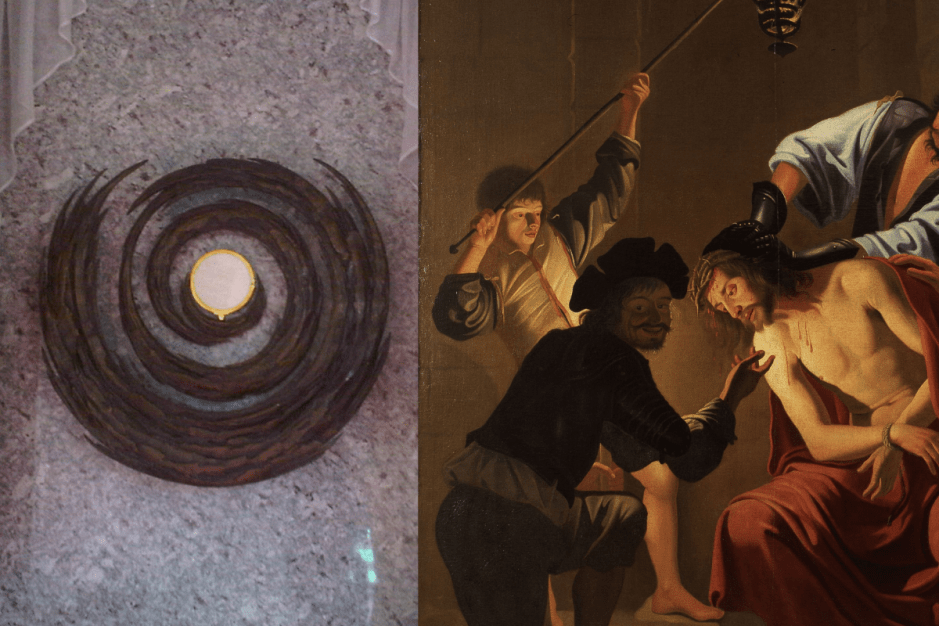
The spiral surrounding the host is made of metal plates, something akin to the scales of a snake. Snakes have an obvious relevance when it comes to Christianity and witchcraft: they represent Lucifer and his rebellion against God.

According to the book, The Women’s Encyclopedia of Myths and Secrets, a spiral represents “death and rebirth as movement into the disappearing-point of formlessness, and out of it again, to a new world of form.”

One variation of the spiral is the labyrinth, and one of these is found in the grounds of the church in question. To pagans,  the labyrinth is a “metaphor for the spiritual journey and a powerful tool for transformation. This walking meditation is an archetype, a mystical ritual found in all religious traditions.” Thus walking the labyrinth is a form of meditation – the dangerous mind-emptying kind, not the wholesome Catholic tradition of mental prayer.

Labyrinths are specifically related to Goddess worship, with the circle being an important symbol of the Divine Feminine. So in this setting, the Sacred host is surrounded by two symbols of the Feminine, with the spiral appearing as though it is ready to strangle or consume the Host and the scale of the curtains suggesting the apparent superiority of the goddess over the Triune God.

This raises the question: is the Host in this chapel Consecrated? It is truly the Body, Blood, Soul and Divinity of Christ? My answer to that is yes, probably. For the insult is only complete when such an ignoble setting surrounds the True Presence of the Lord, precisely as He endured during His Passion.

What the wicked people responsible for this abomination fail to acknowledge is that He alone created them and died for their sins. Unless they repent, the veil of their souls’ temples will one day be torn in two and they will be cast into everlasting fire for their rebellion and their failure to adore the One, True God.

As I was putting together a header image for this post, I wanted to use sacred artwork to counter the foul images of witchcraft that have been flooding my screen. On seeing a beautiful representation of Christ’s Passion, it occurred to me that the Host surrounded by a diabolical wreath of scales is not unlike Christ’s Sacred Head crowned with thorns. Perhaps this is yet another layer of mockery those responsible had in mind.

Australian Bishops are in the Synodal Way

Even though they missed out on the red hat, three of Australia’s bishops remain happy to carry water for the Synod.

One of them is Shane Mackinlay, bishop of Sandhurst, who is representing the Bishops Conference at the Synod in Rome. According to McKinley, Fiducia Supplicans was a direct result of the Synod. He told a press conference that although the Pope didn’t act synodally by issuing the heretical document, that’s fine by him:

“As with many things Pope Francis has done in the last year, he did not wait for the final document. He has already responded to things that were raised in the discussions and in the final report last year.”

This is despite the Pope stating that he would absolutely not be making a decision on same-sex unions before the second Synod sessions.

According to Mackinlay, “Fiducia supplicans is a significant step forward … and then I think those of us from the West are not so surprised that in some other parts of the world it is received differently and has a different kind of priority.”

Yes, it is received differently because ‘in some parts of the world’ the Bishops are actually Catholic! Mackinlay is so popular in Rome that he was elected for the second time as the Oceania representative for the Commission for the Final Document of the Synod – quite the appointment.

Another Synod apparatchik is Archbishop Timothy Costelloe, no stranger to these pages. As Archbishop of Perth and president of the Australian Catholic Bishops’ Conference, Costelloe is completely onboard with the Synod’s agenda of re-imagining Catholicism. He couldn’t hide his enthusiasm for heterodox novelty when he told Vatican News that it was great to have priests, women, and lay people usurping to role of the Bishops by being given full voting rights instead of having a ‘back row seat’.

“It shows us the equality and unity of all. Unity is communion of mind and heart, of spirit and action, and of faith at the service of the Church’s evangelising mission.”

This ‘unity’ is nowhere to be found either at the Synod or outside of it, of course. The persecution of traditional Catholics and the clamouring voices of dissenters from the Faith are evidence of that.

Archbishop Costelloe also explained that the so-called ‘conversation in the spirit’ “serves to free oneself from prejudices. The Synod must convert us from a competitive approach to a spirit of listening because in this way it will be of real and effective help to the Pope.”

He posed a few more rhetorical questions: “Should the Synod office be restructured in favour of the local Churches? If so, how? And could the reports become documents to be published?”

Now, don’t worry too much if you don’t have the answer to these questions. Something tells me that the Synod Fathers (and Mothers) already have the answers – pencilled in from Day 1.

The third Australian Synod mouthpiece is Anthony Randazzo, Bishop of Broken Bay diocese, who seems to have mastered the art of verbally giving with one hand while taking with the other.

One the one hand, Randazzo criticises those who are ‘obsessed’ by the issue of women’s ordination. But look at the reasons he gives as objections to it:

“Those issues become all-consuming and focusing for people, to the point that they then become an imposition on people who sometimes struggle simply to feed their families, to survive the rising sea levels, or the dangerous journeys across wild oceans to resettle in new lands.”

The Catholic Diocese of Broken Bay website reports that while Randazzo has ‘no problem with the topic of women’s ordination being discussed and studied at the Synod’, he thinks it should be poor women and not wealthy, well-educated ones who call for it. What? So now the disobedient notion of ordaining women is only wrong when it is attached to white privilege?

Maybe someone needs to tell His Grace that the Amazonian women are way ahead of the curve. They are already receiving a para-liturgical blessing from their Cardinal before beginning their ‘ministry’ of distributing the Sacraments.

How anyone can think this matter was not laid to rest in the past with an infallible statement is beyond me.

A Providential Good News story

this morning, without an article ready to publish, i was overwhelmed with discouragement at having to present yet another post containing an Apostate pope in a funny hat or a freemason prelate expelling a faithful priest or any similarly dismal theme.

Lo and behold, this sweet testimony, full of hope and gratitude, arrived in my inbox. It originated here.

NOTES in square brackets [ ] added by yours truly.

Cara Veronica,

On June 19, 2024, a sad day to remember, the last Latin Mass was celebrated in St. Patrick’s Cathedral (Melbourne). More than 850 faithful were present.

On Wednesdays of every week of the year, an ancient mass was celebrated in that church, attended by hundreds of young people.

The document to suppress it was sent by the Vatican and signed by Archbishop Vittorio Francesco Viola. In it they apologized, saying that since there is an anti-traditional climate in Rome, it is not appropriate for the Cathedral to continue with the usual Mass. Words that really make no sense…

Now, that one has been suppressed, only two parishes remain that celebrate the traditional mass. Among these is mine, which has the authorization for another 2 years. Then we will have to ask for permission again, which we fear will not be granted. Let us pray intensely that the Lord will come to free us soon, Veronica! It was too much pain for us! What a disappointment! What an outrage!

We are all infinitely sorry, also because that Holy Mass was attended by many young people: students, seminarians and young workers. For them it was the only ancient, midweek Mass they could attend. 

Already in 2021, after receiving the first order from Rome, the archbishop had forbidden all parishes to celebrate in Latin. Then we do not know what happened: suddenly he gave permission to the Cathedral to celebrate it and on Wednesdays it was very popular. At least 500 [NOTE: a slight exaggeration – by a factor of 10] faithful attended each time. Its suppression was a real scandal! Let us entrust ourselves to the Virgin Mary, Mother of the Church, Veronica, and pray that Her Immaculate Heart will soon triumph.

In my parish, as I was saying, one of the two still authorized to celebrate the ancient rite of the Saturday mass,*  by Grace, the Sunday mass is reformed, but in Latin** and is solemn.  [NOTE: Most Masses in this parish are Novus Ordo, offered ad Orientem; there is a weekly TLM as permitted by the local Ordinary.] Between incense, blessings and Gregorian chants, many are the young people and large families, with many children, who attend it, even coming from very far away. There are those who travel hundreds of kilometers by car to be there, on holidays.

The solemn Mass lasts about an hour and a half. Many women, like me, wear the veil and 90% of the faithful and more, receive Communion on the tongue. 

Our parish priest is an exemplary priest. Very young, but with a traditionalist background.

Upon his arrival, a new air was breathed. Softer, more sacred. He made a radical counter-revolution, abolishing all modernist customs and practices and restoring a certain material and spiritual discipline.

First he removed the altar girls and placed the Tabernacle back in the center, from a lateral position where it had previously been placed. He removed an ugly table, placed in place of the Altar, installing another, worthy of the name. He put back the kneelers to receive Holy Communion on the tongue and began to use the plate under the chin again, during His distribution. With him the sign of peace immediately became a distant memory and he began to distribute Holy Communion personally, completely excluding extraordinary ministers.

Needless to say, the priest wears a cassock and I noticed that the toes of his shoes are bent upwards, so much time is spent kneeling. God bless him and confirm. He has already bought the balustrades [altar rails] that will be installed soon.

During the lockdown he never abandoned or neglected the faithful. He heard confessions for more than 3 hours on Saturdays, when other churches were closed. He even installed an automatic dispenser for holy water, instead of taking it away. So great is his zeal, that he always found a solution for every problem that arose.

The Church in Australia has changed in recent years, but it has not reached the negative extremes of Italy: for example, no priest has ever thought of refusing Communion to the faithful, because they want to receive it on the tongue and kneeling . [NOTE: this does, in fact, sometimes happen in Australia, unfortunately.] The Our Father has not changed either and normally everyone kneels during the Consecration.

We know well that in particular everything depends on the priest and in general we notice a certain awakening among them.

The young consecrated people are very devoted and lovers of the two-thousand-year-old tradition of the Catholic Church.

Let’s hope so, Veronica.

A big hug to you. Thank you

Silvia, da Melbourne (Australia)

While there are some who say that the reverent Novus Ordo is “part of the problem”, I say, along with St. Pio of Pietrelcina, that in times like these, we must take the good wherever we find it. Thank God for this woman and for her blessed little parish which is evidence that God never abandons His Church.

Early Australian Freemasonry

NOT ECCLESIASTICAL, BUT OF INTEREST NONETHELESS!

SOURCE: THE WEBSITE OF FIRST FLEET FELLOWSHIP VICTORIA INC  BY CHERYL TIMBURY

Freemasonry has been associated with the British discovery and settlement of Australia from the very beginning. Sir Joseph Banks (1743-1820), the naturalist who sailed into Botany Bay with James Cook in 1770 became a Freemason prior to 1768 and was a member of the Old Horn Lodge No. 4 in England.

Thomas Lucas (1759-1815), a Private in the 23rd Company Marine Corps and a member of Lodge of Temperance No 225 in England, arrived with the First Fleet. Captain Matthew Flinders (1774-1814), who arrived in 1795, was initiated into Friendly Cultivator Lodge while held in Mauritius.

The following men were all freemasons and convicts:

Thomas Prior (1756-1836),

Robert William Felton Lathrop Murray (1777-1850) – editor of the Colonial Times,

Richard Fitzgerald (1772-1860) – early proprietor of the Bank of New South Wales,

James Alexander Thomson (1805-1860) – architect, engineer and builder,

Dr William Bland (1789-1868) – Sydney’s first full-time private practitioner,

Samuel Clayton (1783-1853) – transported for forgery and engraved the banknotes for Bank New South Wales when it opened its doors in 1817,

Francis Greenway (1777-1837) – colonial architect who appeared on the old $10 note.

In 1797, the Grand Lodge of Ireland, meeting in Dublin, received a petition from Privates George Kerr, Peter Farrell and George Black requesting a warrant to form a Masonic Lodge in the New South Wales Corps serving at Port Jackson. The matter was deferred and no warrant was issued.

In September 1802, two French naval vessels, Le Geographe and Le Naturaliste, were anchored in Port Jackson and whilst there held a lodge meeting at which a Captain Anthony Fenn Kemp of the New South Wales Corps was initiated. It is interesting to note that Anthony Kemp was a Captain attached to the New South Wales Corps stationed at Port Jackson and therefore a senior officer of the Port Jackson battery.

The war between France and England had ended only months before with the signing of the Treaty of Amiens on 21 March 1802 but these two French ships, on a scientific expedition under the control of Commodore Nicholas Baudin of the Le Geographe, had been sailing in Australian waters for nearly a year before they came into Sydney in June for replenishment of their stores. They did not sail again until November, so the crews had five months to fraternise with the settlers and the military personnel ashore.

Captain Kemp was heavily involved in a trade bringing spirits into the colony, much to Governor King’s disgust. When the Atlas arrived with a cargo of brandy in September 1802, King forbade it being landed ashore but he did allow eight hundred gallons of the shipment to be sold to Baudin to replenish his ships. Kemp was furious and accused some of the French officers of on-selling the brandy to settlers. King ordered an investigation and, finding the complaint unfounded, directed Kemp to officially apologise to the French officers concerned. 

It is also recorded that Lodge Rameau d’Or d’Eleus (The Legend of the Golden Acacia) was formed by French gold miners at Ballarat (Victoria) in 1856 and that it had applied for recognition by the English Constitution lodge already in existence in the same town. Recently (1992) a French language lodge was constituted in Sydney.

Sir Henry Browne Hayes (1762-1832), an Irish convict, attempted to form a Lodge in 1803 in defiance of an order from Governor King, however, his meeting held on 14th May 1803 is regarded as the foundation day of Freemasonry in Australia. He did not try again even though he later formed a friendship with Lachlan Macquarie, the first of many Governors to be members of the Masonic fraternity.

It was common practice at this time for Masonic Lodges to be formed on board naval vessels and within regiments of the British Army and for Freemasonry to be practiced wherever the ship or regiment was stationed. The 46th Regiment of Foot, which arrived in 1814, had attached to it the Lodge of Social and Military Virtues No. 227, Irish Constitution. The 48th Regiment with Lodge No. 218, Irish Constitution, replaced this regiment in 1817.

It was this Lodge that granted dispensation to form the first Lodge in Sydney in 1820 at a time when the total population of the colony was only 30,000. This Lodge, with just twelve foundation members, was called the Australian Social Lodge and was issued with warrant No. 260 by the Grand Lodge of Ireland. The Lodge still meets in Sydney as Lodge Antiquity No. 1 on the register of the United Grand Lodge of New South Wales and the Australian Capital Territory.

Four years later, The Leinster Marine Lodge of Australia No. 266, Irish Constitution, was formed in Sydney and, in due course, other Lodges were warranted, not only by the Grand Lodge of Ireland but also by the United Grand Lodge of England, in Sydney, in 1828 and the Grand Lodge of Scotland, in Melbourne, in 1844.

From the early years of the nineteenth century, the free settlers had sought some measure of political self-determination, which resulted in the establishment of a Legislative Council in New South Wales in 1824, due largely to the work of Bro. William Charles Wentworth.

This, in turn, led the Freemasons to seek local control of their Masonic affairs, which resulted in a number of attempts to form local Grand Lodges independent from the parent bodies in Britain. The Grand Lodges of England, Ireland and Scotland in particular, strenuously opposed such a move and it was not until 1877 that mainly the Irish Lodges in the colony formed the Grand Lodge of New South Wales.

The first Grand Master was the Hon. James Squire Farnell, at the time the Premier of New South Wales, who had previously been Provincial Grand Master for New South Wales of the Irish Constitution. There was a similar line of Masonic development in Victoria, which resulted in the establishment of the Grand Lodge of Victoria in 1883 with the Hon. George Selth Coppin, a Member of the Legislative Assembly, as the first Grand Master.

Eventually, the other colonies each formed a Grand Lodge with South Australia leading in 1884, Tasmania in 1890, Western Australia in 1900 and Queensland in 1904. United Grand Lodges were established in New South Wales in 1888, Victoria in 1889 and Queensland in 1921.

Open Letter to Australia’s Catholic Bishops regarding Freemasonry

Is something finally going to be done about this disgraceful state of affairs? Well, we won’t be holding our breath.

From the remnant newspaper

In a document dated 13 November 2023, the Dicastery for the Doctrine of the Faith has reaffirmed the incompatibility between Catholicism and Freemasonry and has reiterated the Church’s centuries-old prohibition on Catholics being members of Freemasonry.

Responding to a request for pastoral direction from the Most Rev. Julito Cortes, Bishop of Dumaguete, (Philippines) who expressed concern about the increasing numbers of his Catholic flock who were enrolled in Freemasonry, Cardinal Víctor Manuel Fernández, Prefect of the Dicastery for the Doctrine of the Faith, issued a “Note for the Audience With the Holy Father Regarding the Best Pastoral Approach to Membership in Freemasonry by the Catholic Faithful”1. The document was countersigned by Pope Francis. In addition to providing practical suggestions and pastoral guidelines, the document states that:

“ … active membership in Freemasonry by a member of the faithful is forbidden because of the irreconcilability between Catholic doctrine and Freemasonry (cf. Congregation for the Doctrine of the Faith, “Declaration on Masonic Associations” [1983], and the guidelines published by the Catholic Bishops Conference of the Philippines in 2003). Therefore, those who are formally and knowingly enrolled in Masonic Lodges and have embraced Masonic principles fall under the provisions in the above-mentioned Declaration. These measures also apply to any clericsenrolled in Freemasonry.”

The 1983 “Declaration on Masonic Associations” states:

“Therefore the Church’s negative judgment in regard to Masonic association remains unchanged since their principles have always been considered irreconcilable with the doctrine of the Church and therefore membership in them remains forbidden. The faithful who enrol in Masonic associations are in a state of grave sin and may not receive Holy Communion.”

Given this recent confirmation by the Apostolic See of the Church’s perennial ban on Catholic membership in Freemasonry, we feel it is an opportune moment to remind Your Excellencies of the ongoing deep concern among many Australian Catholics that was first sparked over six years ago by a letter of 11 July 2017 written by the then General Secretary of the Australian Catholic Bishops’ Conference, the Rev Stephen Hackett [see letter].

Fr. Hackett’s response to the Grand Master, written on behalf of the ACBC, clearly leaves the door open to sacramental reception by Australian Catholic Freemasons in many or most cases, even though that door had been totally and firmly closed – and remains closed – by the Church’s perennial doctrine and discipline.

Fr. Hackett was replying to a letter sent a year earlier to the ACBC by Mr Stephen Michalak, a Catholic who was then Grand Master of Freemasonry for South Australia and the Northern Territory. In this letter, which he said was written with the unanimous support of all Masonic Grand Masters in Australia, Mr. Michalak not only asked the Australian bishops to “outline a pathway for Catholics who are Freemasons to full participation in the sacramental life of the Church,” but appealed to the present Holy Father’s pastoral approach in support of this request. To deny Catholic Masons access to the sacraments, said the Grand Master, “seems totally at variance to my understanding of what Pope Francis is actively trying to promote – a spirit of understanding and reconciliation . . . love and forgiveness”.

Rome’s recent reiteration of the Church’s absolute prohibition of membership in Freemasonry shows how completely Grand Master Michalak misunderstood the Holy Father’s thinking on this matter. But it seems possible that Fr. Hackett, along with the members of the Bishops’ Commissions on Canon Law and Doctrine and Morals whom he says he consulted, and not a few others among Your Excellencies, may have shared that misunderstanding. For Fr. Hackett’s response to the Grand Master, written on behalf of the ACBC, clearly leaves the door open to sacramental reception by Australian Catholic Freemasons in many or most cases, even though that door had been totally and firmly closed – and remains closed – by the Church’s perennial doctrine and discipline. Fr. Hackett’s response is particularly shocking to many of the faithful in this country, given that it claims merely to “reiterate” an Australian episcopal policy dating right back to 1984 that has been “affirmed this year” (i.e., some time between January and July 2017). As if to drive the point home, Fr. Hackett ends his letter to the representative of Australian Freemasonry by stating that this essentially affirmative response to his request is “the preferred approach of the Bishops [sic] Conference”.

So what, precisely, does this “preferred approach” consist in? Fr. Hackett assures Mr. Michalak that “no penalty attaches to Catholic membership in the Masonic order”. This is technically correct, given that in the 1983 Code of Canon Law the previous Code’s canonical penalty of excommunication for Masonic membership was deleted and replaced by a more general penal sanction against those who join any society that “plots against the Church” (cf. c. 1374). But since Fr. Hackett did not insert the word “canonical” before “penalty”, and since most lay Catholic readers would certainly regard their exclusion from the sacraments as a “penalty”, his statement is wide open to creating the false and scandalous impression that the Church no longer excludes Freemasons from the sacraments in any way.

The second point Fr. Hackett ignores in his letter is the CDF’s insistence that local ecclesiastical authorities have no authority to mitigate or derogate from the Church’s total exclusion of Catholic Freemasons from the sacraments in places where (as in Australia, apparently) they may discern a benign, rather than hostile, attitude towards the Church in local Masonic lodges.

It is true that Fr. Hackett nuances this seemingly permissive generalization by acknowledging that “in some other countries, . . . Freemasonry can be antithetical to Catholic faith” (in which case, presumably, membership would fall foul of canon 1374). So because of such regional or local divergences within Freemasonry, says Fr. Hackett, the Australian bishops have “prudently” decided not to issue any general directive on “Catholic involvement in Freemasonry”. Rather, he says, “such involvement is in each instance best addressed personally with the local parish priest”. Nevertheless, Fr. Hackett, claiming to express the official position of the ACBC, makes it abundantly clear that admission to the sacraments is to be the norm for Australian Catholic Freemasons, and exclusion from them the exception. For he tells the Grand Master that “where a local pastoral response is not consistent with this expectation [i.e., the expectation of admission to the sacraments as a general rule following the Church’s elimination of any “penalty” for Masonic membership] and liturgical-sacramental participation is made difficult or refused, that this might be referred to the local vicar-general or to me”.

In all this, however, Fr. Hackett’s letter ignores what seem to us two fundamentally important points. The first is that even when Freemasons do not “plot against the Church”, and so don’t incur the canonical penalty laid down in c. 1374, Masonic membership as such is still affirmed by the Church to be a grave sin that excludes from Holy Communion. Why? Because of “the irreconcilability between Catholic doctrine and Freemasonry”. Masonic communities do indeed allow members to profess and practice the religion of their choice, Christian or non-Christian; but only as one human tradition among others. Freemasonry’s relativistic, deistic and anti-supernatural ideology rejects the Catholic Church’s claim to possess uniquely the fullness of divine revelation. Moreover, Freemasonry has its own syncretistic religious rituals (which it tries to keep a closely guarded secret), and participation in prohibited rites such as these remains penalized in the current Code of Canon Law. In the section “Offences Against Religion and the Unity of the Church”, we read, “One who is guilty of participation in prohibited religious rites is to be punished with a just penalty” (c. 1365).

The second point Fr. Hackett ignores in his letter is the CDF’s insistence that local ecclesiastical authorities have no authority to mitigate or derogate from the Church’s total exclusion of Catholic Freemasons from the sacraments in places where (as in Australia, apparently) they may discern a benign, rather than hostile, attitude towards the Church in local Masonic lodges. Indeed, Fr. Hackett’s message to this country’s Catholic Masons that the ACBC has in general opened the door to their liturgical and sacramental participation, and that exceptional or problematical cases may be referred to “the local parish priest”, the “local vicar general”, or Fr. Hackett himself, stands in open defiance of the 1983 Vatican ruling. For the Declaration ends with the following affirmation:

“It is not within the competence of local ecclesiastical authorities to give a judgment on the nature of Masonic associations which would imply a derogation from what has been decided above, and this in line with the Declaration of this Sacred Congregation issued on 17 February 1981. (cf. AAS 73 1981 pp. 240-241.)”

We present them with a view to mitigating the scandal experienced in this matter by the faithful, as well as by members of Freemasonry, whose immortal souls may have been put in jeopardy by rash assurances that such membership is not sinful and is compatible with the reception of the Eucharist.

In view of the above, we respectfully request a new clarification from Your Excellencies regarding Catholic involvement in Freemasonry that includes a formal repudiation of Fr. Hackett’s erroneous position. More specifically:

1. We ask that the Australian Catholic Bishops Conference formally state its commitment to upholding the 1983 Declaration from the Congregation for the Doctrine of the Faith and the November 2023 Note from the Dicastery for the Doctrine of the Faith. Both of these are in continuity with the Church’s longheld judgment when they affirm, “The principles [of Freemasonry] have always been considered irreconcilable with the doctrine of the Church and therefore membership in them remains forbidden. The faithful who enrol in Masonic associations are in a state of grave sin and may not receive Holy Communion.”

2. We ask that the Bishops’ Commission for Canon Law and the Bishops’ Commission for Faith and Morals, both explicitly mentioned by Fr Hackett as having been consulted prior to the release of his letter, clarify for those unfamiliar with canon law that the statement “no penalty attaches to Catholic membership in the Masonic order” refers only to the absence of an ecclesiastically imposed canonical punishment such as excommunication or interdict, and in no way implies that such membership is morally acceptable.

3. We ask that, in a manner similar to that which has now been recommended to the Filipino Bishops by the DDF, the Australian Bishops “conduct catechesis accessible to the people and in all parishes regarding the reasons for the irreconcilability between the Catholic Faith and Freemasonry”.

4. We ask that the results of any investigation into the preparation and publishing of Fr. Stephen Hackett’s 2017 letter be made public. For that letter, written on behalf of the ACBC, directly contradicts the well-known doctrine and discipline of the Catholic Church towards Freemasonry that had been declared in 1983 by the CDF under Pope St. John Paul II and has now been reaffirmed by the DDF under Pope Francis.

These requests to Your Excellencies are being respectfully made in the spirit of canon 212, sections 2 and 3, which recognize the right of Christ’s faithful to make known to the Pastors of the Church their spiritual needs and their views on matters which concern the good of the Church. We present them with a view to mitigating the scandal experienced in this matter by the faithful, as well as by members of Freemasonry, whose immortal souls may have been put in jeopardy by rash assurances that such membership is not sinful and is compatible with the reception of the Eucharist.

Be assured of our prayers for Your Excellencies as we thank you for your gracious attention to this submission ….