Most of the information in this article comes from a fascinating book, ‘Pope Leo XIII and the Prayer to St. Michael’. The book looks at various accounts of the origin of the prayer as well as its significance.
Pope Leo XIII famously composed the prayer to St. Michael after seeing a vision in which God gave the devil permission to have free reign over the earth from the mid-twentieth century. The date of that apparition is traditionally given as October 13, 1884 – coincidentally, that is exactly 140 years ago today. This date is significant for several reasons, none of which should be a surprise to my readers. October 13, as well as being the anniversary of Leo’s apparition, it is the date of the miracle of the sun at Fatima (1917) and of the final apparition of Our Lady at Akita (1973).
Some sources believe that Leo’s decision to write the prayer coincided with his increasing concern over the influence of Freemasonry on the Catholic Church. His predecessor, Pius IX, had ordered a set of prayers to be prayed by priest and faithful after Low Mass for the protection of the Church. Leo inserted the prayer to St. Michael into that set of prayers – a practise which continues today in traditional parishes – requesting this from his priests in his classic encyclical against Freemasonry, Humanem Genus.
Leo issued continued warnings to his priests to be increasingly vigilant with regard to dangers both within and without the Church. As well as the St. Michael prayer, Leo composed an exorcism prayer just for priests which is based on the St. Michael prayer as well as a longer version of the St. Michael prayer to be used by the laity.
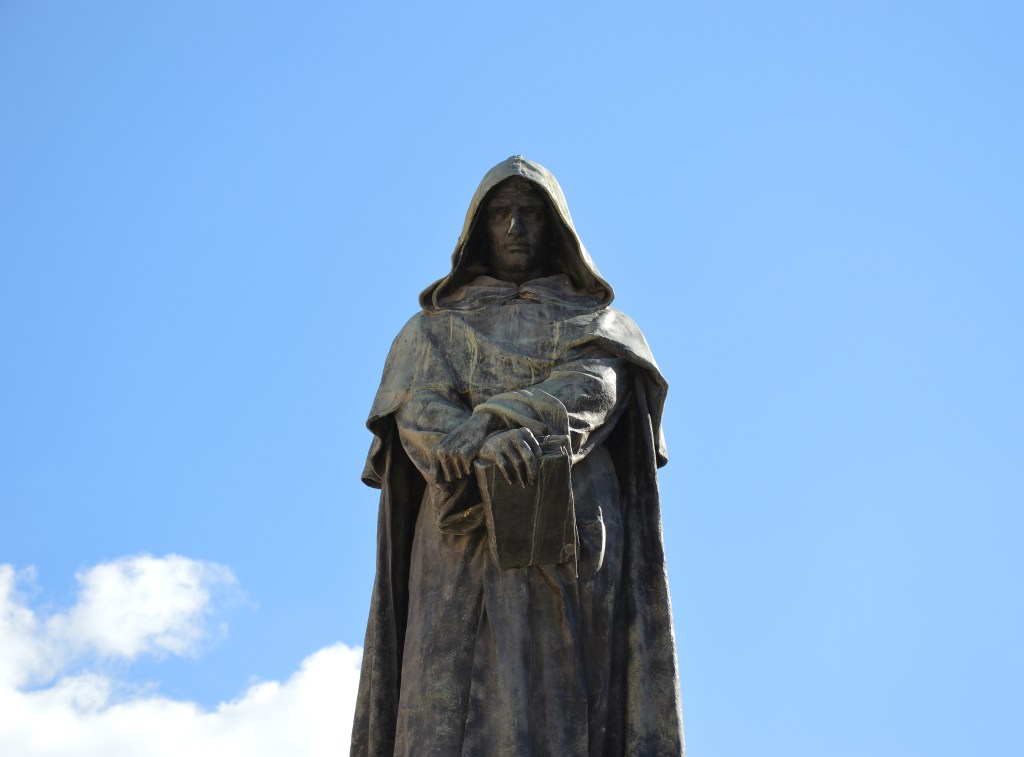
SOURCE: Livioandronico2013 via Wikimedia Commons
Leo’s strong condemnations of Masonry drew the ire of the secret societies against him. In particularly egregious incident, the Masons erected a statue of an infamous heretic in Rome. The heretic, Giordano Bruno had been condemned and executed under the Inquisition in 1600.
Bruno was a hero to the Freemasons and other subversive groups and the statue’s sculptor went on to become the Grand Master of the Grand Orient lodge of Italy. By erecting Bruno’s statue, the Masons were in effect thumbing their noses at Pope Leo. Leo’s response was to release another encyclical, Dall’alto dell’Apostolico Seggio, condemning the Freemason’s act. The date of issue was October 15, 1890, just two days after the mysterious and highly significant date of October 13th.
[As an aside, Giordano Bruno was posthumously rehabilitated by the highly suspect Cardinal Angelo Sodano in the year 2000! As another aside, and this is very strange: St. Michael is a saint who is perversely venerated by the Masons, who think of him as the ‘planetary angel of the sun.’]
One reason why Pius and Leo sought to engage extra help from the archangels can be found in the records of exorcists. During exorcisms performed after their pontificates, demons admitted that there had been ‘unusually numerous and strong invasions by diabolical spirits on the earth’ during Pius’ pontificate. One exorcist wrote:
In their battle against the Church, the demons use the wicked people as their allies. They have succeeded in enlisting a large number of people under their banner.
“We have the will of the people on our side,” they say.
The demon ‘Caesar’ leads their forces to stir up governments against the Church. “The people are our trusty storm troops”, he stated.
The Masons are among the main supporters of the demons. Lucifer admits that they are his ‘dearly beloved children’ and calls them his ‘representatives on earth.’
The exorcist continued:
Once they are defeated, the time will come when the members of the secret societies will be humiliated. The Virgin will destroy the secret societies. She has already set herself against them.
So we can see that before Modernism infiltrated the Church, Freemasonry was identified as being Her fundamental enemy, leading Pius to institute extra prayers after Mass for the protection of the Church and leading Leo to compose some very powerful new prayers invoking the great St. Michael.
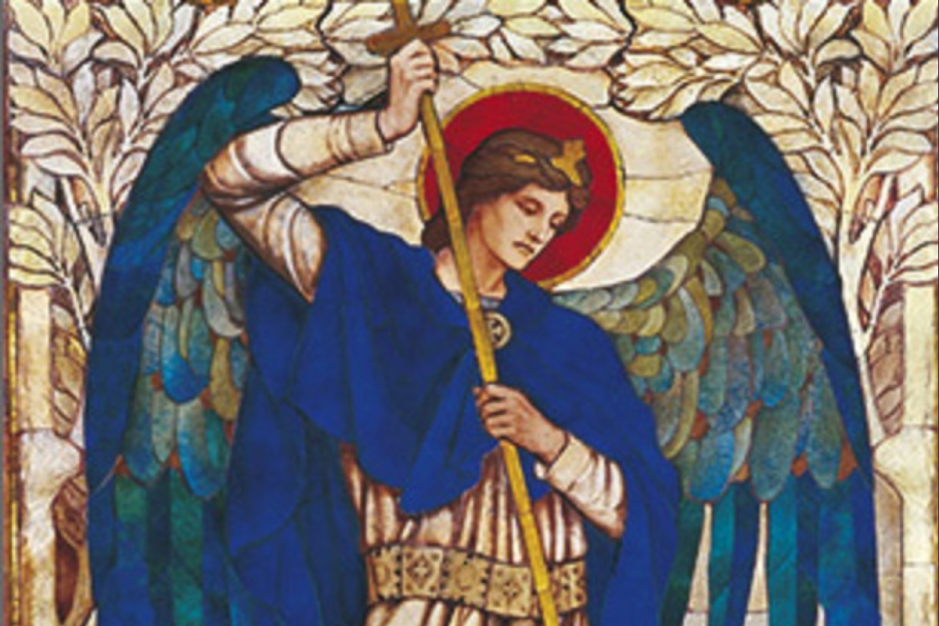
IMAGE SOURCE: detail from James Powell and Sons of the Whitefriars Foundry, Public domain, via Wikimedia Commons









 Ecclesiastical Freemasonry