Deism, Esotericism and Gnosis in the Masonic Constitutions of 1723

FROM: CORRISPONDENZA ROMANA by Fr Paolo Siano

Published May, 2020. (Automatic online translation from Italian)

1723 is the year of the first Constitutions of the new Grand Lodge of London (later of England ) founded in 1717. The author is the Presbyterian pastor and Master Mason James Anderson (1679-1739). By now modern Freemasonry, that of the “Modern” Freemasons, no longer builds churches, but wants to rebuild Man, Society, social and religious relations.

In The Constitutions of the Free-Masons (London 1723), instead of the Old Charges , or Ancient Duties (for which cf. article here ), we find new Duties (“Charges”: Pp. 49-56), still valid in Freemasonry, for example in the Grand Orient of Italy from which I draw the Italian translation (GOI, Antichi Duty – Constitution – Regulation , Rome 2018) of some passages from the 1723 text.

New duties establish in Title I ( The Constitutions , p.50) that Freemasons are henceforth bound ” to that Religion in which all men agree, leaving them their particular opinions; that is, to be good and sincere men, or men of honor and honesty“.

In Title VI, 2 it is written that Freemasons belong to the aforementioned Universal Religion (“as Masons, of the Catholick Religion above mention’d “: p.54; catholic means universal). This religion, with which Freemasonry unites men of all religions or religious confessions (in an alchemical coincidentia oppositorum ), is not at all the Catholic Christian religion ( as, instead, some Catholic Freemasons of the pro-English area affirm ), but it is a natural, anthropocentric and rationalist religiosity that relegates the dogmas to mere opinions. It is Deism, as also admitted by English Freemasons [ AQC 78 (1965), pp.50-51.55].

Historian David Stevenson notes that Anderson, as pastor, hates Catholics and Deists in his sermons, but writing as a Freemason the Constitutions also includes Deism in the Masonic Universal Religion (cf. Heredom, vol. 10/2002, Scottish Rite Research Society , Washington DC , USA, pp. 97,115-116,119-121,127; p.136 note70).

There’s more: I discovered that even in the Constitutions of 1723 there are traces of Esotericism and Gnosis. Here they are in summary. On the cover or frontispiece there is the image of Phoebus-Apollo, the shining sun-god who, young and naked, travels the sky with his chariot. Phoebus, god of divination, gives life and death (alchemical death-rebirth?), Loves both Daphne and Giacinto (divine, initiatory bisexuality?). The image of the god Phoebus, together with that of the Cainite Tubalcain, is already in an alchemical booklet printed in Florence in the 14th century (cf. A Libretto di Alchemy engraved on lead sheets in the 14th century… , Città di Castello 1910, pp. 27.30). Again on the title page of the Constitutions, under the title there is a bird that seems to resemble the ibis, the symbol of Hermes Trismegistus.

I discovered that, in the seventeenth century, in London, in the Devil’s Tavern, in a room called the Oracle of Apollo, the Apollo Club met: a literary club that also recited odes to the Devil. In the Devil’s Tavern there was also a libertine and blasphemous circle, the Hell-Fire-Club to which belonged the Duke of Wharton, Freemason, depicted in the Constitutions of 1723 as newly elected Grand Master!

From 1722 in the Devil’s Tavern a lodge met that took that name, “Devil”. In the “Apollo” of the Devil’s Tavern, from 1725 to 1767, the Grand Lodge of London held at least 75 meetings (cf.The New England Freemason, N° 12, pp.543-544; AQC 11 (1898), p.30; cf. G. Oliver, in W. Hutchinson, Spirit of Masonry, 1843, p.12).

In the historical-legendary part of the Constitutions of 1723 the 4 sons of Lamech, Cainites, do not have a prominent position as in the previous Old Charges of the XV-XVIII centuries. Now it is God who directly transmits the Art / Science of Geometry / Masonry to Adam and these then to his sons Cain and Seth. Abel is not mentioned (pp. 1-2). Anderson does not say that, even according to the Jewish Kabbalah, God passed on the Secrets of the Kabbalah to Adam.

In fact, modern Freemasonry presents itself as an initiatory society and as a spiritual art that binds the Initiates to each other and to the Divine. In a hymn attached to the Constitutions , Freemasonry is defined as divine art revealed by Heaven ( “Craft divine!… From Heav’n reveal’d“: P. 83). Even in Anderson’s Constitutions, Cain figures as the first Mason who builds a city.

Anderson writes that Cain is the Prince of one half of humanity and his posterity has imitated his royal example in improving Science and Masonry (p. 2). Then, in a note, the descendants of Cain (Tubalcain, Jabal…) are credited with the invention of metalworking, architecture and other arts (p. 2). Among the keepers of the Masonry, Nimrod, king of Babylon, is also praised; in footnote Anderson specifies that Nimrod means Rebel and that he was revered as Baal and Bacchus (p. 4).

Anderson mentions the wise men of the Chaldeans, the “Magi,” – hence the term: magic, and the priests of ancient Egypt as custodians and transmitters of Masonry; he specifies that about the Chaldeans, the Magi, Hiram Abiff and Moses, it is necessary to speak only in a constituted Lodge! Another keeper of the Muratoria is Cam (“Ham”), one of Noah’s sons. Pythagoras and Euclid are also among the keepers of the Masonry (cf. pp. 4-5, 8, 16, 20-21). It is good to know that in magical literature, at least since the sixteenth century, Cam is associated with black magic (cf. BE Jones, Freemasons’ Guide and Compendium , London 1950, p. 314).

In the Constitutions, Anderson praises the architect, Vitruvius, (p.25) and affirms that in times of ignorance geometry was considered to be the evocation of spirits (p. 36, note *). The scholar, Frances Yates, (1899-1981) sees a similarity between these statements by Anderson and what the magician, John Dee, (1527-1608) wrote in his preface to Euclid’s Mathematics: Dee praised Vitruvius and called out those who accused him of evoking spirits (The Rosicrucian Enlightenment, London – New York 2002, pp. 271-272). Scholar Susann Mitchell Summers found that Anderson possessed the writings of John Dee and other wizards and occultists (cf. The Square , December 2018, Addlestone, UK, p. 18).

In the Constitutions 1723 there is mention of the ” shining and free Genius ” of the Freemasons, then in one of the songs in the appendix to the Constitutions the powerful Genius of the Upper Lodge is praised (” The Mighty Genius of the lofty Lodge “: p.80). Later in the title page of the Constitutions of 1784 will appear ” the Genius of Masonry “, a winged angel bearing light (a lucifer), defined as she (“She”). Initiatory androgyny? In Title II of Masonic Duties , Anderson writes that even if a Mason commits a crime against the State, he cannot be expelled from the Lodge and maintains an irrevocable bond (“indefeasible “), or indelible, with the Lodge (p. 50)

Also interesting is Anderson’s 1738 New Book of Constitutions approved by the Grand Lodge of London at the Devil’s Tavern . After Anderson’s preface, there is the image of a seated woman, surrounded by various objects including the Caduceus of Mercury (p. X), that is the winged staff with two entwined snakes, symbol of Hermes Trismegistus. In the appendix to The New Book of Constitutions there is a pamphlet from 1730, A Defense of Masonry , in which the rites and principles of Freemasonry are linked to those of ancient pagan, Egyptian, Pythagorean, Druid, Qabalist Mysteries (pp. 216- 226).

In 1739 a posthumous, non-Masonic work by Anderson, ” News from Elysium: or Dialogues of the Dead ” was published in two volumes in London . On the title page of both volumes stands the figure of Hermes Trismegistus flying in the sky and carrying his Caduceus (cf. AQC 18 (1905) pp. 34-37). In the second image Hermes / Mercury appears to have female breasts. Androgyny? 

The Bugnini Effect: part 1

FROM: Liturgical Time Bombs in Vatican II: The Destruction of Catholic Faith Through Changes in Catholic Worship

by Michael Davies

The Rise and Fall and Rise and Fall of Annibale Bugnini

Before discussing the time bombs in the Council texts, more specifically those in its Constitution on the Sacred Liturgy, which would lead to the destruction of the Roman Rite, it is necessary to examine the role of Annibale Bugnini, the individual most responsible for placing them there and detonating them after the Constitution had won the approval of the Council Fathers.Annibale Bugnini was born in Civitella de Lego [Italy] in 1912. He began his theological studies in the Congregation of the Mission (the Vincentians) in 1928 and was ordained in this Order in 1936. For ten years he did parish work in a Roman suburb, and then, from 1947 to 1957, was involved in writing and editing the missionary publications of his Order. In 1947, he also began his active involvement in the field of specialized liturgical studies when he began a twenty-year period as the director of Ephemerides liturgicae, one of Italy’s best-known liturgical publications. He contributed to numerous scholarly publications, wrote articles on the liturgy for various encyclopaedias and dictionaries, and had a number of books published on both the scholarly and popular level.

Father Bugnini was appointed Secretary to Pope Pius XII’s Commission for Liturgical Reform in 1948. In 1949 he was made a Professor of Liturgy in the Pontifical Propaganda Fide (Propagation of the Faith) University; in 1955 he received a similar appointment in the Pontifical Institute of Sacred Music; he was appointed a Consultor to the Sacred Congregation of Rites in 1956; and in 1957 he was appointed Professor of Sacred Liturgy in the Lateran University. In 1960, Father Bugnini was placed in a position which enabled him to exert an important, if not decisive, influence upon the history of the Church: he was appointed Secretary to the Preparatory Commission on the Liturgy for the Second Vatican Council. [Biographical details are provided in Notitiae, No. 70, February 1972, pp. 33-34.] 

He was the moving spirit behind the drafting of the preparatory schema (plural schemata), the draft document which was to be placed before the Council Fathers for discussion. Carlo Falconi, an “ex-priest” who has left the Church but keeps in close contact with his friends in the Vatican, refers to the preparatory schema as “the Bugnini draft.” [Carlo Falconi, Pope John and His Council (London: Weidenfeld & Nicholson, 1964), p. 244.] It is of the greatest possible importance to bear in mind the fact that, as was stressed in 1972 in Father Bugnini’s own journal, Notitiae (official journal of the Sacred Congregation for Divine Worship), the Liturgy Constitution that the Council Fathers eventually passed was substantially identical to the draft schema which he had steered through the Preparatory Commission. [Notitiae, No. 70, February 1972, pp. 33-34.] According to Father P. M. Gy, O.P., a French liturgist who was a consultor to the pre-conciliar Commission on the Liturgy, Father Bugnini “was a happy choice as secretary”:

He had been secretary of the commission for reform set up by Pius XII. He was a gifted organizer and possessed an open-minded, pastoral spirit. Many people noted how, with Cardinal Cicognani, he was able to imbue the discussion with the liberty of spirit recommended by Pope John XXIII. [A. Flannery, Vatican II: The Liturgy Constitution (Dublin: Sceptre Books, 1964), p. 20.]

The Bugnini schema was accepted by a plenary session of the Liturgical Preparatory Commission in a vote taken on January 13, 1962. But the President of the Commission, the eighty-year old Cardinal Gaetano Cicognani, had the foresight to realize the dangers implicit in certain passages. Father Gy writes: “The program of reform was so vast that it caused the president, Cardinal Gaetano Cicognani, to hesitate.” [Flannery, p. 23.] Unless the Cardinal could be persuaded to sign the schema, it would be blocked. It could not go through without his signature, even though it had been approved by a majority of the Commission. Father Bugnini needed to act. He arranged for immediate approaches to be made to Pope John, who agreed to intervene. He called for Cardinal Amleto Cicognani, his Secretary of State and the younger brother of the President of the Preparatory Commission, and told him to visit his brother  and not return until the schema had been signed. The Cardinal complied.Later a peritus of the Liturgical Preparatory Commission stated that the old Cardinal was almost in tears as he waved the document in the air and said: “They want me to sign this but I don’t know if I want to.” Then he laid the document on his desk, picked up a pen, and signed it. Four days later he died. [Fr. Ralph M. Wiltgen, S.V.D., The Rhine Flows into the Tiber: A History of Vatican II (1967, rpt. Rockford, IL. TAN, 1985), p. 141.]

A Future Pope’s Masonic/Mafia Connections

From: THE RITE OF SODOMY V by Randy Engels

Montini and the Mafia:

Archbishop Montini Meets “the Shark”

Michele Sindona, aka, “the Shark” was an underworld financial fixture in Milan long before Montini became Archbishop.[80]

Born in Messina at the eastern end of Sicily in 1917, the Jesuit educated Sindona was studying law when the British and American troops invaded Italy during World War II. The enterprising Sindona decided to take advantage of the lucrative black market and went into the lemon and wheat business. Since the Sicilian Mafia controlled the produce trade, Sindona cut a deal with Mafioso head, Vito Genovese, whereby he would turn over a certain percentage of his earnings for protection from the mob for his business and his person.

In 1948, Sindona left the poorer war-ravaged southern boot of Italy and migrated north to the richer industrialized city of Milan where he became a “financial advisor” to a number of influential and wealthy Milanese. His Mafia credentials traveled north with him.

In 1954, when Sindona learned that Pius XII had appointed Msgr. Montini to the See of Milan, he secured a letter of introduction to the new Archbishop from the Archbishop of Messina, his home diocese. Sindona soon had a new client in Montini and the Milanese Church.

Archbishop Montini was so grateful to Sindona, that he took the Sicilian to Rome and introduced him to Pope Pius XII and Prince Massimo Spada, a senior official at the Istituto per le Opere de Religioni (the Institute for Religious Works). The IOR, which is popularly known as the Vatican Bank functions as a depository for the Church’s patrimony earmarked for charitable works.[81] Sindona became “a man of confidence” and was given virtually full control over the IOR’s foreign investment program.

The gross assets of the IOR at the time were over $1 billion, but money was secondary to the IOR’s tax-free status and its potential as a laundry for washing dirty money, specifically, Mafiosi earnings from heroin trade, prostitution and illegal political contributions from underground sources including Freemasons.[82]

In 1960, Sindona, operating under the old adage “the best way to steal from a bank is to own one,” purchased his own bank, the Banca Privata, and within a very short time was receiving deposits from the IOR. He used these funds to pyramid his own financial investments and started to launder illegal funds through the Vatican Bank.

After the election of Pope Paul VI, Sindona followed Montini to Rome and became a major player at the IOR. His operations and financial portfolio grew exponentially. In 1964, Sindona formed an international currency brokerage firm called Moneyrex with 850 client banks and annual financial dealings of $200 billion. Many members of the Palazzo, the rich and famous of Rome, used the firm to shield their fortunes from taxation through illegal offshore accounts. Sindona kept a secret ledger of his clients’ transactions with Moneyrex as insurance for a rainy day. The Vatican and Pope Paul VI, along with the name and numbers of the secret accounts of high ranking members of the Christian Democratic Party as well the Socialist and Social-Democratic Parties were all in Sindona’s little black book.

By the late 1960s, the “Gruppo Sindona” included six (later nine) banks in Italy and abroad and more than 500 giant corporations and conglomerates. One of the banks, the Franklin National Bank of New York, the 18th largest bank in the United States with assets of more than $5 billion, was purchased in part with money Sindona had skimmed off from his Italian banks.[83] He also skimmed off funds from his secret masters, that is, the Sicilian Mafia and, after 1971, from the Propaganda Duo (P2), a Mafia-inspired Masonic Lodge catering to Italy’s elite headed by Grandmaster Licio Gelli. In addition, Sindona was handling financial transactions for the U.S. Central Intelligence Agency (CIA) which during the post-war period was pouring large sums of money into Italy, some of which made its way to the Vatican Bank.[84]

Meanwhile Sindona’s friend, Pope Paul VI was the recipient of bad tidings from the State. The Italian government was threatening to remove the fiscal tax exemption on the Church and Church properties and investments that the Holy See had enjoyed since the days of Mussolini’s Fascist regime. Under the revised tax-code, the Vatican State would be taxed like any other corporate entity. Sindona proposed a scheme to hide Vatican money in offshore investments and the pope agreed.

One of Sindona’s prominent protégés was a native Milanese by the name of Roberto Calvi.

Calvi was the central manager of the Banco Ambrosio, Italy’s most prominent Catholic bank as distinguished from the lay or secular banking institutions operated by the Jews and Freemasons. Calvi was a man after Sindona’s own heart, which spelled disaster ahead not only for the Banco Ambrosiano, but also for its major depositor, the Holy See. Calvi had his own connections to the IOR through Monsignor Macchi, Montini’s personal secretary. He was also on excellent terms with an American priest at the Secretariat of State, Msgr. Paul Marcinkus.

FOOTNOTES

Footnotes.

  1. This section on Vatican finance is based in information taken from a large number of publications and web sites including Conrad Goeringer, “History of the IOR – Murder, Bank, Strategy – the Vatican.” See also David A. Yallop “In God’s Name – An Investigation into The Murder of Pope Paul I.” (Free downloadable e-book available at this site.)

Other footnotes available on request.

A Conciliar Pope with the Odour of Masonry

While there is little indication that Paul VI was a formal Mason, there is no doubt that his programme of reform was completely in line with the agenda of Freemasons to create an ape of the Church.

Anonymous Catholic

FROM: Society of Saint Pius X

Archbishop Lefebvre’s assessment

On December 20, 2012, Benedict XVI authorized the Congregation for the Causes of Saints to promulgate a decree recognizing the “heroic virtues” of Paul VI, pope from 1963 to 1978. Now only a miracle obtained through the intercession of Paul VI is necessary to proceed to his beatification. Apparently the postulator for his cause, Fr. Antonio Marrazzo, has already chosen a case to present to the medical commission, the cure of an unborn child diagnosed with severe malformation. According to Andrea Tornielli of La Stampa’s Vatican Insider, the beatification could take place in 2013.

Paul VI is the pope who closed the Second Vatican Council, opened by his predecessor John XXIII. It was during Paul VI’s pontificate that the Novus Ordo Missae was developed. He wrote unhesitatingly to Archbishop Marcel Lefebvre in 1976, “The Second Vatican Council is no less authoritative than the Council of Nicea, and is even more important in some respects.”

Archbishop Lefebvre, who was suspended a divinis during Paul VI’s pontificate, gave his opinion of Paul VI to the seminarians of Econe in the lecture series he gave on the Magisterium that provided the material for his book They Have Uncrowned Him (Angelus Press, 1994).

Chapter 31, “Paul VI, a Liberal Pope,” provides a strong indication of what the Society of St. Pius X’s founder would have said about the pending beatification. DICI has introduced headings in the form of questions into Archbishop Lefebvre’s text, the better to follow his analysis.

How will Paul VI be judged by the Church of the future?

Obviously, the Church will one day judge this council and these popes. How will Paul VI, in particular, fare? Some call him heretic, schismatic, and apostate; others believe themselves to have proved that he could not have acted for the good of the Church, and that therefore he was not in fact pope—the theory held by sedevacantists. I do not deny that these opinions have some arguments in their favor. Perhaps, you will say, in 30 years secrets will have been revealed, or elements that should have been obvious to contemporary observers will stand out, statements made by this pope in complete contradiction to the traditions of the Church, etc. Perhaps. But I do not believe that such hypotheses are necessary; in fact, I think it would be a mistake to espouse them.

Others think, simplistically, that there were two popes: one, the true pope, imprisoned in the cellars of the Vatican, and the other, an imposter, his double, seated on the throne of Peter, working for the destruction of the Church. Books have been published about the two popes, based on the ‘revelations’ of a possessed person and on supposedly scientific arguments that state, for instance, that the double’s voice is not the same as that of the real Paul VI…!

What is your own explanation of Paul VI’s pontificate?

The real solution seems entirely different to me, much more complex, more difficult, and more painful. It is given us by a friend of Paul VI, Cardinal Danielou. In his Memoirs, published by a member of his family, the cardinal clearly states, “It is clear that Paul VI is a liberal pope.”

Such is the solution that seems the most historically likely, because this pope was himself a fruit of liberalism. His whole life was permeated with the influence of the men he chose to surround him or to rule him, and they were liberals.

Paul VI did not hide his liberal leanings; at the Council, the men he chose as moderators to replace the presidents appointed by John XXIII, were Cardinal Agagianian, a cardinal of colorless personality from the Curia, and Cardinals Lercaro, Suenens and Dopfner, all three liberals and the pope’s friends. The presidents were sidelined at the head table, and these three liberals directed the conciliar debates. In the same way, Paul VI supported the liberal faction that opposed the tradition of the Church throughout the entire Council. This is a recognized fact. Paul VI repeated—I quoted it to you—the exact words of Lammenais at the end of the Council: “L’Eglise ne demande que la liberte” – the Church only seeks freedom—a doctrine condemned by Gregory XVI and Pius IX.

Paul VI was undeniably very strongly influenced by liberalism. This explains the historic evolution experienced by the Church over the last few decades, and it describes Paul VI’s personal behavior very well. The liberal, as I have told you, is a man who lives in constant contradiction. He states the principles, and does the opposite; he is perpetually incoherent.

Could you provide some examples in support of your analysis?

Here are a few examples of the thesis-antithesis conundrums that Paul VI loved to present as so many insoluble problems, mirroring his anxious and conflicted mind. The encyclical Ecclesiam suam, (August 6, 1964), provides an illustration:

If, as We said, the Church realizes what is God’s will in its regard, it will gain for itself a great store of energy, and in addition will conceive the need for pouring out this energy in the service of all men. It will have a clear awareness of a mission received from God, of a message to be spread far and wide. Here lies the source of our evangelical duty, our mandate to teach all nations, and our apostolic endeavor to strive for the eternal salvation of all men. (…) The very nature of the gifts which Christ has given the Church demands that they be extended to others and shared with others. This must be obvious from the words: ‘Going, therefore, teach ye all nations,’ Christ’s final command to His apostles. The word apostle implies a mission from which there is no escaping.” 

That is the thesis, and the antithesis follows immediately:

To this internal drive of charity which seeks expression in the external gift of charity, We will apply the word ‘dialogue.’ The Church must enter into dialogue with the world in which it lives. It has something to say, a message to give, a communication to make.” 

And finally he attempts a synthesis, which only reinforces the antithesis:

Before we can convert the world—as the very condition of converting the world—we must approach it and speak to it.”[1] 

Have you another example?

Of greater gravity are the words with which Paul VI suppressed Latin in the liturgy after the Council, and they are even more characteristic of his liberal psychology. After restating all the advantages of Latin: a sacred language, an unchanging language, a universal language, he calls, in the name of adaptation, for the “sacrifice” of Latin, admitting at the same time that it will be a great loss for the Church. Here are his very words, reported by Louis Salleron in his book La nouvelle messe [The New Mass] (Nouvelles Editions Latines, 2nd ed., 1976, p. 83)

On March 7, 1965, he said to the faithful gathered in St. Peter’s square: 

‘It is a sacrifice that the Church makes in renouncing Latin, a sacred language, beautiful, expressive, and elegant. The Church sacrifices centuries of tradition and unity of language in the name of an ever-growing desire for universality’.” 

The ‘sacrifice’ of which he spoke became a reality with the Instruction Tres abhinc annos (May 4, 1967) which established the use of the vernacular for reciting the Canon of the Mass aloud.

This ‘sacrifice,’ in Paul VI’s mind, seems to have been final. He explained it once again on November 26, 1969, when he presented the new rite of the Mass:

The principal language of the Mass will no longer be Latin, but the vernacular. For anyone familiar with the beauty and power of Latin, its aptness for expression of the sacred, it will certainly be a great sacrifice to see it replaced by the vernacular. We are losing the language of centuries of Christianity, we become as intruders, reduced to the profane in the literary domain of expressing the sacred. We lose, too, the greater part of the admirable, incomparable wealth of art and spirituality contained in Gregorian chant. It is with good reason, then, that we experience regret and even distress.” 

Everything therefore should have dissuaded Paul VI from imposing this ‘sacrifice’ and persuaded him to maintain the use of Latin. On the contrary, deriving a singularly masochistic pleasure from his ‘distress,’ he chose to act against the principles he had just set forth, and decreed the ‘sacrifice’ in the name of promoting understanding of prayer, a specious argument that was only a modernist pretext.

Never has liturgical Latin been an obstacle to the conversion of infidels or to their education as Christians. Quite the opposite: the simple peoples of Africa and Asia loved Gregorian chant and the one sacred language, the sign of their affiliation to Catholicism. And experience shows that where Latin was not imposed by missionaries of the Latin Church, there the seeds of future schism were planted.

Paul VI followed these remarks with this contradictory pronouncement:

The solution seems banal and prosaic, but it is good, because it is human and apostolic. The understanding of prayer is more precious than the dilapidated silks in which it has been royally clad.  More precious is the participation of the people, the people of today who want us to speak clearly, intelligibly, in words that can be translated into their secular tongue. If the noble Latin language cuts us off from children, from youth, from the world of work and business, if it is an opaque screen instead of a transparent crystal, would we fishers of men do well to maintain its exclusive use in the language of prayer and religion?” 

Alas, what mental confusion. Who prevents me from praying in my own tongue? But liturgical prayer is not private prayer; it is the prayer of the whole Church.  Moreover, another lamentable lack of distinction is present: the liturgy is not a teaching addressed to the faithful, but the worship the Christian people address to God. Catechism is one thing, and the liturgy is another. The point is not that we “speak clearly” to the people assembled in the church, but rather that these people may praise God in the most beautiful, most sacred, and most solemn manner possible. “Praying to God with beauty” was St. Pius X’s liturgical maxim. How right he was!

How would you describe a liberal?

You see, the liberal mind is conflicted and confused, anguished and contradictory. Such a mind was Paul VI’s. Louis Salleron explained it very well when he described Paul VI’s physical countenance, saying “he was two-faced.” Not duplicitous—this word expresses a malicious intent to deceive which was not present in Paul VI. No, he had a double personality, and the contrast between the sides of face expressed this: traditionalist in words, then modernist in action; Catholic in his premises and principles, and then progressive in his conclusions; not condemning what he should have, and then condemning what he ought to have preserved.

This psychological weakness afforded an ideal opportunity for the enemies of the Church. While maintaining a Catholic face (or half-face, if you like) he contradicted tradition without hesitation, he encouraged change, baptized mutation and progress, and followed the lead of the enemies of the Church, who egged him on.

Did not the Izvestia, official newspaper of the Communist Soviet party, demand from Paul VI my condemnation and that of Econe in the name of Vatican II? And the Italian Communist paper L’Unita followed suit after the sermon I gave in Lille on August 29, 1976; furious because of my attack on Communism, they devoted an entire page to their demand. “Be aware,” they wrote, addressing Paul VI, “be aware of the danger Lefebvre represents, and continue the magnificent approach initiated through the ecumenism of Vatican II.” With friends like these, who needs enemies? This is a sad illustration of a rule we have already established: liberalism leads from compromise to treason.

How should priests and faithful who are attached to tradition act under a liberal pope?

The psychology of a liberal pope is easy enough to imagine, but difficult to bear! Indeed, such a leader—be it Paul VI or John Paul II—puts us in a very delicate position.

In practice, our attitude must base itself on a preliminary distinction, made necessary by the extraordinary circumstances of a pope won over by liberalism.  This is the distinction we must make: when the pope says something in keeping with tradition, we follow him; when he opposes the Faith, or encourages opposition of the Faith, or allows something to be done that attacks the Faith, then we cannot follow him. The fundamental reason for this is that the Church, the pope, and the hierarchy must serve the Faith. They do not make the Faith, they must serve it. The Faith cannot be made; it is immutable, and must be transmitted.

This is why papal teachings intended to validate actions opposed to tradition cannot be followed. In following, we would participate in the self-destruction of the Church, in the destruction of our Faith.

It is clear that what is unceasingly demanded of us—complete submission to the pope, complete submission to the Council, acceptance of the entire liturgical reform—is in opposition to tradition, in the sense that the pope, the Council and the reforms lead us far from tradition, as the facts show more overwhelmingly every year. Therefore, to demand these things is to require us to participate in the downfall of the Faith. Impossible! The martyrs died to defend the Faith; we have the example of Christians imprisoned, tortured, sent to concentration camps for the Faith. One grain of incense offered to an idol, and their lives would have been safe. I was advised once, “Sign, sign saying you accept everything, and then you can continue as before!” No! One does not play games with the Faith.


Footnote

1 English translation taken from the Vatican’s website, consulted Jan. 29, 2013.


Translated from Archbishop Marcel Lefebvre, Ils l’ont decouronne, Clovis, 3rd ed., 2008; pp. 253-260. Available in English translation at Angelus Press as They Have Uncrowned Him (1994).

(Source: DICI no. 269, 2-1-2013)

Freemasons on the Second Vatican Council

From The Devil’s Final Battle by Fr Paul Kramer, p 61-62; footnotes in original

“Along with the neo-modernists, the Masons and Communists have rejoiced at the Council’s outcome. Just as the authors of the Permanent Instruction of the Alta Vendita had hoped, just as the Communist infiltrators spoken of by Bella Dodd had hoped, the notions of liberal culture had finally won adherence among the major players in the Catholic hierarchy. Freemasons and Communists have celebrated the astounding turn of events wrought by the Council. They rejoice that Catholics have finally “seen the light,” and that many of their Masonic principles have been sanctioned by the Church.

For example, Yves Marsaudon of the Scottish Rite, in his book Ecumenism Viewed by a Traditional Freemason praised the ecumenism nurtured at Vatican II. He said:

Catholics …. Must not forget that all roads lead to God. And they will have to accept that this courageous idea of free-thinking, which we can really call a revolution, pouring forth from our Masonic lodges, has spread magnificently over the dome of St. Peter’s.”1

Yves Marsaudon was delighted to add that “One can say that ecumenism is the legitimate son of Freemasonry.”2

The post-Vatican II spirit of doubt and revolution obviously warmed the heart of French Freemason Jacques Mitterand, who wrote approvingly:

Something has changed within the Church, and replies given by the Pope to the most urgent questions such as priestly celibacy and birth control, are hotly debated within the Church itself; the word of the Sovereign Pontiff is questioned by bishops, by priests, by the faithful. For a Freemason, a man who questions dogma is already a Freemason without an apron.3

Marcel Prelot, a senator for the doubs region in France, is probably the most accurate in describing what has really taken place. He wrote:

We had struggled for a century and a half to bring our opinions to prevail within the Church and had not succeeded. Finally, there came Vatican II and we triumphed. From then on the propositions and principles of liberal Catholicism have been definitively and officially accepted by the Church.3

  1. Cited from Open Letter to Confused Catholics, pp 88-89
  2. Yves Marsaudon, Oecumènisme vu par un Maçon de Tradition, pp 119-120
  3. Cited from Open Letter to Confused Catholics, pp 88-89
  4. Ibid.

Catholicism vs. Freemasonry—Irreconcilable Forever

This article was reproduced online but was originally produced in pamphlet form by the World Apostolate of Fatima in the 1980’s.

What is the truth regarding the present official attitude of the Catholic Church toward Freemasonry? To begin this inquiry into that which is now in effect, we should go back to what was stated in the Church’s canon law before there was any doubt about where the Church stood on Masonry. The former code (which, incidentally, was promulgated on Pentecost, May 27, 1917, just two weeks after Our Lady’s first apparition at Fatima) contained a canon which definitely capped all the previous papal condemnations of it. Canon 2335 reads as follows:

Persons joining associations of the Masonic sect or any others of the same kind which plot against the Church and legitimate civil authorities contract ipso facto excommunication simply reserved to the Apostolic See.

In the wake of the Second Vatican Council, however, when the revision of the Code of Canon Law was underway, the prevailing spirit of “ecumenical dialogue” prompted questions among various bishops as to whether or not Canon 2335 was still in force. Responding to these questions, a letter from Cardinal Francis Seper, Prefect of the Sacred Congregation for the Doctrine of the Faith, to the presidents of all the episcopal conferences, dated July 18, 1974, stated that: (1) the Holy See has repeatedly sought information from the bishops about contemporary Masonic activities directed against the Church; (2) there will be no new law on this matter, pending the revision of the Code now underway; (3) all penal canons must be interpreted strictly and (4) the express prohibition against Masonic membership by clerics, religious and members of secular institutes is hereby reiterated.1

This rather awkwardly structured letter (which, for whatever reason, was not published in the Acta Apostolicae Sedis, the official journal of record for the Holy See) came to be interpreted in many quarters as allowing membership by laymen in any particular Masonic (or similar) lodge which, in the judgment of the local bishop, was not actively plotting against the Church or legitimate civil authorities.

This state of affairs, in which undoubtedly a fair number of Catholics in good faith became Masons, lasted for some years. Then, on February 17, 1981, Cardinal Seper issued a formal declaration: (1) his original letter did not in any way change the force of the existing Canon 2335; (2) the stated canonical penalties are in no way abrogated and (3) he was but recalling the general principles of interpretation to be applied by the local bishop for resolving cases of individual persons, which is not to say that any episcopal conference now has the competence to publicly pass judgment of a general character on the nature of Masonic associations, in such a way as to derogate from the previously stated norms.2

Because this second statement seemed to be as awkwardly put together as the first, the confusion persisted. Finally, in 1983 came the new Code with its Canon 1374:

A person who joins an association which plots against the Church is to be punished with a just penalty; one who promotes or takes office in such an association is to be punished with an interdict.

CARDINAL RATZINGER’S DECLARATION

Following the promulgation of the new Code, Cardinal Joseph Ratzinger, the new Prefect of the Congregation for the Doctrine of the Faith, issued a new declaration: (1) the new Canon 1374 has the same essential import as the old Canon 2335, and the fact that the “Masonic sect” is no longer explicitly named is irrelevant; (2) the Church’s negative judgment on Masonry remains unchanged, because the Masonic principles are irreconcilable with the Church’s teaching (“earum principia semper iconciliabilia habita sunt cum Ecclesiae doctrina”); (3) Catholics who join the Masons are in the state of grave sin and may not receive Holy Communion and (4) no local ecclesiastical authority has competence to derogate from these judgments of the Sacred Congregation.3

With these official statements of the Universal Church now on record,4 it should be clear that the lamentable confusion of so many Catholics regarding Freemasonry must be seen as only a temporary aberration—to be written off as one most costly consequence of a mindless “spirit of Vatican II.” But we may hope that, as in other issues that have plagued the Church in the last score of years, there is a providence in this, a veritable blessing in disguise. For now, more clearly than ever before, we should see just why the Catholic Church has been—and will always be—so opposed to Masonry.

It may at first seem plausible that the main (if not only) reason for its being condemned by the Catholic Church is that Masonry is conspiratorial. Its plotting against the Church (and, in the old Code, its also plotting against the State) is the one descriptive statement mentioned in both versions of the Code of Canon Law. Moreover, as the first curial document we cited (that of 1974) seems clearly to imply, the one requisite condition for permitting Catholics to join a Masonic lodge is that the lodge in question was not actively plotting against Church and State. Yet, for all its initial plausibility, this opinion seems to be inadequate. The proof of this is evident not only from the two subsequent curial documents (of 1981 and 1983), but more decisively still from the entire previous history of Roman documents, both curial and papal, treating of Masonry.

Beginning in 1738 with Clement XII’s encyclical In Eminenti (just twenty-one years after the establishment of the Grand Lodge of England, the event usually recognized as the commencement of the modern Masonic movement) and running through ten successive pontificates, the Church’s case against Freemasonry finds its culminating statement in 1884 in Leo XIII’s encyclical Humanum Genus. Masonic deceitfulness regarding its real objectives in society—and its consequent policy of secrecy regarding the authorities of Church and State, and including even the rank-and-file of its own membership—has always been noted by the popes, and most tellingly by Leo XIII.5 And in the century since then and in our own country this conspiratorial policy has been amply documented.6

However useful this knowledge of Masonic strategy is for our understanding of the authentic nature of the movement, it is quite secondary. It is wholly subordinate to that which defines the movement itself: the content in function of which conspiracy is but “method,” the end determining and justifying the means. That content—that end—is what we must now examine, if we are to find the fundamental and explicit reason for the Church’s condemnation of Freemasonry .

This fundamental reason can be briefly stated. The following summary passage from Leo XIII’s Humanum Genus suffices.

. . . that which is their ultimate purpose forces itself into view— namely, the utter overthrow of that whole religious and political order of the world which the Christian teaching has produced, and the substitution of a new state of things in accordance with their ideas, of which the foundations and laws shall be drawn from mere “Naturalism.”…

Now, the fundamental doctrine of the Naturalists, which they sufficiently make known by their very name, is that human nature and human reason ought in all things to be mistress and guide. Laying this down, they care little for duties to God, or pervert them by erroneous and vague opinions. For they deny that anything has been taught by God; they allow no dogma of religion or truth which cannot be understood by the human intelligence, nor any teacher who ought to be believed by reason of his authority. And since it is the special and exclusive duty of the Catholic Church fully to set forth in words truths divinely received, to teach, besides other divine helps to salvation, the authority of its office, and to defend the same with perfect purity, it is against the Church that the rage and attack of the enemies are principally directed.7

Catholicism and Freemasonry are therefore essentially opposed. If either were to terminate its opposition to the other, it would by. that very fact become something essentially different from what it previously was; it would in effect cease to exist as itself. For Catholicism is essentially a revealed religion; it is essentially supernatural, both in its destiny and in its resources. Beyond all natural fulfillment, it tends toward an eternity of ineffable union with God in Himself; and beyond all natural resources, it begins that union here and now in the sacramental life of the Church.

Masonry, on the other hand, is essentially a religion of “reason.” With an insistence and a consistency matching Catholicism’s self- definition, Masonry promises perfection in the natural order as its only destiny—as indeed the highest destiny there is. And it provides for this perfectibility with its resources: the accumulated sum of purely human values, subsumed under the logo of “reason.”

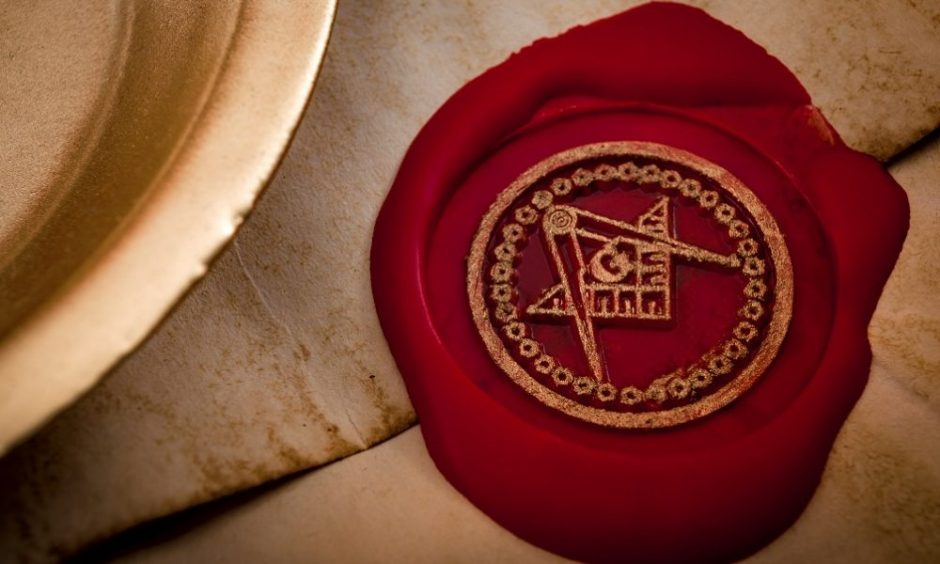
Literally a logo, the Masonic compass and square are the symbol of a Rationalism that claims to be identified with all that is “natural.” The consequent syncretism, blending all the strands of human experience—from the cabalistic mysteries of an immemorial Orient to the technological manipulations of a post- modern West—is the basis for Masonry’s claim to be not just a religion but the religion: the “natural” Religion of Man. That is why its claim to date from the beginning of history—its calendar numbers the “Years of Light” (from the first day of Creation) or the “Years of the World”—is no mere jest on its part. And that is why its opposition to the Catholic Church antedates the Catholic Church’s opposition to it. For it cannot abide the Church’s claim to be the One True Church, and the consequent refusal by the Church to be relegated to the status of a “sect” which Masonry would have it be.

Since the Church’s claim to be the One True Church is ultimately founded and validated on the reality of the One True God, the opposing Masonic claim must ultimately derive from a perception of God that diametrically opposes the Church’s faith. And so it does. Although Pope Leo does not explicitly speak of this essential opposition between Catholicism and Masonry in terms of the First Commandment of God—”I am the Lord thy God, thou shalt not have strange gods before me”—surely the most radical and simplest way of situating this opposition is to say just this. The Masonic “God” is an idol. What the Masons really worship is Man—or the Spirit who has deceived man from the beginning: the masked Spirit of Evil. This is the one primal reason why the Catholic Church has condemned, and will always condemn, Freemasonry. It is clearly sufficient to stand by itself as the only reason—and in a most fundamental sense, as Leo XIII seems to imply, that is the only reason in fact.

GRAVELY EVIL MISUSE OF OATHS

We can, however, give a second reason for the Church’s opposition to Masonry. Not strictly independent of the first reason, based as that reason is on the First Commandment, we can yet distinguish a second reason—based on the Second Commandment. Some ten years earlier than Humanum Genus, there appeared (even in English translation) a brief (barely more than pamphlet-sized) but penetrating work, A Study of Freemasonry, by the great bishop of Orleans, Felix Dupanloup.8 All the more impressive because of his “liberal” credentials, Dupanloup duly notes the facts, and the gravity, of the Masonic conspiracy. But what he stresses, besides the same primary point subsequently stressed by Leo XIII, viz., the Masonic violation of the First Commandment, is its violation of the Second Commandment by its gravely evil misuse of oaths. The famous (or, rather, infamous) oaths that run through the entire ritual of Masonic initiation are more than mere promises based on personal honor. They formally invoke the Deity, and have for their object a man’s total commitment to a cause under the direst sanctions. The Catholic Church sees in such oaths an inescapable grave evil. Either the oaths mean what they say or they do not. If they mean what they say, then God is being called to invert by his witness loyalties (viz., to Church and to State) already sanctioned by Him. If the oaths are merely fictitious, then God is being called to witness to a joke.

It is not the secrecy of what goes on “behind the lodge door” that elicits and justifies the Church’s condemnation of Masonry. It is rather the formal violation of the Second Commandment which these proceedings inescapably entail. The vaunted Masonic secrets, moreover, are scarcely that secret any longer. There is in fact a frequent Masonic plea to the effect that there are no secrets in Masonry—that all is open to a truly open mind. On this point we may take the Mason at his word: he is speaking more truly than he knows!

The case for the Catholic Church’s condemnation of Freemasonry is open and clear. By its very nature as formulated in its philosophical statements and as lived in its historical experience, Masonry violates the First and Second Commandments of God. It worships not the One True God of revelation—Father, Son and Holy Spirit—but a false god, symbolically transcendent but really immanent: the “god” called “Reason.” And it invokes without adequate cause the Name of the One True God. After such a case as this, to cite the secrecies of initiation and the further secrecies of machination called “conspiracy” is not only anti-climactic, it is beside the point.

To conclude: we Catholics should now see the Masons more clearly for what they essentially are. They are the heirs (unwitting or otherwise is irrelevant) of a religion which purports to be the one religion of the one “God”—and therefore the enemy, intrinsically and implacably so, of Catholicism. Freemasonry in its modern mode is “modernity” in the deepest (i.e., the philosophical and religious) sense of that term. It is, in a word, “Counterfeit Catholicism.” For its “God” is the “Counterfeit God”: the one who would be as God, the one who is the prince of this world, the one who is the Father of Lies.

ENDNOTES

1. “Complures Episcopi,” Notiziario CEI (1974) 191. (From Enchiridion Vaticanum, No. 563, pp. 350-51.

2. “S. Congregation pro Doctrina Fidei,” Acta Apostolicae Sedis 73 (1981) 240-41. (From EV, No. 1137, pp. 1036-39)

3. “Quaesitum est,” AAS 76 (1984) 300. (From EV, No. 553, pp. 482-87)

4. A summary of this documentation was made available in this country by the American Bishops’ Committee for Pastoral Research and Practice, in a report entitled “Masonry and Naturalistic Religion,” published in Origins, 15 (June 27,1985), pp. 83-84.

5. Acta Sanctae Sedis 16 (1883 sic) 420.

6. For an excellent recent survey, with emphasis on the American scene, see Paul Fisher’s Behind the Lodge Door: Church, State and Freemasonry in America (Bowie, MD: Shield, 1988).

7. Acta Sanctae Sedis 16 (1883 sic) 421. The English version used here is from a Paulist pamphlet first published in 1944 and reprinted by TAN (Rockford, IL: 1987), pp. 6-7.

8. The English edition which I used was published in Philadelphia in 1856.

Printed with ecclesiastical permission

This leaflet, item # 96595, may be obtained for 5 cents per copy from: World Apostolate of Fatima Washington, New Jersey 07882-0976

This item 2652 digitally provided courtesy of CatholicCulture.org