Is Rupnik finally about to receive justice?

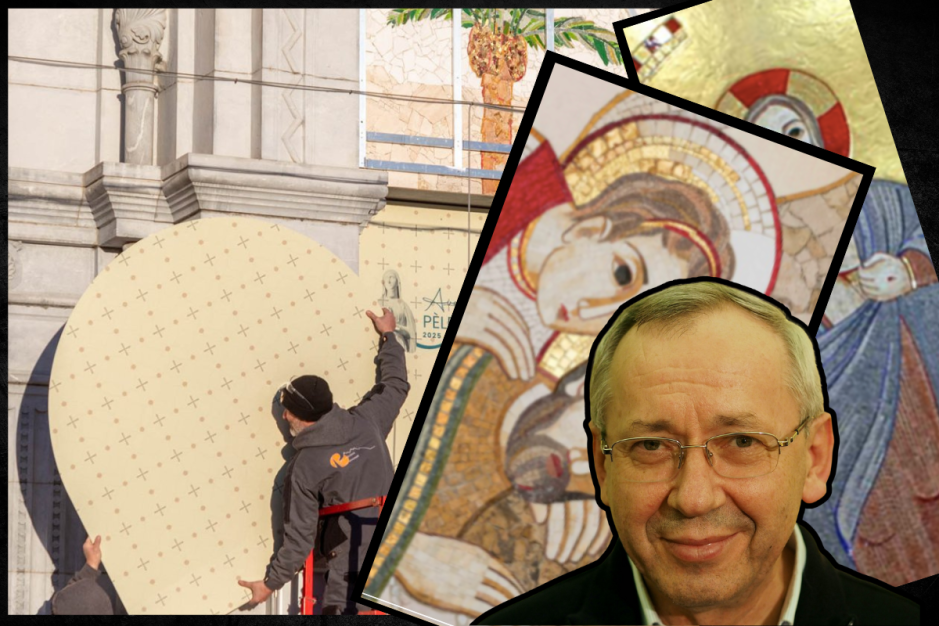
Some good news, finally, from the Vatican on the Rupnik case: it was announced that the notorious abuser of 30 nuns and occult-artist will soon be subject to an independent investigation.

Cardinal Fernandez, unusually this time the bearer of good news, reported that the panel “is made up of judges who are all independent and external to our dicastery” in order “to dissolve the idea that the Dicastery for the Doctrine of the Faith or the Holy See had any interest or were subject to pressure. People were chosen who would not give rise to any suspicion.”

It is certainly to be hoped that the individuals comprising the panel and will actually be independent and not secret minions of Rupnik’s – a man whose reach seems to be enormous.

Rupnik’s victims are pleased at the move, and their lawyer said “will certainly cooperate fully in reconstructing the facts and seeking the truth. We hope that this case will be concluded as soon as possible and that it will finally bring comfort to the victims.”

The news outlet responsible for bringing so much of the details of the Rupnik case to out attention is Silere non possum. This group interviewed victims and traced many appointments in the Dicastery for Communications back to the influence of Rupnik. This explains why Rupnik’s disturbing artwork continued to be promoted by the Vatican for years after his abuse was made public.

For reference, a timeline is given below to show how long the Vatican has known that Rupnik is an abuser and blaphemer: the first credible accusations were brought to the Jesuit’s attention back in 1995.

The Rupnik Timeline

  • 1995: first allegations1 against Rupnik reported: secret investigation led by Mgr. Daniele Libanori, SJ
  • 2016, April: Pope Francis celebrates Mass for the Aletti Centre.
  • 2020: Rupnik is quietly excommunicated, latae sententiae, for having absolved in confession a person with whom he had engaged in sexual relations.
  • 2020: excommunication is lifted almost immediately.2
  • 2021: investigation by Vatican into Rupnik’s Aletti community
  • 2021, Dec: news of Rupnik’s investigation, latae sententiae excommunication and its subsequent lifting were published by Italian outlet Silere non possum.
  • 2022, Jan: Pope Francis meets with Rupnik.
  • 2022, May: Rupnik preaches a clergy retreat in Italy.
  • 2022, Dec: Rupnik suspended by Jesuits
  • 2023, June: Rupnik expelled from the Jesuits for refusing to obey restrictions
  • 2023, October: Diocese of Koper in Rupnik’s native Slovenia announces that it incardinated Father Rupnik in its diocese In August.
  • 2023, October: After pushback over Rupnik’s incardination in Slovenia, Pope Francis lifts statute of limitations, allowing DDF to investigate him.3
  • 2024, August: evidence that Pope Francis continues to hang Rupnik’s art in his apartment.
  • 2025, Jan: evidence that Pope Francis keeps another Rupnik artwork in his study.
  • 2025, Feb: retired bishop of the Diocese of Koper says that the priest “continues his work all over the world.”
  • 2025, June 2025: Vatican News removes artwork by Rupnik from its website
  • 2025, July: DDF announces Rupnik will be investigated by an independent panel
  1. His alleged victim reported: “After my first complaint, nobody helped me, neither the Community, nor the Archbishop of Ljubljana then, nor the spiritual director of Fr. Rupnik with whom I spoke trying to explain what had happened. All of them, even the Jesuit superiors of Fr. Rupnik and those who became aware of the facts, decided to cover everything with a blanket of silence.” ↩︎
  2. According to Cardinal Fernandez, this practice happens “much more often than one might imagine.” ↩︎
  3. The Vatican said the decision was made after “the Pontifical Commission for the Protection of Minors brought to the pope’s attention that there were serious problems in the handling of the Father Marko Rupnik case and lack of outreach to victims.” ↩︎

Fernandez Approves Gender Mutilation

From the New Daily Compass & translated from Italian by AI.

During a conference organised in mid-February by the Catholic Theological Faculty of the University of Cologne in Germany, the Prefect of the Congregation for the Doctrine of the Faith (CDF), Cardinal Victor Manuel Fernández, made a video contribution. This report was then incorporated into a document entitled The Ontological Dignity of the Person in Dignitas infinita Some clarifications. This document aims to explain some of the conceptual points contained in the Declaration Dignitas infinita published by the same Dicastery in March 2024.

Fernández’s document was drafted to respond to some criticisms, but raises several critical issues of its own. One of these is undoubtedly the question of medical treatments aimed at so-called ‘gender reassignment’. The document, which denounces gender ideology, recalls the condemnation of such interventions already present in Dignitas infinita, but if in Dignitas infinita the condemnation was absolute, that is, it allowed no exceptions, in the recent document signed by Fernández there appears one that is decisive. Fernández writes: “We don’t want to be cruel and say that we don’t understand the conditioning of people and the deep suffering that exists in some cases of “dysphoria”, which manifests itself even in childhood. When the document [Dignitas infinita] uses the expression “as a rule”, it does not exclude the possibility that there are cases outside the norm, such as severe dysphoria, which can lead to an unbearable existence or even suicide. These exceptional situations must be assessed with great care”.

Let’s focus our attention on the part where the Prefect refers to the Dignitas infinita and quotes the the words ‘as a rule’. Let’s look at the relevant passage in Dignitas infinita: “Any operation to change the sex of a human being normally risks jeopardising the unique dignity which the person possesses from the moment of conception. This does not exclude the possibility that a person with genital anomalies, whether present at birth or developed later, may choose to undergo medical treatment to correct these anomalies. Such intervention would not constitute gender reassignment as we use the term here (60).

In essence, Dignitas infinita is right to say: no to interventions on the reproductive system when the aim is to try unsuccessfully to change sexual identity. Yes to the same interventions when they are aimed at confirming sexual identity, that is, when they are therapeutic, modifying the reproductive system in order to bring it into line with genetic data, which is the primary reference for understanding which sex a person belongs to. In fact, in certain pathologies, the reproductive organs may not correspond morphologically and to varying degrees to the person’s XY or XX chromosomes. This explains why Dignitas infinita uses the phrase “as a rule”: it wants to affirm that in the majority of cases (as a rule) such interventions are to be condemned, except for those that are therapeutic in nature.

As already mentioned, Fernández refers in his document to the expression “as a rule”, which is present in Dignitas infinita. We have seen that this expression is used by Dignitas infinita in relation to genital surgery. It is therefore reasonable to assume that Fernández also uses it in relation to these. So, if we re-read Fernández’s text, we discover that he considers these interventions to be illegal, except in cases of severe dysphoria and, implicitly, in cases of therapeutic treatment. Therefore, the Prefect considers such interventions legal even in the case condemned by Dignitas infinita, that is, when they are used to contradict sexual identity, provided that the dysphoria is severe and involves serious risks for the person. Therefore, the prohibition does not concern, as in the case of Dignitas infinita, the moral nature of the act – treatments to “change” sex – but only the condition that motivates the intervention: no to those interventions where the dysphoria is mild. In short, for the Prefect, the “change” of sex is morally acceptable when the dysphoria is severe. But surgical interventions that contradict the genetic sex are intrinsically evil acts and remain so regardless of the conditions that motivate them. This is why Cardinal Fernández has accepted the principle of “yes to sex reassignment”. Once the principle has been accepted, logical consistency will take us from borderline cases to common cases, from the exceptional to the normal.

This is why Fernández refers inappropriately to the “normal” contained in Dignitas infinita: in fact, he refers to it in order to legitimise sexual “change” in a sense that is the opposite of that indicated by the Dignitas infinita document itself. The latter declares that genital surgery is generally reprehensible, except when it is performed for therapeutic purposes; Fernández declares that genital surgery is generally reprehensible, except when it accentuates dysphoria (and when the purpose is therapeutic).

Conclusion: the Prefect of the Congregation for the Doctrine of the Faith qualifies the transsexual condition as morally acceptable.

Shades of Tucho in Cardinal Pierre’s Sad Commentary on the Real Presence

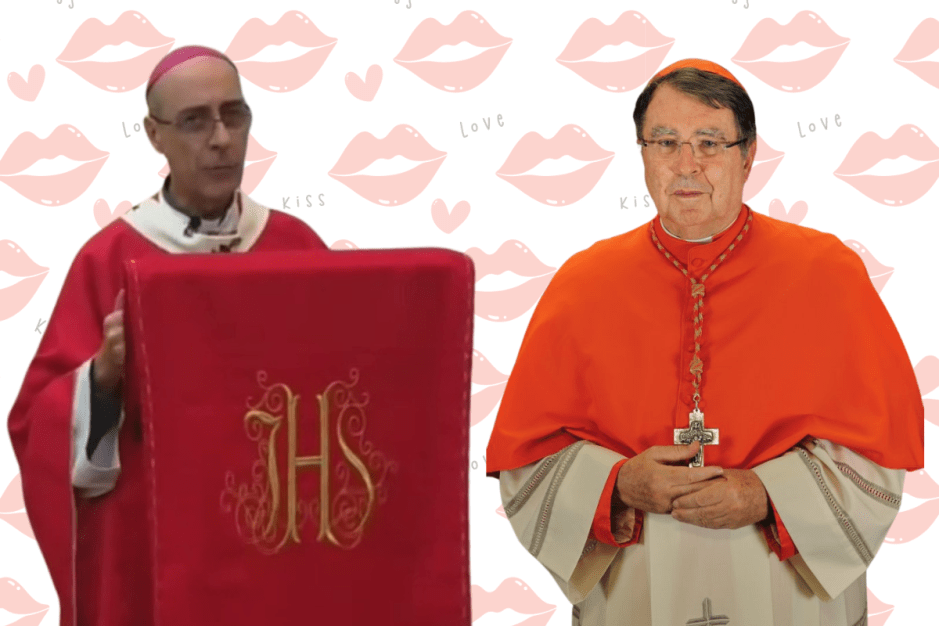
It is a sign of the times when a senior Catholic churchman wastes an ideal opportunity for increasing devotion to the Blessed Sacrament in favour of pushing the idea that the Body, Blood, Soul and Divinity of Christ are just as present in the average sinful human being. It is also a sign sign, albeit a very disturbing one, to hear language reminiscent of Cardinal “Heal me with your Mouth” Fernandez in a discourse on the most sacred reality of the Catholic faith.

In his address to the Eucharistic Congress in Indiana, the Papal Nuncio to the United States, Christophe Cardinal Pierre, began by reminding attendees that to be Catholic is to be united with the Papacy. So far, so good – although one always wonders with these Modernists if they really mean “being united with every word that falls from the mouth of Frances” rather than with the office of the Pope, and all that entails. By beginning his address by quoting the Council and JPII, Pierre suggests the latter.

After that dubious introduction, Pierre next asks the questions, “What is Eucharistic revival?”  and “How will we know that we are experiencing Eucharistic revival?” He then goes to to list the initiatives that have been presented by the US bishops to the faithful in recent times:

” … increased opportunities for adoration and benediction.  There has been catechesis on the Eucharist and, of course, processions. By displaying the Blessed Sacrament for worship and increasing our acts of devotion, we have drawn attention once more to this great Sacrament in order to “stir up” a renewed faith, both in our fellow Catholics and in ourselves.  We have even attracted the curiosity of people of other faiths.”

Again, so far, so good. Then comes the “BUT”. (With the Modernist, there is always a “but.”) Time to draw our attention, not to God, but to “the other.”

“Not only is He present in our family, friends, and communities; but He is also present in our encounters with people from whom we would otherwise consider ourselves “divided”.  This might include people from a different economic class or race, people who challenge our way of thinking, and people whose perspective is informed by experiences that differ greatly from our own.  ….. If we are experiencing true “Eucharistic revival”, then one of the signs will be a greater movement on our part to build bridges of unity.”

The term, “building bridges” always calls to mind the arch-heresiarch, James Martin. But there’s more:

And so, to believe in the real presence of Christ is not only to say: In these forms of bread and wine are His body, blood, soul, and divinity

Wait! Did he mean that during Consecration the bread and wine are changed into the Body, Blood, Soul and Divinity of Christ, or did he say something else? It sounds more like Luther’s Consubstantiation (the idea that the Real Presence presence exists alongside the bread and wine) than Catholic Transubstantiation. It’s a bit ambiguous. Finally comes the humanist clincher: the Real Presence is just not that big of a deal. Christ’s Presence is all over the place – most especially when we are dealing with “the other.”

“But Christ is also present in the assembly of His believing people.  Not only that, but he is present to people who struggle to connect with Him because of wounds, fear, and sin.  We need to be there with Him, accompanying such people, and helping them to experience the real presence of Christ’s love.”

Now to the act of Eucharistic Adoration itself. Of course it is good, ….. “but”……

Adoration, is essential to our relationship with Christ — but it is important that we treat it as that: a relationship.  If, in the act of Eucharistic adoration, we were to look at the Sacrament merely as an “object” to be admired, then we would be remaining, as it were, “on the outside….” 

Does any Catholic actually do that? Simply admire the Blessed Sacrament? In any case, here comes the really strange part. The “heal me with your mouth” part. But even stranger is the fact that this reference to “mouth to mouth contact” came not from Tucho Fernandez but from Pope Benedict!

“…. Pope Benedict explained: “The Latin word for adoration is ad-oratio — mouth to mouth contact, a kiss, an embrace, and hence, ultimately love….”

The reference does check out: Pope Benedict did in fact use these words at World Youth Day in Cologne in 2005. To young people. But here is the really strange bit: the Latin word adoratio does NOT have anything to do with kissing, embracing or “mouth to mouth contact” – at least not in any of my three Latin dictionaries or that I could find anywhere online. The noun, adoratio (from the verb adorare, to speak or entreaty or worship), only means an act or worship or prayer. That’s it.

So where does the kissing come in? Benedict was meant to be a great Latinist! The mind boggles.

Getting back to Cardinal Pierre and his address, it finishes by emphasising that the purpose of Adoration is not to give perfect worship to God but merely to solve the problems of this world. This is pure naturalism; it lines up perfectly with the Masonic ideology of a horizontal, humanist church.

There’s a bit more about the being open to the surprises of the Spirit and Synodality, and that listening “to one another and to the Spirit in the person we listen to” will be the “fruit of the Eucharistic revival.”

So there we have it: the main fruit of this Eucharistic Revival will be a Synodal, listening Church. And they wonder why the majority of mainstream Catholics do not believe in the Real Presence!

IMAGES SOURCE: Romanuspontifex, CC BY-SA 3.0 <https://creativecommons.org/licenses/by-sa/3.0&gt;, via Wikimedia Commons; http://nuntiususa.org/nuncio