This text is from a pamphlet published by the Catholic Truth Society during the twentieth century. As with many similar online articles about Freemasonry, the original webpage is no longer available: this came from the an internet archive here:
By Rev Dr L. RUMBLE, M.S.C.
AUSTRALIAN CATHOLIC TRUTH SOCIETY No. 1127 (1951).
THIS booklet is intended not only for Catholics, but for all — including Freemasons themselves — who want to know just why the Catholic Church so rigidly forbids her own members to join the Masonic Lodge.
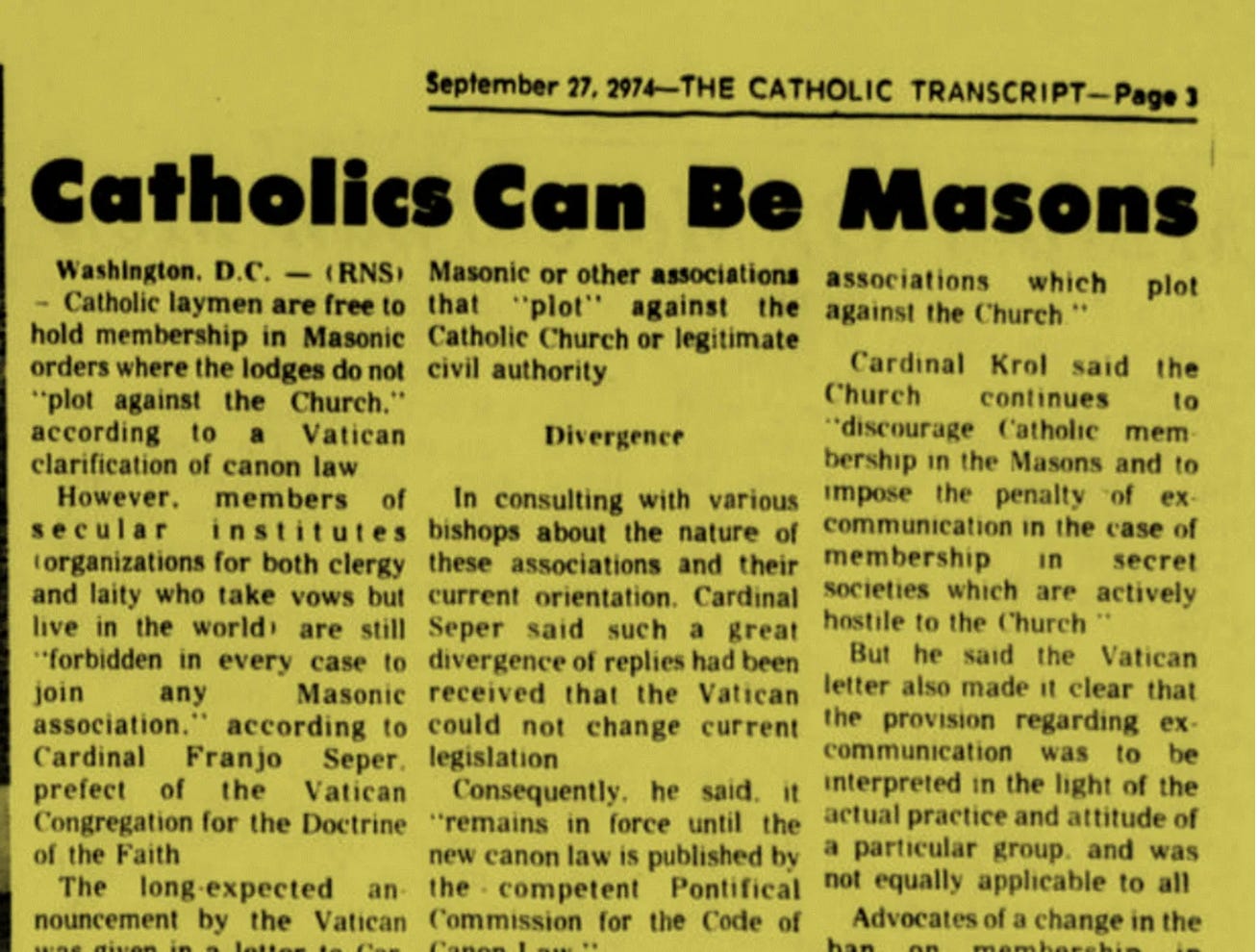
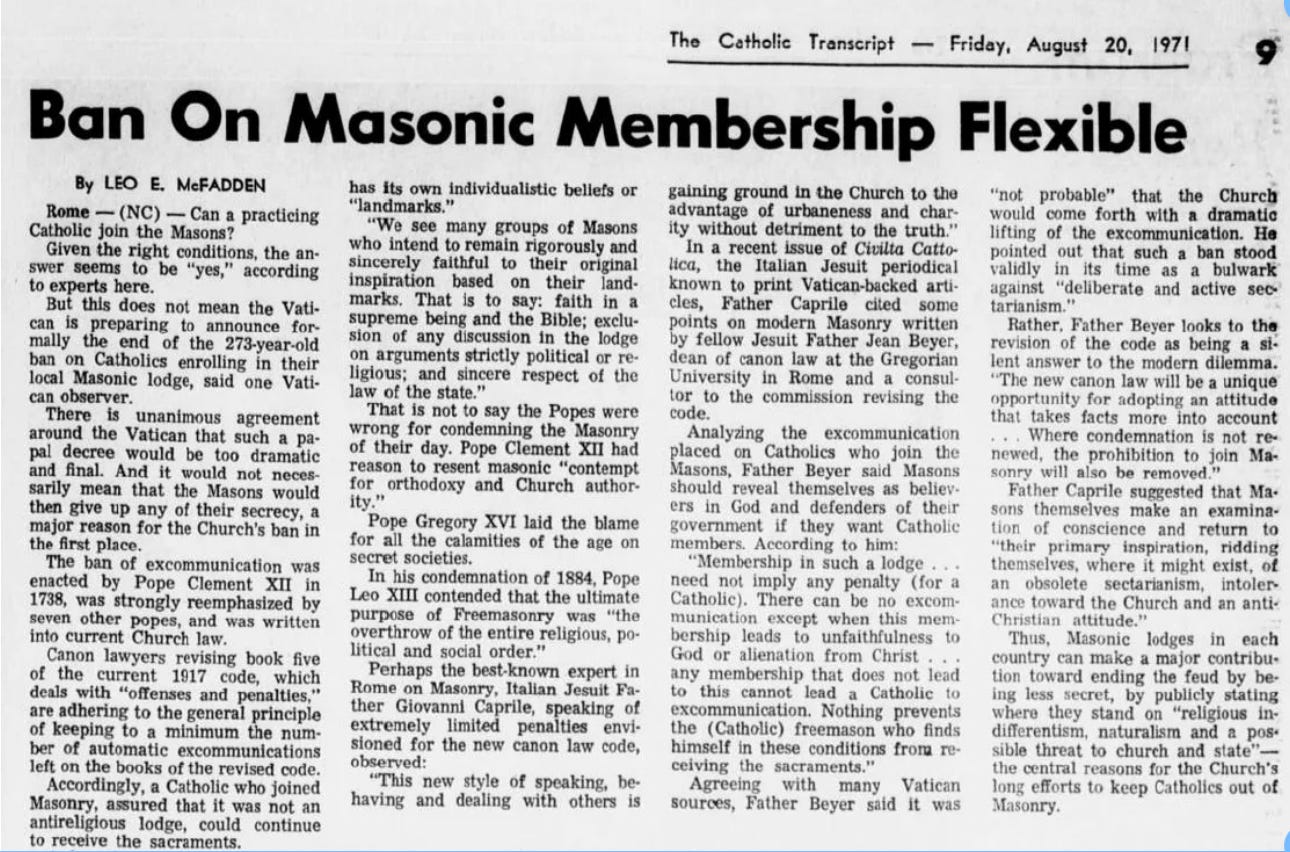
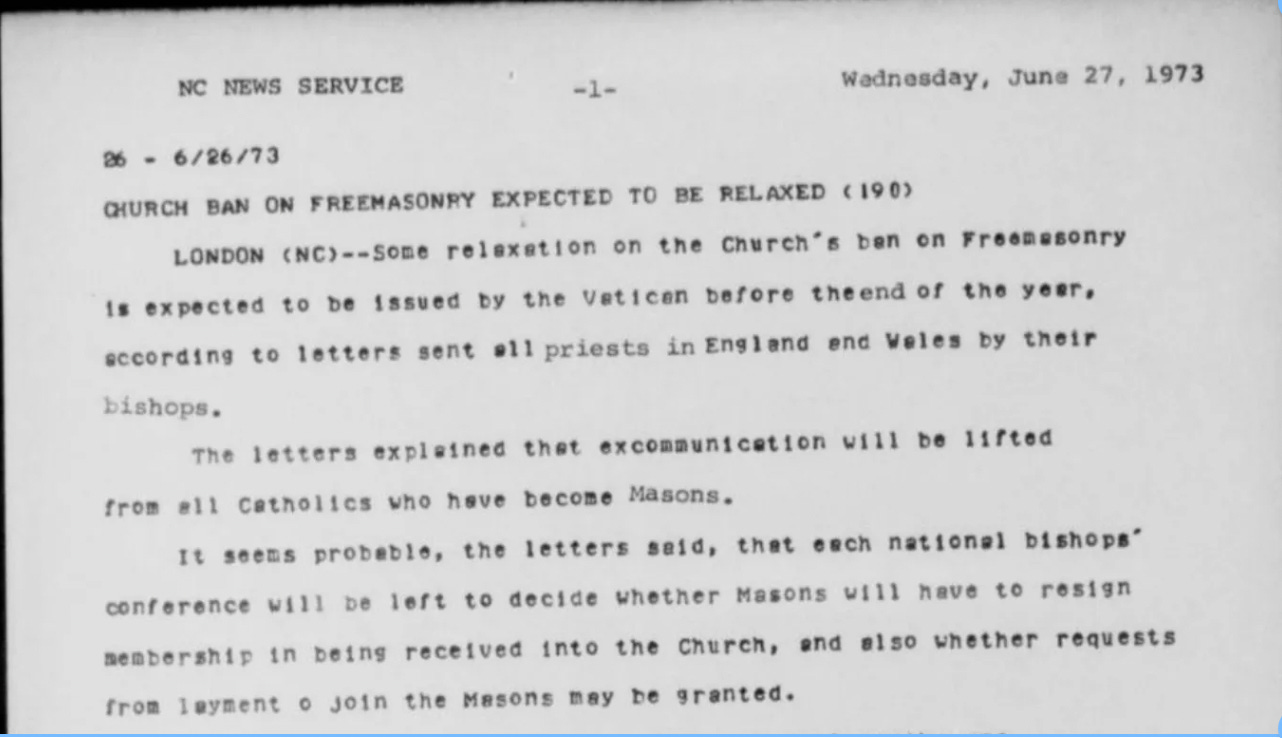
[For clarity, readers need to know that the bans on Catholics joining the Freemasons still apply. The relevant document to consult is “Quaesitum est” which is a declaration by the Congregation for the Doctrine of the Faith forbidding Catholics from joining Masonic organizations. It is also known in English as the Declaration on Masonic Associations. The document reasserts that Catholics who join Masonic organizations are in a state of grave sin and may not receive Holy Communion. It was issued on 26 November, 1983 by the prefect of the congregation, Joseph Cardinal Ratzinger, who became Pope Benedict XVI in 2005.]
The Catholic Church does not deny that many decent and honourable non-Catholics who profess to be Christians see no harm in belonging also to a Masonic Lodge. These men find its mysterious ceremonial, the absence of sectarian strife within its walls, and the mutual assistance members can afford one other, a great source of attraction; and they have never experienced any scruples of conscience in the matter. Such men the Catholic Church refuses to judge. She leaves them to their own consciences. And Masons will themselves appreciate the fact that the laws of the Catholic Church dealing with this problem concern her own members.
But the truth remains that the Catholic Church declares the Masonic System to be such that no Catholic can in conscience belong to it. And her reasons for that demand explanation, an explanation I hope to supply as adequately as a small booklet such as this will permit.
Do Only Masons Know?
Of necessity I will have to say a good deal of the nature of Freemasonry as it is in itself. And at once the charge is likely to be made that, since Masonry is a secret society, a non-Mason cannot have accurate knowledge of it. But one doesn’t have to be a Mason to obtain reliable knowledge of it, any more than one has to have visited America before he can possess any accurate information about that particular country.
There is an abundant Masonic literature written by Masons for Masons which is accessible to all willing to go to the trouble of procuring it; and, as a matter of fact, in my own public discussions of the subject I have shown sufficient knowledge of it to be charged by Freemasons themselves with being an ex-Mason of the Royal Arch Degree!
On the other hand, it has been said that the various Masonic books I have on occasion quoted are not official, but that they contain merely the individual opinions of their authors. That, however, cannot be accepted. For not only have many of these books received the highest commendation from Masonic leaders, but they are all fundamentally in agreement, expressing the body of opinion prevalent amongst all Masons who have made anything like a serious study of Masonic teachings.
Masons, of course, say that they are at a disadvantage in this matter; that they cannot refute wrong explanations of Masonry without giving what they know to be the truth; and that their Masonic obligation of secrecy forbids them to do that. They say that they can merely assert Masonry to be harmless, and beyond that reconcile themselves to letting adversaries appear to get away with anything. I appreciate their difficulty. But I myself do not believe that anything is to be gained by exaggerations and false charges; and I certainly am not prepared to believe anything hostile critics of Masonry have chosen merely to surmise, nor am I prepared to subscribe to conclusions based on the wild imaginations in which those critics have often indulged. Certainly in this booklet nothing will be set down which cannot be authenticated.
What is Freemasonry?
Many people, including a goodly number of Masons themselves, regard Freemasonry as little more than a social institution, with a charitable outlook and a spice of interest thrown in by its secrecy and its mysterious rites and ceremonies.
Officially, however, it claims to be a non-sectarian fraternity, teaching a lofty system of morality and basic religion “veiled in allegory and illustrated by symbols” — symbols derived mainly from ancient mythology and from the builders’ craft — the members being bound by oath never to reveal its modes of recognition and its ritualistic practices.
Constitutionally, it is organized in groups of Lodges subject to a Grand Lodge, which is invested with supreme power and authority over all the Craft within its jurisdiction. The Grand Lodges in each country, or in the various provinces of each country, are constitutionally independent of one another, claiming only a moral unity in Masonic principles and practices.
Despite its claims to antiquity, Grand Lodge Masonry as we know it dates only from A.D. 1717. It is true that there were Masonic Guilds in medieval times. But these were Catholic Associations of free and independent operative stone masons, with which Freemasonry today cannot claim continuity. These Catholic Confraternities were disrupted by the Protestant Reformation; and it was only after an interval of almost a century that some Deists, Jews and Protestants began to form societies, borrowing the terminology of the old masonic guilds, but with a very different spirit and outlook. Members were admitted to their “lodges or assemblies” by a secret ritual which was greatly influenced by the Rosicrucians, who had begun to join them. These Rosicrucians brought with them from the mystic sect to which they belonged extravagant claims to an occult knowledge of the hidden secrets of nature.
In 1717 four of these” Lodges” which had been established in London met at the Apple Tree Tavern, and after placing the oldest Master Mason amongst them in the chair, constituted themselves into the “Grand Lodge of England.” From London, “Grand Lodge Masonry” was transplanted to the Continent in 1721. In 1723 the Constitutions were revised, specifically Christian references being eliminated so that non-Christians (though not atheists) might join the Lodge without embarrassment.
The United Grand Lodge of England recognizes but three Degrees, though it makes allowance for the existence of certain so-called Higher Degrees. The Constitutions of 1813 contain the following statement. “It is declared and pronounced that pure Ancient Masonry consists of three Degrees and no more, viz. Those of the Entered Apprentice, the Fellow Craft, and the Master Mason, including the Supreme Order of the Holy Royal Arch.” The last was regarded, not as a fourth Degree, but as the third completed.
On the Continent Freemasonry soon became deeply involved in politics, violently anti-clerical, and atheistic. In 1877 the “Grand Orient” of France deleted references to the Great Architect of the Universe from its constitutions so that Positivists and even those who had no belief in God at all could be admitted. The Grand Lodge of England protested against this adoption of atheism, but in vain; and in 1878 English Masonry severed all relations with the Grand Orient, forbidding its own members to enter into any communication with the French Lodges.
Condemnations.
It was not long before Freemasonry on the Continent was brought to the notice of the Catholic Church. Within ten years of its establishment in France its existence and nature had become known by the publication of its Constitutions and Ritual, and by the subversive activities of its members in relation to both Church and State.
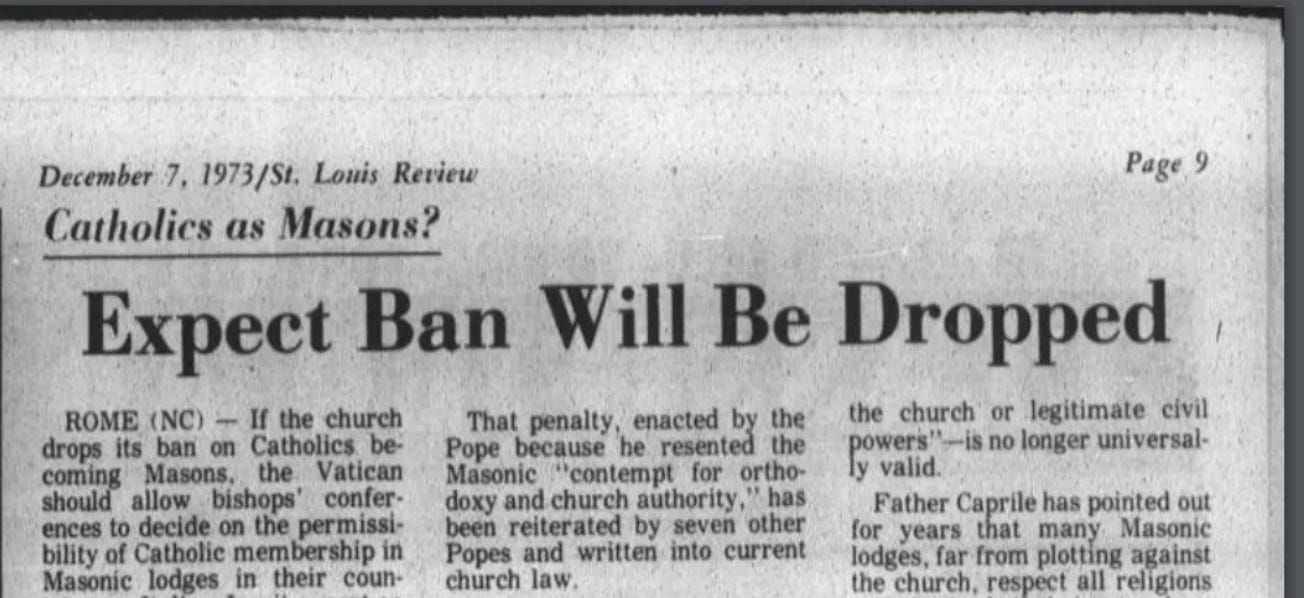
In 1738, therefore, Pope Clement XII condemned the Society of Freemasons, and forbade Catholics to have anything to do with it under pain of excommunication. In 1751 Pope Benedict XIV renewed this condemnation, stressing the secularism, secrecy and revolutionary activities of the Society. Pius VI in 1775, Pius VII in 1821, Leo XII in 1825, Pius VIII in 1829, Gregory XVI in 1832, and Pius IX in 1846, all issued similar letters of condemnation. In 1884, since Freemasons disputed the authority of these Papal Documents on the grounds that they were based on erroneous information and were excessively severe, Pope Leo XIII issued his great Encyclical, Humanum Genus, declaring Freemasonry utterly incompatible with the Christian religion, and forbidding Catholics, as they valued their Faith and eternal salvation, to join it. Nine different Popes, therefore, have seriously forbidden to Catholics membership of the Masonic Lodge, and it is impossible to believe that they have not had very good reasons for doing so. Such decisions are not made lightly, nor without thorough investigation of all relevant facts.
There are those, of course, who accuse the Catholic Church of having taken up a very intolerant stand in this matter. But surely any Church has the right to put a ban on any society of which it does not approve. That should give no offence to anybody. After all, the decision in the matter rests with those affected by the ban — Catholics themselves. If a man wants to join a Club and is presented with a book of Rules, he cannot reasonably say, “This is sheer intolerance. How dare you talk to me of obligations!” The officials would rightly reply, “Nonsense. You wish to become a member of this Club, and these are our Regulations. We cannot accept you unless you agree to conform to them.” So the Catholic Church has the right to legislate for those who choose to remain or to become Catholics.
Pleading with his own Anglican Church (unsuccessfully) to inquire into the compatibility of Freemasonry with Christianity, the Rev. Walton Hannah wrote in the Anglican Church Times, March 30th, 1951, “If the Church has Christ’s sole authority to teach faith and morals, surely she has not only the right but the duty to investigate and to pronounce on the teachings of any other body which claims religious knowledge.”
But if the Anglican Church hesitates, other religious bodies have not hesitated to take the same stand as the Catholic Church in this matter. In 1925, General Booth addressed a letter to every Officer in the Salvation Army in which he said, “No language of mine could be too strong in condemning any Officer’s affiliation with any Society which shuts Him (Christ) outside its temples; and which in its religious ceremonies gives neither Him nor His Name any place . . . the place where Jesus Christ is not allowed is no place for any Salvation Army Officer. As for the future, the Army’s views upon this matter will be made known to all who wish to become Officers, and. acceptance of these views will be necessary before candidates can be received for training; and, further, from this time it will be contrary to our regulations for any Officer to join such a Society.” In 1927, the Free Presbyterian Church of Scotland made abstention from the Lodge a condition of membership. In the same year the Wesleyan Methodist Conference in England unanimously adopted a resolution that the claims which have been put forward by Freemasons both in writing and in speech are wholly incompatible with Christianity.
In practice, of course, most Catholics are content with the fact that their Church forbids them to become Masons. They know that the Popes are not given to acting unwisely. They fully acknowledge their supreme authority over all members of the Church; and in a spirit of obedience they willingly accept their ruling in the matter.
But non-Catholics frequently ask for the reasons prompting such drastic legislation on the part of the Church, and Catholics themselves are often called upon to explain and defend it. It will be well, then, to make a brief survey of the whole question, dwelling for a few moments on each of the main points which render Masonry unacceptable in the eyes of the Catholic Church.
The reasons for the Catholic prohibition make a truly formidable list. For Freemasonry has been condemned as constituting a pagan religion of naturalism offering itself as a substitute for Christianity, as a secret society unlawful of its very nature, as exacting a morally-unjustified oath of allegiance, as subversive of both civil and religious authority, as a prolific source of injustice in social relationships, and as a movement essentially inimical to the welfare of the Catholic Church in particular.
If any one of these reasons can be substantiated, it is surely not a matter of surprise that the Catholic Church should proscribe Masonry as far as her own members are concerned. Yet there is a good and solid foundation for every one of them. Let us see.
Masonry a Religion.
It has often been said by Masons that “Freemasonry, though religious, is not a religion.” But that is an impossible subterfuge. For the word “religious” is an adjective, and it demands an answer to the further question, “From what religion is its religious character derived?” A man charged with treason does not refute the charge by saying, “I am loyal!” The vital question is, “To what country are you loyal?” And so to the Mason we say, “According to what religion is Freemasonry religious?” And the only honest answer would be, “According to our own Masonic religion.”
For Masonry has its own dogmas, temples, ritual, and moral code. Like all other mystic sects through the ages, it claims to give its members a more profound understanding of the Great Architect of the Universe than is possible to those who have not been initiated into its secret rites and ceremonies.
The Masonic writer, Albert Mackey, tells us, “All our ceremonies commence and terminate with prayer.” The Rituals contain religious ceremonies for the opening and closing of various Lodge meetings, for the consecration of a new Lodge, for the laying of foundation stones, and for the dedication of Masonic Temples. They also include a special burial service for deceased members of the Craft. Needless to say, no Catholic who worships God according to Catholic religious rites is free to accept or engage in these non-Catholic religious rites
It must be remembered, too, that these Masonic religious rites are derived from, and are an expression of, the ancient pagan mystery religions. Bro. J. S. M. Ward, in his book, Freemasonry and the Ancient Gods, p. 347, tells us that “Free-masonry is the survivor of the ancient mysteries — nay, we may go further and call it the guardian of the mysteries.” If that be so, then it is an effort to do precisely that which St Paul so strongly denounced in his Epistle to the Galatians (4: 8—9), “In those days, when you were ignorant of God, you were in servitude to gods who are really not gods at all; but now that you know God — or, rather, are known by God — how is it that you are turning back again to the weakness and poverty of the elemental spirits? Why do you want to be enslaved all over again by them?” (Moffatt’s translation).
But Masonry is not only a false religion. It aims at becoming the universal religion, to the exclusion of all others. If it declares that it is non-sectarian, if it denies that it is another religious denomination, that is only because it claims to be above all sects, upon which it looks tolerantly as merely partially true religions. But it is Masonry which claims to be the true religion, and it aims at becoming universal.
Dr Fort Newton, in The Builder, says, “We only pursue the Universal Religion.” In the book I quoted a moment ago, pages 336 — 338, Bro. J. S. M. Ward, after urging the alliance of the Grand Lodges of all countries, says: “Then the time will be ripe for the formation of the Supreme Grand Lodge of the World, whose Grand Master could be elected for a term of years . . . filling a post compared with which even that of the Pope will fall into insignificance. . . . So, gradually, we can build up a Masonic Temple to the glory of God and the good of humanity. . . . Freemasonry is, I contend, the mightiest force in the world. All that is best in religion and nationality is united with all that is best in internationalism. Masonry has not survived the fall of mighty empires and the corroding hand of time to remain . . . merely a pleasant social club.”
But what is the nature of this religion? The “Old Charges” of 1738 declared it to be “that religion in which all men agree.” “All men” would include Jews, Moslems, Hindus, Buddhists and Deists — the last-mentioned repudiating all ideas of supernatural revelation. At best this means a religion of natural Theism. And this religion is declared to be quite enough for man! A Christian may adhere to his Christian religion if he wishes. But it is not at all necessary for his salvation that he should do so.
Thus the “Masonic Services Association” series, Vol. 19, p. 14, says, “Man is never closer to God than when he kneels, spiritually naked, at the Altar of Masonry.” And in the Freemasons’ Monitor, pages 97—98, Sichels writes regarding the Third Degree, ”We now find a man complete in morality and intelligence, with a state of religion added to ensure him the protection of the Deity; and to guard him from going astray. Nor can we conceive that anything more can be suggested which the soul of man requires.”
Even as I write I have before me a copy of a hymn after investiture in the First Degree, used at Lodge Hunters Hill, No. 139, U.G.L., N.S.W., one of the verses of which assures the candidate
“Pure as that badge thy life may be,
If by its teachings thou abide;
God’s Holy Face thine eyes shall see,
If thou wilt make that badge thy guide.”
And is there an English Mason who is not familiar with the plea, addressed to God in the name of his Masonry:
“By the badge and mystic sign,
Hear us, Architect Divine.”
If all I have recorded does not mean that the teaching and precepts of Masonry are enough to ensure a man’s salvation without the aid of any other religion, what does it mean? And how could any Catholic give even the appearance of accepting such a proposition?
In attempting to grapple with this problem, the Rev. J. L. C. Dart, an Anglican Masonic Chaplain, writing in Theology, April, 1951, says candidly, “We can’t answer without being unfaithful to Masonic obligation. . . . The light of Masonry is not in conflict with the light of religion. It is something peculiar to itself; and there I must leave it.” But others can’t leave it at that!
A Non-Christian Religion.
The truth is that Masonry is definitely a non-Christian religion. The God of Masonry is not the Christian God. In the Royal Arch Degree the nature of the Masonic God is expressed by a combination of the names of Jahweh, Baal, and On (Osiris) in the word “JAH-BUL-ON” — the names of the pagan deities Baal and Osiris constituting part of the name of God. [Jahweh is the Hebrew word for the ‘name’ of God – ‘He Who Is’ – revealed to Moses.]
Again, the Volume of the Sacred Law (V.S.L.) need not be the Bible. It can equally well be the Mahometan or Moslem Koran or the Hindu Vedic Books. Writing in the Masonic Record, June, 1926, in an article entitled, “What Are Our Landmarks?”, Bro. T.H.R. explains that “the Second Landmark is the Volume of the Sacred Law, open in the Lodge. But the Bible is not, in Masonry, more than one of the Great Lights, and never has been, for the reason that Masons are not required to believe its teachings. . . . The stern fact is that we are constantly admitting Hindus, Chinese, Mohammedans, Parsees and Jews, not one of whom believes all the teachings of the Bible, and this forces the conclusion that Masonry regards the Bible only as a symbol.” The Oxford University Press publishes a special edition of the Bible for presentation to Masonic candidates containing a declaration that the Bible “itself is a symbol — that is, a part taken for the whole.” And in the same edition Dr Fort Newton explains that “the whole includes God’s revelation through the Bible, the Koran, the Vedas, etc.”!
But not only does Masonry claim that there is a hidden mystery of truth attainable only within its closed Lodges as though the fullness of divine revelation had not been given to mankind in Christianity; it positively excludes the name of Christ from its Rituals. The Masonic conception of the deity is the same as that of the Hindus and finds room for an interpretation in terms of Brahma, Vishnu and Shiva. Yet Christians believe that “there is no other name under heaven given to men, whereby we must be saved” (Acts 4:12). If one puts Christ above all else, how can one join a religious body which does not accept Him as Supreme?
To this some Masons reply by saying that the “Higher Degrees” are Christian even if the Craft Degrees of Blue Masonry do derive their religious significance from pagan antiquity. But the Constitutions declare that “Ancient Masonry consists of three Degrees and no more” namely, the Craft Degrees. In any case, no one can get to the “Higher Degrees “unless he has first professed the lower pagan ones recognized by Grand Lodge. And even when he does get to those “Higher Degrees” he will find that any Christian symbols may be given meanings from the pagan mysteries.
The truth is that Christian interpretations of Masonry in any of its Degrees are not official. By its very Constitutions and its claim to be a universal fraternity, Masonry can never present such interpretations to the non-Christian world. Bro. J. S. M. Ward, in Freemasonry and the Ancient Gods, p. 347, writes, “Even our so-called Christian Degrees have taken on a Christian colour merely because, in the main, we are Christians, and not because they are in essence Christian.” To the same effect Dr Albert Mackey writes, in the Encyclopaedia of Freemasonry, “The interpretation of the symbols of Freemasonry from a Christian point of view is a theory adopted by some, but one which I think does not belong to the ancient system. The principles of Freemasonry preceded the advent of Christianity. If Masonry were merely a Christian institution, the Jew and the Moslem, the Brahman and the Buddhist, could not conscientiously partake of its illumination. But its universality is its boast. In its language, citizens of every nation may converse; at its altar men of all religions may kneel; to its creed disciples of every faith may subscribe.”
To all of which one must say “You say ‘to its creed disciples of every faith may subscribe,’ Not disciples of the Christian Faith, except those who are so ill-instructed that they don’t know what Christian Faith means, or those who are so illogical that they are not in the least worried by inconsistency in their behaviour; or those who are prepared to put aside their Christianity for the time being whenever it is convenient to do so.” One Anglican layman, Dr Arundell Esdaile, one time Secretary of the British Museum, stated in the East Grinstead Observer for March 2nd, 1951, that he left Masonry about two years ago, after being some twenty years in the Craft. And he declared that Freemasonry is fundamentally pagan and inconsistent with Christianity. “Clergy or laity,” he told his fellow-Anglicans, “we should come out of it.”
The Catholic Church certainly leaves her members in no doubt as to their duty in this matter. To her is given the fullness of the revelation of God, in the custody of which she is safeguarded by the indwelling Presence of the Holy Spirit. And she tells Catholics that it is not possible to become Masons without an equivalent repudiation of their Christian Faith, which cannot but carry with it excommunication from the Church.
Masonic Secrecy.
Besides the religious issue, we are confronted with the fact that Masonry claims to be a secret Society, shrouded in mystery. Its literature loudly proclaims that it has hidden stores of knowledge in reserve for initiates.
That, however, is not a serious aspect of its secrecy. In reality, there is no “Masonic Secret” corresponding with such a claim. Each Mason may speculate to his heart’s content about the mystical significance of Masonry, and arrive at any conclusion he pleases. G. Oliver, in his book, The Historical Landmarks of Freemasonry Explained, Vol. 1, p.11, quotes this very significant passage from the memoirs of the Mason Jacob Casanova de Seingalt, “No man knows all the secrets of Masonry, but every man keeps in view the prospect of discovering them. . . . Those who are made Masons for the purpose of learning the secrets may deceive themselves; for they may be fifty years Masters of Chairs, and yet not learn the secrets of the brotherhood. This secret is, of its own nature, invulnerable, for the Mason to whom it has become known can only have guessed it, and certainly not received it from anyone; he has discovered it because he has been in the lodge — marked, learned and inwardly digested. When he arrives at the discovery, he unquestionably keeps it to himself, not communicating it to his most intimate brother, because should this person not have the capability of discovering it for himself, he would likewise be wanting in the capacity to use it if he received it verbally. For this reason it will forever remain a secret.” (F.Q.R., Vol. 1, N.S., p. 31.) The mystic science of Freemasonry we may, therefore, dismiss as a chimera.
What, then, is the real Masonic secret members are forbidden to reveal? It consists of the symbols and signs and passwords of the Lodge. Thus J. S. M. Ward, in his book, Freemasonry: Its Aims and Ideals, p. 144, says, “The secrets of Masonry are her signs, words and tokens; these the oath regards, and no more. The common language of Masons in conversation on the subject of Masonry is a proof that this is the opinion of the Fraternity in respect to the application of the oaths.” This was confirmed by the Rev. I. M. Lewis, a Masonic Chaplain, in Theology, April, 1951, who wrote that Masonic teachings consist of legends and myths full of errors and false doctrines which are taken only as a peg on which to hang an ethical code. “The one thing taken seriously,” he said, “is the preservation of secret grips and words that enable a man to show that he is a Freemason.”
But there is more to it than that. Ordinary members are caught up by this ‘food’ for their mystery-loving instinct. Then they are used for policies of which they know nothing — as Masonic influence is used in this direction or that according to the practical programmes, social and political, of different leaders in different countries. And it is for this reason that the Catholic Church condemns the secrecy of Freemasonry.
Any society may have its secrets. Every family lawfully has its own private affairs. But it is the particular kind of secret society which Freemasonry happens to be that is condemned by the Church. For in Masonry everything is masked. Other societies, even though they have their “confidential business”, at least declare their objectives and programmes so that prospective members may decide to join or not join accordingly. Not so in Masonry. The candidate must be prepared to advance step by step in the dark, never presuming to try to find out whither his next step will lead. Moreover, he is bound by oath never to reveal anything that transpires in the Lodge. Meantime, the Masonic leaders possess an uncontrolled and irresponsible power subject to the scrutiny neither of the civil society in which they function, nor of any ecclesiastical authorities. This evasion of all outside supervision is most dangerous to the welfare of both State and Church.
In 1913 an Italian paper, Idea Nazionale, conducted a kind of Gallup Poll, canvassing opinions as to the relationship of secret societies to public welfare. General Cadorna, later to be Commander-in-Chief during the 1914—18 War, wrote in reply: “In my opinion the survival of Freemasonry and of any secret association is incompatible with the condition of modern, free, public life. Freedom and light are united together. Instead, to combat obscurantism, as Freemasonry pretends, and at the same time seek refuge in darkness, are contradictory terms. The action of Freemasonry inevitably damages public life, and particularly military institutions . . . . . . . . . Discipline, loyalty and frankness, which should always predominate, are in open contradiction with the mystery that shrouds the activity of this sect.”
Benedetto Croce, the Italian philosopher, declared that secret societies always engender suspicion, and undermine the mutual confidence citizens should have in one another.
In its issue of March 30th, 1951, the Anglican Church Times gave expression to similar anxieties. “The appeal to mystery and to secrecy,” it declared, “constitutes the greatest charge against the Craft. Rome forbids Masonry because any form of secret society must conflict with the authority of the Church. Anglicanism has not quite the same feeling for authority and has never raised the question of secrecy. It may be that the time has come to reconsider this position.”
Unlawful Oath.
A further reason for the condemnation of Freemasonry is found when we turn to a consideration of the Masonic Oath in itself. The form of this Oath varies somewhat in different Rituals and in the different Degrees, but these variations are secondary, and any one form can be considered typical.
The first form met with by an aspirant is that of the First Degree for an Entered Apprentice Mason, and it runs as follows:
“I, ——, in the presence of the Great Architect of the Universe, and of this worthy and worshipful Lodge of Ancient, Free and Accepted Masons, regularly assembled and properly dedicated, of my own free will and accord, do hereby and hereon most solemnly and sincerely promise and swear that I will always hide, conceal and never reveal, any part or parts, point or points, of the secrets or mysteries of, or belonging to, Free and Accepted Masons in Masonry, which may heretofore have been known by, shall now, or may at any future period be communicated to me, unless it be to a true and lawful Brother or Brethren, and not even to him or them until after due trial, strict examination, or a full conviction that he or they are worthy of that confidence, or in the body of a Lodge just, perfect and regular. I further solemnly promise that I will not write those secrets, indite, carve, mark, engrave, or otherwise delineate them, or cause or suffer the same to be so done by others, if in my power to prevent it, upon anything movable or immovable under the canopy of Heaven, whereby or whereupon any letter, character or figure, or the least trace of any letter, character or figure, may become legible or intelligible to anyone in the world, so that our secrets, arts, and hidden mysteries may improperly become known, and that through my unworthiness. These several points I solemnly swear to observe without evasion, equivocation, or mental reservation of any kind, under no less a penalty, on the violation of any or either of them, than that of having my throat cut across, my tongue torn out by the roots, and my body buried in the sand of the sea at low water mark, or a cable’s length from the shore where the tide regularly ebbs and flows twice in twenty-four hours; or the less horrid but no less effective punishment of being branded as a wilfully perjured individual, void of all moral worth, and totally unfit to be received into this worshipful Lodge, or any other warranted Lodge, or society of men who prize honour and virtue above the external advantages of rank and fortune. So help me God, and keep me steadfast in this my great and Solemn Obligation, being that of an Entered Apprentice Freemason.”
At the conclusion of this profession, the Worshipful Master says to the candidate: “What you have just repeated may be regarded as a very serious promise; but, as a pledge of your fidelity, and to render it binding on your conscience as a Solemn Obligation, I call upon you to seal it with your lips once upon the Volume of the Sacred Law.”
The taking of such an Oath the Catholic Church declares to be utterly opposed to all sound moral principles. Nobody is justified in binding himself in such a way. That God’s name should be invoked upon such an outrageously-worded formula is irreverent to the point of blasphemy. Unnecessary oaths are not lawful in the sight of God, in any case, involving such a vain use of His name. If Masonry is merely a benevolent society, such oaths are certainly not necessary. Secrecy and darkness are not needed for philanthropic works. Nor are there any philosophical, scientific, religious or even political secrets proper to Masonry which could justify them. The oaths, therefore, are null and void, and have no ethical force whatever. Masonry, in fact, not being a department of either Church or State, has no authority to administer such oaths, and still less authority to inflict the threatened physical punishments they contain. Then, too, no individual has any right to make such a blind surrender of his conscience to the unknown. People must be sure that what they promise on oath they may lawfully do. And Freemasonry, unlike other societies, as we have seen, does not provide candidates in advance with a prospectus or list of the objects and aims of the Society. One has to become a member first to know what is involved; and even then he is not told all.
In attempting to meet these difficulties, Masons say that candidates are assured beforehand,” In such vows there will be found nothing incompatible with your moral, civil, or religious duties.” But who gives that assurance? The candidate has to take the word of Masons themselves for that, not the voice of his own conscience. And how can there be nothing in such vows incompatible with moral, civil, or religious duties, when the very formula itself is immoral, the penalties invoked an unjustified usurpation of civil authority, and the whole ceremony a participation in pagan religious rites to which no rightly-informed Christian could subscribe?
Some Masons, in their embarrassment, endeavour to laugh the whole thing off. Thus one Master Mason, Bro. W. G. Branch, wrote to the Anglican Church Times, March 30th, 1951, “Concerning the oaths and obligations we may say: Cowboys and Indians!” But if it is only play-acting, then it is certainly wrong to use God’s name in such mock-solemnity. Another Mason, the Rev. J. L. C. Dart, writing in Theology, April, 1951, denied that the Masonic obligation could really be called an oath at all. “It’s just a serious promise,” he said, “with a prayer to be enabled to keep it.” But look at the formula again. “I most solemnly and sincerely promise and swear . . . .” (under penalty of) “being branded as a wilfully perjured individual.” And does not the Worshipful Master say to the candidate afterwards that he must kiss the Volume of the Sacred Law and thus render his serious promise “binding on conscience as a Solemn Obligation”?
When, in May, 1951, Dr Hubert S. Box proposed that the Convocation of Canterbury should set up an inquiry into Freemasonry, the Rev. Alexander Morris protested in horror, “Are they seriously suggesting that all clergy be compelled to renounce their vows made at their initiation and subsequent advancement in the Craft?”
In view of all this, the Rev. Walton Hannah, an Anglican clergyman, in a press interview on an article he had published, “Should a Christian be a Freemason?” rightly said, “I claim that theologically the Freemasons’ ritual is full of pagan superstition. My other great objection is that Masons must take blood-curdling oaths on the Bible. These oaths carry terrific penalties which amount to a murder pact if they are taken literally, and high-sounding nonsense which amounts to blasphemy if they are not to be taken literally.”
But can one imagine a Catholic taking this unlawful oath, and sealing it with his lips upon the Bible (whatever Masons may think of that Sacred Volume), whilst speaking in the very formula of “men who prize honour and virtue above the external advantages of rank and fortune”! Solely for the sake of temporal advantages such a Catholic is throwing honour and virtue to the winds, forswearing his religion, and turning his back upon God!
Subversive Activities.
When we turn to the practical results of Freemasonry, we find its activities so opposed to the welfare of civil government and of the Catholic Church that the real scandal would be the absence of any condemnation by the Popes!
Take first the impact of Freemasonry upon civil government. It must be remembered that they were the Continental Lodges which were first brought to the notice of Rome. And no one can deny that these Lodges took an active part in the revolutionary movements in France, Austria, Italy, Switzerland, Spain, Portugal and Sweden. Freemasons themselves do not dispute this.
Thus Professor John Robinson, an English Mason, was so shocked by his experience of Masonry on the Continent that he wrote a book on the subject, declaring that “In every quarter of Europe where Freemasonry has been established the Lodges have become hotbeds of public mischief.”
Richard Ellison, an ex-Mason, whilst trying to safeguard English Masonry by saying that if it falls under the Catholic ban it is because “the innocent suffer with the guilty”, feels compelled to admit “The truth is that Masonry is more objectionable in some countries than in others. Unquestionably it has been dangerous to the State on the Continent.”
If we turn to a consideration of the Church, we find still more blatant exhibitions of Masonry’s hostility. Thus, on September 20th, 1902, Senator Delpech, President of the Grand Orient in France, declared in a speech to his fellow-Masons “The triumph of the Galilean has lasted many centuries; but now his day is over. . . . He passes away to join in the dust of the ages the other divinities of India, Greece and Rome, who saw so many deceived creatures prostrate before their altars. Brother Masons, we rejoice that we are not without our share in this overthrow of false prophets. The Romish Church began to decay from the day on which organized Masonry was established.” In 1913, the Grand Orient declared officially that its aim was “to crush Catholicism in France first, and then elsewhere”. The Swiss Lodge echoed these sentiments by saying: “We have one irreconcilable enemy — the Pope and clericalism.” It is true that English Masonry repudiates such sentiments and activities. It denies all political and anti-religious aims, and points to the fact that, in 1878, all relations were broken off with the Grand Orient in France because of its professed atheism.
But there are many factors which rob this step of sufficient significance to warrant the Catholic Church exempting English Masonry from her ban — quite apart from all the other reasons which make that ban strictly applicable to it.
We must keep in mind that Freemasonry went to the Continent from England, and the Masonry that went from England had in it that which enabled it to be the source of so many abuses. And it is not without significance that, although Herbert Morrison rejected it, a Labour M.P. Fred Longden asked a question in Parliament, in April, 1951, suggesting that a Royal Commission be appointed to inquire into Freemasonry itself, “concerning their influence in personal appointments and interference in constitutional institution.”
Again, Freemasonry claims to be international, above all national loyalties, though it is not a supernatural but a merely natural society which should be subject to at least the supervision of civil authority. It has no more right than the “Comintern” [the Communist International or Third International] to claim international status, and to direct the activities of groups of citizens independently of their own proper national allegiances.
Furthermore, although English Lodges have broken with the Grand Orient of France, they have not broken with other European and American Lodges still in communication with the Grand Orient. In fact, the American Freemason Albert Pike dismisses the English disclaimer with the words: “It is idle to protest. We are Masons, and we recognize the French Brotherhood as Freemasons in virtue of solidarity. Ours is a Universal Fraternity.”
The Catholic Church, then, cannot be blamed for refusing to accept the distinction between Continental and English Masonry. But whatever may be said on this subject, it is only one aspect of the question. Quite apart from subversive activities, the other reasons already given would be more than enough in themselves to justify the general prohibition on the part of the Catholic Church.
Social Injustice.
Still another aspect of Freemasonry deserving of consideration is its liability to undue influence in our social and business life, against all demands of justice.
It is a matter of common knowledge that men are urged to join the Masons as a means of “getting on in life,” despite the Masonic rule that no one must ever be invited to do so. That rule is more honoured in the breach than in the observance of it. One Mason said to me personally, “I was told that I would never get anywhere unless I joined the Lodge; and from the day I did join, my business was on its feet.” Wilmshurst, in his book, Masonic Initiation, p. 197, says, “It is a well-known fact that commercial houses today find it advantageous for business purposes to insist upon their more important employees being members of the Order”. Is it any wonder that non-Masons feel themselves discriminated against, and that for them jobs are harder to find, and promotion slower?
Writing in the Anglican Church Times, March 20th, 1951, the Rev. I. D. Allen complains of Masonic influence even in his own Church. “It has been seriously suggested”, he says, “that if I wish to get on in the Church I ought to become a Freemason; and numerous Episcopal instances have been quoted!”
Public administration is also not immune from danger. In 1913, Professor Cab, Under-Secretary for State in Italy, wrote in the Idea Nazionale that a law would be justified “declaring the unsuitability of members of the Masonic Lodge to hold certain offices (such as those in the Judiciary, in the Army, in the Education Department, etc.), the high moral and social value of which is compromised by any hidden and therefore uncontrollable tie, and by any motive of suspicion, and lack of trust on the part of the public. Only a few years ago a Judge in a N.S.W. Law Court declared that he could not help concluding that, in the case before him, Masonic influence was preventing necessary evidence from being given, even by police officers themselves.
Danger to the Faith.
Officially and constitutionally, Freemasonry within the British Commonwealth and Empire declares that it has never been, and is not, opposed to the Catholic religion, or to any other religion. It is prepared to welcome members of all religions, and absolutely forbids members to discuss their religious differences within the Lodge. If Catholics cannot become Masons, they say, it is not because the Masonic Lodge is not prepared to receive them, but because the Catholic Church forbids her own members to join the Lodge.
But, as we have seen, even English Masonry cannot be called a merely non-religious Club or Society. It maintains “Deism” as a sufficient religion. It consecrates its Temples; has its own religious teachings; prescribes its own ritual; sings its own hymns. It is a non-Christian religion. If it admits Christians without asking them to repudiate their faith, it holds the anti-Christian principle that Christianity is not necessary.
Thousands of members of the Lodge, therefore, have ended by saying, “Masonry is religion enough for me”. And they have drifted into complete indifference to Christianity. For them, Masonry has indeed become a rival religion to Christianity, and a substitute for it. And prominent Masonic writers have not hesitated to say that that is just how it should be.
Mr W. L. Wilmshurst, President of the Installed Masters’ Association, writes, “It is well for a man to be born in a Church, but terrible for him to die in one; for in religion there must be growth. A young man is to be censured who fails to attend the Church of his nation; the elderly man is equally to be censured if he does attend; he ought to have outgrown what the Church offers, and to have attained a higher order of religious life.” That higher order of religious life is, of course, Masonic! “Those who feel the need of richer fare than the Churches provide”, declares Wilmshurst, “may find it in the ancient gnosis to which Freemasonry serves as a portal of entrance” (Masonic Initiation, pages 215—220).
All forms of Freemasonry, therefore, whether Continental or English, are forbidden by the Catholic Church. How could it be otherwise! For the Catholic religion claims to be the one true religion and one can’t have two religions, Catholicism and Masonry. Intelligent Masons themselves realize this. Thus A. E. Waite, in his book Emblematic Freemasonry, p. 222, admits frankly: “Rome acted logically when it condemned Masonry . . . . . it could not do otherwise from its own standpoint, and it can never rescind the judgment until it renounces its own affirmed tides.”
Eminent Anglicans.
Recently much publicity was given to the fact that the late King George VI was, and that the Archbishop of Canterbury and about half of the Anglican Bishops are Freemasons; and it has been urged that surely they would not belong to the Lodge were it really deserving of the strictures of the Catholic Church in regard to it. But I do not think any Catholic could find that consideration very impressive. That the King was a Mason need be no more than a formality. If he saw nothing wrong with Masonry, it can easily be that he had never gone into the subject any more than many ordinary Masons who have never regarded the Lodge as anything more than a benevolent friendly society. Nor could any Catholic feel justified in becoming a Mason merely because the King was a member of the Lodge. After all, he was also head of the Anglican Church, and no Catholic regards that as a sufficient reason for becoming an Anglican, or for holding that there can be nothing wrong with Anglicanism.
As for the Masonic membership of many Anglican Bishops and clergy, Anglicans themselves are becoming less and less happy about that. In an article in Theology, January, 1951, the Rev. Walton Hannah complained that “the presence of bishops and other clergymen at Lodge meetings has lulled the apprehensions of the average non-Mason into a widely accepted belief that Freemasonry is no more than a benevolent society, full of sociability and high moral principles, with a few probably trivial secrets thrown in for excitement.”
In the May following the publication of that article, therefore, the Rev. Dr Hubert S. Box asked the Convocation of Canterbury to set up a Committee to investigate Freemasonry and decide whether or not it has pagan rites and is idolatrous, and whether membership of a Masonic Lodge is compatible with the teachings of the Christian Faith.
Convocation, for the time being, has refused to face the issue. There are too many of the Anglican clergy in high positions in the Church of England who are Masons to risk their displeasure. Non-Masonic Anglican clergy have retorted rather bitterly that the large proportion of Masons who have secured preferment and who occupy eminent positions in the Church of England owe this precisely to Masonic influence. To the plea that the presence of Anglican clergy in Masonry is a check on its becoming a rival non-Christian religion they have replied that by its very Constitutions Freemasonry excludes any possibility of Christian control. Masonry must be controlled according to non-Christian principles; and long before Masonry is “Christianized” these clergy will be “Masonized”.
Meantime, not unjustly, a Methodist clergyman, the Rev. C. Penney Hunt, in his book, The Menace of Freemasonry to the Christian Faith, asks how Anglican Bishops can refuse to enter the pulpits of Nonconformist Churches where at least the Name of Christ is held in honour, pleading that they dare not be disloyal to the New Testament doctrine of the Church, and then assist in the “dedication” of a heathen Masonic Temple; or how they can pretend to justify their separation from Rome on the ground that they merely cut out “Rome’s pagan accretions” and then embrace a Freemasonry which has cut out all specifically Christian elements and incorporated pagan mythologies!
However, whatever the uncertainty of Protestants in this matter, no room for doubt can possibly exist for Catholics. The clear and definite guidance of their Church has been put before them all.
Duty of Catholics.
The many Papal condemnations of Freemasonry should be final for every Catholic. The first Marquis of Ripon was Grand Master of Freemasonry in England. He became convinced of the truth of the Catholic Church and resigned his office, severing all connections with the Lodge, in order to become a Catholic (in 1874). At the same time he published a letter of explanation saying that he himself had seen nothing wrong with being a Mason, and that he had abandoned Freemasonry solely in obedience to the Holy See. It was only later on, as he grew into a deeper understanding and appreciation of his Catholic Faith that he realized the soundness of the reasons upon which the Papal Decrees were based. But from the very beginning he accepted the disciplinary authority of the Catholic Church, to faith in which he had been led by the grace of God.
Few Masons, however, who have ever studied the question at all, are under any illusions in this matter. They know that Catholic principles can never be harmonized with Freemasonry, and that of their very nature they make it impossible for a Catholic to become a Mason without a serious violation of conscience.
So we find Bro. S. S. Medhurst writing in The Builder, a magazine devoted to Masonic news and teachings, urging the rejection of Catholic applicants on the score that no Catholic can be a good Mason and a good Catholic. “If he won’t be true to his Church,” he says, “how can we expect him to be true to us? Masonry does not exclude Catholics, but Catholics exclude themselves, so long as they are Catholics.”
In the same strain Joseph W. Pomfrey, editor of Five Points Fellowship, a Masonic journal, wrote that a Catholic becoming a member of the Masonic Order cannot be true to both his Church and Masonry. “It is fair to infer”, he declares, “that it is not the sublime teachings of Freemasonry that attracted the Roman Catholic, but only the substantial benefits he hoped would accrue to him by becoming a Mason.”
If that is how Catholics who have joined their ranks are looked upon by Masons, one can’t imagine them being very happy in their new surroundings! I know that Catholics who have been invited to become Masons have been assured that those who have already done so are more than content. But are they? Possibly that assurance may be true of a few who have lost their faith completely, and their self-respect as well. But others certainly do not feel so happily situated. Deep in their hearts they are miserable, and they live in the hope of renouncing Masonry before they die, and of being reconciled with the Catholic Church. But they don’t all get the opportunity.
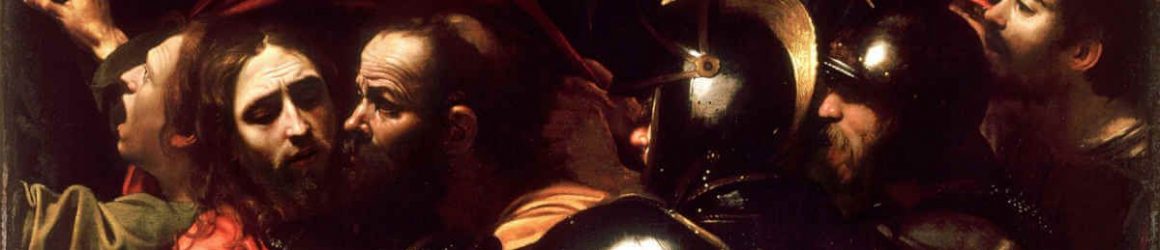
What, then, is to be said to a Catholic who is wavering under pressure from persuasive Masonic friends and business associates? Non-Catholics, who view things differently from Catholics, must be left to their own consciences. But to a Catholic who begins to think that there’s no harm, after all, in becoming a Mason, one can but say, speaking as a Catholic to a Catholic: “If it be no harm to prefer worldly advantages to your religious fidelity, to take an unlawful oath, to call upon God to witness that oath by kissing the Bible as Judas kissed Christ when betraying Him, to be a traitor to the Catholic Church, to forfeit a state of grace for that of mortal sin, to deprive oneself of one’s right to the Sacraments, to undermine one’s spirit of faith and drift gradually to complete religious indifference, to give great scandal to one’s fellow-Catholics, to be excommunicated by the Catholic Church, to risk one’s eternal salvation — if all these things amount to no harm whatever, well and good. But no one with a spark of Catholic Faith left could persuade himself that such is the case.
Every Catholic who has ever joined the Masonic Lodge has been well aware that he has made a choice guilty in the sight of God and of the Church, and with an injury to his own soul for which not the gaining of the whole world could be sufficient compensation.
The duty of Catholics is clear. Under no circumstances may they become Freemasons.




 Ecclesiastical Freemasonry