Is Rome disappointed about the end of Roe vs Wade?

After the Roe vs wade was momentously overturned in the united states, The Pontifical Academy for Life issued a very strange statement.

Perhaps this is not so surprising when we remember that the Academies are no longer Catholic, being comprised of globalists, abortion advocates, sodomites and so on. The Pontifical Academy for Life is headed up by the pro-sodo Archbishop Paglia.

Some of the more questionable sections – apart from only one mention of the word, “abortion”: “After 50 years, it is important to reopen a non-ideological debate on the place that the protection of life has in a civil society to ask ourselves what kind of coexistence and society we want to build.” Hmmmm. A “non-ideological debate”? The Vatican doesn’t want those nasty prolife ideologues always insisting on sticking to Church teaching?

And this in direct violation of traditional Catholic teaching, “….adequate sexual education” and what is perhaps a nod to climate-driven depopulators:

” … a powerful invitation to reflect together on the serious and urgent issue of human generativity…”

I may have missed it, but did Pope Francis bother to mention this wonderful pro-life development at the World Meeting of Families?

“It is a time for healing wounds and repairing social divisions; it is a time for reasoned reflection and civil dialogue, and for coming together to build a society and economy that supports marriages and families, and where every woman has the support and resources she needs to bring her child into this world in love.”

The Court’s opinion shows how the issue of abortion continues to arouse heated debate. The fact that a large country with a long democratic tradition has changed its position on this issue also challenges the whole world. It is not right that the problem is set aside without adequate overall consideration. The protection and defense of human life is not an issue that can remain confined to the exercise of individual rights but instead is a matter of broad social significance. After 50 years, it is important to reopen a non-ideological debate on the place that the protection of life has in a civil society to ask ourselves what kind of coexistence and society we want to build.

It is a question of developing political choices that promote conditions of existence in favor of life without falling into a priori ideological positions. This also means ensuring adequate sexual education, guaranteeing health care accessible to all and preparing legislative measures to protect the family and motherhood, overcoming existing inequalities. We need solid assistance to mothers, couples and the unborn child that involves the whole community, encouraging the possibility for mothers in difficulty to carry on with the pregnancy and to entrust the child to those who can guarantee the child’s growth.

Archbishop Paglia said: “in the face of Western society that is losing its passion for life, this act is a powerful invitation to reflect together on the serious and urgent issue of human generativity and the conditions that make it possible; by choosing life, our responsibility for the future of humanity is at stake”.

Vatican City, June 24, 2022

The Vatican’s music choices leave much to be desired

Someone in the Curia has a very sick sense of humour: whoever it is thought Leonard Cohen’s Hallelujah would be an appropriate way to begin the tenth World Meeting of Families in Rome.

Now, in case you’re labouring under the false assumption that Leonard Cohen’s Hallelujah has some redeeming Christian qualities to it, please study the lyrics. The melody is, of course, very soothing and beautiful, but the title does seem to have fooled many Catholics into thinking this is some kind of statement of faith on the part of Cohen.

On the contrary, Cohen, who died in 2016, rejected the idea of formal religion, presumedly because its demands were too high. Cohen said of Hallelujah:

“This world is full of conflicts and full of things that cannot be reconciled. But there are moments when we can… reconcile and embrace the whole mess, and that’s what I mean by ‘Hallelujah’.

The song explains that many kinds of hallelujahs do exist, and all the perfect and broken hallelujahs have equal value. It’s a desire to affirm my faith in life, not in some formal religious way but with enthusiasm, with emotion.”

If you’ve never read the lyrics to Hallelujah, then scroll to the bottom of the page.

However, the performance of that song pales into insignificance beside the presence of a very strange choir who entertained Francis earlier in June.

A group of women known as the F*** Cancer choir performed for the Pope at a General Audience. Their t-shirts were emblazoned with “F*** Cancer” (yes, the entire word) surmounting a clenched fist.

The Pope smiled his way through the performance, telling the choir-members afterwards that they were “good” and “poets.” As Reuters exclaimed, “The F-word made its debut” at the Vatican. Charming. Another first for Francis.

HALLELUJAH

I’ve heard there was a secret chord
That David played, and it pleased the Lord
But you don’t really care for music, do you?
It goes like this
The fourth, the fifth
The minor fall, the major lift
The baffled king composing Hallelujah

Hallelujah x 4

Your faith was strong but you needed proof
You saw her bathing on the roof
Her beauty in the moonlight overthrew you
She tied you to a kitchen chair
She broke your throne, and she cut your hair
And from your lips she drew the Hallelujah

Hallelujah x 4

Baby I have been here before
I know this room, I’ve walked this floor
I used to live alone before I knew you.
I’ve seen your flag on the marble arch
Love is not a victory march
It’s a cold and it’s a broken Hallelujah

Hallelujah x 4

There was a time when you let me know
What’s really going on below
But now you never show it to me, do you?
And remember when I moved in you
The holy dove was moving too
And every breath we drew was Hallelujah

Hallelujah x 4

Maybe there’s a God above
But all I’ve ever learned from love
Was how to shoot at someone who outdrew you
It’s not a cry you can hear at night
It’s not somebody who has seen the light
It’s a cold and it’s a broken Hallelujah

Hallelujah x 4

You say I took the name in vain
I don’t even know the name
But if I did, well, really, what’s it to you?
There’s a blaze of light in every word
It doesn’t matter which you heard
The holy or the broken Hallelujah

Hallelujah x 4

I did my best, it wasn’t much
I couldn’t feel, so I tried to touch
I’ve told the truth, I didn’t come to fool you
And even though it all went wrong
I’ll stand before the Lord of Song
With nothing on my tongue but Hallelujah

Hallelujah x 17

Leonard Cohen, found here:

Poisoning the young at the Vatican

The Vatican played host to a youth festival on Easter Monday, inviting a bizarre rock star to entertain thousands of confused young Catholics prior to a prayer meeting led by the Pope. It was organised by the Italian Bishops Conference (you know, that outfit who thought this design was appropriate for a church) and Italy’s National Youth Pastoral Service.

The theme of the day was “#Follow Me”: the hashtag attests to its hipness, no doubt, and although it was meant to inspire young Catholics to “find their way and vocation in life”, it’s hard to see an event like this leading them anywhere other than to hell.

One presenter for the concert was an Italian media star renowned for her “heart-attack necklines” and pornographic Instagram feed. But the main event was Riccardo Fabbriconi, aka Blanco, a crossdressing rapper and pop singer.

Blanco at the Vatican. Nero is more like it.
One news outlet lauded his ‘courage’ for exposing his tattoos

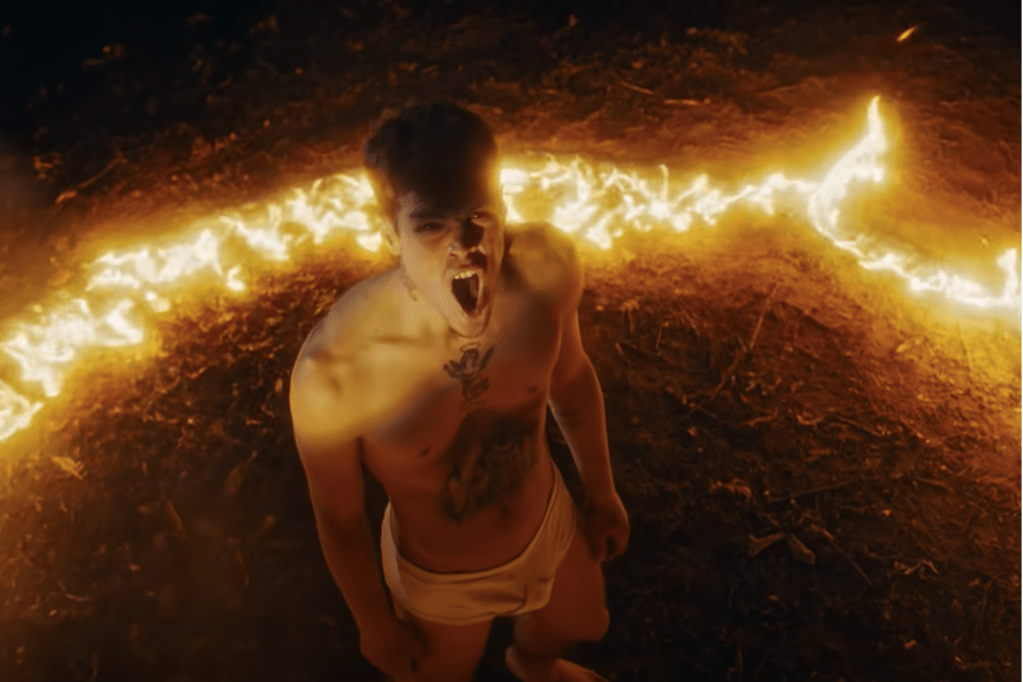
Blanco sang his current hit, Blu Celeste, supposedly written to honour a dead friend of his. The music video is somewhat alarming, as Blanco appears in his underwear, in the centre of a circle of flames. It is reminiscent of a magic circle, the symbol beloved of witches and occultists who perform their rituals inside, believing themselves to be protected from ‘negative forces’. What else could you expect from a guy whose first words as a baby were allegedly to curse his parents?

“This will impress the kidz!”

While Fr Michelle Falabretti, spokesman for the Bishops Conference, called the singer “a gift” to the young people, some of the bishops weren’t so sure. But Falabretti tried to reassure them:

“… the context is very important. Woe to underestimate it! You risk not being on the same wavelength. (Oh, the horror.) The singer who at this moment attracts the very young most of all, means creating the conditions for mutual dialogue and listening. (Yep, he said that.) You need to know who they are, try to understand that inner world whose features the artists interpret and make explicit. And Blanco, with his lyrics that tell of hardships, hopes and wounds, gives voice to the anxieties and moods of the boys, (?) perhaps not of all, but certainly of many.”

At least he remembered to cover his chest this time.
On their way to the after-party at Coccopalmerio’s?

And what did Bergoglio have to say about all this? Not much. He just rambled on about the war, the flames of which his WEF buddies are busily fanning. But hey, who really cares? The kids were there for the concert, and not there for the Pope uttering some half-truths about Catholicism.

Actually, maybe Bergoglio could take some tips from Blanco when it comes to sharing the Faith: after all, the singer doesn’t hold back when it comes to showing the god to which he gives his allegiance.

Masonic Europeanism

FROM: Corrispondenza Romana by Fr Paolo Maria Siano, published February 17, 2021

Professor Gianmario Cazzaniga, a scholar appreciated by the Grand Orient of Italy (see here) explains how the idea of a Universal Republic was prepared between the seventeenth and eighteenth centuries through a Republic of Letters and Sciences, that is, a cultural network of writers, nobles, writers, publishers, antique dealers, scientists, promoted by Huguenot circles, by Protestant and non-Protestant finance (Geneva, Amsterdam, London), and by the Masonry Lodges of 1717. 1

The French scholar Yves Hivert-Messeca also states that in the eighteenth century Masons dreamt of a trans-national and trans-confessional society/fraternity, that is, a new Europe. 2

It is logical to deduce that the realization of a European or Universal Republic according to Masonic principles, was the plan, or at least the hope, of obtaining the socio-cultural transformation (according to Masonic principles of secularism and anti-dogmatism) and/or the revolution and political-military demolition of Catholic confessional monarchies (e.g. , that of the Habsburgs) and the Papal States of the time.

In 1868 the first issue of the newspaper Les Etats-Unis d’Europe was printed: an organ of the League of Peace and Freedom based in Bern (Switzerland) and with branches in France, Belgium, Italy, Germany, England. In issue 1 of January 5, 1868, it was announced that the Mason Giuseppe Garibaldi was its honorary president (p. 1). In issue 47 of 22 November 1868, Freemasonry was praised (pp. 187-188).

In 1889 the Austrian Catholics gathered in Katholikentag accused Freemasons of wanting the destruction of Catholic Austria: Delenda est Austria. 3

An international Masonic congress was held in Paris from 31 August to 2 September 1900 under the auspices of the Grand Orient of France (GOdF). The Grand Master of the Alpine Swiss Grand Lodge, Edouard Quartier-la-Tente (1855-1925), hoped for the coalition of all universal Masonic powers to achieve Masonic ideals and to found the Universal Republic: “pour la foundation de la République Universelle”. 4 The Grand Master of the Grand Orient of France, Louis Lucipia (1843-1904), exalted the French Revolution, criticizing clericalism and the Catholic “theocracy ” (pp. 73-74). Various Freemasons said in that congress: “The République universelle lives!” (pp. 124, 128, 134, 156-160).

In 1902, about 16 years before the fall of the Habsburg Empire, the Magazine of Italian Freemasonry of the Grand Orient of Italy published an article by Freemason Emilio Bossi (1870-1920) which he wrote from Lugano (Switzerland): “It is Freemasonry that should give rise to international arbitration, preparation for the future Federation of the United States of Europe, this same prelude to the United States of the World”. 5

A meeting of French and German Masons was held from 3 to 5 July 1909 in Baden-Baden (Germany). The high dignitary of the Grand Orient of France Charles Bernardin toasted the United States of Europe and Universal Freemasonry. 6

Hungarian Jewish historian François Fejtö (1909-2008) also explains that the eighteenth-nineteenth-century Masonic project of the United States of Europe and the Universal Republic implied the destruction of the Catholic monarchy of Austria-Hungary and in this, Freemasons and Freemasonry, especially the Grand Orient of France, played a great role. 7

Indeed, with the end of the Empire, Freemasonry was able to return to Austrian soil and in particular to Vienna. In 1918 the Grand Lodge of Vienna was founded. In 1922, in Vienna, Count Richard Nikolaus Coudenhove-Kalergi (1894-1972) was initiated as a Freemason in the Humanitas Lodge and then in the “Mozart Chapter ” of the 18 ° degree Prince Rose-Cross of the Ancient and Accepted Scottish Rite. Kalergi founded the Pan-Europe Movement supported from the outset by the Grand Lodge of Vienna. 8

In the book Praktische Idealismus. Adel – Technik – Pazifismus, 9 the Mason Kalergi equates the European Spirit with Lucifer-Prometheus, that is “the Bearer of Light carrying the divine spark on earth, the prince of this Earth and father of struggle, technique, enlightenment.” 10

According to Kalergi “the Spirit of Europe” breaks political despotism and only with the emancipation from Christianity would Europe find itself (cf. pp. 83-85).

Also in the second half of the twentieth century in environments of the Grand Orient of Italy and its Ancient and Accepted Scottish Rite, the “United States of Europe” 11 or “United Europe” is praised, 12, as seen for example in the monthly magazine of Masonic and secular culture The Meeting of People directed since 1960 by the Mason Elvio Sciubba 33 ° (1915-2001).

In a 2010 book, Freemasons Alain Bauer (former Grand Master of the Grand Orient of France) and Jean-Claude Rochigneux (formerly Councilor GOdF) quote the Contrat Maçonnique Européen of the Grand Orient of France (Strasbourg, 5 June 1993) which states, among other things:

  • Freemasonry defends secularism therefore the separation between church and the state, because only secularism defends absolute freedom of conscience and worship
  • Freemasonry carries within itself the European idea inserted in universalism
  • Freemasonry wants a Masonic Europe that contributes to the construction of a cultural Europe 13
  • Masonic Europe desired by the Grand Orient of France consists both in the union of European Freemasonry and in a Europe built culturally, politically and socially according to the principles of Freemasonry, including secularism (pp.70-76), that is, the exclusion from society of any influence of the Catholic Church.

In Brussels on 15 October 2010 and 30 November 2011, the delegations of various European Freemasonry (including the Grand Orient of Italy and the United Grand Lodge of Germany) with their respective Grand Masters, and the representatives of liberal and humanist associations, met the leaders of the European Union (the President of the European Commission, the President of the European Parliament and the President of the European Government) to agree on a common plan for the promotion of “democratic ideals” and “libertarians”. 14

On March 02, 2012, the then vice-president of the European Parliament visited the headquarters of the Grand Orient of Italy and shared the Masonic commitment to secularism. 15

But in April 2011, the center-right majority of the Hungarian Parliament (262 Aye, 44 against) approved a Constitution (entered into force in early 2012) which speaks of God, Christian roots and the traditional family (man + woman). The Hungarian Constitution limits the powers of banks, defends human life from conception, does not recognize the “right ” to abortion or even homosexual unions. The European Union (EU) reacted by defending, among other things, the absolute independence of banks (ECB and IMF) and threatening economic retaliation. The British BBC also criticized Orban’s conservative “drift”. (see hereherehere;
here.)

Still in our day, the promoters of what Freemason Kalergi called “the Spirit of Europe” seek to limit the sovereignty of European states by imposing certain policies, for example in terms of homosexualism/gender or abortion, incompatible with the authentic Christian roots of true Europe. 
correspondenzaromana.it
  1. (cf. G.M. Cazzaniga, Freemasonry and Literature. Dalla République des Lettres to national literature, in G.M. Cazzaniga – G. Turkeys – R. Turks, The Muses in the Lodge. Freemasonry and literature in the eighteenth century, Unicopli Editions, Milan 2002, pp. 11-32). ↩︎
  2. (cf. Europe sous l’Acacia. Histoire des Francs-maçonneries européennes du XVIIIe siècle à nos jours. Tome 1: Le XVIIIe siècle. The âge d’or de la franc-maçonnerie en Europe. Le temps des Lumières et des obscurités. The rêve universel de fraternité et les limites de l’autre, Editions Dervy, Paris 2012, p. 305). ↩︎
  3. (Cf. G. Kuéss – B. Scheichelbauer, 200 Jahre Freimaurerei in Österreich. Zum 175. Geburtstag der Großloge, Verlag O. Kerry, Wien 1959, pp. 152-153). ↩︎
  4. (Grand Orient de France – Suprême Conseil pour la France et les Possessions françaises, Congrès Maç.·. International, Compte rendu des séances du congrès, le 31 Août, 1er, 2 September 1900, Secrétariat Général du Grand Orient de France, Paris 1901, pp. 38-39). ↩︎
  5. (E. Bossi, What is the essential mission of Freemasonry in the present era?, in Magazine of Italian Freemasonry, n ° 13-15, 15-31 July – 15 August 1902, Rome, p.232). ↩︎
  6. (Cf. Brüd.·. Zusammenkunft am 3.-5. Juli in Baden-Baden – Reunion des Francs-Maçons 3-5 Juillet à Baden-Baden 1909, p.18). ↩︎
  7. (Cf. Requiem pour un empire defunt. Histoire de la destruction de l’Autriche-Hongrie, Lieu Commun, (Paris) 1989, pp. 309-313, 337-349). ↩︎
  8. (cf. IS. Semrau, Erleuchtung und Verblendung, Studien Verlag, Innsbruck 2012, p. 95). ↩︎
  9. (Pan-Europa Verlag, Wien-Leipzig 1925) ↩︎
  10. (« In der jüdischen Mythologie entspricht der europäische Geist Luzifer – in der griechischen Prometheus: dem Lichtbringer, der den göttlichen Funken zur Erde t»: p.83). ↩︎
  11. (cf. Albert Tura, Europe divided, in The Meeting of People, Monthly of current events and culture, Year XV, nn. 7-8 (July-August 1975), Rome, pp. 8-9) ↩︎
  12. (cf. A Europe of Garibaldi, in The meeting of people, April-June 1979, Rome, p.11; cf. Elvio Sciubba, The Echo, in The meeting of people, July-September 1979, Rome, p.1) ↩︎
  13. (cf. TO. Bauer – J.-C. Rochigneux, The relations internationales de la franc-maçonnerie française, Armand Colin, Paris 2010, pp. 50-53). ↩︎
  14. (cf. Antonio Panaino, Freemasonry protagonist of the social and moral life of Europe, in News Erasmus, Information Bulletin of the Grand Orient of Italy, N ° 18, 30 October 2010, Rome, pp. 1-2; Cf. News Erasmus, n ° 20, 30 November 2011, pp. 1-5). ↩︎
  15. (cf. The Vice-President of the European Parliament Pittella visits the Grand Orient, in Erasmus news, n ° 4-5, 15 March 2012, p.6). ↩︎