A Vatican Freemason Promotes Indifferentism

This G20 Interfaith Forum took place last year, in October 2020. Australian readers may be interested to note that former Prime Minister, Tony Abbott, was a speaker at this conference – Anonymous Catholic

FROM ChurchMilitant.com:

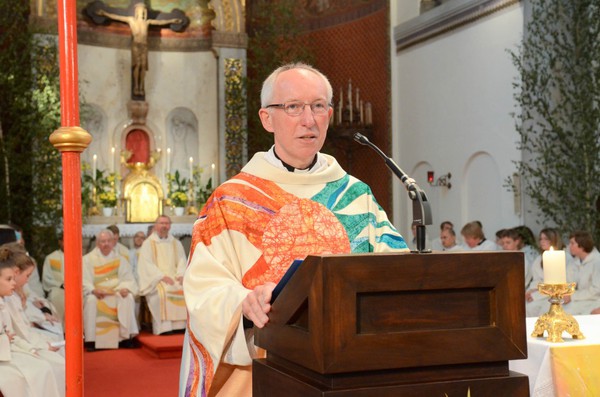
A leading Vatican Freemason from the Pontifical Council for Interreligious Dialogue (PCID) is one of the speakers representing the Holy See at the G20 Saudi Arabia Interfaith Forum Oct. 13–16.

Father Michael Heinrich Weninger, who was outed as a Freemason when celebrating Mass at the 2014 consecration of the new lodge of Mark Master Masons No. 1954, Austria, spoke Tuesday on slavery and human trafficking.

Weninger is accompanied by Islamic expert and PCID president Cdl. Miguel Ángel Ayuso Guixot and Bologna’s Cdl. Matteo Zuppi, the latter of whom is a confidant of Pope Francis and a close ally of Italian Muslims.

Despite the interdicts of 11 popes over 200 years condemning Freemasonry and the Congregation for the Doctrine of Faith (CDF) reiterating that membership in Masonic lodges “remains forbidden,” Fr. Weninger continues to occupy a position in the Roman curia and advocate for freemasonry.

“The faithful who enrol in Masonic associations are in a state of grave sin and may not receive Holy Communion,” the CDF ruled in 1983.

The Interfaith Forum is being viewed as a public relations strategy by Saudi Arabia under Saudi Crown Prince Mohammed bin Salman, “who has tried to put an international sheen on his despotic reign.”

Critics are slamming the Vatican endorsing the regime despite its notable human rights violations and radical departure from the ideals proposed by Pope Francis in his latest encyclical, Fratelli Tutti. Those found with Bibles, crucifixes or other Christian material still risk arrest and, if they’re foreigners, deportation.

Observers have also pointed to the unmistakable coincidence of the Interfaith Forum occurring in light of Saudi Arabia’s bid for a seat on the U.N. Human Rights Council.

On Tuesday, Saudi Arabia failed to secure one of the three-year seats on the U.N. Human Rights Council, obtaining just 90 votes from the 180-member body.

Speaking to Church Militant, renowned Islamic scholar Robert Spencer called the Vatican’s participation in the Interfaith Forum “a travesty.”

“While Saudi Arabia has taken steps toward reform, there still exists no church of any other non-Muslim house of worship on Saudi soil because the Saudi government is bent on implementing Muhammad’s command that only Islam should exist on the Arabian Peninsula,” commented Spencer, author of 21 books on Islam and the Middle East.

“Those found with Bibles, crucifixes or other Christian material still risk arrest and, if they’re foreigners, deportation. Women were recently given the right to drive, but that only underscored how severely Saudi society oppresses women,” Spencer underscored.

Saudi Arabia was the only country up for membership that failed to get elected, leading Bruno Stagno, Deputy Executive Director of Human Rights Watch (HRW), to applaud the “stunning rebuke to Saudi Arabia under Mohammed bin Salman.”

It was the “only country not elected, shunned by a majority of the U.N. The kingdom reaped what it deserves for its serious violations of human rights and war crimes abroad,” Stagno observed.

Ironically, while Saudi Arabia hosts an international Interfaith Forum endorsed by Pope Francis, “with few exceptions, Saudi Arabia does not tolerate public worship by adherents of religions other than Islam,” HRW 2020 World Report states.

The Islamic theocracy “systematically discriminates” even “against Muslim religious minorities” while “government-affiliated religious authorities” continue to “disparage Shia and Sufi interpretations, versions and understandings of Islam in public statements, documents and school textbooks,” HRW reports.

Death Penalty, Immigration

The country is notorious for its use of the death penalty, HRW notes. On April 23, 2019, it carried out a mass execution of 37 men, including 33 from the country’s minority Shia community “who had been convicted following unfair trials.”

Saudi Arabia’s Interior Ministry reported that the country executed 179 persons between January and mid-November 2019, mostly for murder and drug crimes. Executions are by firing squad, beheading and even crucifixion, sometimes in public.

Pope Francis has stridently opposed the death penalty in his latest encyclical, Fratelli Tutti, but has remained silent on the practice in Islamic countries and continues to ally himself with Islamic proponents of the death penalty like Saudi Arabia and Grand Imam of al-Azhar Ahmad al-Tayyeb, Church Militant reported.

In stark opposition to Pope Francis’ call for the welcome and humane treatment of migrants in Fratelli Tutti, Saudi Arabia is known for its systemic oppression of migrant workers.

Further, the theocracy is not a signatory to the 1951 Refugee Convention and does not have an asylum system to protect people fearing persecution.

Call to Unity

At the Forum, Cdl. Ayuso flagged the pontiff’s encyclical calling for “unity, solidarity and fraternity, for bettering our ‘common home,’ as Pope Francis is continuously reminding us all.”

It is necessary to answer Pope Francis’ call to “reaffirm that we are members of the one human family,” he added.

Father Weninger remarked:

The International Conference on 21st Century Slavery stated that human trafficking constitutes a shocking offense against human dignity and a grave violation of fundamental human rights, particularly the sexual exploitation of women and children.

Injustice, exploitation and abuse are often deeply institutionalized due to financial profit. There is a need for faith leaders to challenge these social injustices, particularly as they constitute a fundamental issue of human rights.

Participants at the conference include Ecumenical patriarch Bartholomew, Orthodox metropolitan Emmanuel Adamakis of France, Coptic bishop Anba Marco, Anglican Richard Sudworth representing the archbishop of Canterbury and Sr. Sharon Eubank from the Mormons.

Prominent Hindu, Buddhist and Jewish leaders are also participants.
Cardinal Ravasi flatters the Masons

This 2016 article by Cardinal Ravasi calls for dialogue with Freemasons. The Cardinal disingenuously implies that the penalties cited in Canon Law no longer apply to that ideology which Pope Leo XIII called, “pernicious,” “perverse” and “evil.”

Anonymous Catholic

From Rorate Caeli :

A few days ago, we published a few excerpts of the article published by Cardinal Ravasi, President of the Pontifical Council for Culture, in the Italian paper Il Sole 24 Ore last Sunday, February 14, 2016, calling for dialogue with Freemasons. We now have the full text of the article — followed by a response given by the Cardinal to a reader who asked him for a clarification.
***

DEAR BROTHER MASONS

Over and above our different identities, there is no lack of common values: a sense of community, charitable works and the fight against materialismby Cardinal Gianfranco RavasiI read some time ago in an American magazine that the international bibliography on Freemasonry exceeds more than a 100,000 articles. Certainly contributing to this interest is its aura of secrecy and mystery, more or less with good reason, its different “obediences” and Masonic “rites” shrouded in a sort of murkiness, not to mention its origins, which, according to the English historian Frances Yates, “are one of the most discussed and questionable problems in the entire field of historical research” (curiously the scholar’s study was dedicated to the Rosicrucian Enlightment, translated by Einaudi in 1976).We obviously do not want to go into this archipelago of “lodges” “orients” “arts” “affiliations” and denominations of which history has often weaved – for better or for worse – into the politics of many nations (for example, I’m thinking here of Uruguay where I took part recently in various dialogues with proponents of traditional Masonic culture and society), just as it is not possible to trace the lines of demarcation between the authentic, the false, the degenerate, or para-masonry and the various esoteric or theosophical circles.
It is also arduous to illustrate a map of the ideology which holds such a fragmentary universe, which is why we can speak of a horizon and a method more than a codified doctrinal system. Inside this fluid setting some rather distinct crossroads meet, such as an anthropology based on freedom of conscience, intellect and equal rights, in addition to a deism that acknowledges the existence of God, allowing however, for flexible definitions on His identity. Anthropocentrism and spiritualism, are, therefore, two somewhat excavated paths within a very changeable and flexible map that we are not able to outline in any precise way.


We are content, though, to indicate an interesting little volume which has a clearly distinct aim: that of defining the relationship between Freemasonry and the Catholic Church. Let’s be clear immediately though: it is not a historical analysis of this relationship, neither does it treat of possible contaminations between the two subjects. In fact, it is evident that Masonry has assumed Christian models – even liturgical ones. We must not forget, for instance, that in the 17th century many English lodges recruited members and maestros among the Anglican clergy and it is a fact that one of the first and fundamental Masonic “constitutions” was drawn up by the Presbyterian pastor, James Anderson who died in 1739. In it, among other things, it was affirmed, that an adherent ”will never be a stupid atheist nor an irreligious libertine” even if the creed proposed was, in the end, the vaguest possible, “that of a religion which all men agree on”.


Now, the vacillations of contacts between the Church and Freemasonry have had many varied movements, reaching even manifest hostility, marked by anticlericalism on the one side and excommunication on the other. Indeed, on April 28th 1738, Pope Clement XII, the Florentine Lorenzo Corsini, promulgated the first explicit document on Freemasonry, the Apostolic Letter In eminenti apostulatus specula, in which he declared: “that these same Societies, Companies, Assemblies, Meetings, Congregations, or Conventicles of Liberi Muratori or Francs Massons, or whatever other name they may go by, are to be condemned and prohibited”. Condemnations reiterated by subsequent pontiffs, from Benedict XIV to Pius IX and Leo XIII, affirmed the incompatibility between membership in the Catholic Church and Masonic obedience. Concise was the 1917 code of Canon Law in which canon 2335 reads: “Those who join a Masonic sect or other societies of the same sort, which plot against the Church or against legitimate civil authority, incur ipso facto an excommunication simply reserved to the Holy See.”


The new Code of 1983 tempered the formula, avoiding explicit reference to Freemasonry, conserving the substance of the punishment even if destined in the most generic sense “a person who joins an association which plots against the Church” (canon 1374). However the most articulated Church document on the irreconcilability between adhesion to the Catholic Church and Freemasonry is the Declaratio de associationibus massonicis issued by the Vatican Congregation for the Faith on November 26th 1983, signed by the then Prefect, Cardinal Joseph Ratzinger. It specified precisely the value of the new Code of Canon Law, reaffirming: “the Church’s negative judgment in regard to Masonic association remains unchanged since their principles have always been considered irreconcilable with the doctrine of the Church and therefore membership in them remains forbidden.”


The small volume to which we now return, is interesting since it attaches – along with an Introduction by the present Prefect for the Congregation, Cardinal Gerhard Muller – also two documents from two local Episcopates, the German Episcopal Conference (1980) and the Philippine one (2003). They are significant texts as they address the theoretical and practical reasons for the irreconcilability of masonry and Catholicism as concepts of truth, religion, God, man and the world, spirituality, ethics, rituality and tolerance. It is significant particularly for the method adopted by the Philippine Bishops, who articulate their discourse along three trajectories: the historical, the more explicitly doctrinal and the pastoral. All is examined along the lines of the question-answer type of catechesis. There are 47 question-answers and they go into details, such as the initiation ceremony, symbols, the use of the Bible, the relationship with other religions, the oath of brotherhood, the various levels of the hierarchy and so on. These various declarations on the incompatibility of the two memberships in the Church or in Freemasonry, do not impede, however, dialogue, as is explicitly stated in the German Bishops’ document which had already listed the specific areas for discussion, such as the communitarian dimension, works of charity, the fight against materialism, human dignity and reciprocal knowledge.


Further, we need to overcome that stance from certain Catholic integralist spheres, which – in order to hit out at some exponents even in the Church’s hierarchy who displease them – have recourse to accusing them apodictically of being members of Freemasonry. In conclusion, as the German Bishops wrote, we need to go beyond reciprocal “hostility, insults and prejudices” since “in comparison to past centuries the tone and way of manifesting [our]differences has improved and changed” even if these differences still remain in a clearly distinct way.

[Translation: Contributor Francesca Romana]
***
After being contacted by a Rorate reader, Cardinal Ravasi sent the reader the following message:

Dear [X],
You are probably reacting mainly to the article’s title, which was added by the newspaper’s staff.
My article actually presented the 1983 document from the Congregatio pro Doctrina Fidei, signed by Cardinal Ratzinger, and also the documents on the Masons from the German and Philippine Episcopal Conferences, with clear doctrinal precision as well as practical indications.
Sincere regards,

Gianfranco Card Ravasi