Be silent no more! Cry out with one hundred thousand tongues. I see that, because of this silence, the world is in ruins, the Spouse of Christ has grown pale; the color is taken from her face because her blood has been sucked out, that is the blood of Christ, which is given as a free gift and not by right – St. Catherine of Siena
In the 3rd century BC, King Pyrrhus of Greece went to war against the Romans. Initially, his forces were victorious, but the casualties they sustained were so high that Pyrrhus was unable to win a more decisive later battle. From this historical failure is derived the term, Pyrrhic victory, which has come to mean a victory which is hollow: one which loses more than it gains.
Two thousand years later, Italy is again the scene of a Pyrrhic victory; mainstream traditionalist media is claiming a triumph while also sustaining great losses, both of credibility and of personal integrity.
A deal with the devil
The Tridentine Mass of the Summorum Pontificum pilgrimage held in St. Peter’s Basilica was hailed by some as the sign that Pope Leo is welcoming tradition into the Vatican. It was a product of the “Zip It” policy which promised to “see no evil” in return for access (for some) to the Latin Mass.
With a huge crowd of faithful Catholics and a number of high-ranking prelates in attendance, the liturgy was accompanied by an exorcism prayer offered by Cardinal Ernest Simoni. Cardinal Simoni, aged 97, had been tortured and imprisoned for 28 years in Albania for refusing to renounce his faith.
Without casting shade on the piety of the Cardinal, it must be asked whether a single exorcism prayer could be sufficient to cleanse St. Peter’s from the multitude of abuses she has endured over the past decade. Surely a solemn reconsecration would be necessary before traditionalists could dare to offer Mass inside St. Peter’s walls?
The Vatican’s liaison was Cardinal Matteo Zuppi, who was also in attendance on the day. Zuppi has been assisting at traditional liturgies around Rome for a number of years, one example being the Pontifical Mass he offered for Laetare Sunday with the FSSP in 2014.
Yet, Zuppi is so closely aligned with the promotion of sodomy that his presence at these Masses should be a source of scandal to traditional Catholics.
The pilgrimage of sodomites which entered the Basilica last month, organised with the explicit support of Cardinal Zuppi, was only the latest in a series of his sodomy-related scandals.
Mainstream and alternative media alike continue to share the narrative that the new Pope, Leo XIV, is going to turn the Church away from its chaotic, Bergoglian-era path and onto a more peaceful pathway. However, as the Pope begins to make his Curial appointments, it is clear that this is just a furphy designed to make the synodal Ape of the Church more palatable for traditionalists.
These three key appointments show that Pope Leo’s agenda is simply a continuation, rather than a break with the pontificate of Jorge Bergoglio. Yet these pale into insignificance compared with the great errors being perpetrated by Leo and which are thankfully starting to be called out by traditionalist commentators: Universalism and Indifferentism.
Appointment #1: a feminist nun
The first unworthy appointment is the new Secretary of the Dicastery for Institutes of Consecrated Life and Societies of Apostolic Life, Sr. Tiziana Merletti. This Dicastery oversees religious congregations and orders as well as secular institutes, including of course, many priests and brothers.
The feminist-driven International Union of Superiors General sent its official congratulations to Sr. Merletti, noting that she was a member of the Commission for Safeguarding operated jointly by the men’s and women’s unions of superiors. “Her contributions are a gift to our global network, promoting justice, care and integrity in consecrated life,” the statement said.
However, Sr. Merletti is yet to make her opinion known on the despicable case of Marko Rupnik, who has sexually abused dozens of nuns; it would appear that those traumatised women somehow fall outside the remit of the “safeguarding” Commission.
According to its website, the five heads of the Dicastery now include three women – in a direct violation of Scripture and canon law.
Appointment #2: a pro-contraception Prelate
Also in May, Pope Leo appointed Msgr. Renzo Pegoraro as the new President of the Pontifical Academy for Life. The position was formerly held by the evil Cardinal Vincenzo Paglia but unfortunately, Paglia’s replacement is little better. As Dr. Thomas Ward, of the National Association of Catholic Families in the UK, noted, there’s no record of Pegoraro “disassociating himself from any of the egregious positions and comments of Archbishop Paglia.”
Pegoraro is in favour of contraception and has made worrying remarks about assisted suicide. He told the Wall Street Journal in 2022 that artificial contraception is admissible “… in the case of a conflict between the need to avoid pregnancy for medical reasons and the preservation of a couple’s sex life.”
Regarding assisted suicide, Pegoraro noted in 2022 that this was a preferable alternative to euthanasia:
“We are in a specific context, with a choice to be made between two options, neither of which — assisted suicide or euthanasia — represents the Catholic position.” However, he stated that, of the two options, “assisted suicide is the one that most restricts abuses because it would be accompanied by four strict conditions: the person asking for help must be conscious and able to express it freely, have an irreversible illness, experience unbearable suffering and depend on life-sustaining treatment such as a respirator.”
Pegoraro and Paglia appointed pro-abortion members to the Academy, including the notorious Mariana Mazzucato. Mazzucato, an atheist, is promoted by the World Economic Forum; the WEF website reveals that “Pope Francis appointed her to the Pontifical Academy for Life for bringing ‘more humanity’ to the world.”
Mariana Mazzucato
Pegoraro and Paglia explained their rationale in this way: “In this sense, it is important that the Pontifical Academy for Life include women and men with expertise in various disciplines and from different backgrounds, for a constant and fruitful interdisciplinary, intercultural and interreligious dialogue.”
So while Catholic media continue to claim that by replacing Paglia, Pope Leo is exhibiting signs of orthodoxy, the truth is that the deckchairs are merely being reshuffled and that Paglia, rather than being kicked out was resigning due to his age – a ripe old 80.
Appointment #3 – an anti-Catholic Bishop
One of Pope Leo’s first alarming moves was to appoint a progressive bishop to Saint Gall in Switzerland. Many put that down to his ignorance of the man (unlikely since as Cardinal Prevost, he was in charge of the Dicastery for Bishops) or to the unique relationship between Church and state in Switzerland. (That situation is above my pay-grade.)
But there is a more recent appointment that is also raising alarm bells: Pope Leo has appointed Monsignor Raúl Martín as Archbishop of Paraná, Argentina. Martín is known for banning parishioners from receiving Holy Communion kneeling and on the tongue, for some minor liturgical abuses, and also for his persecution of orthodox priests.
While some say that due to Bergoglio’s activity, there are no decent bishops from whom to select, I can only compare it with the state of affairs here in Australia. While the majority of our prelates are progressive, here and there, some relatively decent ones exist. So it seems highly unlikely that there is absolutely no one else from whom to choose in Argentina.
Leo’s Universalism & Indifferentism
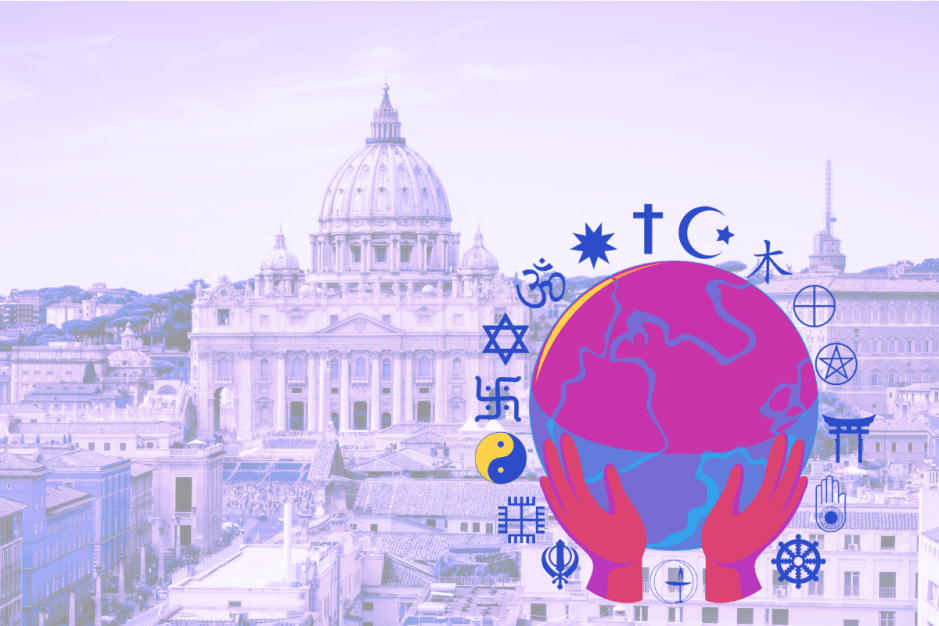
Universalism is the belief that all souls will ultimately be saved, while a related heresy is Indifferentism: the belief that all religions are equal or that all paths lead to heaven. Unfortunately, despite his Latin and lace, Pope Leo is a proponent of both of these errors, which are unsurprisingly, fundamental principles of Freemasonry.
Chris Jackson has done a great job of laying out Pope Leo’s recurring Universalist theme, so I recommend that you read the entire thing at his Substack. Here are a couple of pertinent excerpts:
This phrase, “for all,” was the defining liturgical lie of the Novus Ordo for nearly four decades. It misrepresented the Latin pro multis as a universalist formula, contradicting the teaching of Christ and the explicit theology of the Church. It was corrected under Benedict XVI, who ordered all vernacular translations to finally conform to pro multis: “for many.” But Leo XIV has now restored the deception in the most public and solemn setting possible, consecrating new priests under a cloud of doctrinal subversion.
On May 14, Leo XIV gave an address during the Jubilee of Oriental Churches. In it, he approvingly cited Isaac of Nineveh, a seventh-century Nestorian bishop who died outside communion with Rome. Isaac belonged to the Assyrian Church of the East, rejected the Council of Chalcedon, and taught a form of mystical universalism. He has long been associated with the belief that Hell is not eternal, but rather a purgative experience that ultimately leads all souls, including demons, toward healing and reconciliation.
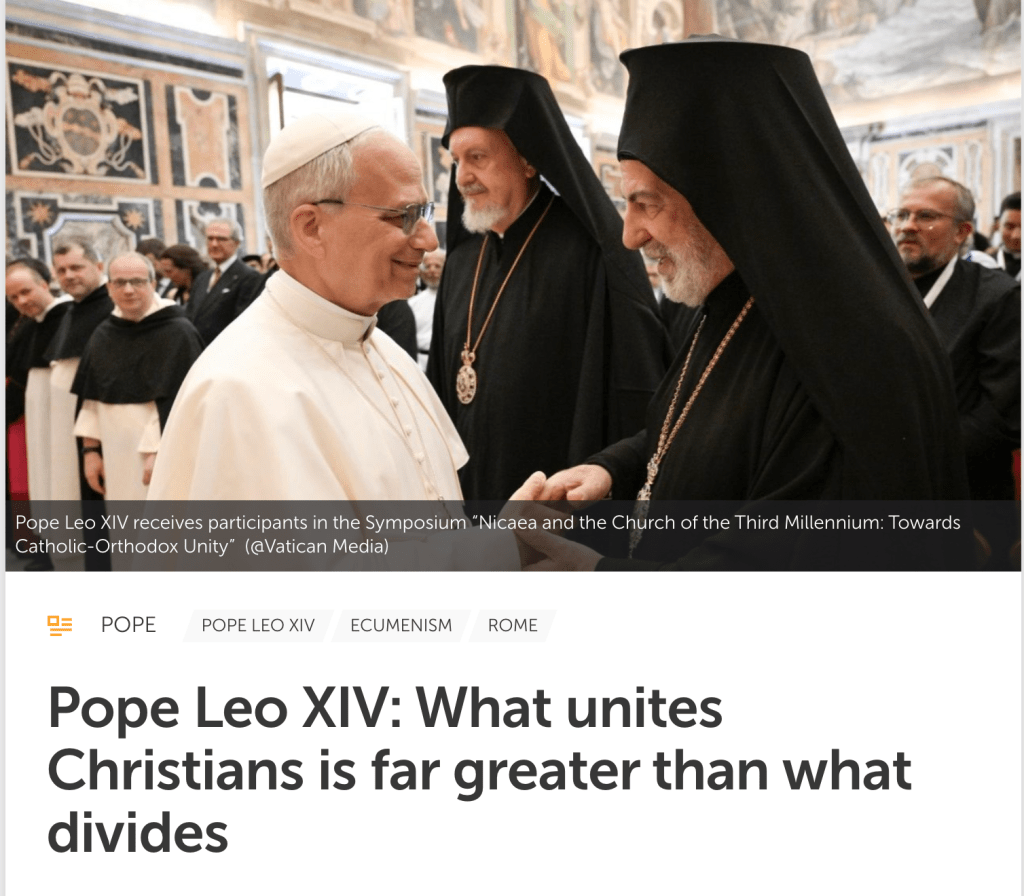
One instance of Pope Leo’s promotion of religious indifferentism can be found in his address to participants at a conference on pursuing Catholic-Orthodox unity: he said that “what unites us is greater than what divides.”
Pope Leo said he saw the conference as “an invaluable opportunity to emphasise that, what we have in common is much stronger, quantitatively and qualitatively, than what divides us.”
For a start, there’s a thousand-year schism shows this is patently untrue. And “what divides us” includes the Orthodox rejection of papal authority, not to mention its leniency towards divorce and remarriage and also contraception.
Then compare Leo’s words with those of Pope Pius XII: “They shall also be on guard lest, on the false pretext that more attention should be paid to the points on which we agree than to those on which we differ, a dangerous indifferentism be encouraged…” (On the Ecumenical Movement, 1949.)
It certainly appears that ‘a dangerous indifferentism’ is being encouraged by the current pontiff. Although he has the power to rescind, or at he very least ignore, his predecessor’s indifferentist manifesto, the Abu Dhabi Document, he actuallyquoted from it in an address to non-Catholic representatives on May 15.
None of this bodes well for the trajectory of the apparent Pax Romana for which Leo is responsible. Rather, it reminds one of the Scripture verse: And it was not enough for them to err about the knowledge of God, but whereas they lived in a great war of ignorance, they call so many and so great evils peace. (Wisdom 14: 22)
Last week in the country town of Myrtleford, two Anglican women, one of whom is a gay Anglican ‘priestess’ joined the Catholic priest in the sanctuary during a public Novus Ordo Mass.
The Mass, part of the town’s annual Italian Festival, was offered in the grounds of St. Mary’s Church on a temporary stage and was dedicated to St. Anthony of Padua. When asked by a stunned attendee why the priestesses were near the altar during Mass, a local (who happened to be an ex-nun) stated that “we do everything together here in Myrtleford”!
Taken from the Festival website.
The eye-witness, a faithful Catholic, was shocked to see the two women consuming the Sacred Host, despite belonging to the Anglican faith. Although neither woman played an active role in the Mass, the ‘priestess’ was given a chalice to hold while Holy Communion was being distributed. She also addressed the crowd after Mass was finished.
According to the eye-witness, “One of them was trying to touch everything and finally got her hands on the incense. The priest cursed before reading the Gospel. He said “mannaggia miseria!” (This means ‘damn it’ in Italian).
Anglican priestesses in the make-shift sanctuary as the priest goes to distribute Holy Communion.
Close-up of the Anglican priestess with the chalice.
The ‘priestess’ is Moira Evers, a known lesbian and LGBTQ activist. In an article posted when she was appointed parish priestess in Myrtleford, Evers said she wanted people to ‘see the church as a place of safety.’
Moira Evers on being made parish priestess at Myrtelford’s Anglican church.
The priestesses in ‘cappae nigrae’ before the Mass
Evers after celebrating an Anglican ‘Fabulous Pride Mass’ in 2016. SOURCE
Evers is controversial even within the Anglican church because of her involvement with a same-sex advocacy group who expressed support for a Satanic Mass. There are also reports of members of her former congregation at Buderim leaving the parish because of her pro-LGBTQ stance.
The parish priest of St. Mary’s Catholic Church is Fr. Tony Shallue. There seems little hope of him being disciplined over the liturgical abuse as St. Mary’s is located in the Diocese of Sandhurst, which is overseen by Bishop Shane Mackinley. This is the same bishop who is notoriously allowing a three-month exhibition of a pagan idol related to witchcraft to remain in Bendigo’s Sacred Heart Cathedral, despite massive pushback from Catholic clergy and the faithful.
Angelo Roncalli has been accused of many things: of conversing with aliens, consorting with Freemasons, being installed by Freemasons, being a Freemason and of course, introducing Synarchy into the heart of the Church. Although those accusations rely on a degree of speculation, he exhibited enough obvious flaws (as evidenced by the disastrous Second Vatican Council) to conclude that his papacy struck a heavy blow to the Church.
Part of that blow came in the form of the ecumenical movement, which was a Modernist counterweight to the longstanding belief of extra ecclesiam nulla salus – there is no salvation outside the Catholic Church. The document, Nostra Aetate, which was a pet project of John’s, formed the basis for the reject of extra ecclesiam. Hidden within its ambiguous text was the suggestion that non-Catholics can be saved without conversion to Catholicism. The document errs mostly by omission in that it fails to advise Catholics to evangelise their non-Catholic neighbours, thus implying that there is, in fact, salvation outside of Catholicism.
One problematic section from Nostra Aetate is given below. For more samples of its errors and a commentary, please read here.)
True, authorities of the Jews and those who followed their lead pressed for the death of Christ (cf. Jn. 19:6); still, what happened in His passion cannot be blamed upon all the Jews then living, without distinction, nor upon the Jews of today. Although the Church is the new people of God, the Jews should not be presented as repudiated or cursed by God, as if such views followed from the holy Scriptures…
While it’s true that prior to being elected Pope, Angelo Roncalli assisted in the protection of thousands of Jewish people as they fled from persecution by the Nazis, he didn’t stop with merely defending their safety. As Pope, John went further and re-wrote the Church’s relationship with the Jews.
In large part, the Church’s relaxation of its policy towards the Jewish religion was the result of lobbying by a French Jewish historian named Jules Isaac.
Jules Isaac
In 1948, Isaac authored a book which, rather brashly, gave suggestions to Christians about how they should teach their children about the Jewish people. Called Jesus and Israel: A Call for Necessary Corrections on Christian Teaching on the Jews, the book included 18 points he believed should be enacted by the Catholic Church. (Read them here.)
Isaac secured a meeting with Pope John XXIII on June 13, 1960, two years prior to the Council, and recorded his thoughts immediately after they met. Isaac’s notes are treasured by Jewish historians.
For the meeting, Isaac was equipped with volumes of material which he believed was evidence that the Church’s teaching was anti-semitic and needed to be changed. Note that Isaac audaciously believed the had a right to change Catholic teaching. He wrote:
The problem of Catholic teaching which I attacked is infinitely more complex than that of the liturgy1. Seen from the special angle concerning Israel, it touches, if not the main ideas of faith and dogma, at least a thousand-year-old tradition, product of the Church fathers, from St. John Chrysostom to St. Augustine.
Isaac’s particular concern was the so-called “teaching of contempt” of Catholic towards Judaism, which he believed to be anti-Christian and which he believed fuelled anti-Semitism. He put forward his arguments and suggested that the Pope create a sub-committee to study his concerns. The Pope agreed to seek advice on the matter and they parted cordially.
Judaic Influence
A few months later, a group of American Jewish men from a society known as B’nai B’rith met with the Pope. B’nai B’rith (see more here) has close ties to Freeemasonry, and founded the Anti Defamation League.
At that meeting, John told them that: “You are of the Old Testament and I of the New Testament, but I hope and pray that we will come closer to the brotherhood of humanity… It gives me great pain and sorrow to see these recent events (a rash of swastika graffiti) which not only violate a natural right of human beings but destroy the understanding between brothers under God…”
That same year, he also met with a group called United Jewish Appeal, when he said: “We are all sons of the same Heavenly Father. Among us there must ever be the brightness of love and its practice. I am Joseph, your brother.”
Later in 1960, John called for those clerics preparing for the Council to add a declaration on the attitude of the Church towards the Jews. He approved the first draft, entitled Decretum de Judaeis (“Declaration on the Jews”) in November 1961, but didn’t live to see the document in its final form. That was left to Paul VI, who promulgated it as Nostrae Aetate in 1965.
Perfidious Pontiff
Yet, the Jewish question had been in John’s mind before these meetings, as back in March of 1959, during the Good Friday Liturgy, John demanded that the word, ‘perfidious’ should not be read during the prayer for the Jews.
As even such Modernists as Cardinal Bea and Henri de Lubac point out, the adjective ‘perfidious’ was included in Medieval times when its meaning was less offensive than it is today. ‘Perfidious’ originally meant ‘unbelieving’ or ‘unfaithful’ and was thus perfectly appropriate for describing the Jewish people.
[It is worth noting that when Benedict XVI allowed for wider use of the traditional Latin Mass, he only authorised the use of the 1962 Missal from which the word “perfidious” had been removed. Fr. Mawdsley has a lot more to say on this.]
Next, John attacked the Rite of Baptism, removing the necessity to “Abhor Jewish unbelief (in Jesus Christ) and reject the Hebrew error (which is that the Messiah has not yet come).”
John also ‘cancelled’ Pius XI’s prayer from 1925, the Act of Consecration of the Human Race to the Sacred Heart of Jesus. The words, ‘Look with Thine eyes of mercy upon the children of that stock, so long Thy Chosen People; May the blood called upon them of old, now descend on them as the waters of redemption and life,’ were now deemed to be politically incorrect.
Making Catholics Pay
John went even firther in his efforts to appease the Jews. With the assistance of the heterodox Cardinal Frings, John required that a prayer be said by German Catholics on the Feast of the Sacred Heart. It went:
“Lord, God of our Fathers! God of Abraham, Isaac and Jacob! God of merry and God of solace! We confess before you: Countless men were murdered in our midst, because they belonged to the people from whom the Messiah rose up in the flesh. We pray Thee: Lead all among us who became guilty through deed, omission, or silence, that we may see the wrong and turn from it. In the spirit of heartfelt atonement, we beg for forgiveness for the sins which were committed by our fellow citizens. We beseech that the spirit of peace and reconciliation return to all homes and we pray for the peace of Israel among the nations; on the borders of its state and in our midst…”
While there was most likely a need for some German Catholics to repent of their collaboration with the Nazis, the hypocrisy of John demand is obvious. The Jews detested being held to account as a group for the crime of their forebears – putting Christ to death – yet John expected German Catholics to be held responsible, as a group, for the crime of the Nazis.
And where was the acknowledgement of the non-Jews who were persecuted under Hitler? Including thousands of priests, nuns and lay Catholics? The prayer does not mention those poor people.
Don’t Convert!
John’s commitment to non-evangelisation was well known. Secretary to John XXIII, Loris Capovilla told this story to Time Magazine:
“A young Jewish lad made the acquaintance of Giuseppe Roncalli when he was the Cardinal-Archbishop of Venice. The young man wanted to become a Catholic, but Roncalli kept putting him off. ‘Look,” he said, ‘you’re a Jew. Be a good Jew. Becoming a Catholic will kill your parents.’ The young man persisted and Roncalli finally said he could be baptized — in secret.
“Several years later (in 1961) after his parents had died, he presented himself at the Vatican to see his old mentor, now the Pope. He wanted the Pope to give him the Sacrament of Confirmation. ‘All right, all right,’ said Pope John XXIII, ‘but you have got to continue to be a good Jew, in your own community, go to the synagogue, support the Jewish schul, because, by being a Catholic, you do not become any less a Jew.”
Pope of the Jews
In 2014, Rabbi Dalin, a former professor of Ave Maria University, reminisced about John’s contribution to Catholic-Jewish relations and it was from this man that we learn John was known as the “Pope of the Jews.”
Dalin tells the story of Pope John driving through the streets of Rome on a Saturday, when he suddenly ordered his car to stop in front of Rome’s great synagogue. He got out of the car so he could bless the Jews of Rome as they were leaving: an important symbolic act that earned their gratitude.
“In doing this,” Rabbi Dalin observes, “he began to transform the history of Catholic-Jewish relations in our time, with initiatives inspired by his work on behalf of Jews during the holocaust….
… “Twentieth and 21st-century Jews will forever be indebted to Pope John XIII for his historic role in bringing about Nostra Aetate. It changed forever the relationship between Catholics and Jews.”
It is worth noting that John XXII was canonised (along with another ecumaniac, John Paul II) on the eve of Yom Hashoah, the international day of Holocaust remembrance observed in Israel and by Jews around the world.
see John XXIII’s changes to the liturgy in a later section ↩︎
Some of the problematic sections from Nostra Aetate are given below. For a fuller explanation of how this and other Vatican II documents deviate from traditional Catholic teaching, please read here.)
Tolerance for Eastern Religions
The Catholic Church rejects nothing that is true and holy (vera et sancta)in these religions. She looks with sincere respect upon those ways of conduct and of life, those rules and teachings which, though differing in many particulars from what she holds and sets forth, nevertheless often reflect a ray of that Truth which enlightens all men….
… Thus in Hinduism, men contemplate the divine mystery and express it through an unspent fruitfulness of myths and through searching philosophical inquiry. They seek release from the anguish of our human condition through ascetical practices or deep meditation or a loving, trusting flight toward God….
…Buddhism in its multiple forms acknowledges the radical insufficiency of this shifting world. It teaches a path by which men, in a devout and confident spirit, can either reach a state of absolute freedom or attain supreme enlightenment by their own efforts or by higher assistance….
Nostra Aetate §2
Tolerance for Islam
Upon the Moslems, too, the Church looks with esteem. They adore one God, living and enduring, merciful and all-powerful, Maker of heaven and earth and Speaker to men (qui unicum Deum adorant etc…., homines allocutum). They strive to submit wholeheartedly even to His inscrutable decrees (cuius occultis etiam decretis toto animo se submittere student), just as did Abraham, with whom the Islamic faith is pleased to associate itself….
…”Though they do not acknowledge Jesus as God, they revere Him as a prophet. They also honor Mary, His virgin Mother1 ; at times they call on her, too, with devotion.”
… Although in the course of the centuries many quarrels and hostilities have arisen between Christians and Moslems, this most sacred Synod urges all to forget the past and to strive sincerely for mutual understanding. On behalf of all mankind, let them make common cause of safeguarding and fostering social justice, moral values, peace, and freedom.
Nostra Aetate §3
JOHN PAUL II AT ASSISI IN 1986 – A LOGICAL CONSEQUENCE OF NOSTRA AETATE
Misrepresentation of the Jewish Religion
True, authorities of the Jews and those who followed their lead pressed for the death of Christ (cf. Jn. 19:6); still, what happened in His passion cannot be blamed upon all the Jews then living, without distinction, nor upon the Jews of today. Although the Church is the new people of God, the Jews should not be presented as repudiated or cursed by God, as if such views followed from the holy Scriptures.
Nostra Aetate §4
Refuting Nostra Aetate’s Claims about Judaism
“Necessary to note here is the attempt to limit the responsibility for Deicide to a small group of quasi private individuals, whereas the Sanhedrin, the supreme religious authority, represented all of Judaism. Therefore, in the rejection of the Messiah and Son of God, it had collective responsibility for the Jewish religion and the Jewish people, and this irrefutably is stated in Holy Scripture: “And from then on, Pilate was looking for a way to release him. But the Jews cried out, saying, ‘If thou release this man, thou are no friend of Caesar; for everyone who makes himself king sets himself against Caesar'” (Jn. 19:12); and “And all of the people answered and said, ‘His blood be on us and our children'” (Mt. 27:25).
“Also striking is the statement that “the Jews should not be presented as repudiated or cursed by God, as if such views followed from the holy Scriptures.” This lacks the necessary distinction between individuals and the Jewish religion. If the subject is individual Jews, the statement is true, and is exemplified by the great number of converts from Judaism in all eras. But if the subject is Judaism as a religion, the assertion is both erroneous and illogical: erroneous, because it contradicts the evangelical texts and the Church’s constant faith from her origins. (Cf. Mt. 21:43: “Therefore I say to you, that the Kingdom of God will be taken away from you and will be given to a people yielding its fruits.”) And it is illogical, because if God did not reject the Jewish religion or the Jewish people in the religious sense (which in Jesus’ time was one and the same thing), then the Old Testament has to be viewed as being still valid, and contiguous and concurrent with the New Testament. This, then, would sanction the unjustified awaiting of the Messiah, a hope still entertained by today’s Jews! All of this is a totally lying representation of Judaism and its relationship to Christianity.”2
She is honoured by Moslems as mother of a prophet, not mother of the Son of God ↩︎
Like the side events staged by NGO’s at the UN, the Pope’s ecumenical side-event at the Synod might be where the real work of demolishing the Catholic Church is taking place.
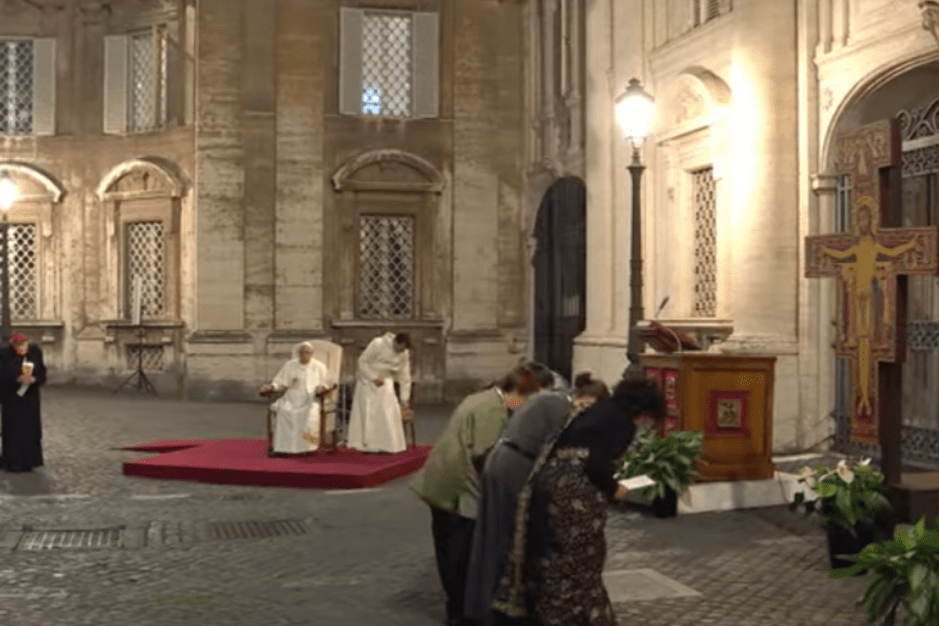
On October 11, the Pope led an ecumenical prayer meeting at a very special non-church venue: the Protomartyrs Square, an area right near St. Peter’s Basilica where the first pope is thought to have died. Francis excelled himself, managing to pack an unprecedented variety of blasphemies into one evening: continuing to promote the Masonic doctrines of religious indifferentism and naturalism, topped off by an egregious insult to every Catholic who shed his blood for the Faith.
The event marked the anniversary of the opening of the Second Vatican Council which the organisers of Francis’ vigil hailed as the beginning of a ‘new ecumenical era.’
For the theme of his reflection, Pope Bergoglio chose the phrase from John’s Gospel: “The glory that you have given me I have given them” (Jn 17:22). This expresses his belief that the martyrdom of early Christians like St. Peter, the shedding of their blood in that very place, had some mystical ecumenical significance.
The Pope continued by saying that the martyrs are ‘accompanying the Church on its ecumenical journey’ – another error with no basis in reality or in Catholic tradition. Unsurprisingly, Pope Francis quoted the arch-ecumenist, John XXIII, linking the pursuit of ecumenism to the unbelievably boring topic of synodality, saying “The journey of synodality… is and must be ecumenical”.
That bit does make sense. Since faithful Catholics are not fooled by either synodality or ecumenism, Francis has to go outside the Church to gain any traction. But that poses no problem when one has no belief in the primacy of Catholicism. When one can give away the bones of St. Peter or sign heretical documents with anti-Christians, then nothing is off the table.
It seems lost on the Pope that the martyrs died rather than compromise their faith to even one degree, let alone completely handing it to non-believers on a platter as he has chosen to do.
The Pope continued to spout his own ‘magisterium of Francis’: “Unity is a grace. We do not know beforehand what the outcome of the Synod will be, just as we cannot predict how the unity we are called to will fully manifest.”
Artist’s impression of how Bergoglio’s ‘unity’ will manifest
In another direct contradiction of Church teaching, Pope Francis claims that a so-called ‘ecumenism of blood’ is a witness of Christian unity to the world. ‘Ecumenism of blood’ is another of Francis’ imaginary theological principles. There really is no such thing. Christians do not achieve unity through martyrdom and this certainly was not the meaning behind Jesus’ discourse at the Last Supper. At least, if it was, then Gnostic Francis is the first Catholic in history to find this hidden interpretation.
Scripture and tradition clearly state that there is no salvation outside the Church. There is no unity when some Christians are outside the Church and others are inside the Church. Further, despite Francis’ many claims to the contrary, heretics can not be considered martyrs. [See note below this article for further explanation.]
St. Peter made this abundantly clear in 1 Corinthians 13:3, when he wrote, “… if I should deliver my body to be burned, and have not charity, it profiteth me nothing.” Charity, of course, means to love God with all one’s mind and heart – including believing everything which has been taught by His Church. Anyone Christian outside of the Catholic Church is by definition, lacking in charity.
The attempted martyrdom by non-Catholics was the precise context of that famous doctrine, extra ecclesiam nulla salus, as first recorded by St. Cyprian of Carthage:
But if not even the baptism of a public confession and blood can profit a heretic to salvation, because there is no salvation out of the Church, how much less shall it be of advantage to him, if in a hiding-place and a cave of robbers, stained with the contagion of adulterous water, he has not only not put off his old sins, but rather heaped up still newer and greater ones!
Pius XII reiterated the importance of membership in the Catholic Church in his Encyclical, Mystici Corporis Christi,
“Actually only those are to be included as members of the Church who have been baptized and profess the true faith, and who have not been so unfortunate as to separate themselves from the unity of the Body, or been excluded by legitimate authority for grave faults committed.”
And these are only a few examples of the constant teaching of the Church prior to Vatican II. Francis’ ecumenical side-event reminds us of his true priority: the deconstruction of Catholicism.
While chancery bureaucrats enjoy their Roman holiday at the Synod, deluding themselves that anything they do will make a scrap of difference to the Pope, Francis puts on his Masonic-coloured lens: promoting religious indifferentism instead of preaching baptism to all nations and promoting the heresy of naturalism by pursuing his Utopian dream of ecumenism.
[NOTE ON NON-CATHOLIC MARTYRS: For a nuanced approach to this topic, consider this: They may have been true martyrs, but only before God (coram Deo), not before the Church (coram Ecclesia). They would be martyrs coram Deo, provided they were habitually willing to believe whatever the Church proposed if they had the means to know it, and it is not their fault. They would not be martyrs coram Ecclesia because only God knows the internal dispositions of a person’s soul at the hour of death. Now the Church can only make a pronouncement about external actions that can be known by one’s senses. Thus, she cannot publicly consider martyrdom something that only God can know, namely, that a person in the state of invincible ignorance decided in his heart, even if only as a desire, to belong to the Catholic Church and who died united to her.]






 Ecclesiastical Freemasonry