Alarm bells over Kazakhstan

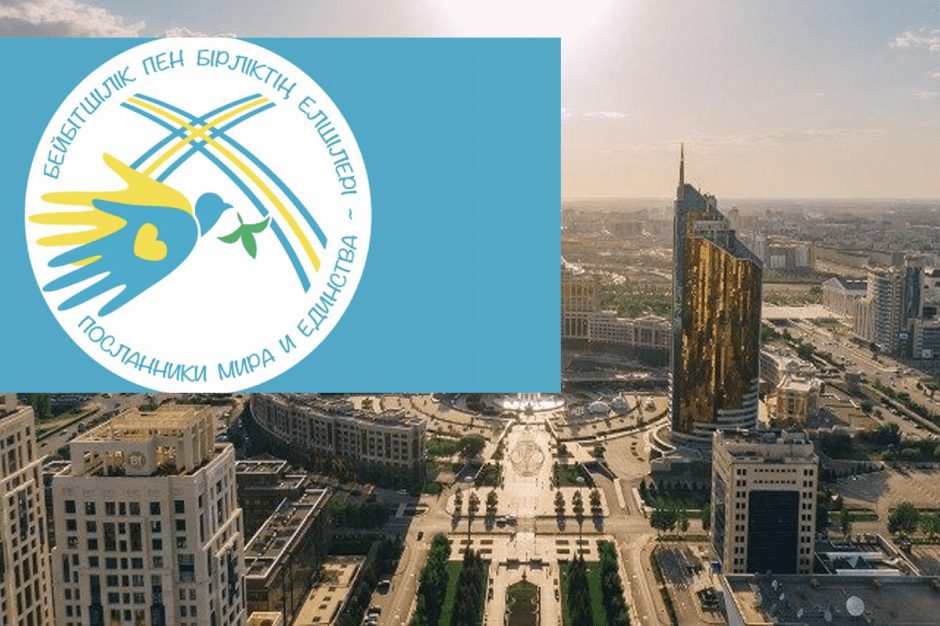
The 7th Congress of Leaders of World and Traditional Religions is taking place on September 14-14th in the Kazakh capital of Nur-Sultan,. Pope Francis will be one of the honoured guests and will be giving the closing address. Other religious leaders include the Grand Imam of Al Azhar, Ahmed Al Tayeb, as well as Rabbis, Patriarchs and representatives of Shintoism, Buddhism, Zoroastrianism, Hinduism.

Invitees are supposed to be “the most renowned … clergy from around the world” so the Pope’s presence is a little mystifying. Bishop Schneider must be out of town next week.

Apparently Muslims are looking for to his visit because they think the Pope is “like a father” to them. That’s obviously because Muslims aren’t big on the Latin Mass.

Somehow, someone who hasn’t yet read The Dictator Pope figures that the Bergoglio is an expert in “mapping out the how and why of resolving and avoiding conflicts.” Hmmmm.

The first Congress was held in 2003, inaugurated by the then-President of Kazakhstan, Nur-Sultan Nazarbayev, “in a direct response to the rise of religious tensions and extremism following the 9/11 tragic events in the United States.” It was yet another bad fruit of John Paul II’s Spirit of Assisi meeting from 2002.

The main focus of the Congress this year is “the role of religious leaders in a post-pandemic world.” One would have thought that was fairly obvious, given the huge number of deaths these leaders are responsible for. Their role is FUNERALS for all those clinical-trial victims.

The promotional material contains a few code-words that indicate this is nothing more than a meeting about the New World Religion.

“Religious fundamentalism on the rise” means “the conservative Right is pushing back against the global cabal.”

Plotting a course for humanity’s renewal” is the spiritual component of Building Back Better.

“Global interreligious dialogue in the name of peace and stability” brings to mind heavily-armed UN “peacekeepers” detaining anyone who isn’t prepared to worship the Beast at their local Indifferentist lodge.

There is a final document to look forward to, as well. With bated breaths, we will certainly be keeping a close eye on that one – and going through the footnotes with a fine-toothed comb.

JPII and his Christ-less Decalogue

My previous article looked at a few secularists who have taken it upon themselves to create a new code of ethics for mankind, meant to replace the Ten Commandments given to Moses on Mount Sinai more than three thousand years ago. It also mentioned one of the current Pontiff’s flights into fantasy when he rewrote the Commandments for a group of adoring fans in Rome.

The Ten Commandments, also known as the Decalogue, were of course, intended by God to be binding for all time. They are engraved into our hearts and are the guide by which we are meant to “know, love and serve God in this life” in order to one day be happy with Him in heaven.

While “Decalogue” literally means “ten words” – without any reference to their divine origin – the dictionary meaning always specifies The Ten Commandments as recorded in the book of Exodus. No dictionary I consulted listed any meaning other than that used by Christians. Thus, the name doesn’t apply to any old list of ten principles.

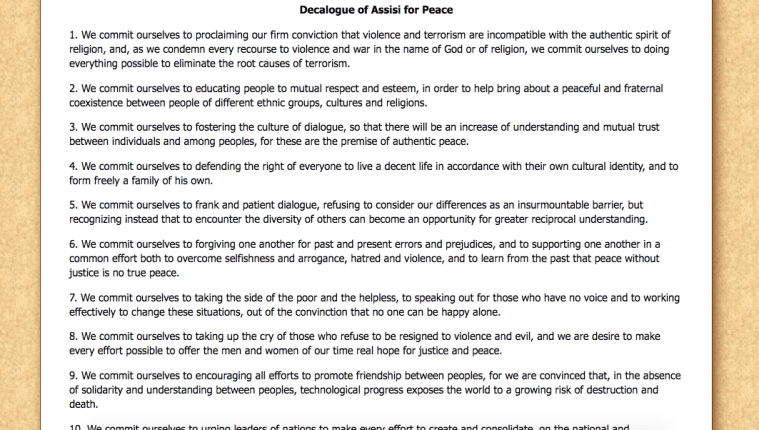
So it was with some surprise that I came across yet another novel “Decalogue” created with input from modern-day Pope: none other than John Paul II, who co-authored a “Decalogue of Assisi for Peace” in 2002. (This link will take you to the Vatican website, so you know it’s legit.)

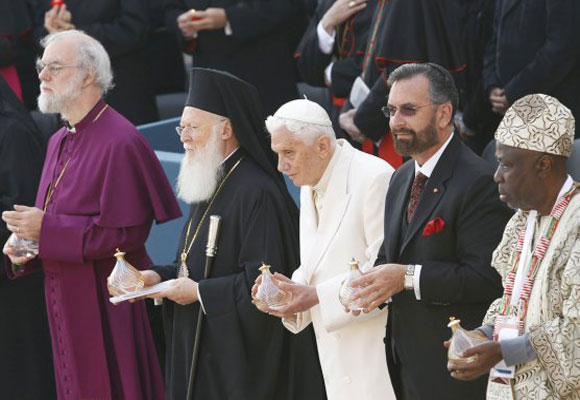
Seeing the word “Assisi” always raises a red flag for traditionally-minded Catholics. That series of meetings with leaders from other faiths, held first by JPII then Benedict, was notorious for its open-slather ecumania and for the utter disdain shown by the reigning pope for his distinguished predecessors who warned of the dangers inherent in such an approach.

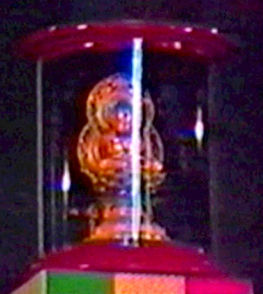
There were many incidents during the Assisi meetings that caused great scandal among believers, but perhaps nothing was worse than seeing a statue of Buddha being placed atop the tabernacle in St Peter Church at Assisi. (Images courtesy TFP except where otherwise cited.)

A small Buddha was placed on the Tabernacle at Assisi in 1986.
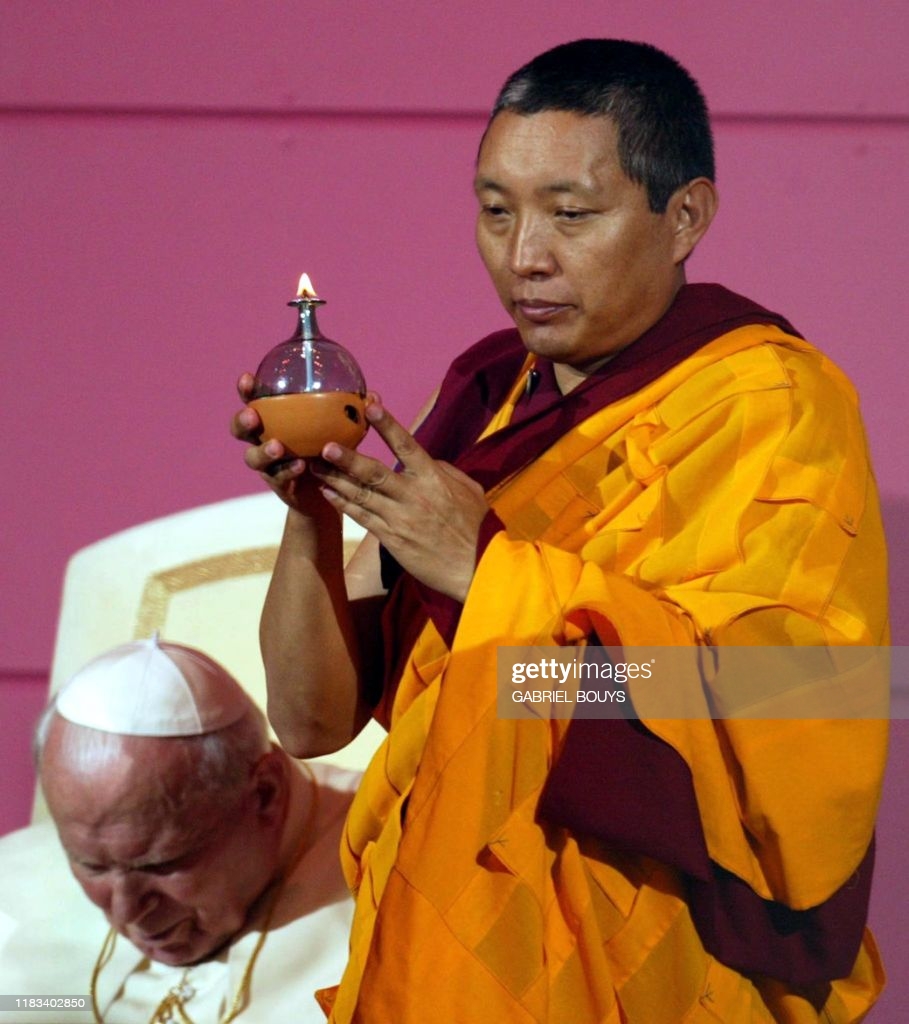
JPII reached out to some very committed heretics.
JPII & the Dalai Lama’s representative in 2001
(Photo by GABRIEL BOUYS/AFP via Getty Images)
Benedict continued the craze. This is from 2011.
A close-up of the Buddha statue.

The Assisi “Decalogue”, like the secular versions already mentioned on this site, focuses on achieving peace on earth. However, as Christians we know that an earthly Utopia is impossible without the entire world acknowledging the Prince of Peace, Jesus Christ as Lord and King. In JPII’s ecumenical “decalogue”, references to Jesus Christ are not just thin on the ground, they are entirely absent.

So while the sentiments sound nice, (what sane person doesn’t want peace on earth, for crying out loud?) the entire project was obviously a complete waste of time. How is that “culture of dialogue” working out for you, Vatican II?

Source
Source

Perhaps the entire Modernist project will be abandoned when our prelates realise that the directives laid down by God are the best ones: the best for our souls and the best for the world.

But then, that assumes that the men who are driving the demolition of the Church are acting in good faith. And, given the Church’s widespread capitulation to the State, the attacks on the traditional liturgy, and a Pachamama-worshipping Pontiff, that is something one very much doubts.

Catholics are encouraged to appreciate the “internal logic” of Islam

Vatican News this week published a story on a new ecumenical initiative designed to help Catholics find “a new understanding of their faith by taking Muslim questions seriously.” One wonders why the old method of teaching Catholics their catechism was found to be wanting. 

“Reasons for our Hope” is a joint project of the Cardinal Angelo Scola’s Oasis International Foundation and the McGrath Institute. 

The current phase of this Islamic-Catholic dialogue involves the release of three videos, designed to teach Moslems and Christians to appreciate the Internal coherence of each others’ faiths. The videos are animated and very simplistic – even insultingly so – distilling two thousand years of Catholic teaching into a feel-good fairy-tale and completely ignoring Islam’s 14 centtury-old animosity and blasphemy toward the Person of Jesus Christ.

The video entitled, “Jesus in the Bible and in the Qur’an” looks at similarities=es and differences between the two holy books’ approaches to Jesus Christ. Nowhere is it mentioned that Christians believe Jesus to be the Son of God, the Second Person of the Trinity, not that He Himself made that claim. Instead, the presentation focuses on the way both faiths present Jesus as a prophet who performed miracles.

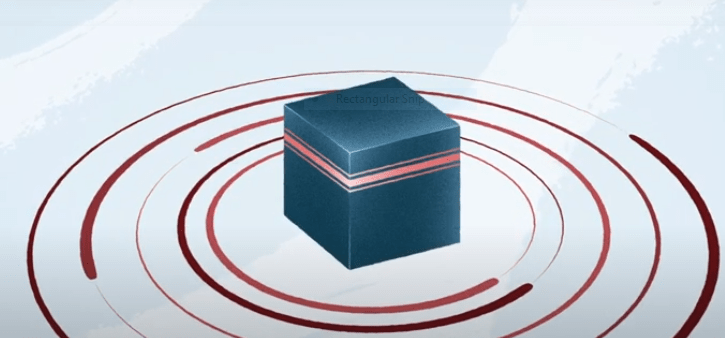
A second video, “Reasons for our Hope” features images that look eerily like the temples planned for the Pope’s Abrahamic House project. “Parallel universes of meaning, each governed by its own law”

“Many prophets, one message.” – to remind the people to worship God. 

This video inches a little closer to the truth about Jesus, saying that His identification with “Emmanuel – God-With-us” is “inconceivable” to Moslems. No problem, the video purrs, all that is necessary is to “journey into another universe of meaning” aka the Christian Bible, where an alternative, internally coherent Truth is taught.

The narrator then males the extraordinarily false claim that “Bible is the story of God’s search for humanity.”

The final episode, “The Place of Jesus in the Bible”, also fails to mention the Trinity and the fact that Jesus is more than the Messiah, but is the only-begotten Son of God. The video closes with the hope that “ … with a generous heart, everyone can see coherence and beauty in the universe of the Qur’an and of the Bible. With this as a beginning, fraternity and friendship are the next steps.”

Cardinal Scola was part of the Nouvelle Théologie of the Conciliar years, and contributed to the publication, “Communio” along with Henri de Lubac, Hans Urs von Balthasar and then-Fr Ratzinger. Like many proponents of the “New Theology”, Scola was relatively orthodox in matters such as the indissolubility of marriage, non-reception of Communion for those in irregular marriages and the existence of the devil. He even defended the traditional Mass when he became Archbishop of Milan in 2017. However, one area in which the “New Theology” went dangerously wrong was in its attitude toward ecumenism.

Cardinal Scola founded the Oasis International Foundation in 20014. Typical of projects attempting to find a “third way” and “common ground”, the Foundation omits much of the truth about Catholicism and the Person of Jesus Christ while glossing over fundamental problems with Islam.

A quote from Cardinal Scola on the Oasis website states that the Christian faith recognises that non-Christian cultures are “inalienable and intrinsic dimensions of its own nature.”

The website features  this logo from the Pope’s trip to Egypt several years ago. It looks less like an image of Catholicism and more like the emblem for a One World Religion.

Collaborating with the Cardinal’s Oasis Foundation is the McGrath Institute for Church Life. A look at the McGrath Institute’s History and Mission page proves quite illuminating and the “Origins” section tells you all you need to know about this outfit. The organisation began as The Centre for Pastoral and Social Ministry, under the guidance of the late Monsignor John Egan, and the website cites his “Chicago-based urban ministry projects.” If that rings an alarm bell, it should – Monsignor Egan was a protege of Saul Alinsky, the communist agitator who actively sought out members of the Catholic hierarchy to collaborate with during the 1940’s.

The videos’ New Age background music and fluid graphics cause one to wonder what kind of subliminal message may be presented to the unwary viewer. 

At a time when the world needs more than ever to hear the saving message of the Gospels, in its pure and unadulterated form, it is more than irresponsible for members of the Church to suggest a “deeper look’ at Islam. However, if one is committed to promulgating a Freemasonic, indifferentist religion, then a project like this ticks all the boxes.

A Vatican Freemason Promotes Indifferentism

This G20 Interfaith Forum took place last year, in October 2020. Australian readers may be interested to note that former Prime Minister, Tony Abbott, was a speaker at this conference – Anonymous Catholic

FROM ChurchMilitant.com:

A leading Vatican Freemason from the Pontifical Council for Interreligious Dialogue (PCID) is one of the speakers representing the Holy See at the G20 Saudi Arabia Interfaith Forum Oct. 13–16.

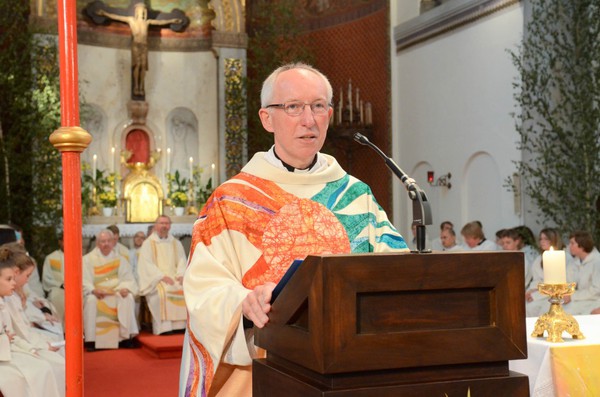
Father Michael Heinrich Weninger, who was outed as a Freemason when celebrating Mass at the 2014 consecration of the new lodge of Mark Master Masons No. 1954, Austria, spoke Tuesday on slavery and human trafficking.

Weninger is accompanied by Islamic expert and PCID president Cdl. Miguel Ángel Ayuso Guixot and Bologna’s Cdl. Matteo Zuppi, the latter of whom is a confidant of Pope Francis and a close ally of Italian Muslims.

Despite the interdicts of 11 popes over 200 years condemning Freemasonry and the Congregation for the Doctrine of Faith (CDF) reiterating that membership in Masonic lodges “remains forbidden,” Fr. Weninger continues to occupy a position in the Roman curia and advocate for freemasonry.

“The faithful who enrol in Masonic associations are in a state of grave sin and may not receive Holy Communion,” the CDF ruled in 1983.

The Interfaith Forum is being viewed as a public relations strategy by Saudi Arabia under Saudi Crown Prince Mohammed bin Salman, “who has tried to put an international sheen on his despotic reign.”

Critics are slamming the Vatican endorsing the regime despite its notable human rights violations and radical departure from the ideals proposed by Pope Francis in his latest encyclical, Fratelli Tutti. Those found with Bibles, crucifixes or other Christian material still risk arrest and, if they’re foreigners, deportation.

Observers have also pointed to the unmistakable coincidence of the Interfaith Forum occurring in light of Saudi Arabia’s bid for a seat on the U.N. Human Rights Council.

On Tuesday, Saudi Arabia failed to secure one of the three-year seats on the U.N. Human Rights Council, obtaining just 90 votes from the 180-member body.

Speaking to Church Militant, renowned Islamic scholar Robert Spencer called the Vatican’s participation in the Interfaith Forum “a travesty.”

“While Saudi Arabia has taken steps toward reform, there still exists no church of any other non-Muslim house of worship on Saudi soil because the Saudi government is bent on implementing Muhammad’s command that only Islam should exist on the Arabian Peninsula,” commented Spencer, author of 21 books on Islam and the Middle East.

“Those found with Bibles, crucifixes or other Christian material still risk arrest and, if they’re foreigners, deportation. Women were recently given the right to drive, but that only underscored how severely Saudi society oppresses women,” Spencer underscored.

Saudi Arabia was the only country up for membership that failed to get elected, leading Bruno Stagno, Deputy Executive Director of Human Rights Watch (HRW), to applaud the “stunning rebuke to Saudi Arabia under Mohammed bin Salman.”

It was the “only country not elected, shunned by a majority of the U.N. The kingdom reaped what it deserves for its serious violations of human rights and war crimes abroad,” Stagno observed.

Ironically, while Saudi Arabia hosts an international Interfaith Forum endorsed by Pope Francis, “with few exceptions, Saudi Arabia does not tolerate public worship by adherents of religions other than Islam,” HRW 2020 World Report states.

The Islamic theocracy “systematically discriminates” even “against Muslim religious minorities” while “government-affiliated religious authorities” continue to “disparage Shia and Sufi interpretations, versions and understandings of Islam in public statements, documents and school textbooks,” HRW reports.

Death Penalty, Immigration

The country is notorious for its use of the death penalty, HRW notes. On April 23, 2019, it carried out a mass execution of 37 men, including 33 from the country’s minority Shia community “who had been convicted following unfair trials.”

Saudi Arabia’s Interior Ministry reported that the country executed 179 persons between January and mid-November 2019, mostly for murder and drug crimes. Executions are by firing squad, beheading and even crucifixion, sometimes in public.

Pope Francis has stridently opposed the death penalty in his latest encyclical, Fratelli Tutti, but has remained silent on the practice in Islamic countries and continues to ally himself with Islamic proponents of the death penalty like Saudi Arabia and Grand Imam of al-Azhar Ahmad al-Tayyeb, Church Militant reported.

In stark opposition to Pope Francis’ call for the welcome and humane treatment of migrants in Fratelli Tutti, Saudi Arabia is known for its systemic oppression of migrant workers.

Further, the theocracy is not a signatory to the 1951 Refugee Convention and does not have an asylum system to protect people fearing persecution.

Call to Unity

At the Forum, Cdl. Ayuso flagged the pontiff’s encyclical calling for “unity, solidarity and fraternity, for bettering our ‘common home,’ as Pope Francis is continuously reminding us all.”

It is necessary to answer Pope Francis’ call to “reaffirm that we are members of the one human family,” he added.

Father Weninger remarked:

The International Conference on 21st Century Slavery stated that human trafficking constitutes a shocking offense against human dignity and a grave violation of fundamental human rights, particularly the sexual exploitation of women and children.

Injustice, exploitation and abuse are often deeply institutionalized due to financial profit. There is a need for faith leaders to challenge these social injustices, particularly as they constitute a fundamental issue of human rights.

Participants at the conference include Ecumenical patriarch Bartholomew, Orthodox metropolitan Emmanuel Adamakis of France, Coptic bishop Anba Marco, Anglican Richard Sudworth representing the archbishop of Canterbury and Sr. Sharon Eubank from the Mormons.

Prominent Hindu, Buddhist and Jewish leaders are also participants.