The Church of the ‘Divine Synarchy’

This is the English translation of a section of Pierre Virion’s “Mystery of Iniquity.” Taken from the Third Edition, and released during the 1970’s, M. Virion masterfully traces the crisis in the Catholic Church back to the plans of the Synarchists.

“The development of the revolution within the Church – for it is indeed a revolution – is linked to the march of international political events. Here we are in the presence of a politico-religious complex combining in its entirety the decadence of doctrinal and institutional Catholicism with the projects of a world government which, in the end, as we have said elsewhere, would be itself, at least visibly, only a universal super-church integrating national churches. In each of these two fields, parallel processes are oriented towards the same goal, so that if one is are in a hurry to follow a political trajectory ordered to their globalism, the others, under the guise of ecumenism, but in reality with a view to a versatile and Masonic dogmatic opening, are busy perfecting this revolution. 

Progress is such that they speak openly about this world government. Le Monde of February 16, 1967, citing as an example: “the rapprochement in ecumenism of the Christian churches said something about it” in advance, like Perrette in the fable, the unhoped-for advantages: no more starving people, no more epidemics, friendly exchanges and a limitation of births. 

Georges Hourdin, in Croissance des Jeunes Nations (n° 61) quoted by the Courrier Communautaire Autaire of 15 January 1967, had a geopolitical program that was more informed about the great synarchical groups: “We must accept to group the states into large regional confederations, then into a world government. It is then necessary, and very quickly, to plan births and savings”.

The pill, which, as we can see, holds a large place in globalist diplomacy, also has the good fortune to be the link between and the ecumenism of the clerics of the new Church. But this is only a small side of the homogeneity of the system, which means that the building of the New Church, as widely open to all the faithful of multiple denominations as the world government is to all the peoples of the earth, so desired, so long awaited, whose Church of Holland is today enthusiastically presented to us like the prototype, or a politico-religious enterprise.

Holland

This will be seen by reading, in Le Figaro, the articles of Abbé Laurentin on “The Dutch Catholicism of Mutation”. For him, “Holland has been a country open to the freedoms of intelligence since the first hurricanes of the sixteenth century”. He forgets to tell his readers that this was so because Holland was then a hotbed of Rosicrucians and sects. In our day, The Masonic centres are Harlem and The Hague, where, we are told, some good Fathers are forgotten, but its activity has not been weakened. That could explain this. 

But what interests the Abbé so keenly is the sudden outburst of “Christian energies”. Let us read it, in fact (emphasis added): “The first symptoms were noticeable as early as 1950. They were linked to the economic and intellectual development that changed the condition of the Dutch Catholics. The phenomenon took on considerable proportions shortly before the opening of the Vatican Council. It catalysed research and provoked immense hope, but became a disappointment from the second session of the Council”. (Le Figaro 19/2/1967)

Doesn’t Father Laurentin know that one should never talk about ropes in the house of a hanged man? So what happened “from 1950 onwards”? We remember the ‘Schumann Bomb’ which initiated the constitution of the European Coal Community in public opinion. Thus began the reputation that the ‘Father of Europe, a title’ Robert Schumann shared with Jean Monnet, whose international synarchic power and financial relations were in direct proportion to the discretion with which it surrounded them. 

Germany

Immediately, the Études of the Jesuit Fathers, in their June issue, sounded the trumpet in favour of the ‘Christian-European epic.’ Mr Robert d’Harcourt extolled in a couplet on ‘German Realism’ the profound views and talents of Mr. Adenauer. It was reported that the Chancellor, proud of the role of the Federal Republic of Germany in this affair, affirmed that, by his decisive influence, it had accompanied Robert Schumann at the London Conference and that it thus became “a factor with which international policy must count”. This “must count” was not a figure of rhetoric. 

Let us not reproach Mr Adenauer for having wanted to create Europe and, to do so, for having used forces and the audience party, the Christian Democratic Party. But from the beginning, the company had partners who were neither on its side nor in its own designs and party whose successes he attributed in 1946 to the assistance of the financier, Pferdmenges, communicated to his European peers a a dynamism led by other powers, those of the ‘Europe of the Bankers’, less zealous than he was for the cause of the Roman Church. Pferdmenges was a pious Protestant who belonged to the Salomon Oppenheim Bank of Cologne, former president of the Chamber of Commerce and of the Bankers’ Association of this city. Having helped Mr. Adenauer to form a powerful party, he was raised by him to the rank of Grand Cross.

Bankers & Bilderbergers

Pferdmenges was chairman of the Rheinische-Westfälische Credit Bank in Cologne and vice-chairman of seven associations attached to the Dresdner Bank. His death did not put an end to other support, including that of a friend Adenauer and his financial advisor: Mr. Abs, a Catholic, it seems. With Mr. Abs, we entered a circle very similar to that of the Dresdner Bank, but more powerful than he, that of the Deutsche Bank, which owns the Rheinische-Westfälische Bank in Düsseldorf. 

With Mr. Abs, again, we had full access to the ‘World Understanding’ through the channel of the famous Bilderbergers in whose meetings he took part assiduously and recently again in Cannes with a line-up of German financiers. Mr. Abs presiding over the destinies of the Western and especially of the Rhine-Westphalia Group enjoys both the confidence of the Anglo-Saxons and holds the threads that connect powerful cosmopolitan consortiums from the Hambros Bank of London, the Lazare Bank and the International Bank of London. Luxembourg, well known to Mr. Van Zeeland, Bilderberger, too, up to the Dutch giant A. K. U. and its trusts, several of which are chaired by Mr Abs and which, as everyone knows, more or less discreetly finance the so-called right-wing parties with a tendency to Catholic or Protestant. Among the Catholic organs are Volkskrant (175,000 copies), the Tydg and its chain of four daily newspapers (114,000 copies), of which there is much talk in these times of the ‘National Council’. In these perspectives, it is conceivable, in fact, as Abbé Laurentin says, that the “economic condition” of the Dutch Catholics have changed.

Luxembourg

The Schumann-Adenauer-Monnet-Gaspéri movement was born in Luxembourg. It also settled in Strasbourg. Let’s say everything immediately: the main and always discreet craftsman was Jean Monnet. The ‘Schumann bomb’ was full of hard-hitting arguments, so powerful that in Christian Democratic circles one could perceive the repercussions as far as Strasbourg where “from 1950 various personalities either in their capacity or representing different Catholic movements belonging to eleven countries “established a Catholic Secretariat for European Problems (SCPE) previously founded in Luxembourg and which defined itself as follows:

 “A technical body made available to organisations and Catholic personalities interested in European problems. Its essential purpose is therefore to establish networks between them information and documentation. The SCPE will inform and inform interested persons of the projects which may be carried out in the Discussion in the bodies called upon to work for European unity. In addition, it will prepare the files and themes of study that will facilitate the examination of European problems involving the Christian conscience and requiring the study and presence of Catholics”. 

The presidency was devolved to the president of Italian Catholic Action, Mr. Vitorino Veronese, who in 1957 became president of UNESCO celebrated the tercentenary of Comenius, the famous Rosicrucian of the sixteenth century. The direction remained with M. Baumgartner, former finance minister with whom we remained in the orbit of the Bilderbergers. Dr. Roesen, President of the Commission to the Katolikentag was delegated by the German Catholics.

The Fingerprint of Synarchy Emerges

In 1951, the Documentation Catholique listing the various European movements presented with advantage the impetus given by the Count of Coudenhove-Kalergi and the action of M. Van Zeeland. This evocation of an authentic synarchic lineage should not make us forget that, in addition, Mr. Van Zeeland “passed through more than one place to dispose of a manoeuvring mass in impressive dollars “added to the presidency of the “Economic League for European Cooperation” of which Mr Giscard d’Estaing was vice-president. The same year, the “Comité de la rue de Penthièvre” led by Mr. Boutémy, secretary general of the French Employers’ Association. He too, it was said, had “considerable funds, not all of which were of French origin, and acted energetically in connection with the international organisation led by the former Belgian minister, Mr Van Zeeland, to promote a federal status for Europe” (J. Hammer). 

In the same year again, in the year of elections, the Communists, hardly suspected of recognizing miracles, were to observe with astonishment that, with tripartism buried, their former Christian Democrat allies had suddenly become Europeans and Globalists. It was a fine piece of work in which a technical body, as the Catholic Secretariat of Strasbourg was called, was not unknown. He had undoubtedly made available to “organisations”, “personalities”, his networks, his documentation, his files and its themes of study, but the rest? His own budget must have been very heavy and such successes are expensive. The rest could not have been neglected.

On 6 March 1953, in Strasbourg, at the Congress of the ‘Europe of the Six’, what political and financial authority other than that of M. von Brentano, Minister for West Germany, could in terms almost identical to those of the Synarchic Pact, better specify the action taken? 

“The mission received from the six Foreign Ministers and the acceptance of a task that we are now leading to its conclusion, constitute a kind of silent revolution; public opinion has taken note of this work, without, however, grasping its significance”. And the result was there, vast as the ‘Europe of the Six’, as deep as the mass of the MRP of which Robert Schumann was a member and leader of the “Movement of Christian Workers for Europe” sitting in the CFTC. 

Sub-Plot to the Vatican II Council

It is therefore understandable that in such a wide environment, in such a favourable atmosphere, in a system as well as to the immense design of politicians, in a pool of people who are as well chosen in terms of its dimensions, its resources and security, the intellectuals of the Catholic Secretariat for Europe have been able, happy as fish in water, to deepen their ‘study themes’ and push their projects. In the European and globalist perspectives, the new theology perceived, now certain of achieving this, distant to the continental measure of Christian confessions and the depths of an ecumenism defying formulations of strict Catholicity. As the occultist Abbé Mélinge predicted, liberal Protestants and broad-minded Catholics could apply “at common expense” for the construction of a new church. At common expense this was, it seems, quite the case.

But if the revolution of the politicians was silent, that of the theologians was not silent enough to be able to carry the masses along in the wake of the New World and discreet enough that one did not realise the work in which one was busy in order to to try to pass on to the future Council, supported by well-known Eminences and Excellencies, the plans prepared during the “that long maturation which has led French, German, Belgian and other theologians to prepare Vatican II from afar.” (Courier January 1967). “The phenomenon took on considerable proportions shortly before the opening of the Council” (Laurentin, Le Figaro, 19-2-1967), but The effort did not relax during the sessions. It is not to the peri-conciliar literature rising like an outbreak of revolution in the press, nor to the declamations with a great deal of costly publicity of the theologians of the future that we only think. There were also in Rome, a whole organisation which constituted an instrument of propaganda and formidable pressure, offering them round tables and crossroads, which could print on the spot and distribute to the Fathers their talks and their “themes of study.”
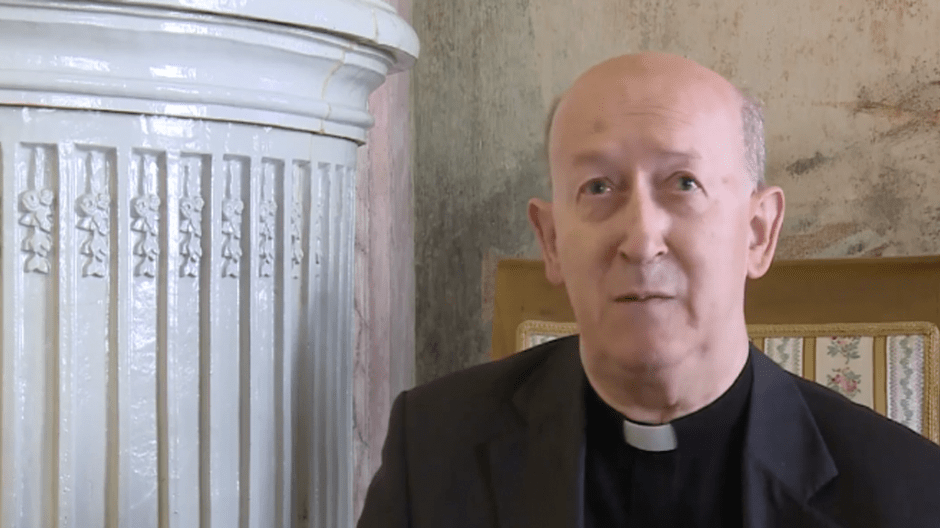
Hungarian Bishop: Masons & Moslems are working together to destroy Christianity

This article comes from the Hungarian outlet Magyar Jelen. interview by Tamás Horváth. English translation by Google translate.

On the occasion of Christmas, we made a big interview with Dr. Gyula Márfi, archbishop emeritus of Veszprém, who – since he was forced to leave the city of the kings in August – spends the holidays in Szombathely again after many years. Among other things, the 79-year-old retired bishop talks about the mission of the Hungarians; about the European Union denying its Christian roots; on migration; on the cooperation of Freemasons and Muslims; about the Kalergi plan; on the unconstitutional Hungarian abortion law; he talked about LGBTQ and how what is going on in the German Catholic Church is practically anti-Christ. He also expressed his opinion on the renovation of the cathedral in Veszprém; he recalled the Christmases of his childhood; and he also told me when he decided to enter the church. The big interview of Tamás Horváth.

 After how many years do you spend Christmas again in Szombathely?

 Twenty-seven. ” In 1995 I moved from Szombathely to Eger, where I was an auxiliary bishop for two years, and in 1997 I was appointed Archbishop of Veszprém by Saint II. Pope John Paul. I retired in 2019, but as archbishop emeritus I continued to live in the city of queens – until this August, when I unfortunately had to leave for known reasons.

But I’m not complaining, I have a very good place in Szombathely. Bishop Székely welcomed me with friendship.

 What does Christmas mean to you? What childhood memories do you have, how did you and your family celebrate the birth of Christ?

 I come from a religious family, we lived in a small village in Zala County, Pördefölde. As far as I know, it currently has 81 inhabitants, at that time it was not much more. The nearest church was in the neighboring settlement, Páka – five kilometers as the crow flies – but we still went to mass every Sunday.

However – perhaps for understandable reasons – we did not go to Advent morning mass, so I only attended rorata for the first time when I was in the seventh grade, when I moved to Páka to complete the last two classes of elementary school.

Anyway, I have very good and defining memories of Christmas, I think back with a warm heart to the times when my parents and brother and I celebrated as a family.

 How was it different to experience Christmas under socialism than later, after the system change?

 The intensity of the celebration did not change much after 1989, because even then Christmas was very important to us. We knew that the state did not sympathize with the churches, if it could, it would eliminate all religions. Because of this, my parents insisted even more on Christianity and its holidays. My brother and I were raised to do the same, which resulted in:

we both lived the Catholic faith wholeheartedly.

However, later, when I was in the seventh or eighth grade, when I started to grow up, the question arose in me, whether the atheists are right?

I didn’t dare to bring up these fears to my parents – who were smart but uneducated peasants – and not to the priests either, so I started formulating various arguments about God. I tried to prove that Jesus is not just a holy idea, but a tangible reality. It is not just a myth as atheists teach.

Perhaps this is precisely why I developed a kind of creativity that would not have happened if there were people around me who would answer all my questions. And let’s not forget that we lived in an atheistic system, so as Christians we had to look behind things and think. There is good in every bad, as they say.

 When did you first realize that you wanted to be a priest?

 About when I was in seventh or eighth grade. ” As I listened to the sermons of the spiritual fathers, I wondered if I could speak like that, could I also say Mass so beautifully? After that, my profession gradually developed.

In a strange way, the problem was that my brother also became a priest, and at one time I felt that I had no vocation of my own, that I was following my brother because I was independent.

Then when it dawned on me that there were also relatives among Jesus’ apostles – Peter and András, James and John must have been close brothers; and the younger Jakab and Tádé Júdás are probably brothers or cousins ​​- then I was reassured that I could have the same profession as my brother.

Why God chooses two is his secret.

 Was there a time when he wavered?”

 Not really. ” It can be said that, apart from the aforementioned adolescent uncertainty and doubts, my path was a straight line, a steady path to the altar. There were no deviations in it.

The possibility of leaving the seminary never occurred to me. I went to high school in Pannonhalma, and my profession only got stronger there.

 Let’s go back to Christmas a bit. ” In his previous writings and interviews, he quite often criticized the current European Union and the zeitgeist prevailing in the Western world. How do you see Christmas in Europe in 2022?

  I can’t judge this exactly, because I don’t know the conditions that well.” However, from what I hear and read, the situation seems catastrophic. In many places, they try to make people forget the word Christmas itself, and they only talk about holidays.

The Christmas tree was already removed from the Brussels City Hall 8-10 years ago, on the grounds that they did not want to offend the sensibilities of Muslims.

However, this is a lie: Christmas trees are also erected in Istanbul and in other parts of the Islamic world. Jesus as a prophet is also respected by Muslims, and according to Islam, it is not a sin to celebrate someone’s birthday.

One of the most striking signs of the European Union’s anti-Christianity is that its constitution did not mention Europe’s Christian roots. They write about Greco-Roman traditions and the Enlightenment, but not about Christianity. Yet ancient culture and art survived thanks to Christians: the writings of Virgil, Tacitus, Homer and others were copied by monks in the depths of their cells.

Without Christianity, we would not be able to read many ancient authors today.

But we can also talk about the fact that the European Commission published a calendar in 2016 in which the holidays of the world’s major religions were entered – even the Sikh religion, which is a relatively small community, a mixed religion between Hinduism and Islam. However, if you turn to December 25, what do you find? Practically nothing. That’s all it says: “A good friend shares your joys and your preoccupations.” I don’t know what this means exactly, but I do know that Christmas was deliberately left out of the significant days.

Let me mention two more examples. A few years ago, in England – which is no longer the EU, but undoubtedly part of the Christian European cultural circle – the Anglican Church wanted to sell a short film of a few minutes promoting Christianity to the national TV channels. None of them accepted.

XVI. At that time, Pope Benedict was not allowed to perform at the State University of Rome, saying that it was not a church, but a secular institution.

So what? I ask. If we were to think like that, then no one would be able to enter St. Peter’s Basilica, only those who can prove that they have been baptized and confirmed.

 Do you think it is conscious that in Europe they want to push Christianity into the background, ad absurdum to destroy it?

 He’s conscious. ” The goal of the Freemasons is to “liberate” Europe from Christianity. To achieve this, they are willing to use all means, using their lobbying power they have also wormed their way into the leaders of the union.

In my opinion, Muslims are also being called in to remove Christ and Christianity from Europe. In doing so, however, they ultimately destroy themselves, because Islam will never accept their liberal principles.

It is practically the same situation as it was in the Savior’s time, when the scribes and Pharisees collaborated with their mortal enemy, Pontius Pilate, to get Jesus out of the way.

Today, Freemasons and Muslims are joining forces to make Christianity disappear from Europe.

But this is not a finished game yet, I hope that their plan will not be successful.

 What can we Hungarians do to protect Christianity?

 We have to hold on to our faith very strongly. ” Padre Pio has a prediction that Hungary is a cage from which a beautiful bird will fly out, bringing blessings to the whole world.

I don’t think it’s out of the question that this will happen.

Not because we Hungarians are better than everyone else, but because God often chooses the little ones to accomplish something big through them.

See, the Guadeloupe seer Juan Diego Cuauhtlatoatzin was also a simple Indian peasant. He was baptized with his wife only four years before he had his vision. At first the bishop didn’t believe him either, saying that Our Lady would certainly not appear to such an unfortunate shepherd, but at least to a nun. ( laughs )

And in Fatima and Lourdes, small children had visions of the Virgin Mary, so it cannot be ruled out that we, Hungarians, will also have a role in preserving Christianity in Europe. But for this we have to take faith seriously, because it is possible to become unworthy of any mission.

 Christian Europe can also be protected with physical means, for example by not allowing those who come to our borders illegally. When, during the migration crisis of 2015, the Hungarian government started to build the border fence (which László Toroczkai – then as the mayor of Ásotthalom – had advocated years earlier), both domestic and foreign liberals shouted that building walls was not humane, and anyway a self-professed Christian accepts everyone. What does an archbishop say about this?

 At the time, I had a rather harsh sentence for this: we must love wolves too – since they too were created by the Good Lord – but not in sheep’s clothing.

The same is true for Muslims. We love them and support their countries as much as we can.

However, this does not mean that we should invite them into Europe and let them Islamize the continent.

They were here in Hungary for 150 years, we know how much destruction they caused. We Hungarians still carry the memory of this in our genes to some extent.

  In your opinion, what poses a greater threat to Europe and Hungary at the moment: Islamization and immigration, or LGBTQ and woke?

 This is difficult to decide, but if a sequence must be established, it is the latter. This loose understanding brackets the foundations of Catholic morality.

And although as Christians we should not condemn homosexuals, lesbians, bisexuals, or transgender people,

creating a cult for them is a mortal sin, which also goes against the laws of nature.

The legalization of same-sex “marriage” is also considered a capital crime, and I regret to see that it has already happened in most European countries.

In relation to the LGBTQ issue, we cannot forget the rights of children either. On the one hand, they should not be allowed to be confused about their gender identity and orientation through the media, advertising and education, and on the other hand, they have the right to a mother and a father.

 According to Catholic teaching, abortion is also a mortal sin, and although the Basic Law in Hungary already protects the fetus from conception, our abortion law is considered liberal even in European terms. Don’t you think this is controversial?

 Of course. “

The current abortion law is unconstitutional, but the Constitutional Court has not yet dared to say so.

The problem is that the majority of the Hungarian people are pro-abortion, so if the government tightened it, it would lose the election.

However, it is welcome that mothers now have to listen to their child’s heartbeat. The ultra-liberals protested vehemently against this as well, so the government is not in an easy situation.

 On the other hand, I see that the heart rate regulation was relatively easily “swallowed” by people. It is true that there was a little excitement, but it did not start a serious avalanche. Is it not possible that after a while the Hungarian society would come to terms with the tightening of abortion?

 It’s possible that he would come to terms with time, yes. ” I pray that it will be so. Also, for my part, I also offer the crosses of old age. I know many of my colleagues do the same.

 You obviously represent the teachings of the Catholic Church in the social topics we have discussed so far. How is it possible that, say, the German Catholic Church, which also belongs to the Pope of Rome, preaches the exact opposite of the ideas you express, for example, on the issue of LGBTQ?

 I don’t understand that either, it can’t be proven. “

Five or six years before that, I said three masses in Hungarian for Hungarians in and around Stuttgart. I explained the arguments that prove the resurrection of Jesus, and I talked a little about heaven and the similes found in the Bible. After one of the Masses, Father Tempfli, the then Hungarian pastor in Stuttgart, came to me and thanked me for touching on these topics, saying that no one in Germany talks about them anymore.

The situation of the German church is truly catastrophic. According to them, it is not important whether Jesus was really born or not, the point is that “he should be born in you!”. Don’t ask if he rose from the dead or not, “may he rise in you!”. Don’t care if there is heaven or not, the point is “create it around you!”

This is all absurd.

A significant number of German Catholic priests now bless same-sex marriages as well as cohabitation and cohabitation relationships.

This is no longer Christianity, it is anti-Christ.

Three years ago, Rome finally ruled that Catholic priests are forbidden to bless homosexual couples. At that time, I was still visited by a German newspaper, so I learned about the protest that the decision had caused among German Catholics.

It is very sad what is happening in Germany. I don’t want to hurt them, but somehow they always fall from one side of the horse to the other. They went from Hitler and National Socialism to cosmopolitan globalism. No more German, French, Hungarian, Italian, only European.

 If the national question has already been mentioned: it is an eternal dilemma, which is more important, national or religious affiliation?

 I am primarily a Catholic, but I also stick to my Hungarianness, without being a chauvinist.

I am Hungarian, but I also respect other peoples. In Europe, diversity is needed in addition to unity, but there is no need for multiculturalism!

They talk about mixing the different species according to the Kalergi plan. But I ask, what comes out of this? A mass of no color at most.

My painter friend Győző Somogyi – I am hitting my belly now – has twenty-five different colors and shades of paint. If you mix them all up, you won’t be able to paint a colorful picture.

In a multicultural, mixed society, the individual loses his own identity, sense of identity, culture, faith, language, practically everything. It becomes easy to manipulate, which is ideal for the big capitalists of the world, who want to turn the whole Earth into a huge collective farm, where there are no ethnic, national and religious identities, only obedient workers and consumers manufactured according to standards.

 We started our interview with the fact that you are spending Christmas again in Szombathely after twenty-seven years. The main reason for this was that he was critical of the renovation plans of the Veszprém cathedral, which is why he had to leave the city of the queens. How do you see the situation in Veszprém afterwards?

  I can only pray for the Diocese of Veszprém, for some kind of consensus to be formed between the faithful and the archbishop, for peace to be restored. I don’t hold grudges against anyone in my heart, but I would regret it if the stained glass window of St. Michael – which was made by Bertalan Badalik, the bishop exiled by the communists – disappeared from the cathedral in Veszprém.

Otherwise, I’ll say it again, I feel very comfortable in Szombathely, I previously worked in the bishop’s office here for seventeen years. I have good experiences with the city, but of course I won’t forget the ones in Veszprém either.

 What is your message to the Hungarians on the occasion of Christmas?

  I wish you all a very Merry Christmas and a blessed New Year! I pray especially for our uncertain compatriots, for those who have not yet decided what to believe. I wish them to approach Christ and Christianity.

May God’s blessing help all Hungarians!

Masonic Europeanism

FROM: Corrispondenza Romana by Fr Paolo Maria Siano, published February 17, 2021

Professor Gianmario Cazzaniga, a scholar appreciated by the Grand Orient of Italy (see here) explains how the idea of a Universal Republic was prepared between the seventeenth and eighteenth centuries through a Republic of Letters and Sciences, that is, a cultural network of writers, nobles, writers, publishers, antique dealers, scientists, promoted by Huguenot circles, by Protestant and non-Protestant finance (Geneva, Amsterdam, London), and by the Masonry Lodges of 1717. 1

The French scholar Yves Hivert-Messeca also states that in the eighteenth century Masons dreamt of a trans-national and trans-confessional society/fraternity, that is, a new Europe. 2

It is logical to deduce that the realization of a European or Universal Republic according to Masonic principles, was the plan, or at least the hope, of obtaining the socio-cultural transformation (according to Masonic principles of secularism and anti-dogmatism) and/or the revolution and political-military demolition of Catholic confessional monarchies (e.g. , that of the Habsburgs) and the Papal States of the time.

In 1868 the first issue of the newspaper Les Etats-Unis d’Europe was printed: an organ of the League of Peace and Freedom based in Bern (Switzerland) and with branches in France, Belgium, Italy, Germany, England. In issue 1 of January 5, 1868, it was announced that the Mason Giuseppe Garibaldi was its honorary president (p. 1). In issue 47 of 22 November 1868, Freemasonry was praised (pp. 187-188).

In 1889 the Austrian Catholics gathered in Katholikentag accused Freemasons of wanting the destruction of Catholic Austria: Delenda est Austria. 3

An international Masonic congress was held in Paris from 31 August to 2 September 1900 under the auspices of the Grand Orient of France (GOdF). The Grand Master of the Alpine Swiss Grand Lodge, Edouard Quartier-la-Tente (1855-1925), hoped for the coalition of all universal Masonic powers to achieve Masonic ideals and to found the Universal Republic: “pour la foundation de la République Universelle”. 4 The Grand Master of the Grand Orient of France, Louis Lucipia (1843-1904), exalted the French Revolution, criticizing clericalism and the Catholic “theocracy ” (pp. 73-74). Various Freemasons said in that congress: “The République universelle lives!” (pp. 124, 128, 134, 156-160).

In 1902, about 16 years before the fall of the Habsburg Empire, the Magazine of Italian Freemasonry of the Grand Orient of Italy published an article by Freemason Emilio Bossi (1870-1920) which he wrote from Lugano (Switzerland): “It is Freemasonry that should give rise to international arbitration, preparation for the future Federation of the United States of Europe, this same prelude to the United States of the World”. 5

A meeting of French and German Masons was held from 3 to 5 July 1909 in Baden-Baden (Germany). The high dignitary of the Grand Orient of France Charles Bernardin toasted the United States of Europe and Universal Freemasonry. 6

Hungarian Jewish historian François Fejtö (1909-2008) also explains that the eighteenth-nineteenth-century Masonic project of the United States of Europe and the Universal Republic implied the destruction of the Catholic monarchy of Austria-Hungary and in this, Freemasons and Freemasonry, especially the Grand Orient of France, played a great role. 7

Indeed, with the end of the Empire, Freemasonry was able to return to Austrian soil and in particular to Vienna. In 1918 the Grand Lodge of Vienna was founded. In 1922, in Vienna, Count Richard Nikolaus Coudenhove-Kalergi (1894-1972) was initiated as a Freemason in the Humanitas Lodge and then in the “Mozart Chapter ” of the 18 ° degree Prince Rose-Cross of the Ancient and Accepted Scottish Rite. Kalergi founded the Pan-Europe Movement supported from the outset by the Grand Lodge of Vienna. 8

In the book Praktische Idealismus. Adel – Technik – Pazifismus, 9 the Mason Kalergi equates the European Spirit with Lucifer-Prometheus, that is “the Bearer of Light carrying the divine spark on earth, the prince of this Earth and father of struggle, technique, enlightenment.” 10

According to Kalergi “the Spirit of Europe” breaks political despotism and only with the emancipation from Christianity would Europe find itself (cf. pp. 83-85).

Also in the second half of the twentieth century in environments of the Grand Orient of Italy and its Ancient and Accepted Scottish Rite, the “United States of Europe” 11 or “United Europe” is praised, 12, as seen for example in the monthly magazine of Masonic and secular culture The Meeting of People directed since 1960 by the Mason Elvio Sciubba 33 ° (1915-2001).

In a 2010 book, Freemasons Alain Bauer (former Grand Master of the Grand Orient of France) and Jean-Claude Rochigneux (formerly Councilor GOdF) quote the Contrat Maçonnique Européen of the Grand Orient of France (Strasbourg, 5 June 1993) which states, among other things:

  • Freemasonry defends secularism therefore the separation between church and the state, because only secularism defends absolute freedom of conscience and worship
  • Freemasonry carries within itself the European idea inserted in universalism
  • Freemasonry wants a Masonic Europe that contributes to the construction of a cultural Europe 13
  • Masonic Europe desired by the Grand Orient of France consists both in the union of European Freemasonry and in a Europe built culturally, politically and socially according to the principles of Freemasonry, including secularism (pp.70-76), that is, the exclusion from society of any influence of the Catholic Church.

In Brussels on 15 October 2010 and 30 November 2011, the delegations of various European Freemasonry (including the Grand Orient of Italy and the United Grand Lodge of Germany) with their respective Grand Masters, and the representatives of liberal and humanist associations, met the leaders of the European Union (the President of the European Commission, the President of the European Parliament and the President of the European Government) to agree on a common plan for the promotion of “democratic ideals” and “libertarians”. 14

On March 02, 2012, the then vice-president of the European Parliament visited the headquarters of the Grand Orient of Italy and shared the Masonic commitment to secularism. 15

But in April 2011, the center-right majority of the Hungarian Parliament (262 Aye, 44 against) approved a Constitution (entered into force in early 2012) which speaks of God, Christian roots and the traditional family (man + woman). The Hungarian Constitution limits the powers of banks, defends human life from conception, does not recognize the “right ” to abortion or even homosexual unions. The European Union (EU) reacted by defending, among other things, the absolute independence of banks (ECB and IMF) and threatening economic retaliation. The British BBC also criticized Orban’s conservative “drift”. (see hereherehere;
here.)

Still in our day, the promoters of what Freemason Kalergi called “the Spirit of Europe” seek to limit the sovereignty of European states by imposing certain policies, for example in terms of homosexualism/gender or abortion, incompatible with the authentic Christian roots of true Europe. 
correspondenzaromana.it

  1. (cf. G.M. Cazzaniga, Freemasonry and Literature. Dalla République des Lettres to national literature, in G.M. Cazzaniga – G. Turkeys – R. Turks, The Muses in the Lodge. Freemasonry and literature in the eighteenth century, Unicopli Editions, Milan 2002, pp. 11-32). ↩︎
  2. (cf. Europe sous l’Acacia. Histoire des Francs-maçonneries européennes du XVIIIe siècle à nos jours. Tome 1: Le XVIIIe siècle. The âge d’or de la franc-maçonnerie en Europe. Le temps des Lumières et des obscurités. The rêve universel de fraternité et les limites de l’autre, Editions Dervy, Paris 2012, p. 305). ↩︎
  3. (Cf. G. Kuéss – B. Scheichelbauer, 200 Jahre Freimaurerei in Österreich. Zum 175. Geburtstag der Großloge, Verlag O. Kerry, Wien 1959, pp. 152-153). ↩︎
  4. (Grand Orient de France – Suprême Conseil pour la France et les Possessions françaises, Congrès Maç.·. International, Compte rendu des séances du congrès, le 31 Août, 1er, 2 September 1900, Secrétariat Général du Grand Orient de France, Paris 1901, pp. 38-39). ↩︎
  5. (E. Bossi, What is the essential mission of Freemasonry in the present era?, in Magazine of Italian Freemasonry, n ° 13-15, 15-31 July – 15 August 1902, Rome, p.232). ↩︎
  6. (Cf. Brüd.·. Zusammenkunft am 3.-5. Juli in Baden-Baden – Reunion des Francs-Maçons 3-5 Juillet à Baden-Baden 1909, p.18). ↩︎
  7. (Cf. Requiem pour un empire defunt. Histoire de la destruction de l’Autriche-Hongrie, Lieu Commun, (Paris) 1989, pp. 309-313, 337-349). ↩︎
  8. (cf. IS. Semrau, Erleuchtung und Verblendung, Studien Verlag, Innsbruck 2012, p. 95). ↩︎
  9. (Pan-Europa Verlag, Wien-Leipzig 1925) ↩︎
  10. (« In der jüdischen Mythologie entspricht der europäische Geist Luzifer – in der griechischen Prometheus: dem Lichtbringer, der den göttlichen Funken zur Erde t»: p.83). ↩︎
  11. (cf. Albert Tura, Europe divided, in The Meeting of People, Monthly of current events and culture, Year XV, nn. 7-8 (July-August 1975), Rome, pp. 8-9) ↩︎
  12. (cf. A Europe of Garibaldi, in The meeting of people, April-June 1979, Rome, p.11; cf. Elvio Sciubba, The Echo, in The meeting of people, July-September 1979, Rome, p.1) ↩︎
  13. (cf. TO. Bauer – J.-C. Rochigneux, The relations internationales de la franc-maçonnerie française, Armand Colin, Paris 2010, pp. 50-53). ↩︎
  14. (cf. Antonio Panaino, Freemasonry protagonist of the social and moral life of Europe, in News Erasmus, Information Bulletin of the Grand Orient of Italy, N ° 18, 30 October 2010, Rome, pp. 1-2; Cf. News Erasmus, n ° 20, 30 November 2011, pp. 1-5). ↩︎
  15. (cf. The Vice-President of the European Parliament Pittella visits the Grand Orient, in Erasmus news, n ° 4-5, 15 March 2012, p.6). ↩︎