Like the side events staged by NGO’s at the UN, the Pope’s ecumenical side-event at the Synod might be where the real work of demolishing the Catholic Church is taking place.
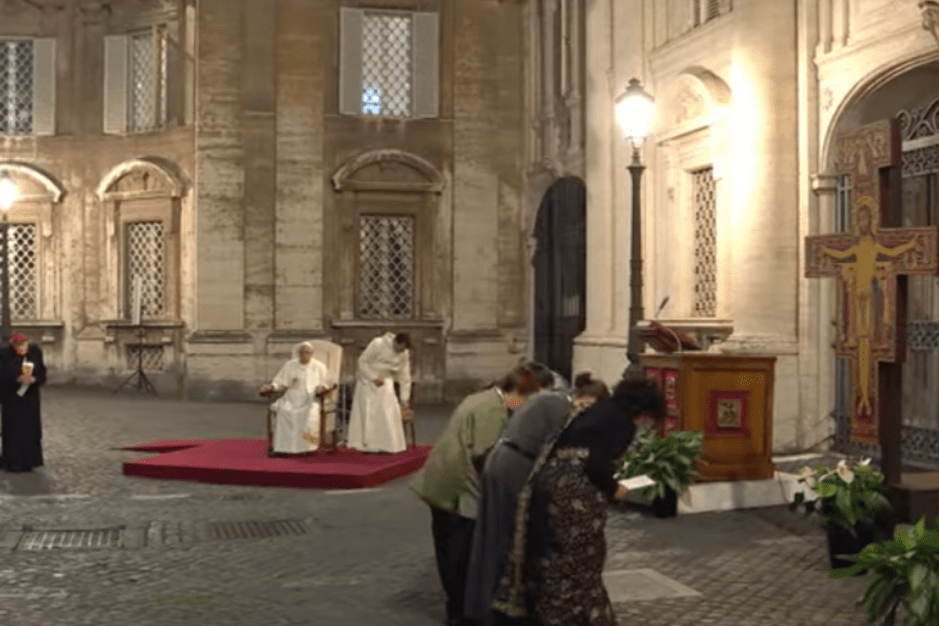
On October 11, the Pope led an ecumenical prayer meeting at a very special non-church venue: the Protomartyrs Square, an area right near St. Peter’s Basilica where the first pope is thought to have died. Francis excelled himself, managing to pack an unprecedented variety of blasphemies into one evening: continuing to promote the Masonic doctrines of religious indifferentism and naturalism, topped off by an egregious insult to every Catholic who shed his blood for the Faith.
The event marked the anniversary of the opening of the Second Vatican Council which the organisers of Francis’ vigil hailed as the beginning of a ‘new ecumenical era.’
For the theme of his reflection, Pope Bergoglio chose the phrase from John’s Gospel: “The glory that you have given me I have given them” (Jn 17:22). This expresses his belief that the martyrdom of early Christians like St. Peter, the shedding of their blood in that very place, had some mystical ecumenical significance.
The Pope continued by saying that the martyrs are ‘accompanying the Church on its ecumenical journey’ – another error with no basis in reality or in Catholic tradition. Unsurprisingly, Pope Francis quoted the arch-ecumenist, John XXIII, linking the pursuit of ecumenism to the unbelievably boring topic of synodality, saying “The journey of synodality… is and must be ecumenical”.
That bit does make sense. Since faithful Catholics are not fooled by either synodality or ecumenism, Francis has to go outside the Church to gain any traction. But that poses no problem when one has no belief in the primacy of Catholicism. When one can give away the bones of St. Peter or sign heretical documents with anti-Christians, then nothing is off the table.
It seems lost on the Pope that the martyrs died rather than compromise their faith to even one degree, let alone completely handing it to non-believers on a platter as he has chosen to do.
The Pope continued to spout his own ‘magisterium of Francis’: “Unity is a grace. We do not know beforehand what the outcome of the Synod will be, just as we cannot predict how the unity we are called to will fully manifest.”

In another direct contradiction of Church teaching, Pope Francis claims that a so-called ‘ecumenism of blood’ is a witness of Christian unity to the world. ‘Ecumenism of blood’ is another of Francis’ imaginary theological principles. There really is no such thing. Christians do not achieve unity through martyrdom and this certainly was not the meaning behind Jesus’ discourse at the Last Supper. At least, if it was, then Gnostic Francis is the first Catholic in history to find this hidden interpretation.
Scripture and tradition clearly state that there is no salvation outside the Church. There is no unity when some Christians are outside the Church and others are inside the Church. Further, despite Francis’ many claims to the contrary, heretics can not be considered martyrs. [See note below this article for further explanation.]
St. Peter made this abundantly clear in 1 Corinthians 13:3, when he wrote, “… if I should deliver my body to be burned, and have not charity, it profiteth me nothing.” Charity, of course, means to love God with all one’s mind and heart – including believing everything which has been taught by His Church. Anyone Christian outside of the Catholic Church is by definition, lacking in charity.
The attempted martyrdom by non-Catholics was the precise context of that famous doctrine, extra ecclesiam nulla salus, as first recorded by St. Cyprian of Carthage:
But if not even the baptism of a public confession and blood can profit a heretic to salvation, because there is no salvation out of the Church, how much less shall it be of advantage to him, if in a hiding-place and a cave of robbers, stained with the contagion of adulterous water, he has not only not put off his old sins, but rather heaped up still newer and greater ones!
Pius XII reiterated the importance of membership in the Catholic Church in his Encyclical, Mystici Corporis Christi,
“Actually only those are to be included as members of the Church who have been baptized and profess the true faith, and who have not been so unfortunate as to separate themselves from the unity of the Body, or been excluded by legitimate authority for grave faults committed.”
And these are only a few examples of the constant teaching of the Church prior to Vatican II. Francis’ ecumenical side-event reminds us of his true priority: the deconstruction of Catholicism.
While chancery bureaucrats enjoy their Roman holiday at the Synod, deluding themselves that anything they do will make a scrap of difference to the Pope, Francis puts on his Masonic-coloured lens: promoting religious indifferentism instead of preaching baptism to all nations and promoting the heresy of naturalism by pursuing his Utopian dream of ecumenism.
[NOTE ON NON-CATHOLIC MARTYRS: For a nuanced approach to this topic, consider this: They may have been true martyrs, but only before God (coram Deo), not before the Church (coram Ecclesia). They would be martyrs coram Deo, provided they were habitually willing to believe whatever the Church proposed if they had the means to know it, and it is not their fault. They would not be martyrs coram Ecclesia because only God knows the internal dispositions of a person’s soul at the hour of death. Now the Church can only make a pronouncement about external actions that can be known by one’s senses. Thus, she cannot publicly consider martyrdom something that only God can know, namely, that a person in the state of invincible ignorance decided in his heart, even if only as a desire, to belong to the Catholic Church and who died united to her.]
 Ecclesiastical Freemasonry