this is the transcript of a talk from the fatima centre; the video can be found at the end of the text.
We see very well and very clearly the development of the satanic powers for the upcoming latter times of the church; the apocalyptic times with the three symbolic dates: 1517, 1717, 1917.
1517 is the Protestant Revolution; 1717 is the foundation of Freemasonry; 1917 is the establishment of Marxism – Communism as a a power, a world power, with the October Revolution in Moscow.
It’s very interesting and very deep that Our Lady exactly mentions that when She gives us, as an answer to all this devilish attack, Her Immaculate Heart and explains in the true devotion to her Immaculate Heart how these major attacks of the devil may be overcome and will be overcome through Her Immaculate Heart. The Five First Saturdays devotion are very much linked with this.
As you see, our Lord Jesus Christ explains why the Five Saturdays. It’s a very important message of our Lord Jesus Christ. He says it’s because there are five blasphemies, major blasphemies, accomplished against Our Lady’s Immaculate Heart.
Now the first are the blasphemies against her Immaculate Conception. The second: blasphemies against her Perpetual Virginity. Blasphemies, third, against her Divine Maternity and the rejection of her role as the Mother of mankind. Now these first three blasphemies are the main errors of Protestantism and other religions who only see Mary as an ordinary woman – or, at most, the mother of the human nature of our Lord Jesus Christ. They don’t want to understand the great privileges God wanted to give to Her. And in that way, they want don’t want to submit to the Will of God.
The Will of God was that He wanted to give all the graces through Mary and therefore He made her so great – the Masterpiece of His creation. It is exactly that. It’s, in fact, the denying of the power of God and the immense love of God towards all the creatures, which focuses on His incredible, eternal love towards the greatest of all creatures, who is Our Lady.
So 1517, it begins – the attack. The great attack of the devil. Before, of course, it was a preparation but it was the establishment of the kingdom of our Lord Jesus Christ. The Christianity all over the world was established in the Middle Ages. But now comes those times about which Jesus Christ is very clear. It will be focusing on the devil’s final attack.
It will be the preparation of the Holy Friday of the Church. It will be the worst of all times: the Apocalyptic times. We know very well that in this Apocalyptic times, against the devil and his two beasts and the anti-trinity, there is only one means, one salvation. It is the Our Lady. The woman, the apocalyptic woman, clothed in Sun, the moon under her feet and around her head a crown with twelve stars.
That’s exactly that. God gives us a remedy and it’s exactly that the enemy wants to destroy.
1517, Protestantism wants to finish with the greatness of Our Lady and through that, with the importance of our Lord Jesus Christ, and in fact the destruction of His kingdom on Earth. The Church – the Catholic Church, the only True Church will vanish in a Pseudo-Christian religion which is exactly the Protestant sects, divided into many pieces with no Pope, with no hierarchy, but also with no no clear doctrine and especially with no clear way back to God. And all that without Our Lady.
Now this is only the beginning. In 1717, we know very well then comes the time where they will kick out Jesus Christ and Christianity, which is Freemasonry. Here we come to the fourth and the fifth blasphemies.
Blasphemies of those who publicly seek to sow in the hearts of the children indifference, scorn and even hatred to this Immaculate Mother. What is this? It is that Freemasonry, 1717, does want to finish with the kingdom of God on Earth.
It is the establishment of the New World Order and this New World Order Order has to finish with all that is supernatural. Now Our Lady is the Mediatrix of all Grace. She gives us the whole supernatural order, the supernatural life, and this is exactly what has to be kicked out. Therefore, we have to establish a new world, a materialistic world, a world which praises our senses, our sensuality. It praises exactly that which is the contradiction of our Lady.
Our Lady is the most pure and the world is most impure. Our Lady has nothing with materialism. She’s the most spiritual being who brings us to Heaven. Freemasonry doesn’t want to speak about heaven or hell. Only for this life on Earth and therefore the very important steps to sow into the hearts of children: indifference, scorn, hatred.
First, indifference: all this supernatural life is is nothing. It’s just a private affair. It’s nothing which is important for us; that is indifference. This religious indifference is one of the most important goals of Freemasonry. That the people just don’t care about their salvation, and what comes after this world is just a fantasy each one can imagine as he likes. That is exactly why Our Lady came and She is the answer for that. Her Immaculate Heart will kick out this indifference; will bring in again the fire of faith, hope and love and of the supernatural life into our hearts.
Therefore scorn: this this is the worst of all. ‘We have to finish with that Woman’. As She crushed the head of the Satan, Satan will try to crush her head and they destroy her. That is how he works. Children, you know it’s a very interesting thing, he will do that in all people but especially in the children.
The children are the most vulnerable and it will be one of the most important works of Freemasonry to get all the educational system under their domination and their control, which is the liberal pedagogy. it is Jean-Jacques Rousseau who posits, who says there is no original sin, the man is good and is only some unhappy things.
So, all these things. Afterwards, a hundred years afterwards: Sigmund Freud’s psychology, which is all focused on exaltation of the senses, of that which are the wounds of original sin are not only normal but are what’s ‘great’ in a human being. Just the inverse and this is a terrible blasphemy.
In fact, it’s indirectly going into straight into the heart of the Mother, of the best of all mothers who love their children. And now the children will be indoctrinated to hate Her. The hatred is the last step towards her, because if somebody is in the mud, if somebody is living in impurity, he cannot stand the the All-Pure.
If somebody is kicking out what is what is true what is valuable his conscience will always accuse him. Because he cannot hear the voice of conscience, he will hate all those who will enkindle, of course, the conscience and will remind us that it’s not that. It’s a lie. What you hear its a terrible lie of the Father of lies and therefore they hate Her.
And this goes very far and this is exactly what Freemasonry does for the last three 300 years as we have seen now, and and we see it all over the world. That culminates then afterwards in the last blasphemy: of the offences of those who outrage Her in Her holy images. This means that it is just open war.
When I was in Albania, the Catholics who received us, would show us an almost destroyed statue of Our Lady which was honoured. This statue of Our Lady was bombed. They put the machine guns on Our Lady and Our Lady’s pictures and all these statues.
If you go to the capital of Lithuanian, Vilnius, you will see there the beautiful picture, the icon of Our Lady of Ostrabrama, Our Lady of the Gate of Dawn, a wonderful, wonderful icon. You will see that there, soldiers had tried to shoot it. We have even the the the remnants of one of the balls, you know, and that is very important to understand that we are we are in such a time.
These were communist people: they tried to destroy, really, the remnants of the presence of Our Lady. This is exactly what happens at the end. This is, in fact, the description of Communism, which is a world without God, which is a world where God and the supernatural level and Our Lady and Jesus Christ has nothing to do. If they show up, they will be just destroyed. They will be ridiculed. They will be made a caricature which is, in my eyes, even worse than to destroy the statues.
This is exactly how the devil is working: with that, he will come to the utmost end of a complete world without God. Of a world where the devil – the dragon – triumphs over all nations where nothing remains of truth, of faith, of love, of hope, and that is the devil’s final victory.
But it is not a victory, because therefore Our Lady came to Fatima and tells us: these are the blasphemies. All this these efforts of the devil are all blasphemies. It’s the most horrible sins committed against God because also against Our Lady.
Therefore, we know very well that the answer is the devotion to her Immaculate Heart. It is to repair and to make atonement for these blasphemies and by this way to establish reestablish the kingdom of Our Lord and of our Lady and to prepare the final Triumph. Because at the end, Her Immaculate Heart will triumph over all these wickednesses of the devil and especially in the latter times.
Unpublished Testimony of Fr. Malachi Martin, Taken from L’Eglise Eclipsee. TRanslated from the French by online translation tool.
Malachi Brendan Martin S.J. : July 23, 1921 ~ †July 27, 1999 Born in County Kerry, Ireland, he studied at the Catholic University of Louvain, Belgium. There he received doctorates in Semitic language, archeology and Oriental history. He then studied at Oxford and at the Hebrew University in Jerusalem.
Ordained as a priest on August 15, 1954, he was a Jesuit priest in Rome from 1958 to 1964, and carried out certain delicate missions for Cardinal Augustine Bea, for whom he was private secretary, and Popes John XXIII and Paul VI. Relieved in 1964 by Paul VI of his vows of poverty and obedience at his own request, he moved to New York and became an international author of bestsellers, fiction and non-fiction. One of his favourite subjects is the Third Secret of Fatima, about which he spoke at length in his works. He recalls that what is most frightening is that it is apocalyptic and corresponds to the eschatological texts of the Holy Scriptures.
We approach this study through the testimony of Father Malachi Martin, who was extremely kind enough to sign his declarations. As he was secretary to Cardinal Bea, and the latter played a major role in the founding of the new “conciliar church”1, as well as in the execution of the plan by enemies of the Church, his testimony is both of great interest and extreme seriousness. This is why we will avoid mentioning the names of the people directly concerned by this investigation; except, of course, Father Malachi Martin himself. Some told us they didn’t really agree with some of the Father’s statements. We point out that it is necessary to distinguish, in this testimony, the events he relates from his personal opinions, which we are not obliged to follow. What seemed important to us in the context of this work are the objective facts that it reports.
It all started with an article entitled “Is the Pope Cardinal Siri?” » signed L.H. Rémy, of which here is the reproduction:
“In one of his writings, Prince Scortesco, first cousin of Prince Borghese, President of the Conclave having elected Montini to the Supreme Pontificate, gives the following information concerning the conclave of June 21, 1963: “During the Conclave, a cardinal left the Sistine Chapel, met the representatives of B’naï B’rith2, announced to them the election of Cardinal Siri. They responded by telling him that the persecutions against the Church would resume immediately. Returning to the conclave, he had Montini elected.”
Visiting Monsieur de la Franquerie in November 1984, with my friend Francis Dallais, we spoke again about this serious problem. Monsieur de la Franquerie, in 1963, was in close contact with numerous Roman prelates, and he confirmed to us that he had heard confidences from reliable and well-informed people who had knowledge of these facts.
To find out for sure, e decided to go see Cardinal Siri in Genoa. Monsieur de la Franquerie, having had the opportunity in the past to meet him and have friendly conversations with him, wrote to him to ask for an audience which the cardinal granted us on the Friday following Ascension 1985.
This is how on May 17, 1985, we found ourselves at my home in Lyon: Monsieur de la Franquerie and Francis Dallais. The evening was wonderful. I admit that I am sensitive to the very old French charm of our dear Marquis and that we spent, until very late in the night, unforgettable moments listening to him tell us his memories of a fruitful life and well filled. Whether it is his memories of Monsignor Jouin, Marshal Pétain or Pius XII, Monsieur de la Franquerie is inexhaustible and fascinating.
The next morning we left early for Genoa where the Cardinal was waiting for us around 10 a.m. and granted us a two-hour audience. We were received with great attention in the magnificent Episcopal Palace of Genoa. The Cardinal, who speaks French very well, was warm, attentive and had a courtesy typical of these people, great in office, but even more so in heart.
A dialogue then began between these two respectable people in a diplomatic language that I did not know and which is of a charm, of a delicacy, the fruit of the education of hundreds of years, and unfortunately disappeared from our days.
Giuseppe Cardinal Siri
They talked about several current or past problems, useless to recount today. As far as we are concerned, we had agreed the evening before to first talk about the exit, during the Conclave, of Cardinal Tisserand. Recalling this story, Cardinal Siri’s reaction was clear, precise, firm and indisputable: “No, no one left the Conclave.” He can only testify to what he saw and not to what might have happened in his sleep or behind his back. But what caught our attention was this firmness, this categorical ‘no’ from the Cardinal.
Moments later, when asked if he had been elected pope, his reaction was completely different. He began by remaining silent for a long time, he raised his eyes to the sky with a grin of pain and sorrow, clasped his hands and said, weighing each word with gravity: “I am bound by secrecy.” Then, after a long silence, heavy for all of us, he continued: “I am bound by secrecy. This secret is horrible. I could write books on the different conclaves; very serious things have happened. But I can’t say anything.”
Let’s think. If he had not been elected pope, he would have said it with as much promptness and firmness as the previous question. Having been elected, he could not say it, bound by secrecy, and, not being able to lie, he took refuge behind this secret.
In fact, it turns out that someone close to me who knew him closely assured me that the Cardinal told them that he had been elected pope twice: in place of Paul VI, and Wojtyla. The first time he refused, the second he was forced to refuse under threat of schism!
We three witnesses were left very shaken and practically convinced of his election.
And then serious questions arise. Did he resign? Was he forced to resign? What about these elections? What heavy secrets weigh on him? During the last Synod, he stayed a few hours and left. Despite his advanced age and the fact that he was over 75, he did not resign and it was not demanded. So?
As he was the last cardinal appointed by Pius XII, we leave it to historians and theologians to study this problem in depth and respond to it. We simply leave this grave testimony3. In the week following the publication of this article, Monsieur de la Franquerie received two telephone calls from Rome, proving that even a small, very confidential magazine was read in the Vatican. The correspondents wanted to know if the article was serious, which Monsieur de la Franquerie confirmed to them.
The article was then translated into English, German, Spanish, Italian and distributed everywhere, so much so that one day a priest asked for a meeting with the director of the magazine. This priest was sent by Father Malachi Martin, a Jesuit, living in New York.
He met him to let him know from Father Malachi Martin, present as an interpreter at the last conclaves (speaking several languages), that what he had written was true. He supplemented this information with an important element: namely that Malachi Martin had to translate a message intended for Cardinal Siri, which contained exactly this sentence: “If you accept the pontificate, we will retaliate against your family.”
During May 1996, one of our friends, who was in the United States for a few months, took the opportunity to go see Father Malachi Martin. He took the initiative to ask him a few questions in writing. Here is the report of the visits, the questions and the answers as they reached us.
First interview on June 3, 1996 in New York
“Malachi Martin lives in the United States. He always says his Mass, confesses and sees people. He is seventy-five years old and in his right mind.
I introduced myself as a friend of friends of the Marquis de la Franquerie. This was enough for him to put things in perspective. (…) Almost by himself, he told me about the Conclaves he experienced. I asked him two or three questions. He told me that Cardinal Siri was indeed elected pope in place of Paul VI and John Paul II and that he refused twice because of threats made against him and his family. He came from a great family from Genoa. During the two Conclaves, none of the cardinals went out. These threats were made to him by another cardinal.
I didn’t dwell too much on the subject and we talked about the crisis in general. Then, on his own, while he was talking about John Paul II, about the fact that he did not govern and that he did not believe in his infallibility, that the Church was governed by the bishops. He told that ultimately all this posed serious problems: that all the ordinations of priests by John Paul II were invalid and that the faithful were lost.
I asked him the question again: “So you say that all of this is invalid?” He answered me with great simplicity and assurance: “But yes, since the sacrament was changed at the Council”4.
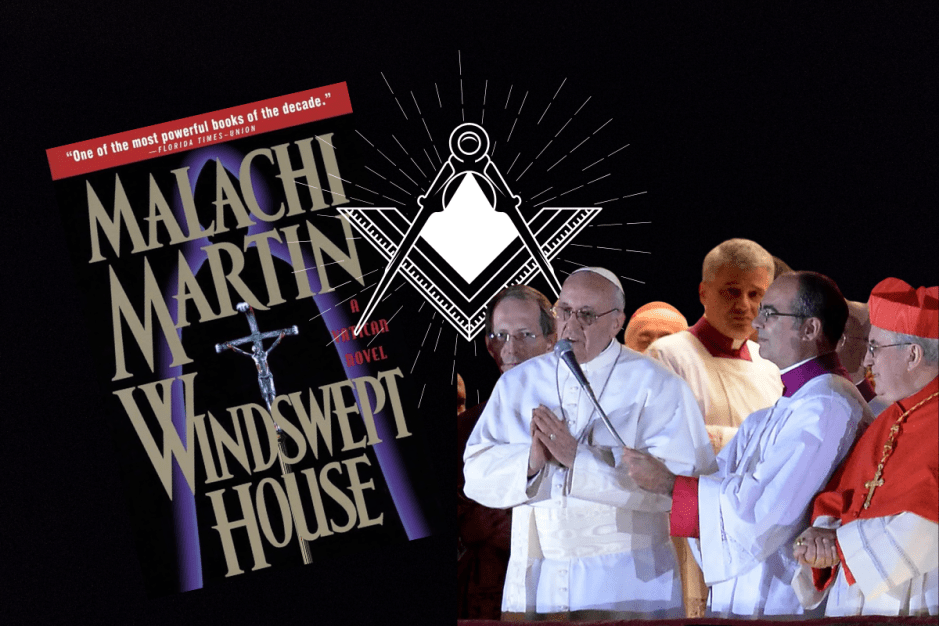
So I told him that we should write all this down and he told me that he is writing a new book on this subject. At the same time he dedicated his latest book to me in English, which will be translated into French: “Windswept House”.
“Then we talked about this and that. He told me that the Abbot of Nantes had come to see him and asked him to insert a page about his community and himself in one of his books, but that he had to refuse. He knew Mgr Guérard des Lauriers, Mgr Ngo Dhin Thuc and many people.
I asked him what he thought of the consecrations carried out by Mgr Ngo Dhin Thuc. He thiinks they are completely valid. He believes that there are currently some 57 bishops who have been consecrated in this way. He asked me if Bishop Williamson is a “sedevacantist” at heart or not. I told him that in any case, he is, as are others, but that he doesn’t say it and that Bishop Fellay claims to have relations with “undeclared sedevacantists”. He invited me to come back and see him – which will happen very soon.”
Second interview of September 12, 1996 in New York
“In my last story I forgot to mention that Cardinal Ottaviani had probably been blackmailed in his last days so that he would accept the Novus Ordo, otherwise he would not be given the last sacraments.
This Thursday evening, Malachi Martin had prepared the written answers to the questions that I had asked him in writing by mail some time before. This with the aim of possible publication. He warned me that our interview will not be long because he was to receive a prelate from Rome in an hour.
John Paul II signed an official document authorizing a Conclave to depose the pope on grounds of physical incapacity or health. So much so that we only talk about the Conclave in Rome… but the next one will be worse and so will the situation!
In addition to the written responses, we took up some of them orally. In particular the question of the Conclave. He described to me again how Cardinal Siri’s refusal happened: “After having been elected Pope and having read a paper which had just reached him, in an envelope, from the rank of cardinals, one of the three cardinals presiding the Conclave approached to ask him according to the consecrated words if he agreed to be pope. At that moment, Siri stood up stiff as a stick and pronounced the Latin phrases of refusal in an impersonal and cold tone as if he were forced. The reason he gave for his refusal was propter metum, that is to say ‘because of fear’.” At this moment, Malachi Martin told me that, canonically, this way of responding could have been a reason to invalidate the Conclave5.
I asked him: “Who did this paper come from?”
He answered me: “It came from the cardinals, probably from Cardinals Villot and …..6..In any case it was the expression of the refusal of the Special Lodge. This Lodge is reserved in Rome for cardinals in close contact with the Grand East. John XXIII and Paul VI were part of the Special Lodge.”
I asked him to confirm: “Was John XXIII a Freemason?” He replied: “On the membership of John XXIII in Freemasonry, all the proofs are in the Vatican archives, jealously guarded by Cardinal Sodano. He himself saw photos taken by his driver revealing John XXIII frequenting Parisian dressing rooms.” The rest of our conversation was a bit of a repetition of the answers he had written. Due to lack of time we stop there. We must meet again the following Tuesday.”
Third interview of September 17, 1996 in New York
“This will be our last meeting before my return to France. Malachi Martin told me again that we are only talking about the Conclave in Rome, that everyone is looking for votes and that the Freemasons are agitating very actively within the special Lodge reserved for cardinals, but in liaison with the rest of Freemasonry via the Grand East and the Grand Master of Italy whose name he does not remember.
He told me that he spoke several times to John Paul II about these pressures (from Freemasonry) and the errors of Vatican II, but that he told him that it was nothing and that he made fun of it.
I asked him: “Does John Paul II consider himself pope?”. He answered me: “He even doubts whether he is pope and he behaves more like a bishop than like a pope.”
We then talked about Mgr Thuc, Mgr Mac Kenna then he read and signed the translation of his responses into French in order to be able to ask that they be published. I asked him for some details on the reason for Cardinal Siri’s first refusal and how it happened. He replied that it was the same process each time (for Paul VI and John Paul II).
Then I asked him what he meant by “advancing issues on Ecumenism and Judaism”. In fact, he was simply an intermediary between John XXIII and Cardinal Bea. Finally, after he gave me his blessing, we parted with the intention of remaining in correspondence.”
Questions asked of Malachi Martin (September 1996)
Subject: Traditionalism
Q. Do you know the so-called Cassiciacum thesis written by Mgr Guérard des Lauriers? What do you think? Do you consider that today the “pope”7 is a usurper, no longer has authority and should either convert or be deposed?
Q. The Society of Saint Pius X9 signed a recognition of the legitimacy of John Paul II before the diaconate. It gives the practical instructions to pray publicly for him and to say “Una cum famulo tuo papa nostro Joanne Paulo” at Mass. What do you think of that?
A. The Society is confused about the papacy.
Q. Do you think that the consecrations performed by Mgr Ngo Dinh Thuc are valid?
A. The consecrations of Mgr Ngo Dinh Thuc are valid.
Q. What do you think of the fight between Mgr Lefebvre and Mgr de Castro Mayer?
A. I think that Mgr Lefebvre and Mgr de Castro Mayer were fallible heroes but heroes.
Q. Do you know the book by Arnaldo Xavier da Silvera “The new Mass, what to think of it?” Is it true that he was murdered?
A. I don’t know anything about Arnaldo Xavier da Silvera.
Subject: Conclaves
Q. Was Cardinal Siri elected pope twice? When ? One might think that his refusal comes from him alone. Why did he refuse and give way to Paul VI then to John Paul II? Some have asked Cardinal Siri; he did not respond and remained silent. You say there was pressure. Which ones and how do you know? From which cardinal do these pressures come? We saw black smoke at the Conclave electing John Paul II. Was it because Cardinal Siri had been elected and refused?
A. That Siri, twice in his old age, was elected pope is an undeniable fact to those who know what happened. All that Siri himself conceded was that fear of retaliation was the determining factor in his behaviour. The pressure on him not to accept the pontificate did not come from a single cardinal. Simply Siri was not acceptable to the progressive faction and its bosses. Yes, there was confusion after a vote at the October 1978 Conclave.
Q. You did not attend the Conclave electing John XXIII but you say that he kindly carried out his personal propaganda. Is this true? Why would he want to be pope?
A. Angelo Roncalli was always a missionary with his intention of becoming pope. He had an entirely Modernist agenda for the Church10.
Subject: The Popes
Q. Was John XXIII an initiate? Some documents refer to him as “brother”. What do you think?
Q. Does the encyclical Pacem in Terris contain heresies? Does it fall under the infallible Magisterium?
A. This should belong to the universal Ordinary Magisterium, but it is a Modernist document.
Q. Should we consider John XXIII as a legitimate pope? Should we follow his liturgical reform?
A. He was validly elected. No, we should not follow his liturgical reform.
Q. Did Paul VI have Jewish origins? What do you think of the thesis of the survival of Paul VI saying that he was replaced by a double?
A. No one really knows all of Montini’s ancestors. No, Paul VI was never replaced by a double.
Q. Did John Paul II have Jewish origins? Was he a heretic before his election? Some Masonic documents acclaimed him because he recognized “the right to make mistakes.” Do you think he is perfectly aware of what he is doing?
A. John Paul II, no, as far as I know, has no Jewish ancestors, but who really knows12? He is perfectly aware of what he did. He is not aware of the mistakes he has made.
Q. Was John Paul I assassinated? For what ?
A. We cannot explain the events surrounding the death of John Paul I by ordinary means. Powerful people didn’t like him as pope.
Q. What do you think of the reform of the psalms by Cardinal Bea under Pius XII? What do we think of the institution of the Easter liturgy at midnight by Pius XII?
A. I think all their changes were harmful.
Q. Which pope is guilty of obscuring the message of Fatima?
A. Pope John XXIII.
Q. Who are the current “papabile” cardinals? Can we hope for a return to order after John Paul II? What future do you envision for the papacy and therefore for the Church?
A. The future of the papacy: the hierarchy of the Church is extremely gloomy.13
Subject: Vatican II
Q. Does the Second Vatican Council include formal heresies? Which ones?
A. Certain parts of certain documents contradict past statements of the Roman Magisterium. For example, about religious freedom, papal primacy and infallibility; about the purpose of marriage, about the role of Jews, about the Church in the world.
Q. Does the Second Vatican Council fall under the Ordinary Universal Magisterium? Is it infallible?
A. Explicitly, Paul VI and the bishops of the Council denied the infallibility of the Second Vatican Council. If it had reflected the Tradition of the Roman Magisterium, it would have been part of the Ordinary Universal Magisterium, but it did not do so.
Q. Should the Second Vatican Council be declared a robbery, in the same way as the Council of Ephesus? Can we interpret the Council in the light of Tradition?
A. What the Roman Magisterium will ultimately do regarding Vatican II is what everyone hopes. Ultimately the pope will have to correct Vatican II and its documents in light of the fixed teaching of the Roman Magisterium – which won’t happen very soon. If you want to interpret Vatican II in the light of Tradition, you will have to reform its main documents completely14.
Subject: Relations at the Vatican
Q. You were Cardinal Bea’s secretary and therefore probably followed his interviews. What do you think of him? Cardinal Bea is said to have been at the origin of Ch.4 of the Schema on Ecumenism concerning the Jews15, which rejects the guilt of the Jewish people in the crucifixion. What do you think? Did you participate in the writing of this text?
A. Cardinal Bea was busy introducing as many progressive doctrines and policies as possible. He was the leading hand in the Schema on Ecumenism. I refused to follow what John XXIII and Bea proposed about the role of the Jewish population.
Augustin Cardinal Bea
Q. It is said that you have spent your entire career in the Vatican. Is this true? In what position?
A. No, I was appointed professor at the Pontifical Biblical Institute in Rome in 1958. From there I became an assistant and advisor to Cardinal Bea.
Q. What was your role during the Council? Did the “observers” participate in the writing of the “New Mass”?
A. During the Council, my role was to be “behind the scenes”, pushing forward plans on Ecumenism and Judaism. Six Protestant clergymen (out of a total of eight consultants) wrote the Novus Ordo under the direction of Mgr. Annibale Bugnini. Unless very special care is exercised, the Novus Ordo is invalid.
Q. All your books are released in novel form with imaginary names. Why is that ? Have you had death threats?
A. Not all of my books are in the form of a novel; only three of them. I have published sixteen books.
Q. Did you know Carlo Falconi? What do you think of him? In his book Seen and heard at the Council, he said: “An otherwise trustworthy thirty-third degree assured me that Montini was a Freemason. For my part, I don’t believe it.” What do you think?
A. I did not know Carlo Falconi personally. Yes, for a certain period, Montini was a member of the Lodge, as was John XXIII.
What matters in this testimony – disregarding the fact that these maneuvers may have rendered these conclaves invalid – is that the election of these conciliar pontiffs is due to enormous manipulation by the servants of the Masonic sect.
Let us thank Father Malachi Martin for his courage. His accusations raise serious questions that only theologians and canonists can resolve. How did we get to this?
The reader will have understood: what Father Malachi Martin reveals is the culmination of a long conspiracy. Indeed, what does he say?
“Siri was not acceptable to the progressive faction and its bosses.” “We cannot explain the events surrounding the death of John Paul I by ordinary means.” “Powerful people didn’t like him as pope.”
Who are the “bosses” of this progressive faction plaguing the Vatican? Who are these “powerful people”? How did they come to dominate in the Vatican, to the point of being able to manipulate Conclaves?
FOOTNOTES
This is the name that Cardinal Benelli used to designate the church resulting from the Council. Cardinal Wojtyla, in his book “Sign of Contradiction”, gives it the name “post-conciliar church”. ↩︎
“B’naï B’rith, which means ‘Sons of the Covenant’ in Hebrew, is the first world Jewish organization. It is at the same time the oldest, the most numerous and undoubtedly the most influential. Founded in 1843 in the United States, this para-Masonic secret society exclusively reserved for Jews includes more than 550,000 Brothers and Sisters in around fifty countries” (The Warriors of Israel, Facta, 1995, p. 415). Also read the remarkable work by Mr. E. Ratier: Mysteries and secrets of B’naï B’rith. ↩︎
The question of the possible invalidity of the post-conciliar rite of the sacrament of orders is dealt with in the magazine “Forts dans la Foi”. Rama P. Coomaraswamy, MD: “The Anglican drama of the post-conciliar Catholic clergy”, n° 9/10, 2nd quarter 1990. ↩︎
L’Osservatore Romano of 03/21/1989 reports a comment by Father Betti about the new formulas of the profession of faith (a chapter should be written to comment on them). He says among other things: “The second category concerns the truths and doctrines that the Magisterium proposes in a definitive manner although they are not divinely revealed. To these truths must correspond to a total assent, even if it is not an assent of faith, because they are precisely not proposed as divinely revealed. For example, the legitimacy of a Roman Pontiff: his election is a historical fact. It could even be theoretically tainted by an electoral defect. It is not the fact in itself which is divinely revealed, but it is so linked to Revelation that the Magisterium can pronounce in a definitive manner on the legitimacy of this or that Pope. Otherwise, the Church would have remained for this or that period without a legitimate leader, without a successor to Peter. This extract would almost seem a response to the testimony published three years before, in 1986 in “Under the Banner”. ↩︎
The second name is difficult to grasp. In order to avoid an error we prefer not to transcribe it. ↩︎
We do not know why Father Malachi Martin did not answer the second question. ↩︎
The Society of Saint Pius X was founded by Mgr Lefebvre in 1970. ↩︎
By evoking this expression of “missionary” Father Malachi Martin means that Cardinal Angelo Roncalli was acting to become Pope. By the word “agenda” he means that he had a modernist program. We will come back to this later. ↩︎
This is an initiation into Freemasonry. Let us note this extract from Father Mouraux’s magazine: “Nuncio in Paris, Mgr Roncalli received at an open table Edouard Herriot and Vincent Auriol, notorious freemasons and politicians who carried out persecutory action against the Church. In the warmth of a banquet, he said to them one day: “What separates us is of little importance”. All his happiness seemed to be that of the table where he wanted above all to please” (Bonum Certamen 122, p. 7). ↩︎
Emilia Kaczorowska, the mother of John Paul II, was Jewish. ↩︎
Note from AC – Fr. Martin had read the Third Secret of Fatima, which is widely believed by traditionalists to have predicted the Crisis. He knew in the 1990’s where the Church was heading. ↩︎
We can note that “totally reforming the main documents” of Vatican II necessarily amounts to rejecting the Council, the good parts of which served to push through the bad ones. ↩︎
During the Council a brochure was distributed to the Council Fathers entitled Judeo-Masonic action in the Council. After having given several proofs that chapter 4 presented to the Council was of Jewish origin, we find this on page 10: “If we want definitive proof that chapter 4 of the Schema on Ecumenism presented to the Council by Cardinal Bea — who personally defended this thesis – is from a Judeo-Masonic source, we find it in the pages of the important French newspaper Le Monde, of November 19, 1963: “The international Jewish organization B’naï B’rith has expressed its desire to establish closer relations with the Catholic Church. The said Order has just submitted to the Council a declaration in which the responsibility of all humanity in the death of Jesus Christ is affirmed. If this declaration is accepted by the Council, declared Mr. Label A. Katz, President of the International Council of B’naï B’rith, the Jewish communities will study the means of cooperation with the authorities of the (Catholic) Church.” In presenting his draft decree in favor of the Jews – completely contrary to the Gospel – His Eminence Cardinal Bea took care not to properly inform the Fathers of the Council of the origin of his theses and to specify to them they were suggested by the Masonic Order of B’naï B’rith. Let us also add this letter from Cardinal Villot to Cardinal Marty of December 22, 1977: “…The Holy Father is indeed well aware of the sincere and fruitful relations that his venerated predecessor Pope John XXIII maintained with Jules Isaac. He also appreciates the happy consequences that these reports have had for subsequent orientation of the relations of the Catholic Church with Judaism, relations which found ecclesial expression in number 4 of the declaration Nostra Aetate of the Second Vatican Council, as well as in other manifestations which preceded it deated or followed” (The Churches before Judaism, Ed. du Cerf, Paris, 1980, pp. 181 and 182). ↩︎
We therefore know, as it is confirmed by this testimony, that the “New Mass” is the work of Protestants and Freemasons. Should we be surprised to find, for example, cabbalistic formulas in the Offertory? To know the thoughts of Protestants on the subject of the mass, let us read what Luther, founder of this sect, wrote: “We declare in the first place that our intention has never been to absolutely abolish all worship of God, but only to purge that which is in use, of all the additions with which it has been soiled: I am speaking of this abominable Canon, which is a collection of muddy lacunae; we made the Mass a sacrifice; we added offerories. The Mass is not a sacrifice or the action of the priest. Let us look at it as a sacrament or as a testament. Let us call it blessing, eucharist, or table of the Lord, or Lord’s Supper, or Memory of the Lord. Let us give it any other title we wish, provided that we do not sully it with the name of sacrifice or action” (Werke, t. xi, p. 774). “When the mass is overthrown, I think we will have overthrown the papacy” (Contra Henricum Angliae Regem, Werke, t. x; sec. ii). ↩︎
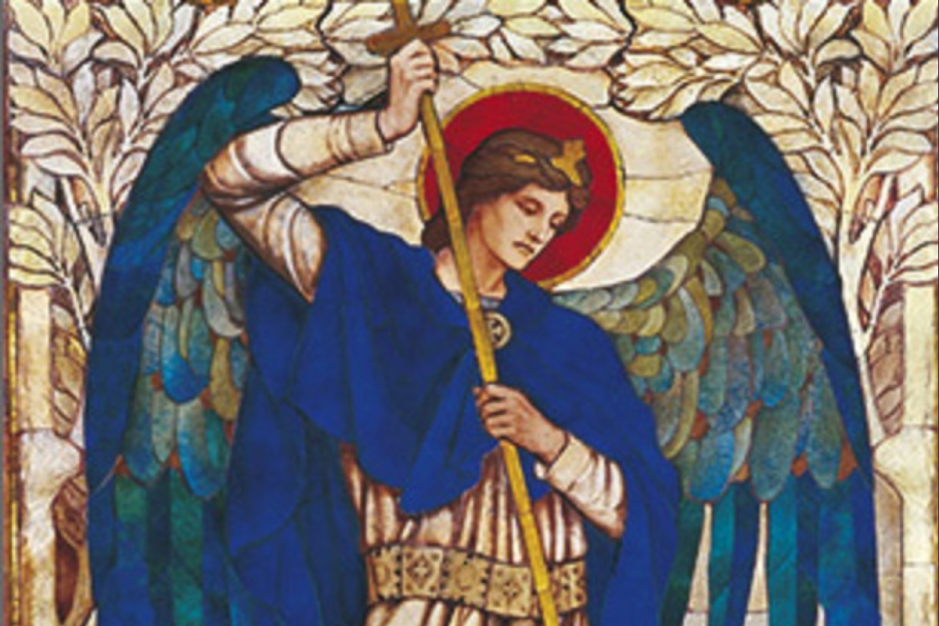
Most of the information in this article comes from a fascinating book, ‘Pope Leo XIII and the Prayer to St. Michael’. The book looks at various accounts of the origin of the prayer as well as its significance.
Pope Leo XIII famously composed the prayer to St. Michael after seeing a vision in which God gave the devil permission to have free reign over the earth from the mid-twentieth century. The date of that apparition is traditionally given as October 13, 1884 – coincidentally, that is exactly 140 years ago today. This date is significant for several reasons, none of which should be a surprise to my readers. October 13, as well as being the anniversary of Leo’s apparition, it is the date of the miracle of the sun at Fatima (1917) and of the final apparition of Our Lady at Akita (1973).
Some sources believe that Leo’s decision to write the prayer coincided with his increasing concern over the influence of Freemasonry on the Catholic Church. His predecessor, Pius IX, had ordered a set of prayers to be prayed by priest and faithful after Low Mass for the protection of the Church. Leo inserted the prayer to St. Michael into that set of prayers – a practise which continues today in traditional parishes – requesting this from his priests in his classic encyclical against Freemasonry, Humanem Genus.
Leo issued continued warnings to his priests to be increasingly vigilant with regard to dangers both within and without the Church. As well as the St. Michael prayer, Leo composed an exorcism prayer just for priests which is based on the St. Michael prayer as well as a longer version of the St. Michael prayer to be used by the laity.
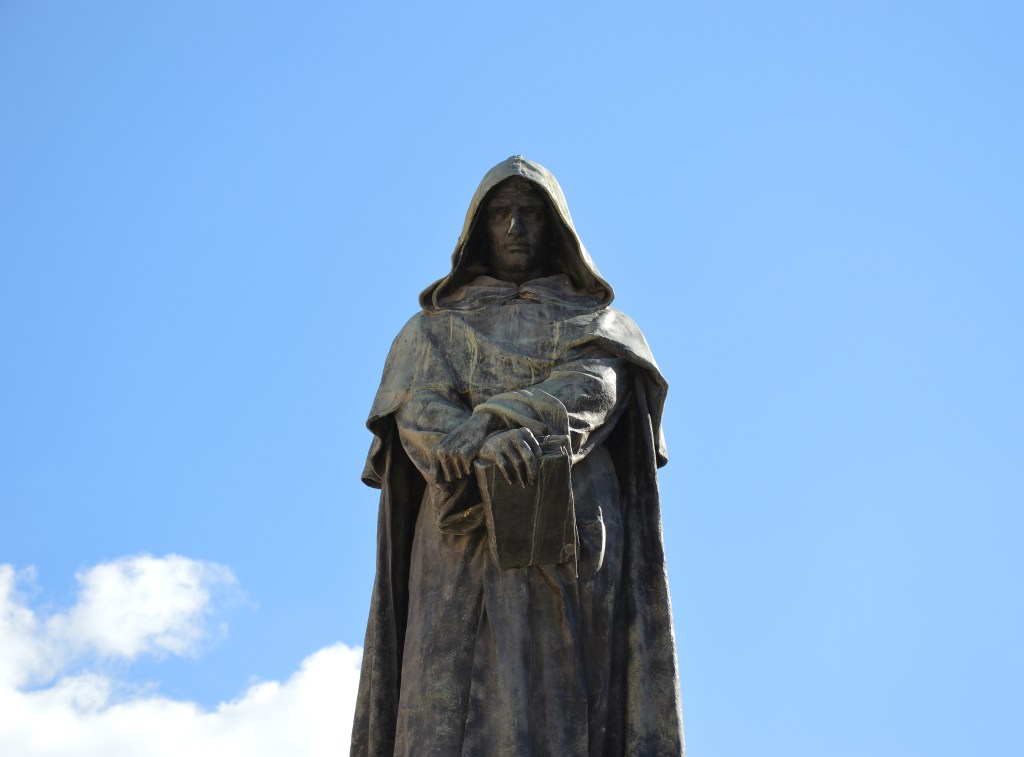
Statue of Giordano Bruno at the Campo de ‘Fiori in Rome. SOURCE: Livioandronico2013 via Wikimedia Commons
Leo’s strong condemnations of Masonry drew the ire of the secret societies against him. In particularly egregious incident, the Masons erected a statue of an infamous heretic in Rome. The heretic, Giordano Bruno had been condemned and executed under the Inquisition in 1600.
Bruno was a hero to the Freemasons and other subversive groups and the statue’s sculptor went on to become the Grand Master of the Grand Orient lodge of Italy. By erecting Bruno’s statue, the Masons were in effect thumbing their noses at Pope Leo. Leo’s response was to release another encyclical, Dall’alto dell’Apostolico Seggio, condemning the Freemason’s act. The date of issue was October 15, 1890, just two days after the mysterious and highly significant date of October 13th.
[As an aside, Giordano Bruno was posthumously rehabilitated by the highly suspect Cardinal Angelo Sodano in the year 2000! As another aside, and this is very strange: St. Michael is a saint who is perversely venerated by the Masons, who think of him as the ‘planetary angel of the sun.’]
One reason why Pius and Leo sought to engage extra help from the archangels can be found in the records of exorcists. During exorcisms performed after their pontificates, demons admitted that there had been ‘unusually numerous and strong invasions by diabolical spirits on the earth’ during Pius’ pontificate. One exorcist wrote:
In their battle against the Church, the demons use the wicked people as their allies. They have succeeded in enlisting a large number of people under their banner.
“We have the will of the people on our side,” they say.
The demon ‘Caesar’ leads their forces to stir up governments against the Church. “The people are our trusty storm troops”, he stated.
The Masons are among the main supporters of the demons. Lucifer admits that they are his ‘dearly beloved children’ and calls them his ‘representatives on earth.’
The exorcist continued:
Once they are defeated, the time will come when the members of the secret societies will be humiliated. The Virgin will destroy the secret societies. She has already set herself against them.
So we can see that before Modernism infiltrated the Church, Freemasonry was identified as being Her fundamental enemy, leading Pius to institute extra prayers after Mass for the protection of the Church and leading Leo to compose some very powerful new prayers invoking the great St. Michael.
IMAGE SOURCE: detail from James Powell and Sons of the Whitefriars Foundry, Public domain, via Wikimedia Commons
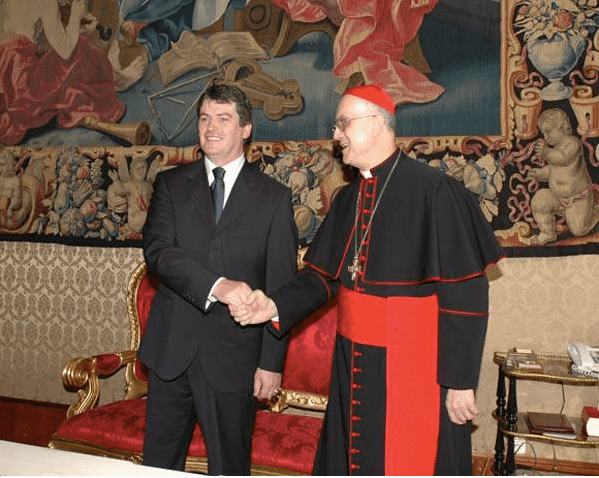
In his recent interview with Franca Giansoldati, Archbishop Carlo Maria Viganò accuses Cardinal Tarscisio Bertone of having Masonic sympathies. Bertone, who is still alive, was Secretary of State to Benedict XVI and he continued in that position for the first seven months of Francis’ pontificate.
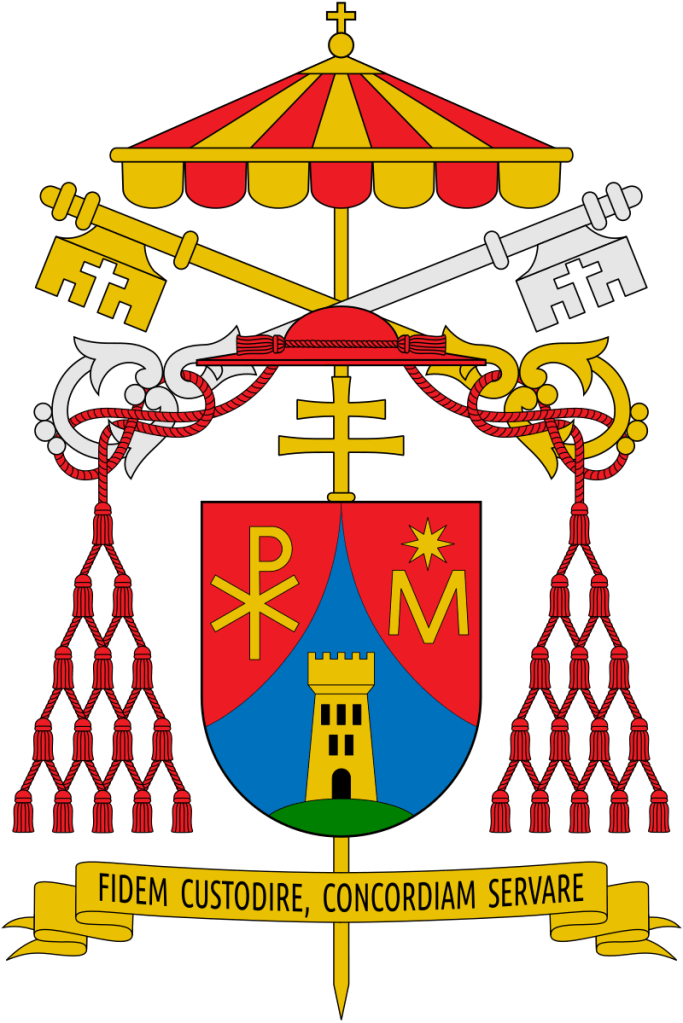
Like Pope John XXIII, Cardinal Bertone’s coat-of-arms includes a tower, which according to Masonic heraldry, represents the Masonic temple.
Bertone is widely regarded as one of Benedict’s ‘gatekeepers’, one who controlled the flow of information to the Pope; he admitted to knowing months in advance of the Pope’s decision to resign. Bertone’s farewell address to Benedict, flatters the Pope for his decision, even though elsewhere he said he did not agree with it:
“All of us have realized that it is precisely the deep love that Your Holiness has for God and the Church that prompted you to make this act, revealing that purity of mind, that strong and demanding faith, that strength of humility and meekness, along with great courage, that have marked every step of your life and your ministry…”
According to Viganò, it was Bertone who exerted pressure on Pope Benedict to have Viganò removed from the Secretariat of State and subsequently transferred to the US as Nuncio. All of this was aimed at stopping Viganò from exposing financial corruption in the Vatican. Viganò was also abruptly evicted from his Curial home the day he turned 75, and denied an alternative within the Vatican walls.
Alarmingly, he suggests that his predecessor as Nuncio, Cardinal Pietro Sandri, was murdered for opposing then-Cardinal Theodore McCarrick.
Said Viganò:
Archbishop Sambi died in circumstances that have never been clarified, after a trivial operation at John’s Hopkins Hospital in Baltimore (which is connected to the Bill & Melinda Gates Foundation and the World Economic Forum in Davos). McCarrick disappeared for a month in 2011 – simultaneous to the death of the Nuncio – and did not attend his funeral. The death certificate issued to Msgr. Jean-François Lanteaume, Chargé d’Affaires at the Nunciature, did not explain the causes of the Nuncio’s death, nor was an autopsy ever carried out on Archbishop Sambi.
So, what is known about Bertone and does he have Masonic form?
We know that he was part of the ‘Old Guard’: that ‘mafia’ of prelates at the highest levels in the Vatican, who ran things behind the scenes before Bergoglio’s new gang came to town. Parolin is one of these, as was Sodano.
Bertone was responsible for making influential appointments within the Curia, the most notable of which was Cardinal Becciu’s appointment as sostituto in 2011. He also appointed Alberto Perlasca as head of the administrative office of the Secretariat of State in 2009. Perlasca monitored all the department’s financial transactions – including the ill-fated London Sloane Avenue deal and both he and Becciu went on to become central figures in the Vatican financial corruption trial.
Bertone himself is no stranger to accusations of financial misappropriation. In 2015, he was at the centre of the Vatileaks 2 scandal when it was revealed that he had used funds from the Bambino Gesù Foundation to renovate his large apartment in Vatican City. The apartment was apparently designed to house Bertone, his secretary and three nuns and included a rooftop entertainment area; half a million US dollars was diverted from the Bambino Gesù to pay for the renovations. In addition, there was corruption involved in the tendering process and a long-time friend of Bertone was given the contract for the job.
Although the case was mentioned in 2017 during the complicated Vatican finances trial, no charges were laid against Bertone, nor was he even called as a witness – Bertone repeatedly has claimed that Pope Francis sanctioned the renovations. The only conclusion given at the trial was that the Bertone affair was ‘anomalous.’
Yet that event pales into insignificance with older accusations that Bertone was involved in a misappropriation of Vatican funds to the tune of USD $15 million. Somehow this incident was never properly investigated and news articles about it have been scrubbed from the internet.
Bertone is also implicated in serious moral failings within the hierarchy. He knew at least as early as 2008 that Theodore McCarrick had slept with seminarians and although he was one of those responsible for placing sanctions on McCarrick, did nothing to enforce them. Also, despite his integral role in the McCarrick case, Bertone was not mentioned in the McCarrick Report.
But without a doubt, the most serious affair Bertone has been involved in was the deception surrounding the Third Secret of Fatima. Bertone, along with then-Cardinal Ratzinger and others, fabricated the interpretation of the Third Secret which was announced to the world in 2000. Their interpretation said that the ‘bishop in white’ who was murdered actually referred to the attempted assassination of John Paul II, that predictions of a chastisement actually referred to the Church’s ongoing opposition by the world and so on. Bertone met with Sr. Lucia on three occasions, claiming she approved their false interpretation as well as the inadequate Consecration made by Pope John Paul II. (For anyone with doubts: where are the fruits of this Consecration?)
It is difficult to fathom the magnitude of this betrayal by Bertone, Ratzinger, John Paul II and their clique. To firstly ignore and then misrepresent Our Lady is treachery of the most hideous kind.
If, as Archbishop Viganò suggests, Bertone is at the very least least, adjacent to Freemasonry, then this only adds insult to the injury of Holy Mother Church. Bertone should be added to the list of prelates who need our prayers: at 89, he has not much time left for conversion, and without it, an eternity in hell awaits him and all those who profit from their status in the Church or go so far as to mock the Mother of God.
IMAGE SOURCES: White House Image/Lawrence Jackson, Public domain, via Wikimedia Commons
It is widely acknowledged among traditionalists that the Second Vatican Council contained many elements which were designed to appease non-Catholics. This is most obvious in the changes which were later made to the Mass and the failure to condemn Communism at the time of the Council itself. However this non-Catholic appeasement also worked in an extraordinary way against devotion to the Mother of God, who was in many ways directly insulted by the progressive Council Fathers.
While the main reason for this was the all-pervading Masonic ecumenism of the Council, two lesser motives were also at work. One of these is a Modernist trend toward denigrating miracles. Modernists do not mind acknowledging Our Lady as an historical fact; after all, there is little doubt that She was a real person who existed in time and gave birth to Jesus Christ. Other religions and cults also venerate the mother of their prophets. But Modernists are less tolerant of miracles associated with Our Lady: Her apparitions, Her messages and especially Her appearance at Fatima.
A second factor at play is the significance placed on the female type by occultists. The ‘Sacred Feminine’ is important to the Rosicrucians, for example, where Our Lady is blasphemously referred to as one of the ‘Great Women Initiates.’ The Pachamama incident at the Amazon Synod was another reference to this female type. Pachamama is a version of Gaia, the earth goddess, who is venerated by Wiccans and climate worshippers as well as by tribalist pagan cults.
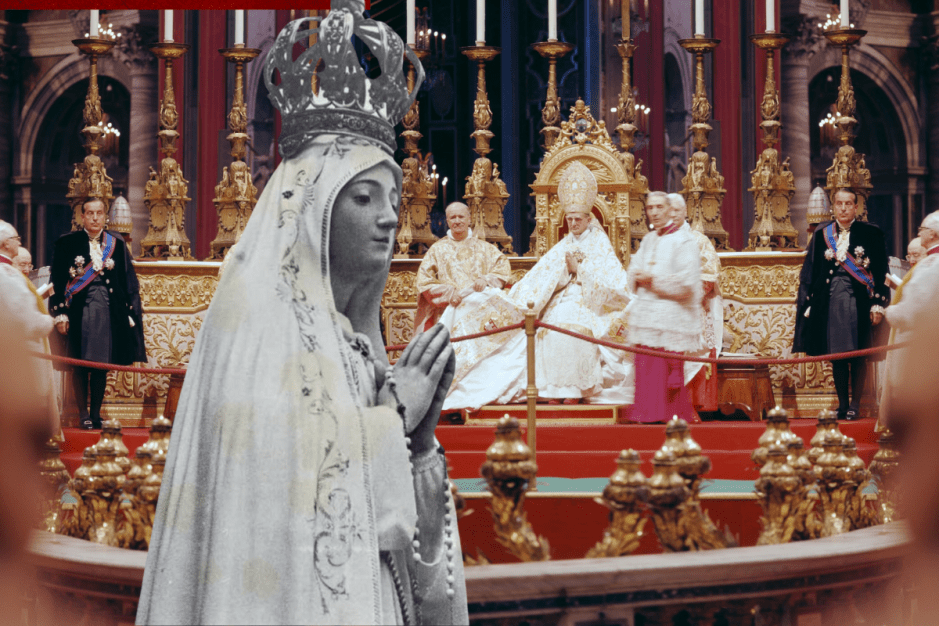
These motives led the progressive element among the Council Fathers to downplay or ‘cancel’ the Mother of God in three main ways. The first was in regard to the proclamation of Our Lady as Mediatrix. There had been a movement among orthodox prelates to have the Mother of God honoured by the proclamation of the Fifth Marian dogma: that She is Mediatrix of all Graces. Many bishops and countless faithful were optimistic that this would be proclaimed by John XXIII at the Council, but the good bishops’ campaign was thwarted at every opportunity. Petitions in favour of the proclamation were not delivered to the correct authorities and speeches bordering on blasphemy against Our Lady were delivered during Council sessions.
The second insult was in regard to Fatima. Readers will recall that the Virgin Mary, through her messenger, Sr. Lucia of Fatima, asked that the Third Secret be revealed by the year 1960, that is, at the latest, under the pontificate of Pope John XXIII. It is known that John read the Secret in August 1959 by which time, preparations for the Council were well underway. After reading the message from Our Lady, John stated, “This does not concern the years of my pontificate.”
These are remarkable words, considering that several sources claim the Secret refers to an evil Council! It is worth remembering that the convening of an ‘evil Council’ was also among the predictions made by the occultist and Synarchist, the false priest Roca.
Even if the Secret contained no reference to a Council, John deliberately disobeyed the Mother of God by failing to make its details public. He further added to the disobedience by failing to consecrate Russia to the Immaculate Heart and formally promulgate First Saturday devotions.
To further disrespect Our Lady, Pope John insulted Her in his Opening Speech to the Council in October 1962. The speech, which had heavy input from Cardinal Montini, the future Paul VI, contrasted John’s highly optimistic aggiornamento with the attitude of the so-called ‘prophets of doom’. This was a clear reference to the children of Fatima who carried Our Lady’s message, as well as to those conservative bishops and Cardinals who were concerned about threats to the Church and to the world at large. John XXIII criticised those who dwelled on ‘ruin and calamity’, echoing the words of the Fatima seers who saw in a vision that ‘the Holy Father crossed a large city half in ruins.’
The insults to Our Lady did not end there, however. The final part of the campaign to denigrate the Mother of God was the denial of the dangers of Communism. It is well-documented that John XXIII made a secret pact with the Communist-run Russian Orthodox Church prior to the Council. John, always anxious to boost his ecumenical credentials, wanted Russian Orthodox ‘observers’ at Vatican II. The Orthodox agreed – but only on condition that there was no condemnation of Communism from the Council. Encouraged by Montini, John went even further, ensuring there was no mention of Communism at all, despite many petitions from the prelates present.
As the Abbe de Nantes wrote, “The greatest Council of all time (supposedly) would therefore remain deaf and blind to the greatest phenomenon of inhumanity of all time: the global expansion of Bolshevism. Thus did it secretly lend its aid.”
Once Montini was elected Pope after the death of John XXIII, this anti-Mary agenda became even more clear. Throughout 1964 particularly, there were many attempts by the more conservative prelates to have Russia consecrated to the Immaculate Heart in the presence of all the world’s bishops. There could have been no better time for such an event as the Bishops were already gathered in Rome for the Council’s next session.
But instead of taking the opportunity to consecrate Russia while all the world’s bishops were present, Paul VI ignored the pleas of the hundreds of Bishops who heeded Our Lady’s warnings. By the end of 1964, however, as Pope Paul could see the damage already being wrought by his reckless Council, he made one small concession: Paul ‘recalled’ the Consecration made by Pius XII in 1942, while declaring Our Lady “Mother of the Church”.
Of course, this feeble response could in no way be said to fulfil the requests made by Our Lady at Fatima.
So it was that Popes John and Paul presided over a Council during which there was a concerted effort to insult, disrespect and denigrate the Mother of God. By refusing to condemn atheistic Communism, the Progressive Popes took the insult even further by refusing to acknowledge the greatest danger posed to the world, one which had precipitated a Divine visitation to earth in the form of the apparitions of Our Lady at Fatima.
“Many of the visitors to Cova da Iria also visited Aljustrel to talk to, or pray with, or plead intercession from the three seers. Although the apparitions had stopped, the events at Fatima had acquired a momentum of their own. The attraction increased over the years, despite violent attacks in the Masonic press, the presence of armed troops at Cova da Iria, and the fact that within four years of the last apparition, none of the little seers lived at Fatima anymore.
“Back at Lisbon, Freemason and Editor-In-Chief of ‘O Seculo’, Avelino de Almeida, was raked over the coals by his fellow leftists for daring to report the miracle of the sun as it actually occurred. It was thought that such a public concession to reality only encouraged the forces of reaction, and consequently imperiled the revolutionary cause in Portugal. In Ourem, no one needed to instruct Arturo Santos (“the Tinsmith”) about the party line. To his dying day he denied that anything miraculous had ever occurred at Cova da Iria – although he never set foot there. On October 23, 1917, however, some of his henchmen did.
“The Tinsmith’s agents were joined by members of the Grand Orient Lodge of Santarem (about forty miles south of Fatima). Under cover of darkness they entered Cova da Iria to cut down the holm oak tree, and remove the rustic wooden arch built over it, from which hung lanterns perpetually lit in honor of the heavenly Lady. They also took a table and the small altar resting on it, and an image of the Blessed Virgin. The carload of booty was driven to Santarem, where the thieves displayed the stolen items the next day. For a small fee, one could view the arch and a small hatcheted tree, and receive a Masonic harangue on medieval superstition. That night the Freemasons staged a public procession with their display, “singing blasphemous litanies to the accompaniment of drums.
“Adding salt to the wound was the fact that the Portuguese government had outlawed Catholic religious processions. The Masonic “procession” was so fanatical in its anti-Catholicism that even the secular press was critical of the event. On the morning of October 24 Maria Carreira hurried to Cova da Iria. Her heart sunk when she saw the arch and lanterns missing, then rose when she saw the little stump of the holm oak tree still sticking up out of the ground. The vandals had cut down the wrong tree.
“Lucy went to investigate too. “I then asked Our Lady to forgive these poor men,” she wrote in her Second memoir,” and I prayed for their conversion.” The next ploy of the “poor men” was to post armed cavalry around Cova da Iria to intimidate pilgrims. The crowds only seemed to increase.
“Publicly dismissing the apparitions at Fatima as a “shameful spectacle staged as a ridiculous comedy” ( as one hyperventilating Brother put it), an implacable hatred of the one true God gave Freemasonry no rest. Truth too tell, the revolution in Portugal was menaced. But it was not, as the Masons supposed, the dark plotting of the Jesuits or Portuguese clerics that would stall the force of progress. Most clergy maintained a prudent silence regarding the apparitions, and more than a few were downright skeptical. Rather, it was the prayers, penances and sacrifices inspired by the beautiful Lady at Cova da Iria that posed the real threat to Masonic authority. Before this onslaught of religious fervour Freemasonry could only sputter impotently, and flee.
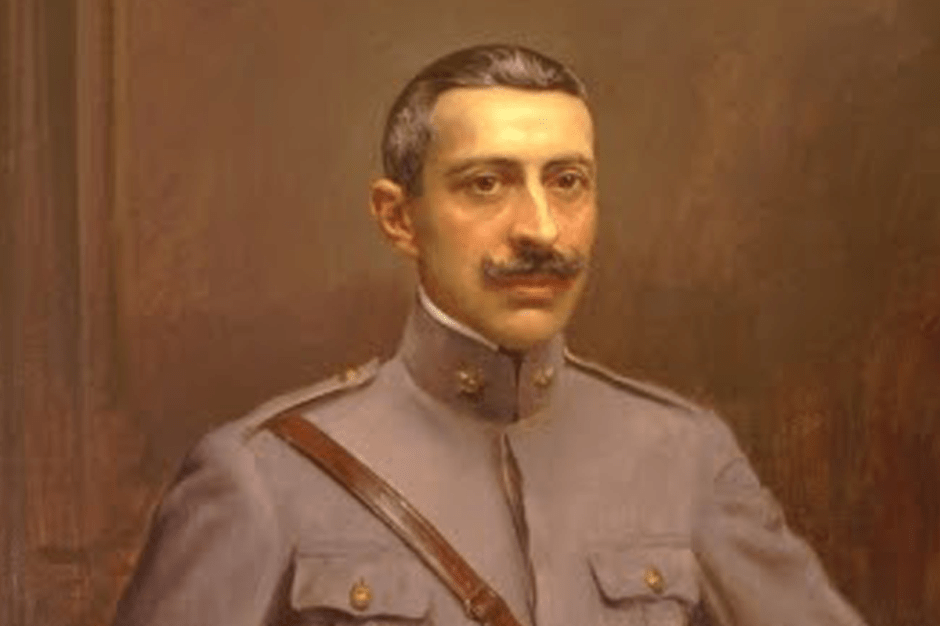
“On December 8, 1917, the Blessed Virgin began to grind Her heal on the spiteful head of the revolution. Portugal’s government was overthrown by one of its own, a Freemason named Sidonio Pais. The day after his coup d’etat Pais allowed the Portuguese bishops to return from exile. Two weeks later he allowed worship in the churches the revolution had confiscated from the Church. Diplomatic relations with the Vatican were reopened, and other measures were taken to allow freedom of worship in Catholic Portugal. Obviously Pais was no ordinary Freemason. He knew that by his actions he was signing his own death warrant. It is said he felt protected by the Blessed Virgin, and even received “encouraging visions” from Her. Had he lived long enough, it is likely he would have converted. But he had made himself a marked man, and he knew the Masonic reputation for vengeance was justified.
“Nevertheless, Pais persisted. His efforts to allow the Jesuits to re-enter Portugal were rewarded by an assassination attempt. Undaunted, Pais had the police raid the Masonic headquarters in Lisbon. On December 14, 1918, he attended Mass for fallen Portuguese soldiers. Afterwards, he was gunned down at a train station in Lisbon. He died there, his body riddled with bullets, a crucifix resting on his bloody chest.
It was another glorious victory for the champions of liberty, equality, and fraternity. Yet Freemasonry had only killed a messenger; they were powerless against the message, and they knew it. Their days were numbered.”
from fatima in twilight by mark fellows. Marmion publications, niagra falls. 2003.




 Ecclesiastical Freemasonry
