Historic Debate on Church-Masonry Relationship in Milan

from “il messagGero” by Franca Giansoldati

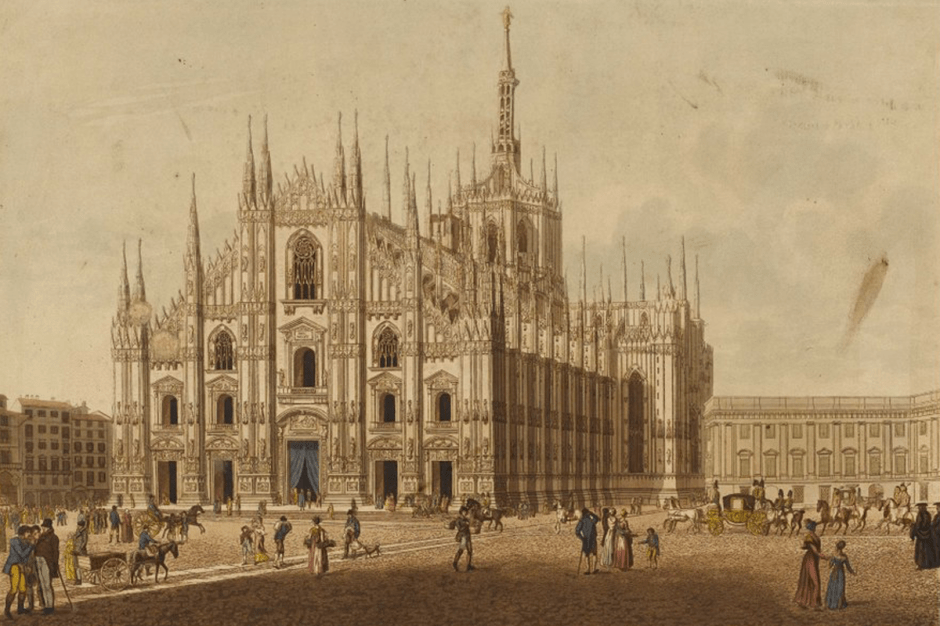
All eyes are on the Church-Masonry confrontation organized in the shadow of the Milan cathedral. The Milanese archbishop, Mario Delpini and the Grand Master of the Grand Orient, Stefano Bisi will be the protagonists of an open discussion on a controversial relationship that has been dragging on for centuries. Two months after the declaration on the absolute incompatibility for Catholics to be part of Masonic lodges («On a doctrinal level active membership is forbidden because of the irreconcilability of the doctrine») signed by Pope Francis at the foundation of the Ambrosianum, an event defined as “historic” by the Masons was organized. Alongside Monsignor Mario Delpini there will also be the president of the Pontifical Academy of Theology Monsignor Antonio Stagliano’ and Cardinal Francesco Coccopalmerio, former president of the Pontifical Council for Legislative Texts. On the website of the Grand Orient it is explained that they will openly discuss how the Church formulated the excommunication under the pontificate of Clement XII up to the present day. Bisi’s report is titled: “Freemasonry between Ratzinger and Bergoglio”.

The last Vatican condemnation dates back to last November. It was raised by a Filipino bishop Julito Cortes rather worried about the continuous increase of faithful enrolled in Freemasonry in his diocese and turned to Rome for guidance on how to deal with the phenomenon from a pastoral point of view. Over the centuries the pronouncements have been different and always with negative connotations. In total there are about six hundred: from the excommunication bull ‘In eminenti apostolatus specula’ (1738) of Clement XII to the important declaration of the Congregation for the Doctrine of the Faith of 1983, drawn up by the then Cardinal Ratzinger and approved by Saint John Paul II.

A declaration, the latter, which reaffirmed «the negative judgment of the Church towards Masonic associations, since their principles have always been considered irreconcilable with the doctrine and therefore membership in them remains prohibited». Pope Francis has also expressed himself several times in critical tones. Talking about the many saints who enriched social life in Turin in the nineteenth century, Bergoglio in 2015, during his Piedmontese trip, emphasized: «In this land – and this I also said to the Salesian Family – at the end of the nineteenth century there were the worst conditions for the growth of youth: there was full-blown Freemasonry, even the Church could do nothing, there were the priest-eaters, there were also the Satanists… It was one of the ugliest moments and places in the history of Italy. But if you want to do a nice homework, go and look for how many saints and how many saints were born at that time! Why? Because they realized that they had to go against the current compared to that culture, to that way of life».

Also in 2015, in Avvenire, a letter from the Grand Master, Bisi, was published, raising the reasons for the incompatibility between the Church and Freemasonry. The occasion to address such an uncomfortable topic was a conference organized by the Grand Orient of Italy in Syracuse at which the then bishop of Noto, Monsignor Antonio Staglianò, had spoken. Bisi explained to Avvenire that the Masons «do not have to convince anyone» but certainly the «Freemasonry will never and never endorse dogmas and fideistic axioms that are far from its centuries-old tradition».

To the letter responded the then director of the newspaper of the Cei, Marco Tarquinio who, while praising the dialogue, clarified that there were two opposing visions. “If the Masons were once excommunicated ipso facto by the Church, over time the judgment seems to have mitigated a bit. In November 1983 the Congregation for the Doctrine of the Faith published a declaration on Masonic lodges. The then prefect Joseph Ratzinger specified that membership constitutes objectively a serious sin and that members of a Masonic association cannot access Holy Communion. Hence the conviction that there is a fundamental incompatibility between the principles of Freemasonry and those of the Christian faith».

The controversies then continued with Monsignor Nunzio Galantino (at the time secretary of the Cei) who from the pages of Famiglia Cristiana had repeated that «everything that by individuals or groups attacks the common good for the benefit of a few cannot be accepted» and condemned those priests or those bishops who had joined the Free Masonry. Bisi’s immediate reply was: «Those of the general secretary of the Italian Episcopal Conference seemed to us very heavy and inappropriate words for a high representative of the Vatican who should have great familiarity in measuring the verb with wisdom, balance and extreme caution before accusing so glaringly and personally excommunicating Freemasonry».

Jesuit Freemasons during JPII’s pontificate

taken from “the jesuits” by malachi martin. something to remember: this is written from Fr Martin’s perspective, as he saw it in 1988. judging from his later books, it appears that he had a less-than-rosy appraisal of JPII’s effectiveness in geopolitical strategy.

” …. there were continual streams of complaints arriving at the papal office, all detailing the unorthodox opinions being taught by Jesuits in Europe and the United States. There were, in addition, revelations that certain circles of the international section of the Masonic Lodge in Europe and Latin America were actively organising opposition to the Pontiff in Poland, that Vatican prelates – some twenty in all – were formal members of the Italian lodge; and that once again Arrupe’s [Superior General of the Jesuits] Jesuits seemed involved with Lodge circles opposed to the Pontiff.

“Paul VI had already in 1965 warned Arrupe and the Delegates to the 31st Jesuit General Congregation of the dangers in belonging to the Compact; it began to appear to John Paul that the warning had not been too wide of the mark.” p 76

“And then, too, there was the strange case of Jesuit Father Caprile, who wrote in the official Jesuit magazine, Civilta Cattolica, published in Rome. At issue for Caprile was the Roman Catholic prohibition, under pain of excommunication, against Catholic membership in the lodge. Excommunication was a dead letter, Caprile wrote in his article, and lodge membership was open to any Catholic. That was a blatant undermining of the Pope’s own decisions about morality….The alliance between the Cardinal Secretary [Cardinal Agostino Casaroli] and Civilta Cattolica was a matter of record….”

Lefebvre thought Silvestrini was a Mason?

In an old interview, Archbishop Marcel Lefebvre, founder of the SSPX, said he thought then-Archbishop (and later Cardinal), Achille Silvestrini was a Freemason. The 1986 article can be found in the archives of the Society’s United States website. The pertinent question and answer are given below – the entire interview is quite enlightening.

Q. I have read that many of the high-ranking members of the Roman hierarchy are secret Masons. Is that true? If so, how deeply have they penetrated the Church?

A. It’s very difficult to say, “This man is a Freemason,” “This man is a Freemason,” or “This man is a Freemason.” We don’t know. It’s very difficult. It is certain that there are some cardinals, some bishops, cardinals in the Curia, or monsignors or secretaries of congregations in Rome that are Freemasons. That is certain because the Freemasons themselves have said that. They have said that they have in their lodge some priests and bishops. It is certain that there are some cardinals and many monsignors in Rome who do the same work as the Freemasons; they have the same thinking, the same mind. Willebrandt is Prefect of the Secretariat for the Unity of Christians, and Archbishop Silvestrini is the first secretary of Cardinal Casaroli who is Secretary of State – and his right hand is Silvestrini. He is a great power in the Curia. He nominates all the nuncios in the world. He has a very great influence and he is probably a Freemason.

According to Malachi Martin in Windswept House, Silvestrini was present at the infamous “Enthronement of Satan” ceremony in the Vatican, which took place sometime during the 1950’s – ’60’s. In the book, Silvestrini was known by the pseudonym, Silvio Aureatini.

Silvestrini, who died in 2019, was also known to be a member of the St Gallen Mafia, the nefarious group which conspired to promote Jorge Bergoglio at both the 2005 and 2013 conclaves.

Fraternity replaces Corpus Christi

Bergoglio’s Vatican treated Sunday’s feast of Corpus Christi as if it were an ‘optional memorial’, by replacing that solemn occasion with the first “World Meeting on Human Fraternity”. Freemasonic “fraternity” was the order of the day – along with dreadfully tiresome entertainment including gay dance moves. The sodomite dancer pictured below apparently also performed for JPII back in the day. (You know, the day before we were all citizen journalists and trusted that everything our popes did was in the best interests of the Church. Image courtesy of Michael Haynes )

There was yet another official signing of yet another universalist document: this one promoted “environmental” and “spiritual fraternity” and as you may guess, omitted any reference to Catholicism. Bergoglio himself wasn’t able to make it due to his recent surgery, but good old Pietro Parolin (Secretary of State) and Mauro Gambetti (Archpriest of St. Peter’s Basilica) held the fort.

According to LifeSite News, this anti-Catholic event was planned months ago, pushing the feast of Corpus Christi out of mind and out of sight. By all accounts, it was not well-attended, by either regular punters or distinguished invitees. Even Andrea Boccelli on a sunny Roman afternoon wasn’t enough to draw people along.

Silere Non Possum gives us a few more details. His translated headlines reads “THE POPE IS HOSPITALIZED AND GAMBETTI TRANSFORMS THE BASILICA INTO A PUB”! From the article:

If Bergoglio feeds on a liquid diet, Mauro Gambetti does not. Today in via della Conciliazione the main guest is Parmigiano Reggiano. For the Franciscan friar , who loves dining with the powerful and certainly not with the poor, this event of Human Fraternity is an opportunity to send clear messages to HE Mons. Salvatore Fisichella. Gambetti, in fact, is strongly opposed to the fact that the Pope has entrusted the archbishop with the management of the Jubilee 2025. After all, it could not have been otherwise, given the disastrous results of the management of St. Peter’s Basilica.

While the Pope, also to the bishops of the CEI, has once again addressed the invitation to poverty, Mauro Gambetti does not abandon the path traced since his arrival in the Vatican. Nobel prizes, celebrities and thousands of money spent on advertising and organization of an event that has no reason to exist. The Vatican Basilica has become a content to be filled as it has been emptied of its essence: prayer. The falling plaster, the dust, the naked men on the altar weren’t enough. Today, a real banquet has been set up in the atrium of the Basilica which probably reminds Gambetti of the fields of Romagna where you can have an aperitif with hay and crates.

“From the Vatican to Camporella is a moment”, reports a cardinal . No Masses, no prayer. In the first vespers of the solemnity of Corpus Domini, the square of Christianity is transformed into a real circus.…..In the meantime, however, numerous law enforcement officers have been employed, the basilica is not accessible and the amount of money lost is staggering.

Vatican continues to use Rupnik’s art!

Have they no shame?

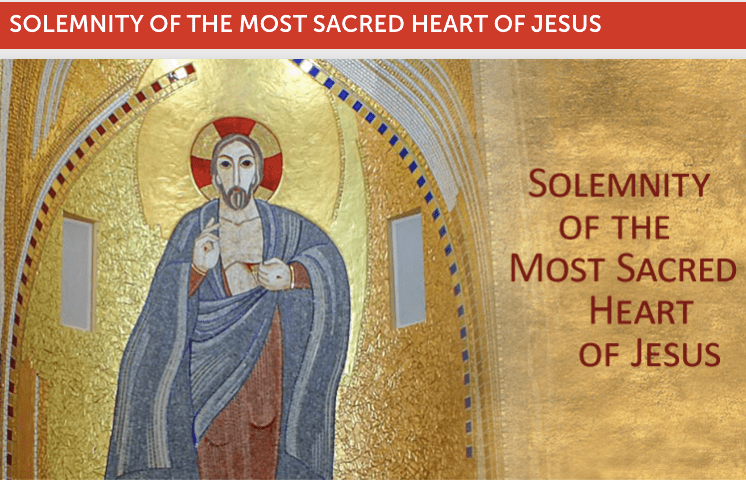
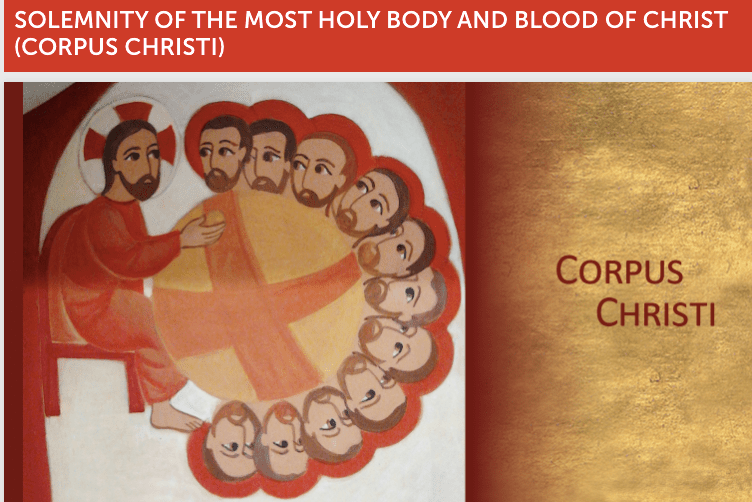
Evil. That is the only way to describe it. The folks at Vatican News apparently think it appropriate to continue using the art of disgraced sex-abuser-priest, Marko Rupnik, to promote some of the liturgical year’s most sacred days. Is this a not-so-subtle message of business as usual at the Vatican?

That the Age of Aquarius is steaming ahead in Francis’ Rome? How dare they? How DARE THEY?

This artwork is so disorienting, some would say, demonic.

And if you have the stomach for something even more bizarre – here is Rupnik explaining his mosaic about St Pio – only he spends the bulk of the time spouting nonsense about Pope Francis and his similarities with our dear Padre.