Pope Leo: 3 Key Appointments & Two Huge Errors

Mainstream and alternative media alike continue to share the narrative that the new Pope, Leo XIV, is going to turn the Church away from its chaotic, Bergoglian-era path and onto a more peaceful pathway. However, as the Pope begins to make his Curial appointments, it is clear that this is just a furphy designed to make the synodal Ape of the Church more palatable for traditionalists.

These three key appointments show that Pope Leo’s agenda is simply a continuation, rather than a break with the pontificate of Jorge Bergoglio. Yet these pale into insignificance compared with the great errors being perpetrated by Leo and which are thankfully starting to be called out by traditionalist commentators: Universalism and Indifferentism.

Appointment #1: a feminist nun

The first unworthy appointment is the new Secretary of the Dicastery for Institutes of Consecrated Life and Societies of Apostolic Life, Sr. Tiziana Merletti. This Dicastery oversees religious congregations and orders as well as secular institutes, including of course, many priests and brothers.

The feminist-driven International Union of Superiors General sent its official congratulations to Sr. Merletti, noting that she was a member of the Commission for Safeguarding operated jointly by the men’s and women’s unions of superiors. “Her contributions are a gift to our global network, promoting justice, care and integrity in consecrated life,” the statement said.

However, Sr. Merletti is yet to make her opinion known on the despicable case of Marko Rupnik, who has sexually abused dozens of nuns; it would appear that those traumatised women somehow fall outside the remit of the “safeguarding” Commission.

According to its website, the five heads of the Dicastery now include three women – in a direct violation of Scripture and canon law.

Appointment #2: a pro-contraception Prelate

Also in May, Pope Leo appointed Msgr. Renzo Pegoraro as the new President of the Pontifical Academy for Life. The position was formerly held by the evil Cardinal Vincenzo Paglia but unfortunately, Paglia’s replacement is little better. As Dr. Thomas Ward, of the National Association of Catholic Families in the UK, noted, there’s no record of Pegoraro “disassociating himself from any of the egregious positions and comments of Archbishop Paglia.”

Pegoraro is in favour of contraception and has made worrying remarks about assisted suicide. He told the Wall Street Journal in 2022 that artificial contraception is admissible “… in the case of a conflict between the need to avoid pregnancy for medical reasons and the preservation of a couple’s sex life.”

Regarding assisted suicide, Pegoraro noted in 2022 that this was a preferable alternative to euthanasia:

“We are in a specific context, with a choice to be made between two options, neither of which — assisted suicide or euthanasia — represents the Catholic position.” However, he stated that, of the two options, “assisted suicide is the one that most restricts abuses because it would be accompanied by four strict conditions: the person asking for help must be conscious and able to express it freely, have an irreversible illness, experience unbearable suffering and depend on life-sustaining treatment such as a respirator.”

Pegoraro and Paglia appointed pro-abortion members to the Academy, including the notorious Mariana Mazzucato. Mazzucato, an atheist, is promoted by the World Economic Forum; the WEF website reveals that “Pope Francis appointed her to the Pontifical Academy for Life for bringing ‘more humanity’ to the world.”

Mariana Mazzucato

Pegoraro and Paglia explained their rationale in this way: “In this sense, it is important that the Pontifical Academy for Life include women and men with expertise in various disciplines and from different backgrounds, for a constant and fruitful interdisciplinary, intercultural and interreligious dialogue.”

So while Catholic media continue to claim that by replacing Paglia, Pope Leo is exhibiting signs of orthodoxy, the truth is that the deckchairs are merely being reshuffled and that Paglia, rather than being kicked out was resigning due to his age – a ripe old 80.

Appointment #3 – an anti-Catholic Bishop

One of Pope Leo’s first alarming moves was to appoint a progressive bishop to Saint Gall in Switzerland. Many put that down to his ignorance of the man (unlikely since as Cardinal Prevost, he was in charge of the Dicastery for Bishops) or to the unique relationship between Church and state in Switzerland. (That situation is above my pay-grade.)

But there is a more recent appointment that is also raising alarm bells: Pope Leo has appointed Monsignor Raúl Martín as Archbishop of Paraná, Argentina. Martín is known for banning parishioners from receiving Holy Communion kneeling and on the tongue, for some minor liturgical abuses, and also for his persecution of orthodox priests.

While some say that due to Bergoglio’s activity, there are no decent bishops from whom to select, I can only compare it with the state of affairs here in Australia. While the majority of our prelates are progressive, here and there, some relatively decent ones exist. So it seems highly unlikely that there is absolutely no one else from whom to choose in Argentina.

Leo’s Universalism & Indifferentism

Universalism is the belief that all souls will ultimately be saved, while a related heresy is Indifferentism: the belief that all religions are equal or that all paths lead to heaven. Unfortunately, despite his Latin and lace, Pope Leo is a proponent of both of these errors, which are unsurprisingly, fundamental principles of Freemasonry.

Chris Jackson has done a great job of laying out Pope Leo’s recurring Universalist theme, so I recommend that you read the entire thing at his Substack. Here are a couple of pertinent excerpts:

This phrase, “for all,” was the defining liturgical lie of the Novus Ordo for nearly four decades. It misrepresented the Latin pro multis as a universalist formula, contradicting the teaching of Christ and the explicit theology of the Church. It was corrected under Benedict XVI, who ordered all vernacular translations to finally conform to pro multis: “for many.” But Leo XIV has now restored the deception in the most public and solemn setting possible, consecrating new priests under a cloud of doctrinal subversion.

Chris Jackson, Leo’s “For All”: The Resurrection of a Lie and the March to Universal Salvation
On May 14, Leo XIV gave an address during the Jubilee of Oriental Churches. In it, he approvingly cited Isaac of Nineveh, a seventh-century Nestorian bishop who died outside communion with Rome. Isaac belonged to the Assyrian Church of the East, rejected the Council of Chalcedon, and taught a form of mystical universalism. He has long been associated with the belief that Hell is not eternal, but rather a purgative experience that ultimately leads all souls, including demons, toward healing and reconciliation.

Chris Jackson, Leo’s “For All”: The Resurrection of a Lie and the March to Universal Salvation

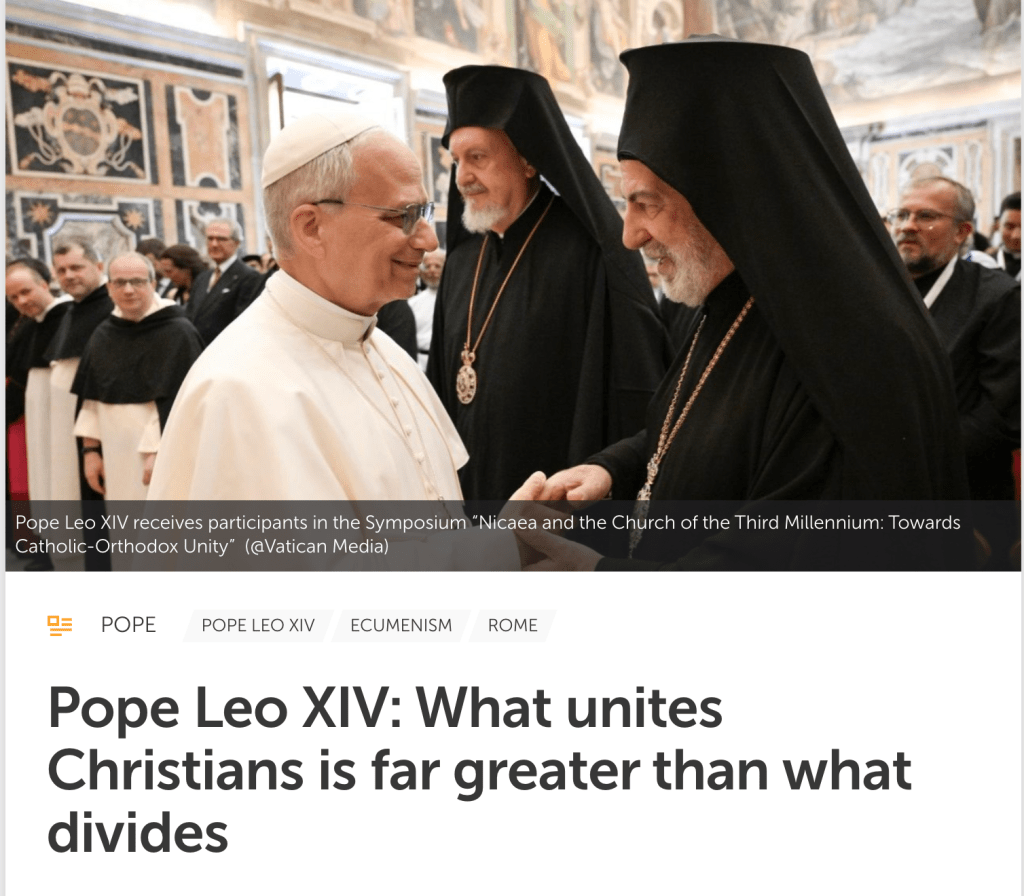
One instance of Pope Leo’s promotion of religious indifferentism can be found in his address to participants at a conference on pursuing Catholic-Orthodox unity: he said that “what unites us is greater than what divides.”

Pope Leo said he saw the conference as “an invaluable opportunity to emphasise that, what we have in common is much stronger, quantitatively and qualitatively, than what divides us.”

For a start, there’s a thousand-year schism shows this is patently untrue. And “what divides us” includes the Orthodox rejection of papal authority, not to mention its leniency towards divorce and remarriage and also contraception.

Then compare Leo’s words with those of Pope Pius XII: “They shall also be on guard lest, on the false pretext that more attention should be paid to the points on which we agree than to those on which we differ, a dangerous indifferentism be encouraged…” (On the Ecumenical Movement, 1949.)

It certainly appears that ‘a dangerous indifferentism’ is being encouraged by the current pontiff. Although he has the power to rescind, or at he very least ignore, his predecessor’s indifferentist manifesto, the Abu Dhabi Document, he actually quoted from it in an address to non-Catholic representatives on May 15.

None of this bodes well for the trajectory of the apparent Pax Romana for which Leo is responsible. Rather, it reminds one of the Scripture verse: And it was not enough for them to err about the knowledge of God, but whereas they lived in a great war of ignorance, they call so many and so great evils peace. (Wisdom 14: 22)

Bendigo Cathedral’s pagan idol vanishes!

A recent article on this website reported on a scandalous ‘artwork’ being exhibited at Sacred Heart Cathedral, Bendigo. Despite the statue’s creator publicly and explicitly explaining that the inspiration for his work was witchcraft, tarot cards and occult philosophy, the Bishop responsible for the Cathedral refused to have the image removed.

Massive pushback from the laity and other clergymen in the form of letters, phone-calls, emails and petitions did not have the desired effect as Bishop Shane Mackinlay and his Diocesan bureaucrats confirmed that the idol would remain in the Cathedral for the duration of the exhibition: an entire three months.

Blatant Occultism in Bendigo Cathedral
The occult-inspired art work in Bendigo Cathedral

However, at some point during the past week, three unknown individuals decided to take matters into their own hands and quietly removed the disgusting image from Sacred Heart. A picture circulating on social media shows the spot where the idol had formerly been placed; its clay foundation, its sheer covering and the information stand remain.

The former site of the hideous idol inside the Cathedral.

The artist, Ben Wrigley, confirmed the theft on his Instagram page (while also showing his ignorance of the Commandments – the directive not to steal is Commandment number 7.)

Transcendence Wand #4 was reported to me this afternoon as having been stolen from inside the Sacred Heart Cathedral, Bendigo, today by three men.

This work depicts the transcendence of being bound by the dense material world. Of the lightness of being. The veil symbolises the gossamer thing significance of moving from the gross self to illuminated being and becoming closer to god.
One of five interconnected works representing five stations of life. L
The significance of the transgression of these three men is palpable. The eighth commandment – thou shall not steal and from a place of worship.
I look forward to having it returned.

To date, there has been no official statement from either Bishop Mackinlay or the Diocese of Sandhurst regarding the idol’s removal.

It is gratifying to know that there are still men within our ranks of the calibre of Saint Boniface who will refuse to allow holy places to be defiled by pagan images. Our prayers this week should include some for the vigilantes’ protection and well as for the conversion of Bishop Mackinlay to the Catholic faith.

A Liberal Confirms that Prevost is Francis II

One of Pope Francis’ greatest fans, austen ivereigh, has written for the liberal commonweal that there is no doubt Leo will continue francis’ agenda, albeit with a little more style.

After burying Pope Francis, the cardinals chose another pope from the Americas to follow in his path, proving both that the “change of era” inaugurated by Francis is here to stay and that Latin America would still be a key source for the universal Church. Leo XIV is from the south suburbs of Chicago, “the descendant of immigrants, who in turn chose to emigrate,” as he put it to the Holy See ambassadors on May 16. He was referring to the decades he spent as a missionary and bishop in Peru. This is why the first U.S.-born pope is also the second from South America. 

The quiet sixty-nine-year-old American, Robert Francis Prevost, friar of the Order of St. Augustine, slipped past the bookmakers and the pundits, quickly overtaking the Italian curial-establishment papabile, Cardinal Pietro Parolin, to be elected after only four ballots, on the afternoon of the second day of the conclave. As they emerged from the conclave, the cardinals were delighted, as if they had stumbled on a pearl of great price. They spoke of the atmosphere inside: the lighthearted peace in the Sistine Chapel, the sense of fraternity and unity back at the Santa Marta. They remarked on the freedom from the pressures and distractions of the internet that allowed them to settle prayerfully on the one man among them whom they believe God had chosen. They described how moving it had been to watch Prevost as his name was read out, over and over. Joseph Tobin, cardinal archbishop of Newark, who knows the new pope well—having been head of the Redemptorists in Rome when Prevost was there as the prior general of the Augustinians—said he “took a look at Bob” and saw that “he had his head in his hands.” At that moment, Tobin prayed for Prevost, “because I couldn’t imagine what happens to a human being when you face something like that.” Yet once Prevost was elected—and on this the cardinals are unanimous—he was remarkably calm, wholly at peace. Over the next few days, Rome was struck by how effortlessly Prevost became Leo. 

What convinced the 133 cardinals, it turned out, had not been a great speech, but rather the way Prevost carried himself: he was humble, direct, synodal, and pastoral. Prevost would be a pope in the tradition of Francis, yet different in ways the cardinals regarded as necessary. They sought three particular qualities in the next pope. First, they wanted someone with experience of the universality of today’s Church, someone familiar with its breadth and complexity. Second, they were looking for someone who could bring the peace of Christ to the divisions within the Church and in the world at large. Third, they needed someone who could govern firmly but also in a more collegial manner than Francis did. The more they got to know Prevost, the more he emerged as the one who fit that profile. 

The young cardinal who heads the Filipino bishops’ conference, Pablo Virgilio David, said it was the pope as pontifex maximus, or “supreme bridge-builder,” that became a key topic for the cardinals in the ten days of private meetings prior to the conclave. He said Leo’s brief address from the loggia of St. Peter’s after his election was virtually a summary of their discussions. Peace was his theme, the disarming peace of Christ. Leo called for “a Church that builds bridges and encourages dialogue…a synodal Church.” 

The next day, at Mass with the cardinals in the Sistine Chapel, Leo dwelt on the great responsibility entrusted to Peter, his mission to bear witness in a world that often mocks or despises Christian faith. Back in 2013, Prevost thought he would escape being made a bishop; ten years later, he hadn’t wanted to leave behind his diocese in Peru when Francis asked him to head the Dicastery for Bishops in Rome. But in the end, he saw the move to Rome as “a new opportunity to live a dimension of my life, which simply was always answering ‘Yes’ when asked to do a service,” he told Vatican News at that time. “With this spirit, I ended my mission in Peru, after eight and a half years as a bishop and almost twenty years as a missionary, to begin a new one in Rome.” 

And now, when Cardinal Parolin asked Cardinal Prevost if he accepted his election as pope, he gave another, even more radical “Yes.” In his homily the next day, Pope Leo described Peter being led in chains to Rome, “the place of his imminent sacrifice,” and said anyone in the Church who exercises a ministry of authority would recognize that journey. He, too, was being called now “to disappear so that Christ may remain, to make oneself small so that He may be known and glorified (cf. John 3:30).” 

Did he ever sense that Francis had prepared his path? After his arrival in Rome in 2023 to head the Dicastery for Bishops (he had been a member since 2020), Prevost and Francis used to meet for two hours every Saturday morning in the Casa Santa Marta, where Francis lived. They discussed, of course, nominations for bishops, but also their vision of the Church. Prevost was one of Francis’s trusted negotiators with the German bishops over demands that arose from their controversial “Synodal Way” process. Francis came to rely on him more and more. He trusted Prevost’s decision-making and admired his way of working—the way he was able to reconcile different sides. Arthur Roche, the English cardinal who heads the Dicastery for Divine Worship, told me that Prevost was without doubt Francis’s “closest collaborator” in the Vatican during the past two years. 

The time they spent together each week was deeply formative for Prevost, who was struck by Francis’s extraordinary capacity for discernment, as well as his radical commitment to God’s mercy. One morning, when the two were discussing clerical sex abuse, the pope said he wanted to show Prevost something. Francis left the room and returned with a picture from a Gothic cathedral in France which showed Judas taking his own life while Jesus cradled him in his arms. Was it really possible, Francis asked him, for God’s mercy to reach the worst of sinners? Telling this story in a talk to a Chicago-area parish in August of last year, Prevost described how Francis “struggles to express and live that dimension of the Gospel.” It was this focus that had led people to misunderstand or criticize the pope. Francis was convinced, Prevost said, that in a world full of mutual condemnation, “we need people, especially ministers, who can live and offer people the mercy, forgiveness, and healing of God.”

The quiet sixty-nine-year-old American, Robert Francis Prevost, friar of the Order of St. Augustine, slipped past the bookmakers and the pundits.

In early February, with his bronchitis worsening, Francis raised Prevost’s status within the College of Cardinals to bishop. It was done so discreetly that it went mostly unnoticed even by the Vatican press corps. Yet only a handful of others at the conclave were cardinal bishops, among them the two whom the media had dubbed the “frontrunner” papabili—Cardinals Parolin and Tagle. Was Francis sending a little posthumous hint that that list needed expanding?

The bond between Bergoglio and Prevost goes back to the first decade of the new millennium, when the American was based in Rome as prior general of the Augustinians. He spent half of each year of his twelve-year term visiting the three thousand Augustinian friars and their parishes and works across the world, extraordinary preparation for a pope of the global era, bringing him into contact with the Church in Africa, Asia, and the Near East, as well as in the Americas. He was often in Argentina, where the Augustinians have a vicariate with five parishes, five schools, and a formation house; and there he sat down with the famous Jesuit archbishop of Buenos Aires. The two men had a lot in common: both had been given major responsibilities in their religious orders from an early age. 

Prevost recounts that, on his last visit with Archbishop Bergoglio, the two had a disagreement. Bergoglio wanted one of Prevost’s friars for some project or other in his archdiocese. Prevost said no; he had other work in mind for him. The archbishop was very unhappy about this, Prevost later learned, and so when Bergoglio was elected pope in March 2013, Prevost—who was coming to the end of his term as prior general—joked with his brother Augustinians that he could relax: this new pope would never make him a bishop. But when Francis met Prevost again in August, after celebrating Mass for the opening of the Augustinians’ general chapter, the pope effusively thanked him for his help with resolving a problem in Rome. “You can relax for now,” he said, thus hinting that he would soon be coming for him. The following year, when Prevost was back in Chicago, Francis made him apostolic administrator of Chiclayo, and a year later its bishop, an appointment for which Prevost needed Peruvian nationality.

Chiclayo is in Lambayeque, a region of northern Peru near Chulucanas and Trujillo, where Prevost missioned in his thirties and forties. There, he had been a formator of friars, a diocesan canon lawyer, and a parish priest. The 1.2 million-strong Diocese of Chiclayo needed a makeover: for more than thirty years, it had been run by Spanish Opus Dei bishops. For the next decade, Prevost would give it new direction, making it a diocese that modelled the ecclesiology of the Second Vatican Council. Francis had “masterfully and concretely set forth” that ecclesiology in his 2013 teaching Evangelii gaudium, as Leo XIV reminded his fellow cardinals on May 10. 

In that address, delivered two days after his election, Leo highlighted six “fundamental points” from Evangelii gaudium, which amount to a program for his pontificate. The first was the “primacy of Christ in proclamation.” (As he put it in a 2023 interview: “This comes first: to communicate the beauty of the faith, the beauty and joy of knowing Jesus. It means that we ourselves are living it and sharing this experience.”) The second was the “missionary conversion” of the whole Christian community, to enable others to encounter Christ in acts of mercy. The third, “growth in collegiality and synodality,” meant co-responsibility for the life and mission of the Church. (Synodality, he told people in Chiclayo, was a way for the Church to be closer to the people.) The fourth, “attention to the sensus fidei,” meant taking seriously the people of God as a believing, discerning subject, valuing their traditions and culture. The fifth, “loving care for the least and the rejected,” was the Church’s option for the poor, expressed in attention and concrete acts. The sixth and final point, “courageous and trusting dialogue with the contemporary world,” meant a Church that confronts contemporary challenges rather than offering a refuge from them. 

………

But he is remembered most for his outstanding capacity to convene, to hold people together and rearrange the decks without earning enemies. He brought firm new direction to his diocese in Peru, yet without rejecting what he had inherited. He won over the Opus Dei priests, engaged movements, and reached out to conservatives and charismatics. From the start, he brought people together in synodal assemblies to agree on pastoral priorities and created an institute to form lay leaders. “After ten years of his work, lay people are really well-trained and are positioned,” his successor in Chiclayo, Bishop Edinson Farfán Córdova (also an Augustinian), told me. The content of the summer courses designed to train hundreds of laypeople was drawn, says Bishop Farfán, from the social magisterium of Francis: not just Evangelii gaudium, but also Laudato si’ and Fratelli tutti

In 2018, Prevost was elected vice president of the Peruvian bishops’ conference. The Church was at that time still dealing with the fallout from revelations of abuse and corruption at the heart of the Sodalitium Christianae Vitae (SCV), a right-wing Peruvian movement founded in the 1970s to combat liberation theology. The SCV enjoyed strong support from wealthy Peruvians and from the Vatican under Pope John Paul II, and over the years, many bishops would become entangled with the movement, especially José Antonio Eguren, the archbishop of Piura—the diocese neighboring Chiclayo. 

The bond between Bergoglio and Prevost goes back to the first decade of the new millennium.

The publication of Mitad monjes, mitad soldados (“Half Monks, Half Soldiers”), a devastating 2015 exposé by former “sodálite” Pedro Salinas and journalist Paola Ugaz, led the SCV’s powerful allies to wage legal warfare on the authors in Peru’s corrupt, sclerotic courts. The other effect of the book was to unleash a wave of previously untold abuse stories, stories of people effectively kept as prisoners for years and humiliated by the power games of the SCV’s inner circle. As new victims continued to step forward, Paola Ugaz, overwhelmed, reached out to the Church for help. The bishops’ conference was unable to act collectively: Archbishop Eguren was involved in suing Salinas and Ugaz, while the conference’s president, Héctor Cabrejos, was reluctant to make trouble. 

Prevost, together with the Jesuit cardinal Pedro Barreto and the apostolic nuncio Nicola Girasoli, acted on their own account, publicly declaring their support for the writers and finding ways over the next two years to help the victims. “Robert became the one who individually reached out to the really broken victims,” recalls Ugaz. “He became the bridge between them and the Sodalicio,” she told me in Rome after the conclave, describing how he would meet with Sodalicio leaders to secure financial and medical assistance for the victims. Ugaz describes Prevost as levelheaded, patient, and tenacious. “Robert’s not the guy who will grab a match and set light to the building. He’ll look for ways to help, to make things happen,” she says. They are friends to this day. In Rome for Pope Francis’s funeral, Ugaz brought chocolates and an Alpaca stole for her friend. She ended up giving them to him once he was pope.

In 2020, the Sodalicio stepped up their campaign against the journalists, using death threats and false claims that they were involved in money laundering. Girasoli and Bishop Prevost believed the only way to protect Ugaz was to arrange a meeting with Francis. But because of Covid, this did not happen until 2022, when Ugaz and Salinas persuaded Francis to send his crack Vatican investigators Archbishop Charles Scicluna and Msgr. Jordi Bertomeu. Their report not only confirmed the journalists’ claims but uncovered much more, including a money-laundering scandal that involved diocesan cemeteries. 

After Prevost moved to Rome to head the Dicastery for Bishops, he was closely involved in the measures that led to the SCV’s suppression. In 2024 Francis expelled the Sodalicio founder, Luis Figari, and forced out Archbishop Eguren. He then expelled Eguren and nine other founders. Not long after Eguren fell, Prevost began to be accused of abuse coverup in media close to the SCV. The reports alleged that he had failed to deal properly with a case in Chiclayo. The diocese denied the claims, pointing out that Prevost had followed guidelines precisely. Meanwhile, Ugaz and Salinas began receiving death threats. They came to the Vatican last October, where Prevost saw them more than once. He arranged for them to meet Francis, who promised he would act decisively against the Sodalicio, telling Ugaz: “Pecadores sí, corruptos no” (“One thing are sinners; another thing are the corrupt”). In January this year, in one of his final acts, Francis signed a decree closing down the SCV, which took effect in April, shortly before he died. 

At the conclave, the right-wing Spanish group InfoVaticana recirculated the claims against Prevost—claims rejected by the diocese of Chiclayo and by the Doctrine of the Dicastey of Faith in Rome—to try to prevent his election. A day before the conclave, InfoVaticana described him as a “defeated candidate…frustrated because his aspirations to the papacy had crumbled.” The quote has not worn well. 

…….

Leo has already used the freedoms Francis won to make his own decisions about how to dress and where to live. He is much younger than Benedict and Francis were when they were elected; he uses X and WhatsApp; he speaks fluent American English. But he has made clear that he will continue to build the synodal Church of which Francis dreamed, while likely reformulating some of the themes of Francis’s pontificate in more Augustinian terms. He will teach us how to build a celestial city alongside the earthly city governed by the libido dominandi of the technocratic paradigm, AI, nationalism, and war. Knowing that the world will not listen to a divided Church, he asked at his inauguration Mass that we pray for a united Church, a sign of unity and communion, which becomes a leaven for a reconciled world. As he told the journalists, quoting St. Augustine: “We are the times: Such as we are, such are the times.”

The Synodal Pope

Many traditionalists and conservative Catholics have been asking themselves how it could be possible that Cardinals as diverse as the arch-heretics Hollerich, the ultra-orthodox Burke and the so-called ‘centrist’ Timothy Dolan, could all come away from a decisive conclave in complete agreement over the outcome. They all seem both satisfied and confident.

Even the unholy gay priestesses featured in another article on this site like the new guy and they picked up something about the Pope Leo which others, including me, had missed.

Indeed, an outcome which pleases the likes of Bishops Strickland and Fr. James Martin is quite remarkable. Until recent years, the possibility of such an outcome was almost non-existent – barring a mass conversion of dissidents to true Catholicism. This was due to the inherent unity of Catholic doctrine which ensures that a papal candidate who deviates from that doctrine – or upholds it – should be upsetting someone. “For there shall be from henceforth five in one house divided: three against two, and two against three (Lk 12: 52),” said Our Lord. This is division, not for its own sake but as a consequence of the inability of truth and error to coexist.

Thanks to the acceleration of revolutionary error under Pope Francis, however, the possibility of a consensus among polarised Catholic groups has presented itself and has seemingly materialised with the election of Pope Leo XIV. The mechanism for the change is one of the long-held goals of Vatican II: what is now known as ‘Synodality’.

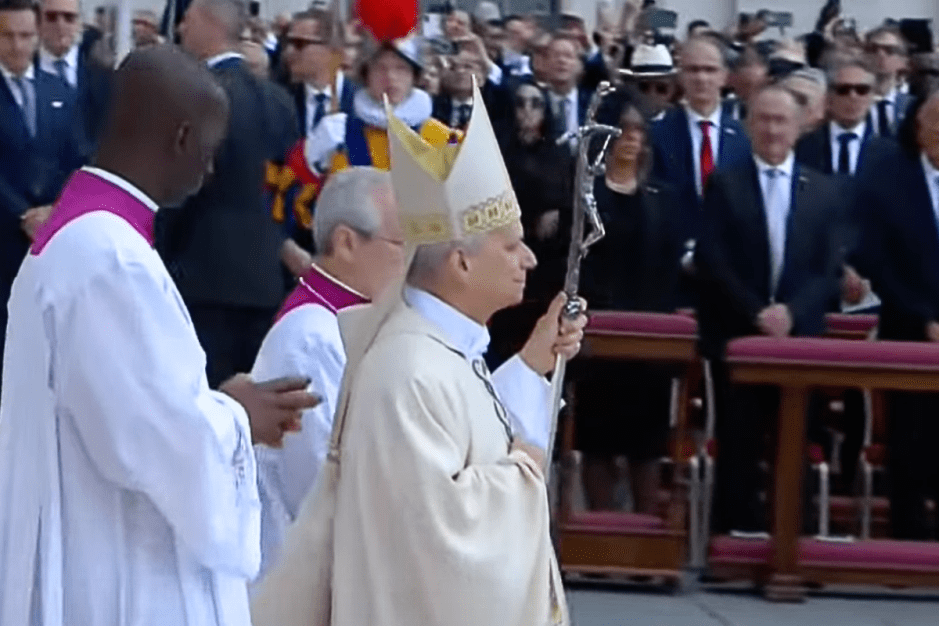
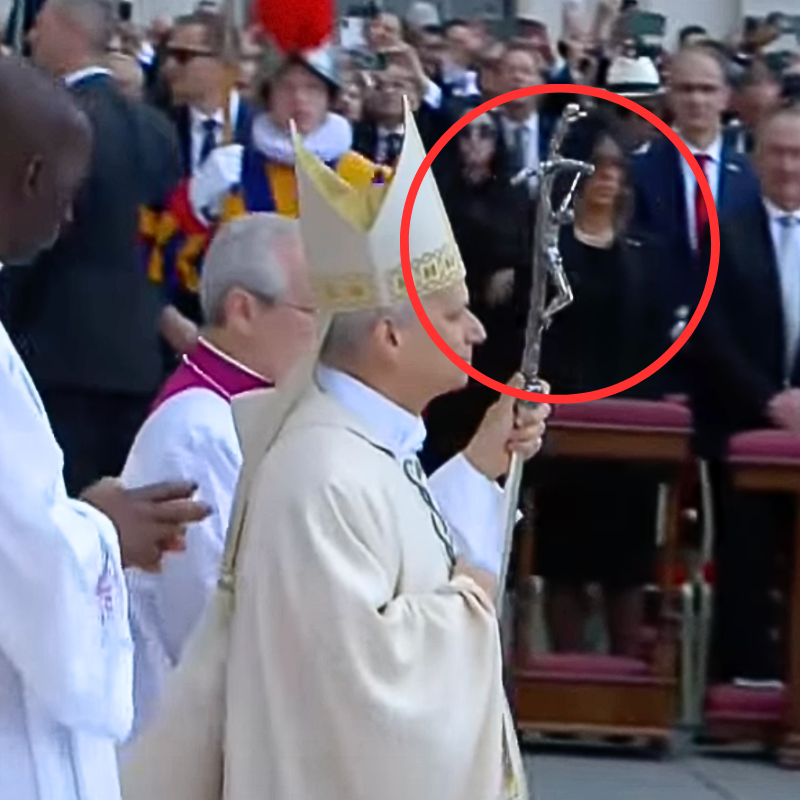
Pope Leo at his installation, carrying the hideous ferula topped by the Scorzelli cross, used by his predecessors. See more here.

Synodality

Prevost spoke about Synodality on a number of occasions prior to his election as Pope. For instance, in 2024 he said:

“One of the risks of that is that we miss the presence of the Holy Spirit. That breeze that may go by that says, ‘Yeah you always did it that way, and maybe for six centuries it was wonderful, but maybe it’s time to change. Maybe it’s time to look at things differently.’”

The dissident Cardinal Hollerich explained Prevost’s point of view in his interview with Avenire:

“Pope Leo spoke of a “Synodal Church ” in his first message. Having participated in the work of the Synod, we have a Pontiff who knows synodality, who understands synodality, who dares synodality. There will be no revolution that nobody wants in the Church, but instead an evolution. And that’s the best way to change.”

There we have it: an evolution and not a revolution, according to Hollerich.

He goes on to outline the Hegelian paradigm that is at play here, describing Leo XIV as a synthesis of Bergoglio and Ratzinger before him; a man who has something to offer traditionalists yet something also for radicals and revolutionaries. He adds that “Synodality is inherent in the Church”, confirming the prediction of anti-Catholic extremists prior to the election of Francis who said that “after four years of Francis, nothing will be the same.”

Cardinal Tagle repeated the same prediction about Prevost almost verbatim at a press conference after the conclave. “Now, will the programs be clones or photocopies? The programs may evolve, and they may take different expressions. But there’s no turning back from that.”

Fiducia Supplicans

Speaking specifically on the encyclical, Fiducia Supplicans, which allows blessings for same-sex couples, Hollerich opines that Leo may reinterpret it but that he won’t abolish it. Prevost’s comments from October 2024 see to confirm this.

Cultural differences may be one of the reasons why “each episcopal conference needs to have a certain authority, in terms of saying, ‘how are we going to understand this in the concrete reality in which we’re living,?’” he told a press briefing at the sidelines of the synod.

“The bishops in the episcopal conferences of Africa were basically saying, that here in Africa, our whole cultural reality is very different … it wasn’t rejecting the teaching authority of Rome, it was saying that our cultural situation is such that the application of this document is just not going to work.

“You have to remember there are still places in Africa that apply the death penalty, for example, for people who are living in a homosexual relationship … So, we’re in very different worlds.”

Prevost is not known ever to have rejected or criticised Fiducia Supplicans himself which indicates that he is personally in favour of blessings for same-sex couples. According to the principle of Sunodlaity (which, remember, is not a Catholic principle), bishops are free to apply or not apply FS as they see fit.

Under the new Pope, we should expect to see FS being implemented where a bishop is liberal and being denounced where a bishop is orthodox in the name of ‘Synodality.’

Traditional Latin Mass

Similarly, we should expect the TLM to be widely available in some diocese yet severely limited in others. It doesn’t appear that Prevost is willing to tarnish the image of his predecessor, Francis, in any way. This means that it’s unlikely that Traditiones Custodes will be rescinded – unless this was part of a deal carved out with traditional Cardinals during the conclave in exchange for votes.

Pope Leo’s first Mass was a Novus Ordo in Latin, which is perhaps a metaphor for what is to come: a dressing-up of error in the trappings of tradition. This indicates Prevost has no intention of getting to the heart of the problem, which is the Modernism that has infected the Church thanks to the Council.

An unholy Spirit

If the spirit of Synodality is alive and well in the Vatican, then so, apparently is the spirit of Francis. This may be the most unsettling thing that has come from the new Pope yet:

Pagan Idol Diocese allows Mass with Lesbian Priestess

Last week in the country town of Myrtleford, two Anglican women, one of whom is a gay Anglican ‘priestess’ joined the Catholic priest in the sanctuary during a public Novus Ordo Mass.

The Mass, part of the town’s annual Italian Festival, was offered in the grounds of St. Mary’s Church on a temporary stage and was dedicated to St. Anthony of Padua. When asked by a stunned attendee why the priestesses were near the altar during Mass, a local (who happened to be an ex-nun) stated that “we do everything together here in Myrtleford”!

Taken from the Festival website.

The eye-witness, a faithful Catholic, was shocked to see the two women consuming the Sacred Host, despite belonging to the Anglican faith. Although neither woman played an active role in the Mass, the ‘priestess’ was given a chalice to hold while Holy Communion was being distributed. She also addressed the crowd after Mass was finished.

According to the eye-witness, “One of them was trying to touch everything and finally got her hands on the incense. The priest cursed before reading the Gospel. He said “mannaggia miseria!” (This means ‘damn it’ in Italian).

Anglican priestesses in the make-shift sanctuary as the priest goes to distribute Holy Communion.
Close-up of the Anglican priestess with the chalice.

The ‘priestess’ is Moira Evers, a known lesbian and LGBTQ activist. In an article posted when she was appointed parish priestess in Myrtleford, Evers said she wanted people to ‘see the church as a place of safety.’

Moira Evers on being made parish priestess at Myrtelford’s Anglican church.
The priestesses in ‘cappae nigrae’ before the Mass
Evers after celebrating an Anglican ‘Fabulous Pride Mass’ in 2016. SOURCE

Evers is controversial even within the Anglican church because of her involvement with a same-sex advocacy group who expressed support for a Satanic Mass. There are also reports of members of her former congregation at Buderim leaving the parish because of her pro-LGBTQ stance.

The parish priest of St. Mary’s Catholic Church is Fr. Tony Shallue. There seems little hope of him being disciplined over the liturgical abuse as St. Mary’s is located in the Diocese of Sandhurst, which is overseen by Bishop Shane Mackinley. This is the same bishop who is notoriously allowing a three-month exhibition of a pagan idol related to witchcraft to remain in Bendigo’s Sacred Heart Cathedral, despite massive pushback from Catholic clergy and the faithful.

A Modernist in Trad Clothing

Beware of false prophets, who come to you in the clothing of sheep, but inwardly they are ravening wolves – Matthew 7:15.

Some may think that the election of yet another unworthy Cardinal to the Papacy causes perverse delight for writers who routinely expose wrongdoing in the Church. Nothing could be further from the truth! It is actually a source of pain to be counted among the minority who disregards popular opinion in order to defend the rights of God.

It was Christ Himself who warned us to be on the watch for dangerous men who like to appear as one thing, while having intentions that are altogether different. Our Lord even specifically warned that such men will dress the part in order to lead His unsuspecting sheep astray.

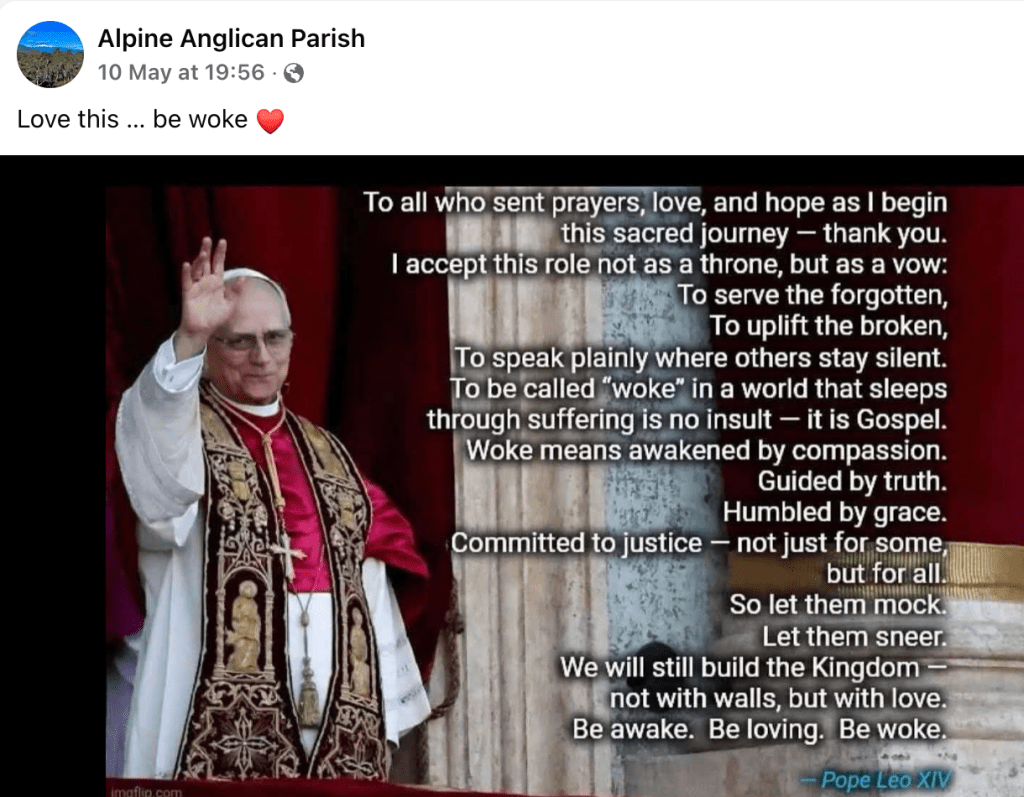
This profile of a ravenous wolf perfectly fits the latest Pontiff, Leo XIV, who has chosen to adopt the outward persona of a traditionalist, all the way from his heavily embroidered pallium down to his relic-embedded pectoral cross.

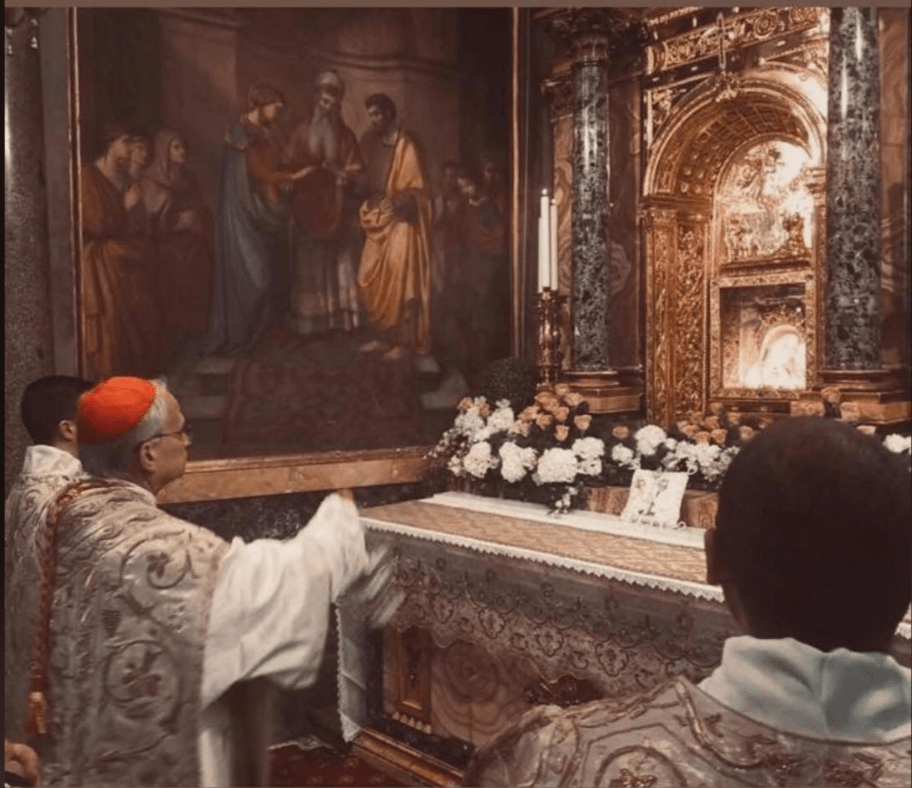
He is gaining favour with Trads, as stories of him offering private Latin Masses are doing the rounds of social media. Those posts are often accompanied by a photograph, shown below, of then-Cardinal Prevost wearing traditional vestments. However, the liturgical event was not a traditional Mass; rather Prevost was simply incensing an image of Our Lady, possibly the miraculous icon at Gennazzo.  [We know it wasn’t a Mass because the altar is covered, and there are no altar cards, vessels or missal.]

Prevost NOT offering a TLM.

So what is underneath the lovely vestments and fluent Latin that should have us so concerned? It is that Prevost is a Modernist, through and through, and that he a stated goal of picking up where Francis left off, steering the Barque of Peter firmly along a course of Synodality.

The Catholic Esquire has done a great job of explaining succinctly the programme of this papacy and how it is in perfect continuity with that of Francis – and of the entire Revolution. [His short (17min) video can be found here.]

In short, Synodality is the name of the game: decentralising the Church in an attempt to obliterate the foundation of Her unchanging doctrinal authority. Now, obviously, this plan can never ultimately succeed, as Christ is that foundation, but the Synodalists have and will continue to inflict great damage on the Church in their attempt.

We should expect to see national bishops’ conferences implementing their own local brand of Catholicism whilst tolerating all manner of error. We can also expect some tinkering with the Novus Ordo liturgy, as Synodalists move along in their efforts to further delegitimise, and one day completely invalidate that form.

The persecution of Traditional Catholics could perhaps appear to soften, but in no way should a return to the widespread traditional practice of the Faith be expected. Should Traditiones Custodes be revoked, then Traditional Catholics must not let down their guard. If a convincing wolf is in charge, then we must not stand near him saying “what big teeth you have!”

As explained in my last article, we also should not expect to see a cleansing of sodomites from the ranks of the hierarchy under this pontificate. The moral chaos and errors are very likely to increase, rather than diminish. And that means an increase of moral chaos in the wider society as well.

What about Ecclesiastical Freemasonry? Will Pope Leo denounce Masonry in the strongest terms, like his namesake, Leo XIII? That is most unlikely. The best that can be hoped for is the reiteration – on paper, at least – of the Church’s longstanding condemnation as was produced by Tucho Fernandez under Bergoglio in November 2023. That ostensible condemnation was more likely aimed at disempowering the Masonic Old Guard in the Curia, led by then-papabile Cardinal Parolin, than at actually dissuading Catholics from becoming Masons. Francis’ Masonic credentials certainly suggest that this was the case.

Speaking of Masons, an intriguing image was posted on a Masonic Instagram account a few days after the death of Bergoglio. There’s no way of knowing what it meant, but the timing was most interesting. It was accompanied by a snippet of Masonic poetry, without any additional commentary. Note the red cuff on the figure of the Pope, as well as the (Rosicrucian-inspired?) equilateral crosses on his vestments.

From a Masonic Instagram account, posted April 26th, 2025. Pope Francis died April 21st and Leo XIV was elected on May 8th.

As with the election of other Popes since the Council, Freemasons have expressed their congratulations to the newest Pontiff. This was the only example that was easily found, but it is early days yet.

Pope Leo XIV welcomed by the Freemasons of Tanzania

The surest confirmation of Pope Leo’s agenda will be his selection of a new Curia, which won’t happen until after his official installation on May 18th. Some more Masonic well-wishing around that time is to also be expected.

So is there reason for us to be disoriented? Or disillusioned …. depressed? Well, no. All of this has to play out before the time of Our Lady’s Triumph.

Since the majority of Catholics, including a series of Popes, has refused to honour the requests of Our Lady at Fatima and elsewhere, another destructive papacy is simply part of the package.

However, we are not powerless in the face of adversity. In fact, there is much we can do to mitigate the effects of another ‘worm-ridden’ papacy. The following Rules of Engagement with the revolutionary forces – both natural and supernatural – may be of assistance:

  • A renewed commitment to daily prayer, especially the Holy Rosary
  • A commitment to a small form of daily penance for Pope Leo XIV, that God will work much good through his pontificate (and even a conversion can’t be ruled out)
  • A commitment to limiting online criticism to the actions of the new pope, while being careful not to demean his office
  • Similarly, great care should be taken always to distinguish between the human element of the Church and Her Divine origin. {For example, as clearly stated by Pope Gregory XVI in Mirari Vos: “To use the words of the fathers of Trent, it is certain that the Church “was instructed by Jesus Christ and His Apostles and that all truth was daily taught it by the inspiration of the Holy Spirit.” Therefore, it is obviously absurd and injurious to propose a certain “restoration and regeneration” for her as though necessary for her safety and growth, as if she could be considered subject to defect or obscuration or other misfortune.“]
  • Asking heaven for the grace to remain on the Ark; to stay within His Church, no matter how bad things get.

PS. It is well-known that Hollywood and the celeb-world are in cahoots with the revolution everywhere – including within the Church.

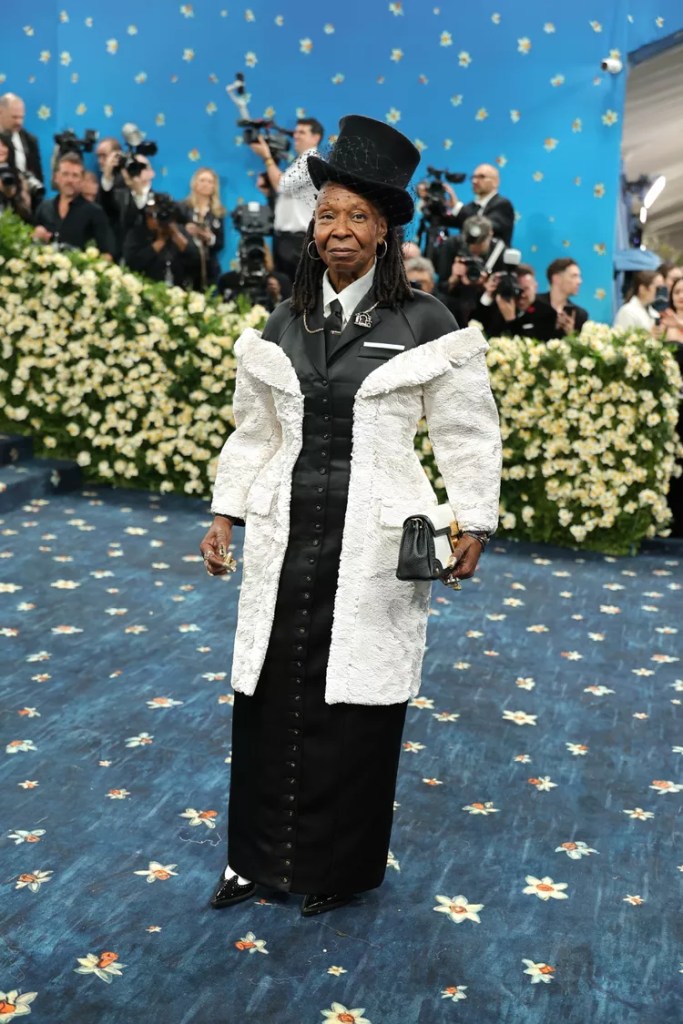
Does anyone else think this costume worn by Whoopi Goldberg at the recent Met Gala refers to an ecclesiastical wolf in sheep”s clothing? The furry-looking overcoat seems to peel away, revealing a sombre, even militaristic suit beneath. The bottom of the suit is even more surprising, as it is buttoned all the way down, just like a cassock.

To top it off, the brooch on her lapel is in the shape of a key-hole. Food for thought….