Fraternity replaces Corpus Christi

Bergoglio’s Vatican treated Sunday’s feast of Corpus Christi as if it were an ‘optional memorial’, by replacing that solemn occasion with the first “World Meeting on Human Fraternity”. Freemasonic “fraternity” was the order of the day – along with dreadfully tiresome entertainment including gay dance moves. The sodomite dancer pictured below apparently also performed for JPII back in the day. (You know, the day before we were all citizen journalists and trusted that everything our popes did was in the best interests of the Church. Image courtesy of Michael Haynes )

There was yet another official signing of yet another universalist document: this one promoted “environmental” and “spiritual fraternity” and as you may guess, omitted any reference to Catholicism. Bergoglio himself wasn’t able to make it due to his recent surgery, but good old Pietro Parolin (Secretary of State) and Mauro Gambetti (Archpriest of St. Peter’s Basilica) held the fort.

According to LifeSite News, this anti-Catholic event was planned months ago, pushing the feast of Corpus Christi out of mind and out of sight. By all accounts, it was not well-attended, by either regular punters or distinguished invitees. Even Andrea Boccelli on a sunny Roman afternoon wasn’t enough to draw people along.

Silere Non Possum gives us a few more details. His translated headlines reads “THE POPE IS HOSPITALIZED AND GAMBETTI TRANSFORMS THE BASILICA INTO A PUB”! From the article:

If Bergoglio feeds on a liquid diet, Mauro Gambetti does not. Today in via della Conciliazione the main guest is Parmigiano Reggiano. For the Franciscan friar , who loves dining with the powerful and certainly not with the poor, this event of Human Fraternity is an opportunity to send clear messages to HE Mons. Salvatore Fisichella. Gambetti, in fact, is strongly opposed to the fact that the Pope has entrusted the archbishop with the management of the Jubilee 2025. After all, it could not have been otherwise, given the disastrous results of the management of St. Peter’s Basilica.

While the Pope, also to the bishops of the CEI, has once again addressed the invitation to poverty, Mauro Gambetti does not abandon the path traced since his arrival in the Vatican. Nobel prizes, celebrities and thousands of money spent on advertising and organization of an event that has no reason to exist. The Vatican Basilica has become a content to be filled as it has been emptied of its essence: prayer. The falling plaster, the dust, the naked men on the altar weren’t enough. Today, a real banquet has been set up in the atrium of the Basilica which probably reminds Gambetti of the fields of Romagna where you can have an aperitif with hay and crates.

“From the Vatican to Camporella is a moment”, reports a cardinal . No Masses, no prayer. In the first vespers of the solemnity of Corpus Domini, the square of Christianity is transformed into a real circus.…..In the meantime, however, numerous law enforcement officers have been employed, the basilica is not accessible and the amount of money lost is staggering.

A fascinating article about Freemasons & Catholics from Pillar Catholic

when catholics could be masons by nico fassino at pillar catholic

For hundreds of years, the Catholic Church has prohibited its members from joining Masonic lodges.

Freemasonry has been denounced by numerous popes, beginning with Pope Clement XII in 1738, on the grounds that it promotes religious indifferentism.

But after the Second Vatican Council, many Catholics around the world suddenly became confused about whether it was permissible for Catholics to become Masons. 

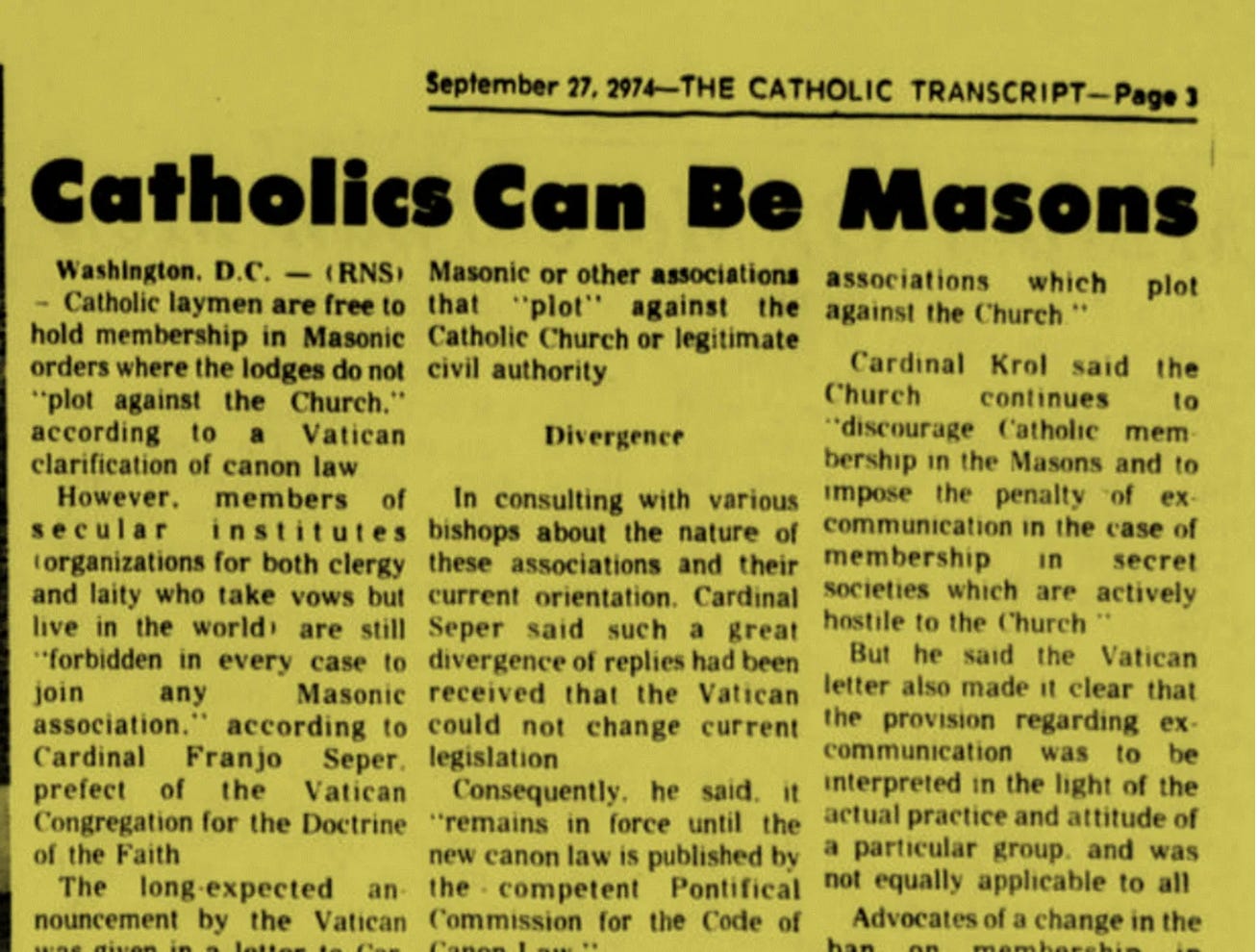
From the Catholic Transcript (newspaper of the Archdiocese of Hartford), September 27, 1974, page 3. Scan via Catholic News Archive, public domain.

In fact, there was a seven-year stretch in the 1970s when the English-speaking Catholic world was taught by its bishops that, although it was not encouraged, it was in fact permitted to become a Mason, as long as certain conditions were met. 

Then, at the end of those seven years, these Catholics were suddenly informed that joining the Masons was actually still forbidden under pain of excommunication – and always had been.

That period in history is all but forgotten today. But a survey of Catholic newspapers from the time period offers a glimpse into the confusion that surrounded the subject of Masonry in the American Catholic world 50 years ago.

Changes anticipated: 1971-1974

While work was underway on the revised Code of Canon Law in Rome in the early 1970s, it became clear that there was widespread anticipation that the Church would soon change her teaching on Catholic participation in Freemasonry. 

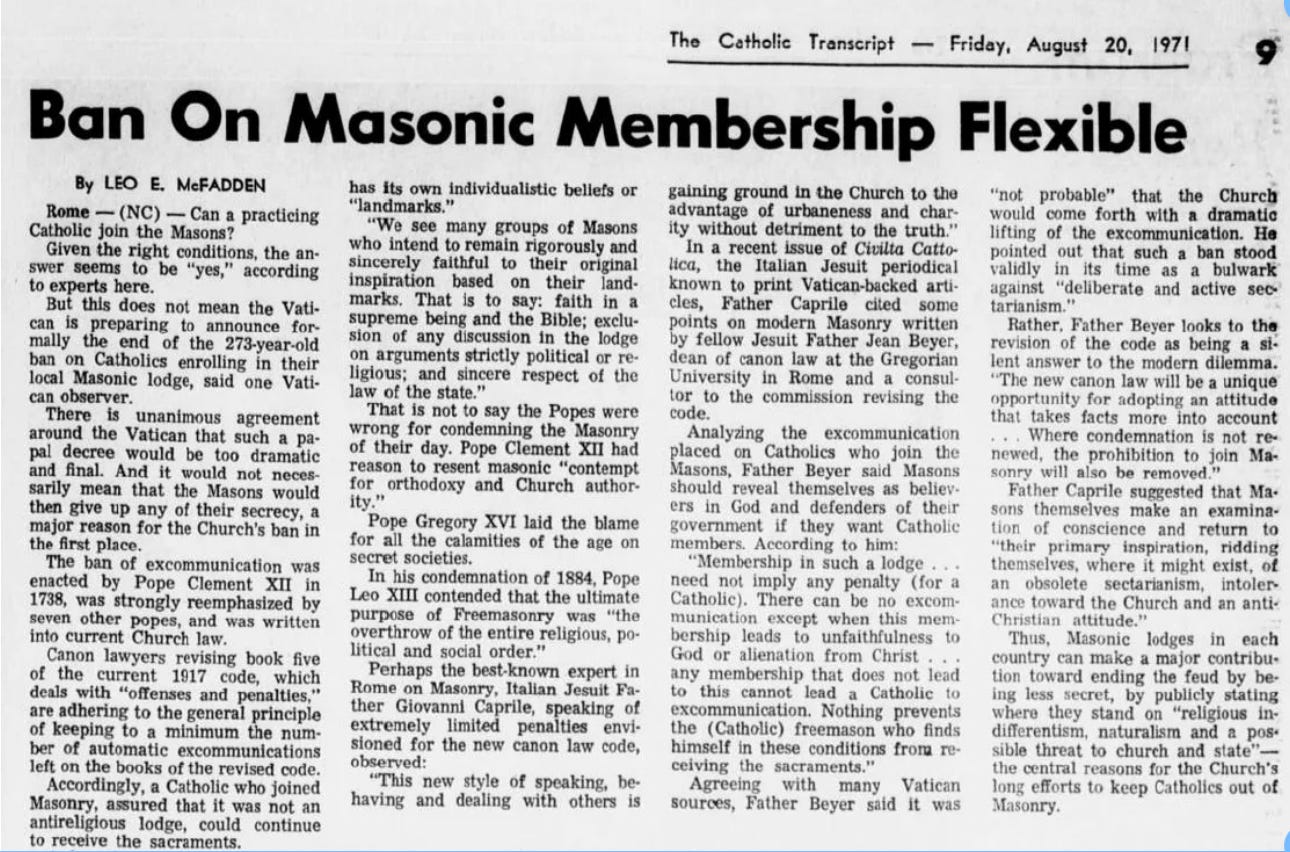
In August 1971, National Catholic News Service – the news service of the U.S. bishops – issued a lengthy report which predicted that the Church would soon modify her teaching on the matter. 

Headlined, “Catholic-Masonic Relations Enter Friendly New Era,” the report included commentary from leading experts in Rome, including Fr. Jean Beyer, SJ – Dean of Faculty of Canon Law at the Gregorian University in Rome and a consultor to the Vatican Commission for the Revision of the Code of Canon Law. The syndicated story ran in official diocesan newspapers throughout the nation. 

The Catholic Transcript (newspaper of the Archdiocese of Hartford), August 20, 1971, page 9. Scan via Catholic News Archive, public domain.

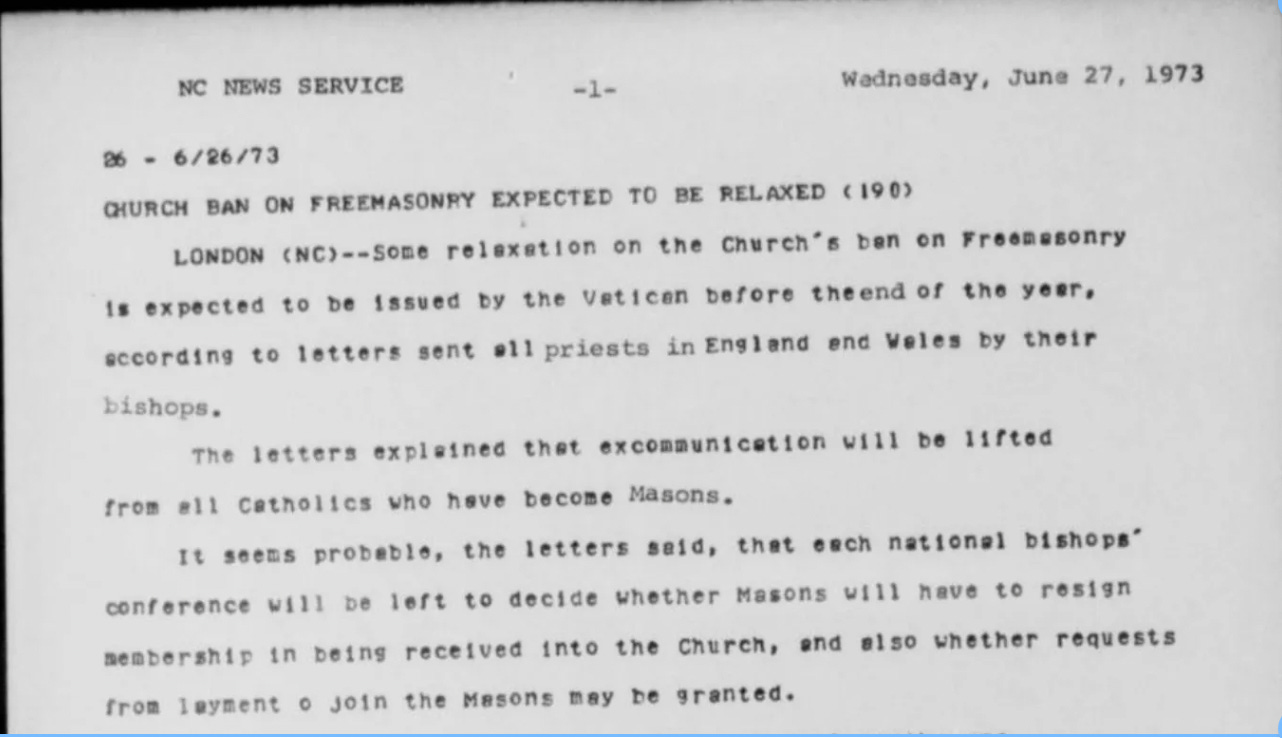
Two years later, in June 1973, National Catholic News Service again reported that Church officials were expecting and planning for a change in Church teaching. 

The article, headlined “Church ban on Freemasonry expected to be relaxed,” revealed that the Catholic Bishops of England and Wales had sent letters to all priests in their country, informing them that some “relaxation” in the ban on Freemasonry was expected soon. 

According to the letter from the English hierarchy, “it seems probable that each national bishops’ conference will be left to decide whether Masons will have to resign membership in being received into the Church, and also whether requests from laymen [to] join the Masons may be granted.”

The National Catholic News Service (by the US Bishops Conference), June 27, 1973, wire copy page 1. Scan via Catholic News Archive, public domain.

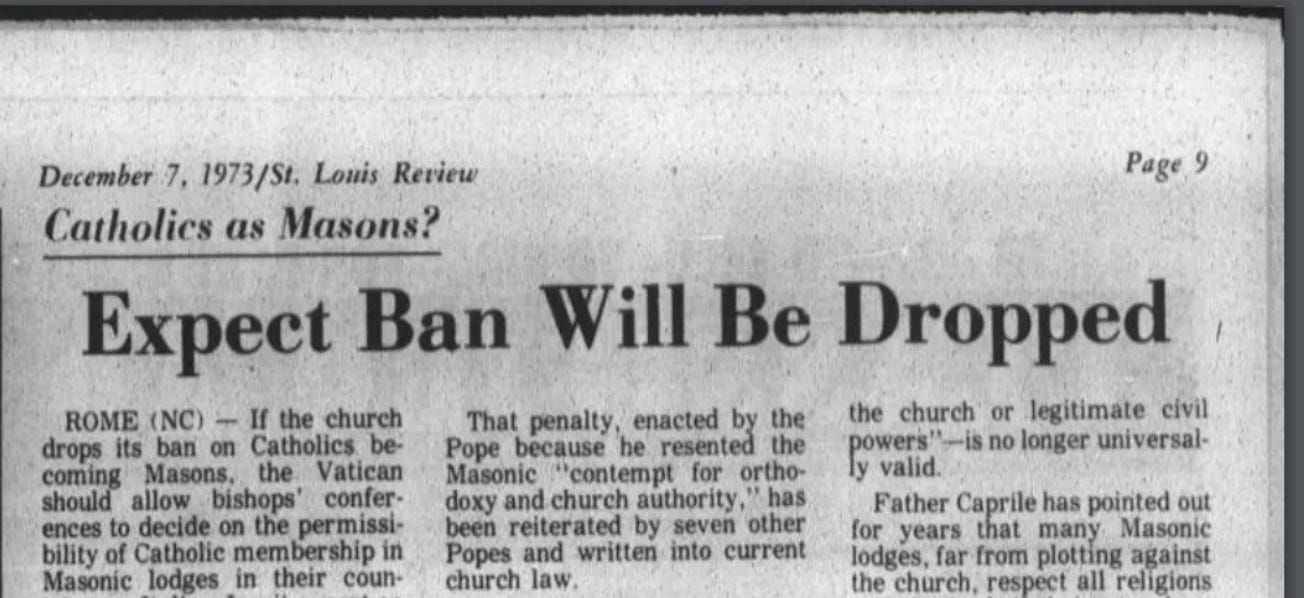
This news was widely printed in official diocesan newspapers throughout the country and continued to be discussed in newspapers and clerical journals between the summer of 1973 and spring 1974.

The growing consensus — as promoted by the U.S. bishops’ news service — was that the old prohibition would soon be changed.

The St. Louis Review (newspaper of the Archdiocese of St. Louis), December 7, 1973, page 9. Scan via Catholic News Archive, public domain.

Continue reading this article at Pillar Catholic:

Note regarding the main image: it was found at this site and is obviously taken more recently than the 1970″s!!

Freemasons at Fatima in the 1920’s

From “fatima in twilight” by Mark fellows

“Many of the visitors to Cova da Iria also visited Aljustrel to talk to, or pray with, or plead intercession from the three seers. Although the apparitions had stopped, the events at Fatima had acquired a momentum of their own. The attraction increased over the years, despite violent attacks in the Masonic press, the presence of armed troops at Cova da Iria, and the fact that within four years of the last apparition, none of the little seers lived at Fatima anymore.

“Back at Lisbon, Freemason and Editor-In-Chief of ‘O Seculo’, Avelino de Almeida, was raked over the coals by his fellow leftists for daring to report the miracle of the sun as it actually occurred. It was thought that such a public concession to reality only encouraged the forces of reaction, and consequently imperiled the revolutionary cause in Portugal. In Ourem, no one needed to instruct Arturo Santos (“the Tinsmith”) about the party line. To his dying day he denied that anything miraculous had ever occurred at Cova da Iria – although he never set foot there. On October 23, 1917, however, some of his henchmen did.

“The Tinsmith’s agents were joined by members of the Grand Orient Lodge of Santarem (about forty miles south of Fatima). Under cover of darkness they entered Cova da Iria to cut down the holm oak tree, and remove the rustic wooden arch built over it, from which hung lanterns perpetually lit in honor of the heavenly Lady. They also took a table and the small altar resting on it, and an image of the Blessed Virgin. The carload of booty was driven to Santarem, where the thieves displayed the stolen items the next day. For a small fee, one could view the arch and a small hatcheted tree, and receive a Masonic harangue on medieval superstition. That night the Freemasons staged a public procession with their display, “singing blasphemous litanies to the accompaniment of drums.

“Adding salt to the wound was the fact that the Portuguese government had outlawed Catholic religious processions. The Masonic “procession” was so fanatical in its anti-Catholicism that even the secular press was critical of the event. On the morning of October 24 Maria Carreira hurried to Cova da Iria. Her heart sunk when she saw the arch and lanterns missing, then rose when she saw the little stump of the holm oak tree still sticking up out of the ground. The vandals had cut down the wrong tree.

“Lucy went to investigate too. “I then asked Our Lady to forgive these poor men,” she wrote in her Second memoir,” and I prayed for their conversion.” The next ploy of the “poor men” was to post armed cavalry around Cova da Iria to intimidate pilgrims. The crowds only seemed to increase.

“Publicly dismissing the apparitions at Fatima as a “shameful spectacle staged as a ridiculous comedy” ( as one hyperventilating Brother put it), an implacable hatred of the one true God gave Freemasonry no rest. Truth too tell, the revolution in Portugal was menaced. But it was not, as the Masons supposed, the dark plotting of the Jesuits or Portuguese clerics that would stall the force of progress. Most clergy maintained a prudent silence regarding the apparitions, and more than a few were downright skeptical. Rather, it was the prayers, penances and sacrifices inspired by the beautiful Lady at Cova da Iria that posed the real threat to Masonic authority. Before this onslaught of religious fervour Freemasonry could only sputter impotently, and flee.

On December 8, 1917, the Blessed Virgin began to grind Her heal on the spiteful head of the revolution. Portugal’s government was overthrown by one of its own, a Freemason named Sidonio Pais. The day after his coup d’etat Pais allowed the Portuguese bishops to return from exile. Two weeks later he allowed worship in the churches the revolution had confiscated from the Church. Diplomatic relations with the Vatican were reopened, and other measures were taken to allow freedom of worship in Catholic Portugal. Obviously Pais was no ordinary Freemason. He knew that by his actions he was signing his own death warrant. It is said he felt protected by the Blessed Virgin, and even received “encouraging visions” from Her. Had he lived long enough, it is likely he would have converted. But he had made himself a marked man, and he knew the Masonic reputation for vengeance was justified.

“Nevertheless, Pais persisted. His efforts to allow the Jesuits to re-enter Portugal were rewarded by an assassination attempt. Undaunted, Pais had the police raid the Masonic headquarters in Lisbon. On December 14, 1918, he attended Mass for fallen Portuguese soldiers. Afterwards, he was gunned down at a train station in Lisbon. He died there, his body riddled with bullets, a crucifix resting on his bloody chest.

It was another glorious victory for the champions of liberty, equality, and fraternity. Yet Freemasonry had only killed a messenger; they were powerless against the message, and they knew it. Their days were numbered.”

from fatima in twilight by mark fellows. Marmion publications, niagra falls. 2003.

Masons involved in the Synod on Synodality

Well, I guess it’s not really surprising.

During Australia’s Plenary Council process, there were lapsed Catholics, alphabet-soup Catholics, Protestants, Moslems, and even atheists all giving their two-cents’ worth on the Church. So it stands to reason that somewhere along the line, Freemasons would want to have some input into the Church’s future – especially seeing as so many of them occupy important positions in the hierarchy these days.

From FSSPX NEWS:

“The Conference of Bishops of the Philippines (CBCP) has just issued a statement reminding the faithful of the impossibility of a Catholic being a part of Freemasonry. A welcome clarification, as it appears that Freemasons in the archipelago had been participating in the preparatory work for the Synod on Synodality.

The declaration of the Filipino bishops is part of the context of the synod organized in the archipelago, as everywhere else in the world. The debate is indeed more and more lively on the participation of “Catholic Freemasons” in synodal consultations.

“We thought that the teachings of the Catholic Church on the matter had evolved. Since several participants in the Synod are Freemasons, we thought that the Church had relaxed its rules on joining Masonry and participating in activities of the Catholic Church,” explains Gloria Buencamino.

For this parishioner from Quezon City, the episcopal development is surprising, because in some churches, “Catholic Freemasons help the priest distribute communion; in our parish alone we have two and they were delegated to the Synod on Synodality. They are good and pious Catholics,” she says.

“Good and pious Catholics?”

Well, of course they are. At least Freemasons believe in the Real Presence, (albeit only in order to profane the Lord) which is more than can be said for the majority of non-Mason Catholics.

As usual, the Masons themselves have no problem with Church membership: it is only the Catholics who are bigoted and exclusive. From the article:

… Frank Munez hosts a lodge in Manila. For this 61-year-old Mason, there is no opposition between Catholicism and Masonry: “It is above all a fraternal community. What’s wrong with that? We have nothing against God, in fact, we encourage our members to be men of faith and good citizens,” he told Ucanews.

One further reason why Masons want to be involved in the Synod? I’ll give you a clue. It rhymes with Synodality. (And here’s what I wrote about it a little while ago)

How does a prelate become a Freemason?

From ‘Unholy Craft’by Arnaud de Lassus

In Italy, in 1999, a book was published anonymously entitled Via col vento in Vaticano and, according to the editor the French version, “would have come from a group of high-ranking Vatican dignitaries who chose to break the law of silence.”

It is a collective work describing various disorders affecting the Holy See. The chapters are not all of equal value and some call for serious reservations. Chapter 18, The Smoke of Satan in the Vatican, deals with Freemasonry and, in four very interesting pages, explains the process used to entice prelates to affiliate to the craft.

There is a real novitiate for recruiting ecclesiastics to the Masonic order. Among ecclesiastics, there is a certain category of men in which Masonry seeks possible collaborators; these must combine certain gifts: keen intelligence, a great desire for advancement, ambition, quickness to understand and to pretend to understand nothing, willingness to serve and, if necessary, a good physical presence and a pleasing face.

When a young ecclesiastic meets these criteria … it remains only to engage him by titillating his pride.

The author insists on the secrecy of the operation which is a consideration of its success:

In this first phase it is absolutely necessary that the designated candidate remains in total ignorance of what is being set up around him. The Masonic technique requires to be revealed progressively, so that the associate discovers the secret society’s aims only gradually, as the superiors think fit.

The first contact is made as naturally as possible. An invitation to an accomodating embassy for a national festival, unexpectedly meeting someone who claims to be delighted to have met him, a prelate who asks him for something and shows his gratitude. Then comes the phase of compliments and flattery: What a treasure, such kindness, such keen intelligence … You deserve better – you are wasting your time. Why don’t we address each other less formally? …. Then one enters the phase of future prospects: I know such a prelate, such a cardinal, such an ambassador or such a minister ….I’ll willingly put in a word for you; I’ll say you are someone who deserves higher responsibilities ….

At this stage, the proposer immediately realises whether the interested party has taken the bait.

The process thus described will continue for several years, always in secret.

Gradually, the promises made are fulfilled. The pre-selected candidate notes that these were not in vain and believes it is his duty to be grateful to the friend whom he regards as his benefactor. During this time, his career progresses very smoothly without encountering any difficulties. Brilliant prospects in the service of the Church appear before him and he begins to see a position which would suit him rather well.

Then, when fired with ambition and vanity, the naive prelate has at hand the evidence of his effortless advancement, which he hasn’t yet fully grasped, and when other promotion to higher levels still beckon – it is at this stage that the explanatory phase arrives.

The recruiters explain to the candidate that:

  • If he has attained such wonderful positions, it is thanks to the discrete support of the Masonic order and its friends
  • He is free to continue to collaborate with this order, which will ensure his advancement continues.

In this very delicate phase, it is up to the prelate, in crisis, to decide which choice to make.

The desire to continue to advance, the excitement of knowing one is being introduced into the Masonic group, the fear of unavoidable revelations should he refuse to join, or, on the contrary, the vacuum he can already feel around him, the fraternal exhortation of some dignitary to go ahead, as he himself has done formerly: In a word, all this ends up convincing the prelate to follow the path mapped out for him by others without him being aware of it.

The higher one’s position, the more likely one is likely to be gripped by the fear of losing the high position one has attained. One abyss opens after another. One seeks to justify oneself.

Many prelates, thus compromised, end up by giving in and become members of the Masonic apparatus and under obligation to obey its instructions.

Thus, once infiltrated into his ecclesiastical setting, the brave Masonic novice’s first duty is to maintain his credibility by keeping his promises and, if necessary, to cast, as poseurs and hypocrites, the prelates of the place he has infiltrated.

Skilfully hooked, the new Freemason then becomes a pawn in the secret lodge’s sphere of action and is added to the others already there. His rise can now continue unabated towards the top with the help of other ‘brothers.’

This is a remarkable process, founded on secrecy, which can easily last ten years and which can be implemented by disciplined, well trained …. and patient personnel. It is undoubtedly used not only in the Curia, but just as much in the secular and ecclesiastical worlds.

Two general remarks can be made following the observations which have been made on Masonic infiltration within the Curia and on the process used for that purpose.

The presence of Freemasons in key positions in the Church explains to a great extent the doctrinal and disciplinary deviations of these last forty years. It is particularly clear in the case of liturgical reform.

As for the process that is used to produce Masonic prelates, it is very important to understand it and to make it known, because it obviously loses its effectiveness when it is known.

In conclusion, let us remain alert to the Masonic question. It is one of the keys to the current crisis, political as well as religious and, as Pope Leo XIII said in the encyclical Humanum genus,it is necessary ‘to tear away the mask from Freemasonry and to let it be seen as it really is.

Let us remain alert and keep faith in the Church; we know that the gates of hell will not prevail against Her.

The Church is truly a supernatural society, truly holy. The Mystical Body of Christ, the Bride of Christ, of unblemished fidelity, in the image of the Virgin Mary. Without exception, throughout the centuries, and until the end of the world, ‘She is Jesus Christ, given and communicated. That and nothing else.’
Pope Francis on the spot over Freemasonry

SOURce: LifeSiteNews

Italian Freemasons have said they will appeal to Pope Francis for support, after the local Catholic bishop re-iterated the Catholic Church’s condemnation on Freemasonry in light of renewed Masonic activity in the area.

Local Freemasons in the Archdiocese of Chieti-Vasto in eastern Italy have declared that they will seek “rapid and active intervention” from Pope Francis, after Archbishop Bruno Forte reminded the archdiocese of the Catholic Church’s strict ban on participating in Masonic activities.

On February 7, Forte issued a letter to his archdiocese in which he presented the Congregation for the Doctrine of the Faith’s (CDF) 1983 document on Masonry. 

Forte stated that: “the condemnation of Freemasonry remains unchanged; second, Catholics who belong to a lodge are in a state of grave sin and cannot take communion; third, no exceptions are allowed.”

His letter was prompted by renewed, public activities organized by Masons of the Sovereign Arabian Phoenix lodge in Forte’s archdiocese, including a conference at the Iacone hotel on “Francesco d’Assisi: mysticism or esotericism?”

Many locals protested the conference, calling the Masons “absolute evil.” The venerable master Ginevra Di Nicola stated that the protests represented “social hatred.” Di Nicola added that the Masons would “invite Bruno Forte to our next meeting.” 

“We are not a religious creed but we believe in a superior being whom we call the ‘great architect of the universe’ who created everything,” said Di Nicola. “We are a brotherhood that embraces every religious belief.”

Days later, Forte – who has led the archdiocese since 2004 – issued his letter which consisted chiefly of the text of the CDF’s 1983 document. That text – signed by then-Cardinal Joseph Ratzinger and approved by Pope John Paul II – reads:

Therefore, the Church’s negative judgment regarding Masonic associations remains unchanged, since their principles have always been considered irreconcilable with Church doctrine and therefore membership in them remains forbidden. The faithful who belong to Masonic associations are in a state of grave sin and cannot access Holy Communion.

The CDF’s ruling further adds that local bishops cannot issue documents which in some way differ from the firm line presented by the CDF regarding the Catholic Church’s relationship with Masonry. “It is not for local ecclesiastical authorities to pronounce on the nature of Masonic associations with a judgment that implies derogation from the above, and this is in line with the Declaration of this Holy Congregation of February 17, 1981.”

In response, the Masonic lodge declared that they would appeal to Pope Francis to intercede on their behalf against Forte. “We will turn to Pope Francis to ask for his swift and proactive intervention in this diatribe, which damages our honorability and, on balance, threatens our security,” Di Nicola told local news.

The Mason also directly quoted from Pope Francis’ 2020 encyclical Fratelli Tutti, citing paragraph 46: “It must be recognized that fanaticisms that lead to the destruction of others also have religious people as protagonists, not excluding Christians, who may participate in networks of verbal violence.”

Such a tactic is noteworthy: Francis’ Fratelli Tutti promotes a “Universal Brotherhood” and also links back to his controversial 2019 Abu Dhabi document on Human Fraternity. Both texts have been widely criticized by Catholics since their publication. Former Papal Nuncio to the U.S. Archbishop Carlo Maria Viganò notably wrote that Francis’s concept of fraternity was “theologically blasphemous.”

A prominently vocal German priest also described the text as being interwoven with “Masonic” ideology. Francis’s push for religions to be on an equal footing, Father Frank Unterhalt noted was a key element of Masonic goals:

The striving for universal ecumenism of religions has always been a concern of Freemasonry on the way to its actual goal, namely to bring about the breakthrough of that self-constructed religion in which all human beings are supposedly in agreement.

Indeed, following Fratelli Tutti’s publication, it was welcomed by the Masonic Lodge of Spain, who stated it was “the latest encyclical” of Pope Francis in which he “embraces the Universal Fraternity, the great principle of Modern Freemasonry.”

Continue reading at LifeSiteNews: