A Modernist in Trad Clothing

Beware of false prophets, who come to you in the clothing of sheep, but inwardly they are ravening wolves – Matthew 7:15.

Some may think that the election of yet another unworthy Cardinal to the Papacy causes perverse delight for writers who routinely expose wrongdoing in the Church. Nothing could be further from the truth! It is actually a source of pain to be counted among the minority who disregards popular opinion in order to defend the rights of God.

It was Christ Himself who warned us to be on the watch for dangerous men who like to appear as one thing, while having intentions that are altogether different. Our Lord even specifically warned that such men will dress the part in order to lead His unsuspecting sheep astray.

This profile of a ravenous wolf perfectly fits the latest Pontiff, Leo XIV, who has chosen to adopt the outward persona of a traditionalist, all the way from his heavily embroidered pallium down to his relic-embedded pectoral cross.

He is gaining favour with Trads, as stories of him offering private Latin Masses are doing the rounds of social media. Those posts are often accompanied by a photograph, shown below, of then-Cardinal Prevost wearing traditional vestments. However, the liturgical event was not a traditional Mass; rather Prevost was simply incensing an image of Our Lady, possibly the miraculous icon at Gennazzo.  [We know it wasn’t a Mass because the altar is covered, and there are no altar cards, vessels or missal.]
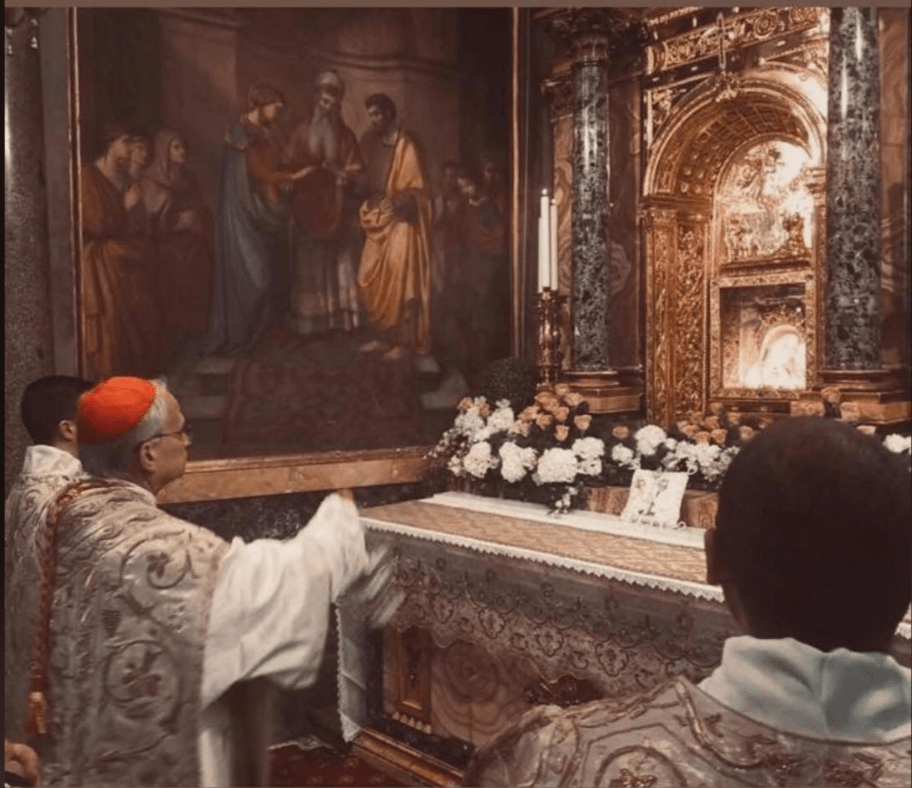
Prevost NOT offering a TLM.

So what is underneath the lovely vestments and fluent Latin that should have us so concerned? It is that Prevost is a Modernist, through and through, and that he a stated goal of picking up where Francis left off, steering the Barque of Peter firmly along a course of Synodality.

The Catholic Esquire has done a great job of explaining succinctly the programme of this papacy and how it is in perfect continuity with that of Francis – and of the entire Revolution. [His short (17min) video can be found here.]

In short, Synodality is the name of the game: decentralising the Church in an attempt to obliterate the foundation of Her unchanging doctrinal authority. Now, obviously, this plan can never ultimately succeed, as Christ is that foundation, but the Synodalists have and will continue to inflict great damage on the Church in their attempt.

We should expect to see national bishops’ conferences implementing their own local brand of Catholicism whilst tolerating all manner of error. We can also expect some tinkering with the Novus Ordo liturgy, as Synodalists move along in their efforts to further delegitimise, and one day completely invalidate that form.

The persecution of Traditional Catholics could perhaps appear to soften, but in no way should a return to the widespread traditional practice of the Faith be expected. Should Traditiones Custodes be revoked, then Traditional Catholics must not let down their guard. If a convincing wolf is in charge, then we must not stand near him saying “what big teeth you have!”

As explained in my last article, we also should not expect to see a cleansing of sodomites from the ranks of the hierarchy under this pontificate. The moral chaos and errors are very likely to increase, rather than diminish. And that means an increase of moral chaos in the wider society as well.

What about Ecclesiastical Freemasonry? Will Pope Leo denounce Masonry in the strongest terms, like his namesake, Leo XIII? That is most unlikely. The best that can be hoped for is the reiteration – on paper, at least – of the Church’s longstanding condemnation as was produced by Tucho Fernandez under Bergoglio in November 2023. That ostensible condemnation was more likely aimed at disempowering the Masonic Old Guard in the Curia, led by then-papabile Cardinal Parolin, than at actually dissuading Catholics from becoming Masons. Francis’ Masonic credentials certainly suggest that this was the case.

Speaking of Masons, an intriguing image was posted on a Masonic Instagram account a few days after the death of Bergoglio. There’s no way of knowing what it meant, but the timing was most interesting. It was accompanied by a snippet of Masonic poetry, without any additional commentary. Note the red cuff on the figure of the Pope, as well as the (Rosicrucian-inspired?) equilateral crosses on his vestments.

From a Masonic Instagram account, posted April 26th, 2025. Pope Francis died April 21st and Leo XIV was elected on May 8th.

As with the election of other Popes since the Council, Freemasons have expressed their congratulations to the newest Pontiff. This was the only example that was easily found, but it is early days yet.

Pope Leo XIV welcomed by the Freemasons of Tanzania

The surest confirmation of Pope Leo’s agenda will be his selection of a new Curia, which won’t happen until after his official installation on May 18th. Some more Masonic well-wishing around that time is to also be expected.

So is there reason for us to be disoriented? Or disillusioned …. depressed? Well, no. All of this has to play out before the time of Our Lady’s Triumph.

Since the majority of Catholics, including a series of Popes, has refused to honour the requests of Our Lady at Fatima and elsewhere, another destructive papacy is simply part of the package.

However, we are not powerless in the face of adversity. In fact, there is much we can do to mitigate the effects of another ‘worm-ridden’ papacy. The following Rules of Engagement with the revolutionary forces – both natural and supernatural – may be of assistance:

  • A renewed commitment to daily prayer, especially the Holy Rosary
  • A commitment to a small form of daily penance for Pope Leo XIV, that God will work much good through his pontificate (and even a conversion can’t be ruled out)
  • A commitment to limiting online criticism to the actions of the new pope, while being careful not to demean his office
  • Similarly, great care should be taken always to distinguish between the human element of the Church and Her Divine origin. {For example, as clearly stated by Pope Gregory XVI in Mirari Vos: “To use the words of the fathers of Trent, it is certain that the Church “was instructed by Jesus Christ and His Apostles and that all truth was daily taught it by the inspiration of the Holy Spirit.” Therefore, it is obviously absurd and injurious to propose a certain “restoration and regeneration” for her as though necessary for her safety and growth, as if she could be considered subject to defect or obscuration or other misfortune.“]
  • Asking heaven for the grace to remain on the Ark; to stay within His Church, no matter how bad things get.
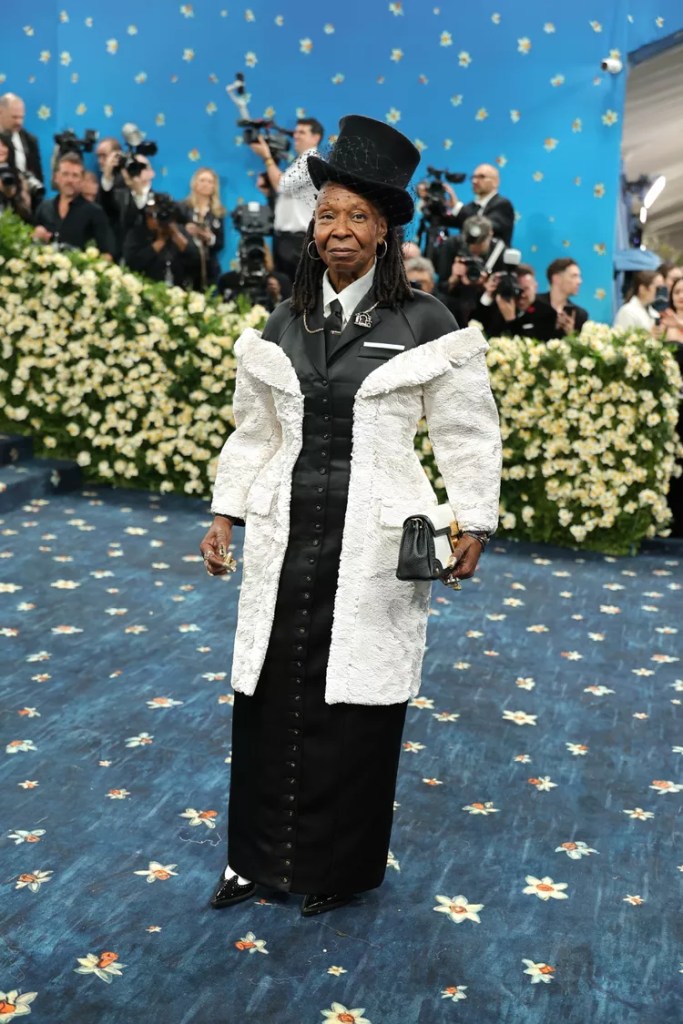
PS. It is well-known that Hollywood and the celeb-world are in cahoots with the revolution everywhere – including within the Church.

Does anyone else think this costume worn by Whoopi Goldberg at the recent Met Gala refers to an ecclesiastical wolf in sheep”s clothing? The furry-looking overcoat seems to peel away, revealing a sombre, even militaristic suit beneath. The bottom of the suit is even more surprising, as it is buttoned all the way down, just like a cassock.

To top it off, the brooch on her lapel is in the shape of a key-hole. Food for thought….

Yet Another Pope Beloved by the Masons

It is being widely reported that the Italian Grand Lodge has released a very positive farewell statement after the passing of Pope Francis, entitled, “Francis, the Pope of the Least”. (Reproduced below)

This is, of course, no great surprise considering how closely Bergoglio followed the pattern set down by the Masons in the Alta Vendita almost two hundred years ago: “…a Pope according to our needs…” During his life, Masons regularly thanked Bergoglio for his contribution to their aims. In fact, most of his programme, from Synodality to his new-fangled mortal sins, were completely in line with Masonic principles.

What is a surprise is how few realise that this appreciation is just standard fare for the Masons in regard to the conciliar popes. For example,

  • In June 1963, Mexican Freemasons glowingly farewelled Pope John XXIII 1
  • After the death of Paul VI, French and Italian Masons spoke of him favourably 2
    • “To us, it is the death of him who made the condemnation of Clement XII and of his successors fall. That is, it is the first time – in the history of modern Freemasonry – that the Head of the greatest Western religion dies not in a state of hostility with the Freemasons.”
  • During his life, John Paul II was granted an award for his dedication to promoting human fraternity by Portuguese Masons – he declined it, however.3
  • Australian Freemasons also honoured John Paul II for his leadership qualities4:
    • “John Paul II’s most outstanding leadership quality was his ability to create real presence in those who looked to him. The capacity for a leader to make those who follow them believe that the person to whom they aspire can understand, listen and comfort them in a manner that is enriching; is a quality not to be underestimated.” (Note the reference to the Real Presence – remember Masons prize mocking God above all!)
  • Sometimes the praise went in the other direction, for example when John Paul I praised a Mason, who was also known to be a satanist! (Read the article here.)

Now for the latest praise of a post-conciliar Pope by the Masons: a statement on the death of Francis from the Grand Lodge of Italy. The Mason’s mention of Bergoglio’s “path free from dogmas” is perhaps ironic given how dogmatic he was in regard to eliminating tradition.

Francis the Pope of the least

The Grand Lodge of Italy of the ALAM joins the universal condolences for the disappearance of Pope Francis, a pastor who, with his magisterium and his life, has embodied the values of brotherhood, humility and the search for planetary humanism .

The Grand Lodge of Italy of the Ancients, Free, Accepted Masons joins the universal condolences for the passing of Pope Francis, a shepherd who, with his magisterium and his life, embodied the values of brotherhood, of humility and of the search for a planetary humanism. Coming from the “end of the world”, Jorge Mario Bergoglio has been able to change the Church, reporting the revolutionary teaching of St. Francis of Assisi to the topicality of history.

In this moment of mourning, our Communion intends to pay homage to the vision of Pope Francis, whose work is characterized by a profound resonance with the principles of Freemasonry: the centrality of the person, respect for the dignity of each individual, the construction of a community of solidarity, the pursuit of the common good. His encyclical Brothers all represents a manifesto. Freedom, Equality and Brotherhood it is the triple value asset of Freemasonry. Overcome divisions, ideologies, unique thinking to recognize the richness of differences and build a humanity united in diversity, this was ardently wanted by Francis, the same design pursued by the Grand Lodge of Italy.

Pope Francis has been able to combine faith and reason, complementary dimensions of human experience, renewing the Anselmian principle of credo ut intelligam (I believe so that I may understand). A faith capable of questioning itself, of welcoming doubt and of dialoguing, which we also find in the Masonic initiatory method, founded on a path free from dogmas, substantiated by incessant search for truth.

Francis’ pontificate placed in the center the last, together with the planet care and a an ethics of development based on human dignity. This too is found in the Masonic construction of the “Inner temple”, based on tolerance, solidarity and resistance against hatred and ignorance, and finds a profound correspondence in the pastoral care of Bergoglio, which with his “sweet revolution”, showed that humility and dialogue are instruments of authentic strength. In the wake of the “Francesco Economy ” and the vision of one “common home ”, there Masonry supports the commitment to a sustainable, fair and supportive future.

In this time crossed by serious critical issues, the Grand Lodge of Italy finds itself in Pope Francis’ appeal for a “planetary consciousness”, which recognizes humanity as one community of destiny. We honor his memory by continuing to work for an ethics of the limited, for respect for the other and for the construction of a temple based on solidarity, freedom of thought and universal brotherhood.

Luciano Romoli
Grand Master of the Grand Lodge of Italy of the A.L.A.M.
Rome, April 22, 2025

  1. https://www.traditioninaction.org/ProgressivistDoc/A_145_J23-Masons.html ↩︎
  2. https://www.fisheaters.com/srpdf/xxPaul_VI.._beatified_english.pdf ↩︎
  3. https://www.traditioninaction.org/ProgressivistDoc/A_072_JPII_Masonry.htm ↩︎
  4. https://www.freemasonsvic.net.au/wp-content/uploads/2020/05/SummerJv5_FINAL.pdf ↩︎

Esoteric Sacrilege in a Viennese Church

Update – readers from Austria have assured me that Villach is a small town south-west of vienna, rather than a suburb, as I previously thought. Apologies for the error!

A new art exhibition displayed in an Austrian Catholic church is not only sacrilegious, but also shows indications of an occult influence.

The exhibition was launched during Mass on March 9 with the enthusiastic blessing of the parish priest. Entitled CROSS: WAY: STATION (“Kreutz: Weg: Station” in the native tongue) the installation will be displayed in St. Jakob Church in Villach, Austria until April 4.

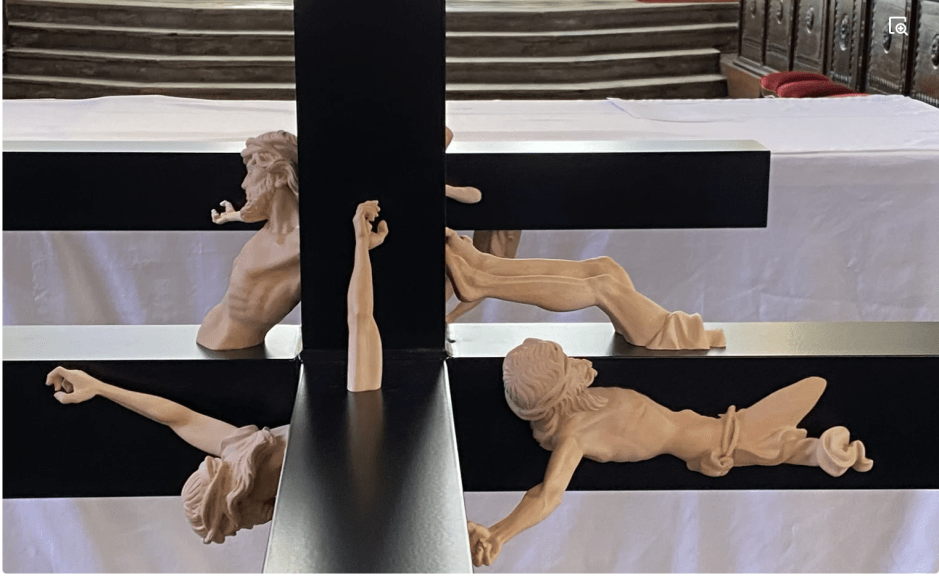
Artist Michael Kos has taken classic images of Christ and subjected them to abuse in the name of his spiritualised ‘art’. Kos claims that his three pieces, a crucifix, a tabernacle and a bizarre architectural structure in front of the altar are meant to represent the Son of God being subjected to a ‘real ordeal’ – something he undoubtedly managed to achieve by his disrespectful display.

According to Gloria TV, the diocese is run by the heterodox bishop who gave the world an “Episcopal Vicaress.”

Body Cube

The so-called ‘Body Cube’ is set in front of the altar and is large enough to stand in. It is quite disturbing, containing 49 dismembered body parts of Jesus Christ.

Kos explains the structure as a three-dimensional cross and says “the open axis structure of the cube creates a variable play of cross shapes. From every other point of view, different forms arise, from the simple cross to the half cross, the cross of the room to the swastika.”

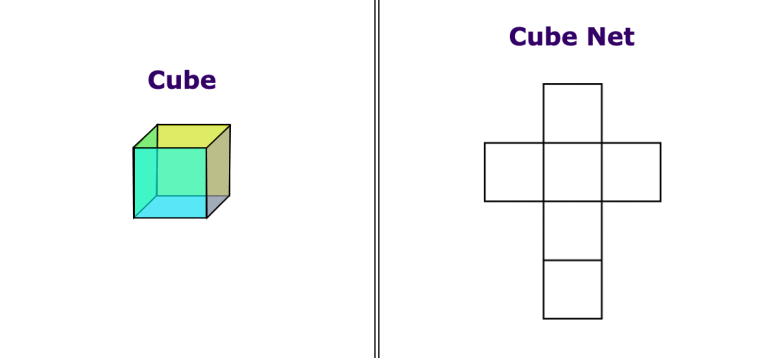
The use of cubes is the first clue to the display’s occult meaning as adepts appreciate the cube’s secret: when unfolded, it becomes a cross. As explained here in an article about liturgical design, cubes are ‘inherently Masonic.

Kos’ reference to the swastika, is another red flag since the swastika is a well-known New Age symbol. The composition of the structure, black-painted aluminium is a further clue since in the occult, the use of a base-metal for construction of a cross symbolises humiliation.

‘Body Cube’ shown in its entirety
The cube bears a resemblance to the ‘triple-tau’ cross, revered by Freemasons.

Balance Act

A second piece of artwork in the installation is a wooden figure of Christ, covered with white chalk and appearing to balance on a tightrope. The artist believes that this represents “a kind of resurrection happening through a rapture” and that it also refers to the concept of ‘balance.’

As mentioned many times in these pages, the principle of balance is very significant in the occult world. In choosing this theme, the artist underscored the balancing of chaos with order, sin with grace.

Although black-and-white tiled floors are not unusual in Catholic churches, it is perhaps no coincidence that one is found in this particular church. The contrast between black and white is yet another reference to finding ‘balance’ between opposites.

Here is what article Michael Kos says about “Balance Act”:

“Art is very often a balancing act because it can support values but also overthrow them.”

The installation balance.AKT is an unusual, sacred representation that not only shows the change in religion and culture, but also the wafer-thin dividing line between play and existential fall.

No god can be safe in the long run. Every individual and a son of heaven can experience the loss of balance. Man has become one who knows about the light-footed play and the bottomless abyss. [Emphasis added.]

Kos makes no attempt to hide his disdain for the Son of God.

Christpower

The final and most blasphemous of all the artworks is entitled, “Christpower.”

Believe it or not, this is a tabernacle (or at least represents a tabernacle – it isn’t clear whether or not the Blessed Sacrament is actually housed in this monstrosity.)

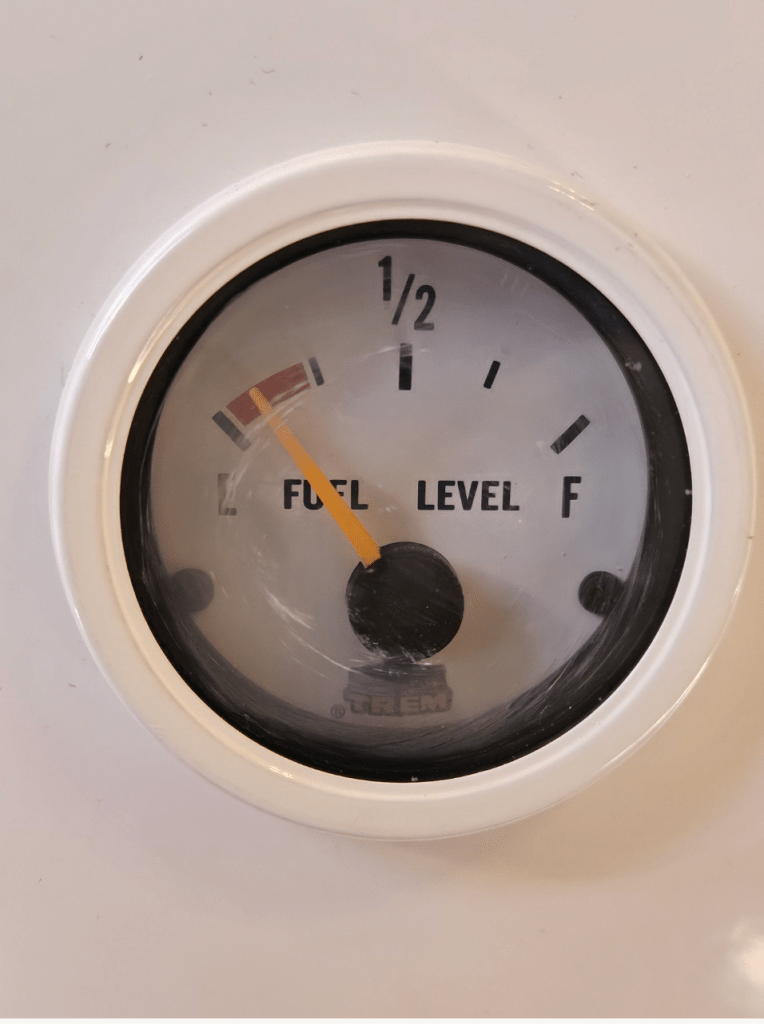
“Christ Power” is a white lacquered steel tank with a fill indicator which the artist says was inspired by the idea of “a critical tabernacle – or rather a tabernacle in crisis.”

Again, references to the occult are peppered in the artist’s explanation: he says that “shrine”, “transformation” and “secrecy” are all aspects of the tabernacle. ‘Transformation’ is of course, the ultimate ‘balancing’ act.

In his explanation of the work, Kos again shows his disregard for the Catholic faith, calling its veneration for the Blessed Sacrament ‘exaggerated.’ He goes on to suggest that divinity is found within the individual. This is the immanentism of esoteric philosophy and may be contrasted with the Christian idea of transcendence – that God is found beyond the individual.

“The question arises as to the relevance of a unique object today, which was characterized for centuries by cult dramaturgy and symbolic exaggeration.

This work of art oscillates between affirmation and negation of the religious level. The fill indicator is just before the vacancy rate and refers to a vacuum where there could also be spiritual abundance. But what is this abundance? Who fills up at all?

… Isn’t CHRISTPOWER also a psychoanalytic transmission that the believer unconsciously performs himself? So less an external force than an active internal force. A intrinsic force that fades away.

SOURCES: Carinthia Diocese website and Gloria TV.

B’nai B’rith

B’nai B’rith is a name that pops up from time to time as one researches events surrounding the Second Vatican Council. Many sources call the group straight-out ‘Jewish Freemasons’.

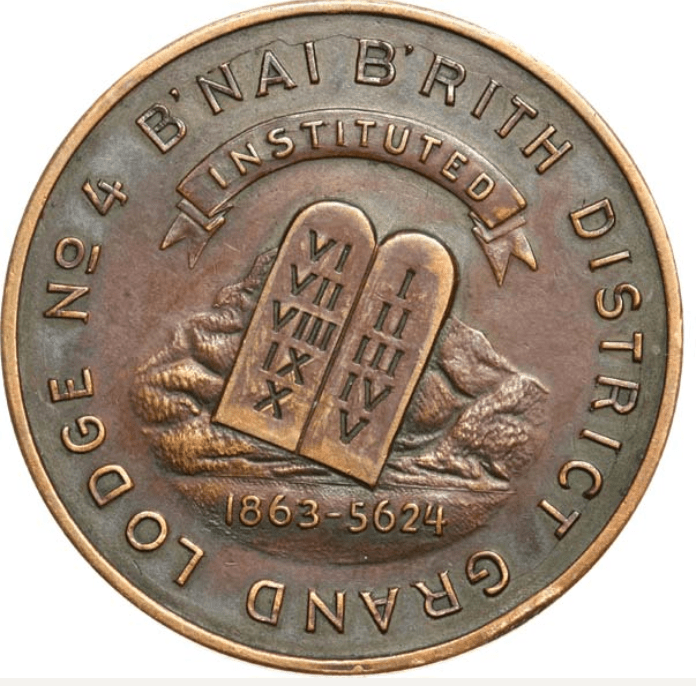
B’nai B’rith coin with the numbers of the Ten Commendmants reading from right to left. Hebrew read from the right, of course, but we also know how occultists love to reverse things.

Origins

According to Masonic sources, B’nai B’rith was founded on October 13, 1843 in the USA. (Note the date – it’s a Fatima day.) The twelve founders were Jewish German immigrants who had met each other through various Masonic and Odd Fellows Lodges and other secret societies. They ostensibly wanted to provide support for immigrant families, especially those in need.

B’nai B’rith means ‘sons of the covenant.’ The group went on to become involved in a number of philanthropic ventures and created the Anti-Defamation League. It is a strong opponent of ‘anti-semitism’ and a vocal supporter of the State of Israel and also attends the UN as a non-government organization, where it lobbies for the rights of Israel.

B’nai B’rith and Ecumenism

Members of the B’nai B’rith International Council also visited John XXIII, as reported at its January 1960 meeting in Amsterdam. President Label A. Katz, reported that “the Pope’s serious intentions to guide the Catholic Church toward brotherly understanding of the Jews were unmistakable” and that Cardinals Bea and König were enthusiastic promoters of reconciliation.

Later, B’Nai B’rith recalled the desire expressed by John XXIII at the opening of the Council “to make up for millenias’ persecution of the Jews and to recall instead the common heritage.” One of the members of B’Nai B’rith suggested that religious textbooks be revised to reflect the Jews’ unhappiness at being painted as the killers of God – something they believed resulted in anti-Semitism.

“We’ll be here ’til there’s no more hate.”

B’nai B’rith and Ecclesiastical Freemasonry

There are a couple of ties between this quasi-Masonic group and some prominent clerics. One is Fr. Malachi Martin, who according to E. Michael Jones “was being paid by both B’nai B’rith and the American Jewish Committee to subvert the Catholic claim that the Jews had killed Christ.”

It is difficult to know how much truth there is to this accusation, but it is certainly true that Fr. Martin was once secretary to ecumaniac Cardinal Bea (before his apparent conversion to orthodoxy and tradition) and also that the Jews did have an agenda to make the Church repeal its historical condemnation of them.

Also linked to B’nai B’rith was Cardinal Albert Decourtray who accepted a humanitarian award from the group in 1991 for his work in promoting inter-religious relations.

I have a feeling there are lots of links that are yet to be discovered when it comes to this influential Masonic/Zionist lobby group.

For more information please see this video on Bitchute.

Freemasonry and Judaism

From ‘the plot against the church’ by maurice pinay. Chapter two: The Jews as Founders of Freemasonry.

“To unmask Freemasonry” – said Leo XIII – “means to conquer it.” When we lift its mask, then every honest mind and every Christian heart will turn away from it with revulsion; and through this fact alone will it fall, completely destroyed and detested particularly by those who obey it. The learned scholar and Jesuit Monsignor Leon Meurin, S.J., Archbishop, Bishop of Port-Louis, shows us in his so very richly authenticated work, “Clarification of Freemasonry”, with crushing authority that the Jews are the founders, organisers and leaders of Freemasonry, which they use to attain world domination, in order to destroy the Holy Catholic Church and the remaining existing religions. Among the attested literature that he presents in this connection appear several quotations, which we mention in the following:

“The First Highest Masonic Council was, as we have already said, formed on 31st May 1801 in Charleston, 33 degrees northern latitude, under the chairmanship of the Jew Isaac Long, who was made inspector general by the Jew Moses Cohen, and who had received his degree from Hyes, from Franken, and the Jew Morin.”1

“The Jews were thus the founders of the First Great Council, which was to transform itself into the middlepoint of world Freemasonry. And they placed it in America, in a city chosen exactly on the 33rd parallel, Northern Latitude. The successive head has lived in Charleston since 1801. In the year 1889 this was Albert Pike, whom we have already mentioned in his circular letter of 14th July 1889, the famed anniversary and tercentenary.

“He assumes the title of each of the 33 degrees and in addition adds the following:

“Most mighty and all-highest Commander, Grand Master of the Supreme Council of Charleston, first highest council of the globe, Grand Master and preserver of the holy Palladium, all-highest Pontifex of world Freemasonry.
“With these pompous titles he published his circular letter in the one and thirtieth year of his Pontificate, supported by ten high dignitaries, most enlightened and most sublime brothers, rulers, grand-general inspectors, chosen magi, who form the most illustrious grand collegium of ancient Freemasons, the council of the chosen troops and of the holy battalion of the Order.”2

“The circular letter enumerates the 23 highest councils, which previously were directly ‘created’ through that of Charleston and are dispersed over the entire world. Then it lists the hundred Grand Orients and Grand Lodges of all rites which are connected with the highest Council of Charleston as the all-highest power of Freemasonry; the exclusive rite of the Jews. For example, the Grand Orient of France, the General Council of the Rite of Mizraim, the Grand Council of the Freemason Oddfellows, etc. From the preceding we must conclude that Freemasonry all over the world is one in countless forms, however, under the supreme direction of the all-highest Pontifex of Charleston.”3

JEWISH ORIGIN

“The rites and symbols of the Freemasons and of the other secret sects remind one constantly of the ‘Cabbala’ (secret Jewish mystique) and Jewry: The reconstruction of the temple of Solomon, the star of David, the seal of Solomon; the names of the different degrees, as for example, Knight Kadosh. ‘Kadosh’ means in Hebrew ‘holy’; Prince of Jerusalem, Prince of Lebanon, Knight of the serpent of Airain, etc. And does not the prayer of the English Freemasons, which was recorded in an assembly held in 1663, recall Judaism in a most clear manner?”4

“Finally the Scottish Freemasons made use of the Jewish calendar; for example, a book, which was written by the American Freemason Pike5 in the year 1881, is dated ‘Anno mundi 5641’. At present this calendar is retained only in the highest degrees, while the Freemasons in general add four thousand years to the Christian calendar, and not 3760 like the Jews.”6

The clever Rabbi Benamozegh writes the following:

“Those who wish to make the effort to examine the questions of relations between Jewry and philosophic Freemasonry, between Theosophy and the secret doctrines in general, will lose a little of their arrogant despisal of the Cabbala (Jewish Mysticism). They will cease to smile contemptuously at the idea that the ‘Cabbalistic’ theology perhaps has to fulfil a mission in the religious re-shaping of the future.” 7

“Who are the true leaders of Freemasonry? This is one of the secrets of the sect, which is very carefully kept; but one can assert that Freemasonry all over the world develops in agreement with one and the same plan; that its methods are always and in all parts identical, and that the aims pursued are permanently the same. This occasioned us to believe that a uniform middlepoint exists, which directs all movements of the Sect.

“Further on we will touch upon this question; however, here let us recall that ‘Carta de Colonia’, dated 24th June 1935, speaks of a director of Freemasonry: the Grandmaster or patriarch, who, although known by very few brothers, exists in reality; and Gougenot des Mousseaux points out that this choice of the Order, these real directors, whom only a very few initiates know, exercise their function in useful and secret dependency upon the Israelite Cabbalists (Mystics)’ and that the true directors of Freemasonry are the friends, the helpers and the vassals of the Jew to whom they do homage as their highest Lords. The same judgment is shared by Eckert, Drumont, Deschamps, Msgr. Jouin, Lambelin and other savants of Freemasonic and Jewish questions”.8

Let us leave the dogmatic teachings of the Freemasons and Jewry to one side and let us examine the alliances between both from the purely practical and realistic standpoint. If one proceeds logically, one cannot avoid drawing the conclusion which is formulated by L. de Poncins in “The Secret Powers Behind Revolution.”

“The manifoldness of Freemasonry, its permanence, the inalterability of its goals, which are completely explicable since it is a question of a Jewish creation to serve the Jewish interests, would be completely incomprehensible if its origin were of a Christian nature.

“Even the purpose in itself of Freemasonry, namely the destruction of Christian civilisation, reveals to us the Jew, for only the Jew can draw advantage from it, and the Jew alone is inspired by a sufficiently violent hatred towards Christianity to create such an organisation.”

“Freemasonry”, continues de Poncins, “is a secret society and is directed by an international minority. It has sworn Christianity an irreconcilable hatred. These three characteristics are exactly the same as those that describe Jewry and represent the proof that the Jews are the leading element of the lodges.”9

Already in 1867 the “permanent international league for peace” came into existence, and its secretary, the Jew Passy, outlined the ideas of a court of justice, to settle all conflicts between the nations without appeal.10

The newspaper “The Israelite Archive” dreamed of a similar court of justice in the year 1864. “Is it not natural and necessary” – wrote a certain Levy Bing-“that as soon as possible we see erected an additional court of justice, and in fact a highest court of justice, to whom the great open conflicts and the quarrels among the nations are submitted, which in the last instance passes judgment, and whose last word is given powerful weight? This will be the word of God, which is uttered by his first-born sons (the Hebrews), and before which the general rest of mankind will bow in respect before our brothers, our friends and our pupils.”11

These are the dreams of Israel. As always they accord with those of Freemasonry. The “Freemasons calendar” writes:

“When the Republic has been set up in the whole of old Europe, Israel, as ruler will rule over this old Europe.”12

At the world congress of Jewish youth, which was held on 4th August 1928, H. Justin Godard announced that the Jews were the firmest supporters of the League of Nations, which had to thank its existence to them.”13 The Jew Cassin gave more exact information:

“The rebirth of Zionism is the work of the League of Nations. Through it the Jewish organisations place themselves as defenders of the League of Nations, and therefore Geneva swarms with representatives of the ‘chosen people’.”14

The most venerable Cardinal Jose Maria Caro R., Archbishop of Santiago and Primate of Chile, also proves, in his authoritatively supported work “The Secret of Freemasonry”, that it is the Jews who direct this sect, in order to rule the world and to destroy Holy Church. In connection with its origin he affirms:

“The Freemasonic rite clearly betrays its Jewish origin: the symbols, which begin with the Bible itself; the coat of arms upon which an attempt is made to explain the different forms of the Cherubim described by Ezekiel in his second poem, an ox, a man, a lion and an eagle; the two pillars of the Freemasonic temple in remembrance of the temple of Solomon; the rebuilding of the temple which is the work of the Freemasons, etc. The reading matter and the handbooks, which in greater part are taken from the Bible, they turn almost always towards Freemasonic taste, especially the legend of Hiram, which plays an important role in the Freemasonic rite.

“The customary words and expressions, like the names of the pillars Boaz’ and Jachin’, the words of knowledge and of admittance: Tubalcain, Shibboleth, Giblim or Moahon, Nekum or Nekam, Abibalc, etc; the the importance, which is allotted to numbers, a matter very original to the Cabbala, all these are further proofs of the Cabbalistic influence on Freemasonry.

“Finally the facts, the rule of terror, the outbreak of Satanic hatred against the Church, against our Lord Jesus Christ, the terrible blasphemies against God that the revolutionary Freemasons perpetrated in France, are nothing more than the expression and the fulfilment of the Cabbalistic and secret sects, which already for several centuries have fought secretly against Christianity. What the Jewish Bolshevists to greatest part do in Russia against Christianity, is only another edition of the deeds of the Freemasons in the French revolution. The executioners are others; however, the doctrine that motivates and empowers them and the supreme leadership are the same.”15

  1. Pablo Rosen, Satán y Cia, Buenos Aires, 1947, p. 219. ↩︎
  2. Adolphe Ricoux, L’existence des loges de femmes. Paris, Téqui, 1891, pp. 78-95. ↩︎
  3. Monsignor Leon Meurin, S. J., Archbishop, Bishop of Port-Louis, Simbolismo de la masonería. Madrid: Editorial Nos, 1957, pp. 201-202. ↩︎
  4. “Revue Internationale des Sociétés Secrètés” (RISS). Paris, 1913, no. 2, p. 58. ↩︎
  5. Albert Pike, Morals and Dogma of the Ancient and Accepted Scottish Rite of Freemasonry, Anno mundi 5641 (1881). ↩︎
  6. Maurice Fara, La masonería en descubierto. Buenos Aires: La hoja de roble, 1960, p. 23. ↩︎
  7. Rabino Benamozegh, Israel y la humanidad. Paris, 1914. p. 71. ↩︎
  8. Gougenot des Mousseaux, Le juif, le judaïsme et la judaïsation des peuples chrétienne. Paris, 1869, pp. 338-339. ↩︎
  9. León de Poncins, Les forces secrètes de la Révolution, pp. 139-140. ↩︎
  10. “Revue Internationale des Sociétés Secrètes” (R.I.S.S.), 1926, no. 8, p. 269. ↩︎
  11. “Archivos Israelitas”, 1864, p. 335. ↩︎
  12. Freimaureralmanach, Leipzig, 1884. ↩︎
  13. Les Cahiers de l’Ordre, 1926, nos. 3-4, pp. 22-23. ↩︎
  14. Maurice Fara, op. cit. p. 111. ↩︎
  15. Cardinal Jose Maria Caro, R., Archbishop-Bishop of Santiago, Primate of Chile: The Secret of Freemasonry, Difusion Publishers, page 258. ↩︎

The Eleusinian School

The Eleusinian School was the most popular of the many so-called ‘mystery religions’ of ancient times. Like all mystery religions, Eleusinianism was based on rites of initiation which led to ‘transformation’, through a mystical ‘birth’ and ‘rebirth’.

This principle of transformation is commonly found among today’s secret societies and cults such as Illuminism.

The Mystery Religions

As Manly P. Hall points out, the ancient mystery religions “were branches from one philosophic tree [which,] with its roots in heaven and its branches on the earth…” 1

This idea could be seen through the Christian lens of truth and grace having their source in God, yet is an interesting turn of phrase, as it also exemplifies the occult principle of ‘as above, so below‘. This principle falsely posits that what is conceived in the spiritual realm is manifested on earth.

As Christians, we believe that the eternal Wisdom of the Holy Trinity guides all activities on the earth: world events are only the result of God’s Permissive Will or of His Direct Will, but they are always the Will of God alone. [If a satanist or witch ‘manifests’ an outcome via a ritual or spell, then God has merely allowed a demon to fulfil the request in order to honour that person’s free will. We hope that at some point in the unfortunate person’s life, he or she will recognise the demonic power to which they are enslaved and repent.]

‘Eleusinian Mysteries’, Dirck van Baburen, 17th century.

The Eleusinian School

The Eleusinian School was widespread, moving from Greece to Rome and eventually to Britain. Over time, it absorbed some of the smaller mystery cults.

Every year, (some rituals were performed only every five years) its rituals were performed in the city of Eleusis, near Athens, in honour of the goddess, Ceres, and her daughter Persephone.

Ceres and Persephone are the subjects of a famous Greek myth in which Persephone is kidnapped by Hades, god of the Underworld. With assistance from the sun-god, Helion, Ceres succeeds in rescuing Persephone for half the year. This myth came about as an explanation of the seasons; during winter, vegetation ‘dies’ while Persephone visits the Underworld.

IMAGE: Fragments of the Great Eleusinian Relief with Demeter (left), Persephone (right) and Triptolemos (centre). C 450 BC.

Initiates were sworn to secrecy regarding the precise nature of the rituals, however, we do know that the ceremony would begin in Athens with ritual washing, followed by animal sacrifice. On the fourth day of the ten-day festival, participants processed from Athens to Eleusis – a 22km journey. Finally initiates spend several days together inside a temple, undergoing some kind of traumatic ritual which was designed to produce the ‘transformation.’

The intense ritual, wherein candidates were symbolically led on a journey through Hades,2 was led by priests and priestesses while former initiates watched on. It involved activities designed to alter the consciousness of initiates, probably involving emotive music and dancing, and possibly involving hallucinogens.3

Eleusinian Philosophy

At the heart of Eleusinianism is the belief that man’s state after death changes little unless he manages to access ‘secret wisdom’ during his time on earth. “If he does not rise above ignorance during his sojourn here, man goes at death into eternity to wander about forever, making the same mistakes which he made here.”4

Interestingly, the Church Father, Hippolytus, mentioned the Eleusinians in his classic work, the Refutation of all Heresies. Hippolytus draws attention to one part of the secret rituals, the moment when ‘an ear of corn is reaped in silence’. 5 Likewise, Clement of Alexandria warned of the cult in the 3rd century.6

Plato, in his Republic, is thought to contain a reference to the ‘rebirth’ contained in Eleusinian doctrine, and Carl Jung is said to have used the Eleusinian mysteries as a basis for some of his work, particularly his notion of initiation and rebirth as a metaphor for psychoanalysis.7

Frederic Leighton, “The Return of Persephone” (1891). Persephone’s ascent from the Underworld symbolises the initiate’s ‘rebirth’ and lasting transformation.

Eleusinian Symbolism

The following text is taken from Manly P. Hall’s The Secret Teachings of All Ages. It is instructive because it sheds light on the importance placed on the various materials and surfaces with which occultists who are inspired by the Eleusinians surround themselves.

“God being a luminous principle, residing in the midst of the most subtile fire, he remains for ever invisible to the eyes of those who do not elevate themselves above material life: on this account, the sight of transparent bodies, such as crystal, Parian marble, and even ivory, recalls the idea of divine light; as the sight of gold excites an idea of its purity, for gold cannot he sullied. Some have thought by a black stone was signified the invisibility of the divine essence. To express supreme reason, the Divinity was represented under the human form–and beautiful, for God is the source of beauty; of different ages, and in various attitudes, sitting or upright; of one or the other sex, as a virgin or a young man, a husband or a bride, that all the shades and gradations might be marked. Every thing luminous was subsequently attributed to the gods; the sphere, and all that is spherical, to the universe, to the sun and the moon–sometimes to Fortune and to Hope. The circle, and all circular figures, to eternity–to the celestial movements; to the circles and zones of the heavens. The section of circles, to the phases of the moon; and pyramids and obelisks, to the igneous principle, and through that to the gods of Heaven. A cone expresses the sun, a cylinder the earth; the phallus and triangle (a symbol of the matrix) designate generation.”

Expressed in table form, we have

MATERIAL

crystal, marble, ivory

gold

black stone

a beautiful human form (representing God)

anything luminous

anything spherical

anything circular

sections of circles

pyramids and obelisks

cone

cylinder

triangle, phallus

MEANING

divine light

purity

invisibility of the divine essence

supreme reason

the gods

the universe, sun, moon, Fortune, Hope

eternity or the celestial movements

phases of the moon

the Igneous principle/the gods of Heaven

sun

earth

regeneration

We can see that the meaning attributed to some of these symbols differs from that given by other schools, however this list could help when interpreting the communications and loyalties of occultists.

Conclusion

Having briefly examined the ancient cult of the Eleusinians, we can see its influence on modern-day Gnostic cults.

In fact, some occultists posit that when Christianity took hold and paganism fell into disrepute, the Eleusinians went underground and became the basis for many esoteric religions such as Hermeticism, Kabbalah, Freemasonry, Gnosticism, Neo-Platonism and Alchemy,8 all of which are centred on the theme of spiritual transformation via the attainment of ‘secret’ knowledge.

Additionally, Ceres is the equivalent of Demeter (Rome) and Isis (Egypt), so with goddess worship becoming increasing popular in our post-Christian world, the beliefs and symbolism of the Eleusinians hold extra relevance for us.

Votive plaque depicting elements of the Eleusinian Mysteries, discovered in the sanctuary at Eleusis (mid-4th century BC)

SOURCES: [note: may contain Amazon affiliate links]

  1. The Secret Teachings of All Ages, Kindle Edition, p 107. ↩︎
  2. The Secret Teachings of All Ages, Kindle Edition, p 109 ↩︎
  3. Mystical Initiation in Ancient Greece video ↩︎
  4. The Secret Teachings of All Ages, Kindle Edition, p 109 ↩︎
  5. Wikipedia – Eleusinian Mysteries ↩︎
  6. Mystical Initiation in Ancient Greece video ↩︎
  7. Wikipedia – Eleusinian Mysteries ↩︎
  8. Theosophical.org ↩︎