Grand Master Bisi’s speech at the Catholic-Freemason seminar.

From the grand orient of italy website

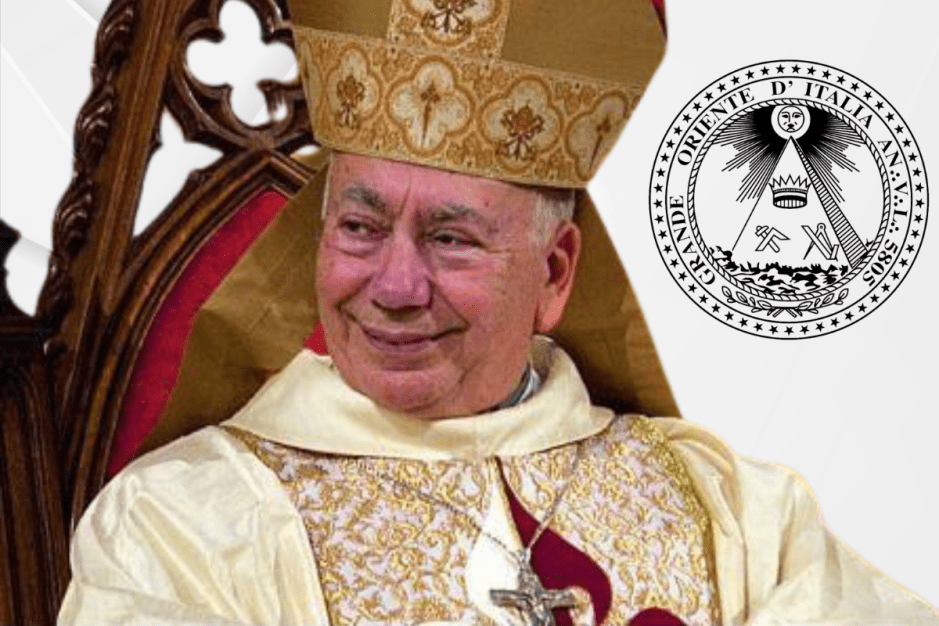
“Let’s start from the things that unite us. This morning three workers died on a construction site in Florence. May this fact unite us in mourning, in the respectful thoughts of three men who leave behind families. I think that strong thoughts should be addressed to the victims and their families.” This is how Grand Master Stefano Bisi began by speaking at the seminar on Church and Freemasonry, wanted by the Catholic association Gris, represented by the national secretary Giuseppe Ferrari, and organized in Milan at the Ambrosianum Foundation with the endorsement of the archbishop of the city Monsignor Mario Delpini, who spoke at the event which was attended among others by Cardinal Francesco Coccopalmerio, former president of the Pontifical Council for Legislative Texts, the president of the Pontifical Academy of Theology Monsignor Antonio Staglianò and Grand Master Bisi, who has always hopes for a thaw in mutual relations, has been the bearer of numerous initiatives to this end and whose dream is, as he revealed in an interview, to walk together with the Pope under the sky of the Great Architect of the Universe.

Below is the speech that the Grand Master gave during the meeting

I would like to thank the Group for socio-religious research and information for this invitation to a meeting which I consider very significant. It is not the first time since I have been Grand Master of the Grand Orient of Italy of Palazzo Giustiniani that I have discussed the complex topic of relations between the Church and Freemasonry. I did it in Turin, Pescara, Arezzo, Matera, Gubbio and I talked about it several times around Italy and before that. I confess to you that the first table I sculpted in my long 41 and a half years of belonging to the Grand Orient of Italy was precisely on this topic. Maybe it was a joke from my older brothers who wanted to better understand why, this young man, I, saw him enter a church for a few minutes which is located along the main street of Siena, along the struscio. The truth is that I wanted to spend a few moments in meditation, away from the noise, the noise of words and chatter. Maybe they wanted to understand why, I, who went to nursery school thanks to a country priest; that I went to middle school thanks to a priest who wanted to help the children of workers, blacksmiths, truck drivers; that I made the first printed newspaper thanks to the parish priest of the neighborhood; my older brothers perhaps wanted to investigate the reason for my choice to seek admission to Freemasonry.

So I’ve been passionate about the topic for a long time. I would like the prelate, the man of the Church in front of me, not to be afraid of me and I would like not to be afraid of him. And I’m pleased to be here today because it means that progress has been made along the path of knowledge and respect. And I hope that the participants in this seminar do not end up in the media pillory as happened to two bishops, from Arezzo and Terni, who participated in public initiatives of the Grand Orient of Italy. Over the course of its more than 300 years of life, no institution has been opposed, fought, mystified, slandered and feared as much as Universal Freemasonry. From the Catholic Church which saw Freemasonry as a potential competitor in the spiritualisation and elevation of Man, to dictators of all colours, up to certain populist political forms which fear the inexhaustible and libertarian strength of its profound human and social charge.

A long history that starts from 1738 and, with ups and downs, between pseudo tolerances and small glimmers of hope, has in fact continued until today without ever resulting in a desirable and true opportunity to change the course of History by opening the doors of constructive dialogue and putting an end to that excommunication which – although attenuated by the modification of article 1374 of the Canon Code with the disappearance of the precise reference to Freemasonry – still hangs over millions of free masons scattered around the globe, many of whom are wondering how to overcome that presumed and substantial dogma of irreconcilability which would preclude any rapprochement between the two realities.

The Church and Freemasonry both place Man at the center of everything, albeit with different bases. For us we must work internally to sublimate his being and strengthen him “in virtue and against vice” to elevate him in that fraternal love aimed at the Good of Humanity and the Glory of the Great Architect of the Universe. The Freemason, who lives in doubt and polishes his own stone, tends towards Good and divine Love by following the steep Path of Knowledge in the constant search for the Truth. By nature and mindset I do not subscribe to the circle of doctors and lovers of irreconcilability, a word that I don’t like and which has never produced bridges on which to unite but has divided men.

I believe, but I use this term only secularly, instead of never thinking that something is impossible to achieve. And, for this reason, in 2016 I greatly appreciated the writing of Cardinal Gianfranco Ravasi, to whom I sent a letter after the publication of his article entitled “Dear Freemasons” in the newspaper “Il Sole24Ore”. On that occasion I too hoped for the path of dialogue and discussion starting from the things that in some way unite the two institutions. Here is what I wrote: “As the president of the Pontifical Council for Culture wisely recalled, citing the document of the German bishops of 1983, the points of contact between Freemasonry and the Church cannot be ignored, which find common values ​​in the community dimension, in human dignity, in fight against materialism, in charity. In this we can have an open and free discussion, maintaining the differences but reducing the distances that the Philippine bishops instead articulate in their document”. But what matters is perhaps starting from a limited reconcilability and discussing it instead of still professing an absolute, intransigent and dogmatic irreconcilability. Who has the Truth? Man or just God? Cardinal Ravasi himself wrote a few years ago: “The Truth is only one but like the diamond has many faces, we can, from our angle of vision, see only one of these faces”. Those who think they see everything and hold the only Truth are therefore deluding themselves. This is why Freemasons with humility and many doubts perpetually seek it, leaving dogmas to others. But always looking for dialogue and discussion with anyone. At that time there was certainly no shortage of criticism of the cardinal and there was no further development of dialogue. And two bishops present at our initiatives at the invitation did not fail to be the target of heavy attacks. In 2019 the then archbishop of Arezzo-Cortona-Sansepolcro Riccardo Fontana went to one of our conferences for the 150 years of the Benedetto Cairoli lodge organized by the Grand Orient of Italy and in the provincial council room he said: “The historical fences remain but we must look forward, to what unites” and subsequently received the reproach and dismay of circles close to the Episcopal Conference, wrote a newspaper. In October 2022 the bishop of Terni Monsignor Francesco Antonio Soddu took part in the inauguration of the Masonic house showing courage and desire for dialogue. They told him all kinds of things. Yet already in the 1960s, during the pontificate of Paul VI, contacts began between a group of priests, such as Rosario Esposito and Giovanni Caprile and the bishop of Livorno Ablondi and the leaders of the Grand Orient of Italy, to understand each other. Numerous meetings followed but then the death of Paul VI stopped the dialogue.

And let’s go to current times. Both during the pontificate of Pope Benedict XVI and that of Pope Bergoglio there was no significant attempt at openness. The then Cardinal Ratzinger, in the role of prefect of the Congregation for the Doctrine of the Faith, intervened with a “Declaration” on 26 November 1983 – approved by Pope Wojtyla – in which he maintained that “the negative judgment of the Church remains (…) unchanged with regards to Masonic associations, since their principles have always been considered irreconcilable with the doctrine of the Church and therefore membership in them remains prohibited”.

The text did not speak of excommunication but added that the faithful registered in the lodges “are in a state of grave sin and cannot access Holy Communion”. Pope Francis made the famous statement “who am I to judge?” at the beginning of his pontificate aimed at homosexuals, he then opened the doors to divorced people but he forgot that among the Freemasons there are also many Catholics who are prevented from receiving communion and when it came to granting credentials to a Freemason ambassador said “no”.

Finally, the last act took place last November with the document made known by the Dicastery of the Doctrine of the Faith signed by Prefect Victor Hernandez with the approval of the pontiff. Catholics remain prohibited from joining Freemasonry. A solution to the problem of reconcilability between the Catholic faith and membership of Freemasonry appears not to be close, through no fault of ours, but in the meantime let’s talk about it. Just like we do today. Let’s start again from what Father Josè Ferrer Benimeli and Father Giovanni Caprile stated: desiring, encouraging, attempting, conducting dialogue prudently “does not mean betraying the Catholic faith, nor opening the doors to presumed enemies, nor giving in to irrefutable ideas. It involves only the patient search for common points of understanding, the desire to exchange the real goods possessed by each, the tension so that the truth (without any possessive adjective) has the upper hand, the search for union for the good of all”.

Freemasonry is a great tree of Freedom that sways in the wind but does not break and continues to work for the good of Humanity by creating better men, available to listen and which makes Tolerance a principle that everyone should practice with great love. This is why we speak today – in broad daylight and without preconceived plans – in the various meetings organized in every part of Italy with exponents of all religions and we strive to find syntheses that can help people overcome prejudices, conflicts, wars, fanaticism and selfishness which are the evil of a Society. Why is the Masonic lodge beautiful and why does the ecclesiastical authorities not like it? Because under the same sky – which represents Creation – every man is the brother of the other, the bond of brotherhood is independent of faith. We just need to believe in the Great Architect of the Universe. The starry sky is the same for the Buddhist, for the Catholic, for the Waldensian, for the Islamic, for all those who believe in a supreme being. For all those who have the awareness that we are a point within something greater which is the universe, which we can call god. And as Vito Mancuso says, “by saying God I mean a reality perceived as bigger and more important than one’s own self. This something more important can be called in many ways, but the essential point is that, by perceiving it, one lives for a different and higher value than oneself”, that is, “the real difference is not between those who believe and those who do not believe, but between those who surpass themselves and those who don’t. Between those who know a god, and those who only know their own self.” In short, look beyond. Towards the sky or infinity, which are the same thing.

We leave our brothers free to adhere to any religion and practice it. Absolute truths and the walls of the mind do not belong to us and must be torn down for us. As for the feared danger for the Church of exposing itself to a dangerous dialogue with the Freemasons because it is against the Faith, I add that I do not think in the slightest that this thesis can lead to such extremes consequences. Reconciliability, on the contrary, if well rooted and illuminated by reason, can only strengthen it. And give all men the opportunity to meet on bridges of light to travel together while respecting the different paths. Our doors are perpetually open. The world has changed, the breach of Porta Pia dates back to 1870 and, as Paul VI said, it is a date desired by Providence because it leaves the spiritual power to the church and the government of earthly things to the civil authority. In 2010 the then Secretary of State Cardinal Tarcisio Bertone went to the Breccia monument together with the President of the Republic Giorgio Napolitano. An important act. And it would be even more significant if tomorrow, February 17, the anniversary of the fire of Giordano Bruno, a man, dressed in white, walked a few hundred meters to gather in front of the Nolan monument. Maybe? I hope that the dialogue continues, I would like the compatibility between belonging to a Masonic lodge and belonging to the Catholic faith to be declared. I say this because the path in this direction is still long, and many brothers experience access to the sacraments in a clandestine way because they know that they are in a state of grave sin. From the canon code the word excommunication has been removed but the effects are the same.

We move forward with tolerance and trust. I want to quote a thought from Luciano De Crescenzo who says: doubt the men who have certainties, they are usually the most intolerant and anti-democratic, however when you encounter question marks, prefer those who have doubts, they are usually almost always people open to dialogue , tolerant.

Well, I prefer these people. And I would like to remember, among these people, Cardinal Carlo Maria Martini who was at home here. I still remember today a response from him in the Corriere della Sera to a reader who wrote to him: “I am an atheist but I see Beauty around me”. Martini replied: “I, a Catholic, and you, an atheist, are fundamentally united by the same wonder of Creation.” This message, which is also a universal response, still seems very beautiful to me today. My wish – which is also a hope – is that one day a Pope and a Grand Master will be able to meet and travel a part of the way together, in the light of the sun. It comes to me to say in the light of the Great Architect of the universe.
Italian Bishop has no scruples about going to the Lodge

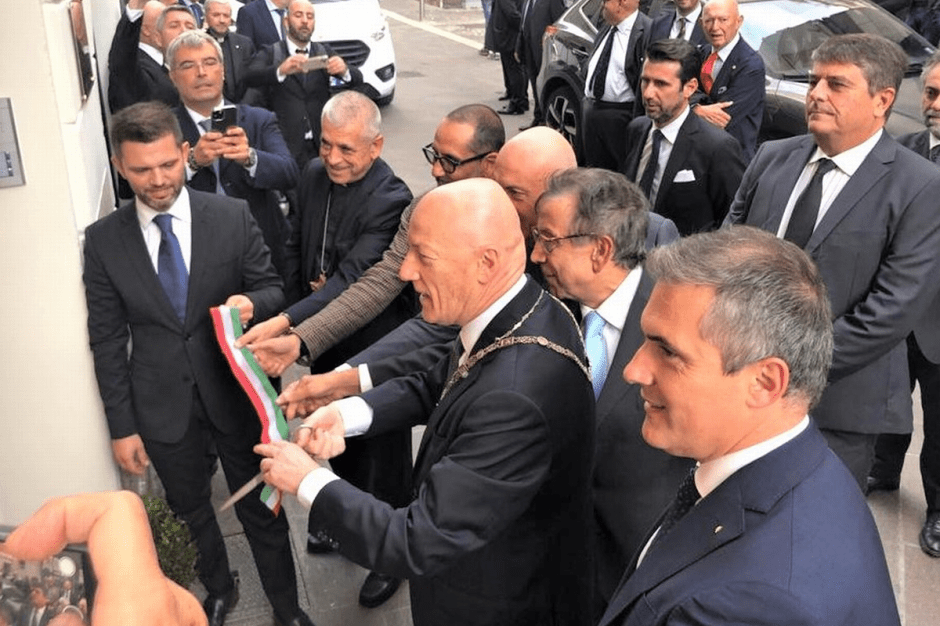
According to LifeSite news, the Bishop was “astonished” at the backlash he received after cutting the ribbon at the opening of a new Masonic temple. “Synodality”, he cried.

“…. astonishment, bewilderment and bitterness are aroused by the instrumental reading, deliberately misunderstood and misinterpreted, of Bishop Soddu’s presence at this circumstance.” The diocese further claimed that the bishop’s purpose at the ceremony was “witnessing fidelity to the Gospel and to the Church, especially in this time of the Synodal path that characterizes it.” 

Rapprochement from 2017

FROM KATHOLISCHES – NOVEMBER 2017

In 2017 the Masonic lodges will celebrate their 300th anniversary. Since 1717 the relationship between Lodge and Church has been rife with tension and conflict. In Syracuse there is a new attempt at an understanding with a spectacular aspect: For the first time a Catholic bishop takes part in a public box event and will discuss with the master of the chair. Some insights into the background of a controversial experiment.

Truth and the search for truth

For the Catholic Church the prescribed relativism and the factually practiced syncretism of the Lodge Brothers are incompatible with the truth of reality revealed by God. The lodges reject this revelation as a truth of faith. The orientation of the lodges is not only deistic, agnostic or atheistic, depending on obedience, but was from the beginning significantly shaped by the esoteric “search” for a “different” truth than the Christian one. In the Catholic states the lodges saw and organized themselves as direct opponents of the church. Following their relativistic credo, they want to eliminate the public influence of the church, which is why Freemasonry has always been attached to a striving for power. This battle has been raging for three centuries.

The history of the lodges, however, also knows the phenomenon of church representatives who allowed themselves to be initiated and thus became apostates according to the church’s understanding. Your covert work in the church as “agents of the lodges” is still awaiting investigation. A particularly striking example is the magnificent Benedictine Abbey of Melk on the Danube. At the end of the 18th century there was not only a monk’s convent in the monastery, but also a lodge. A part of the monks belonged to her and thus formed a convention of the “initiates” in the convent.

The status as a secret society, to which the lodges cling to this day, allows the abbreviated brothers undetected to infiltrate other organizations, parties and churches and to create an invisible network.

“Relaxation Exercises” after the Council

One consequence of the Second Vatican Council it was that lodge-friendly church districts ventured with newfound confidence from obscurity. The 1970s were marked by efforts, also in the German-speaking area, to bring about a “reconciliation” between lodge and church. Faithful bishops in the countries and the election of Pope John Paul II put an end to these attempts in the early 1980s.

Lists of alleged or actual church representatives, including cardinals, who are said to be lodge members, circulate repeatedly. The sociologist of religion, Massimo Introvigne, warned against false suspicions and in May 2013 formulated a sure way to clarify the suspicion of lodge membership:

“The crucial core of Masonic ideology is relativism, with all the related political implications, which often lead Masonic obedience to promote laws to legalize abortion, euthanasia, and gay associations. So if you hear about a Catholic church representative or politician saying that he is a Freemason, the question should be: does he represent relativistic ideas? Is he an abortion advocate? Is he in favor of euthanasia or the legal recognition of gay partnerships?

If the answer is ‘yes’, then he is – according to the definition used by the current Grand Master of the Grand Orient of Italy – a ‘Freemason without an apron’, a companion of Freemasonry, and the question of whether he has an official membership card or not is then only secondary.

If the answer is ‘no’ and the church official or Catholic politician openly opposes relativism and its consequences, then there is good reason to conclude that the allegations are defamatory. “

New signals of rapprochement

Although Freemasonry failed 35 years ago in its attempt to be recognized by the Church, the Lodge Brothers have neither given up their fight for repression against the Church, nor have they tried to make them spiritually submissive to their thinking. Since Pope Francis was elected, the curtailed or unvarnished “brothers” believe they see a new opportunity outside and inside the Church .

Among the signals that point in this direction include not only praise of the pope from Latin America, but also the sensational letter from Cardinal Gianfranco Ravasi to the ” Brethren“.

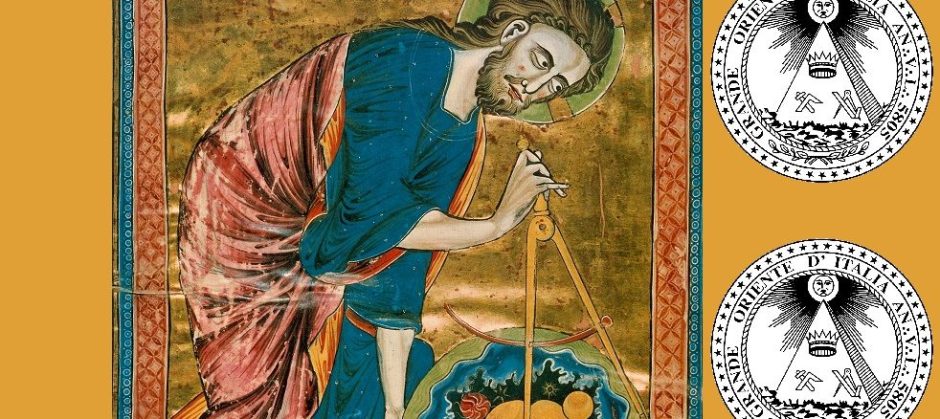
The latest example is a discussion meeting of the Masonic Grand Orient of Italy , to be held at Syracuse next November 12 in the cathedral square. The invitations show Jesus Christ with a compass in hand, a typical Masonic instrument. The circle is one of the “three great lights” of Masonic symbolism, which lies on the altar in the lodge temples.

The theme of the event is: “ Church and Freemasonry – so close, so far? “The portrayal of Jesus is part of the title picture showing the creation of the world. The representation has nothing to do with the Lodge Brothers and their world of ideas. It was created around 1220, 500 years before Freemasonry was founded. The panel discussion is part of the 300-year-anniversary celebrations of the Grand Orient.

The purpose of the event is to present an understanding between lodge and church as possible. It gives the impression of a compatibility that the Church has rejected for 300 years.

Despite the provocative image and an even more provocative title, a Catholic bishop will take part in the discussion. Msgr. Antonio Staglianò, Bishop of Noto and Msgr. Maurizio Aliotta from the Archdiocese of Syracuse will discuss with two Honorary Grand Masters of the Greater Orient, Santi Fedele and Sergio Rosso. The host is the Master of the Chair of Syracuse, Alessandro Spicuglia.

“Communitarianism” as common ground?

Nuova Bussola Quotidiana (NBQ) reports that there are violent protests from devout Catholics against the event. People ask the Archdiocese of Syracuse what this “hug” is about with an organization condemned by the Church.

“It’s about an organization that in southern Italy has always had to do with (often occult) power and always had an esoteric streak between rites and brotherhood that was never really revealed.”

The Catholic Internet newspaper asked Bishop Staglianò what his participation was about. The bishop referred to the spectacular and equally controversial letter from Cardinal Gianfranco Ravasi to the “Brothers Freemasons”. The chairman of the Pontifical Council for Culture had “clearly shown” that there could be similarities between the Church and Loge, namely the “communitarianism”. Bishop Staglianò said:

“I assume that he meant the opposition to unbridled individualism, anti-materialism, a certain idea of spirituality and finally also the philanthropy, that is, the solidary aspect.”

However, the Church gave a negative answer to all these alleged “similarities”, which not least had to do with the “danger of a relativistic and deistic methodology”, according to NBQ, which the lodges are trying to do.

“Hug process in progress”

“The reality is that there is a hugging process going on today,” NBQ said. The most recent example: On the discussion in Syracuse, there appeared in the daily newspaper of the Italian Bishops Conference an article by the priest Ennio Stamile, who argued for the “dialogue” with the Freemasons. Bishop Staglianò was one of his theology professors, the priest defends the bishop’s participation. Stamile also refers to Pope Francis, who called for a dialogue “with everyone, no one excluded”.

The priest accuses the critics of rapprochement as “ignorant” and “superficial” because they “have no idea” about Freemasonry. The claim that the lodges are a “power lobby” is a fairy tale that must finally “disappear”.

Fr Ennio Stamile is one of the most famous priests in southern Italy. He is chairman of the Libera Calabria (Free Calabria) association, an umbrella organization “against the Mafia”. The association proves to be a firmly integrated part of the political left through language, symbols, actionism and contacts, and in any case it is fully recognized by this side. Stamile comes from the circle of Don Ciotti, the founder of the association, whom Pope Francis kissed on the hand in March 2014.

The union has received several hundred hectares of agricultural land by the state, confiscated from the members of the ‘Ndrangheta. The ‘Ndrangheta is the group of organized crime in Calabria and the Mafia in Sicily is comparable. The association runs farms on these areas with those who have been released from prison, former drug addicts, immigrants and those who have dropped out of the Mafia.

Lodge and Mafia?

Don Stamile’s request to speak is important not only because of his anti-Mafia reputation. His partisanship for the dialogue with the lodge is interesting. More information could explain this and open the door to a remarkable circular if the entanglement with organized crime – mafia and lodge are “occult” powers, as it has already been said – may even be a regional problem.

Since the 1960s there have been indications that mafia bosses have entered the lodges. Within the Calabrian mafia, the ‘Ndrangheta, there were violent conflicts about it. The initiative for this cooperation seems to go back to Gioa Tauro’s boss, Girolamo Piromalli (1918–1979).

Since then, investigative files by the public prosecutor have repeatedly referred to a “mass mafia”, a merger of Freemasonry and mafia into a Masonic mafia. 2014 protocol extracts were the interrogation of the former Grand Master of the Grand Orient of Italy, Giuliano Di Bernardo (1990-1993), known. Di Bernardo left the Grand Orient in the wake of the scandal surrounding the mysterious Propaganda Due Lodge (P2). Today he is Grand Master of the Grand Lodge of Italy . According to the data Di Bernardo early 90s were 28 of 32 Calabrian boxes from , ‘Ndrangheta has been inspected.

In 2007 mafia boss Sebastiano Altomonte said in a conversation with his wife that had been recorded by the police through acoustic room surveillance:

“There is one you know about and one you don’t know about. There is the visible and the invisible that nobody knows about, except the invisible. “

The statement has been associated with the “Santa” – the group created by Girolamo Piromalli at the highest management level; the ‘Ndrangheta , whose members are all members of Freemasonry. However, this thesis has not yet been confirmed in a court-relevant manner.

In a conversation between mafia boss Pantaleone Mancuso, overheard by the police in 2013, said during a walk:

“The ‘Ndrangheta no longer exists… It once existed. Today ‘Ndrangheta is part of Freemasonry … Let’s put it this way: It is under Freemasonry but has the same rules! … The ‘Ndrangheta no longer exists, all that remains are Freemasonry and the four idiots who still believe in the’ Ndrangheta. “

Against this background, the words of Don Ennio Stamile may have a slightly different meaning, who mentions a connection between Mafia and Freemasonry in his statement, but dismisses it as an invention and attempt at disinformation by people who want to become something without “merits and competencies” and by to whom the Church is not free either.

But it is also a fact that the former President of the Higher Regional Court of Catanzaro (Calabria) and Honorary President of the Supreme Court of Italy, Giuseppe Tuccio, has to answer in court for membership of the Mafia. It was only in 2016 that Tuccio, who was not unknown to Libera Calabria , published a book about the fight against the Mafia. “The Piromalli had judge Tuccio, a Freemason, in their hands,” a key witness had testified in a court case. Even in the wheels of justice of senior judges came in the wake of anti-mafia Operation Gotha .

Bishop Staglianò: Hans Küng and “why I talk to the Freemasons”

But back to the discussion event in Syracuse. Bishop Staglianò justifies his participation with a statement from Pope John XXIII: “Let us look more for what unites us than what divides us.” Despite all condemnations by the Church, especially Leo XIII. With the encyclical Humanum genus and the letter Inimica vis , or the declaration of the Congregation for the Doctrine of the Faith of 1983, the bishop sees no problem in “having a dialogue with the lodge brothers, for example when these Freemasons should organize themselves to fight against injustice “. It should be examined where one can act together for the “common good”.

The question remains, according to NBQ, what “common good” means from a Catholic point of view and what it means, however, from the point of view of Freemasonry. Bishop Staglianò admitted that he was not “competent” to answer this question. Literally he let it be known:

“Look, I don’t know anything about Freemasonry. I am in the process of reading up, starting with the Congregation for the Doctrine of the Faith declaration [from 1983]. I think that one can have no other opinion on the condemnation of the Masonic theses. I will say more: it is the first time that I have found myself in the situation of speaking to Freemasons. I think that I will begin my remarks with the text by Hans Küng on the ‘Magic Flute’ by Mozart, who was both a Freemason and a Christian. But we cannot ignore the church at the time of the genius from Salzburg as a bureaucratic institution. Not true?”

Criticism of the “integralist” dialogue

NBQ asks whether it is “credible” when a recognized theologian and bishop like Staglianò describes himself as “not competent”. The bishop’s statement could also be seen as a provocation, since he seems to be saying one thing in a few sentences but seem to mean the opposite.

When asked about the Freemason’s invitation with the representation of Jesus Christ, the bishop said that this “does not scandalize” him:

“Didn’t Arius also attribute the cosmogonic traits of a demiurge to Jesus? If Arius made a mistake, it was – if he did – that he did not ascribe God’s features to the demiurge. “

And further:

“I will go like Jesus to the tax collectors and prostitutes and proclaim Christ. The Freemasons will then determine how close or how far they are to this proclamation. “

Bishop Staglianò condescendingly described criticism of the dialogue with the Freemasons as “stupid, superficial and integralistic”. He used one of those “magical” terms with which progressive church circles bludgeon devout Catholics. Ultimately, the bishop insulted the popes of the past 300 years, who condemned Freemasonry, as “stupid, superficial and integralist”. Leo XIII. wrote in Humanum genus :

“The sect is, according to its whole being and its innermost nature, corruption and vice; therefore it is not allowed to join her and to be of any help. “

Finally, Bishop Staglianò also refers to Pope Francis, who urged to go to the “existential fringes”, “and Freemasonry seems to be one”.

Is the Church still equipped for “dialogue” with Freemasonry?

The question that remains, according to NBQ, goes beyond Bishop Staglianò. In the past few years the church has tried to hardly speak about the Freemasons anymore. The intellectual and scientific preoccupation with the lodges at the relevant academies, institutes and faculties had almost completely come to a standstill. There are hardly any more coherent and thorough studies on the subject. The declaration by Paolo Maria Siano, of the Franciscan Friars of the Immaculate, form a remarkable exception.

It is almost as if one does not want to be labeled with the stigma of a “conspiracy theorist”. However, the boxes are a reality, as the celebrations show. Other church districts have elevated dialogue to the “highest dogma” in which they believe, which is why any form of exclusion is frowned upon – at least any form contrary to the spirit of the times. The attempt at a more or less open distancing from the past with its condemnations of Freemasonry is obvious. This raises the question of “how the Church wants to meet Freemasonry, since its younger representatives have hardly any knowledge of the Lodge and reflexively tend to dismiss criticism of it as a“ yesterday’s conspiracy theory ”of an“ integralism ”that has been overcome.

The signals for a new “dialogue” are increasing, although the church staff seem less and less prepared for it. Or is the willingness to dialogue growing parallel to the loss of knowledge?

Dazu NBQ:

“Dialogue is not a gospel term. Does the church want to use the excuse of dialogue – after the radicals, the Protestants, the anti-clerical atheists and the plutocratic elites – to break the last taboo that lodges, which were once enemies, are now only ‘different’? “

Text: Giuseppe Nardi
Image: Wikicommons / Grande Oriente d’Italia (Screenshots)

(Note – the original article was published in German. An online translation rendered some phrases unintelligible.)