PART I
When someone uses the term, ‘Synarchy’ he or she is generally referring to one of two things. It may be that they mean the general concept of a technology-based rule by a minority, which is also synonymous with technocracy. Or they may mean something more specific: a group of high-level occultists who seek to manipulate the world using Luciferian powers, and who infiltrate governments, institutions and religious organisations in order to create their own totalitarian, globalist World Order. It is this second meaning, a specific secret society with their specific goal of world governance, to which this article refers.
Although these days, there are very few who acknowledge that the shadowy figures behind the New World Order are Synarchists, there were, in the past, a number of writer and investigators who exposed Synarchy in all its brutal reality. One of these was the Catholic author, Pierre Virion, who wrote extensively on Synarchy and the New World Order during the 1970’s.
In his book, Mysterium Iniquitas, Virion wrote that Synarchy is defined as:
a set of occult powers of all orders and of all schools united to contribute to the formation of an invisible world government. Politically, it is the desired integration of all the social and especially financial powers, forming this government in a generalized, technicalized socialist regime, extending to the world divided into geo-political zones.”
Virion continues,
Catholicism would be like all religions reputed to be equal, absorbed in a universal syncretism.
Looking at Virion’s definition, it becomes immediately obvious that the goals of Synarchy coincide precisely with the goals of Freemasonry: a universalist world religion in which the Catholic Church is no longer seen as the One, True Faith. This is the end goal of the false ecumenism which is so prevalent in the Church today, and indeed, the ecumenical movement grew out the false ideas of the Synarchists.
The religion of Synarchy itself sprang from the Lodges and, as we will eventually see, influenced the Masons to work with the Catholic Church, rather than trying to annihilate Her, as had previously been their plan.
Another early writer on Synarchy was Fr Gruber, who described it as: “a centralized world state with a centralized government planned as an anti-church.” (Athanasius and the Church of our Time p 31)
Thus, is can be seen that Synarchy is a form of Freemasonic totalitarian government, the religion of the Technocrats. Rather than being a purely spiritual movement, Synarchy seeks to employ financiers, industrialists, technocrats as well as spiritual leaders to force compliance on the populace. This is the dark and sinister end-game of globalist entities such as the World Economic Forum, the Bilderbergers, the Council on Foreign Relations and the United Nations for which the hysterical COVID ‘pandemic’ was a trial run.
[Note: In Europe, the media sometimes uses the term “synarchy” to describe any kind of conspiracy or cartel.]
The Goal of Synarchy
It is important to realise that within the dark and shadowy world of the the secret societies, there are not always bright lines delineating particular philosophies and denominations. There is a great deal of overlap, with shifting loyalties, degrees of understanding by adherents, a constant splintering and restructuring within groups with everything veiled in the utmost secrecy.
Individual initiates join the various groups for a variety of reasons – none of which may be related to world domination or even to the occult. This is particularly true of the lower levels of Freemasonry, when members may be interested purely in fostering business relationships. Even though they necessarily become involved in occult rituals, these men and women may not even realise the fact.
There are certain groups, however, whose membership is limited to those specifically pursuing esoteric knowledge. These include the Rosicrucians, the Martinists, members of the Order of the Golden Dawn and the OTO, Theosophists and so on and they are under no illusions about the true source of any power they may acquire. The Synarchists are part of this latter group, and its leaders are part of the highest level of occultists: those in direct communication with satan.
The common thread in all these brotherhoods is the source of the anti-Christic inspiration behind them. Although each adherent may perform a different series of rituals and be influenced by a completely different set of philosophies and personalities, the end goal of the demonic intelligence behind all of them is the same: the total enslavement of the human race to satan using technology and every other lever of power in society.
This is the diabolical inversion of the reign of Christ the King: the reign of satan as lord of the world. Every secret society is in some way contributing to that goal, whether or not the individuals within those groups understand it.
The History of Synarchy
Given the secretive nature of Synarchy, there will always remain some aspects and personalities that are unknown to us – especially those at the ‘top’ for whom their involvement would compromise their ability to work behind the scenes.
There are many men from the past, however, whose involvement is documented; they are the founders of Synarchy and their disciples. These include the defrocked Abbé Roca, Joseph Alexandre Saint-Yves Alveydre, and Raoul Husson. (Each of these has a separate page which can be accessed by clicking on their name.)
Joseph Alexandre Saint-Yves d’Alveydre was an occultist who was active at the turn of the 19th Century. He is credited as being the founder of Synarchy because he was the first to record its doctrines. According to Saint-Yves, the principle tenet of Synarchy was to pursue a world government with a world religion which was a mixture of the major spiritualities, including Christianity, Buddhism, Hinduism, Judaism and Islam. This world religion would be based on superstition and esotericism, rather than on any true supernatural belief.
Out of Saint-Alveydre’s teachings came the Martinist Order, founded by another occultist named Gerard Encausse, also known as Papus. One of the chief aims of this order was to form a “United States of Europe.” Saint-Yves had this idea as did his friend, Victor Hugo. Some say the Martinists also wanted to unite all occultists into a reformed Rosicrucianism, making Russia a link between East and West. Martinists initiated only master Masons into their brotherhood.
Synarchy then became linked with the rise of Fascism, especially in Italy and with the Pan-European movement. An International Synarchist Movement was founded in 1919 to counter the rise of Communism after the Russian Revolution. There also seems to have been some influence by Synarchists on the ideology of Nazism.
The death of Encausse in 1916 led to a rupture among the Martinists due to the aversion of some to be involved in politics. The political Martinists went on to form the Martinist and Synarchic Order in 1921, headed by Victor Blanchard, who was another friend of Saint-Yves.
Blanchard was the secretary to the French government’s Council of Ministers and was also a member of the Polaire Brotherhood, a mysterious group which apparently received its orders via the Ouija Board.
Blanchard went on to form the Synarchic Central Committee in 1922, followed by the Synarchic Revolutionary Convention, in order to enlist fresh young blood from the business and bureaucratic worlds.
United Europe – the Synarchist Pact
From the 1930’s, the explicit idea of a United Europe became a theme among the Synarchists. A document known as the Synarchist Pact was written (possibly) by the occultist, Vivien Postel du Mas, in 1930 and this became a platform for the various Synarchist groups. The Pact was kept so secret that its existence remained unknown until 1941.
The Pact described the Synarchists’ plan to infiltrate governments and first take over France then form a “European Union.” Postel du Mas held soirees in his apartment where information from the “secret master” was delivered through a medium. It is said that the meetings were attended by “men of science, company directors and bankers.”
The Synarchist Empire Movement was formed in 1932 by Postel du Mas and another occultist, Jeanne Canudo. Their own secret society had the stated aim of influencing politics and the economy using spiritism. This group was responsible for much of France’s right-wing terrorism initiated by groups such as CSAR, the Secret Committee for Revolutionary Action, during the 1930’s
The movement to unite Europe continued unabated and from 1932 was spearheaded by Count Richard Coudenhove-Kalergi of Austria under the banner of the Pan-European movement. Coudenhove-Kalergi became extremely influential: Otto von Hapsburg referred to him as “guide and prophet” of a United Europe while even Winston Churchill was influenced by him and in 1953, wrote the foreword to the Count’s book.
Churchill also began to promote the idea of a united Europe. One of Coudenhove-Kalergi’s ideas, that of dividing the world into “five Imperial federations” was found in the Synarchic Pact document.
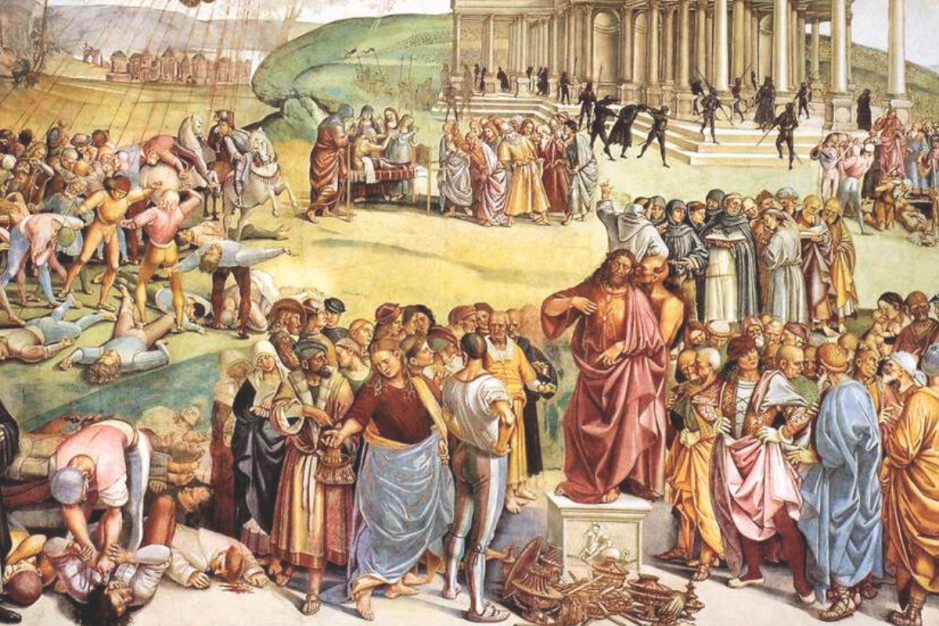
IMAGE CREDIT: Luca Signorelli: Sermon and Deeds of the Antichrist – Wikimedia


 Ecclesiastical Freemasonry