Extract from Jesus and Israel: A Call for Necessary Corrections on Christian Teaching on the Jews, published in 1948 (Impact-Site-Verification: 8dad7fd3-e727-499b-bef3-6d8d25dba811)
For purposes of greater clarity, may I be allowed to submit for the examination of Christians of good will—who are agreed in principle on the need for rectification—the following Eighteen Points, meant to serve at least as a basis for discussion.
Christian teaching worthy of the name should
give all Christians at least an elementary knowledge of the Old Testament; stress the fact that the Old Testament, essentially Semitic—in form and substance—was the Holy Scripture of Jews before becoming the Holy Scripture of Christians;
recall that a large part of Christian liturgy is borrowed from it, and that the Old Testament, the work of Jewish genius (enlightened by God), has been to our own day a perennial source of inspiration to Christian thought, literature, and art;
take care not to pass over the singularly important fact that it was to the Jewish people, chosen by Him, that God first revealed Himself in His omnipotence; that is was the Jewish people who safeguarded the fundamental belief in God, then transmitted it to the Christian world;
acknowledge and state openly, taking inspiration from the most reliable historical research, that Christianity was born of a living, not a degenerate Judaism, as is proved by the richness of Jewish literature, Judaism’s indomitable resistance to paganism, the spiritualization of worship in the synagogues, the spread of proselytism, the multiplicity of religious sects and trends, the broadening of beliefs; take care not to draw a simple caricautre of historic Phariseeism;
take into account the fact that history flatly contradicts the theological myth of the Dispersion as providential punishment for the Crucifixion, since the Dispersion of the Jewish people was an accomplished fact in Jesus’ time and since in that era, according to all the evidence, the majority of the Jewish people were no longer living in Palestine; even after the two great Judean wars (first and second centuries), there was no dispersion of the Jews of Palestine;
warn the faithful against certain stylistic tendencies in the Gospels, notably the frequent use in the Fourth Gospel of the collective term “the Jews” in a restricted and pejorative sense—to mean Jesus’ enemies: chief priests, scribes, and Pharisees—a procedure that results not only in distorting historic perspectives but in inspiring horror and contempt of the Jewish people as a whole, whereas in reality this people is in no way involved;
state very explicitly, so that no Christian is ignorant of it, that Jesus was Jewish, of an old Jewish family, that he was circumcised (accordsing to Jewish Law) eight days after his birth; that the name Jesus is a Jewish name, Yeshua, Hellenized, and Christ the Greek equivalent of the Jewish term Messiah; that Jesus spoke a Semitic language, Aramaic, like all the Jews of Palestine; and that unless one reads the Gospels in their earliest text, which is in the Greek language, one knows the Word only through a translation of a translation;
acknowledge—with Scripture—that Jesus, “born under the [Jewish] law” (Gal. 4:4), lived “under the Law”; that he did not stop practicing Judaism’s basic rites to the last day; that he did not stop preaching his Gospel in the synagogues and the Temple to the last day;
not fail to observe that during his human life, Jesus was uniquely “a servant to the circumcised” (Rom. 15:8); it was in Israel alone that he recruited his disclples; all the Apostles were Jews like their master;
show clearly from the Gospel texts that to the last day, except on rare occasions, Jesus did not stop obtaining the enthusiastic sympathies of the Jewish masses, in Jerusalem as well as in Galilee;
take care not to assert that Jesus was personally rejected by the Jewish people, that they refused to recognize him as Messiah and God, for the two reasons that the majority of the Jewish people did not even know him and that Jesus never presented himself as such explicitly and publicly to the segment of the people who did know him; acknowledge that in all likelihood the messianic character of the entry into Jerusalem on the eve of the Passion could have been perceived only by a small number;
take care not to assert that Jesus was at the very least rejected by the qualified leaders and representatives of the Jewish people; those who had him arrested and sentenced, the chief priests, were representatives of a narrow oligarchic caste, subjugated to Rome and detested by the people; as for the doctors and Pharisees, it emerges from the evangelical [Gospel] texts themselves that they were not unanimously against Jesus; nothing proves that the spiritual elite of Judaism was involved in the plot;
take care not to strain the texts to find in them a universal reprobation of Israel or a curse which is nowhere explicitly expressed in the Gospels; take into account the fact that Jesus always showed feelings of compassion and love for the masses;
take care above all not to make the current and traditional assertion that the Jewish people committed the inexpiable crime of deicide; and that they took total responsibility on themselves as a whole; take care to avoid such an assertion not only because it is poisonous, generating hatred and crime, but also because it is radically false;
highlight the fact, emphasized in the four Gospels, that the chief priests and their accomplices acted against Jesus unbeknownst to the people and even in fear of the people;
concerning the Jewish trial of Jesus, acknowledge that the Jewish people were in no way involved in it, played no role in it, probably knew nothing about it; that the insults and brutalities attributed to them were the acts of the police or of some members of the oligarchy; that there is no mention of a Jewish trial, of a meeting of the Sanhedrin in the fourth Gospel;
concerning the Roman trial, acknowledge that the procurator Pontius Pilate had entire command over Jesus’ life and death; that Jesus was condemned for messianic pretensions, which was a crime in the eyes of the Romans, not the Jews; that hanging on the cross was a specifically Roman punishment; take care not to impute to the Jewish people the crowning with thorns, which in the Gospel accoounts was a cruel jest of the Roman soldiery; take care not to identify the mob whipped up by the chief priests with the whole of the Jewish people of Palestine, whose anti-Roman sentiments are beyond doubt; note that the fourth Gospel implicates exclusively the chief priests and their men;
last, not forget that the monstrous cry, “His blood be on us and on our children!” (Mt. 27:25), could not prevail over the Word, “Father, forgive them; for they know not what they do” (Lk. 23:34).
Unpublished Testimony of Fr. Malachi Martin, Taken from L’Eglise Eclipsee. TRanslated from the French by online translation tool.
Malachi Brendan Martin S.J. : July 23, 1921 ~ †July 27, 1999 Born in County Kerry, Ireland, he studied at the Catholic University of Louvain, Belgium. There he received doctorates in Semitic language, archeology and Oriental history. He then studied at Oxford and at the Hebrew University in Jerusalem.
Ordained as a priest on August 15, 1954, he was a Jesuit priest in Rome from 1958 to 1964, and carried out certain delicate missions for Cardinal Augustine Bea, for whom he was private secretary, and Popes John XXIII and Paul VI. Relieved in 1964 by Paul VI of his vows of poverty and obedience at his own request, he moved to New York and became an international author of bestsellers, fiction and non-fiction. One of his favourite subjects is the Third Secret of Fatima, about which he spoke at length in his works. He recalls that what is most frightening is that it is apocalyptic and corresponds to the eschatological texts of the Holy Scriptures.
We approach this study through the testimony of Father Malachi Martin, who was extremely kind enough to sign his declarations. As he was secretary to Cardinal Bea, and the latter played a major role in the founding of the new “conciliar church”1, as well as in the execution of the plan by enemies of the Church, his testimony is both of great interest and extreme seriousness. This is why we will avoid mentioning the names of the people directly concerned by this investigation; except, of course, Father Malachi Martin himself. Some told us they didn’t really agree with some of the Father’s statements. We point out that it is necessary to distinguish, in this testimony, the events he relates from his personal opinions, which we are not obliged to follow. What seemed important to us in the context of this work are the objective facts that it reports.
It all started with an article entitled “Is the Pope Cardinal Siri?” » signed L.H. Rémy, of which here is the reproduction:
“In one of his writings, Prince Scortesco, first cousin of Prince Borghese, President of the Conclave having elected Montini to the Supreme Pontificate, gives the following information concerning the conclave of June 21, 1963: “During the Conclave, a cardinal left the Sistine Chapel, met the representatives of B’naï B’rith2, announced to them the election of Cardinal Siri. They responded by telling him that the persecutions against the Church would resume immediately. Returning to the conclave, he had Montini elected.”
Visiting Monsieur de la Franquerie in November 1984, with my friend Francis Dallais, we spoke again about this serious problem. Monsieur de la Franquerie, in 1963, was in close contact with numerous Roman prelates, and he confirmed to us that he had heard confidences from reliable and well-informed people who had knowledge of these facts.
To find out for sure, e decided to go see Cardinal Siri in Genoa. Monsieur de la Franquerie, having had the opportunity in the past to meet him and have friendly conversations with him, wrote to him to ask for an audience which the cardinal granted us on the Friday following Ascension 1985.
This is how on May 17, 1985, we found ourselves at my home in Lyon: Monsieur de la Franquerie and Francis Dallais. The evening was wonderful. I admit that I am sensitive to the very old French charm of our dear Marquis and that we spent, until very late in the night, unforgettable moments listening to him tell us his memories of a fruitful life and well filled. Whether it is his memories of Monsignor Jouin, Marshal Pétain or Pius XII, Monsieur de la Franquerie is inexhaustible and fascinating.
The next morning we left early for Genoa where the Cardinal was waiting for us around 10 a.m. and granted us a two-hour audience. We were received with great attention in the magnificent Episcopal Palace of Genoa. The Cardinal, who speaks French very well, was warm, attentive and had a courtesy typical of these people, great in office, but even more so in heart.
A dialogue then began between these two respectable people in a diplomatic language that I did not know and which is of a charm, of a delicacy, the fruit of the education of hundreds of years, and unfortunately disappeared from our days.
Giuseppe Cardinal Siri
They talked about several current or past problems, useless to recount today. As far as we are concerned, we had agreed the evening before to first talk about the exit, during the Conclave, of Cardinal Tisserand. Recalling this story, Cardinal Siri’s reaction was clear, precise, firm and indisputable: “No, no one left the Conclave.” He can only testify to what he saw and not to what might have happened in his sleep or behind his back. But what caught our attention was this firmness, this categorical ‘no’ from the Cardinal.
Moments later, when asked if he had been elected pope, his reaction was completely different. He began by remaining silent for a long time, he raised his eyes to the sky with a grin of pain and sorrow, clasped his hands and said, weighing each word with gravity: “I am bound by secrecy.” Then, after a long silence, heavy for all of us, he continued: “I am bound by secrecy. This secret is horrible. I could write books on the different conclaves; very serious things have happened. But I can’t say anything.”
Let’s think. If he had not been elected pope, he would have said it with as much promptness and firmness as the previous question. Having been elected, he could not say it, bound by secrecy, and, not being able to lie, he took refuge behind this secret.
In fact, it turns out that someone close to me who knew him closely assured me that the Cardinal told them that he had been elected pope twice: in place of Paul VI, and Wojtyla. The first time he refused, the second he was forced to refuse under threat of schism!
We three witnesses were left very shaken and practically convinced of his election.
And then serious questions arise. Did he resign? Was he forced to resign? What about these elections? What heavy secrets weigh on him? During the last Synod, he stayed a few hours and left. Despite his advanced age and the fact that he was over 75, he did not resign and it was not demanded. So?
As he was the last cardinal appointed by Pius XII, we leave it to historians and theologians to study this problem in depth and respond to it. We simply leave this grave testimony3. In the week following the publication of this article, Monsieur de la Franquerie received two telephone calls from Rome, proving that even a small, very confidential magazine was read in the Vatican. The correspondents wanted to know if the article was serious, which Monsieur de la Franquerie confirmed to them.
The article was then translated into English, German, Spanish, Italian and distributed everywhere, so much so that one day a priest asked for a meeting with the director of the magazine. This priest was sent by Father Malachi Martin, a Jesuit, living in New York.
He met him to let him know from Father Malachi Martin, present as an interpreter at the last conclaves (speaking several languages), that what he had written was true. He supplemented this information with an important element: namely that Malachi Martin had to translate a message intended for Cardinal Siri, which contained exactly this sentence: “If you accept the pontificate, we will retaliate against your family.”
During May 1996, one of our friends, who was in the United States for a few months, took the opportunity to go see Father Malachi Martin. He took the initiative to ask him a few questions in writing. Here is the report of the visits, the questions and the answers as they reached us.
First interview on June 3, 1996 in New York
“Malachi Martin lives in the United States. He always says his Mass, confesses and sees people. He is seventy-five years old and in his right mind.
I introduced myself as a friend of friends of the Marquis de la Franquerie. This was enough for him to put things in perspective. (…) Almost by himself, he told me about the Conclaves he experienced. I asked him two or three questions. He told me that Cardinal Siri was indeed elected pope in place of Paul VI and John Paul II and that he refused twice because of threats made against him and his family. He came from a great family from Genoa. During the two Conclaves, none of the cardinals went out. These threats were made to him by another cardinal.
I didn’t dwell too much on the subject and we talked about the crisis in general. Then, on his own, while he was talking about John Paul II, about the fact that he did not govern and that he did not believe in his infallibility, that the Church was governed by the bishops. He told that ultimately all this posed serious problems: that all the ordinations of priests by John Paul II were invalid and that the faithful were lost.
I asked him the question again: “So you say that all of this is invalid?” He answered me with great simplicity and assurance: “But yes, since the sacrament was changed at the Council”4.
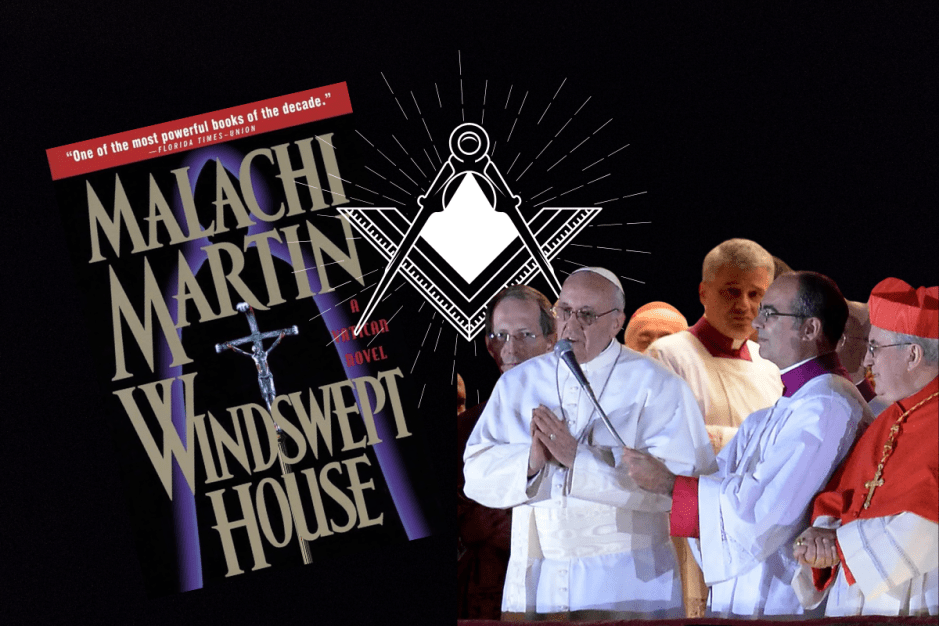
So I told him that we should write all this down and he told me that he is writing a new book on this subject. At the same time he dedicated his latest book to me in English, which will be translated into French: “Windswept House”.
“Then we talked about this and that. He told me that the Abbot of Nantes had come to see him and asked him to insert a page about his community and himself in one of his books, but that he had to refuse. He knew Mgr Guérard des Lauriers, Mgr Ngo Dhin Thuc and many people.
I asked him what he thought of the consecrations carried out by Mgr Ngo Dhin Thuc. He thiinks they are completely valid. He believes that there are currently some 57 bishops who have been consecrated in this way. He asked me if Bishop Williamson is a “sedevacantist” at heart or not. I told him that in any case, he is, as are others, but that he doesn’t say it and that Bishop Fellay claims to have relations with “undeclared sedevacantists”. He invited me to come back and see him – which will happen very soon.”
Second interview of September 12, 1996 in New York
“In my last story I forgot to mention that Cardinal Ottaviani had probably been blackmailed in his last days so that he would accept the Novus Ordo, otherwise he would not be given the last sacraments.
This Thursday evening, Malachi Martin had prepared the written answers to the questions that I had asked him in writing by mail some time before. This with the aim of possible publication. He warned me that our interview will not be long because he was to receive a prelate from Rome in an hour.
John Paul II signed an official document authorizing a Conclave to depose the pope on grounds of physical incapacity or health. So much so that we only talk about the Conclave in Rome… but the next one will be worse and so will the situation!
In addition to the written responses, we took up some of them orally. In particular the question of the Conclave. He described to me again how Cardinal Siri’s refusal happened: “After having been elected Pope and having read a paper which had just reached him, in an envelope, from the rank of cardinals, one of the three cardinals presiding the Conclave approached to ask him according to the consecrated words if he agreed to be pope. At that moment, Siri stood up stiff as a stick and pronounced the Latin phrases of refusal in an impersonal and cold tone as if he were forced. The reason he gave for his refusal was propter metum, that is to say ‘because of fear’.” At this moment, Malachi Martin told me that, canonically, this way of responding could have been a reason to invalidate the Conclave5.
I asked him: “Who did this paper come from?”
He answered me: “It came from the cardinals, probably from Cardinals Villot and …..6..In any case it was the expression of the refusal of the Special Lodge. This Lodge is reserved in Rome for cardinals in close contact with the Grand East. John XXIII and Paul VI were part of the Special Lodge.”
I asked him to confirm: “Was John XXIII a Freemason?” He replied: “On the membership of John XXIII in Freemasonry, all the proofs are in the Vatican archives, jealously guarded by Cardinal Sodano. He himself saw photos taken by his driver revealing John XXIII frequenting Parisian dressing rooms.” The rest of our conversation was a bit of a repetition of the answers he had written. Due to lack of time we stop there. We must meet again the following Tuesday.”
Third interview of September 17, 1996 in New York
“This will be our last meeting before my return to France. Malachi Martin told me again that we are only talking about the Conclave in Rome, that everyone is looking for votes and that the Freemasons are agitating very actively within the special Lodge reserved for cardinals, but in liaison with the rest of Freemasonry via the Grand East and the Grand Master of Italy whose name he does not remember.
He told me that he spoke several times to John Paul II about these pressures (from Freemasonry) and the errors of Vatican II, but that he told him that it was nothing and that he made fun of it.
I asked him: “Does John Paul II consider himself pope?”. He answered me: “He even doubts whether he is pope and he behaves more like a bishop than like a pope.”
We then talked about Mgr Thuc, Mgr Mac Kenna then he read and signed the translation of his responses into French in order to be able to ask that they be published. I asked him for some details on the reason for Cardinal Siri’s first refusal and how it happened. He replied that it was the same process each time (for Paul VI and John Paul II).
Then I asked him what he meant by “advancing issues on Ecumenism and Judaism”. In fact, he was simply an intermediary between John XXIII and Cardinal Bea. Finally, after he gave me his blessing, we parted with the intention of remaining in correspondence.”
Questions asked of Malachi Martin (September 1996)
Subject: Traditionalism
Q. Do you know the so-called Cassiciacum thesis written by Mgr Guérard des Lauriers? What do you think? Do you consider that today the “pope”7 is a usurper, no longer has authority and should either convert or be deposed?
Q. The Society of Saint Pius X9 signed a recognition of the legitimacy of John Paul II before the diaconate. It gives the practical instructions to pray publicly for him and to say “Una cum famulo tuo papa nostro Joanne Paulo” at Mass. What do you think of that?
A. The Society is confused about the papacy.
Q. Do you think that the consecrations performed by Mgr Ngo Dinh Thuc are valid?
A. The consecrations of Mgr Ngo Dinh Thuc are valid.
Q. What do you think of the fight between Mgr Lefebvre and Mgr de Castro Mayer?
A. I think that Mgr Lefebvre and Mgr de Castro Mayer were fallible heroes but heroes.
Q. Do you know the book by Arnaldo Xavier da Silvera “The new Mass, what to think of it?” Is it true that he was murdered?
A. I don’t know anything about Arnaldo Xavier da Silvera.
Subject: Conclaves
Q. Was Cardinal Siri elected pope twice? When ? One might think that his refusal comes from him alone. Why did he refuse and give way to Paul VI then to John Paul II? Some have asked Cardinal Siri; he did not respond and remained silent. You say there was pressure. Which ones and how do you know? From which cardinal do these pressures come? We saw black smoke at the Conclave electing John Paul II. Was it because Cardinal Siri had been elected and refused?
A. That Siri, twice in his old age, was elected pope is an undeniable fact to those who know what happened. All that Siri himself conceded was that fear of retaliation was the determining factor in his behaviour. The pressure on him not to accept the pontificate did not come from a single cardinal. Simply Siri was not acceptable to the progressive faction and its bosses. Yes, there was confusion after a vote at the October 1978 Conclave.
Q. You did not attend the Conclave electing John XXIII but you say that he kindly carried out his personal propaganda. Is this true? Why would he want to be pope?
A. Angelo Roncalli was always a missionary with his intention of becoming pope. He had an entirely Modernist agenda for the Church10.
Subject: The Popes
Q. Was John XXIII an initiate? Some documents refer to him as “brother”. What do you think?
Q. Does the encyclical Pacem in Terris contain heresies? Does it fall under the infallible Magisterium?
A. This should belong to the universal Ordinary Magisterium, but it is a Modernist document.
Q. Should we consider John XXIII as a legitimate pope? Should we follow his liturgical reform?
A. He was validly elected. No, we should not follow his liturgical reform.
Q. Did Paul VI have Jewish origins? What do you think of the thesis of the survival of Paul VI saying that he was replaced by a double?
A. No one really knows all of Montini’s ancestors. No, Paul VI was never replaced by a double.
Q. Did John Paul II have Jewish origins? Was he a heretic before his election? Some Masonic documents acclaimed him because he recognized “the right to make mistakes.” Do you think he is perfectly aware of what he is doing?
A. John Paul II, no, as far as I know, has no Jewish ancestors, but who really knows12? He is perfectly aware of what he did. He is not aware of the mistakes he has made.
Q. Was John Paul I assassinated? For what ?
A. We cannot explain the events surrounding the death of John Paul I by ordinary means. Powerful people didn’t like him as pope.
Q. What do you think of the reform of the psalms by Cardinal Bea under Pius XII? What do we think of the institution of the Easter liturgy at midnight by Pius XII?
A. I think all their changes were harmful.
Q. Which pope is guilty of obscuring the message of Fatima?
A. Pope John XXIII.
Q. Who are the current “papabile” cardinals? Can we hope for a return to order after John Paul II? What future do you envision for the papacy and therefore for the Church?
A. The future of the papacy: the hierarchy of the Church is extremely gloomy.13
Subject: Vatican II
Q. Does the Second Vatican Council include formal heresies? Which ones?
A. Certain parts of certain documents contradict past statements of the Roman Magisterium. For example, about religious freedom, papal primacy and infallibility; about the purpose of marriage, about the role of Jews, about the Church in the world.
Q. Does the Second Vatican Council fall under the Ordinary Universal Magisterium? Is it infallible?
A. Explicitly, Paul VI and the bishops of the Council denied the infallibility of the Second Vatican Council. If it had reflected the Tradition of the Roman Magisterium, it would have been part of the Ordinary Universal Magisterium, but it did not do so.
Q. Should the Second Vatican Council be declared a robbery, in the same way as the Council of Ephesus? Can we interpret the Council in the light of Tradition?
A. What the Roman Magisterium will ultimately do regarding Vatican II is what everyone hopes. Ultimately the pope will have to correct Vatican II and its documents in light of the fixed teaching of the Roman Magisterium – which won’t happen very soon. If you want to interpret Vatican II in the light of Tradition, you will have to reform its main documents completely14.
Subject: Relations at the Vatican
Q. You were Cardinal Bea’s secretary and therefore probably followed his interviews. What do you think of him? Cardinal Bea is said to have been at the origin of Ch.4 of the Schema on Ecumenism concerning the Jews15, which rejects the guilt of the Jewish people in the crucifixion. What do you think? Did you participate in the writing of this text?
A. Cardinal Bea was busy introducing as many progressive doctrines and policies as possible. He was the leading hand in the Schema on Ecumenism. I refused to follow what John XXIII and Bea proposed about the role of the Jewish population.
Augustin Cardinal Bea
Q. It is said that you have spent your entire career in the Vatican. Is this true? In what position?
A. No, I was appointed professor at the Pontifical Biblical Institute in Rome in 1958. From there I became an assistant and advisor to Cardinal Bea.
Q. What was your role during the Council? Did the “observers” participate in the writing of the “New Mass”?
A. During the Council, my role was to be “behind the scenes”, pushing forward plans on Ecumenism and Judaism. Six Protestant clergymen (out of a total of eight consultants) wrote the Novus Ordo under the direction of Mgr. Annibale Bugnini. Unless very special care is exercised, the Novus Ordo is invalid.
Q. All your books are released in novel form with imaginary names. Why is that ? Have you had death threats?
A. Not all of my books are in the form of a novel; only three of them. I have published sixteen books.
Q. Did you know Carlo Falconi? What do you think of him? In his book Seen and heard at the Council, he said: “An otherwise trustworthy thirty-third degree assured me that Montini was a Freemason. For my part, I don’t believe it.” What do you think?
A. I did not know Carlo Falconi personally. Yes, for a certain period, Montini was a member of the Lodge, as was John XXIII.
What matters in this testimony – disregarding the fact that these maneuvers may have rendered these conclaves invalid – is that the election of these conciliar pontiffs is due to enormous manipulation by the servants of the Masonic sect.
Let us thank Father Malachi Martin for his courage. His accusations raise serious questions that only theologians and canonists can resolve. How did we get to this?
The reader will have understood: what Father Malachi Martin reveals is the culmination of a long conspiracy. Indeed, what does he say?
“Siri was not acceptable to the progressive faction and its bosses.” “We cannot explain the events surrounding the death of John Paul I by ordinary means.” “Powerful people didn’t like him as pope.”
Who are the “bosses” of this progressive faction plaguing the Vatican? Who are these “powerful people”? How did they come to dominate in the Vatican, to the point of being able to manipulate Conclaves?
FOOTNOTES
This is the name that Cardinal Benelli used to designate the church resulting from the Council. Cardinal Wojtyla, in his book “Sign of Contradiction”, gives it the name “post-conciliar church”. ↩︎
“B’naï B’rith, which means ‘Sons of the Covenant’ in Hebrew, is the first world Jewish organization. It is at the same time the oldest, the most numerous and undoubtedly the most influential. Founded in 1843 in the United States, this para-Masonic secret society exclusively reserved for Jews includes more than 550,000 Brothers and Sisters in around fifty countries” (The Warriors of Israel, Facta, 1995, p. 415). Also read the remarkable work by Mr. E. Ratier: Mysteries and secrets of B’naï B’rith. ↩︎
The question of the possible invalidity of the post-conciliar rite of the sacrament of orders is dealt with in the magazine “Forts dans la Foi”. Rama P. Coomaraswamy, MD: “The Anglican drama of the post-conciliar Catholic clergy”, n° 9/10, 2nd quarter 1990. ↩︎
L’Osservatore Romano of 03/21/1989 reports a comment by Father Betti about the new formulas of the profession of faith (a chapter should be written to comment on them). He says among other things: “The second category concerns the truths and doctrines that the Magisterium proposes in a definitive manner although they are not divinely revealed. To these truths must correspond to a total assent, even if it is not an assent of faith, because they are precisely not proposed as divinely revealed. For example, the legitimacy of a Roman Pontiff: his election is a historical fact. It could even be theoretically tainted by an electoral defect. It is not the fact in itself which is divinely revealed, but it is so linked to Revelation that the Magisterium can pronounce in a definitive manner on the legitimacy of this or that Pope. Otherwise, the Church would have remained for this or that period without a legitimate leader, without a successor to Peter. This extract would almost seem a response to the testimony published three years before, in 1986 in “Under the Banner”. ↩︎
The second name is difficult to grasp. In order to avoid an error we prefer not to transcribe it. ↩︎
We do not know why Father Malachi Martin did not answer the second question. ↩︎
The Society of Saint Pius X was founded by Mgr Lefebvre in 1970. ↩︎
By evoking this expression of “missionary” Father Malachi Martin means that Cardinal Angelo Roncalli was acting to become Pope. By the word “agenda” he means that he had a modernist program. We will come back to this later. ↩︎
This is an initiation into Freemasonry. Let us note this extract from Father Mouraux’s magazine: “Nuncio in Paris, Mgr Roncalli received at an open table Edouard Herriot and Vincent Auriol, notorious freemasons and politicians who carried out persecutory action against the Church. In the warmth of a banquet, he said to them one day: “What separates us is of little importance”. All his happiness seemed to be that of the table where he wanted above all to please” (Bonum Certamen 122, p. 7). ↩︎
Emilia Kaczorowska, the mother of John Paul II, was Jewish. ↩︎
Note from AC – Fr. Martin had read the Third Secret of Fatima, which is widely believed by traditionalists to have predicted the Crisis. He knew in the 1990’s where the Church was heading. ↩︎
We can note that “totally reforming the main documents” of Vatican II necessarily amounts to rejecting the Council, the good parts of which served to push through the bad ones. ↩︎
During the Council a brochure was distributed to the Council Fathers entitled Judeo-Masonic action in the Council. After having given several proofs that chapter 4 presented to the Council was of Jewish origin, we find this on page 10: “If we want definitive proof that chapter 4 of the Schema on Ecumenism presented to the Council by Cardinal Bea — who personally defended this thesis – is from a Judeo-Masonic source, we find it in the pages of the important French newspaper Le Monde, of November 19, 1963: “The international Jewish organization B’naï B’rith has expressed its desire to establish closer relations with the Catholic Church. The said Order has just submitted to the Council a declaration in which the responsibility of all humanity in the death of Jesus Christ is affirmed. If this declaration is accepted by the Council, declared Mr. Label A. Katz, President of the International Council of B’naï B’rith, the Jewish communities will study the means of cooperation with the authorities of the (Catholic) Church.” In presenting his draft decree in favor of the Jews – completely contrary to the Gospel – His Eminence Cardinal Bea took care not to properly inform the Fathers of the Council of the origin of his theses and to specify to them they were suggested by the Masonic Order of B’naï B’rith. Let us also add this letter from Cardinal Villot to Cardinal Marty of December 22, 1977: “…The Holy Father is indeed well aware of the sincere and fruitful relations that his venerated predecessor Pope John XXIII maintained with Jules Isaac. He also appreciates the happy consequences that these reports have had for subsequent orientation of the relations of the Catholic Church with Judaism, relations which found ecclesial expression in number 4 of the declaration Nostra Aetate of the Second Vatican Council, as well as in other manifestations which preceded it deated or followed” (The Churches before Judaism, Ed. du Cerf, Paris, 1980, pp. 181 and 182). ↩︎
We therefore know, as it is confirmed by this testimony, that the “New Mass” is the work of Protestants and Freemasons. Should we be surprised to find, for example, cabbalistic formulas in the Offertory? To know the thoughts of Protestants on the subject of the mass, let us read what Luther, founder of this sect, wrote: “We declare in the first place that our intention has never been to absolutely abolish all worship of God, but only to purge that which is in use, of all the additions with which it has been soiled: I am speaking of this abominable Canon, which is a collection of muddy lacunae; we made the Mass a sacrifice; we added offerories. The Mass is not a sacrifice or the action of the priest. Let us look at it as a sacrament or as a testament. Let us call it blessing, eucharist, or table of the Lord, or Lord’s Supper, or Memory of the Lord. Let us give it any other title we wish, provided that we do not sully it with the name of sacrifice or action” (Werke, t. xi, p. 774). “When the mass is overthrown, I think we will have overthrown the papacy” (Contra Henricum Angliae Regem, Werke, t. x; sec. ii). ↩︎
This is an extract from the book I’m working on: The unofficial title is “Synarychy: How John XXIII opened the door to Freemasonry and the New World Order.”
Finally, and perhaps the most bizarre story of all, John is said to have spoken with an alien at Castelgandalfo in 1961. His longtime secretary, Cardinal Loris Capovilla, also claimed to have witnessed the meeting.
The story was first published in an Argentinian online news service in 2014, (and later shared at Tradition in Action here) and the author was a ‘psychic’ named Luis Sartori.
Sartori was related to Capovilla, who was the first cousin of his maternal grandmother. Sartori claimed he had a written testimony from his relative who wrote that the incident took place when he and Pope John were walking in the gardens of Castelgondolfo, the papal holiday residence, in July 1961.
Capovilla wrote that they saw “a craft above our heads. It was oval and had flashing blue and amber lights.” The craft set down “on the grass on the south side of the garden. A strange being emerged from it: it looked like a human except that it was surrounded by a golden light and had elongated ears. His Holiness and I knelt down. We didn’t know what we were seeing, but we knew it was not of this world, so it must have been a heavenly event.
“We prayed and when we raised our heads, the being was still there. That was proof that we had not had a vision. The Holy Father stood up and walked toward the being. The two of them talked for about 20 minutes. They did not call me, so I stayed where I was and could not hear anything they said. Finally the being turned around, walked toward the ship and left.”
“His Holiness returned and told me that the children of God are everywhere; sometimes we have difficulty recognizing our own brothers.”
Sartori concluded by writing that “…. the Church accepts the existence of extraterrestrials and has even set up, together with NASA, in some very secret place, some kind of secret research center to follow the movements of these beings and their ships night and day.”
Sartori adds some interesting commentary; namely that, Pope Roncalli had regular communications with Our Lord and the Blessed Virgin Mary and that this has been common knowledge since 1959. According to Sartori, the heavenly apparitions gave John prophecies about the future. Curiously, this lines up with the statements made by Carpi in his book, although it is always possible that this claim originated with Carpi himself.
The entire incident including Capovilla’s testimony is exceedingly strange and its veracity is let down by several weak links in the chain of information. Yet, it is significant that so many equally bizarre stories swirl around the figure of Pope John. Also significant is the theory that alien communications are in fact manifestations of the demonic. If it is true that John was involved in the occult, then direct communication with demons is hardly surprising. That a demon would disguise itself as an alien when meeting with men who fully believed in extra-terrestrial creatures is also unsurprising.
It brings to mind comments made by Constance Cumbey, an evangelical Protestant lawyer, in her 1983 book, Hidden Dancers of the Rainbow. In it, she wrote:
“If there has been a single Catholic Pope who permitted the New Ager’s plan to take root within the Roman Catholic Church, it was Pope John XXIII, who is spoken of reverentially by New Agers and ‘Catholic’ modernists.” (p. 160.)
stories of pope John’s occult involvement abound, but it is only recently that i have begun to take them seriously. some of you may think i am foolish for even considering the prospect.
As time has gone on and I have undertaken more research, this accusation seems somewhat more credible than it first appeared to be. Certainly, to my knowledge, Rome has never put out a statement denying the story of John’s occult initiation.
The following is taken from Pier Carpi’s ‘Les Propheties du Pape Jean XXIII’, which was written in the late ’70’s. Along with the alleged prophecies is an account of the Rosicrucian initiation ritual apparently undertaken by Angelo Roncalli when he was stationed in Bulgaria.
I present it here for you in the interests of pursuing the truth about Pope John, the Council and the influence of the occult on the Church during the twentieth century.
We pick up the story at a conversation between Carpi and an occultist. (The text has been run through an online translation tool so may be a bit rough in places.)
The old man took up the document and put it back in the azure blue napkin. “I must not add anything to that. You will have understood the fundamental importance of this table. It constitutes a real restoration of the esoteric tradition that allows the initiates to be free initiators. To choose their disciples, to to form the chain — down through their descendants.”
I knew the tradition but I knew nothing about this document and the reality of the meeting between the three masters in Paris. The old man put down his napkin, got up and went to the window, set aside the white curtains that hid the night, as if he was looking for someone or something in the darkness. He turned around, stood and looked at me. “The evening I met you in Saint-Léon, I told you about the books of ‘T’ and ‘M’.”
“You told me that, like my other friend, you had read them in a dream”.
“If it can be called a dream. Alas! We must use secular terms that betray the content of our thought. However, I feel that we understand each other. If I am here, it is because I have something else to show you, something that needs to be disclosed, that must be made public. But, before I demonstrate it to you, I must tell you the facts.”
He returned to his seat, took up his napkin, which he pressed still more tightly against him and stared at me intensely: “I have to tell you about a man that everyone knows. Angelo Roncalli.”
“John XXIII?”
Here we pause to consider the motivation Carpi may have had for writing a book about John XXIII. By this time, John had been dead for almost fifteen years so it could not undermine his papacy. Carpi does not attempt to taint John’s legacy: from the point of view of an occultist, the book actually benefits John’s image. This leads us to wonder if Carpi had no other motivation than to tell the truth.
He hesitated for a moment, his eyes half-closed: “Jean,” he murmured. “1935 ….. Life was not easy for Angelo Roncalli, Archbishop of Mesembria, delegate in Turkey. Like all other religious, he was made to wear civilian dress, because of persecutions. Under constant surveillance, it was difficult for him to move: the spies were everywhere. Yet all those who approached him at that moment found in him a great serenity, which was not only that joy which he knew so well how to transmit, especially in difficult times.
“It was precisely at this time that his first contact with the unknown world took place.
“That evening Angelo Roncalli hastily retired to his apartments, as if he had an appointment. He lay down on his bed after undressing without the help of anyone – he had always done so and was to continue to do so, even when he became pope.
“Before turning off the light, he looked at the pictures on the walls, images of the extended family. He closed his eyes and, while continuing his prayer, all the faces encountered that day flashed through his mind, especially those of the most humble people. Could he have expected it? More faces, smiles, sad eyes. Then sleep invaded him. But he would never know if it was really sleep. He had an appointment with the old man of sleep.
“Six nights in a row he had seen him. It was the seventh. The most important and perhaps the last.
“He appeared; old, very white hair, thin face, dark skin, eyes sweet and piercing.
” “Will you be able to recognize me?” he asked.
” “Always, master.”
“Then, suddenly, the sacred books of ‘T’ and ‘M’ appeared in his hands. He leafed through. Inscribed on paper, knowledge, the words of knowledge, in a a language that Angelo had never known, never read before. But from his first rendezvous with the old man, in a dream which was perhaps not a dream, Angelo had known how to decipher it.
“He read and everything became simple. God, how simple everything was, how clear everything was! If the other men might have known, the world could have been very different. But Angelo realised it was not given to everyone to know, because these things could be dangerous. Only a few could give them a correct meaning, use them to the good of all. In malevolent hands, they could become terrible weapons against man.
“The two books closed. An intense light illuminated their covers on which were inscribed the two silver letters in relief – a light like the one Angelo felt within him. Impalpable, intransmissible by the poor instruments at man’s disposal; for millennia, has man not renounced forces, powers, and knowledge to replace them by a way as difficult as it is useless?
” “Now you are ready,” said the old man. “And you’re on your way. I came because you called me. Now you know. But you still have a lot to learn, to see, to live. That’s why we’ll see each other again.”
” “I’m waiting for you, master.”
“The old man smiled. “Will you be able to recognize me?”
“He repeated the same question three times. Three times Angelo gave the same answer. Then he woke up. He was alone in his room. He got up from the bed, went to the table, took some sheets of paper of paper and a pencil. He tried to write down what he had read in the books of knowledge. But his hand remained inert, his mind empty.
“It was not possible. Words did not exist. Yet he had something in him – something that no one, could ever erase. That light had made him another man. He knew that the dream would never happen again. That the old man would return, but in reality. What else awaited him? He was not afraid because he knew he was on the the right way, that of the Good. He put down the pencil and thought.
“He thought of the saints, the mystics, the men of faith, of the Church, men of truth and of peace. He took pleasure in remembering St. John the Evangelist, St. Anthony, St. Albert the Grand, St. Teresa, St. Francis. He rose, stopped in front of the crucifix, knelt down and prayed to the Virgin Mary for a long time.
“She too had an apparition. Was it not in a dream that her destiny was fulfilled, when someone appeared to the sleeping Joseph to explain to him, in very simple words, the greatest of mysteries of faith, of all humanity?
“He felt happy. And for the first time that night, he knew that someone was praying for him, in a big secret way.”
The old man had finished his story. I looked at him: “They met?” I asked.
He confirmed it. Seven days later, to be exact. Angelo Roncalli celebrated the sacraments in his humble house, before an even more humble community. While the others were going to work before lunch, Angelo went downstairs. In the hallway, sitting on a chair, stood the old man of his dream. No one had heard him knock or ring. But Angelo didn’t even wonder how he could have gotten in. He approached him and kissed him, as one embraces a brother who returns after a long absence. He invited him to his table but the other shook his head, smiling: “We must sit at a completely different table,” he said. Angelo looked at him. As the old man of his dream had asked him, he had immediately recognized him, and he listened.
“Are you ready?”
“I don’t know”.
“Then you are.” Leave everything and follow me. He followed him, without telling anyone. For a long time they marched through the deserted city. The old man stopped in a small narrow square, with its low houses. He who, until then, had guided Angelo, turned and said:
“Since you are ready, since you will soon be my equal, since the path we have to follow will be the same, you know it too. It is now up to you to lead me.”
Angelo hesitated, looking around him. The man encouraged him:
“Let’s go”.
He advanced and chose without hesitation an alley, and entered it. Behind him, he could hear the footsteps of the old one. He stopped in front of a door of rough wood.
“Is it there?” he asked. The other smiled.
“Push the door, it’s only half closed. Climb up the stairs and don’t wait for me”.
Angelo let himself be led by the voice he felt within him. He climbed two small staircases in almost total darkness, found himself in front of a new door, even smaller and lower than the other, and pushed it. It was ajar and he knew it. He entered.
The room was large and pentagonal. The walls were bare. There were two large windows, closed. In the middle of the room, there was a large cedar table, also pentagonal. There were three chairs, leaning against three of the walls. On the chairs, a linen tunic, coloured belts and envelopes sealed with red. On the table, a Bible opened at the beginning of the Gospel of Saint John. There was a flaming sword with silver hilt; a censer; coloured ribbons; two bronze candelabra with three branches, each bearing three red candles. Then the magical and esoteric symbol of the Order to which Angelo would shortly be initiated. Under the symbol, there were three crossed roses, made of fabric. One white, one red, one black.
The only dim lighting came from the three candles lit on one of the two lampposts. The others were extinguished. Angelo stood in front of the table. He looked at these objects, which, since he had read the sacred books in his dream, meant many things to him. He hardly dared to touch them. He began to read the first chapters of the Gospel of St. John, which had always fascinated him; he had, moreover, penetrated its most secret keys.
He detached himself from it when he heard light footsteps behind him. It was the master, who smiled. He had recently entered the room, behind him the door was closed. He wore a long linen tunic – the protective fabric of any initiation ceremony – down to his feet. Around his neck, there was the magic symbol of the Order, in silver, hung at the end of a chain fromTemplar knots. With his hands gloved in white, his head bare, he approached, and without ceasing to smiled, placed a hand on Angelo’s right shoulder:
“Kneel, on your right knee only”.
Angelo obeyed, and the ceremony began.
The master gave the meaning of each object, explained their symbolism. He took sealed envelopes, opened them and read their contents. On a sheet of blue paper were the ancient regulations of the Order. He opened another envelope, handed the sheet of paper to Angelo, who read what it said: seven questions.
“Do you feel able to answer them?” the master asked him.
Angelo replied in the affirmative and gave him back the paper. Then with the help of a candle, master lit the candles of the second candelabra.
“These lights are for the masters of the past who are among us”.
He put incense in the censer, purified the room by its four corners: then he turned three times and at each turn waved it three times. He returned to the table, and placed his hands on the profane man’s head and began to speak. He told him the mysteries of the Order. He asked questions. He received answers. At last the old master bent over him.
“As you know, we call each other by the name we have chosen. Each one thus signs his freedom, his work program, the new link in the chain. What will your name be?”
The layman did not hesitate: “John.”
Here, we pause to consider the name that Angelo Roncalli chose for himself on being elected as Pope. It was John XXIII. That name had in fact been used once before: by an antipope in the fifteenth century. That John XXIII was eventually tried for “piracy, rape, sodomy, murder and incest” with “the more scandalous” charges being “suppressed”!!
We continue our narrative, making note that the ‘peculiar and complex ritual’ is the great Secret of the Rosicrucians, something so depraved and unnatural that it cannot be mentioned outside of the brotherhood.
“John”, repeated the master. And he then undertook the peculiar and complex ritual of the initiation ceremony.
Finally, he put his sword on the neophyte’s head. At that moment, some new, elusive thing happened in John, something exploded in him. He was quite stunned and confused while reaching the height of serenity and happiness.
“What you are experiencing at this moment, Brother John, many others have experienced before You: Myself, the masters of the past, the other brothers around the world. That thing, call it Light, but it has no name”.
The master helped the disciple to his feet, kissed him seven times, and exchanged fraternal greetings with him. Then he taught him the secret words, the signs of recognition, the touching, the ritual of group work. Verbally, according to tradition.
He then taught him the daily rites to be performed at three very specific moments of the day — which correspond to the three points of the operation of the sun — and in the most great secret, a Greek sentence and gestures to repeat.
“At these three moments precisely,” explained the master, “our brothers and sisters all over the world make the same gestures, say the same sentence. Their strength is great, it comes from afar and is goes very far. Day after day, it acts on humanity.
Finally, the master took the last envelope, opened it, and read its contents to John. On a sheet of paper was inscribed the formula of the oath: an oath not to reveal the secrets of the Order, to follow tradition, to always act for good, to be always strong, to help the brethren and the unfortunate, to respect above all the law of God and his ministers.
Without hesitation, John signed at the end of the formula. He was animated by great strength. Near his signature, he wrote the number and the acronym that the master indicated to him. These two elements codified his initiation and rank. The master took the sheet back, folded it seven times, and asked the disciple to put it with the tip of his hand onto the flaming sword. This was done.
The master brought the sword close to the candelabra where it was burning the candles for the masters of the past; the fire licked the paper. In a few seconds, the Oath was taken, reduced to ashes which the master scattered. “You have sworn, John, but know that the freedom of the brothers is far superior to all oaths. Today, you really know what freedom is. He kissed him again. John began to cry.
The last consideration I will present here is that even if the described events did not not involve Angelo Roncalli, they do offer us an insight into the diabolical world of the mystery religions. We catch a glimpse of the mindset of those involved: their disdain for true religion, their arrogance in believing that the occult offers a solution to life’s problems that is superior to that of Our Lord Jesus Christ, Who is the Way, Truth and the Life.
It is widely acknowledged among traditionalists that the Second Vatican Council contained many elements which were designed to appease non-Catholics. This is most obvious in the changes which were later made to the Mass and the failure to condemn Communism at the time of the Council itself. However this non-Catholic appeasement also worked in an extraordinary way against devotion to the Mother of God, who was in many ways directly insulted by the progressive Council Fathers.
While the main reason for this was the all-pervading Masonic ecumenism of the Council, two lesser motives were also at work. One of these is a Modernist trend toward denigrating miracles. Modernists do not mind acknowledging Our Lady as an historical fact; after all, there is little doubt that She was a real person who existed in time and gave birth to Jesus Christ. Other religions and cults also venerate the mother of their prophets. But Modernists are less tolerant of miracles associated with Our Lady: Her apparitions, Her messages and especially Her appearance at Fatima.
A second factor at play is the significance placed on the female type by occultists. The ‘Sacred Feminine’ is important to the Rosicrucians, for example, where Our Lady is blasphemously referred to as one of the ‘Great Women Initiates.’ The Pachamama incident at the Amazon Synod was another reference to this female type. Pachamama is a version of Gaia, the earth goddess, who is venerated by Wiccans and climate worshippers as well as by tribalist pagan cults.
These motives led the progressive element among the Council Fathers to downplay or ‘cancel’ the Mother of God in three main ways. The first was in regard to the proclamation of Our Lady as Mediatrix. There had been a movement among orthodox prelates to have the Mother of God honoured by the proclamation of the Fifth Marian dogma: that She is Mediatrix of all Graces. Many bishops and countless faithful were optimistic that this would be proclaimed by John XXIII at the Council, but the good bishops’ campaign was thwarted at every opportunity. Petitions in favour of the proclamation were not delivered to the correct authorities and speeches bordering on blasphemy against Our Lady were delivered during Council sessions.
The second insult was in regard to Fatima. Readers will recall that the Virgin Mary, through her messenger, Sr. Lucia of Fatima, asked that the Third Secret be revealed by the year 1960, that is, at the latest, under the pontificate of Pope John XXIII. It is known that John read the Secret in August 1959 by which time, preparations for the Council were well underway. After reading the message from Our Lady, John stated, “This does not concern the years of my pontificate.”
These are remarkable words, considering that several sources claim the Secret refers to an evil Council! It is worth remembering that the convening of an ‘evil Council’ was also among the predictions made by the occultist and Synarchist, the false priest Roca.
Even if the Secret contained no reference to a Council, John deliberately disobeyed the Mother of God by failing to make its details public. He further added to the disobedience by failing to consecrate Russia to the Immaculate Heart and formally promulgate First Saturday devotions.
To further disrespect Our Lady, Pope John insulted Her in his Opening Speech to the Council in October 1962. The speech, which had heavy input from Cardinal Montini, the future Paul VI, contrasted John’s highly optimistic aggiornamento with the attitude of the so-called ‘prophets of doom’. This was a clear reference to the children of Fatima who carried Our Lady’s message, as well as to those conservative bishops and Cardinals who were concerned about threats to the Church and to the world at large. John XXIII criticised those who dwelled on ‘ruin and calamity’, echoing the words of the Fatima seers who saw in a vision that ‘the Holy Father crossed a large city half in ruins.’
The insults to Our Lady did not end there, however. The final part of the campaign to denigrate the Mother of God was the denial of the dangers of Communism. It is well-documented that John XXIII made a secret pact with the Communist-run Russian Orthodox Church prior to the Council. John, always anxious to boost his ecumenical credentials, wanted Russian Orthodox ‘observers’ at Vatican II. The Orthodox agreed – but only on condition that there was no condemnation of Communism from the Council. Encouraged by Montini, John went even further, ensuring there was no mention of Communism at all, despite many petitions from the prelates present.
As the Abbe de Nantes wrote, “The greatest Council of all time (supposedly) would therefore remain deaf and blind to the greatest phenomenon of inhumanity of all time: the global expansion of Bolshevism. Thus did it secretly lend its aid.”
Once Montini was elected Pope after the death of John XXIII, this anti-Mary agenda became even more clear. Throughout 1964 particularly, there were many attempts by the more conservative prelates to have Russia consecrated to the Immaculate Heart in the presence of all the world’s bishops. There could have been no better time for such an event as the Bishops were already gathered in Rome for the Council’s next session.
But instead of taking the opportunity to consecrate Russia while all the world’s bishops were present, Paul VI ignored the pleas of the hundreds of Bishops who heeded Our Lady’s warnings. By the end of 1964, however, as Pope Paul could see the damage already being wrought by his reckless Council, he made one small concession: Paul ‘recalled’ the Consecration made by Pius XII in 1942, while declaring Our Lady “Mother of the Church”.
Of course, this feeble response could in no way be said to fulfil the requests made by Our Lady at Fatima.
So it was that Popes John and Paul presided over a Council during which there was a concerted effort to insult, disrespect and denigrate the Mother of God. By refusing to condemn atheistic Communism, the Progressive Popes took the insult even further by refusing to acknowledge the greatest danger posed to the world, one which had precipitated a Divine visitation to earth in the form of the apparitions of Our Lady at Fatima.
Having hitherto used only a free, online version of Peter Hebblethwaite’s biography “Pope John XXIII”, it was quite a treat to finally find myself with a used hardcopy version. Although it took some months for it to arrive from the States, it was well worth the wait.
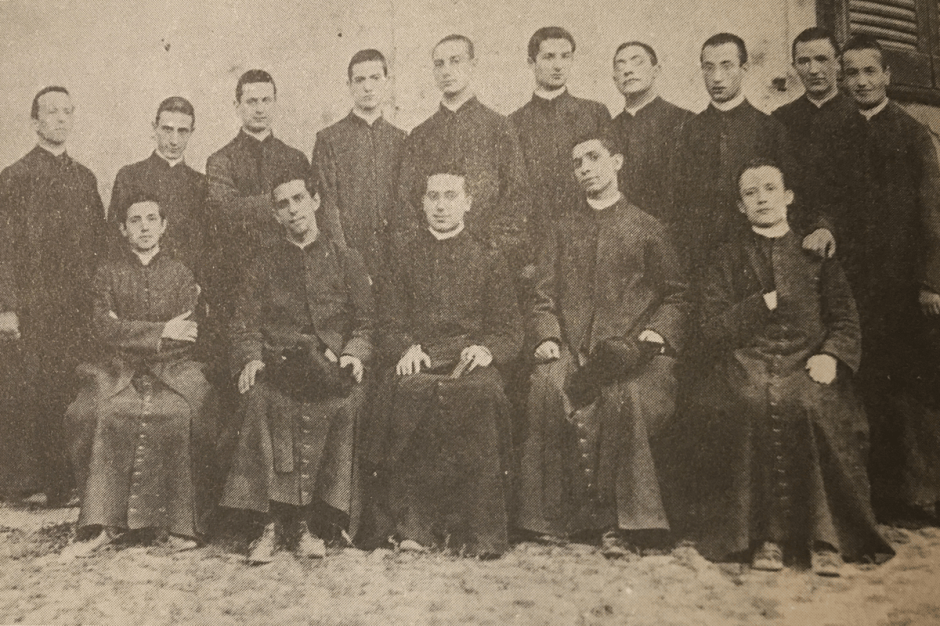
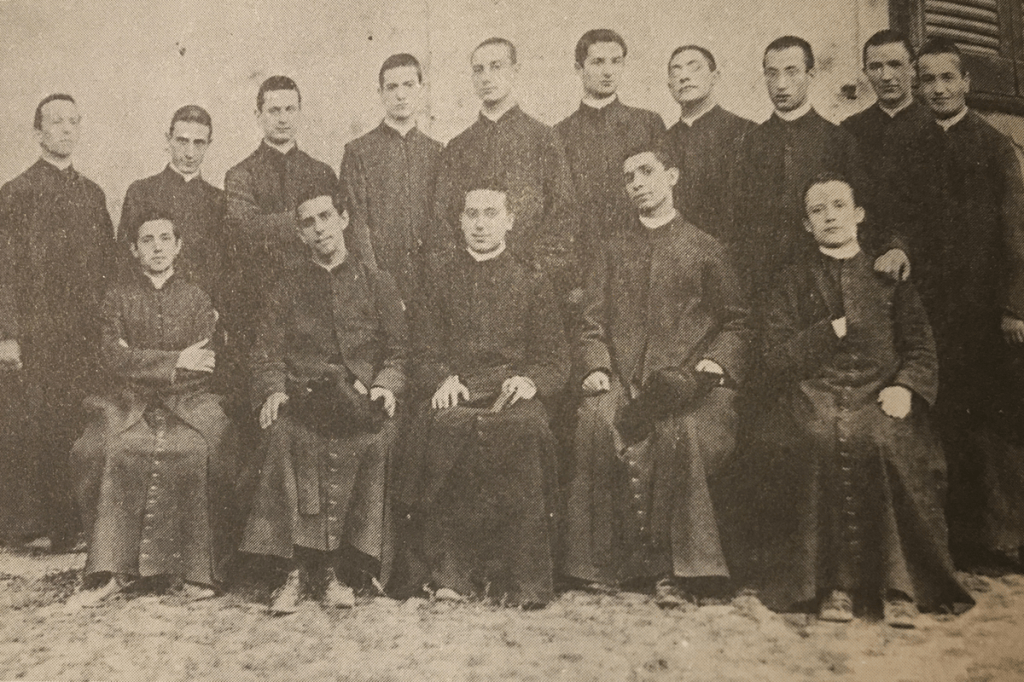
A casual initial flip through the book yielded this very revealing photograph, taken in 1901. It shows a group of seminarians, including the future Pope John XXIII, Angelo Roncalli. Roncalli is in the back row, on the extreme right.
As can be seen in the main image, one of the seminarians was photographed with his hand inside his cassock – a very intentional gesture designed, surely, to indicate this young man’s Masonic connections.
To the right of this potential priest is Angelo Roncalli, (circled in red) with his hand on the shoulder of the Mason.
The photograph’s caption reads, “Angelo’s ‘year’ at the Roman seminary, 1901; he is at the right hand end of the back row.”
This ‘year’ was Roncalli’s first year of theology, at the age of nineteen. Awarded a scholarship, he had relocated to Rome to continue his studies for the priesthood. Roncalli had entered the minor seminary at the age of twelve, receiving the tonsure in 1895.
When time permits, I will research the names of Roncalli’s classmates and promise to keep you posted. Who knows? I may even get my book on John XXII finished one day.
(A quick look at ordination dates would indicate that this is not Roncalli’s friend, Ernesto Buonaiuti, who was later excommunicated for his extreme Modernism.)



 Ecclesiastical Freemasonry
