B’nai B’rith

B’nai B’rith is a name that pops up from time to time as one researches events surrounding the Second Vatican Council. Many sources call the group straight-out ‘Jewish Freemasons’.

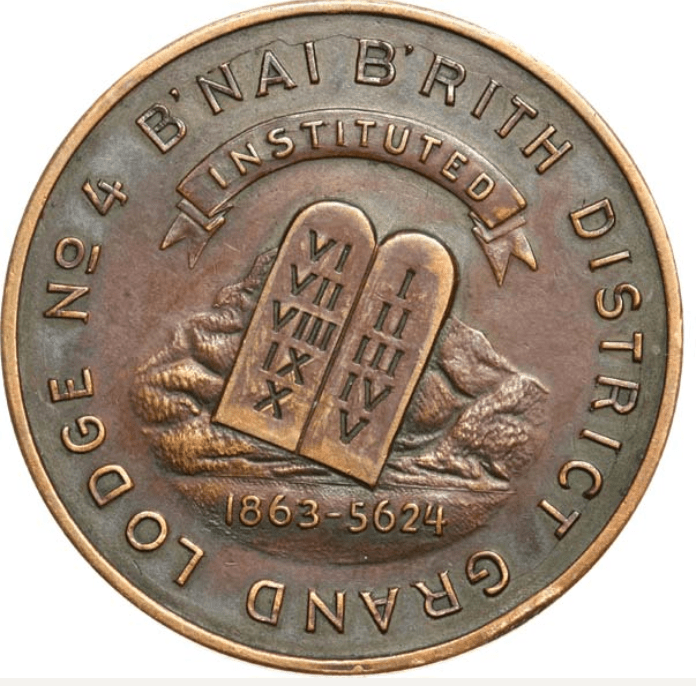
B’nai B’rith coin with the numbers of the Ten Commendmants reading from right to left. Hebrew read from the right, of course, but we also know how occultists love to reverse things.

Origins

According to Masonic sources, B’nai B’rith was founded on October 13, 1843 in the USA. (Note the date – it’s a Fatima day.) The twelve founders were Jewish German immigrants who had met each other through various Masonic and Odd Fellows Lodges and other secret societies. They ostensibly wanted to provide support for immigrant families, especially those in need.

B’nai B’rith means ‘sons of the covenant.’ The group went on to become involved in a number of philanthropic ventures and created the Anti-Defamation League. It is a strong opponent of ‘anti-semitism’ and a vocal supporter of the State of Israel and also attends the UN as a non-government organization, where it lobbies for the rights of Israel.

B’nai B’rith and Ecumenism

Members of the B’nai B’rith International Council also visited John XXIII, as reported at its January 1960 meeting in Amsterdam. President Label A. Katz, reported that “the Pope’s serious intentions to guide the Catholic Church toward brotherly understanding of the Jews were unmistakable” and that Cardinals Bea and König were enthusiastic promoters of reconciliation.

Later, B’Nai B’rith recalled the desire expressed by John XXIII at the opening of the Council “to make up for millenias’ persecution of the Jews and to recall instead the common heritage.” One of the members of B’Nai B’rith suggested that religious textbooks be revised to reflect the Jews’ unhappiness at being painted as the killers of God – something they believed resulted in anti-Semitism.

“We’ll be here ’til there’s no more hate.”

B’nai B’rith and Ecclesiastical Freemasonry

There are a couple of ties between this quasi-Masonic group and some prominent clerics. One is Fr. Malachi Martin, who according to E. Michael Jones “was being paid by both B’nai B’rith and the American Jewish Committee to subvert the Catholic claim that the Jews had killed Christ.”

It is difficult to know how much truth there is to this accusation, but it is certainly true that Fr. Martin was once secretary to ecumaniac Cardinal Bea (before his apparent conversion to orthodoxy and tradition) and also that the Jews did have an agenda to make the Church repeal its historical condemnation of them.

Also linked to B’nai B’rith was Cardinal Albert Decourtray who accepted a humanitarian award from the group in 1991 for his work in promoting inter-religious relations.

I have a feeling there are lots of links that are yet to be discovered when it comes to this influential Masonic/Zionist lobby group.

For more information please see this video on Bitchute.

John XXIII, ‘Pope of the Jews’

Angelo Roncalli has been accused of many things: of conversing with aliens, consorting with Freemasons, being installed by Freemasons, being a Freemason and of course, introducing Synarchy into the heart of the Church. Although those accusations rely on a degree of speculation, he exhibited enough obvious flaws (as evidenced by the disastrous Second Vatican Council) to conclude that his papacy struck a heavy blow to the Church.

Part of that blow came in the form of the ecumenical movement, which was a Modernist counterweight to the longstanding belief of extra ecclesiam nulla salus – there is no salvation outside the Catholic Church. The document, Nostra Aetate, which was a pet project of John’s, formed the basis for the reject of extra ecclesiam. Hidden within its ambiguous text was the suggestion that non-Catholics can be saved without conversion to Catholicism. The document errs mostly by omission in that it fails to advise Catholics to evangelise their non-Catholic neighbours, thus implying that there is, in fact, salvation outside of Catholicism.

One problematic section from Nostra Aetate is given below. For more samples of its errors and a commentary, please read here.)

True, authorities of the Jews and those who followed their lead pressed for the death of Christ (cf. Jn. 19:6); still, what happened in His passion cannot be blamed upon all the Jews then living, without distinction, nor upon the Jews of today. Although the Church is the new people of God, the Jews should not be presented as repudiated or cursed by God, as if such views followed from the holy Scriptures…

While it’s true that prior to being elected Pope, Angelo Roncalli assisted in the protection of thousands of Jewish people as they fled from persecution by the Nazis, he didn’t stop with merely defending their safety. As Pope, John went further and re-wrote the Church’s relationship with the Jews.

In large part, the Church’s relaxation of its policy towards the Jewish religion was the result of lobbying by a French Jewish historian named Jules Isaac.

Jules Isaac

In 1948, Isaac authored a book which, rather brashly, gave suggestions to Christians about how they should teach their children about the Jewish people. Called Jesus and Israel: A Call for Necessary Corrections on Christian Teaching on the Jews, the book included 18 points he believed should be enacted by the Catholic Church. (Read them here.)

Isaac secured a meeting with Pope John XXIII on June 13, 1960, two years prior to the Council, and recorded his thoughts immediately after they met. Isaac’s notes are treasured by Jewish historians.

For the meeting, Isaac was equipped with volumes of material which he believed was evidence that the Church’s teaching was anti-semitic and needed to be changed. Note that Isaac audaciously believed the had a right to change Catholic teaching. He wrote:

The problem of Catholic teaching which I attacked is infinitely more complex than that of the liturgy1. Seen from the special angle concerning Israel, it touches, if not the main ideas of faith and dogma, at least a thousand-year-old tradition, product of the Church fathers, from St. John Chrysostom to St. Augustine. 

Isaac’s particular concern was the so-called “teaching of contempt” of Catholic towards Judaism, which he believed to be anti-Christian and which he believed fuelled anti-Semitism. He put forward his arguments and suggested that the Pope create a sub-committee to study his concerns. The Pope agreed to seek advice on the matter and they parted cordially.

Judaic Influence

A few months later, a group of American Jewish men from a society known as B’nai B’rith met with the Pope. B’nai B’rith (see more here) has close ties to Freeemasonry, and founded the Anti Defamation League.

At that meeting, John told them that: “You are of the Old Testament and I of the New Testament, but I hope and pray that we will come closer to the brotherhood of humanity… It gives me great pain and sorrow to see these recent events (a rash of swastika graffiti) which not only violate a natural right of human beings but destroy the understanding between brothers under God…”

That same year, he also met with a group called United Jewish Appeal, when he said: “We are all sons of the same Heavenly Father. Among us there must ever be the brightness of love and its practice. I am Joseph, your brother.”

Later in 1960, John called for those clerics preparing for the Council to add a declaration on the attitude of the Church towards the Jews. He approved the first draft, entitled Decretum de Judaeis (“Declaration on the Jews”) in November 1961, but didn’t live to see the document in its final form. That was left to Paul VI, who promulgated it as Nostrae Aetate in 1965.

Perfidious Pontiff

Yet, the Jewish question had been in John’s mind before these meetings, as back in March of 1959, during the Good Friday Liturgy, John demanded that the word, ‘perfidious’ should not be read during the prayer for the Jews.

As even such Modernists as Cardinal Bea and Henri de Lubac point out, the adjective ‘perfidious’ was included in Medieval times when its meaning was less offensive than it is today. ‘Perfidious’ originally meant ‘unbelieving’ or ‘unfaithful’ and was thus perfectly appropriate for describing the Jewish people.

[It is worth noting that when Benedict XVI allowed for wider use of the traditional Latin Mass, he only authorised the use of the 1962 Missal from which the word “perfidious” had been removed. Fr. Mawdsley has a lot more to say on this.]

Next, John attacked the Rite of Baptism, removing the necessity to “Abhor Jewish unbelief (in Jesus Christ) and reject the Hebrew error (which is that the Messiah has not yet come).”

John also ‘cancelled’ Pius XI’s prayer from 1925, the Act of Consecration of the Human Race to the Sacred Heart of Jesus. The words, ‘Look with Thine eyes of mercy upon the children of that stock, so long Thy Chosen People; May the blood called upon them of old, now descend on them as the waters of redemption and life,’ were now deemed to be politically incorrect. 

Making Catholics Pay

John went even firther in his efforts to appease the Jews. With the assistance of the heterodox Cardinal Frings, John required that a prayer be said by German Catholics on the Feast of the Sacred Heart. It went:

“Lord, God of our Fathers! God of Abraham, Isaac and Jacob! God of merry and God of solace! We confess before you: Countless men were murdered in our midst, because they belonged to the people from whom the Messiah rose up in the flesh. We pray Thee: Lead all among us who became guilty through deed, omission, or silence, that we may see the wrong and turn from it. In the spirit of heartfelt atonement, we beg for forgiveness for the sins which were committed by our fellow citizens. We beseech that the spirit of peace and reconciliation return to all homes and we pray for the peace of Israel among the nations; on the borders of its state and in our midst…”

While there was most likely a need for some German Catholics to repent of their collaboration with the Nazis, the hypocrisy of John demand is obvious. The Jews detested being held to account as a group for the crime of their forebears – putting Christ to death – yet John expected German Catholics to be held responsible, as a group, for the crime of the Nazis.

And where was the acknowledgement of the non-Jews who were persecuted under Hitler? Including thousands of priests, nuns and lay Catholics? The prayer does not mention those poor people.

Don’t Convert!

John’s commitment to non-evangelisation was well known. Secretary to John XXIII, Loris Capovilla told this story to Time Magazine:

“A young Jewish lad made the acquaintance of Giuseppe Roncalli when he was the Cardinal-Archbishop of Venice. The young man wanted to become a Catholic, but Roncalli kept putting him off. ‘Look,” he said, ‘you’re a Jew. Be a good Jew. Becoming a Catholic will kill your parents.’ The young man persisted and Roncalli finally said he could be baptized — in secret.

“Several years later (in 1961) after his parents had died, he presented himself at the Vatican to see his old mentor, now the Pope. He wanted the Pope to give him the Sacrament of Confirmation. ‘All right, all right,’ said Pope John XXIII, ‘but you have got to continue to be a good Jew, in your own community, go to the synagogue, support the Jewish schul, because, by being a Catholic, you do not become any less a Jew.”

Pope of the Jews

In 2014, Rabbi Dalin, a former professor of Ave Maria University, reminisced about John’s contribution to Catholic-Jewish relations and it was from this man that we learn John was known as the “Pope of the Jews.”

Dalin tells the story of Pope John driving through the streets of Rome on a Saturday, when he suddenly ordered his car to stop in front of Rome’s great synagogue. He got out of the car so he could bless the Jews of Rome as they were leaving: an important symbolic act that earned their gratitude.

“In doing this,” Rabbi Dalin observes, “he began to transform the history of Catholic-Jewish relations in our time, with initiatives inspired by his work on behalf of Jews during the holocaust….

… “Twentieth and 21st-century Jews will forever be indebted to Pope John XIII for his historic role in bringing about Nostra Aetate. It changed forever the relationship between Catholics and Jews.”

It is worth noting that John XXII was canonised (along with another ecumaniac, John Paul II) on the eve of Yom Hashoah, the international day of Holocaust remembrance observed in Israel and by Jews around the world.


  1. see John XXIII’s changes to the liturgy in a later section ↩︎

 Jules Isaac – Jesus and Israel

Extract from Jesus and Israel: A Call for Necessary Corrections on Christian Teaching on the Jews, published in 1948 (Impact-Site-Verification: 8dad7fd3-e727-499b-bef3-6d8d25dba811)

For purposes of greater clarity, may I be allowed to submit for the examination of Christians of good will—who are agreed in principle on the need for rectification—the following Eighteen Points, meant to serve at least as a basis for discussion.

Christian teaching worthy of the name should

  1. give all Christians at least an elementary knowledge of the Old Testament; stress the fact that the Old Testament, essentially Semitic—in form and substance—was the Holy Scripture of Jews before becoming the Holy Scripture of Christians;
  2. recall that a large part of Christian liturgy is borrowed from it, and that the Old Testament, the work of Jewish genius (enlightened by God), has been to our own day a perennial source of inspiration to Christian thought, literature, and art;
  3. take care not to pass over the singularly important fact that it was to the Jewish people, chosen by Him, that God first revealed Himself in His omnipotence; that is was the Jewish people who safeguarded the fundamental belief in God, then transmitted it to the Christian world;
  4. acknowledge and state openly, taking inspiration from the most reliable historical research, that Christianity was born of a living, not a degenerate Judaism, as is proved by the richness of Jewish literature, Judaism’s indomitable resistance to paganism, the spiritualization of worship in the synagogues, the spread of proselytism, the multiplicity of religious sects and trends, the broadening of beliefs; take care not to draw a simple caricautre of historic Phariseeism;
  5. take into account the fact that history flatly contradicts the theological myth of the Dispersion as providential punishment for the Crucifixion, since the Dispersion of the Jewish people was an accomplished fact in Jesus’ time and since in that era, according to all the evidence, the majority of the Jewish people were no longer living in Palestine; even after the two great Judean wars (first and second centuries), there was no dispersion of the Jews of Palestine;
  6. warn the faithful against certain stylistic tendencies in the Gospels, notably the frequent use in the Fourth Gospel of the collective term “the Jews” in a restricted and pejorative sense—to mean Jesus’ enemies: chief priests, scribes, and Pharisees—a procedure that results not only in distorting historic perspectives but in inspiring horror and contempt of the Jewish people as a whole, whereas in reality this people is in no way involved;
  7. state very explicitly, so that no Christian is ignorant of it, that Jesus was Jewish, of an old Jewish family, that he was circumcised (accordsing to Jewish Law) eight days after his birth; that the name Jesus is a Jewish name, Yeshua, Hellenized, and Christ the Greek equivalent of the Jewish term Messiah; that Jesus spoke a Semitic language, Aramaic, like all the Jews of Palestine; and that unless one reads the Gospels in their earliest text, which is in the Greek language, one knows the Word only through a translation of a translation;
  8. acknowledge—with Scripture—that Jesus, “born under the [Jewish] law” (Gal. 4:4), lived “under the Law”; that he did not stop practicing Judaism’s basic rites to the last day; that he did not stop preaching his Gospel in the synagogues and the Temple to the last day;
  9. not fail to observe that during his human life, Jesus was uniquely “a servant to the circumcised” (Rom. 15:8); it was in Israel alone that he recruited his disclples; all the Apostles were Jews like their master;
  10. show clearly from the Gospel texts that to the last day, except on rare occasions, Jesus did not stop obtaining the enthusiastic sympathies of the Jewish masses, in Jerusalem as well as in Galilee;
  11. take care not to assert that Jesus was personally rejected by the Jewish people, that they refused to recognize him as Messiah and God, for the two reasons that the majority of the Jewish people did not even know him and that Jesus never presented himself as such explicitly and publicly to the segment of the people who did know him; acknowledge that in all likelihood the messianic character of the entry into Jerusalem on the eve of the Passion could have been perceived only by a small number;
  12. take care not to assert that Jesus was at the very least rejected by the qualified leaders and representatives of the Jewish people; those who had him arrested and sentenced, the chief priests, were representatives of a narrow oligarchic caste, subjugated to Rome and detested by the people; as for the doctors and Pharisees, it emerges from the evangelical [Gospel] texts themselves that they were not unanimously against Jesus; nothing proves that the spiritual elite of Judaism was involved in the plot;
  13. take care not to strain the texts to find in them a universal reprobation of Israel or a curse which is nowhere explicitly expressed in the Gospels; take into account the fact that Jesus always showed feelings of compassion and love for the masses;
  14. take care above all not to make the current and traditional assertion that the Jewish people committed the inexpiable crime of deicide; and that they took total responsibility on themselves as a whole; take care to avoid such an assertion not only because it is poisonous, generating hatred and crime, but also because it is radically false;
  15. highlight the fact, emphasized in the four Gospels, that the chief priests and their accomplices acted against Jesus unbeknownst to the people and even in fear of the people;
  16. concerning the Jewish trial of Jesus, acknowledge that the Jewish people were in no way involved in it, played no role in it, probably knew nothing about it; that the insults and brutalities attributed to them were the acts of the police or of some members of the oligarchy; that there is no mention of a Jewish trial, of a meeting of the Sanhedrin in the fourth Gospel;
  17. concerning the Roman trial, acknowledge that the procurator Pontius Pilate had entire command over Jesus’ life and death; that Jesus was condemned for messianic pretensions, which was a crime in the eyes of the Romans, not the Jews; that hanging on the cross was a specifically Roman punishment; take care not to impute to the Jewish people the crowning with thorns, which in the Gospel accoounts was a cruel jest of the Roman soldiery; take care not to identify the mob whipped up by the chief priests with the whole of the Jewish people of Palestine, whose anti-Roman sentiments are beyond doubt; note that the fourth Gospel implicates exclusively the chief priests and their men;
  18. last, not forget that the monstrous cry, “His blood be on us and on our children!” (Mt. 27:25), could not prevail over the Word, “Father, forgive them; for they know not what they do” (Lk. 23:34).

Freemasonry and Judaism

From ‘the plot against the church’ by maurice pinay. Chapter two: The Jews as Founders of Freemasonry.

“To unmask Freemasonry” – said Leo XIII – “means to conquer it.” When we lift its mask, then every honest mind and every Christian heart will turn away from it with revulsion; and through this fact alone will it fall, completely destroyed and detested particularly by those who obey it. The learned scholar and Jesuit Monsignor Leon Meurin, S.J., Archbishop, Bishop of Port-Louis, shows us in his so very richly authenticated work, “Clarification of Freemasonry”, with crushing authority that the Jews are the founders, organisers and leaders of Freemasonry, which they use to attain world domination, in order to destroy the Holy Catholic Church and the remaining existing religions. Among the attested literature that he presents in this connection appear several quotations, which we mention in the following:

“The First Highest Masonic Council was, as we have already said, formed on 31st May 1801 in Charleston, 33 degrees northern latitude, under the chairmanship of the Jew Isaac Long, who was made inspector general by the Jew Moses Cohen, and who had received his degree from Hyes, from Franken, and the Jew Morin.”1

“The Jews were thus the founders of the First Great Council, which was to transform itself into the middlepoint of world Freemasonry. And they placed it in America, in a city chosen exactly on the 33rd parallel, Northern Latitude. The successive head has lived in Charleston since 1801. In the year 1889 this was Albert Pike, whom we have already mentioned in his circular letter of 14th July 1889, the famed anniversary and tercentenary.

“He assumes the title of each of the 33 degrees and in addition adds the following:

“Most mighty and all-highest Commander, Grand Master of the Supreme Council of Charleston, first highest council of the globe, Grand Master and preserver of the holy Palladium, all-highest Pontifex of world Freemasonry.
“With these pompous titles he published his circular letter in the one and thirtieth year of his Pontificate, supported by ten high dignitaries, most enlightened and most sublime brothers, rulers, grand-general inspectors, chosen magi, who form the most illustrious grand collegium of ancient Freemasons, the council of the chosen troops and of the holy battalion of the Order.”2

“The circular letter enumerates the 23 highest councils, which previously were directly ‘created’ through that of Charleston and are dispersed over the entire world. Then it lists the hundred Grand Orients and Grand Lodges of all rites which are connected with the highest Council of Charleston as the all-highest power of Freemasonry; the exclusive rite of the Jews. For example, the Grand Orient of France, the General Council of the Rite of Mizraim, the Grand Council of the Freemason Oddfellows, etc. From the preceding we must conclude that Freemasonry all over the world is one in countless forms, however, under the supreme direction of the all-highest Pontifex of Charleston.”3

JEWISH ORIGIN

“The rites and symbols of the Freemasons and of the other secret sects remind one constantly of the ‘Cabbala’ (secret Jewish mystique) and Jewry: The reconstruction of the temple of Solomon, the star of David, the seal of Solomon; the names of the different degrees, as for example, Knight Kadosh. ‘Kadosh’ means in Hebrew ‘holy’; Prince of Jerusalem, Prince of Lebanon, Knight of the serpent of Airain, etc. And does not the prayer of the English Freemasons, which was recorded in an assembly held in 1663, recall Judaism in a most clear manner?”4

“Finally the Scottish Freemasons made use of the Jewish calendar; for example, a book, which was written by the American Freemason Pike5 in the year 1881, is dated ‘Anno mundi 5641’. At present this calendar is retained only in the highest degrees, while the Freemasons in general add four thousand years to the Christian calendar, and not 3760 like the Jews.”6

The clever Rabbi Benamozegh writes the following:

“Those who wish to make the effort to examine the questions of relations between Jewry and philosophic Freemasonry, between Theosophy and the secret doctrines in general, will lose a little of their arrogant despisal of the Cabbala (Jewish Mysticism). They will cease to smile contemptuously at the idea that the ‘Cabbalistic’ theology perhaps has to fulfil a mission in the religious re-shaping of the future.” 7

“Who are the true leaders of Freemasonry? This is one of the secrets of the sect, which is very carefully kept; but one can assert that Freemasonry all over the world develops in agreement with one and the same plan; that its methods are always and in all parts identical, and that the aims pursued are permanently the same. This occasioned us to believe that a uniform middlepoint exists, which directs all movements of the Sect.

“Further on we will touch upon this question; however, here let us recall that ‘Carta de Colonia’, dated 24th June 1935, speaks of a director of Freemasonry: the Grandmaster or patriarch, who, although known by very few brothers, exists in reality; and Gougenot des Mousseaux points out that this choice of the Order, these real directors, whom only a very few initiates know, exercise their function in useful and secret dependency upon the Israelite Cabbalists (Mystics)’ and that the true directors of Freemasonry are the friends, the helpers and the vassals of the Jew to whom they do homage as their highest Lords. The same judgment is shared by Eckert, Drumont, Deschamps, Msgr. Jouin, Lambelin and other savants of Freemasonic and Jewish questions”.8

Let us leave the dogmatic teachings of the Freemasons and Jewry to one side and let us examine the alliances between both from the purely practical and realistic standpoint. If one proceeds logically, one cannot avoid drawing the conclusion which is formulated by L. de Poncins in “The Secret Powers Behind Revolution.”

“The manifoldness of Freemasonry, its permanence, the inalterability of its goals, which are completely explicable since it is a question of a Jewish creation to serve the Jewish interests, would be completely incomprehensible if its origin were of a Christian nature.

“Even the purpose in itself of Freemasonry, namely the destruction of Christian civilisation, reveals to us the Jew, for only the Jew can draw advantage from it, and the Jew alone is inspired by a sufficiently violent hatred towards Christianity to create such an organisation.”

“Freemasonry”, continues de Poncins, “is a secret society and is directed by an international minority. It has sworn Christianity an irreconcilable hatred. These three characteristics are exactly the same as those that describe Jewry and represent the proof that the Jews are the leading element of the lodges.”9

Already in 1867 the “permanent international league for peace” came into existence, and its secretary, the Jew Passy, outlined the ideas of a court of justice, to settle all conflicts between the nations without appeal.10

The newspaper “The Israelite Archive” dreamed of a similar court of justice in the year 1864. “Is it not natural and necessary” – wrote a certain Levy Bing-“that as soon as possible we see erected an additional court of justice, and in fact a highest court of justice, to whom the great open conflicts and the quarrels among the nations are submitted, which in the last instance passes judgment, and whose last word is given powerful weight? This will be the word of God, which is uttered by his first-born sons (the Hebrews), and before which the general rest of mankind will bow in respect before our brothers, our friends and our pupils.”11

These are the dreams of Israel. As always they accord with those of Freemasonry. The “Freemasons calendar” writes:

“When the Republic has been set up in the whole of old Europe, Israel, as ruler will rule over this old Europe.”12

At the world congress of Jewish youth, which was held on 4th August 1928, H. Justin Godard announced that the Jews were the firmest supporters of the League of Nations, which had to thank its existence to them.”13 The Jew Cassin gave more exact information:

“The rebirth of Zionism is the work of the League of Nations. Through it the Jewish organisations place themselves as defenders of the League of Nations, and therefore Geneva swarms with representatives of the ‘chosen people’.”14

The most venerable Cardinal Jose Maria Caro R., Archbishop of Santiago and Primate of Chile, also proves, in his authoritatively supported work “The Secret of Freemasonry”, that it is the Jews who direct this sect, in order to rule the world and to destroy Holy Church. In connection with its origin he affirms:

“The Freemasonic rite clearly betrays its Jewish origin: the symbols, which begin with the Bible itself; the coat of arms upon which an attempt is made to explain the different forms of the Cherubim described by Ezekiel in his second poem, an ox, a man, a lion and an eagle; the two pillars of the Freemasonic temple in remembrance of the temple of Solomon; the rebuilding of the temple which is the work of the Freemasons, etc. The reading matter and the handbooks, which in greater part are taken from the Bible, they turn almost always towards Freemasonic taste, especially the legend of Hiram, which plays an important role in the Freemasonic rite.

“The customary words and expressions, like the names of the pillars Boaz’ and Jachin’, the words of knowledge and of admittance: Tubalcain, Shibboleth, Giblim or Moahon, Nekum or Nekam, Abibalc, etc; the the importance, which is allotted to numbers, a matter very original to the Cabbala, all these are further proofs of the Cabbalistic influence on Freemasonry.

“Finally the facts, the rule of terror, the outbreak of Satanic hatred against the Church, against our Lord Jesus Christ, the terrible blasphemies against God that the revolutionary Freemasons perpetrated in France, are nothing more than the expression and the fulfilment of the Cabbalistic and secret sects, which already for several centuries have fought secretly against Christianity. What the Jewish Bolshevists to greatest part do in Russia against Christianity, is only another edition of the deeds of the Freemasons in the French revolution. The executioners are others; however, the doctrine that motivates and empowers them and the supreme leadership are the same.”15
  1. Pablo Rosen, Satán y Cia, Buenos Aires, 1947, p. 219. ↩︎
  2. Adolphe Ricoux, L’existence des loges de femmes. Paris, Téqui, 1891, pp. 78-95. ↩︎
  3. Monsignor Leon Meurin, S. J., Archbishop, Bishop of Port-Louis, Simbolismo de la masonería. Madrid: Editorial Nos, 1957, pp. 201-202. ↩︎
  4. “Revue Internationale des Sociétés Secrètés” (RISS). Paris, 1913, no. 2, p. 58. ↩︎
  5. Albert Pike, Morals and Dogma of the Ancient and Accepted Scottish Rite of Freemasonry, Anno mundi 5641 (1881). ↩︎
  6. Maurice Fara, La masonería en descubierto. Buenos Aires: La hoja de roble, 1960, p. 23. ↩︎
  7. Rabino Benamozegh, Israel y la humanidad. Paris, 1914. p. 71. ↩︎
  8. Gougenot des Mousseaux, Le juif, le judaïsme et la judaïsation des peuples chrétienne. Paris, 1869, pp. 338-339. ↩︎
  9. León de Poncins, Les forces secrètes de la Révolution, pp. 139-140. ↩︎
  10. “Revue Internationale des Sociétés Secrètes” (R.I.S.S.), 1926, no. 8, p. 269. ↩︎
  11. “Archivos Israelitas”, 1864, p. 335. ↩︎
  12. Freimaureralmanach, Leipzig, 1884. ↩︎
  13. Les Cahiers de l’Ordre, 1926, nos. 3-4, pp. 22-23. ↩︎
  14. Maurice Fara, op. cit. p. 111. ↩︎
  15. Cardinal Jose Maria Caro, R., Archbishop-Bishop of Santiago, Primate of Chile: The Secret of Freemasonry, Difusion Publishers, page 258. ↩︎