An Adoration chapel at St. Kevin’s Novus Ordo parish in suburban Melbourne raises questions as to just who has been designing our modern churches. Named, “Our Father’s Womb”, the chapel exhibits several hallmarks of Wiccan influence: exultation of the Feminine; mockery of the sacred; a giant labyrinth and a spell-casting tool.
Wicca is differentiated somewhat from witchcraft, although the two are related. Wicca is a religion whose disciples, known as practitioners, worship both a God and a Goddess. Wiccans celebrate rituals according to the seasons which, they believe, put them in touch with the Divine. The beliefs of each Wiccan vary according to the individual although the overarching rule is ‘Harm none and do as you will’. Most, but not all, Wiccans practise witchcraft, but not all witches are Wiccans.
The name of this chapel is absolutely bizarre, and suggests the glorification of the Feminine: “Our Father’s Womb: to the glory of God and in honour of our Blessed Mother.”
‘God’ in this case, does not necessarily refer to the Christian God; just as ‘the Blessed Mother’ does not necessarily refer to Our Lady.
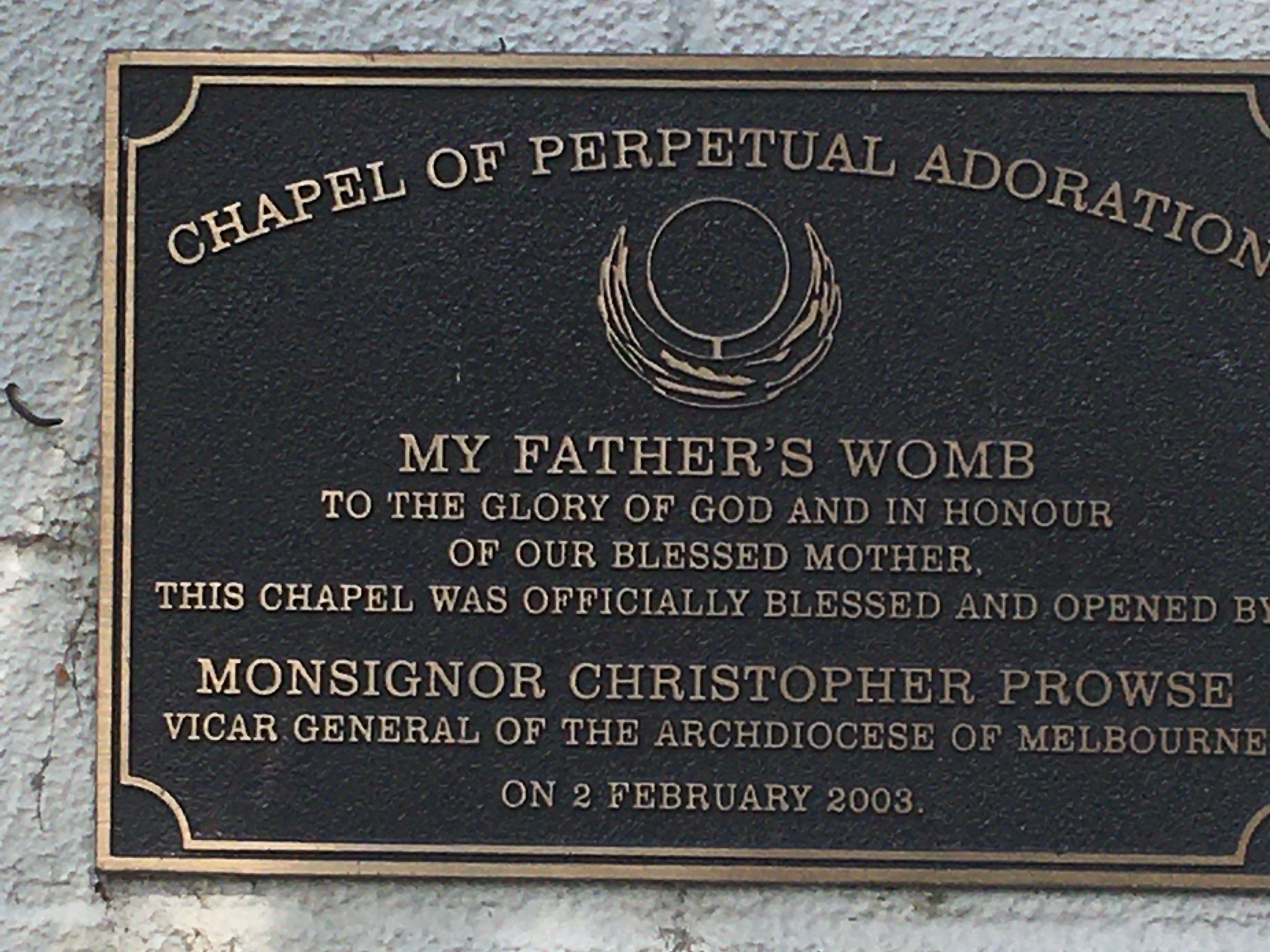
Obviously, men do not have wombs and even more obviously, God is pure spirit and most certainly has no human organ such as a womb. Even if we accept the metaphor of a chapel being a womb-like place of security and comfort, the name is illogical from a Catholic point of view. Peace may be a fruit, but is not the purpose of an Adoration chapel. At best, this is the Modernist ideology of man-centredness at play.
At worst though, we are looking at a deliberately pagan mockery of the Blessed Sacrament.
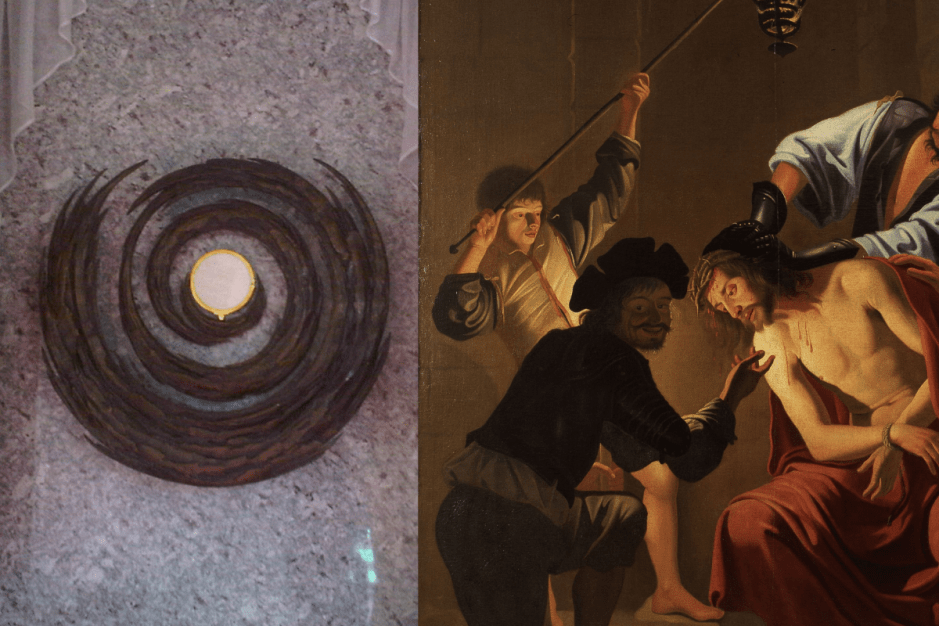
A closeup of the image shows a now-familiar symbol, which has the appearance of a nest holding the Host.

This is very similar to an element found in the logo for the Synod on Synodality.
(I have also previously wondered if this was meant to represent a child in a womb – the Antichrist, perhaps?)

In witchcraft, bird-nests are used for both curses and blessings, so are tools used in spell-casting rituals. There is coincidentally a legend relating to the Celtic saint, St. Kevin, in which a bird made a nest on the palm of his hand. Kevin apparently remained motionless for 40 days while the bird came and went, building the nest.
A different explanation for the nest is that it is actually a crescent moon, which is another symbol for the Feminine.
So far, the signs of a Wiccan influence are somewhat veiled. Once we step inside, however, the occult references are even more pronounced.
To the untrained eye, this is merely a very ugly setting for the exposed consecrated Host. But my learned friend believes that the red curtains are meant to represent female genitalia. He is familiar with this kind of imagery from the shrine to Lucifer in the Brisbane Cathedral.
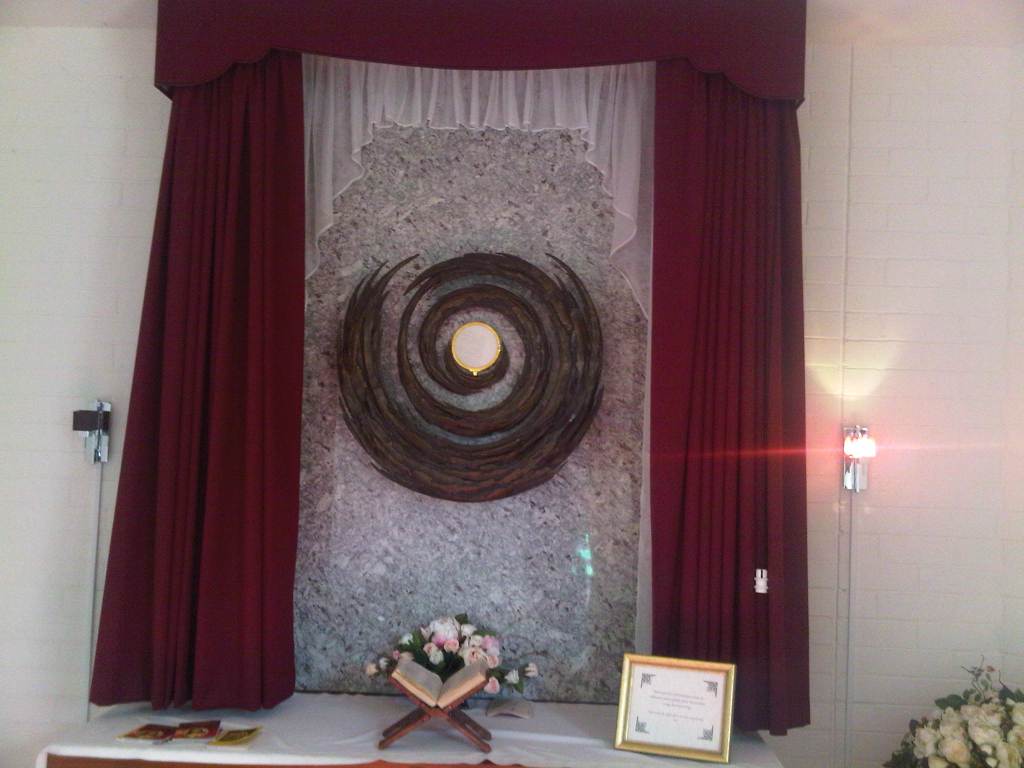
The spiral surrounding the host is made of metal plates, something akin to the scales of a snake. Snakes have an obvious relevance when it comes to Christianity and witchcraft: they represent Lucifer and his rebellion against God.
According to the book, The Women’s Encyclopedia of Myths and Secrets, a spiral represents “death and rebirth as movement into the disappearing-point of formlessness, and out of it again, to a new world of form.”
One variation of the spiral is the labyrinth, and one of these is found in the grounds of the church in question. To pagans, the labyrinth is a “metaphor for the spiritual journey and a powerful tool for transformation. This walking meditation is an archetype, a mystical ritual found in all religious traditions.” Thus walking the labyrinth is a form of meditation – the dangerous mind-emptying kind, not the wholesome Catholic tradition of mental prayer.
Labyrinths are specifically related to Goddess worship, with the circle being an important symbol of the Divine Feminine. So in this setting, the Sacred host is surrounded by two symbols of the Feminine, with the spiral appearing as though it is ready to strangle or consume the Host and the scale of the curtains suggesting the apparent superiority of the goddess over the Triune God.
This raises the question: is the Host in this chapel Consecrated? It is truly the Body, Blood, Soul and Divinity of Christ? My answer to that is yes, probably. For the insult is only complete when such an ignoble setting surrounds the True Presence of the Lord, precisely as He endured during His Passion.
What the wicked people responsible for this abomination fail to acknowledge is that He alone created them and died for their sins. Unless they repent, the veil of their souls’ temples will one day be torn in two and they will be cast into everlasting fire for their rebellion and their failure to adore the One, True God.
As I was putting together a header image for this post, I wanted to use sacred artwork to counter the foul images of witchcraft that have been flooding my screen. On seeing a beautiful representation of Christ’s Passion, it occurred to me that the Host surrounded by a diabolical wreath of scales is not unlike Christ’s Sacred Head crowned with thorns. Perhaps this is yet another layer of mockery those responsible had in mind.
 Ecclesiastical Freemasonry