A Wiccan Adoration Chapel in Melbourne

An Adoration chapel at St. Kevin’s Novus Ordo parish in suburban Melbourne raises questions as to just who has been designing our modern churches. Named, “Our Father’s Womb”, the chapel exhibits several hallmarks of Wiccan influence: exultation of the Feminine; mockery of the sacred; a giant labyrinth and a spell-casting tool.

Wicca is differentiated somewhat from witchcraft, although the two are related. Wicca is a religion whose disciples, known as practitioners, worship both a God and a Goddess. Wiccans celebrate rituals according to the seasons which, they believe, put them in touch with the Divine. The beliefs of each Wiccan vary according to the individual although the overarching rule is ‘Harm none and do as you will’. Most, but not all, Wiccans practise witchcraft, but not all witches are Wiccans.

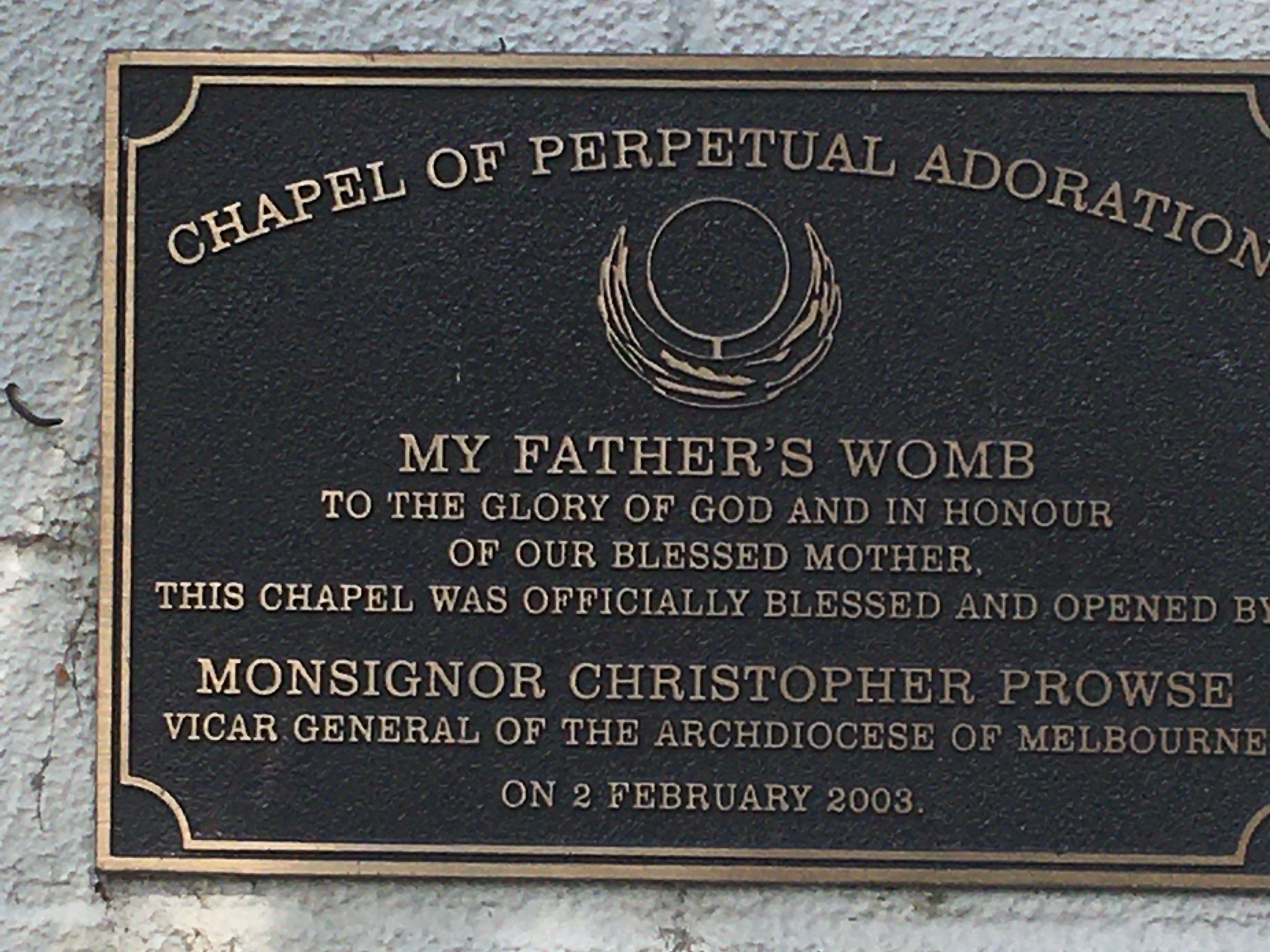
The name of this chapel is absolutely bizarre, and suggests the glorification of the Feminine: “Our Father’s Womb: to the glory of God and in honour of our Blessed Mother.”

‘God’ in this case, does not necessarily refer to the Christian God; just as ‘the Blessed Mother’ does not necessarily refer to Our Lady.

Obviously, men do not have wombs and even more obviously, God is pure spirit and most certainly has no human organ such as a womb. Even if we accept the metaphor of a chapel being a womb-like place of security and comfort, the name is illogical from a Catholic point of view. Peace may be a fruit, but is not the purpose of an Adoration chapel. At best, this is the Modernist ideology of man-centredness at play.

At worst though, we are looking at a deliberately pagan mockery of the Blessed Sacrament.

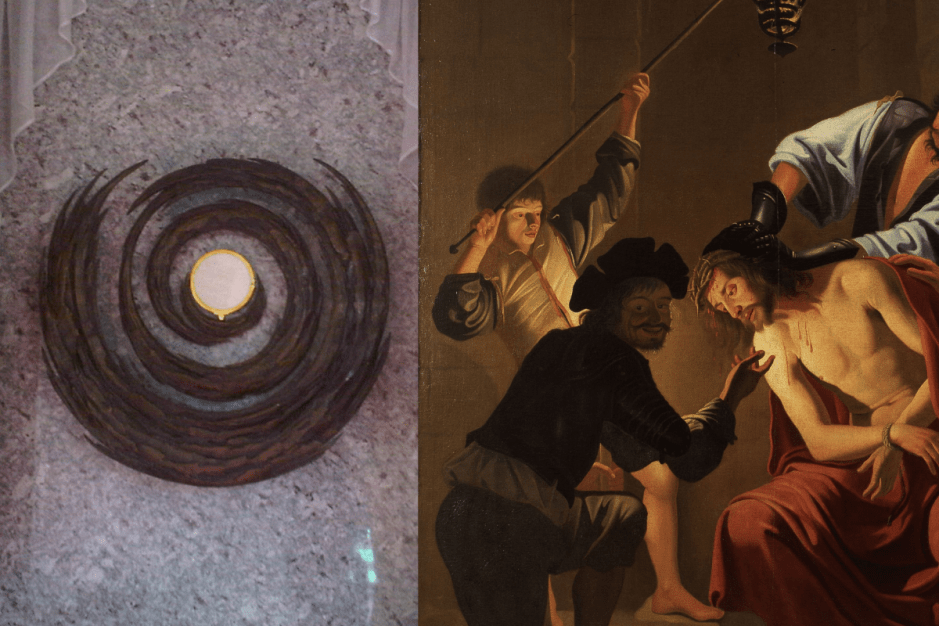
A closeup of the image shows a now-familiar symbol, which has the appearance of a nest holding the Host.

This is very similar to an element found in the logo for the Synod on Synodality.

(I have also previously wondered if this was meant to represent a child in a womb – the Antichrist, perhaps?)

In witchcraft, bird-nests are used for both curses and blessings, so are tools used in spell-casting rituals. There is coincidentally a legend relating to the Celtic saint, St. Kevin, in which a bird made a nest on the palm of his hand. Kevin apparently remained motionless for 40 days while the bird came and went, building the nest.

A different explanation for the nest is that it is actually a crescent moon, which is another symbol for the Feminine.

So far, the signs of a Wiccan influence are somewhat veiled. Once we step inside, however, the occult references are even more pronounced.

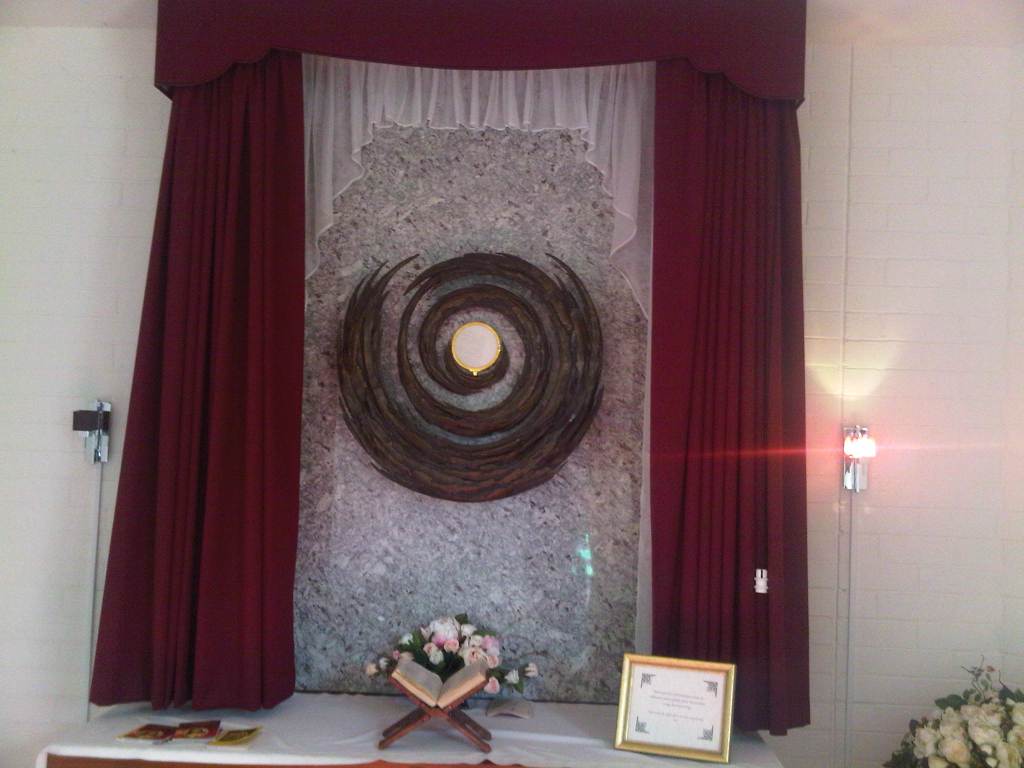
To the untrained eye, this is merely a very ugly setting for the exposed consecrated Host. But my learned friend believes that the red curtains are meant to represent female genitalia. He is familiar with this kind of imagery from the shrine to Lucifer in the Brisbane Cathedral.

The spiral surrounding the host is made of metal plates, something akin to the scales of a snake. Snakes have an obvious relevance when it comes to Christianity and witchcraft: they represent Lucifer and his rebellion against God.

According to the book, The Women’s Encyclopedia of Myths and Secrets, a spiral represents “death and rebirth as movement into the disappearing-point of formlessness, and out of it again, to a new world of form.”

One variation of the spiral is the labyrinth, and one of these is found in the grounds of the church in question. To pagans,  the labyrinth is a “metaphor for the spiritual journey and a powerful tool for transformation. This walking meditation is an archetype, a mystical ritual found in all religious traditions.” Thus walking the labyrinth is a form of meditation – the dangerous mind-emptying kind, not the wholesome Catholic tradition of mental prayer.

Labyrinths are specifically related to Goddess worship, with the circle being an important symbol of the Divine Feminine. So in this setting, the Sacred host is surrounded by two symbols of the Feminine, with the spiral appearing as though it is ready to strangle or consume the Host and the scale of the curtains suggesting the apparent superiority of the goddess over the Triune God.

This raises the question: is the Host in this chapel Consecrated? It is truly the Body, Blood, Soul and Divinity of Christ? My answer to that is yes, probably. For the insult is only complete when such an ignoble setting surrounds the True Presence of the Lord, precisely as He endured during His Passion.

What the wicked people responsible for this abomination fail to acknowledge is that He alone created them and died for their sins. Unless they repent, the veil of their souls’ temples will one day be torn in two and they will be cast into everlasting fire for their rebellion and their failure to adore the One, True God.

As I was putting together a header image for this post, I wanted to use sacred artwork to counter the foul images of witchcraft that have been flooding my screen. On seeing a beautiful representation of Christ’s Passion, it occurred to me that the Host surrounded by a diabolical wreath of scales is not unlike Christ’s Sacred Head crowned with thorns. Perhaps this is yet another layer of mockery those responsible had in mind.

Synarchic Morality

by Plinio Corrêa de Oliveira, written on July 1st, 1961. This article was taken from the Plinio Corrêa de Oliveira website.

“A Roman and Apostolic Catholic, the author of this text submits himself with filial devotion to the traditional teaching of Holy Church. However, if by an oversight anything is found in it at variance with that teaching, he immediately and categorically rejects it.”

 The words “Revolution” and “Counter-Revolution” are employed here in the sense given to them by Prof. Plinio Corrêa de Oliveira in his book Revolution and Counter-Revolution, the first edition of which was published in the monthly Catolicismo, Nº 100, April 1959.

With devotion to the Sacred Hearts, the Church puts in practice the contrary to materialist productivity.

A peculiar set of surreptitious morals is setting out to install itself in the entire West, constituting one of the most significant aspects of the European decadence that clashes with the morals of previous centuries. These morals center on the idea that the production of goods is the supreme value of the each man’s life and of society. Man is worth something to the degree that he in some way, by action or omission, contributes to the production and economy of material goods. If not all, at least many vices and qualities are measured by whether or not they favor production. The same can be said for nations. The production of material goods is the supreme end of man’s life and of all human society.

The penetration of these synarchic morals [Synarchicsynarchismsynarchy are used to refer to the materialist system of morality that gives value to things in so far as they produce. There is not English equivalent for the Portuguese “sinárquica”] is visible in Brazil, above all in the more industrialized centers in the guise of the industrial boom considering the most recent developments of this boom – the current industrialization is not exactly that of the time of Getulio Vargas when people only wished for millions. In the industry of today, the supreme goal, at least remotely, is to be the executive of an immense organization that prides itself in producing much for society and thus elevating the standard of living.

From the point of view of personal interest, the hard working businessman of today doesn’t know exactly why he is working. To fully gratify the largest number of people, the quality always decreases. He aims only for quantity with the minimum of quality. The formula to present and advertise products is: “They are good little trinkets.” It is the industrialization of ABC (as they call the highly industrialized satellite cities of Sao Paulo: Santo André, São Bernardo and São Caetano).

In Europe, the ABC spirit can be seen in the contrast between old monuments that show us the splendor of Europe of the past and the style of life in Europe today. The roads and squares are full of grand things from the past – castles, bridges, gates, etc. – but those who live in the middle of these splendors are each time more at the level of the “modern automobile”: they want to live a modern, tidy little life. Europeans of a certain category are still attached to the quality of products made according the good old tradition. But everything that is a new, modern product is not made of the same quality as things of the past. While what is old and at best still maintained, one way or another tends to decay. New things are produced like tin cans or worse.

This signifies a tendency to take a type of production completely different from the past as a standard. And this type of European, principally the Frenchman, is totally monopolized for social production. His spirit, mentality, way of being are all marked by the idea of economizing as much as possible. Also, productivity becomes a supreme value for him. It is the what is barely acceptable at the European level.

Man, A Mere Producer of Useful Material Goods

One could now ask why call this “moral synarchy.” In the language of the European right, synarchy is qualified as a clan of international nabobs to which they attribute the following state of spirit: They don’t want Communism, but at the same time they are full of the spirit of the Revolution. The are conservatives in the worst sense of the word since they don’t want to correct or destroy anything.  To fight Communism, they are disposed to spend any amount of money, but they are clearly opposed to any return to the past. They are indifferent to the slow evolution of society to the left so long as Communism does not arrive now.

Their action results in a slow form of Revolution in apparent conflict with the rapid form of the Revolution, that is Communism. They are a gang of criminals that in final analysis favor the Revolution considered broadly – for the Communists and even more than even the Communists – while in appearance opposing Communism. In regions where Communism produced crystallization, and only in these regions, synarchy deviates these crystallizations. At the same time they lead to socialism in the form I finished exposing: a way of life dominated by the shoddiest product acceptable and the mystique of work and of production.

This socialism can be directly that of the state as well as that of gigantic private businesses ran less by their owners than by managers who tend to ever greater proletarianization.

Thus, by these two forms of socialism – that of the state and of large businesses – that are easily distinguished in theory and that live well together in practice and of which the second prepares the way for the first, society slips toward Communism. It is a slow, light pink, unperceived, sneaky and non-violent Bolshevization.

The synarchic capitalists, to make their plans go ahead, promote and stimulate in every way this synarchic morality which is centered around the production of economic values and the consideration of man as a mere producer of material goods. But for them the economic production worthy of applause is not the production of any goods, but rather of goods useful for the material human development of man. They do not have hearty applause for an industry with a merely cultural scope.

The Characteristics of Synarchic Morality

Moral synarchy has the following characteristics:

1) It is egalitarian;

2) It depersonalizes;

3) It is materialistic;

4) It erects economic production as the criteria of morality.

Before we examine each of these characteristics, we will study how these morals spread.

From the Encyclopedists until 1939, there were unequal classes and an immense ideological fight by which the egalitarian Revolution advanced, gradually leveling these classes. People had conviction. They reasoned.  Even the adepts of wrong ideas adopted ways of seeing things that revealed an appreciation for logic, an appreciation that is inherent to the old, good traditions of Christian Civilization.  The sophistic revolution was needed to throw down the tendencies which expressed themselves and conquered territory in the realm of the ideas.

A tendential revolution – for example Romanticism, the sentimentality that preceded Romanticism and the French Revolution – was being born from the decline of logic and itself accentuated this decline. At par with reason, sentiments clearly began to appear in the fight between Revolution and Counter-Revolution. An ideological element continues to exist in the Revolution alongside a tendentious element that is each time more influential. The sophistic revolution continued to lose ground.

In our days this fact is even more accentuated coming together with the “new generation.” In reality even in preceding generations, aspects of the new generation of already came in sight. This is the sneaky way tendencies drag such things down. Without firm convictions and rather than discuss them, it was better to slowly fill the mental space of people or of the masses with new convictions.

A Surreptitious Entry Process

Without attacking the past but substituting past themes with new ones, it enters. But its process is that of the surreptitious entry. Men even continue to be friends of order, of hierarchy, etc, but these attitudes become always more platonic.

The sophistic revolution continued during the French Revolution, but it attained its height in the 19th century. In the last two decades of this century, given the climate of pacifism that was established, the sophistic revolution is diminishing. The need to discuss is substituted by a ever greater silencing tendency, and the need to attack or defend the truth with arguments disappears. The taste for discussion grows weaker as the decades pass and finally arrives at its present quasi-death like state. Terror in the face of discussion is one of the traits that characterizes Catholic circles today. They fear (and it is a fear-panic) internal and external discussion.

We have been analyzing the characteristics of the deceitful advance of the tendential synarchic revolution. It is important to describe the relations inside the mentality of the man of today between the old doctrinal deposits that still exist and the new mentality of synarchic morals we are discussing.

The values of past centuries continue to live today. They lost some of their vivacity, but it would be an exaggeration to say they died. One could then object that we are exaggerating the importance of synarchic morals. However, the affirmation I am making must be understood in light of the image I used in Revolution and Counter-Revolution of that tree (the strangler fig) that envelops the other tree and ends up devouring its substance.

The Evolution of the Human Ideal in Recent Centuries

The ideal of man in the Middle Ages was the saint. In the 18th century, it was the viveur. In the 19th century, the brilliant bourgeois. In the 20th century, the productive bourgeois.

In the 18th century, man’s ideal was no longer the saint as in the Middle Ages but rather a man whose glory consisted in making of life a fountain of pleasure for the soul and body. An elegant, refined, noble font of pleasure, at least in appearances if not in matters of morals. It is the man viveur – that is, one who loves life for the pleasure of life, aristocratic and elegant, that preceded the French Revolution.

In the 19th century, with the advent of the bourgeois, this ideal suffered a transformation. The great man of the new society came to be the brilliant bourgeois, above all the man who practiced the liberal professions or that of an artist. To be a great doctor, a great lawyer, scientist, journalist, politician, or artist was the ideal of the respectable and highly esteemed man. When a very rich person favored the arts, at least by underwriting them, he had influence in politics, and thus he could intervene in the field of ideas, in discussions, and in the intellectual life. And because of this title, he was respectable.

But the 19th century, which had so many nouveaux riches, also deeply despised the nouveaux riche. They put them in satires, songs, and made of them the image of the despised egoist. Thus, we cannot say that richness was the ideal of the 19th century.

When we pass to the beginning of the 20th century, with industrialization, the progress of natural sciences, the progress of techniques, international commerce, the accumulation of great fortunes, more and more prestige was constituted around great economic production. To make a great fortune ended up being something prestigious. It mattered little if one was uneducated, ridiculous, pretentious, or if one made his fortune in a prosaic way or even dishonestly: he was rich.

With ever lower moral and intellectual values, with cynicism and opportunism ever more accentuated because of the general decadence of morality, there was more condescendence for the parvenu, and it even arrived to the point that there was a certain consideration for him.

This admiration, which existed to some extent in Europe, was immense in the United States. The “self-made man,” the king of canned onions or chewing gum, with a patent that allows him to accumulate an unheard of fortune, were admired and venerated at the beginning of this century until approximately the Second World War.

This parvenu who is not by far the fidalgo of the past tries as much as possible to appear like the fidalgo. He will buy a title of nobility, marry into the aristocracy, and build palaces that look like wedding cakes. By a stupid luxury – champagne baths for example – he attempts to imitate the refinement of the old nobility.

The Post-War Misery Generated the Synarchic Spirit

Only latter, with the advent of post-war misery – the World War brought misery, and pari passu the horror of misery, of suffering, and of any form of suffering, these existed before, but they were accentuated – another personage rose as the social ideal. The phobia of misery brought the obsessive desire to satiate the hunger of everyone and the idea to produce as much as possible and the cheapest possible to obtain this end. The idea of individual profit was substituted by the idea of collective service. Thus appears the synarchic type that we are speaking about.

How are these things related? The tree of the 18th century, that is the admiration for the elegant, noble man was not totally destroyed by the tree of the 19th century which is admiration for the brilliant bourgeois. On the contrary, the brilliant bourgeois tried in many ways to make himself equal to the noble, imitating as much as possible the spiritual values of the noble, his culture, and his manners. And the nobility, though in a state of decadence, continued to exercise an influence throughout the 19th century that in some aspects was preponderant. Since if the nobility was not the dominant class, it served as the ideal and model of the dominant class.

But the relation of the two forces between the bourgeois and the aristocracy was such that in this coexistence the bourgeois spirit was like a tree that eats the other tree. In the bourgeois world, aristocratic values exist like an old tree with rotten wood that is being devoured and killed by the new living wood. Each day marked a decrease for the nobility and a progress for the bourgeois.

After the intellectual bourgeois came the bourgeois whose grandeur was calculated according to matter; this is what the nouveau riche is. Already, he does not imitate the spiritual values of the noble but only the material opulence of the noble. It is like another tree that eats the previous one.

After this comes finally comes the producing bourgeois who has no type of grandeur other than that productive, collective grandeur. He does not imitate the noble in any shape or form. This forms another tree that again devours the bourgeois spirit of the recently arrived millionaire.

As we have seen, the most recent dynamic force and the one that is consuming the others is the new synarchic bourgeois. Though in a state of decadence, admiration still exists for the nouveau riche. In an even greater state of decadence is appreciation for the intellectual bourgeois, the university professor, etc. In an even greater decadence is the appreciation for the noble. The appreciation for any one of the stages has not entirely died, but each tree, even before it has eaten the previous one, begins to be eaten by the one that succeeds it.

This explains how the various admirations still exist though in a state of agony. Admiration for the noble is almost annihilated while admiration for the intellectual bourgeois is slightly more alive. But the noble could say to the bourgeois: “I was what you are, you will be what I am.” The bourgeois could say the same to the nouveau riche, and he say the same to the boss of the synarchic era.

The New Ideal: The Labor Union Leader of Proletaritized Society

Synarchy did completely eliminate the previous values, but each time more their life and blood are departing. Only synarchism has true life today.  But it is already outlining the importance of the man of tomorrow that is the trade union leader of a totally proletariat society. Now we are in the era of the prestige of production.

Lets imagine an important businessman who is at the office of the Federation of Industries (Chamber of Commerce) conversing with friends before a meeting. A friend asks him: “What do your children do? Lets suppose he responded: “They don’t work because I am rich. They enjoy life.” Today, no one would dare to give this answer which would have been normal 100 years ago. He would not dare to say he has totally unproductive children. He would be a little less embarrassed to say his children were not habituated to the Brazilian ambience and that they went to live in Europe. There, we don’t know why (because he would say that he didn’t have anything to do with this) they fit in well with the aristocratic ambience, and they are very well accepted. One is engaged to the daughter of prince so-and-so, the other to duke so-and-so. He would say all this with a certain embarrassment.

Since this still manifests the acquisition of a certain value though archaic, anachronistic, and worthy of execration, he says this with less shame than if he affirmed simply that his son did not work and lived only off of interest income. But even so, he will not say this with much satisfaction. This goes so far that if he had a son who was a great university professor, he would comment on his situation differently. He would affirm that this one followed a different path, diving into research, and he lives for science. You have no idea how he works; his results are even know internationally; he received such reward, etc. This is already more beautiful compared than the noble.

Deification of Synarchic Spirit

Clearly, this businessman would like to say that his third or fourth child is a hard-working speculator who works day and night and is accumulating a very respectable personal fortune. But even this is not so beautiful since it is not so much production but obtaining profits by playing with money. In some circles, it would be better to say that the son is doing well, having started at the bottom of the ladder without any help from the father. He didn’t even want to start at his father’s business. At another firm, he progressed so fast that he was promoted and transferred afterwards to the father’s business where he is a manager. He works a lot, and perhaps he is the hardest working man at the factory. He is the first to enter and the last to leave. He doesn’t have any privileges. He is very simple and friend of all his co-workers. He even frequents the club of the workers, etc.

Since it is a little shocking to go so far along the proletariat path, the father adds that the son is now engaged to so-and-so, a parvenu. But it is the last son who made the father proud since he was the most productive. To the degree the activity of the son is close to economic production (considered the ideal) and to the degree this economic production is turned toward the collectivity and not to individual profit, the father is proud of the son.

Let’s imagine the contrary lineup. Someone asked a father how his children were, and he started proudly with this last one. When speaking of the speculator, he would speak with less enthusiasm. He would speak of the university professor with even less enthusiasm, of the aristocrat with obvious embarrassment, and of the “useless” son with endless shame.

Through these two gradations, I believe it is clear how the other values are moribund. Almost all of them can only be called values in a very relative sense because in part they cause shame. On the contrary, production is the only authentic value that causes pride and not shame.

Exemplified with Daughters

To express this in a different way, maybe more convincing, let’s imagine we are dealing with daughters instead of sons. In Brazilian society, people are not acclimated to the idea that women also should be economic producers. If a father answers that his daughter is the best because she stays at home, knits, and lives her life, the interlocutor would react with an indifferent “ah” thinking to himself that the girl is stupid and plain.

If he were to say that she spent her life entertaining herself, the interlocutor would smile, but inside he would think: she is useless. If the father said she is in Europe where she frequents high society and fits in quite well – so well that she is engaged to prince so-and-so, he would be well received since this is still beautiful for a woman. Nobility which for man is ugly since it is so distant from production, for women, who are not required to be economically productive, is still beautiful. Instead of slavering at home, at least she is doing something. If he says she married prince so-and-so whom she met while studying at the Sorbonne, this would cause admiration: besides marrying a prince, she studied literature at the Sorbonne!

But he would really be a colossus if he said this: She is at home helping her father with business and it works well; she is engaged to a boy who works for her father and who is making his career; the two live to work and like each other a lot. They would be considered a pair of enchanting little doves since this pays homage to the idol of the day, that is production.

Still, there is more tolerance for a non-producing woman, but even women are already judged according to how close they are to the ideal which is the capacity for economic production.

A Humanitarian Mystique Behind the Moral Synarchy

As always, wrong morals are based on an unilateral study of divine things. Concretely, what mystique are these morals based on? It is based on this: People suffer hunger, suffer from lack of medicine, suffer an indigent and uncomfortable life, and suffer from all limitations brought by illiteracy; they are subject to risks, to being worn out at work; they suffer from the hard contingency of having superiors and having to obey orders. There are many, many people like this – maybe the majority of humanity is in this situation. But even if they weren’t very numerous, this is entirely intolerable, and mankind absolutely must do away with this as soon as possible. This obligation is so very pressing that all must be sacrificed to it. All luxury is theft since it takes away that which is necessary for those needy people.

From this comes the uniform and omnimode tendency to lower the level of the types of production to only produce that which is essential to entirely finish with this state of misery among men.

At first sight, this mystique is humanitarian. It is based on the utopic idea that all misfortunes can be eliminated; it is based on the presupposition that the pain of physical privations is the greatest man can suffer – it is curious that this productivistic mentality ignores moral sufferings, ignores spiritual problems and sufferings, only considering material necessities; it can be qualified in the line of those scripture censures as having their stomach as their god – and they think material suffering is strictly unsupportable and revolting. We must make this stop by finishing with all luxury, pleasure, refinement, etc.

Behind the Humanitarian Mystique, Egalitarianism

Behind this humanitarian idea that is eminently laicist and completely lacking in the sense of the cross and spirituality appears another mystique: egalitarianism. It is insinuated that independent of this a man who possesses more makes the other suffer since the one without desires that which the other possesses. Perfect humanitarianism overflows into complete equality. Equality is needed so long as hunger exists; but even if all material privations ceased, inequality would be irritating; it would constitute a lack of charity. Thus, complete equality appears not as a necessity of the moment to eliminate hunger, but rather as the charming, normal order of humanity.

This position can be called Christian in the blasphemous sense in which the sons of the Revolution understand and explore Christian Democracy; that is, a sweetened, laicist Christianity that has horror of the cross, whose charity consists in hatred of all suffering and in the vision of mere material suffering. They would say that to act like I just described is very Christian, that it corresponds even to the social function of property. In first place, it eliminates misery, and secondly, it establishes equality. I believe that this radically egalitarian scheme is essential in the state of spirit that constitutes revolutionary “Christian” democracy especially in our days.

Let’s see the role of production in all of this. If everyone produces in large quantities what is indispensable, no one will suffer misery. The ideal is that everyone has only the sufficient so that no one lacks anything. Work is for this. It isn’t horrible or enjoyable; it is a duty. It is an activity that must be done. Clearly, if one diverts factories, machines and man-power to establish and maintain luxury and pleasure industries, these means will be taken from industry that produces the indispensable to sustain man. Because of this, luxury and pleasure industries must be eliminated.

On the other hand, the enjoyment of refinement and voluptuousness takes away the disposition to work. And it is a state of soul that is weak and suspect in the eyes of the modern worker-synarch. These refinements complicate life. The poet, artist, musician are seen by everyone as complicated people, almost as much as the aristocrat.  This new humanity, which does not rise to the Byzantine sphere and exclusively worries about production, is much more sympathetic. We must finish with refinement and complications so that everyone works, is simple, content with a little, so that the great economic mass functions well and contents everyone, obtaining uniform progress for all. Man must change his way of being. He cannot be stable, solemn, a thinker, but must be quick, agile, superficial, and work a lot to produce much since to think much does not fill anyone’s stomach.

Thus, we see the links between egalitarianism, the mystique of work, and the mystique of synarchic production, and we see how labourism or synarchic productivity ends up being the same thing as egalitarianism.

The Utopic Character of the Synarchic-Productivist Spirit

Clearly, this influence produces an entire social ambience that we will analyze shortly. Before proceeding, I insist on the utopia-like character of this state of spirit: “We must be optimists. Nothing will be complicated; nothing will cause trouble, everything will work out. Crying doesn’t help. The norm is “break a leg and continue smiling.’” This does not upset the relatives the man who suffered an accident, and that is good since they can go to work without worries – they do not annoy or worry the doctor. What does it help to weep if the doctor knows how much a broken leg hurts? A doctor who is not bothered is taking care of two patients; if you smile, it will help fix your leg and the other man’s too. Thus, in a certain sense social justice leads the man who breaks his leg to continue smiling. It is certain that technology will put an end to all this suffering. We have to look with optimism to the future.

If a man who is an optimist could even auto-suggest and even feel less pain; pain is a type of fantasy and lamentation from the past. The proof of this is that women give birth without pain by using hypnotism. And if science cannot eliminate the men who crash and break a leg, at least the day will arrive when the man who breaks a leg will be able to avoid feeling the pain in his leg. He will wait alongside the road with a bottle of Coke until he can be taken to the hospital. Bureaucracy, being the technique to simplify the human soul, will eliminate all real and imaginary pains. In such a way that we should be optimists, happy, and smiling.

Evidently, there is an immense lie behind all this, an immense utopia, but we must believe to avoid being antipathetic and marginalized, since only the perpetually optimistic, smiling man is nice.

This Mentality Repercuts in Medicine and in the Hospitals

These types of attitudes have an enormous repercussion in medicine. For example, relatives should not stay together with the sick man. The doctor and his technique take care of the sick man; relatives are compassion, company, mercy, and soul. Now, for this productivist world there is no soul. A man who broke his leg does not have pain in his soul. He has pain in his leg. Thus, it is useless to be close to some relative since this does not set the broken bone, and it is from the break that he is suffering. He stays alone, always smiling and giving little trouble to the nurses so they can take care of the others and so they can also live according to their schedule and under syndical vigilance because they also have the right not to suffer. You should carry yourself so that you don’t weigh on others. Isn’t it enough not to be working, thereby diminishing production by your immobility? Relatives, out! The sick one alone, without a bell by his bed, or subject to severe reprimands if he rings the bell needlessly. And he endures it smiling. This is how the productivist hospital goes ahead.

Evidently, euthanasia enters in this line: the elimination of children born with a physical defect or of old people who don’t want to live any longer, or of those who are considered not to want to live, of the incurables, etc. Also, diets to loose wait enter in this line. Never before had medicine discovered so many inconveniences in being fat. In fact, the worst thing about the fat man is that he carries with him so much protein that should belong to others. He is a type of fat shark, monopolizing it for himself on the universal level while in Malaysia there is a thin, consumptive man who would live well with that fat. The fat man is an egotist, and under this title he is seen in a bad light. Thus, medicine recommends that one be thin.

How can we describe the human type formed according to this spirit? I will describe it in man and in woman. Since all differentiations make a mess of production – because the more the standardization, the greater the production – the type of a man and of a woman should be the least different possible. But some differences remain because the weight of tradition is great.

Synarchic morality is very feminist since it wants to masculinize women. It is also somewhat “masculinist” in the sense that that it wants to feminize men to establish a medium quid. But it is above all infantilism. It wants to make of man and woman a stupid entity without soul – a big baby, a simpleton, an imbecile, a joker – with all the defects of irreflection and infantile spontaneity, almost like a mental retard.

In infancy, the sexes are less different. Leading man back to infancy, synarchy leads to the maximum of irreflection, of physical agility, entrainement for work, and the leveling of everything and everyone. In such a way the reduction of all to the physical state of adolescence and intellectual infantility is the ideal to which synarchism leads.

Synarchic Morality Exemplified in a Married Couple

Since we are analyzing man and woman, we will consider a couple with small children (this is the apex of synarchic married life, when the children are young and everything goes well). In very rich families, what characterizes this couple is that they do not join the proletariat, they do not pass to a different social class. But in their own class, they are always the most proletariat possible without falling from that class.

Lets imagine, for example, a very rich couple. They might have a large house. But in this large house, practical worries will be much greater than esthetic ones. In the past, the great preoccupation was to furnish the house beautifully, even sumptuously. Kitchen, pantry, the maid’s room, closets, etc. all well furnished. Today, no. The pride and joy of a girl is to have an ultra easy to clean kitchen organized with the practical spirit of a factory. The laundry and ironing room in the same style; stupendous rooms for the children. Storage places protected from any type of deterioration with neon lights, good ventilation, and of course easy to clean.

All this gives the greatest pride to the synarchic lady of the house who readily economizes in the living rooms to have a kitchen or children’s bathroom the best possible. At the sumptuous house, they still have a lot of money for automobiles, but they do not look for a representative car. If they have an expensive car, it would be a pretty station wagon that already can be used to transport chickens, vegetables, and children to or from the farm, the ocean, or on trips to the country, etc. The ideal is to have two or three small, easy to drive cars that the housewife and also the governess can drive. If necessary, any one of them can go to the market to buy food.

If necessary, they would have servants, but the best is to have the smallest number possible. The mania is for cleanliness. The servant can expend energy as he likes, but everything must be cleared and clean. This, one understands. What is not clean, that is dirtiness, brings with it a certain image of death, of evil. This contrasts with the spirit of utopia that dominates this mentality.

In poor and middle class houses, this spirit also exists to a certain degree. Lets imagine the house of family of the small or medium bourgeois. Everything is cleared, clean, cleanable, easily replaced, and everything is always new. Even the matron who has one or two servants cleans some things herself; the difference between the matron and the servants is not so great just as the difference between the matron, the chauffeur, and the servants is not so great. They converse and have a certain friendship. Evidently, the tendency is for the suppression of servants. It is beautiful since it leads to production.

The micro-synarchic couple in a modest house, as far as possible has a mechanized home: an excellent vacuum cleaner, an electric mixer, a blender, refrigerator, television. Air conditioning that eliminates heat is to be relished. It is funny that there is a certain modesty in feeling cold for people like this; they have a type of phobia of heat. To such a point that they go to the beach and do not say they are hot. The pretend that the heat doesn’t bother them. To feel heat is something ignominious.

In the medium level house, everything has to be cheap, but it must be joyous, dandyish, and a little ostentatious in the sense that it is durable. But nothing grave, or serious, or solemn. A portrait of the great-grandfather would by shocking in this ambience. The children also should be happy, healthy, playing with each other. The mother takes care of the children.

With these intentions, we can divide labourism into two tendencies: 1) one is Malthusian: not to many children because they might lack food; 2) the other is productivist, that is, it encourages more children: that they produce, that children are born since each child is an arm. One tendency satisfies the taste of the Protestant, and the other that of the Catholic.

Depersonalizing Character of Synarchic Morality

The pastimes of synarchic people are simple. First, they do not have vast social relations since this means prestige and prestige signifies soul. It is a spiritual value, that is, fiction, an encumbrance. The couple has their little circle of friends with whom they have fun. It is a limited circle in which the relations are very simple – no ceremony – and everything happens in the strictest intimacy. Pleasure is the television, a quick conversation that is fickle and insignificant. And all these pleasures are in a series. There is an entertainment industry that serves the whole city and all social classes.

A car for everyone since everyone has the ideal of owing a car. They have fun in waves. The style is to go to a summer resort in Guaruja, and everyone goes. No one has to think to choose his pleasure since this is completely socialized and produces in a series for everyone. And everyone has sufficient level of relaxation. To eulogize refined diversions for small groups is antipathetic.

And it is only in this socialist atmosphere that people have fun. Work dominates everything in such a way that pleasure ends up being an image of work. People no longer relax like a pasha seated on his cushions with a narghile or like an intellectual or noble in a brilliant salon, but rather by camping, surfing, climbing a mountain, doing all sorts of difficult excursions since this is the image of work. One notes that hunting is not much appreciated since humanitarianism has pity for the animals. The pleasure of sports is good because it prepares the person for work and thus leisure does not diminish his productivity.

We must admit that even work is collective. The man of exceptional intelligence should be put aside. The team routinely produces well, and produces for everyone. That is how things are good. And the universities form legions of very well informed cretins and with perfect resume for work like this. And even this of the worker university: it only gives information, not structures, general concepts. The people have piles of files, resolve concrete little cases, material life continues and all is well.

These types of people do not sympathize with the horrors of modern art. This is because the horrible is the sublime of the ugly, and it also cannot be accepted. Works of art are reduced to the crude boxes like those long, stretched out ones in Brasilia. You do not have to be an artist to make those. A team suffices that perceives functional needs that are studied and investigated by the team and resolved by the team. Clearly, with this no one is anyone, everyone is anonymous. And the only form of prayer for this type of person is liturgiscism, because people go to church and pray like they live: on a team, in common. The do not even know how to do anything else.

How far will this go? It is clear that these notes have just begun in this gloomy synarchic aurora, but they will be each time more accentuated: each time more anonymous, more egalitarian, depersonalized, a greater adoration of material values. As it becomes more accentuated, this has to arrive at Communism. Under the appearances of fighting communist morals, synarchy introduces another set of morals that is a preparation for communism.

The True Catholic Must Hate Synarchy

We will now look at the attitude of the Catholic in face of this. The true Catholic, that is not a liberal or socialist, must hate synarchy. St. Joseph and Our Lady were the opposite of producers and Our Lord too. St. Francis of Assisi and St. Claire represent the exact opposite of the businessman who adores production.

The good of temporal society is the good of the soul before that of the body. And the production of intellectual and spiritual values in light of eternal salvation is more necessary for humanity than the production of material goods. Obviously, we should tend to eliminate misfortune, but this should be done not so that no one is hungry, so that no one can have culture, or soul. This is to prepare a suffocating life for everyone, and it takes away the very reason for life away from everyone to save a few lives.

In other terms, however great one’s desire to put an end to situations where people suffer from material wants – the Catholic should desire this with all the strength of his soul – one cannot go to the point of destroying all elites, all true culture, all raffinement.

Synarchism is important in that it introduces a morality that applies only as the negation of the spirit. This morality would only be true if man were only matter. It is the logical consequence of two presuppositions: One is materialism, the negation of all Catholic doctrine; the other is the negation of the human personality, also a negation of Catholic doctrine. It is the construction of a morality – and also of a new world – founded on the liturgisist error of only collective piety when Catholic moral formation is before all else essentially personal.

To be capable of fighting this error, we have to fight the myth in us of the man who knows, who can, who does, and who has. It is already a little anachronistic, in so far as it is plutocratic, since today he is merely the manager of his goods. He is no longer an outstanding man, and he is presented as the equal of everyone; who thinks like everyone and is on the same level as the rest; who knows as much as the others; who can do as much as the other can; who has as much as the others, and does as much as the others, ashamed to be less and to be more. It is the abomination of egalitarianism.

To Be Productive in the Moral Order

When man is more, he should be happy and see in this a more faithful reflection of God and gives thanks to God. When he is or has less, he should also be happy and see in this the likeness to Our Lord’s voluntary poverty, and he also should give thanks to God. He should not continually want to be equal to everyone.

We should preserve ourselves from the synarchic morality with the same care we should preserve ourselves from all errors. From this one, with even greater care since the living error always has a greater power of seduction than the dead one. We do not run the risk so much of deforming ourselves with errors of past centuries, but we do run the risk with the errors of our century since unfortunately we are sons of our century, and we feel in us all the charge of the bad attractions of our century. With very special care, we should stomp on this synarchic idea that we should be equal to everyone, that we should not want beautiful, noble, or refined things, that we should think that the most beautiful thing for man is to be productive in the material order.

In reality, not even Catholics should think that the most beautiful thing is for man to be productive in the spiritual order, rather we should thing that the most beautiful is for him to be productive in the moral order, producing love of God. Man was made with the ultimate end not of production but to love God. And when he loves God above all things, he has the reward promised by Our Lord Jesus Christ: “Search ye first for the kingdom of heaven and all else will be added unto you.” And beyond this, we will have eternal life.

Only like this – in the complete repudiation of the synarchic spirit – will one have ordered, calm, stable, and sufficient material production without the utopia of eliminating miseries but with a true desire to reduce them to the degree possible without prejudicing the moral and intellectual necessities of a hierarchical society.

If things are not like this, charity disappears and only the cold feeling of social justice remains. Accompanied by charity, social justice is something beautiful, but separate from charity, it is a monster. It is like a human eye separated from its pair. Both were made to be together, but when they are alone on someone’s face or on the ground, one as the impression of a monstrosity.

On the other hand, we must understand that even for a poor man – who, we repeat, should be helped in every way with his material necessities – it is better to have a society full of spiritual values and to suffer some privations than to live in a society empty of spiritual values but with a full stomach. To have the soul filled is more necessary than to having a full stomach. Full of the love of God, of the light of the Holy Ghost, of the apostolic, Roman Catholic faith in which we were raised.

The task of fighting against this synarchic morality is from several aspects so serious, so arduous that it cannot be done without Divine help. This is the help we should ask for through Our Lady, Mediatrix of all graces. We should ask for these graces through the Immaculate Heart of Mary and the Sacred Heart of Jesus.

With devotion to the Sacred Hearts, the Church puts in practice the contrary to materialist productivity. There are problems of the soul, sufferings of the soul, anxieties of the soul, and the satisfaction one finds in God that the Sacred Hearts of Jesus and Mary teach us. We ask these Hearts for a meticulous and exact repudiation of all the errors of synarchism and a complete conviction and practice of the Catholic truths that are opposed to synarchic morality.
Freemasonic Influence in Papal Conclaves

Unpublished Testimony of Fr. Malachi Martin, Taken from L’Eglise Eclipsee. TRanslated from the French by online translation tool.

Malachi Brendan Martin S.J. : July 23, 1921 ~ †July 27, 1999  Born in County Kerry, Ireland, he studied at the Catholic University of Louvain, Belgium. There he received doctorates in Semitic language, archeology and Oriental history. He then studied at Oxford and at the Hebrew University in Jerusalem. 

Ordained as a priest on August 15, 1954, he was a Jesuit priest in Rome from 1958 to 1964, and carried out certain delicate missions for Cardinal Augustine Bea, for whom he was private secretary, and Popes John XXIII and Paul VI.  Relieved in 1964 by Paul VI of his vows of poverty and obedience at his own request, he moved to New York and became an international author of bestsellers, fiction and non-fiction. One of his favourite subjects is the Third Secret of Fatima, about which he spoke at length in his works. He recalls that what is most frightening is that it is apocalyptic and corresponds to the eschatological texts of the Holy Scriptures.

We approach this study through the testimony of Father Malachi Martin,  who was extremely kind enough to sign his declarations. As he was secretary to Cardinal Bea, and the latter played a major role in the founding of the new “conciliar church”1, as well as in the execution of the plan by enemies of the Church, his testimony is both of great interest and extreme seriousness. This is why we will avoid mentioning the names of the people directly concerned by this investigation; except, of course, Father Malachi Martin himself.  Some told us they didn’t really agree with some of the Father’s statements.  We point out that it is necessary to distinguish, in this testimony, the events he relates from his personal opinions, which we are not obliged to follow. What seemed important to us in the context of this work are the objective facts that it reports. 

It all started with an article entitled “Is the Pope Cardinal Siri?” » signed L.H. Rémy, of which here is the reproduction:

“In one of his writings, Prince Scortesco, first cousin of Prince Borghese, President of the Conclave having elected Montini to the Supreme Pontificate, gives the following information concerning the conclave of June 21, 1963: “During the Conclave, a cardinal left the Sistine Chapel, met the representatives of B’naï B’rith2, announced to them the election of Cardinal Siri. They responded by telling him that the persecutions against the Church would resume immediately. Returning to the conclave, he had Montini elected.” 

Visiting Monsieur de la Franquerie in November 1984, with my friend Francis Dallais, we spoke again about this serious problem. Monsieur de la Franquerie, in 1963, was in close contact with numerous Roman prelates, and he confirmed to us that he had heard confidences from reliable and well-informed people who had knowledge of these facts. 

To find out for sure, e decided to go see Cardinal Siri in Genoa.  Monsieur de la Franquerie, having had the opportunity in the past to meet him and have friendly conversations with him, wrote to him to ask for an audience which the cardinal granted us on the Friday following Ascension 1985. 

This is how on May 17, 1985, we found ourselves at my home in Lyon: Monsieur de la Franquerie and Francis Dallais. The evening was wonderful. I admit that I am sensitive to the very old French charm of our dear Marquis and that we spent, until very late in the night, unforgettable moments listening to him tell us his memories of a fruitful life and well filled. Whether it is his memories of Monsignor Jouin, Marshal Pétain or Pius XII, Monsieur de la Franquerie is inexhaustible and fascinating.

The next morning we left early for Genoa where the Cardinal was waiting for us around 10 a.m. and granted us a two-hour audience. We were received with great attention in the magnificent Episcopal Palace of Genoa. The Cardinal, who speaks French very well, was warm, attentive and had a courtesy typical of these people, great in office, but even more so in heart. 

A dialogue then began between these two respectable people in a diplomatic language that I did not know and which is of a charm, of a delicacy, the fruit of the education of hundreds of years, and unfortunately disappeared from our days. 

Giuseppe Cardinal Siri

They talked about several current or past problems, useless to recount today. As far as we are concerned, we had agreed the evening before to first talk about the exit, during the Conclave, of Cardinal Tisserand. Recalling this story, Cardinal Siri’s reaction was clear, precise, firm and indisputable: “No, no one left the Conclave.” He can only testify to what he saw and not to what might have happened in his sleep or behind his back. But what caught our attention was this firmness, this categorical ‘no’ from the Cardinal. 

Moments later, when asked if he had been elected pope, his reaction was completely different. He began by remaining silent for a long time, he raised his eyes to the sky with a grin of pain and sorrow, clasped his hands and said, weighing each word with gravity: “I am bound by secrecy.” Then, after a long silence, heavy for all of us, he continued: “I am bound by secrecy. This secret is horrible. I could write books on the different conclaves; very serious things have happened. But I can’t say anything.” 

Let’s think. If he had not been elected pope, he would have said it with as much promptness and firmness as the previous question. Having been elected, he could not say it, bound by secrecy, and, not being able to lie, he took refuge behind this secret. 

In fact, it turns out that someone close to me who knew him closely assured me that the Cardinal told them that he had been elected pope twice: in place of Paul VI, and Wojtyla. The first time he refused, the second he was forced to refuse under threat of schism!

We three witnesses were left very shaken and practically convinced of his election. 

And then serious questions arise. Did he resign? Was he forced to resign? What about these elections? What heavy secrets weigh on him? During the last Synod, he stayed a few hours and left. Despite his advanced age and the fact that he was over 75, he did not resign and it was not demanded. So? 

As he was the last cardinal appointed by Pius XII, we leave it to historians and theologians to study this problem in depth and respond to it. We simply leave this grave testimony3. In the week following the publication of this article, Monsieur de la Franquerie received two telephone calls from Rome, proving that even a small, very confidential magazine was read in the Vatican. The correspondents wanted to know if the article was serious, which Monsieur de la Franquerie confirmed to them. 

The article was then translated into English, German, Spanish, Italian and distributed everywhere, so much so that one day a priest asked for a meeting with the director of the magazine. This priest was sent by Father Malachi Martin, a Jesuit, living in New York.

He met him to let him know from Father Malachi Martin, present as an interpreter at the last conclaves (speaking several languages), that what he had written was true. He supplemented this information with an important element: namely that Malachi Martin had to translate a message intended for Cardinal Siri, which contained exactly this sentence: “If you accept the pontificate, we will retaliate against your family.” 

During May 1996, one of our friends, who was in the United States for a few months, took the opportunity to go see Father Malachi Martin. He took the initiative to ask him a few questions in writing. Here is the report of the visits, the questions and the answers as they reached us.

First interview on June 3, 1996 in New York 

“Malachi Martin lives in the United States. He always says his Mass, confesses and sees people. He is seventy-five years old and in his right mind.

I introduced myself as a friend of friends of the Marquis de la Franquerie. This was enough for him to put things in perspective. (…) Almost by himself, he told me about the Conclaves he experienced. I asked him two or three questions. He told me that Cardinal Siri was indeed elected pope in place of Paul VI and John Paul II and that he refused twice because of threats made against him and his family. He came from a great family from Genoa. During the two Conclaves, none of the cardinals went out. These threats were made to him by another cardinal. 

I didn’t dwell too much on the subject and we talked about the crisis in general. Then, on his own, while he was talking about John Paul II, about the fact that he did not govern and that he did not believe in his infallibility, that the Church was governed by the bishops. He told that ultimately all this posed serious problems: that all the ordinations of priests by John Paul II were invalid and that the faithful were lost. 

I asked him the question again: “So you say that all of this is invalid?” He answered me with great simplicity and assurance: “But yes, since the sacrament was changed at the Council”4.

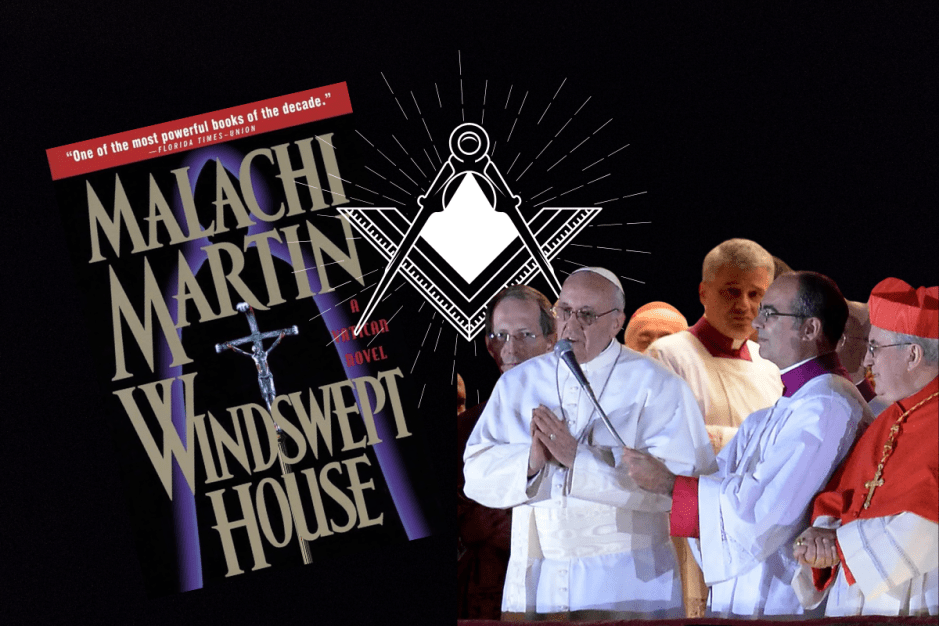
So I told him that we should write all this down and he told me that he is writing a new book on this subject. At the same time he dedicated his latest book to me in English, which will be translated into French: “Windswept House”. 

“Then we talked about this and that. He told me that the Abbot of Nantes had come to see him and asked him to insert a page about his community and himself in one of his books, but that he had to refuse. He knew Mgr Guérard des Lauriers, Mgr Ngo Dhin Thuc and many people. 

I asked him what he thought of the consecrations carried out by Mgr Ngo Dhin Thuc. He thiinks they are completely valid. He believes that there are currently some 57 bishops who have been consecrated in this way. He asked me if Bishop Williamson is a “sedevacantist” at heart or not. I told him that in any case, he is, as are others, but that he doesn’t say it and that Bishop Fellay claims to have relations with “undeclared sedevacantists”. He invited me to come back and see him – which will happen very soon.”

Second interview of September 12, 1996 in New York 

“In my last story I forgot to mention that Cardinal Ottaviani had probably been blackmailed in his last days so that he would accept the Novus Ordo, otherwise he would not be given the last sacraments. 

This Thursday evening, Malachi Martin had prepared the written answers to the questions that I had asked him in writing by mail some time before. This with the aim of possible publication. He warned me that our interview will not be long because he was to receive a prelate from Rome in an hour.

John Paul II signed an official document authorizing a Conclave to depose the pope on grounds of physical incapacity or health. So much so that we only talk about the Conclave in Rome… but the next one will be worse and so will the situation! 

In addition to the written responses, we took up some of them orally.  In particular the question of the Conclave. He described to me again how Cardinal Siri’s refusal happened: “After having been elected Pope and having read a paper which had just reached him, in an envelope, from the rank of cardinals, one of the three cardinals presiding the Conclave approached to ask him according to the consecrated words if he agreed to be pope. At that moment, Siri stood up stiff as a stick and pronounced the Latin phrases of refusal in an impersonal and cold tone as if he were forced.  The reason he gave for his refusal was propter metum, that is to say ‘because of fear’.” At this moment, Malachi Martin told me that, canonically, this way of responding could have been a reason to invalidate the Conclave5

I asked him: “Who did this paper come from?”

He answered me: “It came from the cardinals, probably from Cardinals Villot and …..6..In any case it was the expression of the refusal of the Special Lodge. This Lodge is reserved in Rome for cardinals in close contact with the Grand East. John XXIII and Paul VI were part of the Special Lodge.”

I asked him to confirm: “Was John XXIII a Freemason?” He replied: “On the membership of John XXIII in Freemasonry, all the proofs are in the Vatican archives, jealously guarded by Cardinal Sodano.  He himself saw photos taken by his driver revealing John XXIII frequenting Parisian dressing rooms.” The rest of our conversation was a bit of a repetition of the answers he had written. Due to lack of time we stop there. We must meet again the following Tuesday.”

Third interview of September 17, 1996 in New York 

“This will be our last meeting before my return to France. Malachi Martin told me again that we are only talking about the Conclave in Rome, that everyone is looking for votes and that the Freemasons are agitating very actively within the special Lodge reserved for cardinals, but in liaison with the rest of Freemasonry via the Grand East and the Grand Master of Italy whose name he does not remember.

He told me that he spoke several times to John Paul II about these pressures (from Freemasonry) and the errors of Vatican II, but that he told him that it was nothing and that he made fun of it. 

I asked him: “Does John Paul II consider himself pope?”. He answered me: “He even doubts whether he is pope and he behaves more like a bishop than like a pope.” 

We then talked about Mgr Thuc, Mgr Mac Kenna then he read and signed the translation of his responses into French in order to be able to ask that they be published. I asked him for some details on the reason for Cardinal Siri’s first refusal and how it happened. He replied that it was the same process each time (for Paul VI and John Paul II). 

Then I asked him what he meant by “advancing issues on Ecumenism and Judaism”. In fact, he was simply an intermediary between John XXIII and Cardinal Bea. Finally, after he gave me his blessing, we parted with the intention of remaining in correspondence.”

Questions asked of Malachi Martin (September 1996) 

Subject: Traditionalism 

Q. Do you know the so-called Cassiciacum thesis written by Mgr Guérard des Lauriers? What do you think? Do you consider that today the “pope”7 is a usurper, no longer has authority and should either convert or be deposed?

A. I don’t know Cassiciacum8.

Q. The Society of Saint Pius X9 signed a recognition of the legitimacy of John Paul II before the diaconate. It gives the practical instructions to pray publicly for him and to say “Una cum famulo tuo papa nostro Joanne Paulo” at Mass. What do you think of that? 

A. The Society is confused about the papacy. 

Q. Do you think that the consecrations performed by Mgr Ngo Dinh Thuc are valid? 

A. The consecrations of Mgr Ngo Dinh Thuc are valid.

Q. What do you think of the fight between Mgr Lefebvre and Mgr de Castro Mayer? 

A. I think that Mgr Lefebvre and Mgr de Castro Mayer were fallible heroes but heroes. 

Q. Do you know the book by Arnaldo Xavier da Silvera “The new Mass, what to think of it?” Is it true that he was murdered? 

A. I don’t know anything about Arnaldo Xavier da Silvera. 

Subject: Conclaves 

Q. Was Cardinal Siri elected pope twice? When ? One might think that his refusal comes from him alone. Why did he refuse and give way to Paul VI then to John Paul II? Some have asked Cardinal Siri; he did not respond and remained silent. You say there was pressure. Which ones and how do you know? From which cardinal do these pressures come?  We saw black smoke at the Conclave electing John Paul II. Was it because Cardinal Siri had been elected and refused? 

A. That Siri, twice in his old age, was elected pope is an undeniable fact to those who know what happened. All that Siri himself conceded was that fear of retaliation was the determining factor in his behaviour. The pressure on him not to accept the pontificate did not come from a single cardinal. Simply Siri was not acceptable to the progressive faction and its bosses. Yes, there was confusion after a vote at the October 1978 Conclave.

Q. You did not attend the Conclave electing John XXIII but you say that he kindly carried out his personal propaganda. Is this true? Why would he want to be pope? 

A. Angelo Roncalli was always a missionary with his intention of becoming pope.  He had an entirely Modernist agenda for the Church10.

Subject: The Popes 

Q. Was John XXIII an initiate? Some documents refer to him as “brother”. What do you think? 

A. Yes, he was initiated by Vincent Auriol11.

Q. Does the encyclical Pacem in Terris contain heresies? Does it fall under the infallible Magisterium? 

A. This should belong to the universal Ordinary Magisterium, but it is a Modernist document.

Q. Should we consider John XXIII as a legitimate pope? Should we follow his liturgical reform? 

A. He was validly elected. No, we should not follow his liturgical reform. 

Q. Did Paul VI have Jewish origins? What do you think of the thesis of the survival of Paul VI saying that he was replaced by a double? 

A. No one really knows all of Montini’s ancestors. No, Paul VI was never replaced by a double. 

Q. Did John Paul II have Jewish origins? Was he a heretic before his election?  Some Masonic documents acclaimed him because he recognized “the right to make mistakes.” Do you think he is perfectly aware of what he is doing? 

A. John Paul II, no, as far as I know, has no Jewish ancestors, but who really knows12? He is perfectly aware of what he did. He is not aware of the mistakes he has made. 

Q. Was John Paul I assassinated? For what ? 

A. We cannot explain the events surrounding the death of John Paul I by ordinary means. Powerful people didn’t like him as pope. 

Q. What do you think of the reform of the psalms by Cardinal Bea under Pius XII?  What do we think of the institution of the Easter liturgy at midnight by Pius XII? 

A. I think all their changes were harmful. 

Q. Which pope is guilty of obscuring the message of Fatima?

A. Pope John XXIII. 

Q. Who are the current “papabile” cardinals? Can we hope for a return to order after John Paul II? What future do you envision for the papacy and therefore for the Church? 

A. The future of the papacy: the hierarchy of the Church is extremely gloomy.13 

Subject: Vatican II

Q. Does the Second Vatican Council include formal heresies? Which ones? 

A. Certain parts of certain documents contradict past statements of the Roman Magisterium. For example, about religious freedom, papal primacy and infallibility; about the purpose of marriage, about the role of Jews, about the Church in the world. 

Q. Does the Second Vatican Council fall under the Ordinary Universal Magisterium? Is it infallible? 

A. Explicitly, Paul VI and the bishops of the Council denied the infallibility of the Second Vatican Council. If it had reflected the Tradition of the Roman Magisterium, it would have been part of the Ordinary Universal Magisterium, but it did not do so. 

Q. Should the Second Vatican Council be declared a robbery, in the same way as the Council of Ephesus? Can we interpret the Council in the light of Tradition? 

A. What the Roman Magisterium will ultimately do regarding Vatican II is what everyone hopes. Ultimately the pope will have to correct Vatican II and its documents in light of the fixed teaching of the Roman Magisterium – which won’t happen very soon. If you want to interpret Vatican II in the light of Tradition, you will have to reform its main documents completely14.

Subject: Relations at the Vatican 

Q. You were Cardinal Bea’s secretary and therefore probably followed his interviews. What do you think of him? Cardinal Bea is said to have been at the origin of Ch.4 of the Schema on Ecumenism concerning the Jews15, which rejects the guilt of the Jewish people in the crucifixion. What do you think? Did you participate in the writing of this text? 

A. Cardinal Bea was busy introducing as many progressive doctrines and policies as possible. He was the leading hand in the Schema on Ecumenism.  I refused to follow what John XXIII and Bea proposed about the role of the Jewish population. 

Augustin Cardinal Bea

Q. It is said that you have spent your entire career in the Vatican. Is this true? In what position? 

A. No, I was appointed professor at the Pontifical Biblical Institute in Rome in 1958. From there I became an assistant and advisor to Cardinal Bea. 

Q. What was your role during the Council? Did the “observers” participate in the writing of the “New Mass”?

A. During the Council, my role was to be “behind the scenes”, pushing forward plans on Ecumenism and Judaism. Six Protestant clergymen (out of a total of eight consultants) wrote the Novus Ordo under the direction of Mgr.  Annibale Bugnini. Unless very special care is exercised, the Novus Ordo is invalid. 

Q. Was Mgr Bugnini initiated into Freemasonry? 

A. Yes, Bugnini was a member of the Lodge16.

Q. All your books are released in novel form with imaginary names.  Why is that ? Have you had death threats? 

A. Not all of my books are in the form of a novel; only three of them. I have published sixteen books. 

Q. Did you know Carlo Falconi? What do you think of him? In his book Seen and heard at the Council, he said: “An otherwise trustworthy thirty-third degree assured me that Montini was a Freemason. For my part, I don’t believe it.”  What do you think?

A. I did not know Carlo Falconi personally.  Yes, for a certain period, Montini was a member of the Lodge, as was John XXIII.  

What matters in this testimony – disregarding the fact that these maneuvers may have rendered these conclaves invalid – is that the election of these conciliar pontiffs is due to enormous manipulation by the servants of the Masonic sect.

Let us thank Father Malachi Martin for his courage. His accusations raise serious questions that only theologians and canonists can resolve. How did we get to this? 

The reader will have understood: what Father Malachi Martin reveals is the culmination of a long conspiracy. Indeed, what does he say?

“Siri was not acceptable to the progressive faction and its bosses.”  “We cannot explain the events surrounding the death of John Paul I by ordinary means.” “Powerful people didn’t like him as pope.” 

Who are the “bosses” of this progressive faction plaguing the Vatican? Who are these “powerful people”? How did they come to dominate in the Vatican, to the point of being able to manipulate Conclaves? 

FOOTNOTES

  1. This is the name that Cardinal Benelli used to designate the church resulting from the Council. Cardinal Wojtyla, in his book “Sign of Contradiction”, gives it the name “post-conciliar church”. ↩︎
  2.  “B’naï B’rith, which means ‘Sons of the Covenant’ in Hebrew, is the first world Jewish organization. It is at the same time the oldest, the most numerous and undoubtedly the most influential. Founded in 1843 in the United States, this para-Masonic secret society exclusively reserved for Jews includes more than 550,000 Brothers and Sisters in around fifty countries” (The Warriors of Israel, Facta, 1995, p. 415). Also read the remarkable work by Mr. E. Ratier: Mysteries and secrets of B’naï B’rith. ↩︎
  3. Under the Banner, July/August 1986. ↩︎
  4. The question of the possible invalidity of the post-conciliar rite of the sacrament of orders is dealt with in the magazine “Forts dans la Foi”. Rama P. Coomaraswamy, MD: “The Anglican drama of the post-conciliar Catholic clergy”, n° 9/10, 2nd quarter 1990. ↩︎
  5. L’Osservatore Romano of 03/21/1989 reports a comment by Father Betti about the new formulas of the profession of faith (a chapter should be written to comment on them). He says among other things: “The second category concerns the truths and doctrines that the Magisterium proposes in a definitive manner although they are not divinely revealed. To these truths must correspond to a total assent, even if it is not an assent of faith, because they are precisely not proposed as divinely revealed. For example, the legitimacy of a Roman Pontiff: his election is a historical fact. It could even be theoretically tainted by an electoral defect. It is not the fact in itself which is divinely revealed, but it is so linked to Revelation that the Magisterium can pronounce in a definitive manner on the legitimacy of this or that Pope. Otherwise, the Church would have remained for this or that period without a legitimate leader, without a successor to Peter. This extract would almost seem  a response to the testimony published three years before, in 1986 in “Under the Banner”. ↩︎
  6. The second name is difficult to grasp. In order to avoid an error we prefer not to transcribe it. ↩︎
  7. In quotation marks in the original. ↩︎
  8. We do not know why Father Malachi Martin did not answer the second question. ↩︎
  9.  The Society of Saint Pius X was founded by Mgr Lefebvre in 1970. ↩︎
  10. By evoking this expression of “missionary” Father Malachi Martin means that Cardinal Angelo Roncalli was acting to become Pope. By the word “agenda” he means that he had a modernist program. We will come back to this later. ↩︎
  11. This is an initiation into Freemasonry. Let us note this extract from Father Mouraux’s magazine: “Nuncio in Paris, Mgr Roncalli received at an open table Edouard Herriot and Vincent Auriol, notorious freemasons and politicians who carried out persecutory action against the Church.  In the warmth of a banquet, he said to them one day: “What separates us is of little importance”. All his happiness seemed to be that of the table where he wanted above all to please” (Bonum Certamen 122, p. 7). ↩︎
  12.  Emilia Kaczorowska, the mother of John Paul II, was Jewish. ↩︎
  13. Note from AC – Fr. Martin had read the Third Secret of Fatima, which is widely believed by traditionalists to have predicted the Crisis. He knew in the 1990’s where the Church was heading. ↩︎
  14. We can note that “totally reforming the main documents” of Vatican II necessarily amounts to rejecting the Council, the good parts of which served to push through the bad ones. ↩︎
  15. During the Council a brochure was distributed to the Council Fathers entitled Judeo-Masonic action in the Council. After having given several proofs that chapter 4 presented to the Council was of Jewish origin, we find this on page 10:
    “If we want definitive proof that chapter 4 of the Schema on Ecumenism presented to the Council by Cardinal Bea — who personally defended this thesis – is from a Judeo-Masonic source, we find it in the pages of the important French newspaper Le Monde, of November 19, 1963: “The international Jewish organization B’naï B’rith has expressed its desire to establish closer relations with the Catholic Church. The said Order has just submitted to the Council a declaration in which the responsibility of all humanity in the death of Jesus Christ is affirmed. If this declaration is accepted by the Council, declared Mr. Label A. Katz, President of the International Council of B’naï B’rith, the Jewish communities will study the means of cooperation with the authorities of the (Catholic) Church.”
    In presenting his draft decree in favor of the Jews – completely contrary to the Gospel – His Eminence Cardinal Bea took care not to properly inform the Fathers of the Council of the origin of his theses and to specify to them they were suggested by the Masonic Order of B’naï B’rith.
    Let us also add this letter from Cardinal Villot to Cardinal Marty of December 22, 1977: “…The Holy Father is indeed well aware of the sincere and fruitful relations that his venerated predecessor Pope John XXIII maintained with Jules Isaac. He also appreciates the happy consequences that these reports have had for subsequent orientation of the relations of the Catholic Church with Judaism, relations which found ecclesial expression in number 4 of the declaration Nostra Aetate of the Second Vatican Council, as well as in other manifestations which preceded it deated or followed” (The Churches before Judaism, Ed. du Cerf, Paris, 1980, pp. 181 and 182). ↩︎
  16. We therefore know, as it is confirmed by this testimony, that the “New Mass” is the work of Protestants and Freemasons. Should we be surprised to find, for example, cabbalistic formulas in the Offertory?
    To know the thoughts of Protestants on the subject of the mass, let us read what Luther, founder of this sect, wrote: “We declare in the first place that our intention has never been to absolutely abolish all worship of God, but only to purge that which is in use, of all the additions with which it has been soiled: I am speaking of this abominable Canon, which is a collection of muddy lacunae; we made the Mass a sacrifice; we added offerories. The Mass is not a sacrifice or the action of the priest. Let us look at it as a sacrament or as a testament.  Let us call it blessing, eucharist, or table of the Lord, or Lord’s Supper, or Memory of the Lord. Let us give it any other title we wish, provided that we do not sully it with the name of sacrifice or action” (Werke, t. xi, p. 774). “When the mass is overthrown, I think we will have overthrown the papacy” (Contra Henricum Angliae Regem, Werke, t. x; sec. ii).
    ↩︎

Ecumenism: the Utopian Dream

Like the side events staged by NGO’s at the UN, the Pope’s ecumenical side-event at the Synod might be where the real work of demolishing the Catholic Church is taking place.

On October 11, the Pope led an ecumenical prayer meeting at a very special non-church venue: the Protomartyrs Square, an area right near St. Peter’s Basilica where the first pope is thought to have died. Francis excelled himself, managing to pack an unprecedented variety of blasphemies into one evening: continuing to promote the Masonic doctrines of religious indifferentism and naturalism, topped off by an egregious insult to every Catholic who shed his blood for the Faith.

The event marked the anniversary of the opening of the Second Vatican Council which the organisers of Francis’ vigil hailed as the beginning of a ‘new ecumenical era.’

For the theme of his reflection, Pope Bergoglio chose the phrase from John’s Gospel: “The glory that you have given me I have given them” (Jn 17:22). This expresses his belief that the martyrdom of early Christians like St. Peter, the shedding of their blood in that very place, had some mystical ecumenical significance.

The Pope continued by saying that the martyrs are ‘accompanying the Church on its ecumenical journey’ – another error with no basis in reality or in Catholic tradition. Unsurprisingly, Pope Francis quoted the arch-ecumenist, John XXIII, linking the pursuit of ecumenism to the unbelievably boring topic of synodality, saying “The journey of synodality… is and must be ecumenical”.

That bit does make sense. Since faithful Catholics are not fooled by either synodality or ecumenism, Francis has to go outside the Church to gain any traction. But that poses no problem when one has no belief in the primacy of Catholicism. When one can give away the bones of St. Peter or sign heretical documents with anti-Christians, then nothing is off the table.

It seems lost on the Pope that the martyrs died rather than compromise their faith to even one degree, let alone completely handing it to non-believers on a platter as he has chosen to do.

The Pope continued to spout his own ‘magisterium of Francis’: “Unity is a grace. We do not know beforehand what the outcome of the Synod will be, just as we cannot predict how the unity we are called to will fully manifest.”

Artist’s impression of how Bergoglio’s ‘unity’ will manifest

In another direct contradiction of Church teaching, Pope Francis claims that a so-called ‘ecumenism of blood’ is a witness of Christian unity to the world. ‘Ecumenism of blood’ is another of Francis’ imaginary theological principles. There really is no such thing. Christians do not achieve unity through martyrdom and this certainly was not the meaning behind Jesus’ discourse at the Last Supper. At least, if it was, then Gnostic Francis is the first Catholic in history to find this hidden interpretation.

Scripture and tradition clearly state that there is no salvation outside the Church. There is no unity when some Christians are outside the Church and others are inside the Church. Further, despite Francis’ many claims to the contrary, heretics can not be considered martyrs. [See note below this article for further explanation.]

St. Peter made this abundantly clear in 1 Corinthians 13:3, when he wrote,  “… if I should deliver my body to be burned, and have not charity, it profiteth me nothing.” Charity, of course, means to love God with all one’s mind and heart – including believing everything which has been taught by His Church. Anyone Christian outside of the Catholic Church is by definition, lacking in charity.

The attempted martyrdom by non-Catholics was the precise context of that famous doctrine, extra ecclesiam nulla salus, as first recorded by St. Cyprian of Carthage:

But if not even the baptism of a public confession and blood can profit a heretic to salvation, because there is no salvation out of the Church, how much less shall it be of advantage to him, if in a hiding-place and a cave of robbers, stained with the contagion of adulterous water, he has not only not put off his old sins, but rather heaped up still newer and greater ones! 

Pius XII reiterated the importance of membership in the Catholic Church in his Encyclical,  Mystici Corporis Christi,

“Actually only those are to be included as members of the Church who have been baptized and profess the true faith, and who have not been so unfortunate as to separate themselves from the unity of the Body, or been excluded by legitimate authority for grave faults committed.”

And these are only a few examples of the constant teaching of the Church prior to Vatican II. Francis’ ecumenical side-event reminds us of his true priority: the deconstruction of Catholicism.

While chancery bureaucrats enjoy their Roman holiday at the Synod, deluding themselves that anything they do will make a scrap of difference to the Pope, Francis puts on his Masonic-coloured lens: promoting religious indifferentism instead of preaching baptism to all nations and promoting the heresy of naturalism by pursuing his Utopian dream of ecumenism.

[NOTE ON NON-CATHOLIC MARTYRS: For a nuanced approach to this topic, consider this: They may have been true martyrs, but only before God (coram Deo), not before the Church (coram Ecclesia). They would be martyrs coram Deo, provided they were habitually willing to believe whatever the Church proposed if they had the means to know it, and it is not their fault. They would not be martyrs coram Ecclesia because only God knows the internal dispositions of a person’s soul at the hour of death. Now the Church can only make a pronouncement about external actions that can be known by one’s senses. Thus, she cannot publicly consider martyrdom something that only God can know, namely, that a person in the state of invincible ignorance decided in his heart, even if only as a desire, to belong to the Catholic Church and who died united to her.]

The St. Michael Prayer was an Antidote to Freemasonry

Most of the information in this article comes from a fascinating book, ‘Pope Leo XIII and the Prayer to St. Michael’. The book looks at various accounts of the origin of the prayer as well as its significance.

Pope Leo XIII famously composed the prayer to St. Michael after seeing a vision in which God gave the devil permission to have free reign over the earth from the mid-twentieth century. The date of that apparition is traditionally given as October 13, 1884 – coincidentally, that is exactly 140 years ago today. This date is significant for several reasons, none of which should be a surprise to my readers. October 13, as well as being the anniversary of Leo’s apparition, it is the date of the miracle of the sun at Fatima (1917) and of the final apparition of Our Lady at Akita (1973).

Some sources believe that Leo’s decision to write the prayer coincided with his increasing concern over the influence of Freemasonry on the Catholic Church. His predecessor, Pius IX, had ordered a set of prayers to be prayed by priest and faithful after Low Mass for the protection of the Church. Leo inserted the prayer to St. Michael into that set of prayers – a practise which continues today in traditional parishes – requesting this from his priests in his classic encyclical against Freemasonry, Humanem Genus.

Leo issued continued warnings to his priests to be increasingly vigilant with regard to dangers both within and without the Church. As well as the St. Michael prayer, Leo composed an exorcism prayer just for priests which is based on the St. Michael prayer as well as a longer version of the St. Michael prayer to be used by the laity.

Statue of Giordano Bruno at the Campo de ‘Fiori in Rome.
SOURCE: Livioandronico2013 via Wikimedia Commons

Leo’s strong condemnations of Masonry drew the ire of the secret societies against him. In particularly egregious incident, the Masons erected a statue of an infamous heretic in Rome. The heretic, Giordano Bruno had been condemned and executed under the Inquisition in 1600.

Bruno was a hero to the Freemasons and other subversive groups and the statue’s sculptor went on to become the Grand Master of the Grand Orient lodge of Italy. By erecting Bruno’s statue, the Masons were in effect thumbing their noses at Pope Leo. Leo’s response was to release another encyclical, Dall’alto dell’Apostolico Seggio, condemning the Freemason’s act. The date of issue was October 15, 1890, just two days after the mysterious and highly significant date of October 13th.

[As an aside, Giordano Bruno was posthumously rehabilitated by the highly suspect Cardinal Angelo Sodano in the year 2000! As another aside, and this is very strange: St. Michael is a saint who is perversely venerated by the Masons, who think of him as the ‘planetary angel of the sun.’]

One reason why Pius and Leo sought to engage extra help from the archangels can be found in the records of exorcists. During exorcisms performed after their pontificates, demons admitted that there had been ‘unusually numerous and strong invasions by diabolical spirits on the earth’ during Pius’ pontificate. One exorcist wrote:

In their battle against the Church, the demons use the wicked people as their allies. They have succeeded in enlisting a large number of people under their banner.

“We have the will of the people on our side,” they say.

The demon ‘Caesar’ leads their forces to stir up governments against the Church. “The people are our trusty storm troops”, he stated.

The Masons are among the main supporters of the demons. Lucifer admits that they are his ‘dearly beloved children’ and calls them his ‘representatives on earth.’

The exorcist continued:

Once they are defeated, the time will come when the members of the secret societies will be humiliated. The Virgin will destroy the secret societies. She has already set herself against them.

So we can see that before Modernism infiltrated the Church, Freemasonry was identified as being Her fundamental enemy, leading Pius to institute extra prayers after Mass for the protection of the Church and leading Leo to compose some very powerful new prayers invoking the great St. Michael.

IMAGE SOURCE: detail from James Powell and Sons of the Whitefriars Foundry, Public domain, via Wikimedia Commons

The Hideous Context of Bergoglio’s ‘Pro Life’ Comments.

Last week the Pope made his way back from a trip to Oceania and during an in-flight press conference, gave some comments that have been interpreted as bolstering his pro life credentials. However, the whole quote in context is genuinely disgraceful: the Pope equated the great crime of abortion, that sin which cries to heaven for vengeance with the wholly legitimate activity of ejecting illegal immigrants.

As reported by Vatican News, Pope Francis responded to a journalist’s questions about the upcoming US presidential election:

Anna Matranga (CBS News)

Your Holiness, you have always spoken in defence of the dignity of life. In Timor-Leste, which has a high birth rate, you said you felt life pulsing and exploding with so many children. In Singapore, you defended migrant workers. With the US elections coming up, what advice would you give a Catholic voter faced with a candidate who supports ending a pregnancy and another who wants to deport 11 million migrants?

Both are against life: the one that throws out migrants and the one that kills children. Both are against life. I can’t decide; I’m not American and won’t go to vote there. But let it be clear: denying migrants the ability to work and receive hospitality is a sin, a grave sin. The Old Testament speaks repeatedly of the orphan, the widow, and the stranger—migrants. These are the three that Israel must care for. Failing to care for migrants is a sin, a sin against life and humanity.

I celebrated Mass at the border, near the diocese of El Paso. There were many shoes from migrants, who ended poorly there. Today, there is a flow of migration within Central America, and many times they are treated like slaves because people take advantage of the situation. Migration is a right, and it was already present in Sacred Scripture and in the Old Testament. The stranger, the orphan, and the widow—do not forget this.

Obviously the primary error here is that the Pope is equating ILLEGAL immigration with LEGAL immigration. It is true that migration was common in Old Testament days and it is still common today: nations should gladly accept a sensible number of immigrants who commit to assimilating and contributing to the common good.

But when Moses took the Israelites to the Promised Land, they were doing the Will of God. They were bringing with them what was, at that time, the true religion, unlike today’s illegals who are anything from Marxist infiltrators to child sex traffickers to practitioners of Voodoo and Santeria. The Israelites weren’t given debit cards and free housing and we can be fairly sure they didn’t resort to eating the locals’ pets. So the Pope is creating a false equivalence here and ignoring the multiple ways mass illegal migration is tearing at the fabric of western societies.

Then, abortion. Science says that at one month after conception, all the organs of a human being are present. Everything. Having an abortion is killing a human being. Whether you like the word or not, it’s murder. The Church is not closed-minded because it forbids abortion; the Church forbids abortion because it kills. It is murder; it is murder!

And we need to be clear about this: sending migrants away, not allowing them to grow, not letting them have life is something wrong, it is cruelty. Sending a child away from the womb of the mother is murder because there is life. And we must speak clearly about these things. “No, but however…” No “but however.” Both things are clear. The orphan, the stranger, and the widow—do not forget this.

The first thing to note here is that, in mentioning two of the sins that cry to heaven – the cry of the ‘orphan, stranger and widow’ and abortion – the Pope omits two other very relevant ones: sodomy and the failure to pay a just wage. Both of these are widely known to be rampant with the Vatican’s walls under hhis pontificate.

Secondly, not content with saying imported thugs should be given the same treatment as genuine migrants in his first response, the Pope now says imported thugs as just as important as unborn babies.

So the tuberculosis-carrying murderers, rapists, and drug-pushers deserve the same protections as vulnerable babies in the womb? What a regrettable comment from a Successor of St. Peter who is basically saying that both actions are mortally sinful. (If he believes in mortal sin, which is doubtful.)

In your opinion, Your Holiness, are there circumstances in which it is morally permissible to vote for a candidate who is in favor of abortion?

In political morality, it is generally said that not voting is ugly, it’s not good. One must vote. And one must choose the lesser evil. Which is the lesser evil? That lady or that gentleman? I don’t know; each person must think and decide according to their own conscience.

Wrong again, Holy Father. While Catholics MAY deem it prudent to vote for the pro-abortionTrump under the current circumstances, they MAY NOT vote for a pro-abortion candidate of the magnitude of Kamala Harris under any circumstances. (Here is Fr. Ripperger’s opinion on voting for the lesser evil.) And there always remains an option to vote third party as matter of principle.

So what at first glance appears to be a strong defence of life, is in reality merely an excuse for the Pope to bang on about one of his his favourite causes: the mass migration that globalists are using as a tool to smash national identity.

This is yet another pawn being moved on the global chessboard to create a New World Order, with Pope Francis cheerfully playing his part. The Introit from today’s Mass in memory of the martyrs, Sts Cornelius and Cyprian seems particularly apt:

“…O God , the heathens are come into Thine inheritance; they have defiled Thy holy temple…” Psalm 78.