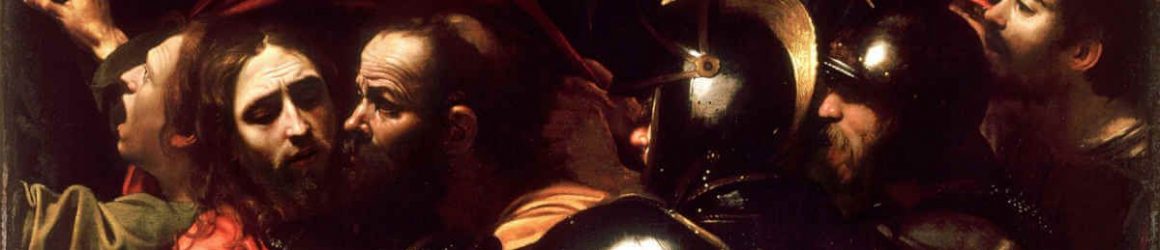
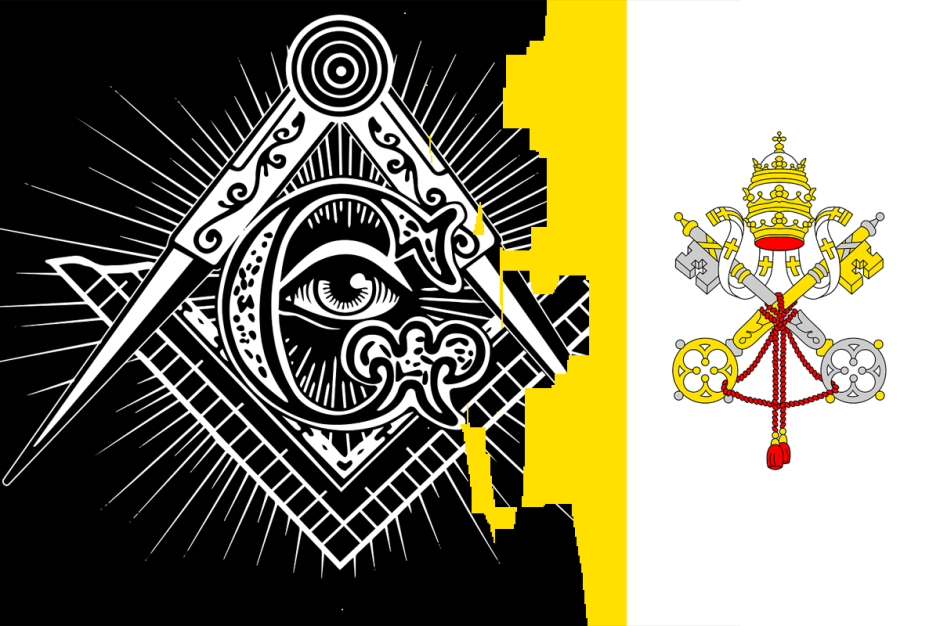
Setting the Scene for Masonic Infiltration

this article, by david l gray, is republished from one peter 5. While i don’t agree with the author’s conclusion (as reflected in my title), it does contain some relevant information for followers of ecclesiastical freemasonry.

There was such a dramatic change in the social and theological dispositions towards Freemasonry amongst many European, Argentinian, and North American Catholics immediately following the conclusion of the Second Vatican Council in 1965, that, at minimum, should have provoked a reasonable and rational concern amongst the faithful.

Some have argued that this divergence from the traditional teaching about Freemasonry was just the fruit of an infiltration of Freemasons that began with the Carbonari’s 1859 Alta Vendita plot. However, this analysis is too simplistic.

The Carbonari was an Italian political sect, whose membership was not exclusively composed of Freemasons. It was not a Masonic sect (i.e., beholden as an affiliate or appendant to the Grand Lodge). The fact the Catholic Church has never treated the Carbonari as a Masonic sect, but as a distinct secret society that plots against the Church, is affirmed by Pope Pius VII in his 1821 Ecclesiam a Jesu, and by Pope Leo XIII in his 1826 Quo Gaviora.

This is not the say that there have not been initiated Freemasons throughout the clergy, for that has certainly been true in the past and in the present. Rather, it is to say we can do better in analyzing and verifying those movements inside the Catholic Church which made it more friendly with Freemasons and more sympathetic toward some sects of Freemasonry. This first article will discuss some of the Masonic influences before Vatican II, stretching back some three hundred years. In the next article we will treat more specifically the claim of some to place the blame of infiltration solely on the plot of the Alta Vendita.

Vatican II Red Flags

Truly, smoke signals should have gone up in 1967 when the Scandinavian Bishop’s Conference (consisting of the countries of Sweden, Norway, Finland, Denmark, and Iceland), following a four-year study into Freemasonry in their dioceses, decided to permit Catholics in their dioceses to retain their Masonic membership, “but only with the specific permission of that person’s bishop.”[1] This deference to the local ordinary on a matter, heretofore, considered to be immutable, was the Scandinavian’s Bishops interpretation of Paul VI’s Apostolic Letter Moto Proprio, De Episcoporum Muneribus, which, itself is an interpretative reading of para. 27 of Lumen Gentium, gave bishops more authority to be the final arbiters of Canon Law.

Truly, alarm bells should have gone off on March 16, 1968, The Tablet (a progressive Catholic international weekly review published in London) reported in their ‘The Church in the World’ news and noted section:

Go-ahead for Catholic Masons: Vatican sources have recently been quoted as saying that Catholics are now free to join the Masons in the United States, Britain and most other countries of the world. However, the European Grand Orient Lodge of Masons, established primarily in Italy and France, is still considered anti-Catholic or, at least, atheistic.

Later that year, The Tablet would also take an Editorial stance in opposition to Pope Paul VI’s encyclical Humanae vitae.

Truly, visible panic should have ensued on July 19, 1974, when Cardinal Franjo Seper, Prefect of the Sacred Congregation for the Doctrine of the Faith, wrote a letter, which was supposedly intended to be private correspondence, to Cardinal John Krol, the Archbishop of Philadelphia at the time, supporting the Scandinavian interpretation of De Episcoporum Muneribus concerning Canon Law No. 2335 (prohibiting membership into societies that plot against the Catholic Church), stating,

Many Bishops have asked this Sacred Congregation about the extent and interpretation of Canon 2335 of the Code of Canon Law which prohibits Catholics, under pain of excommunication, to join masonic associations, or similar associations… Taking particular cases into consideration, it is essential to remember that the penal law has to be interpreted in a restrictive sense. For this reason, one can certainly point out, and follow, the opinion of those writers who maintain that Canon 2335 affects only those Catholics who are members of associations which indeed conspire against the Church.

It was almost hilarious that men who were plotting against the Catholic Church themselves were then putting themselves in a position to tell us which sects of Freemasons were not plotting against the Catholic Church. But this was something that went back centuries.

Pre-Vatican II Efforts to Normalize Freemasonry

This scheme to differentiate the Anglo-sects of Freemasonry (those whose charters and warrants originate from the Mother Grand Lodges of England, Ireland, and Scotland) from the Continental-sects of Freemasonry (those whose constitutions and rites are based upon the Grand Orient Lodges of France and Italy) began in 1738, when on the eve of Pope Clement XII issuance of his Apostolic Constitution In Eminenti apostolatus specula (The High Watch) on April 28, 1738. This Pontiff in fact had to endure the efforts of his nephew, Neri Maria Cardinal Corsini, who attempted to prevail upon him that Freemasonry in England was merely an “innocent mirth.”[2]

Indeed, perhaps Cardinal Neri revealed himself as a Freemason with his choice of those descriptive words, which is, curiously, are the exact instruction given to Freemasons in Article VI of the 1723 Constitution of the Grand Lodge of England (so-called Anderson’s Constitution) concerning how Freemasons ought to behave amongst each other after the official meeting of the lodge has concluded and the brethren are not, yet, gone; “You may enjoy yourself with innocent Mirth . . .”

Pius IX clearly taught in this 1873 Etsi Multa that Church teaching does not distinguish between sects of Freemasonry; “Teach them that these decrees refer not only to Masonic groups in Europe, but also those in America and in other regions of the world.” Nevertheless, Father John E. Burke of the Catholic Board of Negro Mission, reported to the United States Bishops the fact that one of the barriers in place that was preventing more Black Americans from becoming Catholic was that too many of them belonged to forbidden secret societies like the Freemasons. Therefore, he argued, permission should be obtained from the Holy See to allow prospective Black American converts to retain their membership in such societies for the sake of the financial benefits. Burke’s errant finding was that Black secret societies did not present the same threat to Catholics that the White societies did.[3]

The idea of their being a socially acceptable and theologically compatible version of Freemasonry is a myth. All sects of Freemasonry have always been prohibited because they all hold fast to the dogma of indifferentism and the belief that Freemasonry is man’s highest good (see my prior analysis here and here). Yet, to this day, this insane myth, first uttered by Cardinal Neri to Pope Clement XII, continues to be spread throughout the Catholic Church and made amazing strides in the neo-heterodox-praxis of the Catholic faith thanks to the liberal interpretation of para. 27 of Lumen Gentium that birthed De Episcoporum Muneribus in the wake of Vatican II.

Continue reading at One Peter 5
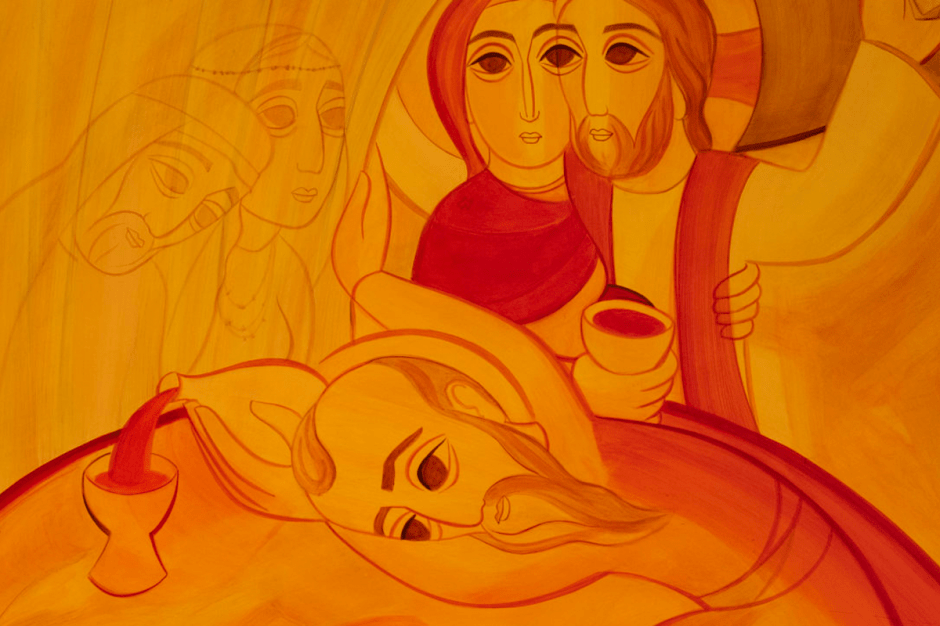
Sex-Abuser Rupnik’s Occult Art

It recently became known that the Vatican covered up for sex-abuser and Jesuit priest, Marko Rupnik. Apparently he was excommunicated in 2019 for serious abuse of the sacrament of Confession – absolving a woman with whom he had fornicated. This unfortunate woman was only one of at least nine with whom he undertook such relations, but it was all swept under the rug by the Jesuit-controlled CDF.

Our interest in this man is not so much for his despicable violations of his vow of chastity, but for his disturbing artwork. Rupnik is the man behind a couple of the Vatican’s very strange logos and also had a hand in the disturbing basilica at San Giovanni Rotondo – the newer version of St Pio’s pilgrimage site.

The logo for the Jubilee Year of Mercy:  “Christ sees with the eyes of Adam, and Adam with the eyes of Christ.”

Could be.

Or maybe this is a tribute to the Gnostic “third-eye” opening after ritual sodomy.

Rupnik’s logo for the 2022 World Meeting of Families, “This mystery is great”, says he. Well, it certainly is a mystery how an excommunicated priest came to design the official logo.

Interesting to see the third-eye symbolism recurring here; this time it is Our Lady and Jesus who share the third eye.

Some more of Rupnik’s talent can be seen in the Redemptoris Mater chapel in the Vatican. John Paul II had the chapel renamed in 1987 then refurbished in 1996. It was meant to be a tribute to his ecumaniacal obsession of uniting the Eastern and Western churches, but the artwork, mosaics completed in the style of Eastern iconography, appears to have an underlying anti-Christ theme to it.

One of the four walls was worked by Alexander Kornoukhov, a Russian Orthodox artist – this seems to be the wall directly behind the (rather bizarre) altar. Rupnik completed the other three walls, which show predominantly scenes from Scripture.

The Knights of Columbus loved the end result so much that in 2005, they paid for this panoramic online version to be set up so that interested parties could make a virtual pilgrimage. The images below are screenshots taken from that site. For a psychedelic taste of Rupnik’s work, you may wish to visit (or to avoid) the Aletti centre website.

It’s hard to know exactly what this depiction of the Annunciation is meant to represent. The scroll probably means that Our Lady was prophesied in the Old Testament, but by placing Her figure in such a way that She appears to be on the scroll itself reduces Her to a mere myth.

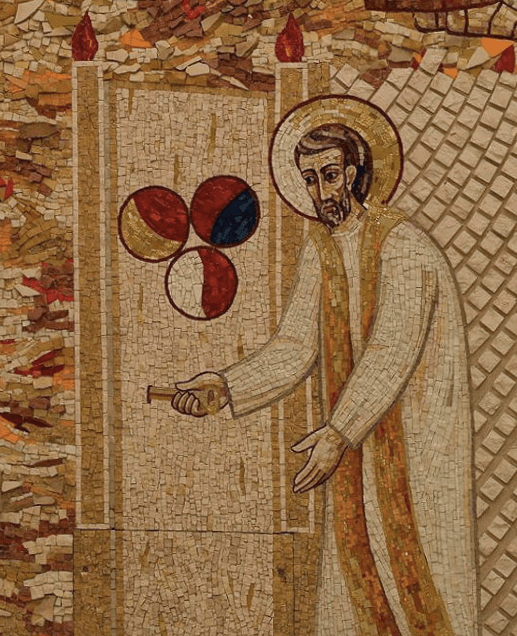
St Peter unlocks the door to his pawn-shop? Note the yin-yang style decoration of the circles.

Perhaps the strangest of the images is this one of Christ with his “as above, so below” gesture. Behind him, JPII looks on approvingly.

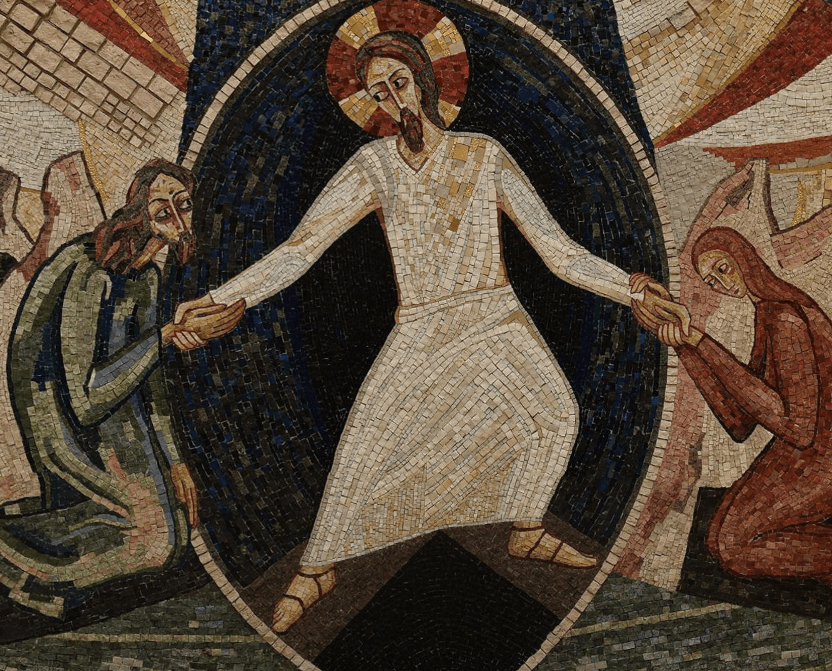
Interesting Masonic-style grip between Christ and the male figure to our left.

Sandro Magister’s take on the Jesuit-9

Republished from L’Espresso, written by Sandro Magister.

Incredible but true. Just now now when in a few decades it has lost a good half of its forces, the Society of Jesus has surged to the heights of command of the Catholic Church as never before.

Francis’s story is well known. He is the first Jesuit pope in history: he who notwithstanding had more adversaries than friends in the Society and took care not to set foot in its general curia whenever he came to Rome as a cardinal.But the innovation is that in this last phase of his pontificate – declining in age but not in ambitions – Francis has equipped himself with a veteran attack team, all his own and made up entirely of Jesuits.The top man of this team is without a doubt Cardinal Jean-Claude Hollerich (pictured), archbishop of Luxembourg. Top man, in Jorge Mario Bergoglio’s plans, both for today and for tomorrow.For today, the task assigned to him by Francis is to steer, as relator general, the world synod that got underway in 2021 and will last at least until 2024, but in the pope’s mind even beyond, with the task of remodeling the Church under the banner of none other than a permanent “synodality.”While for tomorrow it is no mystery that Hollerich is also Francis’s candidate “in pectore” for his succession, on which the current synod will have decisive influence, effectively obliging the future pope – whoever he may be – to take delivery on and continue the “process,” a bit as happened to Paul VI with the Vatican Council II inherited from John XXIII.The general rehearsal of this world synod is the one underway in Germany, which is already infecting other national Churches without Francis’s opposing any effective restraint, with the inevitable litany of fashionable reforms, ranging from married priests to women priests, from new sexual and homosexual morality to the democratization of Church governance.It is impossible not to recall that some of these were the reforms that another great Jesuit, Cardinal Carlo Maria Martini (1927-2012), had included in the agenda of the future Church in a memorable 1999 speech. Martini is known to have had a negative view of Bergoglio, but the supporters of the current pontificate are having a field day making him the “prophet” of the reforms for which Francis is supposedly paving the way at last and of which Hollerich has already repeatedly said he is in favor.“L’Osservatore Romano” published last October 24 a comprehensive agenda-setting interview with this cultured Jesuit cardinal with twenty-seven years of mission in Japan behind him. And in it he once again expressed the hope for “a paradigm change” in the pastoral care and doctrine of the Church on homosexuality, because homosexuals too “are the fruit of creation” and therefore are not “rotten apples” but “something good.” Of course, there is no room – the cardinal added – for a sacramental marriage between persons of the same sex, because the procreative purpose that characterizes a marriage is lacking, “but this does not mean that their affective union has no value.”And to the editor of “L’Osservatore Romano” who brought up the fact that the bishops of Belgium have spoken out in favor of the blessing of homosexual unions, Hollerich replied: “Frankly, the question does not seem decisive to me. If we keep to the etymology of ‘bene-dire’ [bless, literally ‘well-speak,’ Tr.], do you think that God could ever ‘dire-male’ [‘speak ill,’ Tr.] of two persons who care about each other?”These words of Hollerich’s spontaneously bring up the question: but wasn’t it another high-ranking Jesuit at the Vatican, Cardinal Luis F. Ladaria, in his capacity as prefect of the congregation for the doctrine of the faith, who prohibited the blessing of homosexual unions in a “Responsum” made public on March 15 2021?And was it not Francis himself who had “given his consent” to the publication of this “Responsum,” after having been “informed” of it, as written at the bottom of the document?Just so. Except, however, to take note that the following Sunday, at the Angelus, the pope had made it clear that he had no liking at all for “theoretical condemnations” or “claims of legalism or clerical moralism” where what are needed instead are “gestures of love.” And “authoritative Vatican sources” had anonymously made it known that with this he was criticizing none other than the “Responsum” that prohibited the blessing of homosexual unions, which he had approved in words.In short, humiliated by his confrere the pope, the hapless Cardinal Ladaria is the exception that confirms the rule. He is the old school Jesuit whom Bergoglio keeps on the bench while waiting to send him into retirement, off his team. Requiring him in the meantime to answer “no” to those cardinals – and there have been some – who have asked him to call Hollerich back to respect for correct doctrine.But in addition to Hollerich, there are two other Jesuits whom Francis has recently made cardinals and has put on the team in important roles.The first is the Canadian Michael Czerny, for many years more a competitor than a coworker of the Ghanaian cardinal Peter K. A. Turkson, first at the pontifical council for justice and peace and then at the dicastery for promoting integral human development, of which he has now become prefect. Czerny was also the special secretary of the synod for the Amazon. From the defense of nature to migrants, to the “popular movements,” he is the man Bergoglio avails himself of in these fields he favors.The second is the Italian Gianfranco Ghirlanda, former rector of the Pontifical Gregorian University and a seasoned expert in canon law. Among his tasks is that of translating into juridical provisions the imperious acts that Francis carries out with the air of an absolute monarch. From Ghirlanda, for example, came the perfunctory conclusion of the longstanding theological dispute between powers of orders, those derived from episcopal ordination, and powers of jurisdiction, those conferred by a higher authority, opting for the latter in order to place some lay people as well, men or women, at the head of the Vatican curia, with the simple mandate of the pope. Again from Ghirlanda, in his role of juridical “factotum” at the service of Francis, came the dismantling and refounding imposed by the pope on the Order of Malta.But that’s not all. Also among Jesuits who are not cardinals there are some whom the pope has placed in key roles, at his service.In the general secretariat of the synod of bishops there is a consultant who is in fact the associate closest to Cardinal Hollerich. It is Fr. Giacomo Costa, former editor of the magazine “Aggiornamenti Sociali” of the Milan Jesuits and vice-president of the Fondazione Carlo Maria Martini.Not to mention Fr. Antonio Spadaro, editor of “La Civiltà Cattolica” and very close to Francis since his election as pope, he too very active and urgent in promoting the world synod on synodality and in particular in involving in the adventure – with important help from his predecessor at “La Civiltà Cattolica,” Bartolomeo Sorge (1929-2020) – the Italian episcopal conference, initially very distrustful.And then there is the chapter of the Vatican finances, where Francis has appointed the Spanish Jesuit Juan Antonio Guerrero Alves as prefect of the secretariat for the economy, the office that oversees the entire sector.Moreover, for a couple of years there has also been a Jesuit at St. Peter’s Basilica, alongside the cardinal archpriest Mauro Gambetti, the pope’s vicar general for Vatican City. It is Francesco Occhetta, secretary general of the “Fratelli tutti” foundation and until 2020 political columnist for “La Civiltà Cattolica.”And there is also a Jesuit among the auxiliary bishops of the diocese of Rome of which the pope is bishop: Daniele Libanori, who is entrusted with the pastoral care of the city center.With the pope the names listed make nine. And with Sorge and the “prophet” Martini eleven, naturally without counting Cardinal Ladaria. Such a team, entirely of Jesuits, had never been seen in command of the Church.

Masonic Elements in a Californian Cathedral

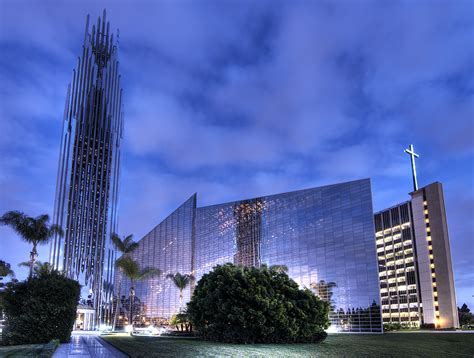
Christ Cathedral in Orange County, California, is another example of a modern church with Masonic overtones. The anti-Catholic theme begins outside with this contemporary take on a Masonic obelisk ….

Exterior of Christ Cathedral, California

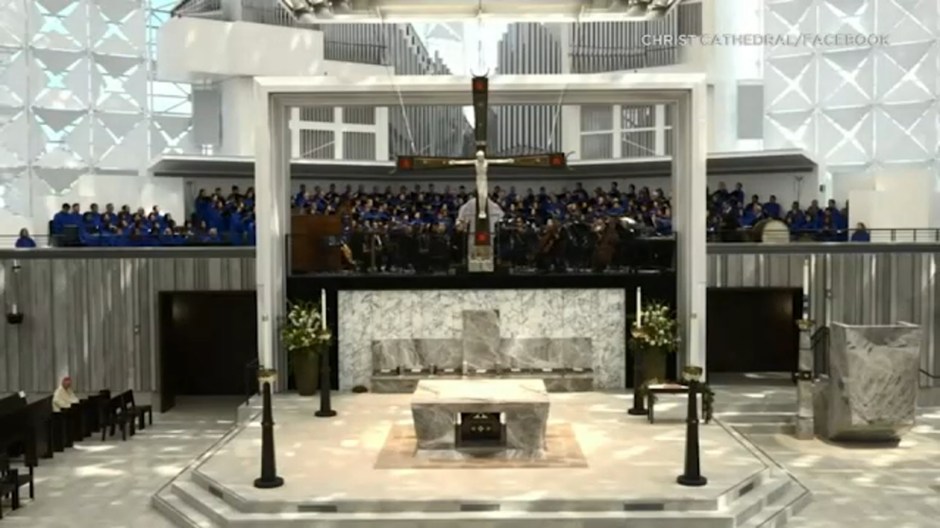
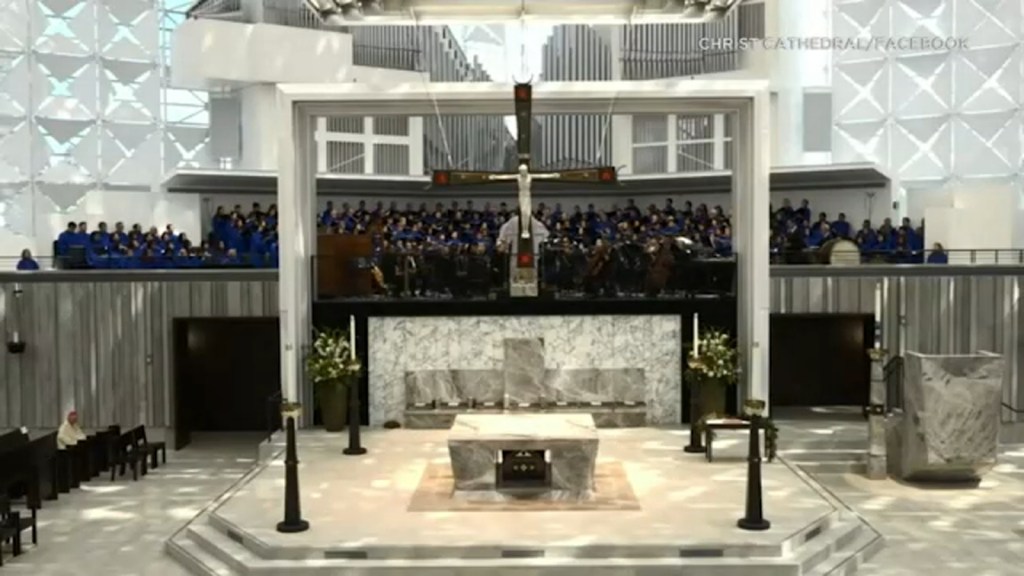
… and continues all the way to the sanctuary and altar. The altar itself is square, unlike the rectangular design of traditional Catholic altars. It is topped by a strange crucifix with crescent-moon shapes attached to the four ends of the cross. Crescent moons are a common symbol in witchcraft and the occult.

Theologian and philosopher, Peter Kwasniewski, gives this description of the sanctuary and offers an example of Freemasonic architecture for comparison:

“The location of the altar in the center of the room, the placement and type of presiders’ chairs, the dark torches on the ground punctuating the corners, the square mensa, and the all-seeing eye below the altar table at once bring us to a blood-curdling full stop. Can it be by accident that the altar at Christ Cathedral is a carbon copy of the altar of Freemasonry? Do we have a “reasonable hope” for denial? Even a cursory look at a Masonic altar makes the visual and symbolic link inescapable.

If one ignores the superior craftsmanship and style of the following Masonic temple, one can see the exact parallel in the disposition of the chairs — the tall chair in the center flanked by lower seating on either side — and then the square altar with the freestanding candles. (There is of course a fourth candle in the church, for it would have looked too strange to retain the asymmetry of three.)

https://onepeterfive.com/dark-symbolism-christ-cathedral/
Dr Kwasniewski gave this example of a Masonic Lodge layout

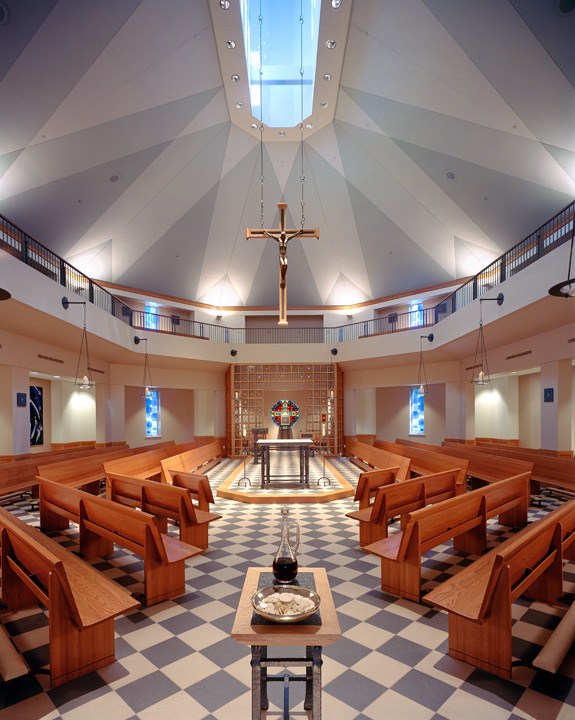
One liturgical ‘expert’ who contributed to the Christ Cathedral was Brother William Woeger. Brother Woeger designed the “Crux Gemmata” – the crucifix – as well as the candlesticks, reliquary and other features. Jesus’ crown of thorns and the altar’s reliquary are studded with strange crystals, reminiscent of those used by New Agers. Below is another design by Brother Woeger, which again shows Masonic influence. Note the checked floor, another square altar, surrounded by large candlesticks and the rows of pews which face each other.

I might return to Brother Woeger in a future article.

Lord of the Dance

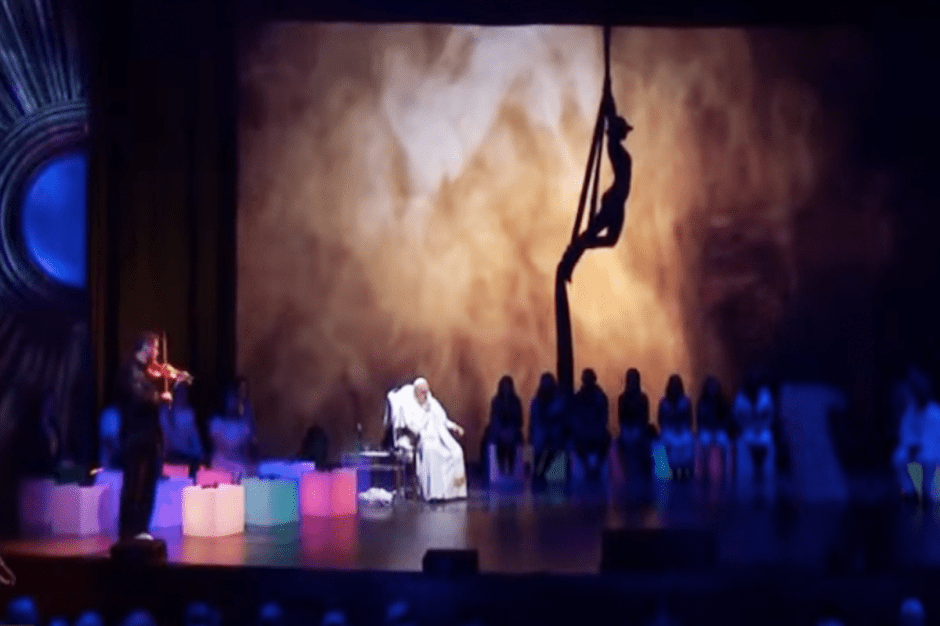
The abysmal “Economy of Francesco” circus is living up to its reputation with a bizarre “interpretive dance” sequence, featuring a silhouetted pole dancer. Take a look:

According to Rome Reports:

“The Pope’s trip to Assisi was full of musical performances to receive him in the first edition of “The Economy of Francis.”

A group of young people performed a modern dance accompanied by a violin and the reading of a poem inspired by the Bible. It is from the book of Isaiah and is titled “Shomèr ma mi-llailah?”

Several young people read the different parts of the poem in their languages. The poetry could be translated as “Sentinel, what time is it at night?””