The Fake St. Michael of the Occult

While Catholics acknowledge the importance of invoking St. Michael in their daily struggle against the Evil One, the Archangel Michael also appears in occult mythology, where He is venerated as a ‘planetary angel’ of the sun. But are practitioners of the occult referring to the same being found in Scripture?

The answer is no, not at all. Like all anti-Christians, the masters of the Dark Arts – just like their unwitting students, the Modernists – like to use the language of the Church while inserting their own meaning into the words. This is how they communicate with each other while fulfilling their twofold aim: instilling confusion into the minds of the faithful while mocking God.

There are various interpretations and role given to St. Michael in the occult world. The most superficial version is found in some New Age circles, where there is an imprecise notion of St. Michael – and angels in general. This school tends to view angels, as well as God Himself, simply as archetypes. In this case, St. Michael is a fairly vague character – he might represent a concept, such as ‘goodness.’ 1 This is possibly the meaning given to Michael in the sculpture mentioned at the end of the article.

However, some systems have a more specific idea of their fake ‘St. Michael’. Most seem to agree, as do Christians, that Michael was created prior to man and was present at the fall of the angels from heaven. There the similarity ends, for the occultists hail Lucifer as the supreme good while presenting the Trinitarian God as evil. (In the occult world, Lucifer and God are equally powerful; this is echoed in Eastern philosophies which search for balance: between good and evil, dark and light, male and female and so on.)

The search for balance between two opposing forces is a feature of Freemasonry. Freemasons have a specific concept of St. Michael, as Albert Pike explained in his book, Morals and Dogma of the Ancient and Accepted Scottish Rite of Freemasonry:

“The pavement (of the Lodge), alternatively black and white, symbolizes the Good and Evil principles of the Egyptian and Persian creeds. It is the warfare between Michael and Satan, Light and Darkness, Freedom and Despotism, Religious Liberty and the Arbitrary Dogmas of a Church that thinks for its votaries and whose Pontiff claims to be infallible.”

Albert Pike 2

Further, Masons regard St. Michael as the “planetary angel of the Sun,” a solar being,
ruler of the “Cosmic Fire,” who assists mankind in expanding their consciousness and becoming liberated.3

The idea of ‘solar being’ is found in several secret orders; these are entities who dwell on the sun. They are luminous, perhaps the size of a dinner plate, with the greatest of these being the Archangel Michael.4

The Occult Encyclopedia5 gives some principles related to the false St. Michael:

  • His Hebrew letter is hod
  • He governs the direction of south
  • His element is fire
  • Astrologically, Michael is related to Mars and the Sun and to the signs of Aries, Sagittarius and Leo
  • The day of the week he rules is Sunday.
  • He is Prince of the angelic choir of Virtues (In Catholic theology, opinions vary as to the status of St. Michael, although none place him as head of the Virtues6.)

According to the same source, the consensus among most occultists is that Michael is an Ascended Master7. The infamous Theosophist, Helena Blavatsky, for example, believed that all the archangels were spiritual messengers.

One of Blavatstky’s disciples, who went onto to create his own occult movement was Rudolf Steiner. Steiner built a fairly sophisticated philosophy around angels, including St. Michael. Steiner taught that Michael was a spirit with whom man could engage; that the ‘Age of Michael’ began at the end of the nineteenth century; and that a principle ‘sin’ against the spirit of Michael was nationalism. Here we see an example of the message of globalism being given incessantly to occultists.8

Another mention of the fake St. Michael is found the esoteric legend of the Holy Grail. In the great battle fought between the good angels and the fallen ones, Michael dislodged a precious gem from Lucifer’s crown. This gem, a sapphire known as the Lapis Exilis, was later used to fashion that legendary treasure: the Holy Grail – Christ’s chalice at the Last Supper.9

St. Michael again appears in the world of the occultist Eliphas Levi, who had recourse to the archangel when creating magical swords. Along with the names of other angels (Gabriel and Samuel), Levi instructed that Michael’s name and his famous cry, Quis est Deus, ‘Who is like God?’, should be inscribed on the sword.10

The Kabbalah has yet another idea about St. Michael. According to Jewish mysticism, God used His angels to communicate Kabbalistic ‘secret knowledge’ to the Patriarchs. Adam was said to have been visited by Raziel; Isaac by Raphael and Moses by Metatron. It was to King David that St. Michael is said to have divulged the mysteries of the Kabbalah.11
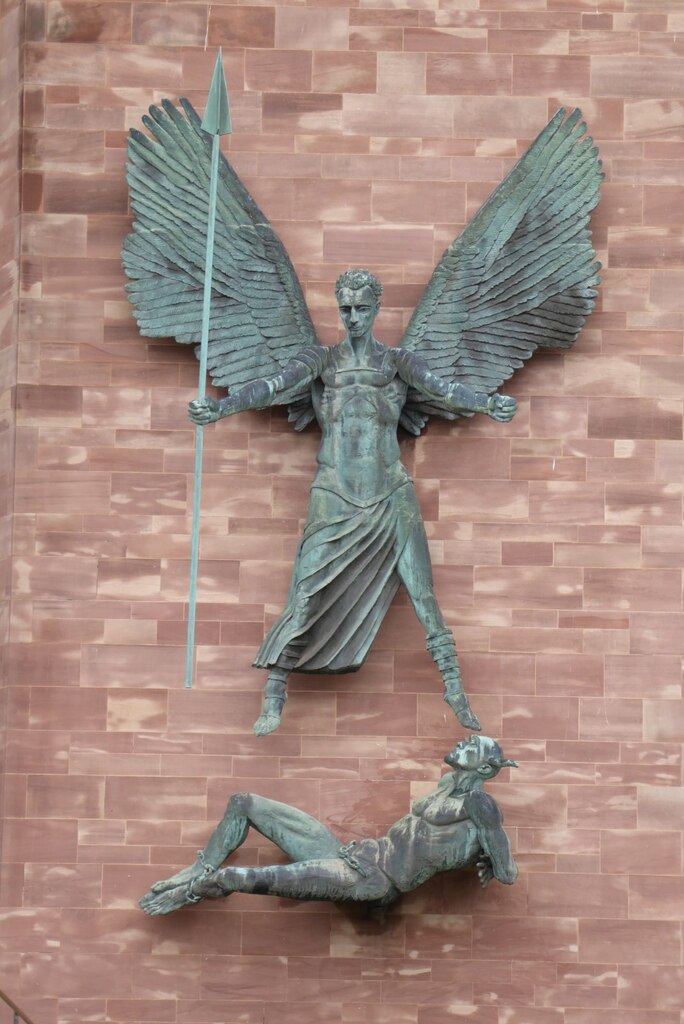
IMAGE SOURCE:

According to the Cathedral website, the sculpture is shows the “triumph of good,” but this is apparently not the angel, acting as an agent of God, defeating the fallen Lucifer. Rather, a benevolent St. Michael shows mercy to his pathetic captive. It reads, “St Michael holds his spear upright, not pointing at his captive with aggression, or intention of revenge.”12.

SOURCES

  1. Cannibalism, Blood Drinking and High Adept Satanism by Kerth Barker (purchase here) ↩︎
  2. Pike, Morals and Dogma of the Ancient and Accepted Scottish Rite of Freemasonry, p. 14 (purchase here). ↩︎
  3. David Ovason, The Secret Architecture of our Nation’s Capital: The Masons and the building
    of Washington, DC (purchase here) ↩︎
  4. Secret Teachings of All Ages – Manly P. Hall (purchase here) ↩︎
  5. Occult Encyclopedia online ↩︎
  6. New Advent online ↩︎
  7. Occult Encyclopedia online ↩︎
  8. The Rudolf Steiner Archive online ↩︎
  9. Secret Teachings of All Ages – Manly P. Hall ↩︎
  10. Secret Teachings of All Ages – Manly P. Hall ↩︎
  11. Secret Teachings of All Ages – Manly P. Hall ↩︎
  12. Coventry Cathedral website ↩︎

A Church Dedicated to the Four Elements

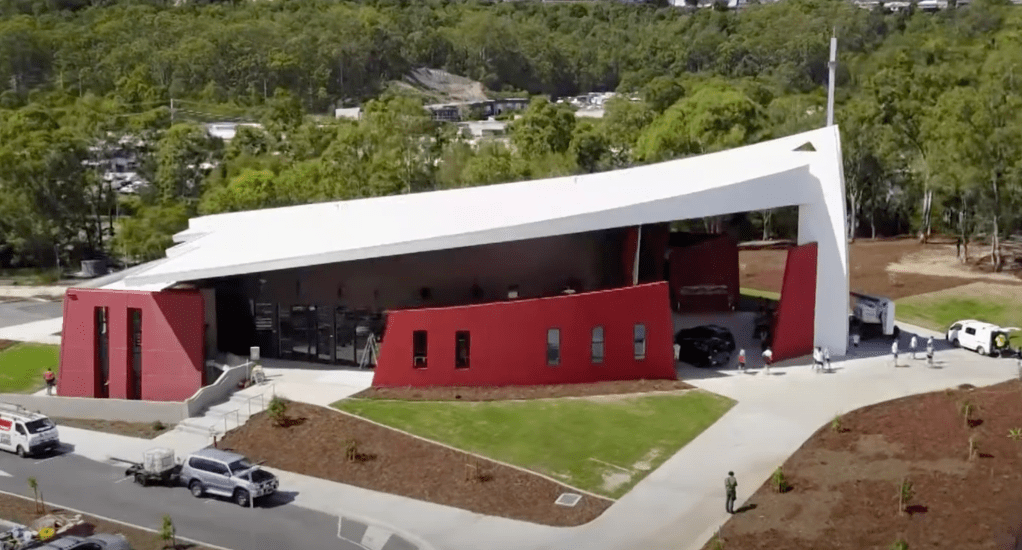
A church built in 2017 at the largest parish in Australia exemplifies the fusion of humanism and paganism which is unfortunately almost ubiquitous in contemporary Australian parishes. The church is one of five in the Burleigh Heads parish, and is part of the Archdiocese of Brisbane.

Named ‘Mary, Mother of Mercy’, the building includes anti-Christian features, including Masonic symbols and indigenous mythology. Pagan and occult features were built into the church’s design and the opening ceremony exemplified the parish’s focus on paganism with a smoking ceremony and allusions to the four principal elements of alchemy.

Problems begin with the logo used for all churches in the parish. It shows five crosses which no doubt represent the total number of churches, but these replace the traditional three-cross arrangement which represents Christ’s saving Crucifixion.

The usual arrangement representing the crosses of Our Lord and the two thieves.
The Burleigh Heads logo attributes to the crosses the merely human aspect of the number of member-churches.

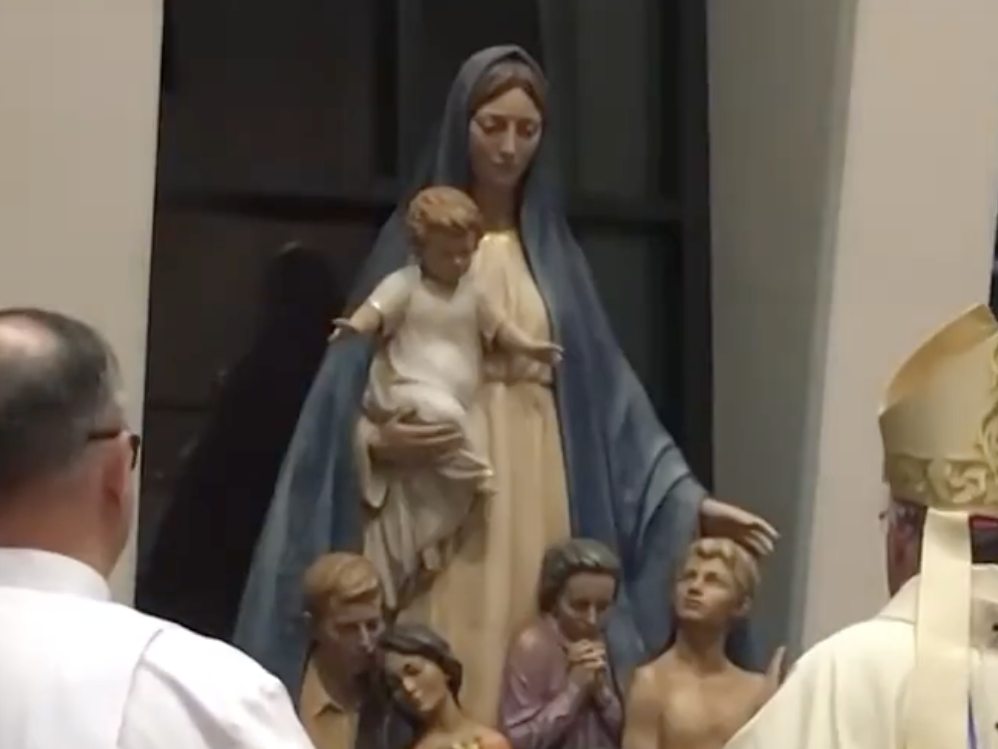
Built in a style typical of modern Australian churches, it features exposed steel beams and is almost devoid of sacred images. One exception is the enormous wooden statue of a very plain-faced Mother of God, surrounded by a group representing the diversity of Australian citizens, including a semi-naked boy with his surfboard.

The exterior of the church
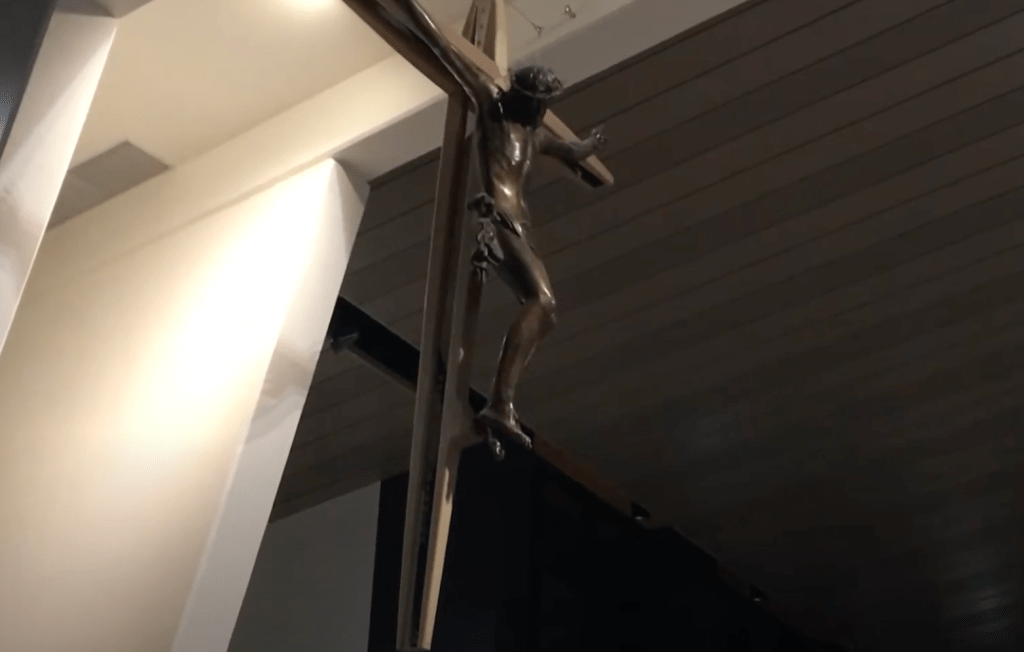
Massive beams and pillars dominate the interior

A plain-faced Mother of God
A topless boy

The sanctuary is typical of many churches here, with the tabernacle hidden from view. The church features a pair of strikingly Masonic design elements: two sets of twin pillars, one at the church’s entrance and one set inside the body of the church. A news report describes the latter set as ‘concrete portals;’ significant because in esotericism, a portal is a gateway to secret knowledge, and is usually achieved via occult rituals.

Interior of a Masonic lodge from Ohio.
The two pillars at the entrance to the church, flanked by structures appearing to represent a modern nod to the traditional flying buttress.
The nave holds the tabernacle; rather than the Blessed Sacrament being the focal point, this area is dominated by the massive pillars which span the entire building. The rows of chairs facing each other is another Masonic motif.

Twin pillars are especially significant in Freemasonry, where are said to represent the truth being found between two opposites, or poles. Duality is a common theme in the occult and was actually part of the design brief given to the designers for the church: they were asked that it embody ‘light and darkness, the masculine and the feminine, the sky and the earth’.

The heretical Archbishop of Brisbane, Mark Coleridge, (who possibly requested the design elements) gave a clue to the occult meaning of the ungodly building in his sermon at the opening Mass. He mentioned wind and fire, two of the four elements associated with alchemy and the occult.

This is the Church that has given birth to us and will continue to give birth to this community of faith in Burleigh Heads. It’s a place of the Spirit. It’s a place therefore of wind and fire, a place that can turn the human womb into a temple of God himself.

Archbishop Mark Coleridge

The third element, earth, is referenced by the twin pillars both inside and outside the church, which the designers explain “visually tie it to the ground.” The fourth element, water, is referenced in the name of the suburb housing the church – Burleigh Waters – as well as in the waters within the womb. Mention of the womb and rebirth also suggests the theme of transformation, so common among occultists.

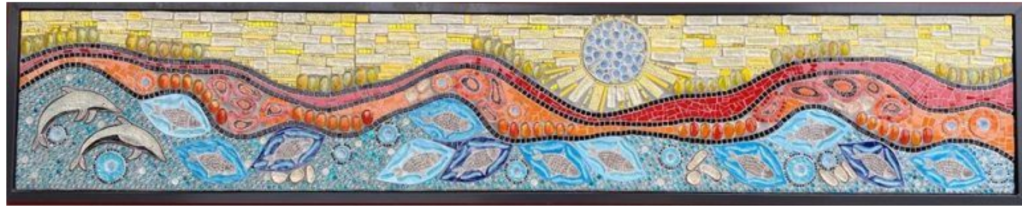
Outside the church is a mosaic, shown below, which was produced by a local indigenous artist. It represents a pagan myth about a hero who was reincarnated as a dolphin.

Indigenous artwork based on a pagan myth

During the church’s opening ceremony, an unknown type of smoking ritual took place. It involved a layman raising a ‘smoking’ bowl over congregants. This appeared similar to indigenous smoking ceremonies in which smoking leaves or herbs are burned in the belief that this cleanses the space of ‘evil spirits’.

A smoking ritual during the opening ceremony

Perhaps unsurprisingly, the parish is home to at least one esoteric prayer group: the ‘Contemplative Women’s Group’ which purports to examine Scripture and which features an activity reminiscent of Wicca: “sinking into the feminine divine.”

Prior to the construction of the building, the former parish priest, Fr Ken Howell, was given a ‘virtual tour’ using cutting edge technology from a company named Oculus. Oculus is, of course, Latin for eye – a very important symbol for occultists.

Fr. Howell, wearing the ‘Oculus’ virtual reality goggles.

Demons on Pope Francis: “We Need Him!”

demons are not usually entities whose word can be relied upon, but in 2015, an evil spirit revealed that hell ‘needs’ Bergoglio. the demon metaphorically put his money where his mouth was and helped foil an attempt on the pontiff’s life.

It is fairly well-known that in 2015, authorities discovered that a young man from New Jersey was planning to assassinate Bergoglio during a papal visit to Philadelphia. The teenager, Santos Colon Jr., had been planning for months to have the Pope shot by a sniper during Mass, after which he would let off explosives nearby. The young man apparently changed his name to “Ahmad Shakoor,” prior to the planned attack, to show his solidarity with the Islamic State.

The plot was foiled by the FBI, and according to a CBS news report of the time:

Officials say that Santos talked to someone he thought was a sniper, but was actually an undercover FBI employee. He then engaged in target reconnaissance with an FBI confidential source and told the source to purchase materials to make explosives.

What is not commonly known is that it was occultists who first tipped off the FBI. In her book, The Devil in Dreamland, (click here to purchase) Catholic paranormal expert, Ursula Bielski, reveals how two occultists were given a message by entities they believed to be ‘aliens’, warning them of the planned assassination of the Pope.

Chris Bledsoe, a New Ager – and possibly a Rosicrucian – , and ‘shaman’ Pamela Nance, were in the habit of using a device known as a ‘ghost box’ or ‘spirit box’ to summon aliens and then receive their messages.

Bielski explains that a ‘ghost box’ is a radio that has been altered to make it scan quickly through frequencies, which UFO-chasers believe somehow allows ‘aliens’ to transmit their messages. As Bielski has come to understand, and as well-formed Catholics should already know, these ‘aliens’ are in fact, demons.

During one of their sessions with the ‘ghost box’, Bledsoe and Nance were given an urgent message from the demon they summoned:

“The Pope is in danger! Help him! We need him!”

Bielski claims that this message led Bledsoe to contact a certain Colonel John Alexander and also Joe McMonagle of the CIA. Both men are apparently involved in the practice of ‘remote viewing‘, similar to clairvoyance and which is defined as “practice of “seeking impressions about a distant or unseen subject, purportedly sensing with the mind.” This disturbing detail adds to the growing mountain of evidence that high-level authorities in the U.S. are involved in the occult – and have for many years used occult practices in their official government work.

The two men investigated and confirmed that a plan to kill the Pope was indeed afoot; they then informed police and the would-be assassin was arrested.

To confirm the occult credentials of John Alexander, one need look no further than a project he was involved in: a book and subsequent movie called, “Men Who Stare at Goats.”

“Goats” is a documentary about the American government’s explorations into New Age practices like remote viewing in the hope that they would enhance the skills of their agents. Strangely, the movie is billed as a comedy – yet the use of paranormal powers by governments is no laughing matter. And neither are warnings by demons about the imminent death of a very unworthy Pope.

To hear that the demons “need him” should fill us with regret about hell’s approval of Bergoglio’s agenda.

Yet, the Pope himself thinks he is more powerful than demons. A newly released book about exorcism, which includes an interview with Pope Francis (and therefore can be considered a form of propaganda in his favour) includes this instructive snippet about a nun who was possessed. During the course of an exorcism, she said, with a demon’s voice:

… that the devil hated Pope Francis: “Have you seen everything I put that Argentine through?” the devil said to the priest. “But he doesn’t go away, he is strong, too much for me.”

Although Pope Francis admits that he probably “gets on the devil’s nerves”, that doesn’t mean they are not on the same team; even very close friends can irritate one another from time to time.

Occult Themes at Notre Dame Cathedral

note: copyrighted images are not included in this post – click through to the original articles to see photographs of the restoration and liturgical furnishings.

It was not surprising to learn that some disturbing occult motifs have been integrated into the newly-restored Notre Dame Cathedral in Paris. While much of the restoration was entirely in keeping with its historic past and Catholic tradition, the innovations are startling enough to make us wonder what role the church is meant to play in the ongoing destruction of the Catholic Faith.

The Phoenix

The first motif sets the scene for the rest of the tour: the rooster which once sat atop the Cathedral has been replaced by the phoenix, an occult symbol. Most are familiar with the Greek myth of the phoenix rising from the ashes, but as a symbol, it is far older, originating in the mystery religions of ancient Egypt. Several pagan religions have used the phoenix to represent transformation and renewal including the Native American Thunderbird, Russian Firebird, and Chinese Fèng Huáng.

Some occultists go further, equating the phoenix with Lucifer: venerating him as the angel who fell into the flames and will one day rise again to rule the earth. Arch-occultist, Aleister Crowley wrote a sacrilegious Thelemic ritual called the ‘Mass of the Phoenix,’ and the phoenix is also employed in Masonic symbolism.

The phoenix motif is one that has been repeated many times of late, most notably in the case of Trump ‘rising up’ from the injury sustained during his assassination attempt (which possibly foreshadowed his ‘rising up’ to be re-elected as President.)

Notre Dame under reconstruction

The symbolism of the phoenix has not been lost on the media, with outlets entitling their reports on the Cathedral’s reopening in terms of ‘Phoenix from the Ashes’ and similar headlines. The bird’s designer, the Chief Architect of the project, Philippe Villeneuve, certainly had this theme in mind. He describes his creation as the rooster ‘reimagined’ to represent a phoenix carrying the ‘fire of resurrection’ to Notre Dame. In a very telling comment, Villeneuve explained that the design process was “so intense he might have to speak to his “therapist” about it.”

This bizarre scene appears to be a bird (another Phoenix?) flying over the organ
– from the Opening Ceremony. SOURCE: FLICKR

The Liturgical Furnishings

The ‘phoenix from the ashes’ theme was taken up by a writer interviewing Guillaume Bardet, the sculptor of Notre Dame’s creepy liturgical furnishings: the altar, lectern, cathedra with seats, tabernacle, and baptistery.

Bardet’s explanation of bronze, his material of choice, sounds like the fascination of an alchemist: ” it looked like a liquid sunshine filled with an extraordinary presence like a mysterious energy emanating from the bottom of the earth.”

Bardet reveals that, strangely, even before the fire, he had already come up with designs for Notre Dame:

In April 2019, I was finalizing my previous exhibition at [a French gallery] when Notre-Dame started going up in flames. In front of me was a large bronze table I had called The Last Supper : it was surrounded by twelve bronze stools, each named after an apostle. The opening evening, a few friends joked (seriously) that I had designed Notre-Dame’s future altar. When Notre-Dame called for creative projects, I felt legitimate to apply. Most of the objects and furniture I had in mind; some of them I had even sketched years before.

By sheer coincidence, the Chief Architect, whose brainchild was the rooster-come-phoenix mentioned above, had also had dreams of building Notre Dame: he made a model of the cathedral as a child.

In another article, Bardet exposes the Masonic, ecumenical agenda behind his designs, which also contains overtones of so-called ‘Synodality’:

‘They should resonate with conviction for Catholics and captivate the attention of non-Christians. Each element carries its own distinct identity, symbolism, and purpose, yet together they form a cohesive ensemble that engages in a meaningful dialogue.

An article on the restoration, written by a traditional Catholic, sheds some light on the theology underpinning the changes. Rita Stewart notes the connection between several ambiguous Vatican II documents and Bardet’s designs and explains his desire to “remove everything that is not necessary, and to arrive at the essential, and so the essential is that it is poor.” This sounds very much like the philosophy which gave us the Catacombs Pact.

Stewart also notes that the baptistery has the form of a circle with a central point – a classic Masonic/occult symbol.

The Vestments

The clown-like vestments worn by clergy at the Opening Mass are the ongoing focus of jokes and memes. Was their inclusion meant to point to some sort of humiliation ritual for the Catholic Church? They certainly gave the impression of something that cannot be taken seriously. Then, what can be expected from sa designer who has created costumes for Illuminists like Lady Gaga, Beyoncé or Katy Perry?

According to the designer, Jean-Charles de Castelbajac, his vestments represent “the rebirth of Notre Dame,” harking back to the phoenix’s theme of transformation. 

The Reliquary

In a similar way, the reliquary for the Crown of Thorns makes a joke of Catholicism. It is extremely tacky, not worthy of its role as a backdrop to a true relic of the Passion. Described by Rita Stewart as looking like ‘target practice at a shooting range’, the sculpture is completely out of place – except perhaps to the occultists. For them, the renovations obviously have a far darker meaning than anything that can be surmised here.

Let us pray for France, the first daughter of the Church, that She does indeed experience a re-birth, in the form of a return to traditional Catholicism.

Notre Dame, ora pro nobis

The Cross and the Occult

Most of the information in this article is taken from the book ‘The Secret Teachings of all Ages’ by Manly P. Hall, the 20th century occultist. click here to purchase your copy of this valuable reference book.

Ancients revered the cross

According to modern occultists, the cross was associated in pre-Christian times with nature-worship. The Aztecs, Toltecs and American Indians are among those who believed the cross had mystical powers. Eastern religions also incorporated the cross into their symbology, while to the Pythagoreans, the number 10, signified by an X, was sacred. The cross is also revered by the Illuminati, Rosicrucians and Alchemists who believe that it symbolises light.

The Tau or Tav Cross
Crux Ansata
Triple Tau

There are three main types of cross: the Tau; the Crux Ansata; and the Christian cross.

The Tau (Tav) Cross

The Tau cross looks like the modern capital ‘T’ and occultists believe it may have originated among the ancient Egyptians. It is believed to be the oldest form of cross and is sometimes referred to as a ‘hammer’ cross. In Kabbala-Masonry, Tubal-Cain presents a hammer in the form of a Tau cross to Hiram Abiff and this symbol is preserved in Freemasonry as the T-square. This cross has multiple forms among the occult groups, such as the Royal Arch of Freemasonry’s Triple Tau.

The Crux Ansata

The Crux Ansata, also known as the ‘cross of life’, is a Tau cross topped by a circle. Some occultists believe this form of cross is connected to a legend about St. Peter’s ‘golden key’ which gives entry to heaven. Occultists from the Egyptian mystery school revere this form of cross as having power over evil, going so far as to co-opt the words of Constantine, in hoc signo vinces. (‘in this sign I will conquer’ – a reference to the vision God granted to the pagan Constantine ensuring his victory in battle if he used Christ’s cross on his banners.)

To the occultist and pagan, the Crux Ansata is generally associated with water.

The Roman and Greek Catholic Crosses

This is the cross used by Christians to represent Christ’s death; however, occultists do not necessarily believe that Our Lord died on this form of cross.

Christian Cross

Occultists acknowledge the importance of the cross to the Christian: that it is a symbol of Christ’s sacrifice while also representing their own hardships in life. But they posit that the sacrificial aspect derives from antiquity, believing that to many ancient civilisations, the cross symbolised the equinoxes and solstices, when the sun was ‘crucified’ in astronomical terms.

Other occultists, unable to attribute Christianity’s popularity to Its intrinsic Truth, claim that the widespread adoption of the cross by Christians is only evidence that it was a highly important symbol to pagans. They point to the Southern Cross constellation, associated with seasonal rainfall and so revered by pagan civilisations, as proof of man’s inherent attraction to the cross as a symbol. The high-level Freemason, Albert Pike, taught that the four letters placed at the top of Christ’s cross during His crucifixion, are connected to the four elements which the Kabbala represents in a cruciform symbol.

Other Significant Ideas about Crosses

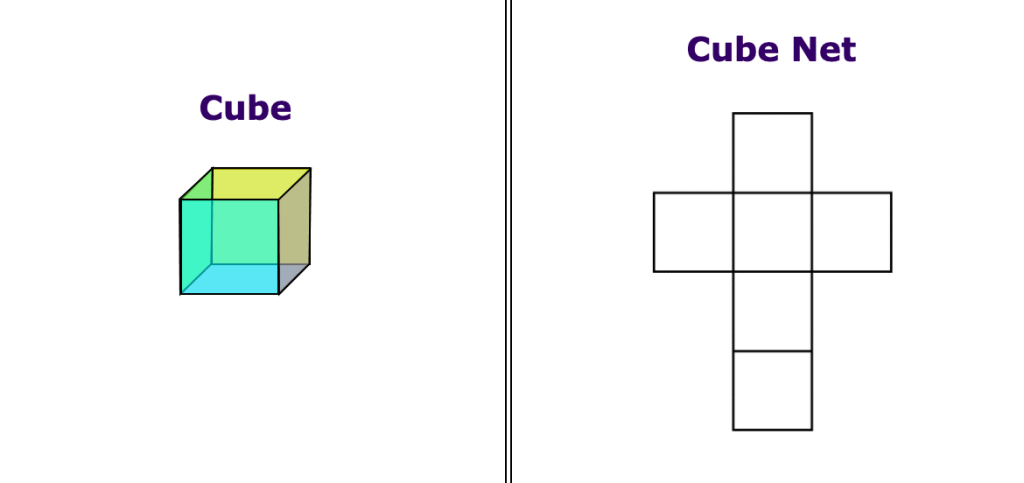
Occultists find significance in the fact that a cube can be opened to form a cross. (Image source here)

To the occultist, the cross within a circle may be either a symbol for the planet Earth, or for the element ‘earth’, because it is formed by four triangles representing the four elements.

Alchemists used a cross to symbolise the four constituents of the Philosopher’s Stone, and Freemasons also revere this form of the cross.

Other alchemy symbols which contain crosses.

Composition of Crosses

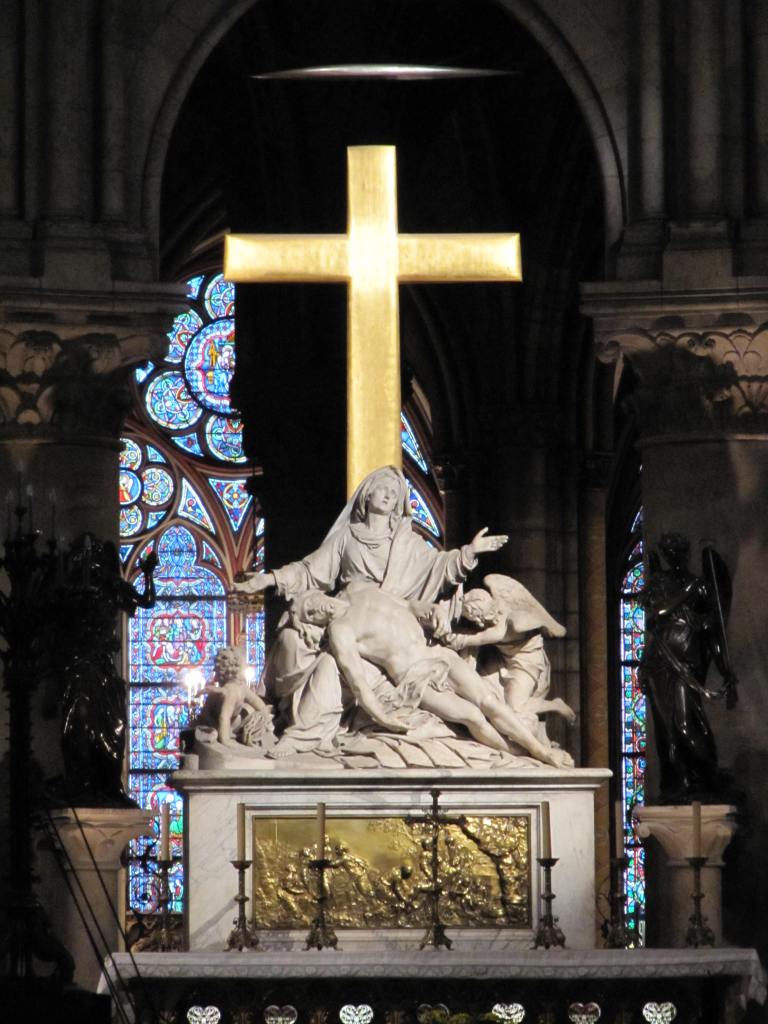
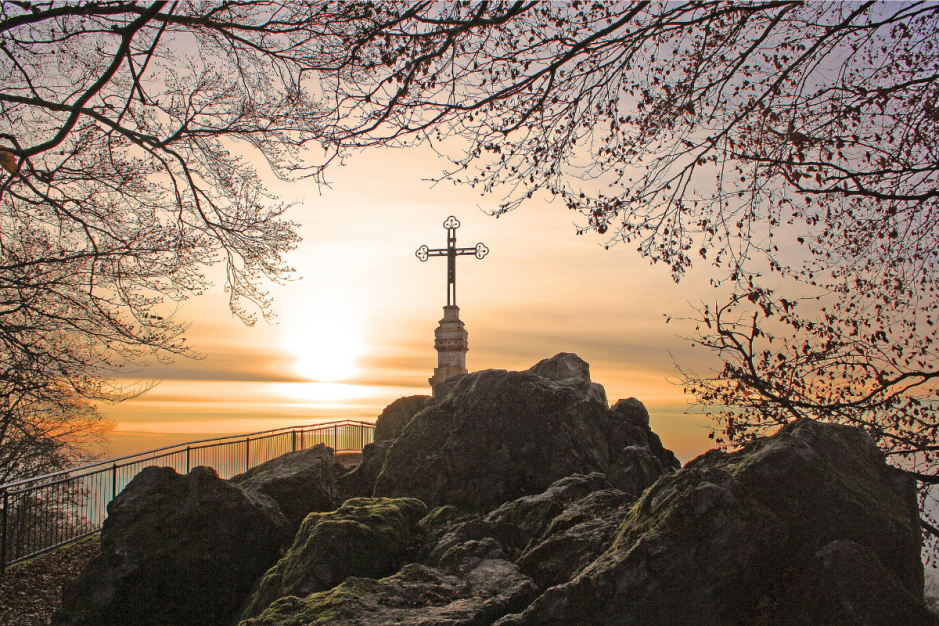
To the occultist, the composition of a cross is highly significant. A golden cross signifies illumination; a silver cross symbolises purification; a base metal cross symbolises humiliation; a wooden cross represents aspiration.

The cross is sometimes said to symbolise the human body due to the practise of those people who extend their arms while in prayer. The Kabbala, which identifies four natures of man (physical, vital, emotional and mental), relates each nature with one of the four elements, thus adding another layer to its association of the cross with the four elements.

A Wiccan Adoration Chapel in Melbourne

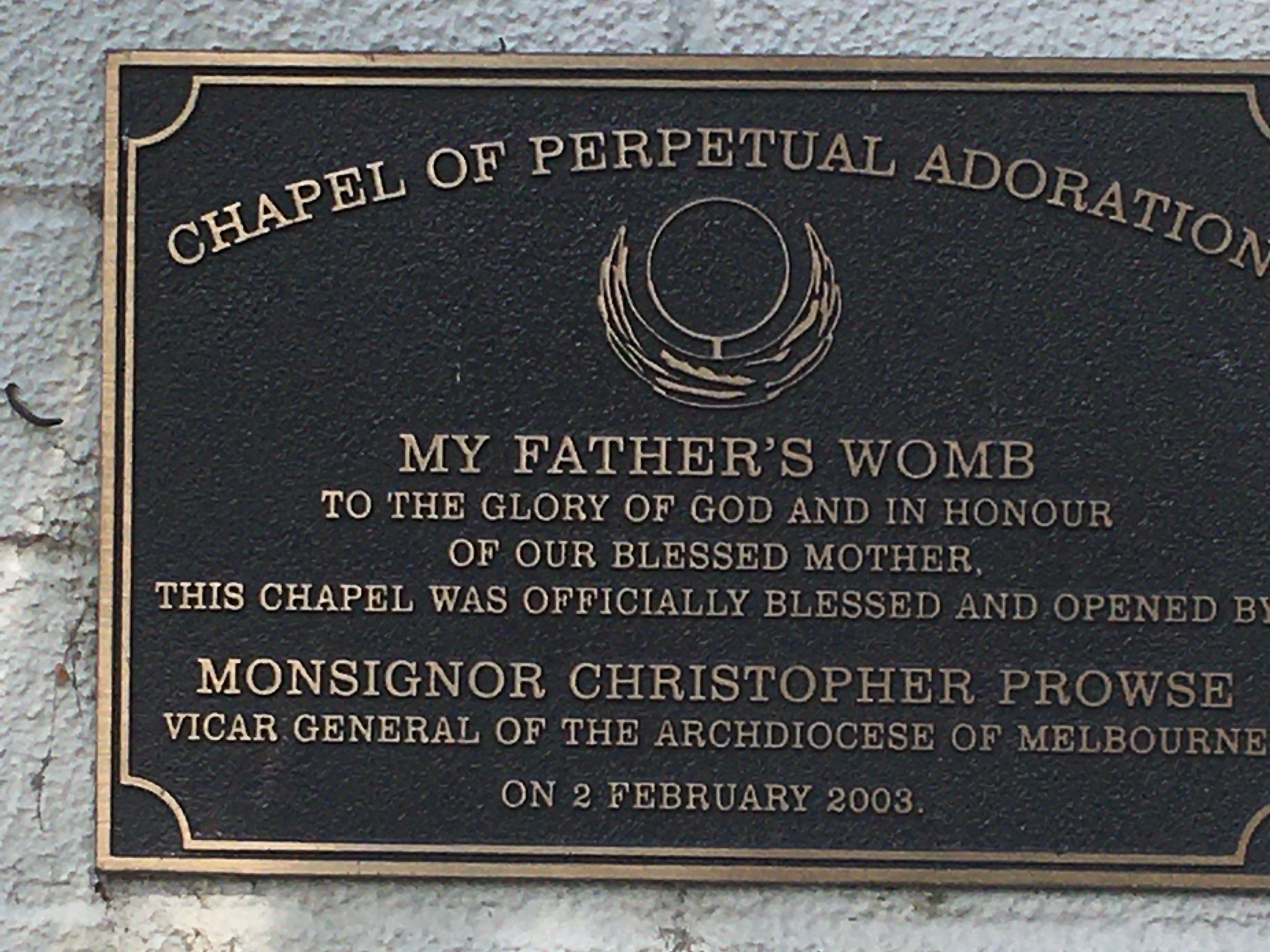
An Adoration chapel at St. Kevin’s Novus Ordo parish in suburban Melbourne raises questions as to just who has been designing our modern churches. Named, “Our Father’s Womb”, the chapel exhibits several hallmarks of Wiccan influence: exultation of the Feminine; mockery of the sacred; a giant labyrinth and a spell-casting tool.

Wicca is differentiated somewhat from witchcraft, although the two are related. Wicca is a religion whose disciples, known as practitioners, worship both a God and a Goddess. Wiccans celebrate rituals according to the seasons which, they believe, put them in touch with the Divine. The beliefs of each Wiccan vary according to the individual although the overarching rule is ‘Harm none and do as you will’. Most, but not all, Wiccans practise witchcraft, but not all witches are Wiccans.

The name of this chapel is absolutely bizarre, and suggests the glorification of the Feminine: “Our Father’s Womb: to the glory of God and in honour of our Blessed Mother.”

‘God’ in this case, does not necessarily refer to the Christian God; just as ‘the Blessed Mother’ does not necessarily refer to Our Lady.

Obviously, men do not have wombs and even more obviously, God is pure spirit and most certainly has no human organ such as a womb. Even if we accept the metaphor of a chapel being a womb-like place of security and comfort, the name is illogical from a Catholic point of view. Peace may be a fruit, but is not the purpose of an Adoration chapel. At best, this is the Modernist ideology of man-centredness at play.

At worst though, we are looking at a deliberately pagan mockery of the Blessed Sacrament.

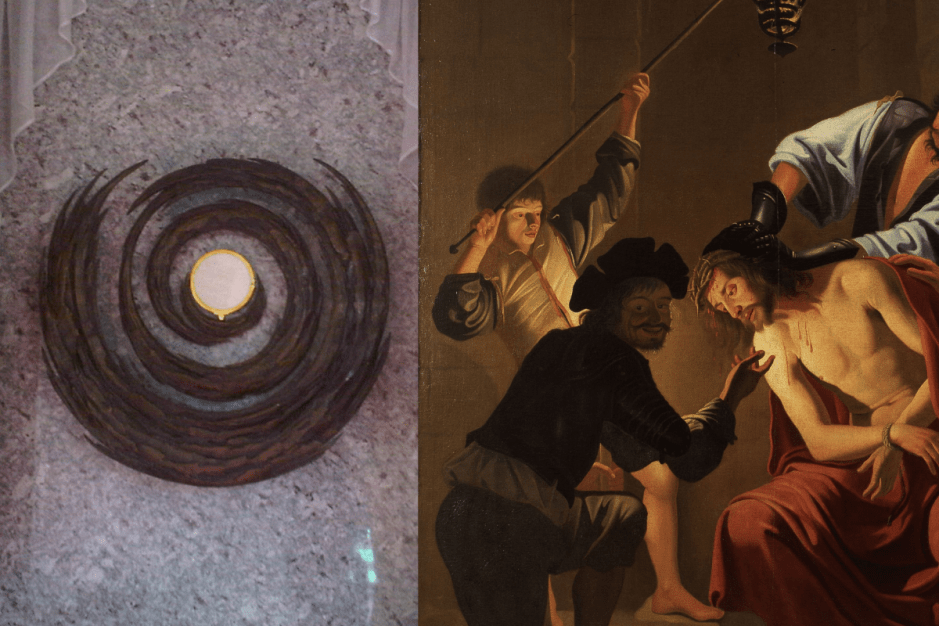
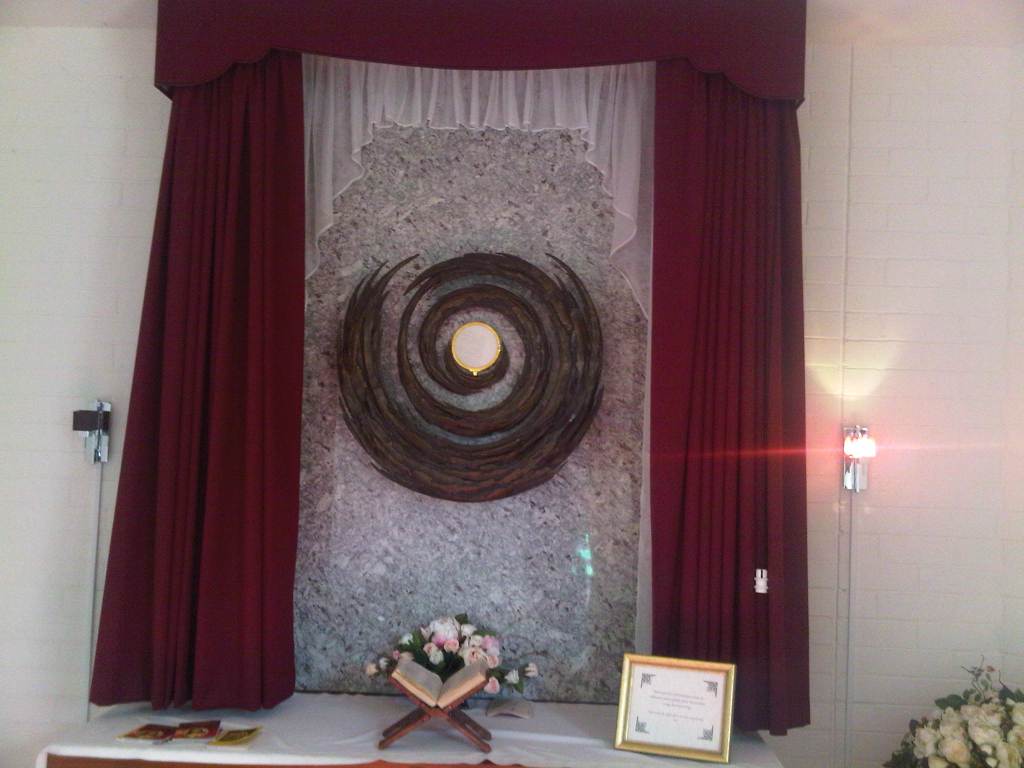
A closeup of the image shows a now-familiar symbol, which has the appearance of a nest holding the Host.

This is very similar to an element found in the logo for the Synod on Synodality.

(I have also previously wondered if this was meant to represent a child in a womb – the Antichrist, perhaps?)

In witchcraft, bird-nests are used for both curses and blessings, so are tools used in spell-casting rituals. There is coincidentally a legend relating to the Celtic saint, St. Kevin, in which a bird made a nest on the palm of his hand. Kevin apparently remained motionless for 40 days while the bird came and went, building the nest.

A different explanation for the nest is that it is actually a crescent moon, which is another symbol for the Feminine.

So far, the signs of a Wiccan influence are somewhat veiled. Once we step inside, however, the occult references are even more pronounced.

To the untrained eye, this is merely a very ugly setting for the exposed consecrated Host. But my learned friend believes that the red curtains are meant to represent female genitalia. He is familiar with this kind of imagery from the shrine to Lucifer in the Brisbane Cathedral.

The spiral surrounding the host is made of metal plates, something akin to the scales of a snake. Snakes have an obvious relevance when it comes to Christianity and witchcraft: they represent Lucifer and his rebellion against God.

According to the book, The Women’s Encyclopedia of Myths and Secrets, a spiral represents “death and rebirth as movement into the disappearing-point of formlessness, and out of it again, to a new world of form.”

One variation of the spiral is the labyrinth, and one of these is found in the grounds of the church in question. To pagans,  the labyrinth is a “metaphor for the spiritual journey and a powerful tool for transformation. This walking meditation is an archetype, a mystical ritual found in all religious traditions.” Thus walking the labyrinth is a form of meditation – the dangerous mind-emptying kind, not the wholesome Catholic tradition of mental prayer.

Labyrinths are specifically related to Goddess worship, with the circle being an important symbol of the Divine Feminine. So in this setting, the Sacred host is surrounded by two symbols of the Feminine, with the spiral appearing as though it is ready to strangle or consume the Host and the scale of the curtains suggesting the apparent superiority of the goddess over the Triune God.

This raises the question: is the Host in this chapel Consecrated? It is truly the Body, Blood, Soul and Divinity of Christ? My answer to that is yes, probably. For the insult is only complete when such an ignoble setting surrounds the True Presence of the Lord, precisely as He endured during His Passion.

What the wicked people responsible for this abomination fail to acknowledge is that He alone created them and died for their sins. Unless they repent, the veil of their souls’ temples will one day be torn in two and they will be cast into everlasting fire for their rebellion and their failure to adore the One, True God.

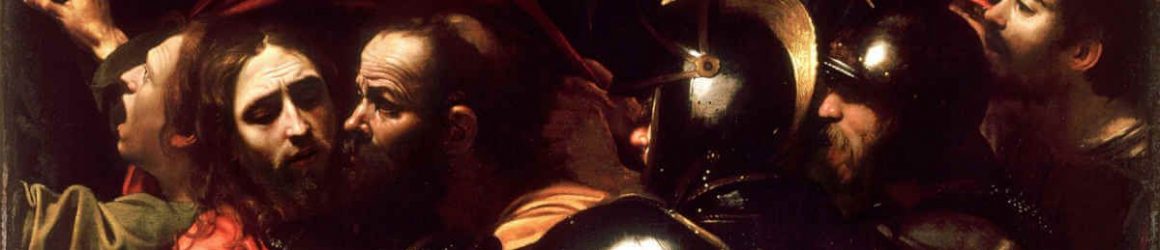
As I was putting together a header image for this post, I wanted to use sacred artwork to counter the foul images of witchcraft that have been flooding my screen. On seeing a beautiful representation of Christ’s Passion, it occurred to me that the Host surrounded by a diabolical wreath of scales is not unlike Christ’s Sacred Head crowned with thorns. Perhaps this is yet another layer of mockery those responsible had in mind.