New Age/Occult Symbols

unless otherwise noted, this information is Taken from ‘The Hidden dangers of the rainbow’ by Constance Cumbey.

The New Age Movement has several important symbols for identification and mystical (hypnotic) use. They are not all used simultaneously, but all are in current use within the Movement.


The Rainbow

(also called the Antahkarana or Rainbow Bridge)/ This is used an a hypnotic device. They also call it an ‘International Sign of Peace.’ They claim they are building a rainbow bridge between the personality (you) and the over-soul or Great Universal Mind (literally Sanat Kumara, i.e., Lucifer!) See Isaiah 24:5 which states that one reason the Lord is destroying the earth in the latter days is for breaking the everlasting covenant. The rainbow is the sign of the everlasting covenant according to Genesis, chapter 9.


The Triangle

The information in this section comes from Tradition in Action.

The triangle is an ancient symbol venerated since pagan times, as representing the harmonious balance of Earth, Sky and Sea. Although they were misguided in their interpretation, their reverence for the triangle reveals some truth that God placed in the human understanding, which reached its plenitude in the Holy Catholic Church.

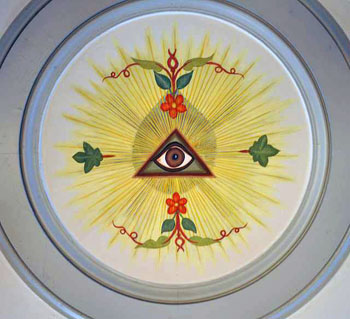
An eye was sometimes added to the center of the triangle to symbolize God’s omniscience as the all-seeing Father watching over His creatures through His Divine Providence, as expressed in the Holy Scriptures: “Behold the eyes of the Lord are on them that fear Him: and on them that hope in His mercy.” (Ps. 32:18)

At right. Eye of Providence on the gallery of St. Gallus Church in Kappel, Germany.The eye of God is also a reminder that, “the eyes of the Lord in every place behold the good and the evil.” (Prov. 15:3) And so, trying to destroy God’s Holy Church the Devil has attempted to mock His omniscience by setting up his own secret societies that fight against the Church.

Kappel eye

New Age/Occult Symbols

Freemasonry stole the symbolism of the eye in the triangle from the Church and adopted it to symbolize the “Supreme Architect of the Universe” and “bestower of light.”

The “light,” which their “Architect” proposes to bestow on his initiates is the light of Gnosis, that pretense secret knowledge that masonry reserves for select members who pass into the higher Orders. The real “god” of the Masons is Lucifer, their Architect who enables the enlightened Masons to become architects of a new world based on equality, fraternity and liberty.

But despite all of their efforts, they themselves are ever under the power and eyes of the Holy Trinity. Their true wretchedness will be made manifest at the Day of Doom: “Behold the eyes of the Lord God are upon the sinful kingdom, and I will destroy it from the face of the earth.” (Amos 9:8)

New Age/Occult Symbols


Rays of light

They represent the seven rays believed to exist in nature and in the rainbow.


The Cross

One version has diagonals placed against it.


The Circle

  • with a point in the centre
  • Centre-ing Symbol: a series of progressively smaller circles within a larger circle leading to a dark and distant (or light and distant) centre
  • divided into two
  • divided into four


The Swastika


The Number 666

Some believe this number has sacred qualities and that by its frequent use, the coming of the Antichrist will be hastened.


Pegasus/Unicorn.


SOURCE: ‘The Hidden Dangers of the Rainbow’ by Constance Cumbey Click here to buy the book. (Please note that I derive a small commission from sales made through this link.)

Was John XXIII Really Initiated into the Rosicrucians?

stories of pope John’s occult involvement abound, but it is only recently that i have begun to take them seriously. some of you may think i am foolish for even considering the prospect.

As time has gone on and I have undertaken more research, this accusation seems somewhat more credible than it first appeared to be. Certainly, to my knowledge, Rome has never put out a statement denying the story of John’s occult initiation.

The following is taken from Pier Carpi’s ‘Les Propheties du Pape Jean XXIII’, which was written in the late ’70’s. Along with the alleged prophecies is an account of the Rosicrucian initiation ritual apparently undertaken by Angelo Roncalli when he was stationed in Bulgaria.

I present it here for you in the interests of pursuing the truth about Pope John, the Council and the influence of the occult on the Church during the twentieth century.

We pick up the story at a conversation between Carpi and an occultist. (The text has been run through an online translation tool so may be a bit rough in places.)

The old man took up the document and put it back in the azure blue napkin. “I must not add anything to that. You will have understood the fundamental importance of this table. It constitutes a real restoration of the esoteric tradition that allows the initiates to be free initiators. To choose their disciples, to to form the chain — down through their descendants.”

I knew the tradition but I knew nothing about this document and the reality of the meeting between the three masters in Paris. The old man put down his napkin, got up and went to the window, set aside the white curtains that hid the night, as if he was looking for someone or something in the darkness. He turned around, stood and looked at me. “The evening I met you in Saint-Léon, I told you about the books of ‘T’ and ‘M’.”

“You told me that, like my other friend, you had read them in a dream”.

“If it can be called a dream. Alas! We must use secular terms that betray the content of our thought. However, I feel that we understand each other. If I am here, it is because I have something else to show you, something that needs to be disclosed, that must be made public. But, before I demonstrate it to you, I must tell you the facts.”

He returned to his seat, took up his napkin, which he pressed still more tightly against him and stared at me intensely: “I have to tell you about a man that everyone knows. Angelo Roncalli.”

“John XXIII?”

Here we pause to consider the motivation Carpi may have had for writing a book about John XXIII. By this time, John had been dead for almost fifteen years so it could not undermine his papacy. Carpi does not attempt to taint John’s legacy: from the point of view of an occultist, the book actually benefits John’s image. This leads us to wonder if Carpi had no other motivation than to tell the truth.

He hesitated for a moment, his eyes half-closed: “Jean,” he murmured. “1935 ….. Life was not easy for Angelo Roncalli, Archbishop of Mesembria, delegate in Turkey. Like all other religious, he was made to wear civilian dress, because of persecutions. Under constant surveillance, it was difficult for him to move: the spies were everywhere. Yet all those who approached him at that moment found in him a great serenity, which was not only that joy which he knew so well how to transmit, especially in difficult times.

“It was precisely at this time that his first contact with the unknown world took place.

“That evening Angelo Roncalli hastily retired to his apartments, as if he had an appointment. He lay down on his bed after undressing without the help of anyone – he had always done so and was to continue to do so, even when he became pope.

“Before turning off the light, he looked at the pictures on the walls, images of the extended family. He closed his eyes and, while continuing his prayer, all the faces encountered that day flashed through his mind, especially those of the most humble people. Could he have expected it? More faces, smiles, sad eyes. Then sleep invaded him. But he would never know if it was really sleep. He had an appointment with the old man of sleep.

“Six nights in a row he had seen him. It was the seventh. The most important and perhaps the last.

“He appeared; old, very white hair, thin face, dark skin, eyes sweet and piercing.

” “Will you be able to recognize me?” he asked.

” “Always, master.”

“Then, suddenly, the sacred books of ‘T’ and ‘M’ appeared in his hands. He leafed through. Inscribed on paper, knowledge, the words of knowledge, in a a language that Angelo had never known, never read before. But from his first rendezvous with the old man, in a dream which was perhaps not a dream, Angelo had known how to decipher it.

“He read and everything became simple. God, how simple everything was, how clear everything was! If the other men might have known, the world could have been very different. But Angelo realised it was not given to everyone to know, because these things could be dangerous. Only a few could give them a correct meaning, use them to the good of all. In malevolent hands, they could become terrible weapons against man.

“The two books closed. An intense light illuminated their covers on which were inscribed the two silver letters in relief – a light like the one Angelo felt within him. Impalpable, intransmissible by the poor instruments at man’s disposal; for millennia, has man not renounced forces, powers, and knowledge to replace them by a way as difficult as it is useless?

” “Now you are ready,” said the old man. “And you’re on your way. I came because you called me. Now you know. But you still have a lot to learn, to see, to live. That’s why we’ll see each other again.”

” “I’m waiting for you, master.”

“The old man smiled. “Will you be able to recognize me?”

“He repeated the same question three times. Three times Angelo gave the same answer. Then he woke up. He was alone in his room. He got up from the bed, went to the table, took some sheets of paper of paper and a pencil. He tried to write down what he had read in the books of knowledge. But his hand remained inert, his mind empty.

“It was not possible. Words did not exist. Yet he had something in him – something that no one, could ever erase. That light had made him another man. He knew that the dream would never happen again. That the old man would return, but in reality. What else awaited him? He was not afraid because he knew he was on the the right way, that of the Good. He put down the pencil and thought.

“He thought of the saints, the mystics, the men of faith, of the Church, men of truth and of peace. He took pleasure in remembering St. John the Evangelist, St. Anthony, St. Albert the Grand, St. Teresa, St. Francis. He rose, stopped in front of the crucifix, knelt down and prayed to the Virgin Mary for a long time.

“She too had an apparition. Was it not in a dream that her destiny was fulfilled, when someone appeared to the sleeping Joseph to explain to him, in very simple words, the greatest of mysteries of faith, of all humanity?

“He felt happy. And for the first time that night, he knew that someone was praying for him, in a big secret way.”

The old man had finished his story. I looked at him: “They met?” I asked.

He confirmed it. Seven days later, to be exact. Angelo Roncalli celebrated the sacraments in his humble house, before an even more humble community. While the others were going to work before lunch, Angelo went downstairs. In the hallway, sitting on a chair, stood the old man of his dream. No one had heard him knock or ring. But Angelo didn’t even wonder how he could have gotten in. He approached him and kissed him, as one embraces a brother who returns after a long absence. He invited him to his table but the other shook his head, smiling: “We must sit at a completely different table,” he said. Angelo looked at him. As the old man of his dream had asked him, he had immediately recognized him, and he listened.

“Are you ready?”

“I don’t know”.

“Then you are.” Leave everything and follow me. He followed him, without telling anyone. For a long time they marched through the deserted city. The old man stopped in a small narrow square, with its low houses. He who, until then, had guided Angelo, turned and said:

“Since you are ready, since you will soon be my equal, since the path we have to follow will be the same, you know it too. It is now up to you to lead me.”

Angelo hesitated, looking around him. The man encouraged him:

“Let’s go”.

He advanced and chose without hesitation an alley, and entered it. Behind him, he could hear the footsteps of the old one. He stopped in front of a door of rough wood.

“Is it there?” he asked. The other smiled.

“Push the door, it’s only half closed. Climb up the stairs and don’t wait for me”.

Angelo let himself be led by the voice he felt within him. He climbed two small staircases in almost total darkness, found himself in front of a new door, even smaller and lower than the other, and pushed it. It was ajar and he knew it. He entered.

The room was large and pentagonal. The walls were bare. There were two large windows, closed. In the middle of the room, there was a large cedar table, also pentagonal. There were three chairs, leaning against three of the walls. On the chairs, a linen tunic, coloured belts and envelopes sealed with red. On the table, a Bible opened at the beginning of the Gospel of Saint John. There was a flaming sword with silver hilt; a censer; coloured ribbons; two bronze candelabra with three branches, each bearing three red candles. Then the magical and esoteric symbol of the Order to which Angelo would shortly be initiated. Under the symbol, there were three crossed roses, made of fabric. One white, one red, one black.

The only dim lighting came from the three candles lit on one of the two lampposts. The others were extinguished. Angelo stood in front of the table. He looked at these objects, which, since he had read the sacred books in his dream, meant many things to him. He hardly dared to touch them. He began to read the first chapters of the Gospel of St. John, which had always fascinated him; he had, moreover, penetrated its most secret keys.

He detached himself from it when he heard light footsteps behind him. It was the master, who smiled. He had recently entered the room, behind him the door was closed. He wore a long linen tunic – the protective fabric of any initiation ceremony – down to his feet. Around his neck, there was the magic symbol of the Order, in silver, hung at the end of a chain fromTemplar knots. With his hands gloved in white, his head bare, he approached, and without ceasing to smiled, placed a hand on Angelo’s right shoulder:

“Kneel, on your right knee only”.

Angelo obeyed, and the ceremony began.

The master gave the meaning of each object, explained their symbolism. He took sealed envelopes, opened them and read their contents. On a sheet of blue paper were the ancient regulations of the Order. He opened another envelope, handed the sheet of paper to Angelo, who read what it said: seven questions.

“Do you feel able to answer them?” the master asked him.

Angelo replied in the affirmative and gave him back the paper. Then with the help of a candle, master lit the candles of the second candelabra.

“These lights are for the masters of the past who are among us”.

He put incense in the censer, purified the room by its four corners: then he turned three times and at each turn waved it three times. He returned to the table, and placed his hands on the profane man’s head and began to speak. He told him the mysteries of the Order. He asked questions. He received answers. At last the old master bent over him.

“As you know, we call each other by the name we have chosen. Each one thus signs his freedom, his work program, the new link in the chain. What will your name be?”

The layman did not hesitate: “John.”

Here, we pause to consider the name that Angelo Roncalli chose for himself on being elected as Pope. It was John XXIII. That name had in fact been used once before: by an antipope in the fifteenth century. That John XXIII was eventually tried for  “piracy, rape, sodomy, murder and incest” with “the more scandalous” charges being “suppressed”!!

We continue our narrative, making note that the ‘peculiar and complex ritual’ is the great Secret of the Rosicrucians, something so depraved and unnatural that it cannot be mentioned outside of the brotherhood.

“John”, repeated the master. And he then undertook the peculiar and complex ritual of the initiation ceremony.

Finally, he put his sword on the neophyte’s head. At that moment, some new, elusive thing happened in John, something exploded in him. He was quite stunned and confused while reaching the height of serenity and happiness.

“What you are experiencing at this moment, Brother John, many others have experienced before You: Myself, the masters of the past, the other brothers around the world. That thing, call it Light, but it has no name”.

The master helped the disciple to his feet, kissed him seven times, and exchanged fraternal greetings with him. Then he taught him the secret words, the signs of recognition, the touching, the ritual of group work. Verbally, according to tradition.

He then taught him the daily rites to be performed at three very specific moments of the day — which correspond to the three points of the operation of the sun — and in the most great secret, a Greek sentence and gestures to repeat.

“At these three moments precisely,” explained the master, “our brothers and sisters all over the world make the same gestures, say the same sentence. Their strength is great, it comes from afar and is goes very far. Day after day, it acts on humanity.

Finally, the master took the last envelope, opened it, and read its contents to John. On a sheet of paper was inscribed the formula of the oath: an oath not to reveal the secrets of the Order, to follow tradition, to always act for good, to be always strong, to help the brethren and the unfortunate, to respect above all the law of God and his ministers.

Without hesitation, John signed at the end of the formula. He was animated by great strength. Near his signature, he wrote the number and the acronym that the master indicated to him. These two elements codified his initiation and rank. The master took the sheet back, folded it seven times, and asked the disciple to put it with the tip of his hand onto the flaming sword. This was done.

The master brought the sword close to the candelabra where it was burning the candles for the masters of the past; the fire licked the paper. In a few seconds, the Oath was taken, reduced to ashes which the master scattered. “You have sworn, John, but know that the freedom of the brothers is far superior to all oaths. Today, you really know what freedom is. He kissed him again. John began to cry.

The last consideration I will present here is that even if the described events did not not involve Angelo Roncalli, they do offer us an insight into the diabolical world of the mystery religions. We catch a glimpse of the mindset of those involved: their disdain for true religion, their arrogance in believing that the occult offers a solution to life’s problems that is superior to that of Our Lord Jesus Christ, Who is the Way, Truth and the Life.

IMAGE CREDIT: Abzeronow, CC BY 4.0 https://creativecommons.org/licenses/by/4.0, via Wikimedia Commons
When a Shrine to Lucifer appeared in a Brisbane Cathedral

Although some us have only recently come to see the influence of the occult underlying the Church’s most serious problems, there are others who saw the dangers years ago and tried to alert fellow Catholics to the danger. One of those faithful pioneers was Tim Pemble-Smith. Through his publication, News From the Pews, he and his colleagues set out to expose Freemasonry and other occult forces with the Archdiocese of Brisbane, in Queensland, Australia.

The following is from Issue 24 of News from the Pews, dated 28 April, 2000. It explains the occult meanings behind an art installation which was once placed inside a chapel at St. Stephen’s Cathedral in Brisbane. At the time, the chapel was dedicated to “The Human Search for God”, but has since been redesigned and dedicated to St. Mary McKillop.

After much public outcry, and largely due to pressure from Mr. Pemble-Smith and his colleagues, the installation was removed. Strangely, no records of this artwork exist online, neither from the indigenous artist, Fiona Foley nor the Cathedral. For copyright reasons, this article contains no photographs from the shrine.

Article begins:

‘Devil’ Shrine in St. Stephen’s

Over the past two years, this newsletter has exposed many hidden demonic messages contained in The Human Search for God shrine in St. Stephen’s Cathedral. Yet, the shrine has not been closed down and requests for an enquiry have been ignored….The Church admits that the shrine contains “systems of meaning”, but neither the artist nor the Church has explained those meanings. In this issue, we re-examine the artwork and see how it corresponds with the writings of the ‘devil-worshipper’ Aleister Crowley.

Influence of Crowley

Although he died in 1947, Aleister Crowley was the most influential occultist of the twentieth century. He was a self-proclaimed devil worshipper and sex and drug fiend. His book, 777 and Other Qabalist Writings of Aleister Crowley, sets out a system of elaborate codes to disguise the meanings of references to the occult. For example, the use of numbers is prevalent in much the same way as a codebook shows the disguised meaning of a message. Crowley created his own cult to worship the devil and wrote books setting out the way to practice his religion. Today there are many believers who follow his methods.

Artwork in Shrine

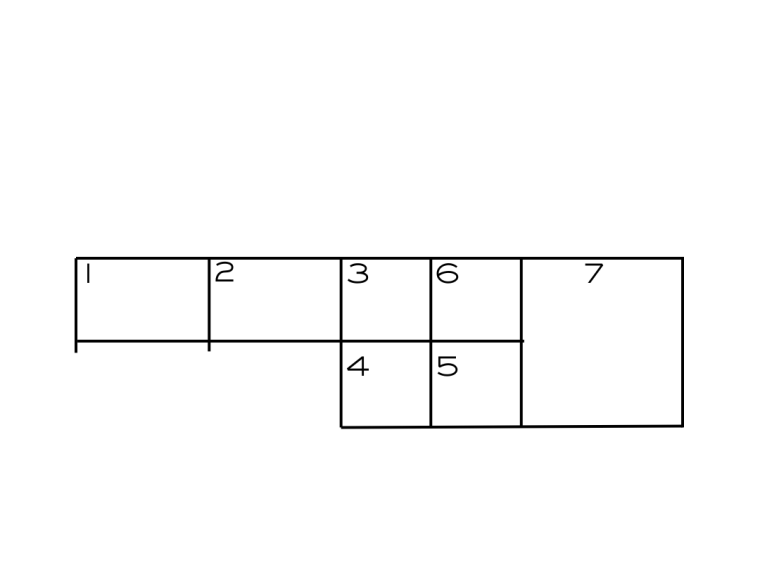
To a person unfamiliar with Crowley’s methods, the artwork presents a series of abstract images. There are seven panels of artwork in all, with four, square, central panels. The panels are all dark. You see a blood moon, a dog, a black luminous disc, and dark blue moon, leaves, pipi shells, fish etc. Certain images are repeated. Perhaps the first thing you notice is panel 1.

The dog in panel 1 stands out. Crowley used the dog as a reference to the Christian God. In Crowley’s system, “dog” is simply “God” spelled backwards. Crowley revelled in the use of wordplay, ie, a play on words. It should be noted that in the Courier-Mail (newspaper) article, Ms Foley is reported to have admitted to using reverse spelling in her art.

A Crowley follower who is familiar with Ms Foley’s other art, will recognise the dog in Panel 1 as the one in Ms Foley’s other work, “The Three-legged dog day.” They would also notice the 7 stars in the left corner in the pattern of a crescent. Cycles of the moon are commonly references to witchcraft. It is a classic Crowleyan reference. As Crowley said, “The best blood is of the moon monthly: then the fresh blood of a child…”

Multiple uses of Images and Shapes

A follower of Crowley will also be looking in the shrine for any repeated images or shapes. Multiple uses of images or shapes could point to Crowley’s codes. The Crowley follower would quickly note the central group of 4 square panels arranged into a larger square – panels 3, 4, 5, & 6.

Functions of Four: Alchemy

The Crowley fan knows that any ‘functions of 4’ are likely to point to alchemy, the ‘black art’ of attaining spiritual union with the devil. In the shrine there are many: the 4, square, central panels arranged to form a larger square, the 4 fish swimming, a group of 4 shells, a 4-part skeletal fish image.

The Crowley follower will know that if these panels relate to alchemy, the four central panels should represent the four elements of alchemy – earth, air, fire and water.

It is clear that panel 4 represents the red earth and that panel 5 represents water. The circular, black disk in panel 3 has a distinctive luminescent quality. It does not reflect light as the moon does, it’s black light comes from within. The Crowley fan will recognise this as Crowley’s vision of a ‘black sun’ – a reference to the abyss (hell) and to the dark angel of the abyss, Lucifer – the light bringer. Panel 3 is the fire panel.

Panel 6 presents the blue moon in the night air. This is the air panel. Air and earth panels are thus, as required, located diagonally opposite each other, as are fire and water. So the four square panels represent the four elements of alchemy, in a way, which – via the black sun – can be referenced to Crowley, the ‘abyss’ and to Lucifer.

Further, panels 3 and 6 present the sun and the moon opposite each other, “in balance”: symbolic of alchemy, as Crowley says.

Fish: Alchemy

Ms Foley presents four fish swimming in panel 5. The number 4 here is symbolic of alchemy. In 777 Crowley also links fish to alchemy. The fish are presented swimming in iridescent water. In 777, Crowley connects iridescence of water and alchemy.

Shells & Leaves

In Crowley’s system, the number ‘777’ itself represents his “world of the shells”, “demon-world” or “abode of the evil spirits” which are called the “shells”. Note that there are 17 shells in panel 4 and 4 more (4: alchemy again) in panel 5 – in total, 21 shells. 21 shells is a way of presenting 7, 7, 7 shells – a reference to Crowley’s codebook 777.

Ms Foley also presents five ‘V’ or heart-shaped, yellow brown leaf images, 3 in panel 4 and 2 more immediately above in panel 3. Reading downwards, this is ‘VVVVV’, Crowley’s signature contraction of the Latin used in reference to himself as ‘Master of the Temple.’ In Crowley’s system, the number 5 corresponds with the heart. Five is also Crowley’s number for sulphur, the yellow brown substance said to be used in alchemy. Crowley linked yellow brown with the ‘earth nature’ of his imaginary ‘camel’, which he says is the ‘means of travelling through the wilderness of the abyss’. As to the heart, Crowley states in 777 in reference to the invocation of his ‘Holy Guardian Angel’ (the devil) that “the human heart is the foundation of the work”.

Foley’s combination of 3 leaves and 17 shells in panel 4 (Remember there were exactly 17 shells in panel 4, for yet another reason; it was not simply coincidence) and 2 leaves in panel 3 immediately above is also significant. In 777, Crowley uses the numbers 2, 3 and 17 to derive a reference to the ‘Angel of Venus’, who is Lucifer.

Is it a shrine to the devil?

This otherwise unexplained shrine speaks for itself. The images and codes it contains correspond all too perfectly with Aleister Crowley’s writings. The parallels are too many and detailed to be mere coincidence. So, is it likely that the reluctant-to-comment Foley “Had never even heard of Crowley”?

HutheMeow, CC BY-SA 4.0 https://creativecommons.org/licenses/by-sa/4.0, via Wikimedia Commons

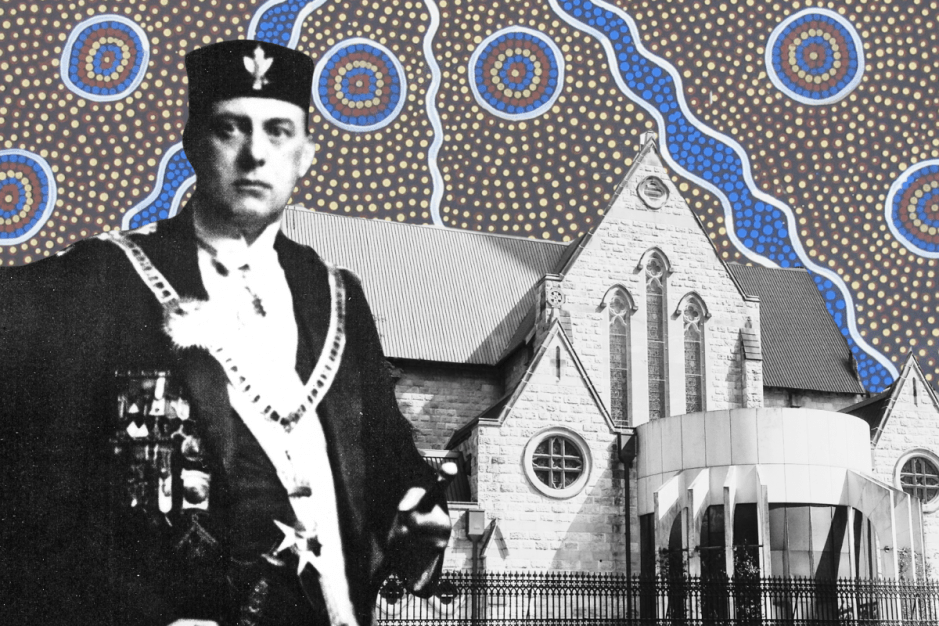
Wikicommons, author unknown: Aleister Crowley in the garments of the Ordo Templi orientis (OTO)

Rampolla: Worse than a Freemason

The figure of Cardinal Mariano Rampolla is well known among those who take an interest in the inner workings of the Roman Curia, especially in events surrounding papal conclaves. He was famously very close to being elected Pope after the death of Pope Leo XIII in 1903, when he was vetoed on behalf of the Austro-Hungarian Empire.

At that time, only three nations retained that ancient power of veto: Austria, Germany and Italy. Even so, Emperor Franz Joseph had been reluctant to intervene in such a solemn matter. He had no choice, however, once presented with evidence that Rampolla was at least associated with Masonry, if not a fully-fledged Freemason himself.

The evidence came from Monsignor Jouin, founder of the International Review of Secret Societies; a priest who dedicated his life to exposing Masonry and its associated ideology. It is said he went first to the Cardinals, but was ignored and so he took his evidence instead to the Emperor.This led to the saintly Pius X being elected instead of Rampolla.

There have been attempts to play down the role of Cardinal Mariano Rampolla in this matter: written histories vary as to the reason behind the veto, with some historians, even Catholic ones, concluding that the intervention was merely political. Some go so far as to accuse the Emperor of vengeance: after son had tragically died, apparently by his own hand, it is said that Rampolla denied the boy a Christian burial.

However, after Rampolla’s death in 1913, hard evidence implicating him in Masonry was discovered by the Curia. Papers confirming his membership were shown the Pope Pius X, who ordered them burned, ostensibly to protect the reputation of this ghastly man. Surely no favours were done to the Church or to the faith of Her members by covering up Rampolla’s true allegiances. Ecclesiastical Freemasonry in the Curia has only flourished from that point forward.

In 1929, Rampolla’s betrayal was corroborated by a Bishop Marty in an interview with Felix Lacointa of the newspaper, The Anti-Revolutionary Bloc. Bishop Marty stated that he had been told by Cardinal Merry dal Val, Secretary of Sate to Pius X that the Pope had indeed viewed and then destroyed the incriminating papers. [Cited in L’Église Éclipsée by Georges Vinson.]

What makes Rampolla’s case even more serious is that the specific cult in which he was involved was the Ordo Templi Orientis or OTO. This cult is a blend of Masonry and Rosicrucianism, with a strong focus on magic and Rampolla is said to have achieved a very high status. While a man may join Masonry without fully realising what he is doing, the same cannot be said about the OTO. It is possible to potentially complete multiple rituals and levels in Masonry without understanding that one in fact giving one’s allegiance to Satan, believing that one is simply doing one’s best to be a good person by acknowledging God, albeit in the vaguest sense possible.

However, the OTO is something different. It is only approached by those who have a keen desire to access hidden knowledge and the powers that go with that.

There are several different routes into OTO initiation. Some first complete all the levels available at their local Masonic Lodge, finding that they still ‘want more’. Others complete several levels of Freemasonry then pivot to follow the seductive promises of magic, alchemy and power that are promised by the OTO and similar groups. Still others, knowingly rejecting the True God from the beginning, pursue from the beginning the rituals that promise them wealth, sex and power in this world, even while damning them in the next. Notably, the OTO has always been seen by Freemasons as something “irregular” and it has received many condemnations from within Masonry, particularly of the OTO’s homosexual rituals.

So what is the OTO and why is it so dangerous, yet so alluring to fallen human beings? Looking at one well-known member, Aleister Crowley, will shed some light on those questions. Crowley was among the OTO’s adherents at the end on the 19th century, eventually becoming a Grand Master. He publicly flaunted his immoral antics and invented some of his own rituals centred around sex magick.

It is perhaps this aspect for which he is most infamous. It was possibly Crowley, moreso than any other individual, who helped to make spell-casting, sexual deviancy and even satanism mainstream, to the point where, in our days, occult rituals at rock concerts and Olympic opening ceremonies are commonplace.

The sexual deviancy promoted by Crowley needs little explanation. It has saturated our culture to the point where its practitioners are a protected class. Even the diabolical Alfred Kinsey, the man responsible for deceiving millions of Westerners into accepting deviancy with his disgusting sexual experimentation on children, and even babies was a protege of Crowley’s.

Since sex-magick is integral to the OTO rituals, this means that Rampolla almost certainly engaged in such rituals. We can only wonder at how great a role he may have played in introducing rampant clerical homosexuality and pedophilia into the Church. ‘Uncle Ted’ McCarrick participated in sex-magick; Cardinals Bernadin and Murphy O’Connor were credibly accused of ritual sex abuse. The writings of Cardinal Tucho Fernandez are replete with sexual occultism and Rupnik is obviously into spiritualised sexual abuse.

When it comes to Rampolla, Crowley and McCarrick, though, there another link tying them to technocracy and the Synarchists: they all spent time in Switzerland. Crowley admitted to first dabbling with alchemy during a trip to Switzerland – a hotspot for the occult and the New World Order ‘elite.’ McCarrick is known to have spent many vacations at St. Gallen, which was also the birthplace of the notorious ‘St. Gallen Mafia’, those unworthy Cardinals who conspired to have Bergoglio elected to the papacy. Rampolla also vacationed in Switzerland, where, according to Felix Lacointa of The Anti-Revolutionary Bloc, that he regularly attended lodges in both Einsiedeln and Zurich.

Felix Lacointa provides the testimony of an unnamed French priest who, when on pilgrimage at Einsiedeln Abbey, was so impressed by Rampolla that he decided to write a favourable report on the conversations he had with the pilgrims. An Einsiedeln bookseller quickly brought him back to earth: “He is not worth it! Every fortnight he goes to the lodge in Zurich!”

Einsiedeln and St. Gallen are only a short distance from each other by car, and each is almost equidistant from Davos, the regular gathering spot for the world’s technocrats, many of whom are part of their own diabolical and esoteric group, Synarchy. Like members of the OTO (and it must be remembered, many of these occult groups overlap in both philosophy and membership), Synarchists access ‘secret knowledge’ from demons which they use to steer the world toward total enslavement to science and rationalism. All three sites are close to Zurich, as well as Lucerne, known as a centre of the OTO in the early twentieth century.

Our knowledge of Rampolla’s alleged attendance at lodges in Switzerland, and his founding of a lodge for ecclesiastics within the walls of the Vatican is confirmed by the occultist (and apostate priest) Roca. Roca moved in circles with Saint-Alveydre, Eliphas Levi and other like-minded magicians. Roca and others stated that Rampolla set up an ecclesiastical lodge within the Vatican, something the Marquis de la Franquerie claimed was recognised by St. Pius X. Roca also included the names of other Cardinals: Ferrata, Gasparri, Ceretti, Béa, and Liénart.

Tellingly, the name of this lodge is dedicated to St. John [either St. John the Baptist or St. John of Jerusalem] which was, of course, the name taken by Angelo Roncalli when he ascended to the papacy in 1958. St. John is apparently a “patron saint” of occultists, along with St. Michael the Archangel.

Rampolla’s name can still be found in registers compiled by members of the OTO. One website, to which I won’t link, lists his name among other famous members: Eliphas Levi, Nietzsche, Papus and Richard Wagner. The page seems to be reproduced from an OTO publication called The Equinox. That journal was once said to be highly confidential but that can hardly be the case now that it is freely available on the ‘net.

While there have been concerted efforts in the last few years to expose Rampolla’s involvement with an esoteric cult, the fact that he is known as a Freemason rather than as an occultist is intriguing. Freemasonry is often treated as a threat of the past and tolerated as no longer being seen as subversive. The result is that the word, “Freemasonry” has largely lost its meaning. Like “abortion” and “gay” the word no longer evokes an image of its true nature, indicating that the trend of describing Rampolla merely as a Mason might be part of the whitewash.

Cardinal Alfons Stickler once told a reputable monk that Annibale Bugnini was something “far worse than a Freemason.” One can only wonder what that was and whether Bugnini was merely following in the magical, alchemical footsteps of Mariano Rampolla.

One-Time
Monthly

PLease donate to help me create more content like this!
Make a one-time donation

Make a monthly donation

Choose an amount

A$5.00
A$15.00
A$100.00
A$5.00
A$15.00
A$100.00

Or enter a custom amount

A$

Your contribution is greatly appreciated!

Your contribution is appreciated.

DonateDonate monthly

Spiritual Effects of Sodomite Priests

This extract is taken from Slaying dragons II: The Rise of the Occult (click here to purchase)

“The effects of sodomy on the individual, in particular on a clergyman, are so much more devastating than many in the hierarchy seem to accept in our age. This sort of devastation, as Fr Athanasius [a pseudonym] explained, can indeed make priests disposed toward occult practices. He said, “Once someone compromises the conscience and habitually lives in sin, the devil’s suggestions become more constant and acceptable. But consider the interest the devil has in high value targets such as priests. Every mortal sin of a priest is a sacrilege. It makes sense that the Enemy will concentrate on them to bring about anti-priests, anti-liturgy, anti-Church. And today we’ve got a lot of possessed clergy thanks to their sodomitical ways, You’d be surprised.” When I further asked if he thought there were occultists in today’s hierarchy, he replied, “Absolutely!”

“The compromising of the conscience mentioned by the above exorcist is surely accomplished by the enemy through the moral and spiritual effects produced by the sin of sodomy. In The Book of Gomorrah, St. Peter Damien presented the evil effects brought about by the presence of this abominable vice within the priesthood in the eleventh century. From these, and in light of the comments by Fr. Athanasius, we can see how this could easily dispose those clergy today to embrace the occult, guilty as they are of the same abominations condemned by St. Peter Damien. St. Peter Damien said that sodomy “evicts the Holy Spirit from the temple of the human heart; it introduces the devil who incites to lust.” Further, “It casts into error [and] extinguishes the light of the mind … It defiles everything, stains everything, pollutes everything.” The damage done to the priest or Bishop involved in such behaviour is immense:

In fact, after this most poisonous serpent once sinks its fangs into the unhappy soul, (moral) sense is snatched away, memory is borne off, the sharpness of the mind is obscured. It becomes unmindful of God and even forgetful of itself. This plague undermines the foundation of faith, weakens the strength of hope, destroys the bond of charity; it takes away justice, subverts fortitude, banishes temperance, blunts the keenness of prudence.

St. Peter Damien, “Book of Gomorrah”, p 63-4.

“Further, St. Peter Damien added, “This vice casts men from the choir of the ecclesiastical community and compels them to pray with the possessed and with those who work for the devils.” With all these negative effects articulated, the mind is quick to respond, “How can a man, given over to this vice, seek to govern the Church as a Bishop or priest, or lead souls to Christ, or protect the Mass, or raise up new holy priests, and avoid leading the people into error?” These men, St. Peter Damien declared, “Try with such desire to ensnare the people of God in the bonds of [their] own ruin,” and lamented, “What fruitfulness can still be found in the flocks when the shepherd is so deeply sunk in the belly of the devil?”

“Given the rampant acceptance of homosexuality in the clergy today, and the presence of these men even among the Bishops, as it was in St. Peter Damien’s day, these criticisms and laments need to be considered as we seek to understand the spiritual fallout which is the result of having these men as the spiritual leaders of the Church today.”