When a Shrine to Lucifer appeared in a Brisbane Cathedral

Although some us have only recently come to see the influence of the occult underlying the Church’s most serious problems, there are others who saw the dangers years ago and tried to alert fellow Catholics to the danger. One of those faithful pioneers was Tim Pemble-Smith. Through his publication, News From the Pews, he and his colleagues set out to expose Freemasonry and other occult forces with the Archdiocese of Brisbane, in Queensland, Australia.

The following is from Issue 24 of News from the Pews, dated 28 April, 2000. It explains the occult meanings behind an art installation which was once placed inside a chapel at St. Stephen’s Cathedral in Brisbane. At the time, the chapel was dedicated to “The Human Search for God”, but has since been redesigned and dedicated to St. Mary McKillop.

After much public outcry, and largely due to pressure from Mr. Pemble-Smith and his colleagues, the installation was removed. Strangely, no records of this artwork exist online, neither from the indigenous artist, Fiona Foley nor the Cathedral. For copyright reasons, this article contains no photographs from the shrine.

Article begins:

‘Devil’ Shrine in St. Stephen’s

Over the past two years, this newsletter has exposed many hidden demonic messages contained in The Human Search for God shrine in St. Stephen’s Cathedral. Yet, the shrine has not been closed down and requests for an enquiry have been ignored….The Church admits that the shrine contains “systems of meaning”, but neither the artist nor the Church has explained those meanings. In this issue, we re-examine the artwork and see how it corresponds with the writings of the ‘devil-worshipper’ Aleister Crowley.

Influence of Crowley

Although he died in 1947, Aleister Crowley was the most influential occultist of the twentieth century. He was a self-proclaimed devil worshipper and sex and drug fiend. His book, 777 and Other Qabalist Writings of Aleister Crowley, sets out a system of elaborate codes to disguise the meanings of references to the occult. For example, the use of numbers is prevalent in much the same way as a codebook shows the disguised meaning of a message. Crowley created his own cult to worship the devil and wrote books setting out the way to practice his religion. Today there are many believers who follow his methods.

Artwork in Shrine

To a person unfamiliar with Crowley’s methods, the artwork presents a series of abstract images. There are seven panels of artwork in all, with four, square, central panels. The panels are all dark. You see a blood moon, a dog, a black luminous disc, and dark blue moon, leaves, pipi shells, fish etc. Certain images are repeated. Perhaps the first thing you notice is panel 1.
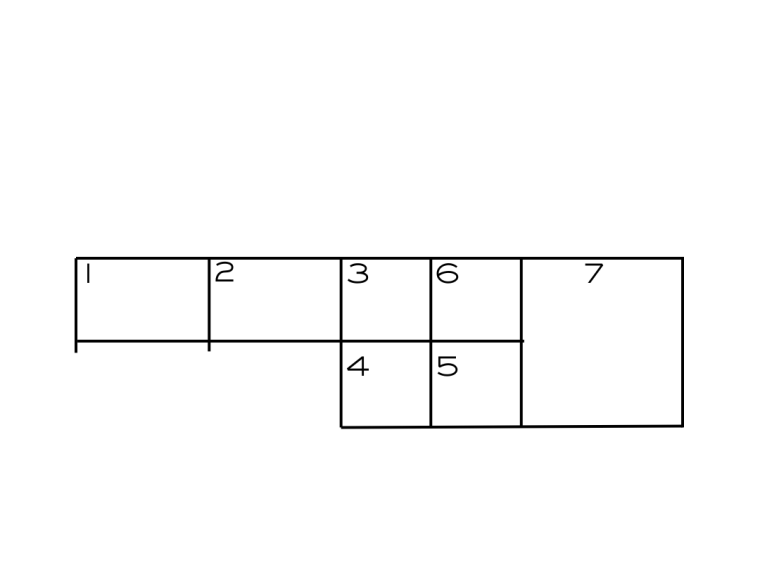
The dog in panel 1 stands out. Crowley used the dog as a reference to the Christian God. In Crowley’s system, “dog” is simply “God” spelled backwards. Crowley revelled in the use of wordplay, ie, a play on words. It should be noted that in the Courier-Mail (newspaper) article, Ms Foley is reported to have admitted to using reverse spelling in her art.

A Crowley follower who is familiar with Ms Foley’s other art, will recognise the dog in Panel 1 as the one in Ms Foley’s other work, “The Three-legged dog day.” They would also notice the 7 stars in the left corner in the pattern of a crescent. Cycles of the moon are commonly references to witchcraft. It is a classic Crowleyan reference. As Crowley said, “The best blood is of the moon monthly: then the fresh blood of a child…”

Multiple uses of Images and Shapes

A follower of Crowley will also be looking in the shrine for any repeated images or shapes. Multiple uses of images or shapes could point to Crowley’s codes. The Crowley follower would quickly note the central group of 4 square panels arranged into a larger square – panels 3, 4, 5, & 6.

Functions of Four: Alchemy

The Crowley fan knows that any ‘functions of 4’ are likely to point to alchemy, the ‘black art’ of attaining spiritual union with the devil. In the shrine there are many: the 4, square, central panels arranged to form a larger square, the 4 fish swimming, a group of 4 shells, a 4-part skeletal fish image.

The Crowley follower will know that if these panels relate to alchemy, the four central panels should represent the four elements of alchemy – earth, air, fire and water.

It is clear that panel 4 represents the red earth and that panel 5 represents water. The circular, black disk in panel 3 has a distinctive luminescent quality. It does not reflect light as the moon does, it’s black light comes from within. The Crowley fan will recognise this as Crowley’s vision of a ‘black sun’ – a reference to the abyss (hell) and to the dark angel of the abyss, Lucifer – the light bringer. Panel 3 is the fire panel.

Panel 6 presents the blue moon in the night air. This is the air panel. Air and earth panels are thus, as required, located diagonally opposite each other, as are fire and water. So the four square panels represent the four elements of alchemy, in a way, which – via the black sun – can be referenced to Crowley, the ‘abyss’ and to Lucifer.

Further, panels 3 and 6 present the sun and the moon opposite each other, “in balance”: symbolic of alchemy, as Crowley says.

Fish: Alchemy

Ms Foley presents four fish swimming in panel 5. The number 4 here is symbolic of alchemy. In 777 Crowley also links fish to alchemy. The fish are presented swimming in iridescent water. In 777, Crowley connects iridescence of water and alchemy.

Shells & Leaves

In Crowley’s system, the number ‘777’ itself represents his “world of the shells”, “demon-world” or “abode of the evil spirits” which are called the “shells”. Note that there are 17 shells in panel 4 and 4 more (4: alchemy again) in panel 5 – in total, 21 shells. 21 shells is a way of presenting 7, 7, 7 shells – a reference to Crowley’s codebook 777.

Ms Foley also presents five ‘V’ or heart-shaped, yellow brown leaf images, 3 in panel 4 and 2 more immediately above in panel 3. Reading downwards, this is ‘VVVVV’, Crowley’s signature contraction of the Latin used in reference to himself as ‘Master of the Temple.’ In Crowley’s system, the number 5 corresponds with the heart. Five is also Crowley’s number for sulphur, the yellow brown substance said to be used in alchemy. Crowley linked yellow brown with the ‘earth nature’ of his imaginary ‘camel’, which he says is the ‘means of travelling through the wilderness of the abyss’. As to the heart, Crowley states in 777 in reference to the invocation of his ‘Holy Guardian Angel’ (the devil) that “the human heart is the foundation of the work”.

Foley’s combination of 3 leaves and 17 shells in panel 4 (Remember there were exactly 17 shells in panel 4, for yet another reason; it was not simply coincidence) and 2 leaves in panel 3 immediately above is also significant. In 777, Crowley uses the numbers 2, 3 and 17 to derive a reference to the ‘Angel of Venus’, who is Lucifer.

Is it a shrine to the devil?

This otherwise unexplained shrine speaks for itself. The images and codes it contains correspond all too perfectly with Aleister Crowley’s writings. The parallels are too many and detailed to be mere coincidence. So, is it likely that the reluctant-to-comment Foley “Had never even heard of Crowley”?

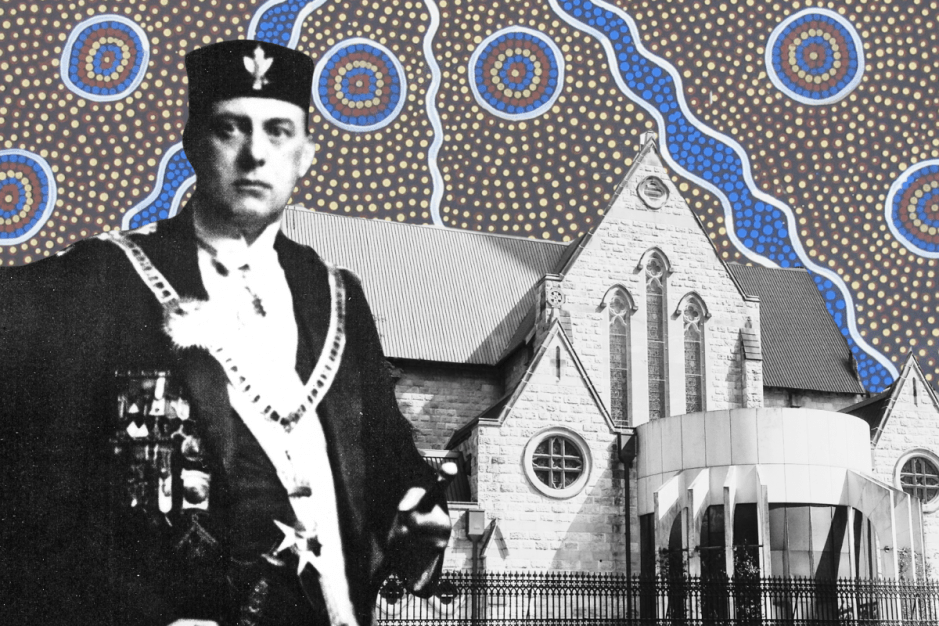
HutheMeow, CC BY-SA 4.0 https://creativecommons.org/licenses/by-sa/4.0, via Wikimedia Commons

Wikicommons, author unknown: Aleister Crowley in the garments of the Ordo Templi orientis (OTO)

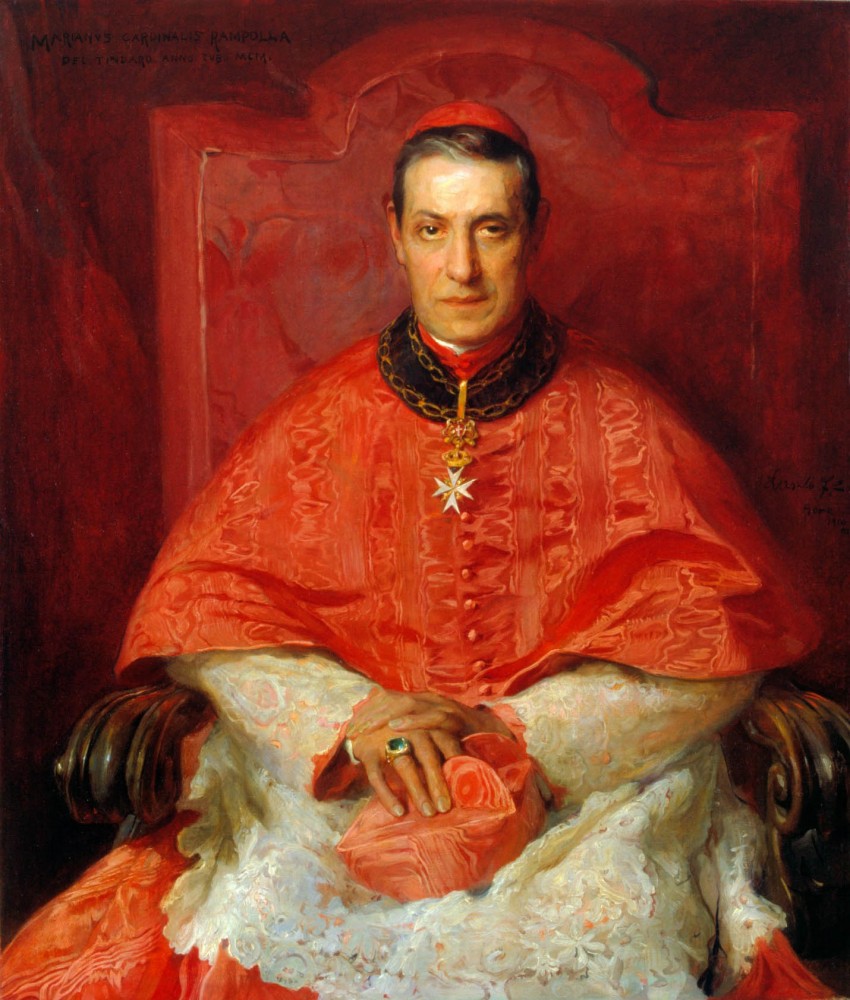
Rampolla: Worse than a Freemason

The figure of Cardinal Mariano Rampolla is well known among those who take an interest in the inner workings of the Roman Curia, especially in events surrounding papal conclaves. He was famously very close to being elected Pope after the death of Pope Leo XIII in 1903, when he was vetoed on behalf of the Austro-Hungarian Empire.

At that time, only three nations retained that ancient power of veto: Austria, Germany and Italy. Even so, Emperor Franz Joseph had been reluctant to intervene in such a solemn matter. He had no choice, however, once presented with evidence that Rampolla was at least associated with Masonry, if not a fully-fledged Freemason himself.

The evidence came from Monsignor Jouin, founder of the International Review of Secret Societies; a priest who dedicated his life to exposing Masonry and its associated ideology. It is said he went first to the Cardinals, but was ignored and so he took his evidence instead to the Emperor.This led to the saintly Pius X being elected instead of Rampolla.

There have been attempts to play down the role of Cardinal Mariano Rampolla in this matter: written histories vary as to the reason behind the veto, with some historians, even Catholic ones, concluding that the intervention was merely political. Some go so far as to accuse the Emperor of vengeance: after son had tragically died, apparently by his own hand, it is said that Rampolla denied the boy a Christian burial.

However, after Rampolla’s death in 1913, hard evidence implicating him in Masonry was discovered by the Curia. Papers confirming his membership were shown the Pope Pius X, who ordered them burned, ostensibly to protect the reputation of this ghastly man. Surely no favours were done to the Church or to the faith of Her members by covering up Rampolla’s true allegiances. Ecclesiastical Freemasonry in the Curia has only flourished from that point forward.

In 1929, Rampolla’s betrayal was corroborated by a Bishop Marty in an interview with Felix Lacointa of the newspaper, The Anti-Revolutionary Bloc. Bishop Marty stated that he had been told by Cardinal Merry dal Val, Secretary of Sate to Pius X that the Pope had indeed viewed and then destroyed the incriminating papers. [Cited in L’Église Éclipsée by Georges Vinson.]

What makes Rampolla’s case even more serious is that the specific cult in which he was involved was the Ordo Templi Orientis or OTO. This cult is a blend of Masonry and Rosicrucianism, with a strong focus on magic and Rampolla is said to have achieved a very high status. While a man may join Masonry without fully realising what he is doing, the same cannot be said about the OTO. It is possible to potentially complete multiple rituals and levels in Masonry without understanding that one in fact giving one’s allegiance to Satan, believing that one is simply doing one’s best to be a good person by acknowledging God, albeit in the vaguest sense possible.

However, the OTO is something different. It is only approached by those who have a keen desire to access hidden knowledge and the powers that go with that.

There are several different routes into OTO initiation. Some first complete all the levels available at their local Masonic Lodge, finding that they still ‘want more’. Others complete several levels of Freemasonry then pivot to follow the seductive promises of magic, alchemy and power that are promised by the OTO and similar groups. Still others, knowingly rejecting the True God from the beginning, pursue from the beginning the rituals that promise them wealth, sex and power in this world, even while damning them in the next. Notably, the OTO has always been seen by Freemasons as something “irregular” and it has received many condemnations from within Masonry, particularly of the OTO’s homosexual rituals.

So what is the OTO and why is it so dangerous, yet so alluring to fallen human beings? Looking at one well-known member, Aleister Crowley, will shed some light on those questions. Crowley was among the OTO’s adherents at the end on the 19th century, eventually becoming a Grand Master. He publicly flaunted his immoral antics and invented some of his own rituals centred around sex magick.

It is perhaps this aspect for which he is most infamous. It was possibly Crowley, moreso than any other individual, who helped to make spell-casting, sexual deviancy and even satanism mainstream, to the point where, in our days, occult rituals at rock concerts and Olympic opening ceremonies are commonplace.

The sexual deviancy promoted by Crowley needs little explanation. It has saturated our culture to the point where its practitioners are a protected class. Even the diabolical Alfred Kinsey, the man responsible for deceiving millions of Westerners into accepting deviancy with his disgusting sexual experimentation on children, and even babies was a protege of Crowley’s.

Since sex-magick is integral to the OTO rituals, this means that Rampolla almost certainly engaged in such rituals. We can only wonder at how great a role he may have played in introducing rampant clerical homosexuality and pedophilia into the Church. ‘Uncle Ted’ McCarrick participated in sex-magick; Cardinals Bernadin and Murphy O’Connor were credibly accused of ritual sex abuse. The writings of Cardinal Tucho Fernandez are replete with sexual occultism and Rupnik is obviously into spiritualised sexual abuse.

When it comes to Rampolla, Crowley and McCarrick, though, there another link tying them to technocracy and the Synarchists: they all spent time in Switzerland. Crowley admitted to first dabbling with alchemy during a trip to Switzerland – a hotspot for the occult and the New World Order ‘elite.’ McCarrick is known to have spent many vacations at St. Gallen, which was also the birthplace of the notorious ‘St. Gallen Mafia’, those unworthy Cardinals who conspired to have Bergoglio elected to the papacy. Rampolla also vacationed in Switzerland, where, according to Felix Lacointa of The Anti-Revolutionary Bloc, that he regularly attended lodges in both Einsiedeln and Zurich.

Felix Lacointa provides the testimony of an unnamed French priest who, when on pilgrimage at Einsiedeln Abbey, was so impressed by Rampolla that he decided to write a favourable report on the conversations he had with the pilgrims. An Einsiedeln bookseller quickly brought him back to earth: “He is not worth it! Every fortnight he goes to the lodge in Zurich!”

Einsiedeln and St. Gallen are only a short distance from each other by car, and each is almost equidistant from Davos, the regular gathering spot for the world’s technocrats, many of whom are part of their own diabolical and esoteric group, Synarchy. Like members of the OTO (and it must be remembered, many of these occult groups overlap in both philosophy and membership), Synarchists access ‘secret knowledge’ from demons which they use to steer the world toward total enslavement to science and rationalism. All three sites are close to Zurich, as well as Lucerne, known as a centre of the OTO in the early twentieth century.

Our knowledge of Rampolla’s alleged attendance at lodges in Switzerland, and his founding of a lodge for ecclesiastics within the walls of the Vatican is confirmed by the occultist (and apostate priest) Roca. Roca moved in circles with Saint-Alveydre, Eliphas Levi and other like-minded magicians. Roca and others stated that Rampolla set up an ecclesiastical lodge within the Vatican, something the Marquis de la Franquerie claimed was recognised by St. Pius X. Roca also included the names of other Cardinals: Ferrata, Gasparri, Ceretti, Béa, and Liénart.

Tellingly, the name of this lodge is dedicated to St. John [either St. John the Baptist or St. John of Jerusalem] which was, of course, the name taken by Angelo Roncalli when he ascended to the papacy in 1958. St. John is apparently a “patron saint” of occultists, along with St. Michael the Archangel.

Rampolla’s name can still be found in registers compiled by members of the OTO. One website, to which I won’t link, lists his name among other famous members: Eliphas Levi, Nietzsche, Papus and Richard Wagner. The page seems to be reproduced from an OTO publication called The Equinox. That journal was once said to be highly confidential but that can hardly be the case now that it is freely available on the ‘net.

While there have been concerted efforts in the last few years to expose Rampolla’s involvement with an esoteric cult, the fact that he is known as a Freemason rather than as an occultist is intriguing. Freemasonry is often treated as a threat of the past and tolerated as no longer being seen as subversive. The result is that the word, “Freemasonry” has largely lost its meaning. Like “abortion” and “gay” the word no longer evokes an image of its true nature, indicating that the trend of describing Rampolla merely as a Mason might be part of the whitewash.

Cardinal Alfons Stickler once told a reputable monk that Annibale Bugnini was something “far worse than a Freemason.” One can only wonder what that was and whether Bugnini was merely following in the magical, alchemical footsteps of Mariano Rampolla.

One-Time
Monthly

PLease donate to help me create more content like this!
Make a one-time donation

Make a monthly donation

Choose an amount

A$5.00
A$15.00
A$100.00
A$5.00
A$15.00
A$100.00

Or enter a custom amount

A$

Your contribution is greatly appreciated!

Your contribution is appreciated.

DonateDonate monthly

Cardinal Rampolla – the archetypal Freemason cleric

The first significant inroad made by Freemasonry into the heart of the Church was the appointment of the influential Cardinal Rampolla as Secretary of State. Ordained in 1866, Mariano Rampolla was made a bishop by Pope Leo XIII and appointed Apostolic Nuncio of Spain in 1882 for five years. 

It was during this time that Pope Leo released his landmark encyclical condemning Freemasonry, Humanum Genus. Released in April of 1884, this was to be his final official condemnation of the Craft. Only six months later, Pope Leo received his famous vision of the devil ‘conversing’ with God and subsequently wrote the prayer to St Michael. The date of that vision is particularly significant: it was October 13th – precisely 33 years before the Miracle of the Sun at Fatima. Some time after this, the Pope decreed that the St Michael prayer and the Salve Regina be recited after every Low Mass.

In 1887, the Pope promoted Rampolla to Cardinal and in the same year, appointed him as his Secretary of State. (16 years)

 It seems strange to think that a Pope who was so opposed to Masonry allowed a character like Rampolla to achieve such prominence. Perhaps Pope Leo’s confidence in Rampolla reflected something of the latter’s character: he has all the hallmarks of a wolf in sheep’s clothing.

Leo XIII died in 1903 and Rampolla became known as the best potential new pope, or  ‘papabile.” This was despite Rampolla’s liberal tendencies already being widely known. 

In an unusual political intervention, the French Foreign Minister urged the French Bishops to vote for Rampolla, in order to maintain the support given to the French by Leo XIII.

Some of Rampolla’s other supporters at this time were Bishop Pietro Gasparri, Rampolla’s Under-Secretary of State, Msgr della Chiesa, and his private secretary, Eugenio Pacelli. Another supporter, Bishop Rafael Merry del Val, became Pro-Secretary of the conclave. This followed the sudden death of the original Pro-Secretary, Msgr Volpini. The Pro-Secretary plays an important ceremonial role after the election of a new pontiff and is also automatically elevated to the role of Cardinal at the same time as a former Cardinal is elevated to the papacy.

Cardinal Rampolla received the highest tally in the first vote and things appeared to be going his way. Suddenly there was an unheard-of intervention by the Metropolitan of Krakow, Cardinal Puzyna, on behalf of His Imperial Majesty Franz Josef of Austria-Hungary. Franz Josef was invoking a power of veto that had not been used in 400 years to eliminate Rampolla as a candidate. Del Val had tried without success to stop this intervention from taking place.

When Rampolla realised that the request was valid, he asked that his supporters transfer their votes to the Patriarch of Venice, Cardinal Giuseppe Sarto. The final ballot in fact elected Cardinal Santo and he took the name Pius X.

Pius X abolished the Imperial Privilege soon after his election, possibly due to the common opinion that the Emperor was motivated by political intentions. The true reason behind the intervention was not known until a decade later.

Rampolla was replaced as Secretary of State by Bishop Merry del Val; other progressive prelates, supporters of Rampolla, still held their important posts in the Vatican.  Rampolla became Secretary of the Holy Office in 1908.

The truth behind the Emperor’s intervention was not revealed until 1918, after Rampolla’s sudden demise. Amongst the Cardinal’s private papers were documents that indicated he was a member of the Ordo Templi Orientis,  or OTO, an occult arm of Freemasonry. This cult incorporates elements of Gnosticism, Kabala and Eastern mysticism and is the foundation of Aleister Crowley’s ‘sex magick.’


Of special interest in our own days is one aspect of the initiation ritual of the eleventh degree of the OTO: sodomy. Msgr Jouin believed that Cardinal Rampolla was initiated into the OTO in Switzerland and that he was a Grand Master of the OTO.

INFORMATION FROM THE RITE OF SODOMY V by Dr Randy Engels

One-Time
Monthly

PLease donate to help me create more content like this!
Make a one-time donation

Make a monthly donation

Choose an amount

$5.00
$50.00
$100.00
$5.00
$15.00
$100.00

Your contribution is greatly appreciated!

Your contribution is appreciated.

DonateDonate monthly