Pope Leo’s Pachamama Mass

On July 9th, Pope Leo offered his first Mass “for the Care of Creation”. The Mass contained many clues that show his agenda is no different from the human-centred goal of his predecessor, Pope Francis. Significantly, the press conference announcing the Mass featured Cardinal Michael Czerny, the man who promotes the Integral Ecology of Liberation Theologian, Leonardo Boff and Archbishop Francesco Viola, the man who wears Annibale Bugnini’s ring.

Firstly, I’d like to present an alternative view to mine, that is, a traditional Catholic’s interpretation of this Mass as being entirely orthodox and in line with the correct Catholic approach to creation. It seems solid, ending with the comment: “The keystone of the entire homily lies in the final sentence: ‘Only a contemplative gaze can change our relationship with created things’,” then providing a thoughtful explanation of what this means for faithful Catholics.

The only problem is, Pope Leo’s ‘contemplative gaze’ quote is taken from Laudato Si – that is, straight from the mouth of Papa Bergoglio. When one reads the entire sermon, it becomes obvious that Pope Leo is not, in fact, as the author suggests, referencing the traditional teaching on creation. Rather, he is continuing Francis’ mission which is none other than that of the subversive forces who gave us the Pact of the Catacombs. Clues such as ‘cry of the earth and cry of the poor’ abound, as do multiple references to Pope Francis and his pantheistic encyclical, Laudato Si. (For a complete analysis, see this article at Novus Ordo Watch.)

Apart from the obvious display of devotion to Pope Francis, there may be even more to this Mass than first appears. For this, it must be viewed through the lens of occult symbolism and so some speculation is in order.

Pachamama Mass

Borgo Laudato Si Gardens

The Mass for Creation took place at the Borgo Laudato Si (The “Praised be” Village) – the immense gardens of the Pope’s holiday residence, Castel Gandolfo. Pope Francis had this turned into a tourist attraction, meant to provide some income for the cash-strapped Vatican whilst educating the public about ‘integral ecology’ (worshipping the environment). Remember, this is the vision that would have us believe that “justice and peace will only dwell on the Earth” when everyone has access to clean water.

The gardens made the perfect setting for a pagan ritual: that is, outdoors, in a grove. Groves were condemned by God throughout the Old Testament for their relationship to paganism and the prophets were often instructed to destroy these places where adulterous Israelites would gather to worship false gods.
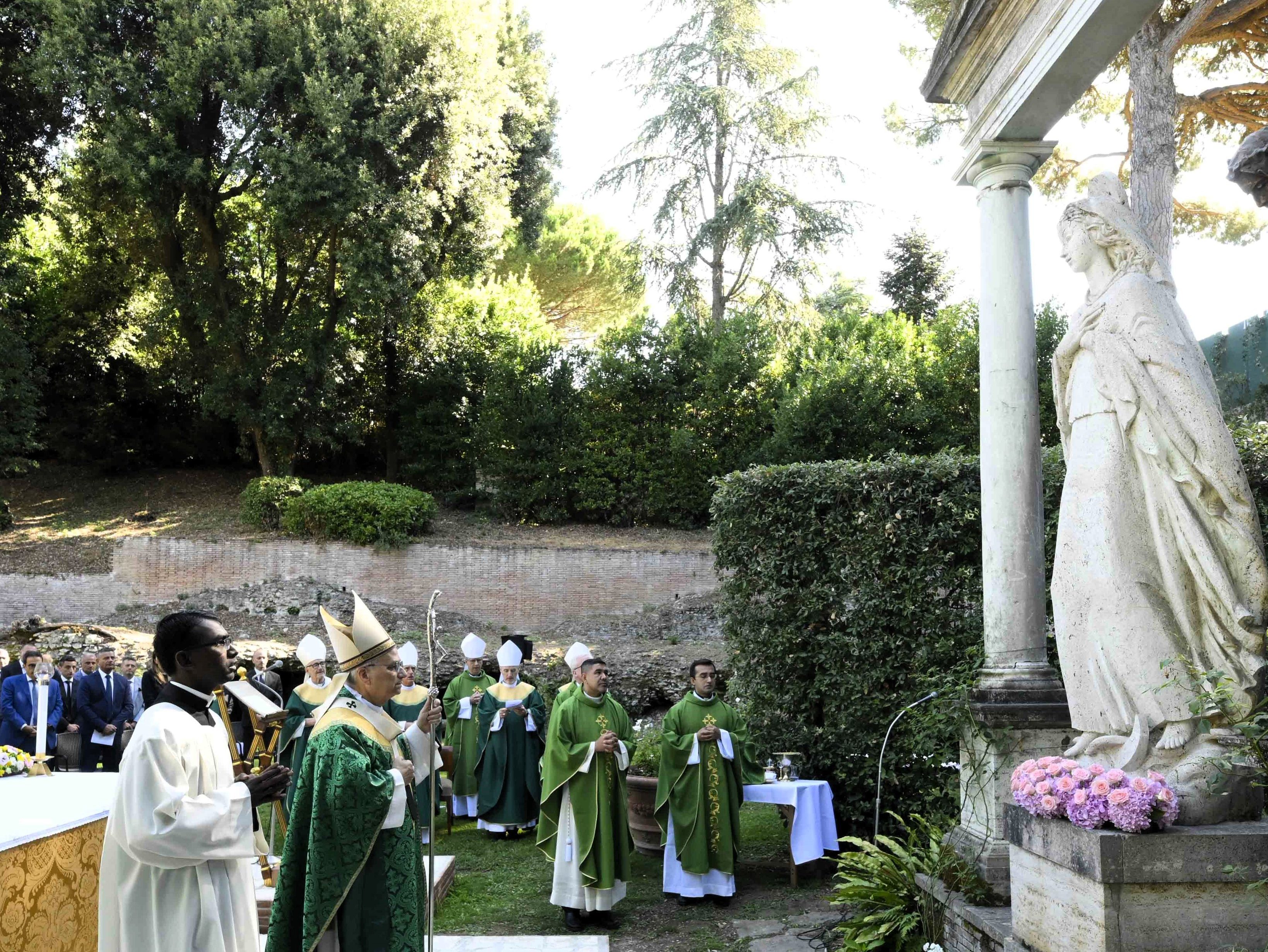
The Dicastery for Integral Human development posted this to social media with the following caption: ‘Only a contemplative gaze can change our relationship with #Creation and bring us out of the ecological crisis’.
But, it must be asked, where is Christ in this scenario?

Groves and the Divine Feminine

Is the statue behind the altar Our Lady? It’s certainly possible and at least she is dressed more modestly than Papa Bergoglio’s false Mary, undoer of knots. But in the current context, I’d like to explore another possibility: that this female figure represents a pagan goddess: Pachamama or perhaps Isis.

The Hebrew word for ‘grove’ is ‘Asherah’ which can also mean a sacred tree or wooden pole or totem which was worshipped as an idol. The name ‘Asherah’ (or ‘Ašratu’ in Akkadian), can also denote the pagan goddess of groves who was worshipped by the Phoenicians, the Akkaddians, the Hittites, and the Canaanites. Ashrerah was considered to be the ‘Queen of Heaven’ and is sometimes identified with the ‘Divine Feminine’.

The Queen of Heaven archetype appears often in pagan belief systems. For example, in Egyptian mythology the Queen of Heaven was Isis, the sister-wife of Osiris, sometimes known as the ‘World Virgin’. Isis is the personification of Nature and like other types of this goddess is associated with fertility.

As a mother-goddess who was and is blasphemously believed by some to be the consort of God, Asherah can be equated with the Pachamama of South America. Pachamama, as we know, is identified with Mother Earth and with the Divine Feminine. A common offering to Pachamama is the gift of flowers, especially yellow ones, and these can be seen on the altar at the Pope’s Mass of Creation – in violation of the GIRM (General Instruction on the Roman Missal).

Yellow flowers, a common offering for Pachamama, were placed on the altar, in violation of the GIRM.

Asherah/Isis was goddess of motherhood, and wisdom and as such may also be identified with ‘Sophia’ – the personification of wisdom. In Gnosticism, Sophia plays a fundament role, as she is an aspect of god and an agent of chaos and confusion which can only be countered by the ‘gnosis’ of ‘Jesus Christ’ which humans require to escape the physical world and return to the spiritual one.

To see a statue of a woman placed prominently behind the altar during the outdoor Mass of Creation, hands crossed over her chest in the gesture of Osiris and surmounted by a triangle (an important occult/Masonic symbol ) makes one wonder if this is not meant to represent Our Lady, but rather the anti-Mary World Virgin who is known as Ashrerah, Isis, Sophia or Pachamama.

Wisdom Between Two Pillars

The placement of the figure of Isis/Pachamama between two pillars provides further material for discussion as this is a specific arrangement in the occult with its own meaning:

The World Virgin is sometimes shown standing between two great pillars–the Jachin and Boaz of Freemasonry–symbolizing the fact that Nature attains productivity by means of polarity. As wisdom personified, Isis stands between the pillars of opposites, demonstrating that understanding is always found at the point of equilibrium and that truth is often crucified between the two thieves of apparent contradiction.

Manly P. Hall, The Secret Teachings of all Ages

Another interpretation of the setting of a female icon of Wisdom between two pillars comes from the Tarot. In this system, the woman is associated with the mythical ‘Pope Joan’ – a false female Pope! Surely, that’s not the message being conveyed here!?!

Opposing Forces

As has been repeated often among these pages, the Great Work of the occultist is to access gnosis in order to reconcile opposing forces. The placement of the female goddess figure between the two pillars echoes that principle. It is repeated in the elegant reflective pool which appears in front of the altar, a perfect embodiment of the principle of ‘as above, so below‘.

The reflective pool expresses the principle of ‘as above, so below’

The occult pectoral cross

For the occasion of the Mass of Creation, Pope Leo wore a pectoral cross decorated with an image of the Good Shepherd. While this appears at first to be the same cross was worn by the infamous Cardinal Bernadin (see article here) on closer inspection, this doesn’t seem to be the case. A separate article studies these crosses and may be found here.

Despite any differences in the crosses, it’s worth noting for our purposes that in the original version of this cross – the one worn by Cardinal Bernadin and Pope Francis – the ‘Good Shepherd’ was modelled on the Egyptian god, Osiris and that as mentioned above, the wife of Osiris was the goddess, Isis.

Conclusion

Rather than merely hijacking the Holy Sacrifice of the Mass to promote the prevailing, disordered, emphasis on the environment, there were enough red flags here to indicate an occult ritual took place under the guise of, or in conjunction with, the liturgy.

Although we may never know the truth, it is educational to decode the hierarchy’s clues which were hiding in plain site in what at first appears to be a tranquil and thoroughly Catholic scene.

To see Mass offered outdoors in a lush grove, near twin pillars that are surmounted by a triangle, close to a reflective pool with all being overseen by the divine feminine should fill us with horror, rather than delight. It is yet another sign of the new papacy’s agenda: to present Modernism with a smile and to lure Catholics into nature worship using the tantalising bait of aesthetics.

An associate of Father Isaac Mary Relyea, made an interesting point on their Youtube channel : he said the name, Mass for the “Care of Creation” immediately reminded him of the “Cremation of Care” ritual performed at Bohemian Grove. Hmmm. Another ritual in an infamous grove. That certainly is food for thought.

This article has been updated.

SOURCES: This site (non-Catholic); Sophia (Wikimedia); The Secret Teachings of All Ages by Manly P. Hall. (affiliate link.)

One-Time
Monthly

PLEASE DONATE TO SUPPORT MORE CONTENT LIKE THIS.

Make a monthly donation

Choose an amount

$5.00
$15.00
$100.00
$5.00
$15.00
$100.00

Your contribution is greatly appreciated.

Your contribution is appreciated.

DonateDonate monthly

Pagan Idol Bishop Gets Promoted?!

republished from The Remnant.

It is by now common knowledge that Pope Leo XIV has made another highly inappropriate episcopal appointment in the person of Shane Mackinlay, currently Bishop of Sandhurst. To rub salt into the wounds of faithful Catholics, this new appointment will include Mackinlay’s promotion to the rank of Archbishop, as he takes over the Archdiocese of Brisbane, Queensland.

Bishop  Mackinlay has become prominent in recent months over his unrepentant installation of a demonic idol inside Sacred Heart Cathedral. Despite repeated calls for the removal of the infamous idol, and a petition singed by more than a thousand people, Bishop Mackinlay refused to back down. The idol had been part of a local art exhibition, and was openly linked by its creator with the occult, specifically with the condemned practices of Tarot card reading and witchcraft. Its placement in the Cathedral, as part of an esoteric ‘pilgrimage’ made a mockery of true Catholic pilgrimages and of Catholic belief itself.

Eventually, the laity stepped in and the idol was ‘relocated‘ by three anonymous men in broad daylight. No apology was ever provided by Bishop Mackinlay to deeply offended Catholics nor was a statement made by the diocese about the statue’s removal from the Cathedral.

The pagan idol display was only one of a series of incidents that point to Bishop Mackinlay’s failure to enforce the Catholic religion in his diocese, as ongoing scandals have been quite a feature of his tenure there. 

The pagan idol display was only one of a series of incidents that point to Bishop Mackinlay’s failure to enforce the Catholic religion in his diocese, as ongoing scandals have been quite a feature of his tenure there.  One recent incident highlights the diocese’s commitment to extreme ecumenism with its accompanying liturgical laxity. 

On that occasion, an Anglican priestess gave the appearance of concelebrating Mass. The woman, a known lesbian, remained near the altar during a Novus Ordo Mass and was administered Holy Communion. She even helped herself to a chalice containing the Precious Blood until it was retrieved by the hapless Catholic priest who has apparently suffered no consequences for his actions from the Bishop. While some good, orthodox priests do exist in Sandhurst diocese, these are few and far between, and they have been living with a constant fear of being targeted by their Bishop.

It is being argued that, along with other recent episcopal appointments made by Pope Leo, this one was in the pipeline long before he became Pope. That rings hollow, however, when one considers his position prior to becoming Pope, for the former Cardinal Robert Prevost was, in fact, Prefect of the Dicastery for Bishops. Having been in that position since January 2023, Cardinal Prevost was one of the churchmen best placed to evaluate the suitability or otherwise of our bishops.

According to the local Catholic grape-vine, Bishop Mackinlay had been earmarked for the Archdiocese of Brisbane for some time. This means that his name was already pencilled in for the position while Cardinal Prevost was still at the Dicastery for Bishops.

According to the local Catholic grape-vine, Bishop Mackinlay had been earmarked for the Archdiocese of Brisbane for some time. This means that his name was already pencilled in for the position while Cardinal Prevost was still at the Dicastery for Bishops. Thus there is little doubt that, due to his former position, Pope Leo is well aware that Bishop Mackinlay is in favour of ordained women deacons as well as Fiducia Supplicans, which the latter believes to be a “significant step forward.”

Bishop Mackinlay is also known internationally for his adherence to the Bergoglian theme of synodality and, just months ago, he released what can only be called a propaganda video extolling the virtues of this Modernist innovation. Note that in the video, pro-life activists are portrayed as antagonists who fail to ‘dialogue’ while, perhaps unsurprisingly, those of other faiths are portrayed as being respectful and therefore able to ‘enrich’ Catholics.

The inappropriateness of Bishop Mackinlay’s new appointment has not been lost on many in the Church. Bishop Strickland criticised the move on social media, drawing attention to Bishop Mackinlay’s stance on female deacons. Bishop Strickland stated that the appointment “raises serious pastoral and doctrinal questions”, saying that “appointing a bishop who holds such views to shepherd a major archdiocese is a source of scandal and division. The faithful deserve clarity, not ambiguity; fidelity, not experimentation.”

Yet, in one sense, the appointment of Archbishop-elect Shane Mackinlay could be seen as being entirely appropriate, as his future Archdiocese is even more notorious than his current one. The Archdiocese of Brisbane has been led by Mark Coleridge since 2012 and he is a man who is possibly even more dedicated to squashing tradition and promoting heterodoxy than is Bishop Mackinlay.

Drawing together all these threads, one can only wonder what criteria is being used by the Dicastery for Bishops when selecting our prelates. For it would be no surprise to learn that those with more than a passing interest in the occult are deliberately being sent to dioceses with a history of tolerating and even promoting New Age practices.

While Bishop Mackinlay has allowed Latin Masses to continue in the Sandhurst Diocese – albeit with caveats – since the introduction of Traditiones Custodes, Archbishop Coleridge has been far less understanding. In 2023, he banished the well-attended Latin Masses offered by the Brisbane Oratory to the nearby parish hall. The Masses had formerly been held in a stunning heritage church which had been sympathetically renovated.

It was Archbishop Coleridge who, during the COVID hysteria, enforced government mandates to an extreme degree – even threatening his priests with removal of faculties if they did not comply with vaccination mandates. Prior to that, Archbishop Coleridge allowed a sacrilegious and indecent performance in one of his churches and possibly enlisted Cardinal Blase Cupich to cover up for him over sex abuse allegations. It was also on Coleridge’s watch as President of the Australian Catholic Bishops Conference that Freemasons were given permission to remain Catholics in good standing.

Archbishop Coleridge pictured with Fr. Marko Rupnik.

The Archdiocese of Brisbane has a history of heterodoxy and scandal, going all the way back to the 1980’s with then-Bishop Cuskelly and Archbishop Rush. Those two clerics, along with a bevy of priests, introduced into the Archdiocese of Brisbane revolutionary ideas such as a democratised Church and the potential for ordination of women. The wider acceptance of sodomy among Catholics can be traced back to this era.

After that came Archbishop Bathersby who infamously allowed a host of New Age practices to flourish within the Brisbane Archdiocese during the 1990’s. That included everything from nuns worshipping Gaia to alchemists lecturing seminarians.

There could only be one goal in such a grim scenario: that of further entrenching anti-Christianity in areas which are catechetical wastelands. Let us hope and pray for God to draw good from these disastrous appointments.

One highlight (or lowlight) during these decades, with particular relevance to Bishop Mackinlay, was a notorious shrine that appeared in Brisbane’s St. Stephen’s Cathedral. The shrine, entitled, The Human Search for God, was an anti-Christic collection of indigenous totems, fertility symbols and motifs related to pagan spirits and tribal ancestor worship. Some Catholics even discerned references to the magick rituals of Aleister Crowley in the designs.  Outrageously, the collection was in place for seven years.

Although the exhibition has now been removed, other disturbing artworks remain at St. Stephen’s including a bizarre crucifix over the main altar.

St. Stephen’s Cathedral’s Resurrected Christ crucifix

Read the rest at The Remnant Newspaper.

The Eleusinian School

The Eleusinian School was the most popular of the many so-called ‘mystery religions’ of ancient times. Like all mystery religions, Eleusinianism was based on rites of initiation which led to ‘transformation’, through a mystical ‘birth’ and ‘rebirth’.

This principle of transformation is commonly found among today’s secret societies and cults such as Illuminism.

The Mystery Religions

As Manly P. Hall points out, the ancient mystery religions “were branches from one philosophic tree [which,] with its roots in heaven and its branches on the earth…” 1

This idea could be seen through the Christian lens of truth and grace having their source in God, yet is an interesting turn of phrase, as it also exemplifies the occult principle of ‘as above, so below‘. This principle falsely posits that what is conceived in the spiritual realm is manifested on earth.

As Christians, we believe that the eternal Wisdom of the Holy Trinity guides all activities on the earth: world events are only the result of God’s Permissive Will or of His Direct Will, but they are always the Will of God alone. [If a satanist or witch ‘manifests’ an outcome via a ritual or spell, then God has merely allowed a demon to fulfil the request in order to honour that person’s free will. We hope that at some point in the unfortunate person’s life, he or she will recognise the demonic power to which they are enslaved and repent.]

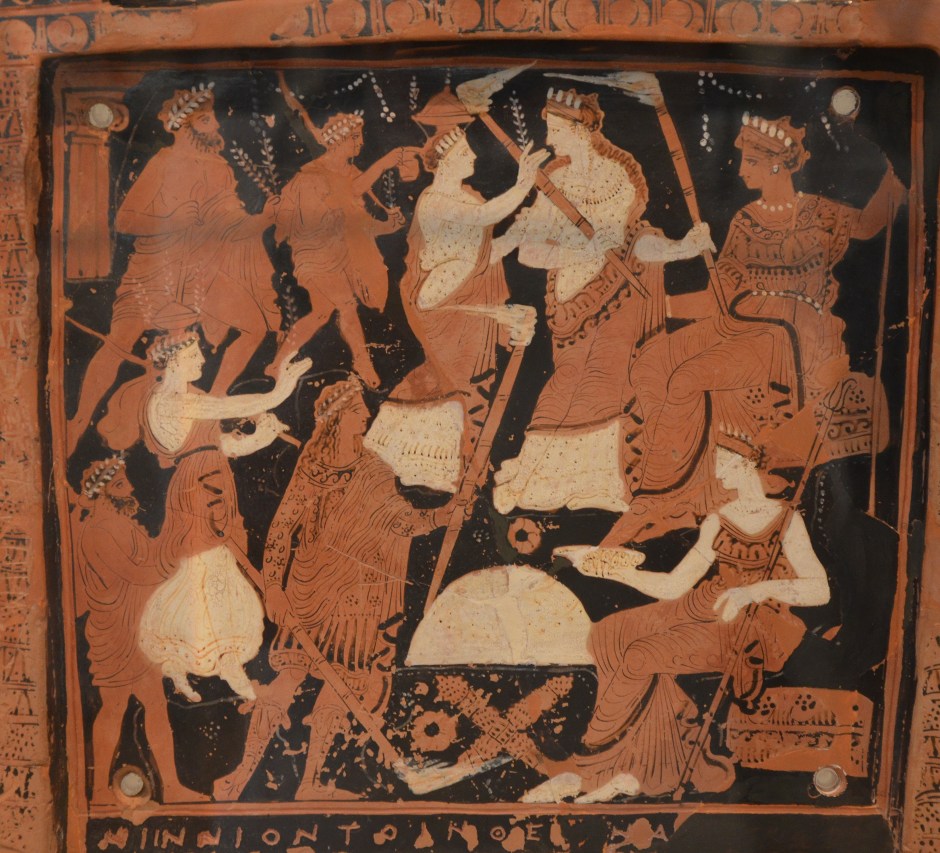
‘Eleusinian Mysteries’, Dirck van Baburen, 17th century.

The Eleusinian School

The Eleusinian School was widespread, moving from Greece to Rome and eventually to Britain. Over time, it absorbed some of the smaller mystery cults.

Every year, (some rituals were performed only every five years) its rituals were performed in the city of Eleusis, near Athens, in honour of the goddess, Ceres, and her daughter Persephone.

Ceres and Persephone are the subjects of a famous Greek myth in which Persephone is kidnapped by Hades, god of the Underworld. With assistance from the sun-god, Helion, Ceres succeeds in rescuing Persephone for half the year. This myth came about as an explanation of the seasons; during winter, vegetation ‘dies’ while Persephone visits the Underworld.

IMAGE: Fragments of the Great Eleusinian Relief with Demeter (left), Persephone (right) and Triptolemos (centre). C 450 BC.

Initiates were sworn to secrecy regarding the precise nature of the rituals, however, we do know that the ceremony would begin in Athens with ritual washing, followed by animal sacrifice. On the fourth day of the ten-day festival, participants processed from Athens to Eleusis – a 22km journey. Finally initiates spend several days together inside a temple, undergoing some kind of traumatic ritual which was designed to produce the ‘transformation.’

The intense ritual, wherein candidates were symbolically led on a journey through Hades,2 was led by priests and priestesses while former initiates watched on. It involved activities designed to alter the consciousness of initiates, probably involving emotive music and dancing, and possibly involving hallucinogens.3

Eleusinian Philosophy

At the heart of Eleusinianism is the belief that man’s state after death changes little unless he manages to access ‘secret wisdom’ during his time on earth. “If he does not rise above ignorance during his sojourn here, man goes at death into eternity to wander about forever, making the same mistakes which he made here.”4

Interestingly, the Church Father, Hippolytus, mentioned the Eleusinians in his classic work, the Refutation of all Heresies. Hippolytus draws attention to one part of the secret rituals, the moment when ‘an ear of corn is reaped in silence’. 5 Likewise, Clement of Alexandria warned of the cult in the 3rd century.6

Plato, in his Republic, is thought to contain a reference to the ‘rebirth’ contained in Eleusinian doctrine, and Carl Jung is said to have used the Eleusinian mysteries as a basis for some of his work, particularly his notion of initiation and rebirth as a metaphor for psychoanalysis.7

Frederic Leighton, “The Return of Persephone” (1891). Persephone’s ascent from the Underworld symbolises the initiate’s ‘rebirth’ and lasting transformation.

Eleusinian Symbolism

The following text is taken from Manly P. Hall’s The Secret Teachings of All Ages. It is instructive because it sheds light on the importance placed on the various materials and surfaces with which occultists who are inspired by the Eleusinians surround themselves.

“God being a luminous principle, residing in the midst of the most subtile fire, he remains for ever invisible to the eyes of those who do not elevate themselves above material life: on this account, the sight of transparent bodies, such as crystal, Parian marble, and even ivory, recalls the idea of divine light; as the sight of gold excites an idea of its purity, for gold cannot he sullied. Some have thought by a black stone was signified the invisibility of the divine essence. To express supreme reason, the Divinity was represented under the human form–and beautiful, for God is the source of beauty; of different ages, and in various attitudes, sitting or upright; of one or the other sex, as a virgin or a young man, a husband or a bride, that all the shades and gradations might be marked. Every thing luminous was subsequently attributed to the gods; the sphere, and all that is spherical, to the universe, to the sun and the moon–sometimes to Fortune and to Hope. The circle, and all circular figures, to eternity–to the celestial movements; to the circles and zones of the heavens. The section of circles, to the phases of the moon; and pyramids and obelisks, to the igneous principle, and through that to the gods of Heaven. A cone expresses the sun, a cylinder the earth; the phallus and triangle (a symbol of the matrix) designate generation.”

Expressed in table form, we have

MATERIAL

crystal, marble, ivory

gold

black stone

a beautiful human form (representing God)

anything luminous

anything spherical

anything circular

sections of circles

pyramids and obelisks

cone

cylinder

triangle, phallus

MEANING

divine light

purity

invisibility of the divine essence

supreme reason

the gods

the universe, sun, moon, Fortune, Hope

eternity or the celestial movements

phases of the moon

the Igneous principle/the gods of Heaven

sun

earth

regeneration

We can see that the meaning attributed to some of these symbols differs from that given by other schools, however this list could help when interpreting the communications and loyalties of occultists.

Conclusion

Having briefly examined the ancient cult of the Eleusinians, we can see its influence on modern-day Gnostic cults.

In fact, some occultists posit that when Christianity took hold and paganism fell into disrepute, the Eleusinians went underground and became the basis for many esoteric religions such as Hermeticism, Kabbalah, Freemasonry, Gnosticism, Neo-Platonism and Alchemy,8 all of which are centred on the theme of spiritual transformation via the attainment of ‘secret’ knowledge.

Additionally, Ceres is the equivalent of Demeter (Rome) and Isis (Egypt), so with goddess worship becoming increasing popular in our post-Christian world, the beliefs and symbolism of the Eleusinians hold extra relevance for us.

Votive plaque depicting elements of the Eleusinian Mysteries, discovered in the sanctuary at Eleusis (mid-4th century BC)

SOURCES: [note: may contain Amazon affiliate links]

  1. The Secret Teachings of All Ages, Kindle Edition, p 107. ↩︎
  2. The Secret Teachings of All Ages, Kindle Edition, p 109 ↩︎
  3. Mystical Initiation in Ancient Greece video ↩︎
  4. The Secret Teachings of All Ages, Kindle Edition, p 109 ↩︎
  5. Wikipedia – Eleusinian Mysteries ↩︎
  6. Mystical Initiation in Ancient Greece video ↩︎
  7. Wikipedia – Eleusinian Mysteries ↩︎
  8. Theosophical.org ↩︎

The Amazon continues to haunt the Church

Ever since the Pacha-scandal, Catholics haven’t been able to think of the Amazon region without an interior spiritual shudder. That day marked the sickening beginning of a nightmare that still continues, for Scripture tells us that pestilence is a punishment for idolatry. Worse than even a “plandemic” is the thought of God’s remaining punishments for idolatry: famine and war. And these have not been closer to our shores than at any time during the past seventy years.

So it is with grave misgivings that I see the Amazonian Rite is still being fabricated in ‘full steam ahead’ mode. One can only ask, why that is? Pope Francis is all for reducing the number of Rites, is he not? Yet, here we see a gaggle of Commissions working away to create – out of thin air – a Rite which will allow the “Local Churches to live and celebrate their faith, according to their native expressions”. Because, as is only too evident whenever the Modernist Church casts its net to the peripheries, it believes that the indigenous people caught in its snare of opportunism lack the intelligence to comprehend the Mass as it has always been offered.

Why else must every prayer, hymn and symbol be dumbed-down for the locals? Surely not, say, to enable paganism to sit side-by-side with true worship? Surely not to see demons usurp the place reserved for Christ alone? Because that is precisely what will happen if the Church continues its headlong path towards syncretism and idolatry.

If we hadn’t had enough of redundant terms, such as a absurd-sounding Synod on Synodality, the South American bishops, (Liberation theologians almost to a man) have given us a new one: inculturation in interculturality. Our shepherds are sounding more like Dr Seuss every day.

Anyone concerned about this new Rite being completely orthodox, decorous and edifying can rest easy. Cardinal Roche has it in hand. As a sworn enemy of the Latin Mass, he will no doubt ensure that the Amazon Rite displays the least possible resemblance to the usus antiquior.

Don’t forget that at the time of the Synod on the Amazon, it was suggested that women deacons be ordained in that region and that married men be allowed to become priests.

Move over Troy, the Amazonian horse is on its way. When it comes to the creation of this new Mass, we can be sure that Tradition will be tossed into a pot with some herbs and a baby llama or two, then burned as an offering to Pachamama.

‘Tis the Season for Gaia worship

The Pope’s 2022 “Season of Creation” has just kicked off: it runs from September 1 to October 4th. Those dates are pretty handy for all the Wiccan nuns involved in the Church since the Spring/Autumn Equinox falls smack in the middle of the “Season”. But that’s just a coincidence.

Its theme is “Listen to the Voice of Creation”, which sounds like another Gnostic attempt at ‘discovering’ what God really wanted all along, diluting the Faith and getting us ready for the One World Religion.

The “Season” kicked off with a World Day of Prayer of which only the most obsequious parishes took any notice: the others were too preoccupied with trying to pay their utility bills.

The European bishops contributed by showing their devotion to The Science with an alarmist statement written in the style of Paul Erlich or Al Gore:

“Our own Europe has been faced with a genuine environmental catastrophe that, in 97% of cases, is attributable to the actions of man. In the 27 countries within the European Union, according to a recent estimate, fires have already devastated a total of 517,881 hectares since the beginning of the year, compared to 470,359 the previous year. Scholars are already hypothesising the transition from our era (Anthropocene) to the next one, to which they have already given the name “pyrocene”, the effects of which are already visible considering that CO2 emissions have reached levels that the planet has not known for well over 3 million years.

3 million years, eh? The author of Genesis might have something to say about that. Speaking of Moses, the symbol for this year’s Season is the burning bush. Its creators tell us why:

“Today, the prevalence of unnatural fires are a sign of the devastating effects that climate change has on the most vulnerable of our planet. Creation cries out as forests crackle, animals flee, and people are forced to migrate due to the fires of injustice.

They certainly have a thing about fire, don’t they? Then again, considering where most of them will be spending the afterlife, it’s no wonder that these heretics are predicting a “pyrocene” future.

Below is another little snippet from the “Season of Creation” website. I really don’t know what it means except that it isn’t helpful and it isn’t Catholic. It isn’t true, either, since the voices calling for “protection of the Earth from anthropogenic climate change” are among the loudest in society these days. Muted, on the other hand, are the voices of traditional and faithful Catholics.

During the COVID-19 pandemic, many have become familiar with the concept of being muted in conversations. Many voices are muted in public discourse around climate change and the ethics of Earth-keeping.

These are voices of those who suffer the impacts of climate change. These are voices of people who hold generational wisdom about how to live gratefully within the limits of the land. These are voices of a diminishing diversity of more-than-human species. It is the voice of the Earth.

If Bergoglio had put as much effort into promoting the concerns of the Holy Trinity as he has to promoting Gaia, the Church – and he world – would be in a much better place.

Pope: Sweet song of praise for Creation has become 'anguished plea'
“A sower went out to sow” ….. dissent.

Another feather in Francis’ cap

The Pope’s decision to accept a traditional indigenous feather headdress while in Canada was not really surprising. After all, nothing of this sort can come as a shock after seeing our Pope publicly honour Pachamama back in 2019.

To the mournful melody of indigenous Indian chanting – the meaning of which no one knows – two American Indian men, wearing traditional blue jeans, presented the Pope with the head dress.

As with Australian Aboriginal ceremonies, there are secrets surrounding the meaning of the feather head dress and its bestowal. From what can be gleaned online, this kind of attire is a reward for warriors who, after earning the individual feathers for their acts of bravery and wisdom, have finally gathered enough to have a head dress made. That all sounds very prestigious and honorific, and consistent with the respect shown to a visiting head of state.

However, also gleaned from the online descriptions is the underlying notion that the feathers contain the ‘eagle spirit.’ If a head dress accidentally touches the ground, the Indians believe a special ritual needs to be performed in order to return the ‘eagle spirit’ to the head dress.

The eagle is sacred to the native Americans, because they believe that bird takes their prayers to the Great Spirit. It would be nice to think that this ‘Great Spirit’ is identical with God the Father, and that we all believe in the same God and that everything is peachy because everyone is taking different paths on the same journey and all of that.

However, as the Psalm makes clear, “the gods of the Gentiles are devils”. So in effect, Francis has agreed to take on yet another demon to add to the collection he has been amassing since at least 2017, when he was prayed over by this Indigenous witch. (left)

Reason would suggest that Jorge Bergoglio’s relationship with pagan gods began long before that.