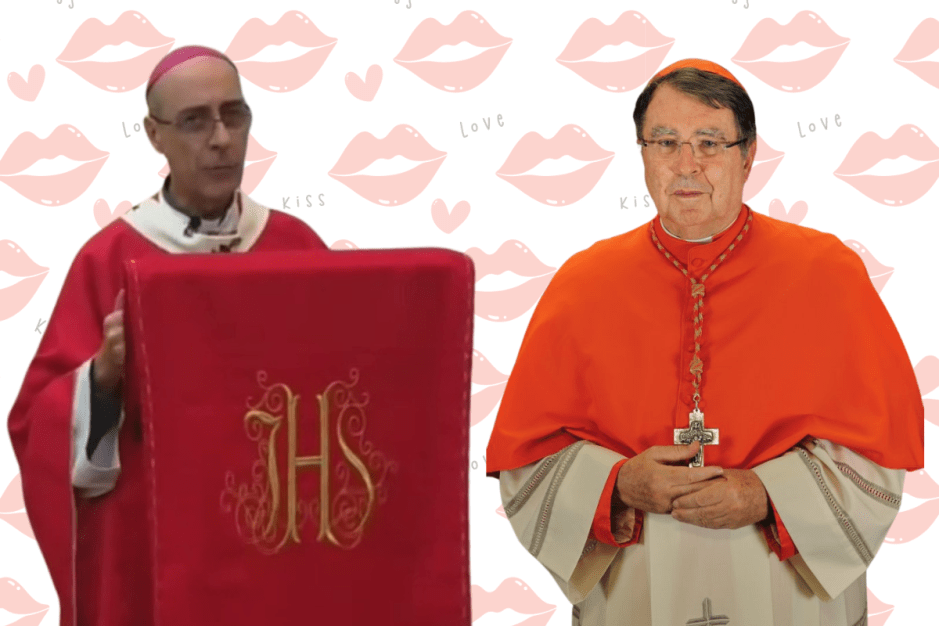
Shades of Tucho in Cardinal Pierre’s Sad Commentary on the Real Presence

It is a sign of the times when a senior Catholic churchman wastes an ideal opportunity for increasing devotion to the Blessed Sacrament in favour of pushing the idea that the Body, Blood, Soul and Divinity of Christ are just as present in the average sinful human being. It is also a sign sign, albeit a very disturbing one, to hear language reminiscent of Cardinal “Heal me with your Mouth” Fernandez in a discourse on the most sacred reality of the Catholic faith.

In his address to the Eucharistic Congress in Indiana, the Papal Nuncio to the United States, Christophe Cardinal Pierre, began by reminding attendees that to be Catholic is to be united with the Papacy. So far, so good – although one always wonders with these Modernists if they really mean “being united with every word that falls from the mouth of Frances” rather than with the office of the Pope, and all that entails. By beginning his address by quoting the Council and JPII, Pierre suggests the latter.

After that dubious introduction, Pierre next asks the questions, “What is Eucharistic revival?”  and “How will we know that we are experiencing Eucharistic revival?” He then goes to to list the initiatives that have been presented by the US bishops to the faithful in recent times:

” … increased opportunities for adoration and benediction.  There has been catechesis on the Eucharist and, of course, processions. By displaying the Blessed Sacrament for worship and increasing our acts of devotion, we have drawn attention once more to this great Sacrament in order to “stir up” a renewed faith, both in our fellow Catholics and in ourselves.  We have even attracted the curiosity of people of other faiths.”

Again, so far, so good. Then comes the “BUT”. (With the Modernist, there is always a “but.”) Time to draw our attention, not to God, but to “the other.”

“Not only is He present in our family, friends, and communities; but He is also present in our encounters with people from whom we would otherwise consider ourselves “divided”.  This might include people from a different economic class or race, people who challenge our way of thinking, and people whose perspective is informed by experiences that differ greatly from our own.  ….. If we are experiencing true “Eucharistic revival”, then one of the signs will be a greater movement on our part to build bridges of unity.”

The term, “building bridges” always calls to mind the arch-heresiarch, James Martin. But there’s more:

And so, to believe in the real presence of Christ is not only to say: In these forms of bread and wine are His body, blood, soul, and divinity

Wait! Did he mean that during Consecration the bread and wine are changed into the Body, Blood, Soul and Divinity of Christ, or did he say something else? It sounds more like Luther’s Consubstantiation (the idea that the Real Presence presence exists alongside the bread and wine) than Catholic Transubstantiation. It’s a bit ambiguous. Finally comes the humanist clincher: the Real Presence is just not that big of a deal. Christ’s Presence is all over the place – most especially when we are dealing with “the other.”

“But Christ is also present in the assembly of His believing people.  Not only that, but he is present to people who struggle to connect with Him because of wounds, fear, and sin.  We need to be there with Him, accompanying such people, and helping them to experience the real presence of Christ’s love.”

Now to the act of Eucharistic Adoration itself. Of course it is good, ….. “but”……

Adoration, is essential to our relationship with Christ — but it is important that we treat it as that: a relationship.  If, in the act of Eucharistic adoration, we were to look at the Sacrament merely as an “object” to be admired, then we would be remaining, as it were, “on the outside….” 

Does any Catholic actually do that? Simply admire the Blessed Sacrament? In any case, here comes the really strange part. The “heal me with your mouth” part. But even stranger is the fact that this reference to “mouth to mouth contact” came not from Tucho Fernandez but from Pope Benedict!

“…. Pope Benedict explained: “The Latin word for adoration is ad-oratio — mouth to mouth contact, a kiss, an embrace, and hence, ultimately love….”

The reference does check out: Pope Benedict did in fact use these words at World Youth Day in Cologne in 2005. To young people. But here is the really strange bit: the Latin word adoratio does NOT have anything to do with kissing, embracing or “mouth to mouth contact” – at least not in any of my three Latin dictionaries or that I could find anywhere online. The noun, adoratio (from the verb adorare, to speak or entreaty or worship), only means an act or worship or prayer. That’s it.

So where does the kissing come in? Benedict was meant to be a great Latinist! The mind boggles.

Getting back to Cardinal Pierre and his address, it finishes by emphasising that the purpose of Adoration is not to give perfect worship to God but merely to solve the problems of this world. This is pure naturalism; it lines up perfectly with the Masonic ideology of a horizontal, humanist church.

There’s a bit more about the being open to the surprises of the Spirit and Synodality, and that listening “to one another and to the Spirit in the person we listen to” will be the “fruit of the Eucharistic revival.”

So there we have it: the main fruit of this Eucharistic Revival will be a Synodal, listening Church. And they wonder why the majority of mainstream Catholics do not believe in the Real Presence!

IMAGES SOURCE: Romanuspontifex, CC BY-SA 3.0 <https://creativecommons.org/licenses/by-sa/3.0&gt;, via Wikimedia Commons; http://nuntiususa.org/nuncio
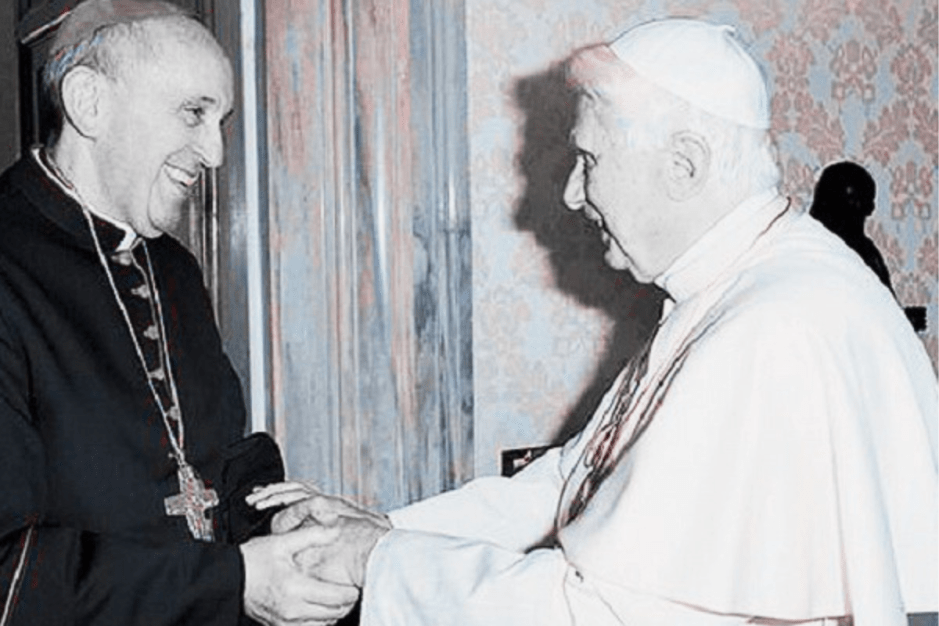
Bergoglio was “too radical” to be elected in 2005

from the website of Marco Tosatti: english translation

Dear Tosatti, I am an Anglican prelate converted to the Catholic faith. When I read something in the newspaper headlines that refers to our Church and Pontiff, I hurry to read the content immediately, before reading other important news. Why? Because what, in my opinion, explains almost everything that has happened in the world for ten years is linked to the history in the same period of our dear Church which I also joined (Pope was Saint John Paul II), in the footsteps of Saint John Henry Newman ( in 1845. But what have I ever done!) .

Never more than in these last ten years have we felt (at least I am a new convert) the lack of a Moral Authority, an authority of the Catholic Church that speaks to the world about the Truth, inviting it to pursue it. And yet we had a very strong and very clear “warning” thanks to the courageous Cardinals who proposed DUBIA I and II. (the first, 2017, without an answer, the second, 2023, with “disturbing” answer). DUBED, ignored, even mocked and despised. Intolerable! But what have I ever done?

In a recent interview, Pope Francis (I apologize, I don’t remember who he gave it to) explains that it was he who appointed Card. Ratzinger in the 2005 Conclave). Exhilarating! and above all not true. I was an involuntary and indirect witness to it.

In 2005 a group of Eminent Cardinals wanted to support Bergoglio’s nomination. It was the great Jesuit cardinal Carlo M. Martini who dissuaded them and instead proposed the card. Ratzinger. The reasons, in short, that were confided to me, were that the former Archbishop of Milan would have considered this appointment a disaster for the Jesuits (it even seems that he had said something like: <if they elect him Pope, we Jesuits will, in fact, come , “suppressed” as in 1773, this time not for 40 years, but at least for 200 years…>).

Who the current Pontiff was and what he had done in his previous roles in Argentina is well known, with testimonies. Who wanted it and why, it is difficult to prove and testify, but in the very days of his appointment to the Papal Throne, therefore well before he began to govern the Church, it was explained from many quarters what his task would be. 100% done. There was even a book published by a French intellectual who joked about the consequences of the choice. Benedict had to renounce so that Francis could be Pope. Francis had to be Pope because Benedict would never have allowed the Church to support the choices of destruction of Christian Civilization that were subsequently made.

Perhaps many Catholics still have not understood that what needed to be destroyed (beyond faith, of course) is Christian Civilization. Well, I really fear that many of you Catholics haven’t understood this yet, you look at the finger but you don’t understand what it indicates.

I would also like to make a critical observation on the behavior of some prelates who are preparing for the (supposed) change of pontificate, expressing negative assessments of the pontificate, all of a sudden and with suspicious delay. “Maramaldesque” assessments, dear Tosatti, and not at all acceptable. I explain the expression “maramaldesca”, which means “vile”. On his arrival in Italy in 1527, Charles V, Catholic emperor of the Holy Roman Empire, eager to punish Pope Clement VII (Giulio de Medici for having joined the Cognac League (pro-French and anti-Habsburg), had hired the Landsknecht (Protestant) mercenaries who they carried out the famous “sack of Rome” and brought the plague throughout Italy. During the siege of Florence in 1530 the famous Maramaldo (Neapolitan mercenary) attacked the commander Francesco Ferrucci, already wounded and half dead on the ground, skewering him (“vile! you kill a dead man”, Ferrucci told him). Here, dear Tosatti, until yesterday everyone (except for a very few) were sock lickers and allowed everything that appeared to happen. Now they are all courageously critical, with interviews and even with books (not credible ) referring to the previous Pope, post-mortem, of course.

It is curious that apart from the famous Cardinals of the DUBIA and a few others, only in this moment of progressive weakening of Francis, some “neo-courageous” ones, suffering from the “Maramaldesque” contagion, are slowly beginning to emerge. This is not exemplary and leaves us fearing even worse times ahead.. Thank you for this hospitality.

His Hugo AGW

Further Posthumous Humiliation of Pope Benedict

After the death of the Pope Emeritus, Benedict XVI, Bergoglio lost no time in rewriting history to hide the fact that he is acting in complete opposition to Tradition. For example, on one of his many ‘Magisterial’ in-flight press conferences, Bergoglio tried to convince us that he and Benedict were besties and that his NWO apostasy agenda had the full support of poor Ratzinger.

This posthumous campaign against the previous Pope ramped up a notch when the current Vatican hierarchy now has its true opinion of Benedict literally etched in stone.

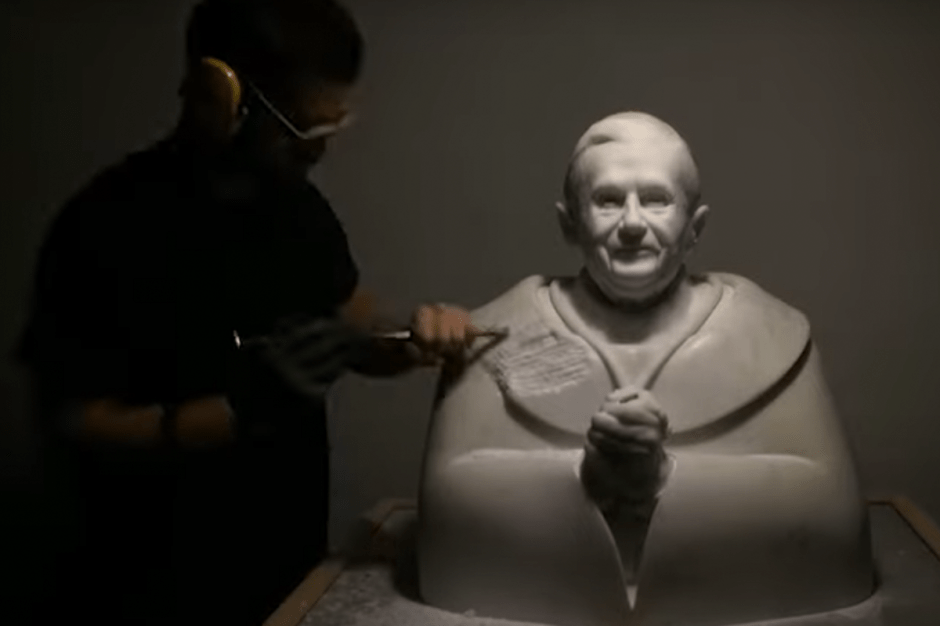
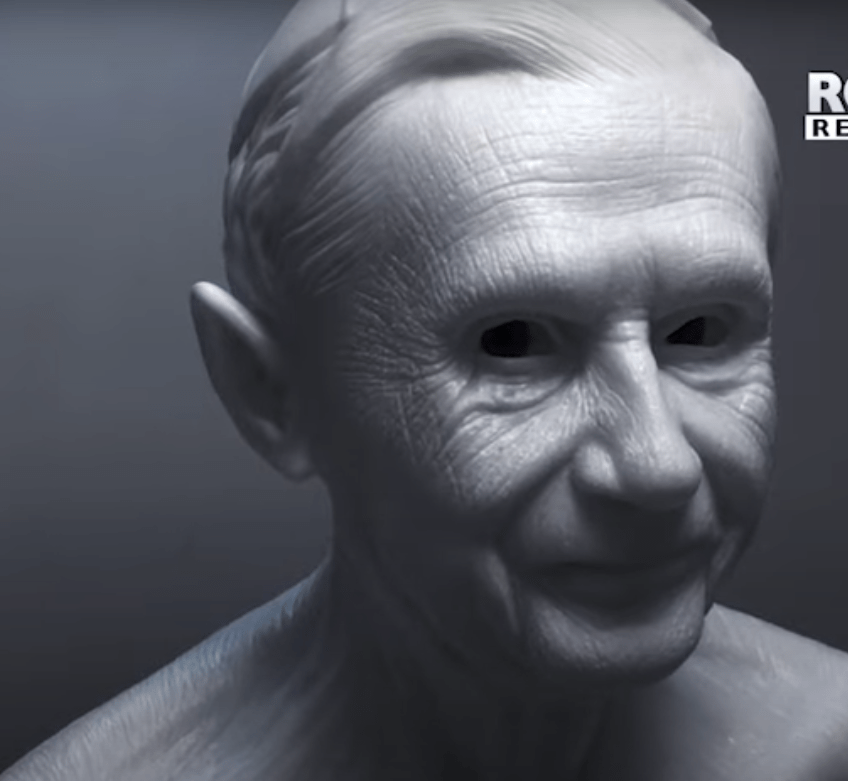
Rome Reports shared the time-lapse video of an artist creating a disturbing bust of the Pope Emeritus from a previous bust made by him. The first version had apparently been rejected by the Vatican because of its hollow, soulless eyes. [It is perhaps of note that having one’s eyes plucked out is a penalty in several degrees of Freemasonry for the violating of one’s oaths.] Apart from that perturbing detail, the statue had some artist merit, being a decent likeness of Ratzinger, and presented with the dignity merited by a Pontiff.

The updated version, however, reminds one of those hideous displays of preserved cadavers that are popular among the avant-garde and their luciferian hangers-on. As shown the in the video, the artist has chipped away his subject’s clothing, leaving the emaciated flesh of an elderly man. Stripped of all dignity in this way, the result is something almost less than a man, or perhaps ore accurately, of a lonely and despairing man without anyone to care for him and cover his nakedness.

It is this shameful image that was awarded a prize by the Pontifical Academy of Fine Arts. Although the artist, Jacopo Cardillo, says that he loved the former Pope, the thumbnail image on the video showing him staring intently at his work, reveals anything but love.

Cardillo named the original bust, ‘Habemus Papam’, while the new version is called ‘Habemus Hominem’. I think you will agree that ‘Habemus Abominamentum’ is a far more accurate description. Cardillo is apparently a ‘self-taught’ artist who created ‘Habemus Papem’ at the age of 23. He was fascinated by the legendary ‘Veiled Christ’ sculpture, which is said to have been wrought by the aid of alchemy. He also seems to have a thing for sculpting fetuses, both living and dead. The source of his talent I will leave to your imagination.

A “hypothetical” papal resignation

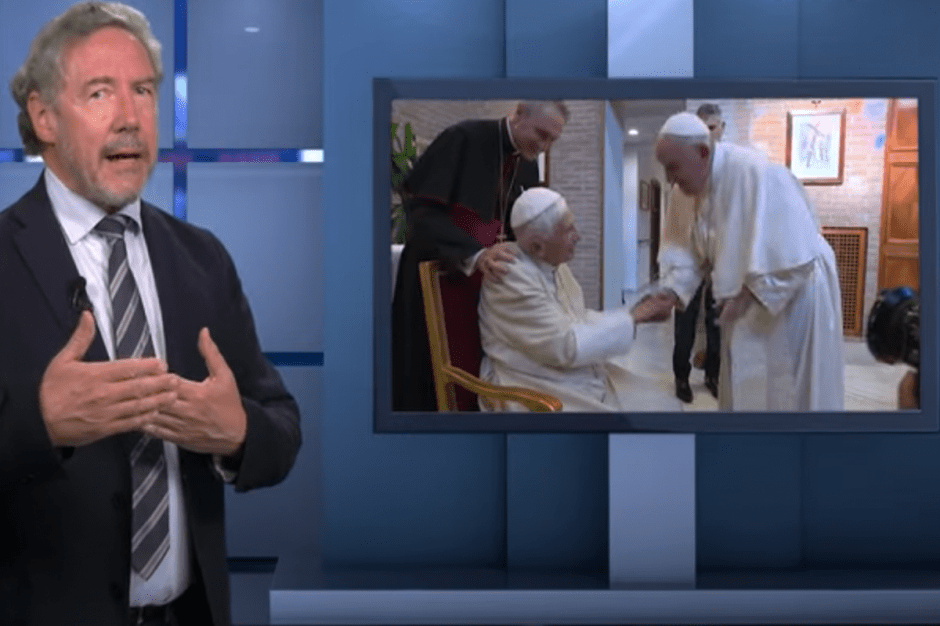
Is good old Rome Reports providing some predictive programming?

Protocols surrounding papal resignations have been around since the time of John Paul II, and Pope Bergoglio has made no secret of the possibility that he could resign at some stage. Liberal Catholic media outlets love to throw the cat among the pigeons (usually on slow new weeks) by suggesting that such a resignation is imminent.

The eighty canon lawyers who have gotten together to discuss what a resignation protocol would look like, “theoretically” of course, might be enjoying their all-expense-paid confab, but it does raise the question how it was possible for Pope Benedict to do it all on his own. His resignation was not without controversy, but it was above board and not an eighty-lawyer-job.

Why on earth should anyone want to discuss resignations when it is obvious that an elderly and unwell Pope will not live forever? What DOES Francis have up his sleeve? Is he about to introduce fixed terms for the papacy, as with our political leaders? Is this another step closer to the One World Masonic Humanist religion?

Or is this just another distraction from the main event, like the “restructuring” or the Curia and “cleaning up” of the Vatican finances? Red herrings both, if you ask me.

Stay tuned for more apostasy. When whatever is about to happen happens, there will be no going back.