Zipping it – for the Greater Good

Ah, the Greater Good.

It’s a little like the Golden Rule (Those who have the Gold Make the Rules) except that in this case, those who think they are greater get to decide what is good.

For when traditional Catholic commentators were told to “zip it” rather than criticise the current papal aberrations, the “good ” involved was not the good of the Church nor was it the salvation of souls. Rather, the apparent “good”, decided by the “greater” ones, was their attempt to secure for themselves their Latin Masses. This, it seems, would be in return for a very small fee: keeping quiet about Leo and his papacy’s remarkable similarity to that of Bergoglio.

The Greater Good must be contrasted with the Common Good, which is actually the Catholic position.

Whereas the Common Good must take the needs of everyone into account, the Greater Good always involves the sacrifice of some for the sake of the whole. This principle is never more consequential than in the matter of salvation, where every individual’s soul needs to be considered.

For to remain silent when Pope Leo unashamedly continues the agenda of Bergoglio and his conciliar and post-conciliar predecessors does put souls at risk – of despair, of error and of deception.

One is reminded of the words of Our Lady of Buen Suceso of the Purification at Quito, Ecuador, where she said several times that ” that one who should speak will fall silent”.

If “the one”, presumably the Pope, falls silent then it is not surprising that other Catholics who should speak out would also follow suit. That is, those traditional Catholic commentators who were so quick to point out Bergoglio’s errors and who did so much good in alerting the faithful during his reign, fell silent when it came to Prevost.

Thankfully, it does appear that the ‘zip it” crowd already have egg on their faces and that some, at least, have begun to rethink their ill-fated strategy.

One commentator, notorious for his self-promotion, has already backtracked somewhat. This is the same man who made a video prior to the conclave in which he said that the election of Prevost would be the worst possible scenario for the Church. After the conclave, he scrubbed that video and refused to call our Pope Leo’s errors. (Thanks to Novus Ordo Watch, the original video can be found here.)

It should be mentioned that this backtracking coincided with the release of his latest book which he unashamedly promoted during his first foray into criticism of the new Pope. Perhaps he realised that the book’s target audience included those Catholics who are feeling dazed and confused by the traditionalists’ Zip-It policy.

Another Zip-it proponent has also begun to loosen his lips to allow some initial criticism of the shameful desecration of St. Peter’s during the James Martin crowd’s pilgrimage. Yet another has put out a strident blogpost, explaining that this LGBT pilgrimage crossed his bright line, allowing criticism to spring forth from his keyboard. We are assured that his wait-and-see policy was born, ever so ‘umbly, out of charity alone.

Don’t forget, these are the men who until now, gave Leo a pass when the red flags first began flying. They remained quiet when footage emerged of a talk he gave, praising the evil Cardinal Bernadin. Likewise, when Leo de facto canonised Bergoglio, the most prominent traditionalist commentators had nothing to say. The pagan Mass for Creation? Silence. Scandalous appointments? Crickets.

If the Great Unzipping really has taken place, it will be interesting to see what the future holds for the likes of Chris Jackson, Steven Kokx and The Catholic Esquire. They have done the heavy lifting during this wait-and-see phase of the new papacy, unflinchingly calling it as they have seen it, rather than kowtowing to the compromise directive issued, as has become all too clear, from the doyen of Trad-dom, Cardinal Burke.

For it is difficult to draw any other conclusion than this: that Burke was the middle-man in a mutually beneficial transaction between wealthy traditionalists and Modernist Rome.

Consider: a group of rich, traditionalist Catholics pulled their purse-strings closed under Bergoglio, thereby making a significant impact on the Vatican’s bottom line. Remember, Rome is in a quite desperate financial situation these days.

Those same wealthy Catholics had been suffering under Bergoglio. His outrageous behaviour caused them a loss of prestige and influence as they were no longer ‘in’ with the papacy, in the same way they had been under John Paul II and Benedict XVI.

In order to restore their reputations as the Catholic elite, it would be necessary to find a new Pope who matched their sensibilities – of aesthetics, anyway. Doctrine doesn’t matter when one has a private chapel with any number of cancelled priests willing to provide bespoke Latin Masses.

And so a deal was struck: in return for the flow of money to Rome, the mild-mannered Prevost would have to be elected. He looked the part and fluently spoke the correct languages: English and Latin. It would fall to Cardinal Burke to do the lobbying prior to the conclave.

If all this seems a bit far-fetched, it should be remembered that Steve Bannon said from the beginning that the conclave was “rigged”.

Additionally, some months ago, Anthony Stine, on Return to Tradition, cited an article from a big legacy media outlet in the US, which revealed that a secret meeting took place in Rome prior to the conclave. It was apparently attended by wealthy Italian and American Catholics who promised to send money to the Vatican if an American was elected Pope.

Remember also that the Italian news outlet, Corriere della Sera, confidently reported that Prevost was seen entering Cardinal Burke’s apartment on April 30 for ‘a top-secret summit’, even though this was strenuously denied by reliable reporters like Diane Montagna and Ed Pentin.

From whom is it likely that Montagna and Pentin receive their Vatican-insider information? Could it be from Cardinal Burke himself? Is it possible that the journalists were set up – no doubt for the Greater Good?

From where did Montagna receive the results of the bishops survey that shows Bergoglio had lied about the Latin Mass being unpopular with the hierarchy? Could those documents not have been leaked by Cardinal Burke himself?

Why did they not come out during Bergoglio’s reign? It was certainly possible to have arranged it.

Was it because such a revelation would have only hardened Bergoglio’s heart against the traditional Mass? Leaked under Prevost, however, the latter would potentially have the opportunity to play the Good Guy and rescind Traditiones Custodes, or at least, not bother to see it enforced.

Where does the so-called Trad Inc. fit into the picture? Well, if they want their Masses secured, and hopefully Traditiones Custodes rescinded, they would have to toe the line. No more criticism of Rome, no more bad press for the Pope. The rest of Christendom would then have to take its chances with the mish-mash of heresy, sodo-liturgies and Modernism going on outside the small enclaves of tradition. This would appease the Catholic elite by making the papacy look reasonable once more and start the coffers flowing to Rome.

Rome would have its income restored; the wealthy Catholics would have their prestige restored; Trad Inc. would have its Masses restored. At least, that was the plan, with Cardinal Burke as the lynch-pin. He was to be truly cardinalis. (Latin for ‘pivotal’).

There were two sticking points in this plot – other than whatever small murmurings came from the consciences of those involved. One is the yearning for truth that exists in the soul of every person of good will; the other is the fact that silence in the face of outrage has a limit.

Many traditional Catholics knew that this silence was unnatural and so sought their news from the few honest reporters, like those mentioned above. And this website, although very small, should be included among those who has tried to expose Pope Leo’s agenda from Day 1. (eg here.)

Now that Trad Inc’s floodgates of histrionics appear ready to open, releasing a barrage of complaints against Pope Leo onto the faithful, we should all be cautious as we begin again to consume their commentary. For they abandoned faithful Catholics in a time of need, no less than the shepherds whom they like to so roundly denounce as having abandoned the faithful.

The public’s trust in Trad. Inc. has been severely eroded and without a clear apology, the damage may be irreparable.

Our Lady, Seat of Wisdom, pray for us.

Pope Leo’s Pachamama Mass

On July 9th, Pope Leo offered his first Mass “for the Care of Creation”. The Mass contained many clues that show his agenda is no different from the human-centred goal of his predecessor, Pope Francis. Significantly, the press conference announcing the Mass featured Cardinal Michael Czerny, the man who promotes the Integral Ecology of Liberation Theologian, Leonardo Boff and Archbishop Francesco Viola, the man who wears Annibale Bugnini’s ring.

Firstly, I’d like to present an alternative view to mine, that is, a traditional Catholic’s interpretation of this Mass as being entirely orthodox and in line with the correct Catholic approach to creation. It seems solid, ending with the comment: “The keystone of the entire homily lies in the final sentence: ‘Only a contemplative gaze can change our relationship with created things’,” then providing a thoughtful explanation of what this means for faithful Catholics.

The only problem is, Pope Leo’s ‘contemplative gaze’ quote is taken from Laudato Si – that is, straight from the mouth of Papa Bergoglio. When one reads the entire sermon, it becomes obvious that Pope Leo is not, in fact, as the author suggests, referencing the traditional teaching on creation. Rather, he is continuing Francis’ mission which is none other than that of the subversive forces who gave us the Pact of the Catacombs. Clues such as ‘cry of the earth and cry of the poor’ abound, as do multiple references to Pope Francis and his pantheistic encyclical, Laudato Si. (For a complete analysis, see this article at Novus Ordo Watch.)

Apart from the obvious display of devotion to Pope Francis, there may be even more to this Mass than first appears. For this, it must be viewed through the lens of occult symbolism and so some speculation is in order.

Pachamama Mass

Borgo Laudato Si Gardens

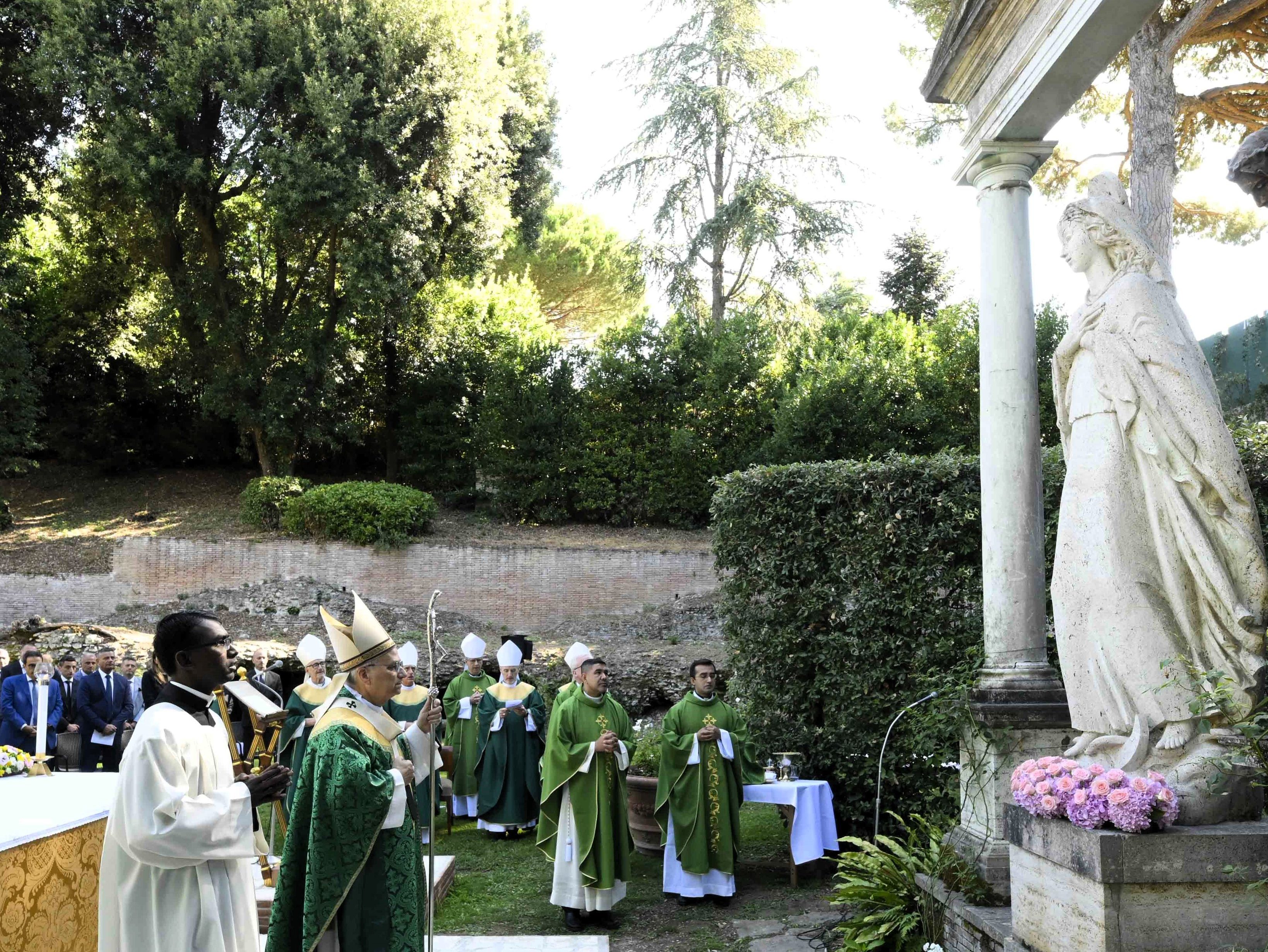
The Mass for Creation took place at the Borgo Laudato Si (The “Praised be” Village) – the immense gardens of the Pope’s holiday residence, Castel Gandolfo. Pope Francis had this turned into a tourist attraction, meant to provide some income for the cash-strapped Vatican whilst educating the public about ‘integral ecology’ (worshipping the environment). Remember, this is the vision that would have us believe that “justice and peace will only dwell on the Earth” when everyone has access to clean water.

The gardens made the perfect setting for a pagan ritual: that is, outdoors, in a grove. Groves were condemned by God throughout the Old Testament for their relationship to paganism and the prophets were often instructed to destroy these places where adulterous Israelites would gather to worship false gods.

The Dicastery for Integral Human development posted this to social media with the following caption: ‘Only a contemplative gaze can change our relationship with #Creation and bring us out of the ecological crisis’.
But, it must be asked, where is Christ in this scenario?

Groves and the Divine Feminine

Is the statue behind the altar Our Lady? It’s certainly possible and at least she is dressed more modestly than Papa Bergoglio’s false Mary, undoer of knots. But in the current context, I’d like to explore another possibility: that this female figure represents a pagan goddess: Pachamama or perhaps Isis.

The Hebrew word for ‘grove’ is ‘Asherah’ which can also mean a sacred tree or wooden pole or totem which was worshipped as an idol. The name ‘Asherah’ (or ‘Ašratu’ in Akkadian), can also denote the pagan goddess of groves who was worshipped by the Phoenicians, the Akkaddians, the Hittites, and the Canaanites. Ashrerah was considered to be the ‘Queen of Heaven’ and is sometimes identified with the ‘Divine Feminine’.

The Queen of Heaven archetype appears often in pagan belief systems. For example, in Egyptian mythology the Queen of Heaven was Isis, the sister-wife of Osiris, sometimes known as the ‘World Virgin’. Isis is the personification of Nature and like other types of this goddess is associated with fertility.

As a mother-goddess who was and is blasphemously believed by some to be the consort of God, Asherah can be equated with the Pachamama of South America. Pachamama, as we know, is identified with Mother Earth and with the Divine Feminine. A common offering to Pachamama is the gift of flowers, especially yellow ones, and these can be seen on the altar at the Pope’s Mass of Creation – in violation of the GIRM (General Instruction on the Roman Missal).

Yellow flowers, a common offering for Pachamama, were placed on the altar, in violation of the GIRM.

Asherah/Isis was goddess of motherhood, and wisdom and as such may also be identified with ‘Sophia’ – the personification of wisdom. In Gnosticism, Sophia plays a fundament role, as she is an aspect of god and an agent of chaos and confusion which can only be countered by the ‘gnosis’ of ‘Jesus Christ’ which humans require to escape the physical world and return to the spiritual one.

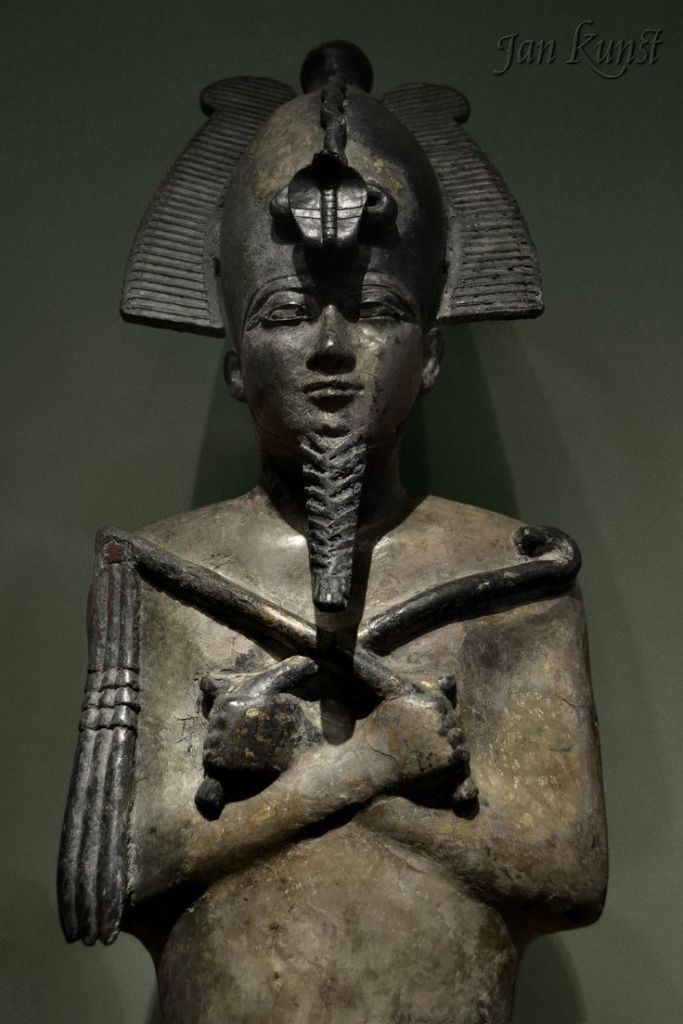
To see a statue of a woman placed prominently behind the altar during the outdoor Mass of Creation, hands crossed over her chest in the gesture of Osiris and surmounted by a triangle (an important occult/Masonic symbol ) makes one wonder if this is not meant to represent Our Lady, but rather the anti-Mary World Virgin who is known as Ashrerah, Isis, Sophia or Pachamama.

Wisdom Between Two Pillars

The placement of the figure of Isis/Pachamama between two pillars provides further material for discussion as this is a specific arrangement in the occult with its own meaning:

The World Virgin is sometimes shown standing between two great pillars–the Jachin and Boaz of Freemasonry–symbolizing the fact that Nature attains productivity by means of polarity. As wisdom personified, Isis stands between the pillars of opposites, demonstrating that understanding is always found at the point of equilibrium and that truth is often crucified between the two thieves of apparent contradiction.

Manly P. Hall, The Secret Teachings of all Ages

Another interpretation of the setting of a female icon of Wisdom between two pillars comes from the Tarot. In this system, the woman is associated with the mythical ‘Pope Joan’ – a false female Pope! Surely, that’s not the message being conveyed here!?!

Opposing Forces

As has been repeated often among these pages, the Great Work of the occultist is to access gnosis in order to reconcile opposing forces. The placement of the female goddess figure between the two pillars echoes that principle. It is repeated in the elegant reflective pool which appears in front of the altar, a perfect embodiment of the principle of ‘as above, so below‘.

The reflective pool expresses the principle of ‘as above, so below’

The occult pectoral cross

For the occasion of the Mass of Creation, Pope Leo wore a pectoral cross decorated with an image of the Good Shepherd. While this appears at first to be the same cross was worn by the infamous Cardinal Bernadin (see article here) on closer inspection, this doesn’t seem to be the case. A separate article studies these crosses and may be found here.

Despite any differences in the crosses, it’s worth noting for our purposes that in the original version of this cross – the one worn by Cardinal Bernadin and Pope Francis – the ‘Good Shepherd’ was modelled on the Egyptian god, Osiris and that as mentioned above, the wife of Osiris was the goddess, Isis.

Conclusion

Rather than merely hijacking the Holy Sacrifice of the Mass to promote the prevailing, disordered, emphasis on the environment, there were enough red flags here to indicate an occult ritual took place under the guise of, or in conjunction with, the liturgy.

Although we may never know the truth, it is educational to decode the hierarchy’s clues which were hiding in plain site in what at first appears to be a tranquil and thoroughly Catholic scene.

To see Mass offered outdoors in a lush grove, near twin pillars that are surmounted by a triangle, close to a reflective pool with all being overseen by the divine feminine should fill us with horror, rather than delight. It is yet another sign of the new papacy’s agenda: to present Modernism with a smile and to lure Catholics into nature worship using the tantalising bait of aesthetics.

An associate of Father Isaac Mary Relyea, made an interesting point on their Youtube channel : he said the name, Mass for the “Care of Creation” immediately reminded him of the “Cremation of Care” ritual performed at Bohemian Grove. Hmmm. Another ritual in an infamous grove. That certainly is food for thought.

This article has been updated.

SOURCES: This site (non-Catholic); Sophia (Wikimedia); The Secret Teachings of All Ages by Manly P. Hall. (affiliate link.)

One-Time
Monthly

PLEASE DONATE TO SUPPORT MORE CONTENT LIKE THIS.

Make a monthly donation

Choose an amount

$5.00
$15.00
$100.00
$5.00
$15.00
$100.00

Your contribution is greatly appreciated.

Your contribution is appreciated.

DonateDonate monthly

Pope Leo & Bergoglio’s occult-inspired pectoral cross

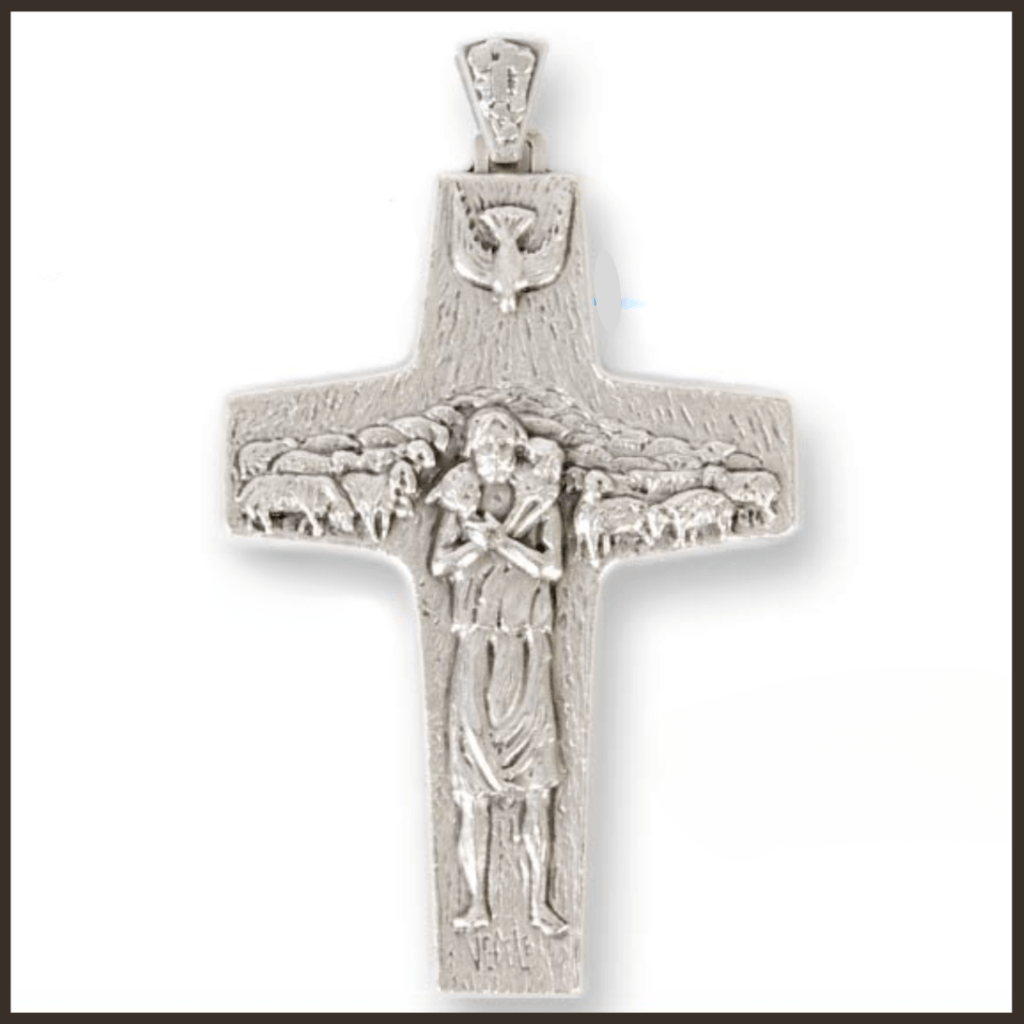
In my recent article about Cardinal Bernadin, I referenced a pectoral cross he often wore which showed his allegiance to the occult and to other nefarious characters in the hierarchy. That article cited information from Rosicrucians which explained that their esoteric version of the ‘Good Shepherd’ was indicated by arms crossed over the chest.

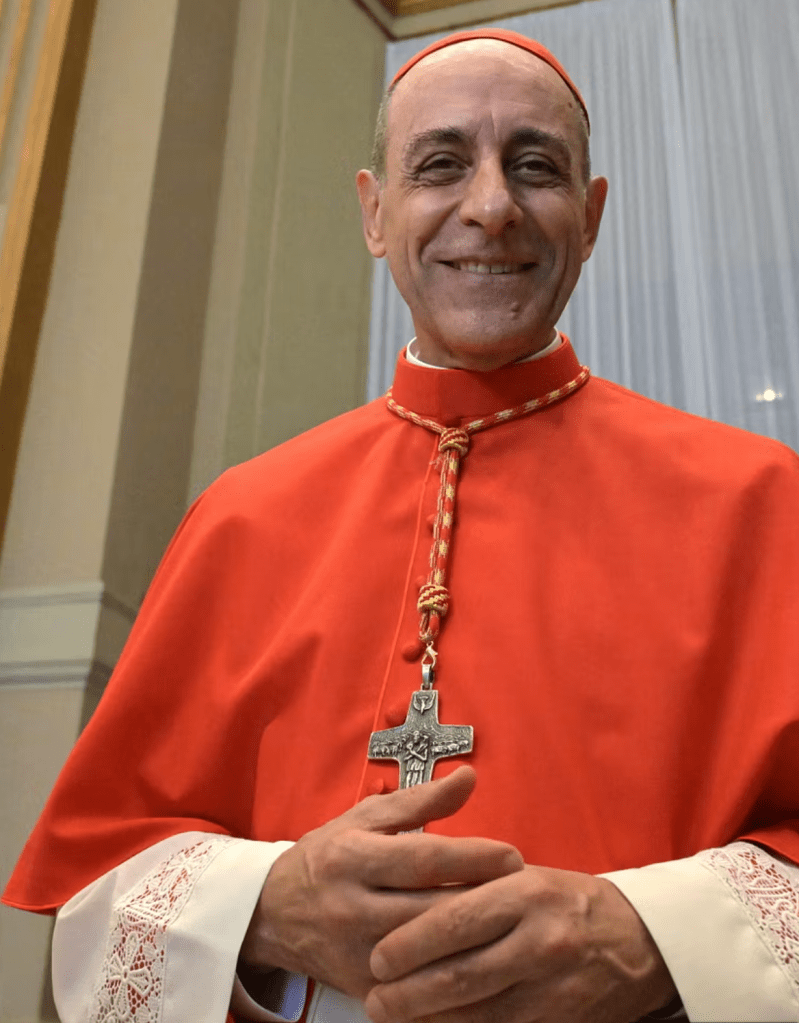
Cardinal Fernandez and Pope Francis have also worn this same cross: in Bergoglio’s case, he wore it first as Archbishop and Cardinal of Argentina. 

Crossed arms are also found in Masonry and in its offshoot, the OTO (Ordo Templi Orientis), and were inspired by the Egyptian god, Osiris.

Osiris
Aleister Crowley as Osiris
First sign in the Super-Excellent Master Mason Degree (Richardson’s Monitor of Freemasonry)

As an aside, celebrities seem to be as fond of being photographed making this gesture as they are of making the Illuminati ‘one-eye’ sign and devils’ horns.

Rapper Eminem
Author Steven King
Artist Marina Abramovic
Cardinal Fernandez pictured wearing the same cross at this year’s conclave.
Pope Francis wearing the occult-inspired cross.
The shepherd with arms crossed, slightly elongated body and background of lines or ridges – from the maker’s website.
Another shot of the cross showing the shepherd’s face looking straight ahead.

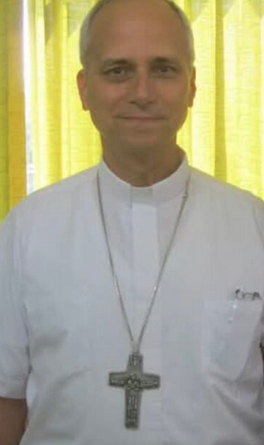
Pope Leo, as Robert Prevost, was apparently apparently photographed wearing the occult-version. I say ‘apparently’, because the photograph on the left is so outrageous that I had waited to see solid proof that it was not photoshopped. That is, proof was wanting until the photograph on the right was sent to me. It came from a Spanish website called Religion the Free Voice and shows Prevost againt wearing the occult-inspired pectoral cross.

Here is a picture of Pope Leo XIV, taken on the day of his ‘Mass for Creation’. As can be seen, he is wearing a pectoral cross bearing an image of the Good shepherd.

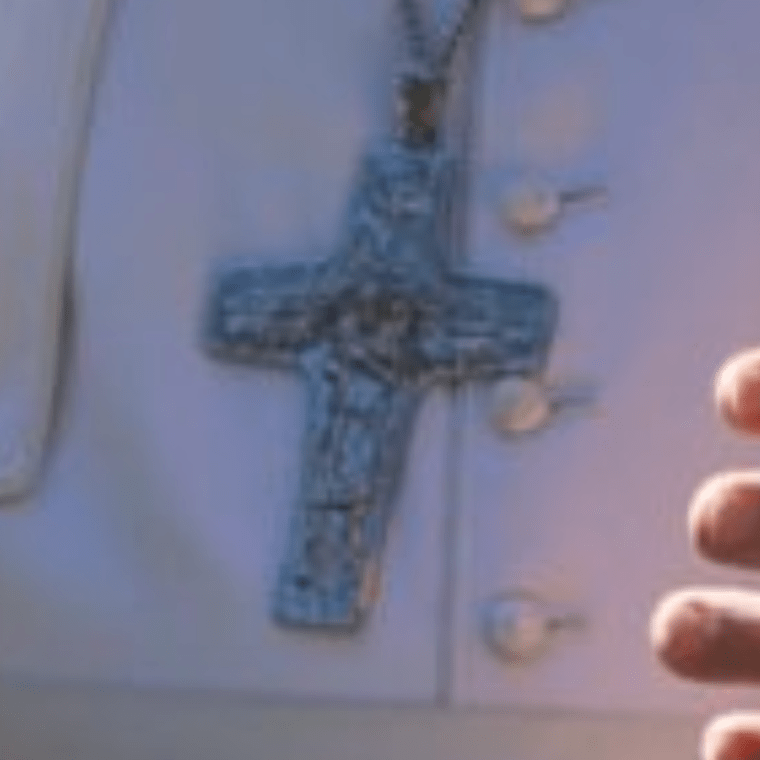
However, there is something very significant about his cross. As the closeups show, this doesn’t appear to be identical with similar crosses worn by Pope Francis, or Cardinals Bernadin and Fernandez: it has been changed slightly.

Zoomed-in image of the cross from the picture above.
Enhanced with Canva software
Here is Leo’s cross again, at even closer range.

What say you, friends? Is this the same cross? In all truth, it appears not to be. The shepherd appears to have only one arm crossed over his breast – his left arm – and his body is a little shorter than in the Bergoglio/Bernadin version. The robe is raised slightly on the right-hand-side (the shepherd’s left) as if he is walking. The Holy Ghost dove is in the same position but the vertical lines/ridges in the background have been removed, or are at least not so prominent. In contrast to the other cross, the shepherd’s head seems to be oriented downwards and slightly towards his right.

What does is all mean? Is Leo playing the players? Has he tapped in to the graces of his new state as Pontiff of the Holy Catholic Church? While I’d like to think this is the case, here is a different theory (as presented to me by my son.) If this ‘Good Shepherd’ is inspired by a god of Ancient Egypt, we must cast our minds back to that period.

We know that at times, ancient Egypt was governed by Pharaohs who demanded that they be worshipped as gods, but this wasn’t always the case. There was a time known as the First Intermediate Period during which the Pharaohs ruled in a more ‘synodal’ style. They shared power with the nomes, who were the rulers of a series of city-states called nomarchs. Most notably, this time came after the more authoritarian period of the Old Kingdom – and was later followed by another time of absolute rule by the Pharaohs.

Is it possible that the updated version of the pectoral cross indicates that the authoritarian rule of Bergoglio has given way to Leo’s ‘synodal’ path of cheerfully allowing bishops to implement whatever degree of orthodoxy or error they desire in their own dioceses? (For that is precisely what synodality entails.) Is this cross the symbol of the next phase of the revolution?

No matter what is the meaning of this strange development, please, PLEASE, dear Catholics, choose a simple daily penance to offer to Our Lady that this Pope will consecrate Russia to Her Immaculate Heart and end the confusion which reigns around us. As I’m fond of saying: he doesn’t have to believe, he just has to do it!

Virgo potens, ora pro nobis!

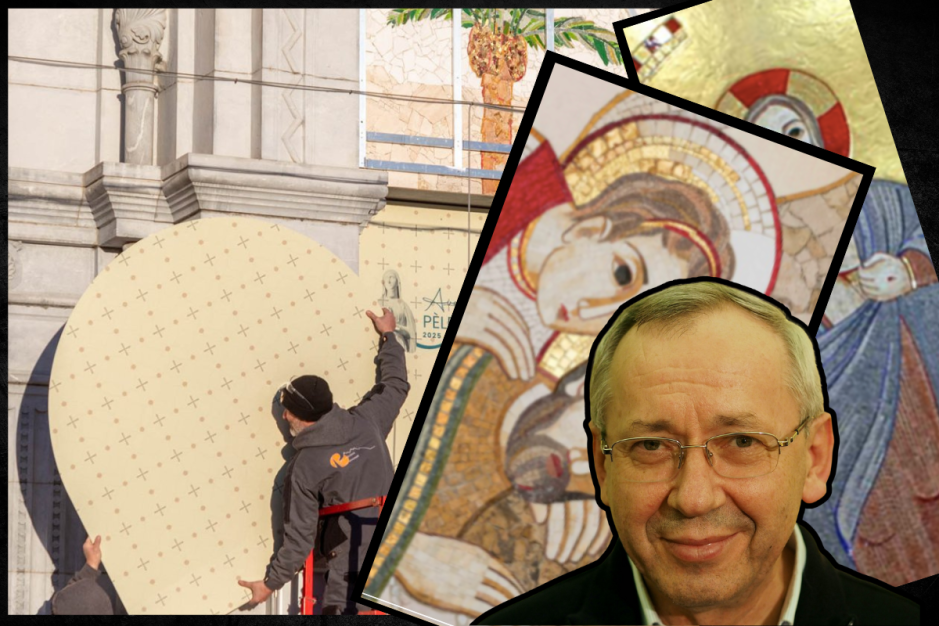
Is Rupnik finally about to receive justice?

Some good news, finally, from the Vatican on the Rupnik case: it was announced that the notorious abuser of 30 nuns and occult-artist will soon be subject to an independent investigation.

Cardinal Fernandez, unusually this time the bearer of good news, reported that the panel “is made up of judges who are all independent and external to our dicastery” in order “to dissolve the idea that the Dicastery for the Doctrine of the Faith or the Holy See had any interest or were subject to pressure. People were chosen who would not give rise to any suspicion.”

It is certainly to be hoped that the individuals comprising the panel and will actually be independent and not secret minions of Rupnik’s – a man whose reach seems to be enormous.

Rupnik’s victims are pleased at the move, and their lawyer said “will certainly cooperate fully in reconstructing the facts and seeking the truth. We hope that this case will be concluded as soon as possible and that it will finally bring comfort to the victims.”

The news outlet responsible for bringing so much of the details of the Rupnik case to out attention is Silere non possum. This group interviewed victims and traced many appointments in the Dicastery for Communications back to the influence of Rupnik. This explains why Rupnik’s disturbing artwork continued to be promoted by the Vatican for years after his abuse was made public.

For reference, a timeline is given below to show how long the Vatican has known that Rupnik is an abuser and blaphemer: the first credible accusations were brought to the Jesuit’s attention back in 1995.

The Rupnik Timeline

  • 1995: first allegations1 against Rupnik reported: secret investigation led by Mgr. Daniele Libanori, SJ
  • 2016, April: Pope Francis celebrates Mass for the Aletti Centre.
  • 2020: Rupnik is quietly excommunicated, latae sententiae, for having absolved in confession a person with whom he had engaged in sexual relations.
  • 2020: excommunication is lifted almost immediately.2
  • 2021: investigation by Vatican into Rupnik’s Aletti community
  • 2021, Dec: news of Rupnik’s investigation, latae sententiae excommunication and its subsequent lifting were published by Italian outlet Silere non possum.
  • 2022, Jan: Pope Francis meets with Rupnik.
  • 2022, May: Rupnik preaches a clergy retreat in Italy.
  • 2022, Dec: Rupnik suspended by Jesuits
  • 2023, June: Rupnik expelled from the Jesuits for refusing to obey restrictions
  • 2023, October: Diocese of Koper in Rupnik’s native Slovenia announces that it incardinated Father Rupnik in its diocese In August.
  • 2023, October: After pushback over Rupnik’s incardination in Slovenia, Pope Francis lifts statute of limitations, allowing DDF to investigate him.3
  • 2024, August: evidence that Pope Francis continues to hang Rupnik’s art in his apartment.
  • 2025, Jan: evidence that Pope Francis keeps another Rupnik artwork in his study.
  • 2025, Feb: retired bishop of the Diocese of Koper says that the priest “continues his work all over the world.”
  • 2025, June 2025: Vatican News removes artwork by Rupnik from its website
  • 2025, July: DDF announces Rupnik will be investigated by an independent panel
  1. His alleged victim reported: “After my first complaint, nobody helped me, neither the Community, nor the Archbishop of Ljubljana then, nor the spiritual director of Fr. Rupnik with whom I spoke trying to explain what had happened. All of them, even the Jesuit superiors of Fr. Rupnik and those who became aware of the facts, decided to cover everything with a blanket of silence.” ↩︎
  2. According to Cardinal Fernandez, this practice happens “much more often than one might imagine.” ↩︎
  3. The Vatican said the decision was made after “the Pontifical Commission for the Protection of Minors brought to the pope’s attention that there were serious problems in the handling of the Father Marko Rupnik case and lack of outreach to victims.” ↩︎

James Martin takes blasphemy to a new level

I didn’t watch the interview – why would any faithful Catholic want to put themself through that? Reading the summary article was bad enough.

For those who aren’t aware, sodomite priest James Martin interviewed sodomite Democrat politician, Pete Buttigieg, for a new podcast series at the sodomite outlet, America Magazine. If the premise itself wasn’t bad enough, Martin took the opportunity to blaspheme in previously unheard of ways.

Well, occultists and sodomites blaspheme like this all the time. The difference is that pious ears normally aren’t aware of it.

According to the interview, Buttigieg is the son of an ex-Jesuit priest, so he didn’t receive the greatest start in life. Buttigieg, the former Secretary of Transportation, likes to think of himself as a “committed Christian”, and Martin does nothing to convince him otherwise. Rather, Martin confirms Buttigieg in his gravely sinful lifestyle: an active sodomite who lives with his gay “husband”. The men have adopted two little boys, deliberately depriving them of their mothers – those irreplaceable women who are most essential for the well-being of any child.

For Buttigieg, being a sodomite Christian is not incidental; it is his very identity. He says, “For There are two things I’m really sure about. One is that God loves me. And another is that I’m gay….

Then comes the blasphemy – and this really is a new low for Martin. He writes that when Buttigieg saw his little son hurt himself, he was struck by the love of God the Father for His Son. Buttigieg said:

“It just took over my entire psyche…. The central story of the New Testament involves the grisly execution of the son of God.… It just makes it so much more searing and visceral now that I’ve got kids.”

Well, for one thing, those aren’t your kids, but whatever, Buttigieg. According to Martin, this realisation “invited him to meditate more deeply on something Trinitarian: the Father’s love for the Son.”

Not only is he unable to count (only two Persons were mentioned, and not the three that constitute the Blessed Trinity) but the perverted mind of James Martin. SJ correlates the mystery of the Holy Trinity with the one sin that not even demons dare to witness! This is obscene blasphemy, friends.

Here is what Our Lord told St. Catherine of Siena about the sin of sodomy:

It is not only that this sin stinks before Me, Who am the Supreme and Eternal Truth, it does indeed displease Me so much and I hold it in such abomination that for it alone I buried five cities by a Divine judgment, My Divine justice being no longer able to endure it.

This sin not only displeases Me as I have said, but also the devils whom these wretches have made their masters. Not that the evil displeases them because they like anything good, but because their nature was originally angelic, and their angelic nature causes them to loathe the sight of the actual commission of this enormous sin.

They truly enough hurl the arrow poisoned with the venom of concupiscence, but when their victim proceeds to the actual commission of the sin, they depart for the reason and in the manner that I have said. 

Our Lord was particularly upset by priests who engaged in this grave perversion:

But they act in a contrary way, for they come full of impurity to this mystery, and not only of that impurity to which, through the fragility of your weak nature, you are all naturally inclined (although reason when free-will permits, can quiet the rebellion of nature), but these wretches not only do not bridle this fragility, but do worse, committing that accursed sin against nature, and as blind and fools with the light of their intellect darkened, they do not know the stench and misery in which they are.

So according to Our Lord, pro-gay priests like James Martin are “full of impurity”, “wretches” and “stench and misery.” Notoriously, Martin was appointed to the Vatican’s Dicastery for Communication in 2017 by Papa Bergoglio and at the time of writing, (June 27, 2025) his name still appears on the Dicastery’s official webpage as a Consulter.

Will Pope Leo XIV remove this dreadful man from his official position? Will Martin be chastised for his blasphemies? This seems very unlikely as Leo and James Martin appear to be on the same page. Recall that Martin was absolutely jubilant at the election of Leo XIV and that this was the first red flag indicating that Prevost would continue Bergoglio’s agenda.

Please make reparations for these blasphemies; the Golden Arrow prayer is ideal for this purpose:

May the most holy, most sacred, most adorable, most incomprehensible and unutterable Name of God be always praised, blessed, loved, adored, and glorified in heaven, on earth, and in the hells, by all the creatures of God and by the Sacred Heart of our Lord Jesus Christ in the Most Holy Sacrament of the Altar. Amen.

A Liberal Confirms that Prevost is Francis II

One of Pope Francis’ greatest fans, austen ivereigh, has written for the liberal commonweal that there is no doubt Leo will continue francis’ agenda, albeit with a little more style.

After burying Pope Francis, the cardinals chose another pope from the Americas to follow in his path, proving both that the “change of era” inaugurated by Francis is here to stay and that Latin America would still be a key source for the universal Church. Leo XIV is from the south suburbs of Chicago, “the descendant of immigrants, who in turn chose to emigrate,” as he put it to the Holy See ambassadors on May 16. He was referring to the decades he spent as a missionary and bishop in Peru. This is why the first U.S.-born pope is also the second from South America. 

The quiet sixty-nine-year-old American, Robert Francis Prevost, friar of the Order of St. Augustine, slipped past the bookmakers and the pundits, quickly overtaking the Italian curial-establishment papabile, Cardinal Pietro Parolin, to be elected after only four ballots, on the afternoon of the second day of the conclave. As they emerged from the conclave, the cardinals were delighted, as if they had stumbled on a pearl of great price. They spoke of the atmosphere inside: the lighthearted peace in the Sistine Chapel, the sense of fraternity and unity back at the Santa Marta. They remarked on the freedom from the pressures and distractions of the internet that allowed them to settle prayerfully on the one man among them whom they believe God had chosen. They described how moving it had been to watch Prevost as his name was read out, over and over. Joseph Tobin, cardinal archbishop of Newark, who knows the new pope well—having been head of the Redemptorists in Rome when Prevost was there as the prior general of the Augustinians—said he “took a look at Bob” and saw that “he had his head in his hands.” At that moment, Tobin prayed for Prevost, “because I couldn’t imagine what happens to a human being when you face something like that.” Yet once Prevost was elected—and on this the cardinals are unanimous—he was remarkably calm, wholly at peace. Over the next few days, Rome was struck by how effortlessly Prevost became Leo. 

What convinced the 133 cardinals, it turned out, had not been a great speech, but rather the way Prevost carried himself: he was humble, direct, synodal, and pastoral. Prevost would be a pope in the tradition of Francis, yet different in ways the cardinals regarded as necessary. They sought three particular qualities in the next pope. First, they wanted someone with experience of the universality of today’s Church, someone familiar with its breadth and complexity. Second, they were looking for someone who could bring the peace of Christ to the divisions within the Church and in the world at large. Third, they needed someone who could govern firmly but also in a more collegial manner than Francis did. The more they got to know Prevost, the more he emerged as the one who fit that profile. 

The young cardinal who heads the Filipino bishops’ conference, Pablo Virgilio David, said it was the pope as pontifex maximus, or “supreme bridge-builder,” that became a key topic for the cardinals in the ten days of private meetings prior to the conclave. He said Leo’s brief address from the loggia of St. Peter’s after his election was virtually a summary of their discussions. Peace was his theme, the disarming peace of Christ. Leo called for “a Church that builds bridges and encourages dialogue…a synodal Church.” 

The next day, at Mass with the cardinals in the Sistine Chapel, Leo dwelt on the great responsibility entrusted to Peter, his mission to bear witness in a world that often mocks or despises Christian faith. Back in 2013, Prevost thought he would escape being made a bishop; ten years later, he hadn’t wanted to leave behind his diocese in Peru when Francis asked him to head the Dicastery for Bishops in Rome. But in the end, he saw the move to Rome as “a new opportunity to live a dimension of my life, which simply was always answering ‘Yes’ when asked to do a service,” he told Vatican News at that time. “With this spirit, I ended my mission in Peru, after eight and a half years as a bishop and almost twenty years as a missionary, to begin a new one in Rome.” 

And now, when Cardinal Parolin asked Cardinal Prevost if he accepted his election as pope, he gave another, even more radical “Yes.” In his homily the next day, Pope Leo described Peter being led in chains to Rome, “the place of his imminent sacrifice,” and said anyone in the Church who exercises a ministry of authority would recognize that journey. He, too, was being called now “to disappear so that Christ may remain, to make oneself small so that He may be known and glorified (cf. John 3:30).” 

Did he ever sense that Francis had prepared his path? After his arrival in Rome in 2023 to head the Dicastery for Bishops (he had been a member since 2020), Prevost and Francis used to meet for two hours every Saturday morning in the Casa Santa Marta, where Francis lived. They discussed, of course, nominations for bishops, but also their vision of the Church. Prevost was one of Francis’s trusted negotiators with the German bishops over demands that arose from their controversial “Synodal Way” process. Francis came to rely on him more and more. He trusted Prevost’s decision-making and admired his way of working—the way he was able to reconcile different sides. Arthur Roche, the English cardinal who heads the Dicastery for Divine Worship, told me that Prevost was without doubt Francis’s “closest collaborator” in the Vatican during the past two years. 

The time they spent together each week was deeply formative for Prevost, who was struck by Francis’s extraordinary capacity for discernment, as well as his radical commitment to God’s mercy. One morning, when the two were discussing clerical sex abuse, the pope said he wanted to show Prevost something. Francis left the room and returned with a picture from a Gothic cathedral in France which showed Judas taking his own life while Jesus cradled him in his arms. Was it really possible, Francis asked him, for God’s mercy to reach the worst of sinners? Telling this story in a talk to a Chicago-area parish in August of last year, Prevost described how Francis “struggles to express and live that dimension of the Gospel.” It was this focus that had led people to misunderstand or criticize the pope. Francis was convinced, Prevost said, that in a world full of mutual condemnation, “we need people, especially ministers, who can live and offer people the mercy, forgiveness, and healing of God.”

The quiet sixty-nine-year-old American, Robert Francis Prevost, friar of the Order of St. Augustine, slipped past the bookmakers and the pundits.

In early February, with his bronchitis worsening, Francis raised Prevost’s status within the College of Cardinals to bishop. It was done so discreetly that it went mostly unnoticed even by the Vatican press corps. Yet only a handful of others at the conclave were cardinal bishops, among them the two whom the media had dubbed the “frontrunner” papabili—Cardinals Parolin and Tagle. Was Francis sending a little posthumous hint that that list needed expanding?

The bond between Bergoglio and Prevost goes back to the first decade of the new millennium, when the American was based in Rome as prior general of the Augustinians. He spent half of each year of his twelve-year term visiting the three thousand Augustinian friars and their parishes and works across the world, extraordinary preparation for a pope of the global era, bringing him into contact with the Church in Africa, Asia, and the Near East, as well as in the Americas. He was often in Argentina, where the Augustinians have a vicariate with five parishes, five schools, and a formation house; and there he sat down with the famous Jesuit archbishop of Buenos Aires. The two men had a lot in common: both had been given major responsibilities in their religious orders from an early age. 

Prevost recounts that, on his last visit with Archbishop Bergoglio, the two had a disagreement. Bergoglio wanted one of Prevost’s friars for some project or other in his archdiocese. Prevost said no; he had other work in mind for him. The archbishop was very unhappy about this, Prevost later learned, and so when Bergoglio was elected pope in March 2013, Prevost—who was coming to the end of his term as prior general—joked with his brother Augustinians that he could relax: this new pope would never make him a bishop. But when Francis met Prevost again in August, after celebrating Mass for the opening of the Augustinians’ general chapter, the pope effusively thanked him for his help with resolving a problem in Rome. “You can relax for now,” he said, thus hinting that he would soon be coming for him. The following year, when Prevost was back in Chicago, Francis made him apostolic administrator of Chiclayo, and a year later its bishop, an appointment for which Prevost needed Peruvian nationality.

Chiclayo is in Lambayeque, a region of northern Peru near Chulucanas and Trujillo, where Prevost missioned in his thirties and forties. There, he had been a formator of friars, a diocesan canon lawyer, and a parish priest. The 1.2 million-strong Diocese of Chiclayo needed a makeover: for more than thirty years, it had been run by Spanish Opus Dei bishops. For the next decade, Prevost would give it new direction, making it a diocese that modelled the ecclesiology of the Second Vatican Council. Francis had “masterfully and concretely set forth” that ecclesiology in his 2013 teaching Evangelii gaudium, as Leo XIV reminded his fellow cardinals on May 10. 

In that address, delivered two days after his election, Leo highlighted six “fundamental points” from Evangelii gaudium, which amount to a program for his pontificate. The first was the “primacy of Christ in proclamation.” (As he put it in a 2023 interview: “This comes first: to communicate the beauty of the faith, the beauty and joy of knowing Jesus. It means that we ourselves are living it and sharing this experience.”) The second was the “missionary conversion” of the whole Christian community, to enable others to encounter Christ in acts of mercy. The third, “growth in collegiality and synodality,” meant co-responsibility for the life and mission of the Church. (Synodality, he told people in Chiclayo, was a way for the Church to be closer to the people.) The fourth, “attention to the sensus fidei,” meant taking seriously the people of God as a believing, discerning subject, valuing their traditions and culture. The fifth, “loving care for the least and the rejected,” was the Church’s option for the poor, expressed in attention and concrete acts. The sixth and final point, “courageous and trusting dialogue with the contemporary world,” meant a Church that confronts contemporary challenges rather than offering a refuge from them. 

………

But he is remembered most for his outstanding capacity to convene, to hold people together and rearrange the decks without earning enemies. He brought firm new direction to his diocese in Peru, yet without rejecting what he had inherited. He won over the Opus Dei priests, engaged movements, and reached out to conservatives and charismatics. From the start, he brought people together in synodal assemblies to agree on pastoral priorities and created an institute to form lay leaders. “After ten years of his work, lay people are really well-trained and are positioned,” his successor in Chiclayo, Bishop Edinson Farfán Córdova (also an Augustinian), told me. The content of the summer courses designed to train hundreds of laypeople was drawn, says Bishop Farfán, from the social magisterium of Francis: not just Evangelii gaudium, but also Laudato si’ and Fratelli tutti

In 2018, Prevost was elected vice president of the Peruvian bishops’ conference. The Church was at that time still dealing with the fallout from revelations of abuse and corruption at the heart of the Sodalitium Christianae Vitae (SCV), a right-wing Peruvian movement founded in the 1970s to combat liberation theology. The SCV enjoyed strong support from wealthy Peruvians and from the Vatican under Pope John Paul II, and over the years, many bishops would become entangled with the movement, especially José Antonio Eguren, the archbishop of Piura—the diocese neighboring Chiclayo. 

The bond between Bergoglio and Prevost goes back to the first decade of the new millennium.

The publication of Mitad monjes, mitad soldados (“Half Monks, Half Soldiers”), a devastating 2015 exposé by former “sodálite” Pedro Salinas and journalist Paola Ugaz, led the SCV’s powerful allies to wage legal warfare on the authors in Peru’s corrupt, sclerotic courts. The other effect of the book was to unleash a wave of previously untold abuse stories, stories of people effectively kept as prisoners for years and humiliated by the power games of the SCV’s inner circle. As new victims continued to step forward, Paola Ugaz, overwhelmed, reached out to the Church for help. The bishops’ conference was unable to act collectively: Archbishop Eguren was involved in suing Salinas and Ugaz, while the conference’s president, Héctor Cabrejos, was reluctant to make trouble. 

Prevost, together with the Jesuit cardinal Pedro Barreto and the apostolic nuncio Nicola Girasoli, acted on their own account, publicly declaring their support for the writers and finding ways over the next two years to help the victims. “Robert became the one who individually reached out to the really broken victims,” recalls Ugaz. “He became the bridge between them and the Sodalicio,” she told me in Rome after the conclave, describing how he would meet with Sodalicio leaders to secure financial and medical assistance for the victims. Ugaz describes Prevost as levelheaded, patient, and tenacious. “Robert’s not the guy who will grab a match and set light to the building. He’ll look for ways to help, to make things happen,” she says. They are friends to this day. In Rome for Pope Francis’s funeral, Ugaz brought chocolates and an Alpaca stole for her friend. She ended up giving them to him once he was pope.

In 2020, the Sodalicio stepped up their campaign against the journalists, using death threats and false claims that they were involved in money laundering. Girasoli and Bishop Prevost believed the only way to protect Ugaz was to arrange a meeting with Francis. But because of Covid, this did not happen until 2022, when Ugaz and Salinas persuaded Francis to send his crack Vatican investigators Archbishop Charles Scicluna and Msgr. Jordi Bertomeu. Their report not only confirmed the journalists’ claims but uncovered much more, including a money-laundering scandal that involved diocesan cemeteries. 

After Prevost moved to Rome to head the Dicastery for Bishops, he was closely involved in the measures that led to the SCV’s suppression. In 2024 Francis expelled the Sodalicio founder, Luis Figari, and forced out Archbishop Eguren. He then expelled Eguren and nine other founders. Not long after Eguren fell, Prevost began to be accused of abuse coverup in media close to the SCV. The reports alleged that he had failed to deal properly with a case in Chiclayo. The diocese denied the claims, pointing out that Prevost had followed guidelines precisely. Meanwhile, Ugaz and Salinas began receiving death threats. They came to the Vatican last October, where Prevost saw them more than once. He arranged for them to meet Francis, who promised he would act decisively against the Sodalicio, telling Ugaz: “Pecadores sí, corruptos no” (“One thing are sinners; another thing are the corrupt”). In January this year, in one of his final acts, Francis signed a decree closing down the SCV, which took effect in April, shortly before he died. 

At the conclave, the right-wing Spanish group InfoVaticana recirculated the claims against Prevost—claims rejected by the diocese of Chiclayo and by the Doctrine of the Dicastey of Faith in Rome—to try to prevent his election. A day before the conclave, InfoVaticana described him as a “defeated candidate…frustrated because his aspirations to the papacy had crumbled.” The quote has not worn well. 

…….

Leo has already used the freedoms Francis won to make his own decisions about how to dress and where to live. He is much younger than Benedict and Francis were when they were elected; he uses X and WhatsApp; he speaks fluent American English. But he has made clear that he will continue to build the synodal Church of which Francis dreamed, while likely reformulating some of the themes of Francis’s pontificate in more Augustinian terms. He will teach us how to build a celestial city alongside the earthly city governed by the libido dominandi of the technocratic paradigm, AI, nationalism, and war. Knowing that the world will not listen to a divided Church, he asked at his inauguration Mass that we pray for a united Church, a sign of unity and communion, which becomes a leaven for a reconciled world. As he told the journalists, quoting St. Augustine: “We are the times: Such as we are, such are the times.”