Saint-Yves Alveydre

Around the turn of the nineteenth century, there was a resurgence of interest in Rosicrucianism, Kabbalism and Spiritualism among Freemasons. You may recall that demons have revealed to exorcists that that this time period was marked by a great increase in demonic activity. Various groups, including the Kabbalist Order of the Rose-Cross, the Martinists and the Symbolists, splintered off from Masonry. These groups were particularly active in France.

One member who had connections with several of these groups was Joseph Alexandre Saint-Yves Alveydre (1842-1909). Saint-Yves was a member of the occult, moving in circles with Victor Hugo and Lord Bulwer-Lytton.

who is credited with being the founder of Synarchy because he was the first to write down its doctrines. Saint-Yves believed that he was in contact with a superior race of beings who communicated with him telepathically. He claimed that the principles of Synarchy were given to him by these beings as a way of countering the spread of anarchy which was prevalent at that time.

Whereas anarchy holds that there should be no governing authority, Synarchy imposes control over every facet of life. More specifically, Saint Yves believed that the superior beings who gave him this secret knowledge would help a ruling elite to govern society.

Saint-Yves believed that the world had once been ruled by such an elite and that their civilization was destroyed by natural disaster. His hypothesis is reflected in the legend of Atlantis and he believed that the Atlantians constructed the Sphinx.. Throughout history, the cosmic powers continued to send prophets such as Jesus, Moses, and of course, Saint-Yves, using secret societies to pass on the philosophy of synarchy. One example of this is the Knights Templar, whom he regarded as the perfect model of Synarchists because of their level of control over the three levers of power: socio-political, religious and economic.

Saint-Yves believed these three areas should be controlled by an elite who took their orders from the “wise ones”. This would be done without the general population realising that they were being governed by elite puppets. Once the elites gained control of the three levers of power, it would not matter whether a government was on the “left” or on the “right” – the outcome would be the same.

Saint-Yves also called for a united state of Europe – something that will become important later in our inquiry. Apart from his interest in geo-politics, His Synarchy adopted elements from popular occult movements of his time, melding them with his principle of taking orders directly from the “enlightened beings.”

Saint-Yves wrote many books in which he described plans for a Universal Synarchist Church, which is nothing other than Masonic syncretism. A blend of Christianity, Judaism, Hinduism, Islam, Buddhism, the church of the Synarchists would be cultural as well as spiritual.

Saint-Alveydre’s Universal Synarchic Church did not attempt to eliminate the Catholic Church, but to subsume Her into its ranks. For this two occur, Catholicism would firstly need to agree that all religions are equal and then to come to terms with Freemasonry. One can see how closely the post-Conciliar Popes have followed this programme through their promotion of ecumenism.

And while they may have officially upheld the Church’s teaching on Freemasonry, in their words and actions, they have been quite tolerant of Masonry within the hierarchy. Saint-Alveydre promoted the idea that Masonry was based in Christianity, writing that:

“If Masonry admits men without distinction of race, worship, creed, to fraternal assistance from the Prince of Wales to the pariahs of India, then it is more Christian, more Orthodox in the eyes of Jesus than you who anathematize it.” (Mission des Souverains, p 446, as quoted in Mystère d’iniquité)

Saint-Alveydre’s comment is reminiscent of Stefano Bisi, Grand Master of the Grand Orient of Italy. At a recent event to promote rapprochement between Masonry and Catholicism, he said:

“The starry sky is the same for the Buddhist, for the Catholic, for the Waldensian, for the Muslim, for all those who believe in a supreme being,” he continued, adding: “We set our brothers free to adhere to any religion and to practice. Absolute truths and walls of the mind do not belong to us, and for us they must be torn down.” 

His 1877 book, Keys to the East, introduced Synarchy to a popular audience. In1886,   Saint-Yves created the Syndicate of the Professional and Economic Press which introduced business and political leaders to synarchy. Enthusiasts included French minister François Césaire Demahy and Paul Deschanel who later became President of France.

There seems little doubt that Saint-Yves was in direct communication with demons and that the principles of Synarchy were directly inspired by hell. Certainly the consequences of a totalitarian state ruled by an unworthy elite seem consistent with their origin. Anything that lacked evidence, such as his ideas about race or the origins of the world were for Saint-Yves a product of the secret knowledge from the “wise ones.”

Summary of Occult Principles

Taken from The Way Down and Out by John Senior.

Occultists tend to believe and act upon the following related notions:

  1. The universe is one, single, eternal, ineffable substance.
  2. This substance manifests itself as spirit, fire or light.
  3. It further manifests itself Demiurge of Logos which orders the created light into the visible world by means of numerous intermediaries likewise emanations from the One.
  4. All things progress be dialectical oppositions. The created universe is composed of paired ‘opposites’ – male-female, light-dark – which generated their own equilibrium or harmony. The creative triad thus formed is then considered as contained in the One, uncreated, ineffable, and thus the universe is seen as a four-fold unity.
  5. Things above are as they are below because, since mind and matter are one, the imagination is real, and any analogy it conceives is as good as ‘scientific’ proof of correspondence.
  6. Since all things are one, a ‘science’ of interference can be established whereby knowledge of the spiritual can be gained by study of the material, and vice versa, as in contemplation of the created universe in mysticism, manipulation of the created universe in alchemy.
  7. The human body is especially taken to be the image of creation. The universe is taken to be, in fact, a living man.
  8. Since men are created by sexual means, sex is an attribute of the divine. The original source is said to separate into male and female parts and, by cohabiting with itself, creates.
  9. Since man is the prototype, man is capable of realising in himself all things. He is capable of becoming God because he is God without ‘realising’ it. In the sex act, man realises his own female nature and becomes symbolically androgynous – becomes one flesh – and therefore whole.
  10. The task of man is therefore self-realisation. To know thyself is everything.
  11. Self-realisation is the progressive discovery of the layers of the psyche which is not mere ego but at least seven separate things including the universal substance.
  12. Certain supermen, having achieved self-realisation, turn back to their unrealised fellows. These are the bodhisattvas, the masters, the guardians, the founders of religions who veil the ultimate in terms suitable to time and place.
  13. Thus all religions are variations on a single transcendent unity.
  14. Ordinary men can become supermen by arduous practice, by grace and/or by virtue of their past experience.
  15. The superman is appraised of his possibilities for illumination, accidental or induces state in which heat, fire or a light surround him and he sees ineffable and profoundly moving truth of the oneness of the universe.
  16. The supermen, according to principal nine, is often sexually androgynous as symbolised by tonsure, circumcision, peculiar dress.
  17. Since the self-realised bodhisattva wants to communicate something of the higher truths to those not able to understand it, he uses symbols in his teaching and in this way affects the less-developed mind on its unconscious levels. He thus not only turns the ego inward so that it may explore as much of the self as possible, but fosters the growth of the soul itself. Symbols are efficacious even when you do not understand them. Ot rather, in the discursive sense, the symbol can never be understood. The symbol is the meeting ground between the ego and the ineffable.
  18. Ziggurats, pyramids, mysteries, myths, alchemical processes, astrological creams – these are symbolic systems of yantras.
  19. To facilitate the work of self-realisation, adepts have often organised brotherhoods, such as Rosicrucians, Pythagoreans and so on. Initiation into these orders is often considered a prerequisite of the necessary extraconsciousness and is usually a ceremony in itself efficacious in producing such states of mind.
  20. All things live according to pulse, or breath, or rhythm, which expresses itself in time as cycles of birth, growth, and decay, as Magnus Annas in the life of worlds, as birth, death and resurrection in men.
  21. In the cycles, both collectively and in history and individually in men, all souls must eventually be all things. The task of the individual man as we know him, of the times as we live them, is to leave things as they seem in order to discover the unknown, which is often symbolised as a descent into hell.

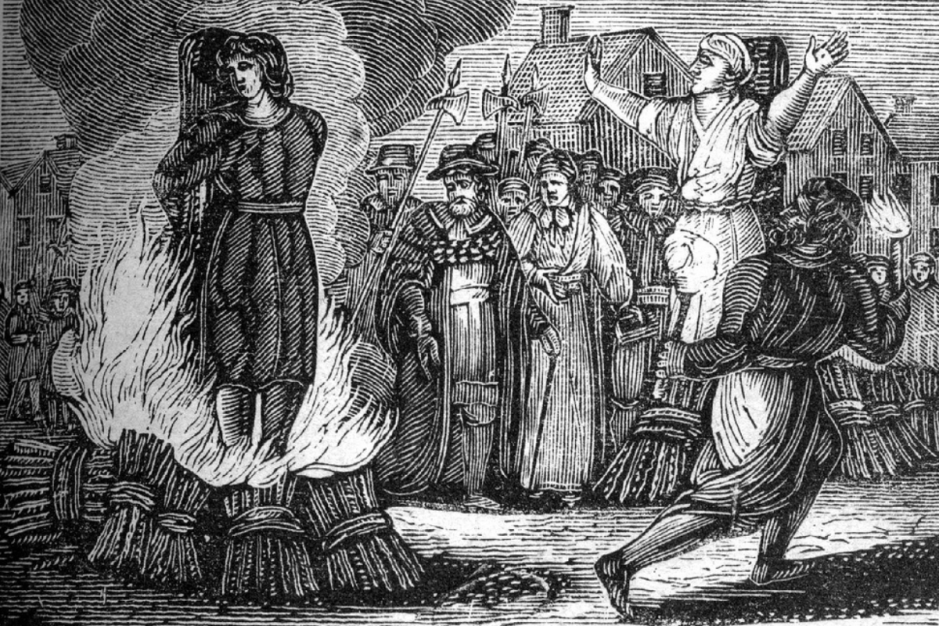
IMAGE SOURCE – ‘WITCH BURNING” – Wikimedia Commons

Was John XXIII Really Initiated into the Rosicrucians?

stories of pope John’s occult involvement abound, but it is only recently that i have begun to take them seriously. some of you may think i am foolish for even considering the prospect.

As time has gone on and I have undertaken more research, this accusation seems somewhat more credible than it first appeared to be. Certainly, to my knowledge, Rome has never put out a statement denying the story of John’s occult initiation.

The following is taken from Pier Carpi’s ‘Les Propheties du Pape Jean XXIII’, which was written in the late ’70’s. Along with the alleged prophecies is an account of the Rosicrucian initiation ritual apparently undertaken by Angelo Roncalli when he was stationed in Bulgaria.

I present it here for you in the interests of pursuing the truth about Pope John, the Council and the influence of the occult on the Church during the twentieth century.

We pick up the story at a conversation between Carpi and an occultist. (The text has been run through an online translation tool so may be a bit rough in places.)

The old man took up the document and put it back in the azure blue napkin. “I must not add anything to that. You will have understood the fundamental importance of this table. It constitutes a real restoration of the esoteric tradition that allows the initiates to be free initiators. To choose their disciples, to to form the chain — down through their descendants.”

I knew the tradition but I knew nothing about this document and the reality of the meeting between the three masters in Paris. The old man put down his napkin, got up and went to the window, set aside the white curtains that hid the night, as if he was looking for someone or something in the darkness. He turned around, stood and looked at me. “The evening I met you in Saint-Léon, I told you about the books of ‘T’ and ‘M’.”

“You told me that, like my other friend, you had read them in a dream”.

“If it can be called a dream. Alas! We must use secular terms that betray the content of our thought. However, I feel that we understand each other. If I am here, it is because I have something else to show you, something that needs to be disclosed, that must be made public. But, before I demonstrate it to you, I must tell you the facts.”

He returned to his seat, took up his napkin, which he pressed still more tightly against him and stared at me intensely: “I have to tell you about a man that everyone knows. Angelo Roncalli.”

“John XXIII?”

Here we pause to consider the motivation Carpi may have had for writing a book about John XXIII. By this time, John had been dead for almost fifteen years so it could not undermine his papacy. Carpi does not attempt to taint John’s legacy: from the point of view of an occultist, the book actually benefits John’s image. This leads us to wonder if Carpi had no other motivation than to tell the truth.

He hesitated for a moment, his eyes half-closed: “Jean,” he murmured. “1935 ….. Life was not easy for Angelo Roncalli, Archbishop of Mesembria, delegate in Turkey. Like all other religious, he was made to wear civilian dress, because of persecutions. Under constant surveillance, it was difficult for him to move: the spies were everywhere. Yet all those who approached him at that moment found in him a great serenity, which was not only that joy which he knew so well how to transmit, especially in difficult times.

“It was precisely at this time that his first contact with the unknown world took place.

“That evening Angelo Roncalli hastily retired to his apartments, as if he had an appointment. He lay down on his bed after undressing without the help of anyone – he had always done so and was to continue to do so, even when he became pope.

“Before turning off the light, he looked at the pictures on the walls, images of the extended family. He closed his eyes and, while continuing his prayer, all the faces encountered that day flashed through his mind, especially those of the most humble people. Could he have expected it? More faces, smiles, sad eyes. Then sleep invaded him. But he would never know if it was really sleep. He had an appointment with the old man of sleep.

“Six nights in a row he had seen him. It was the seventh. The most important and perhaps the last.

“He appeared; old, very white hair, thin face, dark skin, eyes sweet and piercing.

” “Will you be able to recognize me?” he asked.

” “Always, master.”

“Then, suddenly, the sacred books of ‘T’ and ‘M’ appeared in his hands. He leafed through. Inscribed on paper, knowledge, the words of knowledge, in a a language that Angelo had never known, never read before. But from his first rendezvous with the old man, in a dream which was perhaps not a dream, Angelo had known how to decipher it.

“He read and everything became simple. God, how simple everything was, how clear everything was! If the other men might have known, the world could have been very different. But Angelo realised it was not given to everyone to know, because these things could be dangerous. Only a few could give them a correct meaning, use them to the good of all. In malevolent hands, they could become terrible weapons against man.

“The two books closed. An intense light illuminated their covers on which were inscribed the two silver letters in relief – a light like the one Angelo felt within him. Impalpable, intransmissible by the poor instruments at man’s disposal; for millennia, has man not renounced forces, powers, and knowledge to replace them by a way as difficult as it is useless?

” “Now you are ready,” said the old man. “And you’re on your way. I came because you called me. Now you know. But you still have a lot to learn, to see, to live. That’s why we’ll see each other again.”

” “I’m waiting for you, master.”

“The old man smiled. “Will you be able to recognize me?”

“He repeated the same question three times. Three times Angelo gave the same answer. Then he woke up. He was alone in his room. He got up from the bed, went to the table, took some sheets of paper of paper and a pencil. He tried to write down what he had read in the books of knowledge. But his hand remained inert, his mind empty.

“It was not possible. Words did not exist. Yet he had something in him – something that no one, could ever erase. That light had made him another man. He knew that the dream would never happen again. That the old man would return, but in reality. What else awaited him? He was not afraid because he knew he was on the the right way, that of the Good. He put down the pencil and thought.

“He thought of the saints, the mystics, the men of faith, of the Church, men of truth and of peace. He took pleasure in remembering St. John the Evangelist, St. Anthony, St. Albert the Grand, St. Teresa, St. Francis. He rose, stopped in front of the crucifix, knelt down and prayed to the Virgin Mary for a long time.

“She too had an apparition. Was it not in a dream that her destiny was fulfilled, when someone appeared to the sleeping Joseph to explain to him, in very simple words, the greatest of mysteries of faith, of all humanity?

“He felt happy. And for the first time that night, he knew that someone was praying for him, in a big secret way.”

The old man had finished his story. I looked at him: “They met?” I asked.

He confirmed it. Seven days later, to be exact. Angelo Roncalli celebrated the sacraments in his humble house, before an even more humble community. While the others were going to work before lunch, Angelo went downstairs. In the hallway, sitting on a chair, stood the old man of his dream. No one had heard him knock or ring. But Angelo didn’t even wonder how he could have gotten in. He approached him and kissed him, as one embraces a brother who returns after a long absence. He invited him to his table but the other shook his head, smiling: “We must sit at a completely different table,” he said. Angelo looked at him. As the old man of his dream had asked him, he had immediately recognized him, and he listened.

“Are you ready?”

“I don’t know”.

“Then you are.” Leave everything and follow me. He followed him, without telling anyone. For a long time they marched through the deserted city. The old man stopped in a small narrow square, with its low houses. He who, until then, had guided Angelo, turned and said:

“Since you are ready, since you will soon be my equal, since the path we have to follow will be the same, you know it too. It is now up to you to lead me.”

Angelo hesitated, looking around him. The man encouraged him:

“Let’s go”.

He advanced and chose without hesitation an alley, and entered it. Behind him, he could hear the footsteps of the old one. He stopped in front of a door of rough wood.

“Is it there?” he asked. The other smiled.

“Push the door, it’s only half closed. Climb up the stairs and don’t wait for me”.

Angelo let himself be led by the voice he felt within him. He climbed two small staircases in almost total darkness, found himself in front of a new door, even smaller and lower than the other, and pushed it. It was ajar and he knew it. He entered.

The room was large and pentagonal. The walls were bare. There were two large windows, closed. In the middle of the room, there was a large cedar table, also pentagonal. There were three chairs, leaning against three of the walls. On the chairs, a linen tunic, coloured belts and envelopes sealed with red. On the table, a Bible opened at the beginning of the Gospel of Saint John. There was a flaming sword with silver hilt; a censer; coloured ribbons; two bronze candelabra with three branches, each bearing three red candles. Then the magical and esoteric symbol of the Order to which Angelo would shortly be initiated. Under the symbol, there were three crossed roses, made of fabric. One white, one red, one black.

The only dim lighting came from the three candles lit on one of the two lampposts. The others were extinguished. Angelo stood in front of the table. He looked at these objects, which, since he had read the sacred books in his dream, meant many things to him. He hardly dared to touch them. He began to read the first chapters of the Gospel of St. John, which had always fascinated him; he had, moreover, penetrated its most secret keys.

He detached himself from it when he heard light footsteps behind him. It was the master, who smiled. He had recently entered the room, behind him the door was closed. He wore a long linen tunic – the protective fabric of any initiation ceremony – down to his feet. Around his neck, there was the magic symbol of the Order, in silver, hung at the end of a chain fromTemplar knots. With his hands gloved in white, his head bare, he approached, and without ceasing to smiled, placed a hand on Angelo’s right shoulder:

“Kneel, on your right knee only”.

Angelo obeyed, and the ceremony began.

The master gave the meaning of each object, explained their symbolism. He took sealed envelopes, opened them and read their contents. On a sheet of blue paper were the ancient regulations of the Order. He opened another envelope, handed the sheet of paper to Angelo, who read what it said: seven questions.

“Do you feel able to answer them?” the master asked him.

Angelo replied in the affirmative and gave him back the paper. Then with the help of a candle, master lit the candles of the second candelabra.

“These lights are for the masters of the past who are among us”.

He put incense in the censer, purified the room by its four corners: then he turned three times and at each turn waved it three times. He returned to the table, and placed his hands on the profane man’s head and began to speak. He told him the mysteries of the Order. He asked questions. He received answers. At last the old master bent over him.

“As you know, we call each other by the name we have chosen. Each one thus signs his freedom, his work program, the new link in the chain. What will your name be?”

The layman did not hesitate: “John.”

Here, we pause to consider the name that Angelo Roncalli chose for himself on being elected as Pope. It was John XXIII. That name had in fact been used once before: by an antipope in the fifteenth century. That John XXIII was eventually tried for  “piracy, rape, sodomy, murder and incest” with “the more scandalous” charges being “suppressed”!!

We continue our narrative, making note that the ‘peculiar and complex ritual’ is the great Secret of the Rosicrucians, something so depraved and unnatural that it cannot be mentioned outside of the brotherhood.

“John”, repeated the master. And he then undertook the peculiar and complex ritual of the initiation ceremony.

Finally, he put his sword on the neophyte’s head. At that moment, some new, elusive thing happened in John, something exploded in him. He was quite stunned and confused while reaching the height of serenity and happiness.

“What you are experiencing at this moment, Brother John, many others have experienced before You: Myself, the masters of the past, the other brothers around the world. That thing, call it Light, but it has no name”.

The master helped the disciple to his feet, kissed him seven times, and exchanged fraternal greetings with him. Then he taught him the secret words, the signs of recognition, the touching, the ritual of group work. Verbally, according to tradition.

He then taught him the daily rites to be performed at three very specific moments of the day — which correspond to the three points of the operation of the sun — and in the most great secret, a Greek sentence and gestures to repeat.

“At these three moments precisely,” explained the master, “our brothers and sisters all over the world make the same gestures, say the same sentence. Their strength is great, it comes from afar and is goes very far. Day after day, it acts on humanity.

Finally, the master took the last envelope, opened it, and read its contents to John. On a sheet of paper was inscribed the formula of the oath: an oath not to reveal the secrets of the Order, to follow tradition, to always act for good, to be always strong, to help the brethren and the unfortunate, to respect above all the law of God and his ministers.

Without hesitation, John signed at the end of the formula. He was animated by great strength. Near his signature, he wrote the number and the acronym that the master indicated to him. These two elements codified his initiation and rank. The master took the sheet back, folded it seven times, and asked the disciple to put it with the tip of his hand onto the flaming sword. This was done.

The master brought the sword close to the candelabra where it was burning the candles for the masters of the past; the fire licked the paper. In a few seconds, the Oath was taken, reduced to ashes which the master scattered. “You have sworn, John, but know that the freedom of the brothers is far superior to all oaths. Today, you really know what freedom is. He kissed him again. John began to cry.

The last consideration I will present here is that even if the described events did not not involve Angelo Roncalli, they do offer us an insight into the diabolical world of the mystery religions. We catch a glimpse of the mindset of those involved: their disdain for true religion, their arrogance in believing that the occult offers a solution to life’s problems that is superior to that of Our Lord Jesus Christ, Who is the Way, Truth and the Life.

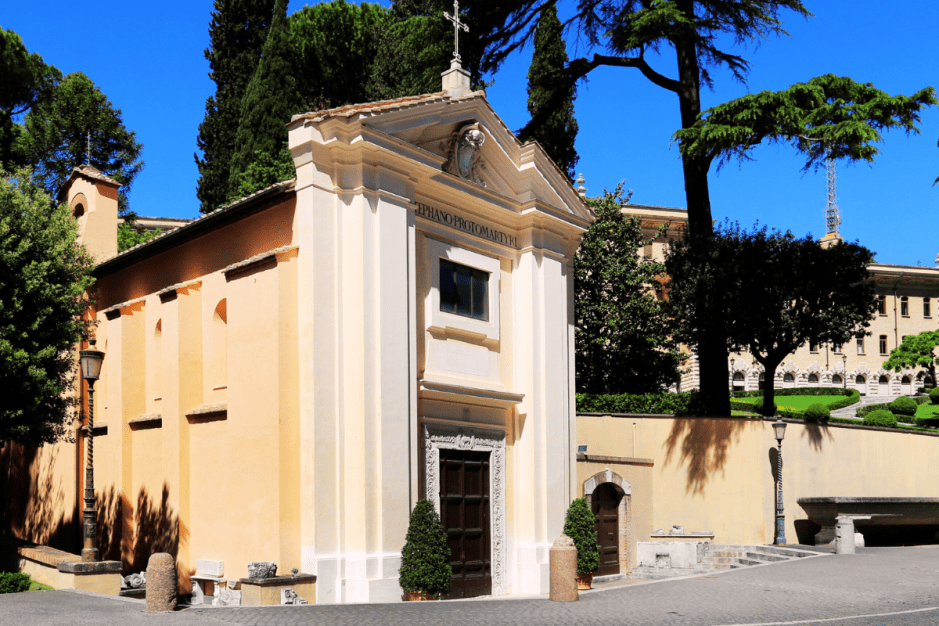
IMAGE CREDIT: Abzeronow, CC BY 4.0 https://creativecommons.org/licenses/by/4.0, via Wikimedia Commons
A Theory about the Desecration of Pell’s Body

Many rumours and half-truths have been flying about in regard to what happened to the body of Cardinal Pell after his death. Actually, there are also a number of rumours about the cause of his death itself, but that is not the theme of this article.

Rather, I’d like to propose a scenario centred around his corpse, one which includes a modest amount of anecdotal evidence.

After it had been reported that Pell’s body was “grossly disrespected” by having its nose broken and being left dirty, without shoes and with clothes just thrown on top of it, a new version of the story has emerged. George Pell’s brother now claims he was perfectly happy with the treatment of the body.

David Pell told The Australian that his brother’s nose “was askew” but that it “could have been broken by the lid of his tight-fitting coffin.” David Pell also thought it reasonable that the Cardinal was without shoes because they just wouldn’t fit into the coffin and clarified that he was clothed but that the vestments were in the wrong order.

I personally find these statements rather troubling. Surely the workers at a reputable funeral parlour would be capable of selecting the correct-sized coffin – one that would account for a large body’s nose and shoes? Is that not simply part of their job? How often do funeral parlours break people’s noses!? Cardinal Pell was a large man, but he wasn’t morbidly obese. There was nothing remarkable about his stature from a coffin-maker’s point of view.

Regarding his vestments: presumably the funeral directors who prepared the body were very familiar with the vestments of Catholic prelates. This was Rome, after all. It seems significant that the Cardinal’s vestments, which played such an integral part in disproving the allegations against him, are again relevant to the mystery surrounding his body’s post-autopsy experiences. [If the reader doesn’t understand what I’m talking about, let him consider the restrictions placed on one’s body by a garment that reaches almost to the floor and which has no front opening. In other words, a Bishop’s vestments would be most inconvenient for someone perpetrating opportunistic s** abuse.]

One online commentator, a Benepapist famous for her histrionic denunciations of all and sundry, has accused the Pell family of being “paid off”. I believe that to be a most uncharitable take on the situation.

It seems far more likely that the family were told that Pell’s nose was broken by the coffin lid and told that his shoes were too big for the coffin. They must have taken it at face value and that would have been the end of it as far as they were concerned.

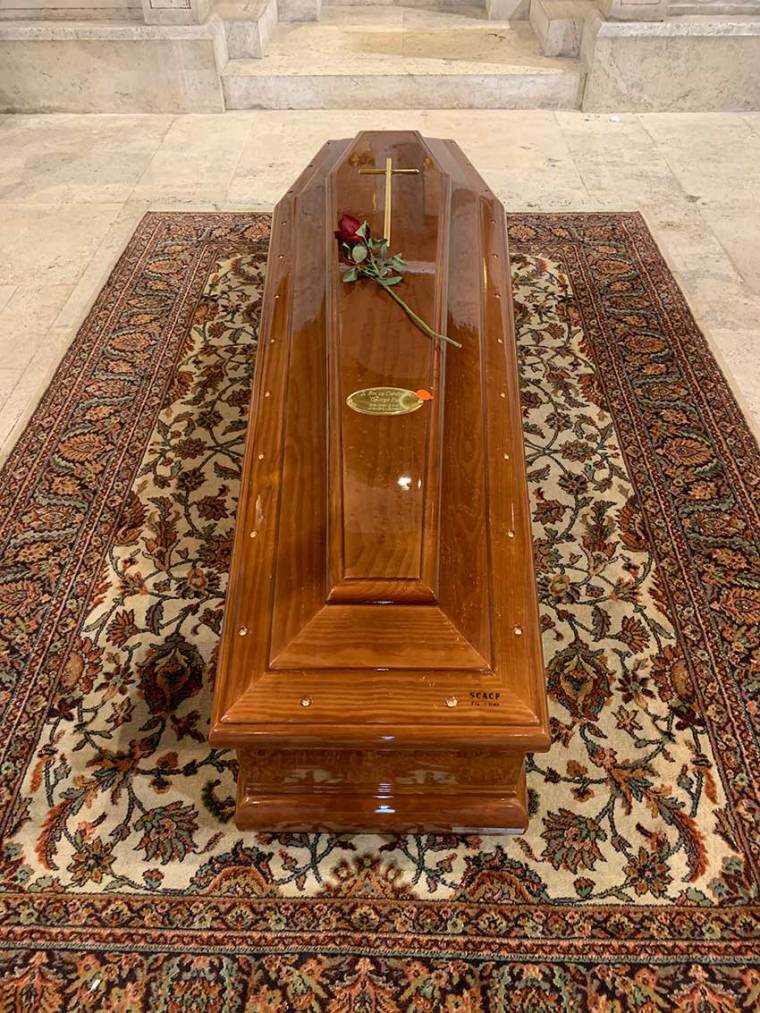
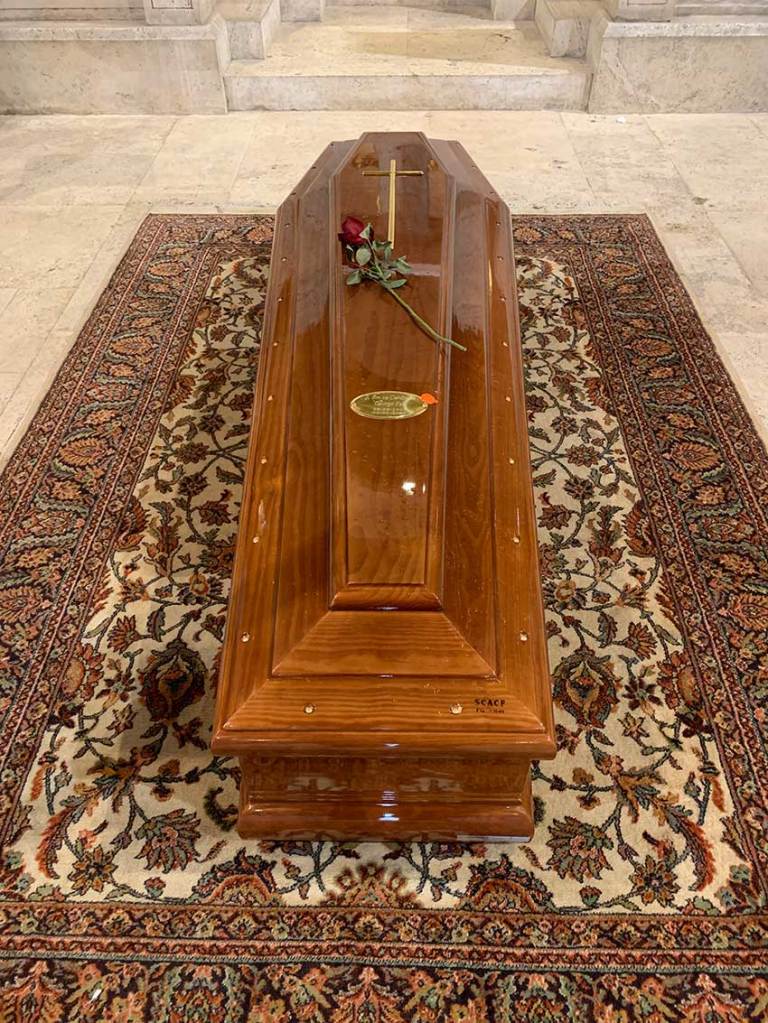
Again, I present the photograph of the coffin as it lay in state in Santo Stefano degli Abissini prior to the Cardinal’s Requiem Mass.

As was pointed out in my previous article, the screw-holes in the coffin’s lid have been filled with a very light- coloured filler, giving it a most unprofessional finish. This is consistent with the coffin being re-opened some time after it left the funeral home.

So I am not suggesting that David Pell was lying. Rather, I am suggesting that he and the family might be just a little naïve – and they were probably in shock, after all. They trusted whomever told them a yarn about the Cardinal’s body – and that someone may well have actually had a hand in the desecration itself, or at least in hiding the fact.

There is precedent for my opinion. Naïveté can run in the family, even among very good and upright people, perhaps especially among good people.

George Pell was known for sometimes making the most disastrous appointments. There is one Australian Bishop, no stranger to the pages of this website, who was a product of the late Cardinal Pell. Pell mentored him, and brought him up through the ranks of the Church to his present high status.

That man is a complete buffoon, without class or culture, an ecumaniac and sycophant to all things LGBT. It is possible that he should never have been a priest, much less a bishop and I actually once heard a priest say that if it hadn’t been for George Pell, that man would “still be sitting on his couch, watching the footy.” Or words to that effect.

In short, George Pell made a huge mistake when he decided that man was bishop material.

Now Pell was definitely not stupid, and was not corrupt, but on occasion was a very poor judge of character. Perhaps his family shares this honest flaw, making them easy prey for the devious Vatican spin doctors.

A Hypothetical Timeline of Events.
  1. Death of Pell in Rome on Tuesday, Jan. 10, 2023.
  2. Family is notified and the usual protocols for dealing with the corpse of a prelate are triggered.
  3. A priority autopsy is performed according to the standards in Rome.
  4. Corpse is sent to funeral home in Rome for priority treatment: cleaning and embalming are performed, coffin is sealed.
  5. Prepared corpse is sent to Santo Stefano degli Abissini for veneration, perhaps as early as Wed. 11 (according to one report.)
  6. Coffin is reopened at the Santo Stefano degli Abissini church (possibly during the night) and the body is desecrated/abused/ritually humiliated. Abuse includes breaking of Pell’s nose and sullying the body which results in the embalming being “buggered up” (in the words of David Pell.)
  7. The abusers re-seal the coffin lid using a new, lighter coloured filler in the screw holes.
  8. Pell’s body is venerated for several days with coffin (unusually for a bishop) closed.
  9. Pell’s body transferred to St. Peter’s Basilica for a Requiem Mass on Saturday Jan. 14th.
  10. Pell’s body is flown to Australia ahead of the burial on Feb 2, 2023.
  11. Desecration is discovered when the coffin is re-opened in Sydney.

A Rosicrucian Calling-Card on Pell’s Coffin?

The very first time I laid eyes on the photograph shown below, which was almost eighteen months ago now, the single rose so carefully placed near the gold cross struck me as being odd. More than odd – it looked like the signature of someone who wanted to publicise his work. A message which might say that, “We were responsible, we had our way with Cardinal Pell.”

Such a signature in the form of a rose and cross could only mean one thing: Rosicrucians, members of that esoteric offshoot of Freemasonry known for its strange mix of Catholicism, magic and secret knowledge.

Cardinal Pell’s mortal remains lying in state at the Santo Stefano degli Abissini, just a stone’s throw from the Pope’s home.

Now of course, that rose might have been placed there by a friend, or a family member, or by some unknown cleaning lady for whom Pell always had a kind word. Which is precisely why I didn’t draw attention to it before now.

However, now that we know that Pell’s body was desecrated ( see video below if this is new to you) and now that the suggestion of murder is being unselfconsciously thrown around, I thought this might be a good time to bring it up.

The coffin seems to have been produced by this company: SCACF, as indicated by the letters in the bottom right hand corner. According to its website, this competent-looking company supplies coffins to more than 2000 funeral homes throughout the world. Presumably the funeral home that prepared the body and ordered the coffin were equally competent.

However, judging by the photograph above, (as found at the Catholic Weekly) whoever filled the screw holes on the coffin’s lid did a fairly poor job. It rather lets down the quality of the thing. Not a very professional look for the funeral home, is it?

This leads us to ponder: is it possible that the coffin left the funeral home with the body prepared to the normal high standards and with the screw-holes filled in an unobtrusive manner, and that the Cardinal’s body was desecrated after that, with the holes refilled by his unholy desecrators?

We know that it happened after the autopsy. Perhaps it took place after the all the preparation procedures had been finished, away from the prying eyes of good and faithful artisans – perhaps in the church itself?

For this church is very close to Casa Santa Marta, the home of Pope Bergoglio and his assortment of highly unsavoury sodomites – some of whom are without doubt, Rosicrucians.

For a further analysis, please see my Theory about the Desecration of Pell’s Body.